

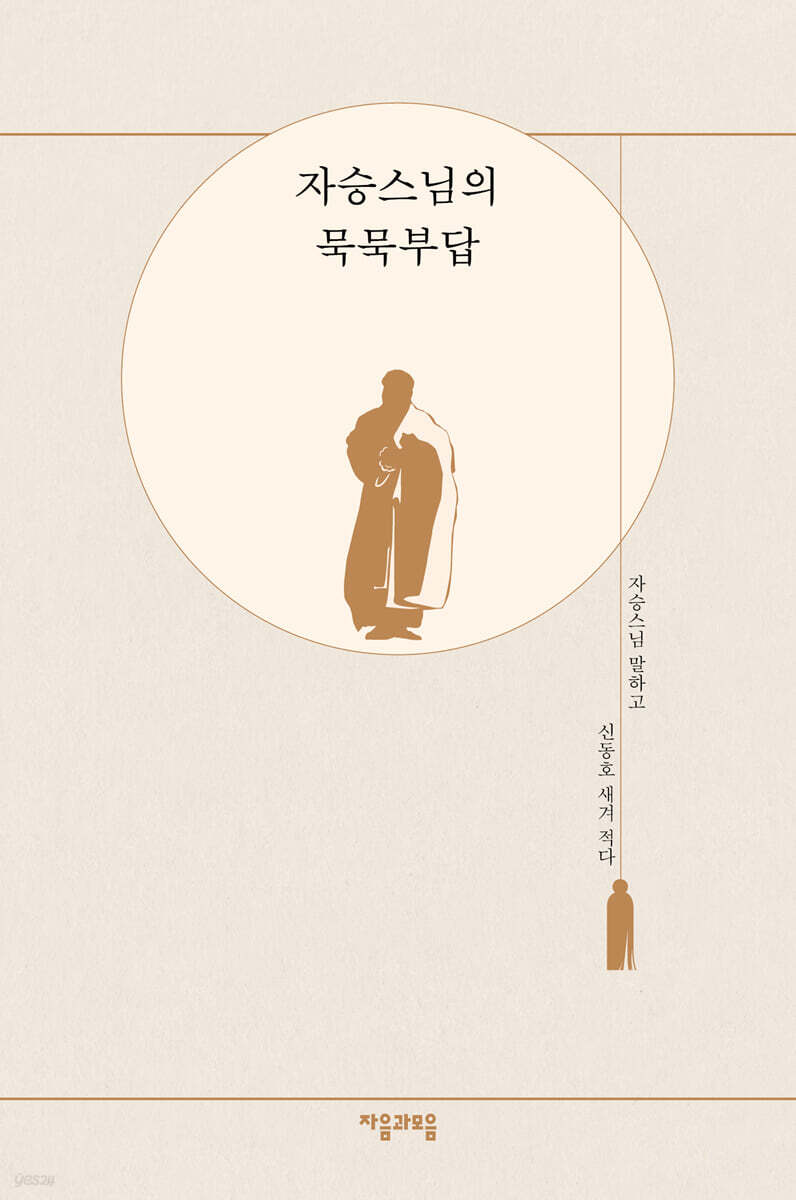
Monk Ja Seung's silent response
 |
Description
Book Introduction
Recommended by Jinwoo, Archbishop Kim Hee-joong, and Pastor Kim Young-joo!
A symbol of leadership that embraced the stagnation of Korean Buddhism with all its might, embodying communication and harmony.
A conversation with Monk Ja Seung
An essay containing the sayings of Monk Ja Seung, who lived to revolutionize the Buddhist world.
As can be seen from the author's note, 'Speaking of Monk Ja Seung and engraved by Shin Dong-ho,' he collected stories shared at events and lectures while serving as the General Manager of the Jogye Order from 2009 to 2017, and poet Shin Dong-ho wrote aphorisms related to them.
It is composed of selected words that are worth remembering and engraving in the teachings of Monk Ja Seung.
『Monk Ja Seung's Silent Answer』 is full of writings about warm aspects unknown to the general public and aspects of inter-religious integration.
It introduces a variety of stories, including deep insights into life, a warm perspective on society, a call for change for religion and the society it belongs to, and even monks who can serve as role models for us. It contains the hope that even non-Buddhists can encounter 'good stories' up close.
Through a daily verse, it will provide an opportunity to reexamine life, rediscover forgotten values, and for those unfamiliar with Korean Buddhism, experience a new culture.
Chapter 1, “Enlightenment in Our Time,” discusses the virtues that Buddhists should possess.
It begins by emphasizing the importance of a life lived through self-reflection.
Chapter 2, “The Path of Practice in Our Time,” mainly deals with the positive aspects of Buddhist art that has continued for thousands of years.
Chapter 3, "The Hardships of Our Times," contains stories about class and generational conflicts, as well as quotes on social issues such as the Ssangyong Motors labor dispute and the Sewol Ferry disaster.
Chapter 4, “The Path to Liberation in Our Time,” introduces social participation within the Buddhist community and encourages those who have worked hard.
Chapter 5, “Teachers of Our Time,” introduces monks.
We will look into the lives of monks who have left a significant mark on the Buddhist world, including monks familiar to readers such as Beopjeong, Seongcheol, and Manhae, and resonate with the words they have tried to convey through their lives.
Poet Shin Dong-ho recalls that Monk Jaseung left behind only regrets about his practice.
Although he was a monk who often stood out in the world for Buddhist reform and social harmony, it is said that his heart was always in his place of practice, and he comforted everyone for reforms that suited the times, and he kept all kinds of misunderstandings and speculations to himself.
In order to uphold the pure intention of reform and achieve social harmony, he tried to discard prejudice with a mind of empathy and an attitude of putting himself in the other person's shoes, and he endured silently to let people know that they were indispensable to each other.
'Monk Ja Seung's Silent Answer' was planned with the intention of dispelling, even if only a little, the misunderstandings and speculations that the monk had carried alone.
In the process, I came to realize how much the monk had fulfilled his role as an adult of our time and how precious the words he left behind were.
They say we live in an age without adults, but that's not true.
This is an era where the roles of adults have changed.
Each individual's ego has matured, and every life has value.
Adults are no longer the ones who teach and enlighten us.
He is the one who mediates, makes conversations happen, and helps people understand each other.
The power of 『The Silent Answer of Monk Jaseung』 lies in the honest and powerful words of Monk Jaseung, who, even in the face of the decline of Buddhism, did not lose his center and constantly pondered the meaning of a Buddhist life from various perspectives.
These words still resonate with us living in the present age, and, combined with poet Shin Dong-ho's aphorisms, they will encourage and comfort us in moments of distress, and sometimes even become words of courage.
A symbol of leadership that embraced the stagnation of Korean Buddhism with all its might, embodying communication and harmony.
A conversation with Monk Ja Seung
An essay containing the sayings of Monk Ja Seung, who lived to revolutionize the Buddhist world.
As can be seen from the author's note, 'Speaking of Monk Ja Seung and engraved by Shin Dong-ho,' he collected stories shared at events and lectures while serving as the General Manager of the Jogye Order from 2009 to 2017, and poet Shin Dong-ho wrote aphorisms related to them.
It is composed of selected words that are worth remembering and engraving in the teachings of Monk Ja Seung.
『Monk Ja Seung's Silent Answer』 is full of writings about warm aspects unknown to the general public and aspects of inter-religious integration.
It introduces a variety of stories, including deep insights into life, a warm perspective on society, a call for change for religion and the society it belongs to, and even monks who can serve as role models for us. It contains the hope that even non-Buddhists can encounter 'good stories' up close.
Through a daily verse, it will provide an opportunity to reexamine life, rediscover forgotten values, and for those unfamiliar with Korean Buddhism, experience a new culture.
Chapter 1, “Enlightenment in Our Time,” discusses the virtues that Buddhists should possess.
It begins by emphasizing the importance of a life lived through self-reflection.
Chapter 2, “The Path of Practice in Our Time,” mainly deals with the positive aspects of Buddhist art that has continued for thousands of years.
Chapter 3, "The Hardships of Our Times," contains stories about class and generational conflicts, as well as quotes on social issues such as the Ssangyong Motors labor dispute and the Sewol Ferry disaster.
Chapter 4, “The Path to Liberation in Our Time,” introduces social participation within the Buddhist community and encourages those who have worked hard.
Chapter 5, “Teachers of Our Time,” introduces monks.
We will look into the lives of monks who have left a significant mark on the Buddhist world, including monks familiar to readers such as Beopjeong, Seongcheol, and Manhae, and resonate with the words they have tried to convey through their lives.
Poet Shin Dong-ho recalls that Monk Jaseung left behind only regrets about his practice.
Although he was a monk who often stood out in the world for Buddhist reform and social harmony, it is said that his heart was always in his place of practice, and he comforted everyone for reforms that suited the times, and he kept all kinds of misunderstandings and speculations to himself.
In order to uphold the pure intention of reform and achieve social harmony, he tried to discard prejudice with a mind of empathy and an attitude of putting himself in the other person's shoes, and he endured silently to let people know that they were indispensable to each other.
'Monk Ja Seung's Silent Answer' was planned with the intention of dispelling, even if only a little, the misunderstandings and speculations that the monk had carried alone.
In the process, I came to realize how much the monk had fulfilled his role as an adult of our time and how precious the words he left behind were.
They say we live in an age without adults, but that's not true.
This is an era where the roles of adults have changed.
Each individual's ego has matured, and every life has value.
Adults are no longer the ones who teach and enlighten us.
He is the one who mediates, makes conversations happen, and helps people understand each other.
The power of 『The Silent Answer of Monk Jaseung』 lies in the honest and powerful words of Monk Jaseung, who, even in the face of the decline of Buddhism, did not lose his center and constantly pondered the meaning of a Buddhist life from various perspectives.
These words still resonate with us living in the present age, and, combined with poet Shin Dong-ho's aphorisms, they will encourage and comfort us in moments of distress, and sometimes even become words of courage.
- You can preview some of the book's contents.
Preview
index
Recommendation
Enlightenment of our time
Shindok|I am because you are┃Someday we will help each other|Learn from poverty|When a tree grows vertically, its branches grow horizontally|A small beginning|Stop and look back|Let go of everything and be reborn|The power of faith|The wind blows in the direction you are going|You must become real|You are free when you have something to protect|Beauty does not disappear even when flowers fall|What is in our hearts|Look closely|We all meet|The answer that hardship gives|Becoming familiar with the changing tomorrow|The wind on the mountain reaches everyone|The two wheels of a cart must be the same size to move forward|Social practice is performance|Conservation and development are not two different things|Sharing goods and sharing our hearts
The path of practice in our time
There is nothing as honest as the sound of a stomach growling|It must be empty to be filled|What will I give to the world|A mountain temple that explains the reason for life in detail|Stories of a mountain temple must be easy|Music paired with the words of Buddha|The choir is the Buddha's law and a painter|We who grew up with ancient temples|We must also comfort the hearts of the dead|Jump into the temple paintings|Paintings that bring comfort to the mind|Art that heals the mind|Seeing smiles the most to make smiles|Precious moments, precious times|Thank you for the musical that contained old stories|Korean 『Cheonsu-gyeong』, a little late|I hope you want to follow along with the chanting|I myself am a tradition|Dance is a Buddhist sermon written with the body|The scent of paper flowers is the scent of people|Flower offerings all mean to sit on the flowers|As ink spreads, relationships spread|Bringing out Buddha from within a stone|The world surrounding Buddha, Buddhist temples|When I see Maitreya Buddha in you, Maitreya Buddha comes|Literature is another The Practitioner | The Enlightenment of a Short Sentence | The Beautiful Affinity of a Book | May the Shingye Temple Cut Off the Karma of Our Time | Traces Grow Through the Relics | Restoring the Old is also a Practice
The arduous path of our times
Buddhas on the street|To avoid repeating the same fight|The downfall of an ordinary person is the downfall of a nation|Hatred comes from outside|The fastest way is to gather one's heart|People migrating is proof that a place is healthy|We must have a lingering attachment to life, and be lingering|Temples must be near young people|Temples must unite their strength and be with their followers|We must become a Buddhism that cries and laughs together in everyday life|We need the wisdom of fusion|May the spirit of coexistence grow through the repatriation of war victims|I hope for the unification of hearts|Peace comes from patience and sacrifice|Goods must travel for news to travel, and news must travel for hatred to diminish|The tragedy of Hiroshima belongs to us all|Looking back at the sorrow excluded from history|Our attitude toward life must change|Small habits illuminate the dawn|Where there is hope to resolve conflict, this is paradise
The path to liberation in our time
Bongseonsa Temple, where the Buddha's words were written down|General Kim Yeong-hwan, the embodiment of the Tripitaka Koreana|The scent of tea from Bodhisattva Kim Mi-hee of Myeongwon|People who have grown bigger than mountains through sharing|Reciting the Diamond Sutra, the heart of diligence|Life changes with a day of practicing the Eight Precepts|Lotus World's love for humanity|A small sharing makes a large cloth that can embrace anything|People who revive a spark of life by multiplying it three thousand times|May, Monk Manjusri's self-immolation|Practice of Mahayana Buddhism|Kim Ryeong-hwa, a girl rises after overcoming the Great East Japan Earthquake|Gwanghwamun is a space for mature people|The police are the country where the people meet most closely|Buddhism approaching modernization|Concerns of the elderly who have preserved hope|Global Community Service Association, extending a helping hand of mercy to the world|People met by Manhae Daesang 1|People met by Manhae Daesang 2|Shining stars of the Life Sharing Practice Headquarters|Harmony created by Yeonhwawon, another process|People with disabilities raised by Sotdae Literature Authors | I don't want to read the eulogy again.
Teachers of Our Time
National Master Do-ui | Monk Baekpa | Monk Gyeongheo | Monk Chowol | Monk Manhae | Monk Mangong | Monk Manam | Monk Cheongdam | Monk Unheo | Monk Seongcheol | Monk Seungsan | Monk Beopjang | Monk Beopjeong | Monk Cheonun | Monk Susan | Monk Seongsu | Monk Dogyeon | Monk Mujinjang | Monk Beopjeon
The words of the one who wrote it
Enlightenment of our time
Shindok|I am because you are┃Someday we will help each other|Learn from poverty|When a tree grows vertically, its branches grow horizontally|A small beginning|Stop and look back|Let go of everything and be reborn|The power of faith|The wind blows in the direction you are going|You must become real|You are free when you have something to protect|Beauty does not disappear even when flowers fall|What is in our hearts|Look closely|We all meet|The answer that hardship gives|Becoming familiar with the changing tomorrow|The wind on the mountain reaches everyone|The two wheels of a cart must be the same size to move forward|Social practice is performance|Conservation and development are not two different things|Sharing goods and sharing our hearts
The path of practice in our time
There is nothing as honest as the sound of a stomach growling|It must be empty to be filled|What will I give to the world|A mountain temple that explains the reason for life in detail|Stories of a mountain temple must be easy|Music paired with the words of Buddha|The choir is the Buddha's law and a painter|We who grew up with ancient temples|We must also comfort the hearts of the dead|Jump into the temple paintings|Paintings that bring comfort to the mind|Art that heals the mind|Seeing smiles the most to make smiles|Precious moments, precious times|Thank you for the musical that contained old stories|Korean 『Cheonsu-gyeong』, a little late|I hope you want to follow along with the chanting|I myself am a tradition|Dance is a Buddhist sermon written with the body|The scent of paper flowers is the scent of people|Flower offerings all mean to sit on the flowers|As ink spreads, relationships spread|Bringing out Buddha from within a stone|The world surrounding Buddha, Buddhist temples|When I see Maitreya Buddha in you, Maitreya Buddha comes|Literature is another The Practitioner | The Enlightenment of a Short Sentence | The Beautiful Affinity of a Book | May the Shingye Temple Cut Off the Karma of Our Time | Traces Grow Through the Relics | Restoring the Old is also a Practice
The arduous path of our times
Buddhas on the street|To avoid repeating the same fight|The downfall of an ordinary person is the downfall of a nation|Hatred comes from outside|The fastest way is to gather one's heart|People migrating is proof that a place is healthy|We must have a lingering attachment to life, and be lingering|Temples must be near young people|Temples must unite their strength and be with their followers|We must become a Buddhism that cries and laughs together in everyday life|We need the wisdom of fusion|May the spirit of coexistence grow through the repatriation of war victims|I hope for the unification of hearts|Peace comes from patience and sacrifice|Goods must travel for news to travel, and news must travel for hatred to diminish|The tragedy of Hiroshima belongs to us all|Looking back at the sorrow excluded from history|Our attitude toward life must change|Small habits illuminate the dawn|Where there is hope to resolve conflict, this is paradise
The path to liberation in our time
Bongseonsa Temple, where the Buddha's words were written down|General Kim Yeong-hwan, the embodiment of the Tripitaka Koreana|The scent of tea from Bodhisattva Kim Mi-hee of Myeongwon|People who have grown bigger than mountains through sharing|Reciting the Diamond Sutra, the heart of diligence|Life changes with a day of practicing the Eight Precepts|Lotus World's love for humanity|A small sharing makes a large cloth that can embrace anything|People who revive a spark of life by multiplying it three thousand times|May, Monk Manjusri's self-immolation|Practice of Mahayana Buddhism|Kim Ryeong-hwa, a girl rises after overcoming the Great East Japan Earthquake|Gwanghwamun is a space for mature people|The police are the country where the people meet most closely|Buddhism approaching modernization|Concerns of the elderly who have preserved hope|Global Community Service Association, extending a helping hand of mercy to the world|People met by Manhae Daesang 1|People met by Manhae Daesang 2|Shining stars of the Life Sharing Practice Headquarters|Harmony created by Yeonhwawon, another process|People with disabilities raised by Sotdae Literature Authors | I don't want to read the eulogy again.
Teachers of Our Time
National Master Do-ui | Monk Baekpa | Monk Gyeongheo | Monk Chowol | Monk Manhae | Monk Mangong | Monk Manam | Monk Cheongdam | Monk Unheo | Monk Seongcheol | Monk Seungsan | Monk Beopjang | Monk Beopjeong | Monk Cheonun | Monk Susan | Monk Seongsu | Monk Dogyeon | Monk Mujinjang | Monk Beopjeon
The words of the one who wrote it
Into the book
Master Imje said, “Creating the master wherever you are, establishing the truth everywhere.”
If you live as the main character anytime, anywhere, that place will soon become the most truthful and happy place.
If we, as the masters of our own lives and this world, overcome this national crisis through wise judgment and choice and build a new future, history will record this as a happy year.
--- From "Monk Ja Seung, 'The Wind Blows in the Direction You Are Going'"
Food is religion, bread is politics.
There is nothing as honest as the sound of a stomach growling.
All reasoning other than the act of eating is an illusion without a foundation.
Politics that cannot maintain daily life is a rhetoric contest.
Someone has put in countless hours of hard work before the food comes to me.
If you don't know the hardship, your heart is poor.
Life comes together to become food.
It is a miracle for all of us to belong to that realm.
When I approached the heart of 'togetherness', which is the sharing contained in simplicity and the absence of anything left behind, the tiny pieces of sesame seeds in the bowl finally came into view.
--- From "Poet Shin Dong-ho, 'There is nothing as honest as the sound of a growling stomach'"
For us Buddhists, giving is the first practice of the six perfections and the key to the storehouse of infinite merit.
It is not easy to give my wealth and time to others without asking for anything in return.
But if it were easy, how could it be practiced? It's difficult, but if you practice, the stubbornness in your heart will melt away, your blessings will accumulate, and you will achieve the affinity for Buddhahood.
Only when each and every one of you gathered here begins to live with a heart that gives thanks to all of humanity will humanity's utopia be realized.
--- From "Venerable Ja Seung, 'What Will I Give to the World?'"
Flowers bloom on their own, but paper flowers bloom with human effort.
The Buddha held up a flower to Kasyapa and taught him the Dharma.
Kasyapa's smile came from the fragrance of the Buddha's heart.
The scent of paper flowers is the scent of people.
It is the most genuine fragrance a person can smell.
--- From "Poet Shin Dong-ho, 'The scent of paper flowers is the scent of people'"
A person who cherishes peace is one who perseveres and sacrifices to the end.
I ask you never to be discouraged by the unexpected cold wave that has come upon you again.
Let us also learn the wisdom of Geumgangsan in winter.
Geumgangsan Mountain, which boasts its beauty throughout spring, summer, and fall, puts everything aside during the season of self-reflection and dreams of a tomorrow that is greener and brighter than the present.
The flower of unification will surely bloom along the path we take.
--- From "Monk Ja Seung, 'Peace Comes from Patience and Sacrifice'"
If you see your own fault before others', you are a bodhisattva.
If you see other people's pain before your own, you are a Buddha.
Bodhisattva Dharmachakra said, “If I cannot reach the Pure Land where there is no suffering for living beings, I will not become a Buddha.”
Here, there are people who practice sharing with their sweat and offering three thousand bows.
If we revive the spark of life one by one, there is no reason why we cannot reach a paradise free from suffering.
It's desperate.
How can those who accumulate meritorious deeds only be here?
--- From "Poet Shin Dong-ho, 'People Who Rekindle a Spark of Life Three Thousand Times'"
In his poem “Summer Nights Are Long,” Monk Manhae wrote, “When you were here, winter nights were short, but after you left, summer nights are long.”
And he said that the long night becomes sad music and a vast desert.
Therefore, the 'you' the monk spoke of is the one who frees us from worry, the one who plays beautiful music, and the one who practices compassion and guides us to the fertile land filled with hope.
We met 'you' just like that.
If you live as the main character anytime, anywhere, that place will soon become the most truthful and happy place.
If we, as the masters of our own lives and this world, overcome this national crisis through wise judgment and choice and build a new future, history will record this as a happy year.
--- From "Monk Ja Seung, 'The Wind Blows in the Direction You Are Going'"
Food is religion, bread is politics.
There is nothing as honest as the sound of a stomach growling.
All reasoning other than the act of eating is an illusion without a foundation.
Politics that cannot maintain daily life is a rhetoric contest.
Someone has put in countless hours of hard work before the food comes to me.
If you don't know the hardship, your heart is poor.
Life comes together to become food.
It is a miracle for all of us to belong to that realm.
When I approached the heart of 'togetherness', which is the sharing contained in simplicity and the absence of anything left behind, the tiny pieces of sesame seeds in the bowl finally came into view.
--- From "Poet Shin Dong-ho, 'There is nothing as honest as the sound of a growling stomach'"
For us Buddhists, giving is the first practice of the six perfections and the key to the storehouse of infinite merit.
It is not easy to give my wealth and time to others without asking for anything in return.
But if it were easy, how could it be practiced? It's difficult, but if you practice, the stubbornness in your heart will melt away, your blessings will accumulate, and you will achieve the affinity for Buddhahood.
Only when each and every one of you gathered here begins to live with a heart that gives thanks to all of humanity will humanity's utopia be realized.
--- From "Venerable Ja Seung, 'What Will I Give to the World?'"
Flowers bloom on their own, but paper flowers bloom with human effort.
The Buddha held up a flower to Kasyapa and taught him the Dharma.
Kasyapa's smile came from the fragrance of the Buddha's heart.
The scent of paper flowers is the scent of people.
It is the most genuine fragrance a person can smell.
--- From "Poet Shin Dong-ho, 'The scent of paper flowers is the scent of people'"
A person who cherishes peace is one who perseveres and sacrifices to the end.
I ask you never to be discouraged by the unexpected cold wave that has come upon you again.
Let us also learn the wisdom of Geumgangsan in winter.
Geumgangsan Mountain, which boasts its beauty throughout spring, summer, and fall, puts everything aside during the season of self-reflection and dreams of a tomorrow that is greener and brighter than the present.
The flower of unification will surely bloom along the path we take.
--- From "Monk Ja Seung, 'Peace Comes from Patience and Sacrifice'"
If you see your own fault before others', you are a bodhisattva.
If you see other people's pain before your own, you are a Buddha.
Bodhisattva Dharmachakra said, “If I cannot reach the Pure Land where there is no suffering for living beings, I will not become a Buddha.”
Here, there are people who practice sharing with their sweat and offering three thousand bows.
If we revive the spark of life one by one, there is no reason why we cannot reach a paradise free from suffering.
It's desperate.
How can those who accumulate meritorious deeds only be here?
--- From "Poet Shin Dong-ho, 'People Who Rekindle a Spark of Life Three Thousand Times'"
In his poem “Summer Nights Are Long,” Monk Manhae wrote, “When you were here, winter nights were short, but after you left, summer nights are long.”
And he said that the long night becomes sad music and a vast desert.
Therefore, the 'you' the monk spoke of is the one who frees us from worry, the one who plays beautiful music, and the one who practices compassion and guides us to the fertile land filled with hope.
We met 'you' just like that.
--- From "Monk Ja Seung, Monk Manhae"
GOODS SPECIFICS
- Date of issue: November 11, 2024
- Page count, weight, size: 336 pages | 452g | 130*196*22mm
- ISBN13: 9788954451833
You may also like
카테고리
korean


korean

![GQ KOREA Mark (Monthly): December [2025]](http://librairie.coreenne.fr/cdn/shop/files/8ef265dbbfbf186523ed75ba7319009d.jpg?v=1765340328&width=3840)


