

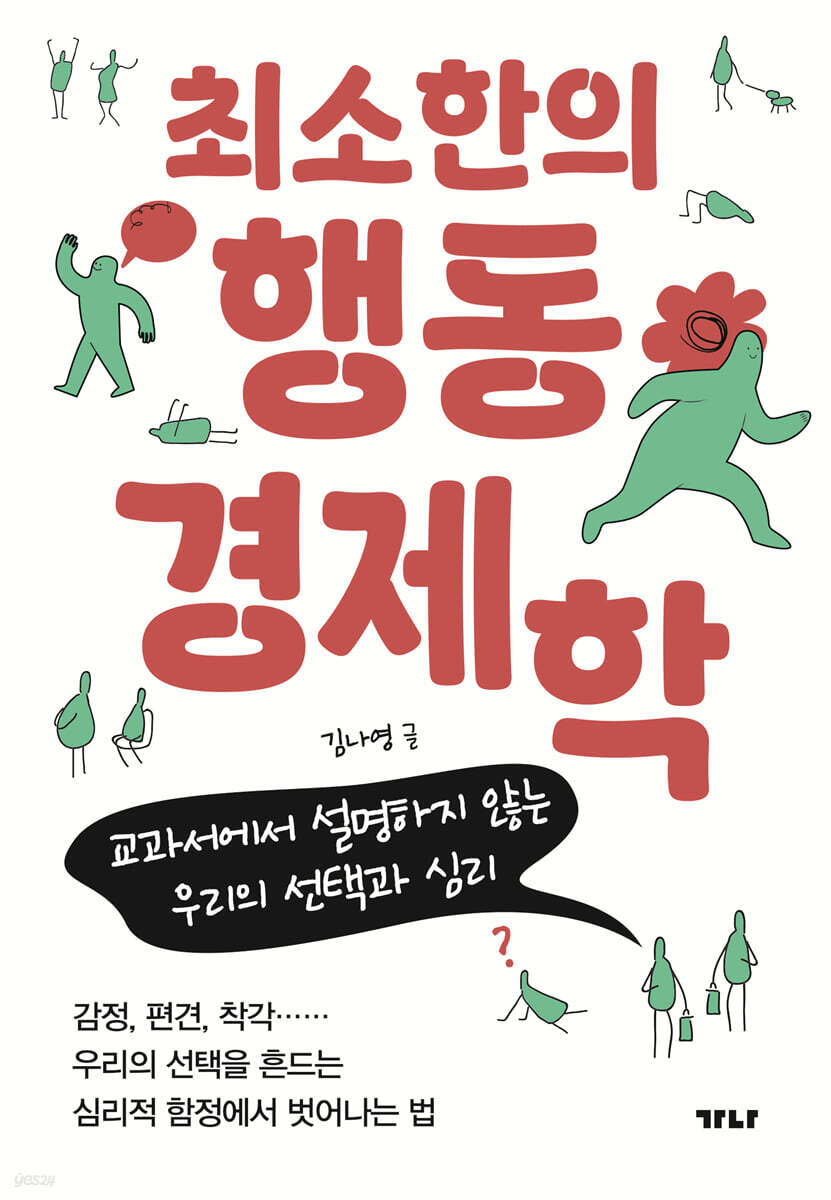
Minimal behavioral economics
 |
Description
Book Introduction
“Why behavioral economics, not psychology or economics?”
Make choices that satisfy you without being swayed by emotions.
36 Psychological Laws You Need to Know to Get Off
We make choices dozens of times a day.
Even when ordering delivery food, I try to make the most reasonable decision by comparing discounts and delivery fees.
But on the other hand, we sometimes impulsively buy expensive items after seeing ads on social media, or we buy things we don't need just because our friends bought them.
Why do we, who strive for rational choices, sometimes make irrational and impulsive choices? Why do we regret choices we made? It's because we are more swayed by emotions and delusions than we realize.
Traditional economics assumes that humans always make rational and reasonable choices, but in reality, we are different.
We are swayed by the gaze of others, open our wallets at the words "discount until today," and choose immediate satisfaction over an uncertain future.
So what should we do? We need to learn about "behavioral economics," which is neither psychology nor economics.
Behavioral economics helps us understand the psychological laws that operate at every moment of choice, and reveals the reasons for our actions that we were unaware of.
"Minimal Behavioral Economics" is an introductory book to behavioral economics for those of us who don't want to have any more regrets.
It opens with stories from everyday life, divided into six topics: relationships, conversations, goals, choices, money, and happiness. It then explores thirty-six essential behavioral economics theories, from the primacy effect to anchoring, framing, and heuristics, along with experiments verified by renowned scholars, including sociologists and psychologists, to find answers.
Behavioral economics is an essential tool for avoiding choice traps and making self-sufficient choices.
If you've ever questioned your choices, even once, why? Open "Minimal Behavioral Economics."
The moment I understand 'why I did that', my next choices will definitely be different.
Make choices that satisfy you without being swayed by emotions.
36 Psychological Laws You Need to Know to Get Off
We make choices dozens of times a day.
Even when ordering delivery food, I try to make the most reasonable decision by comparing discounts and delivery fees.
But on the other hand, we sometimes impulsively buy expensive items after seeing ads on social media, or we buy things we don't need just because our friends bought them.
Why do we, who strive for rational choices, sometimes make irrational and impulsive choices? Why do we regret choices we made? It's because we are more swayed by emotions and delusions than we realize.
Traditional economics assumes that humans always make rational and reasonable choices, but in reality, we are different.
We are swayed by the gaze of others, open our wallets at the words "discount until today," and choose immediate satisfaction over an uncertain future.
So what should we do? We need to learn about "behavioral economics," which is neither psychology nor economics.
Behavioral economics helps us understand the psychological laws that operate at every moment of choice, and reveals the reasons for our actions that we were unaware of.
"Minimal Behavioral Economics" is an introductory book to behavioral economics for those of us who don't want to have any more regrets.
It opens with stories from everyday life, divided into six topics: relationships, conversations, goals, choices, money, and happiness. It then explores thirty-six essential behavioral economics theories, from the primacy effect to anchoring, framing, and heuristics, along with experiments verified by renowned scholars, including sociologists and psychologists, to find answers.
Behavioral economics is an essential tool for avoiding choice traps and making self-sufficient choices.
If you've ever questioned your choices, even once, why? Open "Minimal Behavioral Economics."
The moment I understand 'why I did that', my next choices will definitely be different.
- You can preview some of the book's contents.
Preview
index
Chapter 1: Behavioral Economics of Relationships
1.
How to Make a Positive First Impression? _The Primacy Effect
2.
What to Wear on an Important Day? _The Prominence Effect
3.
How to become close with someone: The similarity effect
4.
First, be visible often _ mere exposure effect
5.
How to resolve the misunderstanding that arises when you feel like you've seen something you haven't? _Memory reconstruction or constructive memory
6.
I've done this much for you, so you'll repay me, right? _Hold-up problem
Chapter 2: Behavioral Economics through Conversation
1.
What to do before asking for a favor? _The Law of Reciprocity
2.
The truth is, they want praise too _ The power of small compliments
3.
Create a sidekick for the protagonist? _The Bait Effect
4.
Good points first, bad points later - Low-ball technique
5.
Find out what they really want? _Social desirability bias
6.
How to Get Your Achievements Respected _ Transactional Utility
Chapter 3: Behavioral Economics for Achieving Goals
1.
Should I Present First or Later? _The Order Effect
2.
How to Reduce Procrastination: Self-Control Tools
3.
How to Quickly Finish Homework You Don't Want to Do _ The Zeigarnik Effect
4.
Where to Prepare for an Important Exam: State-Dependent Memory
5.
A Surefire Way to Achieve Your Goals? _The Public Declaration Effect
6.
When you can't come up with an answer no matter how much you think about it _ Hatching Effect
Chapter 4: Behavioral Economics for Choice
1.
Get a great deal on a sale! Is it really worth it? _The Anchoring Effect
2.
You bought 17 cups of coffee just to get a diary? _Wacked Dog
3.
Why can't I throw away uncomfortable sneakers? _Sunk costs
4.
The Secret of Popcorn Menus: Are Set Menus Really Cheap? _The Contrast Effect
5.
I'm feeling lazy, should I go shopping? _Limited cognitive resources
6.
Conscientious pricing is unpopular? _Reference price
Chapter 5: Behavioral Economics: Making Money
1.
Not all money is created equal? _Mental Accounting
2.
Taller people earn more? _Non-cognitive abilities
3.
What's a fair price for a painting drawn in two minutes? _The Framing Effect
4.
Trust is Money _ Social Capital
5.
Why You Should Care About Loose Ties _ Human Networks
6.
Why It's Hard to Get a Taxi on a Rainy Day - Heuristics
Chapter 6: Behavioral Economics: Creating Happiness
1.
What feels greater: a gain or a loss of the same amount? _Loss Aversion
2.
Several small gifts are better than one big gift _Booking Price
3.
Why will you keep using OTT for a month? _The retention effect
4.
Free passes: Are you satisfied even if they cost more? _Decoupling payment and consumption
5.
Comparisons are not about the son or daughter of a social media company, but about the future me _upward comparisons
6.
The Secret to a Happy School Life: Autonomy + Competence + Relationships
1.
How to Make a Positive First Impression? _The Primacy Effect
2.
What to Wear on an Important Day? _The Prominence Effect
3.
How to become close with someone: The similarity effect
4.
First, be visible often _ mere exposure effect
5.
How to resolve the misunderstanding that arises when you feel like you've seen something you haven't? _Memory reconstruction or constructive memory
6.
I've done this much for you, so you'll repay me, right? _Hold-up problem
Chapter 2: Behavioral Economics through Conversation
1.
What to do before asking for a favor? _The Law of Reciprocity
2.
The truth is, they want praise too _ The power of small compliments
3.
Create a sidekick for the protagonist? _The Bait Effect
4.
Good points first, bad points later - Low-ball technique
5.
Find out what they really want? _Social desirability bias
6.
How to Get Your Achievements Respected _ Transactional Utility
Chapter 3: Behavioral Economics for Achieving Goals
1.
Should I Present First or Later? _The Order Effect
2.
How to Reduce Procrastination: Self-Control Tools
3.
How to Quickly Finish Homework You Don't Want to Do _ The Zeigarnik Effect
4.
Where to Prepare for an Important Exam: State-Dependent Memory
5.
A Surefire Way to Achieve Your Goals? _The Public Declaration Effect
6.
When you can't come up with an answer no matter how much you think about it _ Hatching Effect
Chapter 4: Behavioral Economics for Choice
1.
Get a great deal on a sale! Is it really worth it? _The Anchoring Effect
2.
You bought 17 cups of coffee just to get a diary? _Wacked Dog
3.
Why can't I throw away uncomfortable sneakers? _Sunk costs
4.
The Secret of Popcorn Menus: Are Set Menus Really Cheap? _The Contrast Effect
5.
I'm feeling lazy, should I go shopping? _Limited cognitive resources
6.
Conscientious pricing is unpopular? _Reference price
Chapter 5: Behavioral Economics: Making Money
1.
Not all money is created equal? _Mental Accounting
2.
Taller people earn more? _Non-cognitive abilities
3.
What's a fair price for a painting drawn in two minutes? _The Framing Effect
4.
Trust is Money _ Social Capital
5.
Why You Should Care About Loose Ties _ Human Networks
6.
Why It's Hard to Get a Taxi on a Rainy Day - Heuristics
Chapter 6: Behavioral Economics: Creating Happiness
1.
What feels greater: a gain or a loss of the same amount? _Loss Aversion
2.
Several small gifts are better than one big gift _Booking Price
3.
Why will you keep using OTT for a month? _The retention effect
4.
Free passes: Are you satisfied even if they cost more? _Decoupling payment and consumption
5.
Comparisons are not about the son or daughter of a social media company, but about the future me _upward comparisons
6.
The Secret to a Happy School Life: Autonomy + Competence + Relationships
Detailed image

Into the book
There is also research4 that shows that when the similarity between the interviewer and the applicant is high in an interview situation, the interviewer feels favorable toward the applicant and has a positive influence on the decision.
This feeling of liking someone who is similar to you is called the 'similarity effect'.
Since you can have deeper and more detailed conversations with someone you have something in common with, it's easier to feel good about them and become closer to them.
If you have a friend you want to become close with, try to find something similar about yourself and start a conversation.
Once you find the connection, it will be easier to approach.
--- From "What should I do when I want to become close to someone?"
The reason Starbucks hides the small size in Korea but produces and promotes an even smaller size in India can be seen as a pricing strategy to open the wallets of as many consumers as possible.
Applying different prices to different markets or people who are willing to pay the maximum amount is called price discrimination.
The economic law that 'same goods should cost the same price' has long been accepted, but this law is gradually being broken.
Amazon, a major American online shopping mall, applies different prices depending on the time of day, season, and even person.
Dynamic pricing means that the price changes in real time.
If you have a shopping mall you frequent, take a closer look!
--- From "Find out what they really want?"
There is someone who conducted an experiment to find out whether studying in a place similar to the exam environment makes you remember more of what you studied.
British psychologists Duncan Godden and Alan Baddeley.
They conducted an experiment on divers to memorize words.
We had divers memorize words while underwater, and then recall those words both underwater and out of the water.
Surprisingly, I recalled more words underwater than out of the water.
After that, we did the same experiment after having them memorize the words out of the water, and in this case, they remembered more words out of the water.
The environment in which you memorized the words influenced how you actually recall them.
--- From "Where is the best place to prepare for an important exam?"
Generally, people want to keep their word.
Because when other people see me, I want to be seen as someone who has the will to do something, rather than someone who talks nonsense and is frivolous.
When people tell others about their goals and thoughts, they tend to believe in them more and stick to them without even realizing it.
This is called the Public Commitment Effect.
When you openly tell others about your goals, they often help you achieve them.
--- From "A Sure Way to Achieve Your Goals?"
When you go to a buffet restaurant, don't you sometimes find yourself eating more even when you're full? Thinking, "I paid this much, so I should eat this much."
I have had the experience of overeating and feeling bloated.
Money that has already been paid and cannot be returned is called a 'sunk cost', and sunk costs must be ignored to make rational choices.
--- From "Uncomfortable Sneakers, Why Can't I Throw Them Away?"
If you want to go to a good restaurant, how do you find it? I search on restaurant reservation apps or portals.
Many people have left reviews, and high ratings somehow make you feel more trustworthy.
Choosing based on ratings and reviews.
I'm sure I'm not the only one.
So, wouldn't ratings be like money? But what if those ratings and reviews were revealed to be manipulated? Trust would be shattered.
There are restaurants that have built up trust with customers and accumulated star ratings, but let's say some restaurants manipulate their star ratings.
That would ultimately be taking money away from restaurants that have honestly earned their stars.
A trustworthy system creates value in itself and is valued as capital.
In a trust society, the rating is money.
The level of trust in a society is, of course, closely related to its economic prosperity.
--- From "Trust is Money"
I have a loved one and I want to give them a gift to express my feelings.
Is it better to give one large gift or many smaller gifts? The answer is that giving many smaller gifts is much more effective.
Now, let's assume a situation where you receive several small gifts.
How about receiving 10 won 200,000 times? Receiving small gifts multiple times is great, but if each gift is too small, it won't feel like you've received it and won't be effective.
Even a small gift should be of at least the minimum value that can be recorded in my heart's ledger.
The minimum price recorded in the ledger of the mind is called the 'booking price'.
The bottom line is that it's better to give gifts that exceed the booking price in multiple installments.
This feeling of liking someone who is similar to you is called the 'similarity effect'.
Since you can have deeper and more detailed conversations with someone you have something in common with, it's easier to feel good about them and become closer to them.
If you have a friend you want to become close with, try to find something similar about yourself and start a conversation.
Once you find the connection, it will be easier to approach.
--- From "What should I do when I want to become close to someone?"
The reason Starbucks hides the small size in Korea but produces and promotes an even smaller size in India can be seen as a pricing strategy to open the wallets of as many consumers as possible.
Applying different prices to different markets or people who are willing to pay the maximum amount is called price discrimination.
The economic law that 'same goods should cost the same price' has long been accepted, but this law is gradually being broken.
Amazon, a major American online shopping mall, applies different prices depending on the time of day, season, and even person.
Dynamic pricing means that the price changes in real time.
If you have a shopping mall you frequent, take a closer look!
--- From "Find out what they really want?"
There is someone who conducted an experiment to find out whether studying in a place similar to the exam environment makes you remember more of what you studied.
British psychologists Duncan Godden and Alan Baddeley.
They conducted an experiment on divers to memorize words.
We had divers memorize words while underwater, and then recall those words both underwater and out of the water.
Surprisingly, I recalled more words underwater than out of the water.
After that, we did the same experiment after having them memorize the words out of the water, and in this case, they remembered more words out of the water.
The environment in which you memorized the words influenced how you actually recall them.
--- From "Where is the best place to prepare for an important exam?"
Generally, people want to keep their word.
Because when other people see me, I want to be seen as someone who has the will to do something, rather than someone who talks nonsense and is frivolous.
When people tell others about their goals and thoughts, they tend to believe in them more and stick to them without even realizing it.
This is called the Public Commitment Effect.
When you openly tell others about your goals, they often help you achieve them.
--- From "A Sure Way to Achieve Your Goals?"
When you go to a buffet restaurant, don't you sometimes find yourself eating more even when you're full? Thinking, "I paid this much, so I should eat this much."
I have had the experience of overeating and feeling bloated.
Money that has already been paid and cannot be returned is called a 'sunk cost', and sunk costs must be ignored to make rational choices.
--- From "Uncomfortable Sneakers, Why Can't I Throw Them Away?"
If you want to go to a good restaurant, how do you find it? I search on restaurant reservation apps or portals.
Many people have left reviews, and high ratings somehow make you feel more trustworthy.
Choosing based on ratings and reviews.
I'm sure I'm not the only one.
So, wouldn't ratings be like money? But what if those ratings and reviews were revealed to be manipulated? Trust would be shattered.
There are restaurants that have built up trust with customers and accumulated star ratings, but let's say some restaurants manipulate their star ratings.
That would ultimately be taking money away from restaurants that have honestly earned their stars.
A trustworthy system creates value in itself and is valued as capital.
In a trust society, the rating is money.
The level of trust in a society is, of course, closely related to its economic prosperity.
--- From "Trust is Money"
I have a loved one and I want to give them a gift to express my feelings.
Is it better to give one large gift or many smaller gifts? The answer is that giving many smaller gifts is much more effective.
Now, let's assume a situation where you receive several small gifts.
How about receiving 10 won 200,000 times? Receiving small gifts multiple times is great, but if each gift is too small, it won't feel like you've received it and won't be effective.
Even a small gift should be of at least the minimum value that can be recorded in my heart's ledger.
The minimum price recorded in the ledger of the mind is called the 'booking price'.
The bottom line is that it's better to give gifts that exceed the booking price in multiple installments.
--- From "Several small gifts are better than one big gift"
Publisher's Review
“It’s not price that shakes us, it’s psychology!”
1+1 discount event, swayed by influencer's SNS posts
A Prescription for Action That Will Firm My Heart
At the end of every year.
Several coffee shops are holding events where they give out free gifts if you drink a certain amount of beverages.
At first glance, it feels like 'I just drank coffee anyway, so it's a win-win since they even give me a free gift.'
But if you have to force yourself to drink more coffee or drink something you don't want during the event period to get a free gift, is that really a reasonable choice?
"Minimal Behavioral Economics" begins with these familiar stories.
Breaking the stereotype that 'economics = numbers and money', it brings behavioral economics into our daily lives, not only in consumption but also in relationships, conversations, goals, choices, and happiness, by asking questions such as, "How can I make a positive first impression?", "What should I do when I can't think of an answer no matter how much I think about it?", and "Which is better, one big gift or many small gifts?"
Additionally, for the concern of not being able to come up with ideas, the book suggests taking a break through the hatching effect, and for the concern of wanting to save up pocket money, it suggests a mental accounting effect by calling it an “emergency fund,” and suggests behavioral economics theories that fit each story as alternatives.
This flow, from contemplation to theory and then back to practical application in real life, goes beyond simple theoretical learning. It will help you cultivate a new perspective on the world around you and cultivate a firm mind that will not be swayed by your surroundings.
“What choice would I make?”
Sociologists, psychologists, economists, etc.
An experiential introduction to behavioral economics, taught through experiments in validated research papers.
Group A: Smart, hard-working, impulsive, critical, stubborn, jealous
Group B: Jealous, stubborn, critical, impulsive, hard-working, smart
We extracted keywords for one person and presented them in different order for each group.
How did people in each group evaluate this person? In Group A, where positive keywords came first, many people evaluated him positively, while in Group B, many evaluated him negatively.
This experiment, conducted by American psychologist Solomon Asch, demonstrates the primacy effect.
Judgments can change depending on first impressions.
"Minimal Behavioral Economics" includes experiments based on verified papers and research.
I wanted to clearly and vividly convey the potentially ambiguous theory of behavioral economics by structuring it so that readers can make their own choices and think about it while reading.
Also, it added interest by selecting easy and fun experiments that seem like everyday concerns at first glance, such as, 'If popcorn alone costs 5,000 won and a popcorn and cola set costs 5,500 won, which one would be more reasonable to buy?', 'If there is a performance evaluation period and an opportunity to decide the presentation order, would it be better to do it first or last?', 'When will the other person be happier: when you give them several small gifts or when you give them one big gift?'
As you follow the experiment, you will be able to ponder once more, "What choice would I make?" and, through the process of finding the answer, encounter the psychological principles that guide your choices.
“Now it’s time to create your own selection criteria!”
Economic education expert Nayoung Kim explains
Nudges for better choices
Another keyword that emerged in 2017 when Richard Thaler won the Nobel Prize in Economics for his work in behavioral economics was 'nudge'.
It refers to a method of guiding people's choices through subtle interventions such as a nudge with an elbow.
There are countless nudges in our daily lives.
Things like the default "Do not accept disposable items" setting on delivery apps, or the "No" button being colored when trying to cancel an online account.
Just like the vehicle guidance lines painted on the road to indicate the direction at a fork in the road, these invisible guide lines naturally guide our choices.
Nayoung Kim, who completed her PhD in behavioral economics and teaches social studies at a middle school, has her own tips to help children step out of this trap and reflect on their choices.
These practical tips, which are based on my own experience and the know-how I've accumulated through consistent study and research to easily teach children economic theory, will serve as another nudge that will touch your thoughts and help you break free from nudges.
1+1 discount event, swayed by influencer's SNS posts
A Prescription for Action That Will Firm My Heart
At the end of every year.
Several coffee shops are holding events where they give out free gifts if you drink a certain amount of beverages.
At first glance, it feels like 'I just drank coffee anyway, so it's a win-win since they even give me a free gift.'
But if you have to force yourself to drink more coffee or drink something you don't want during the event period to get a free gift, is that really a reasonable choice?
"Minimal Behavioral Economics" begins with these familiar stories.
Breaking the stereotype that 'economics = numbers and money', it brings behavioral economics into our daily lives, not only in consumption but also in relationships, conversations, goals, choices, and happiness, by asking questions such as, "How can I make a positive first impression?", "What should I do when I can't think of an answer no matter how much I think about it?", and "Which is better, one big gift or many small gifts?"
Additionally, for the concern of not being able to come up with ideas, the book suggests taking a break through the hatching effect, and for the concern of wanting to save up pocket money, it suggests a mental accounting effect by calling it an “emergency fund,” and suggests behavioral economics theories that fit each story as alternatives.
This flow, from contemplation to theory and then back to practical application in real life, goes beyond simple theoretical learning. It will help you cultivate a new perspective on the world around you and cultivate a firm mind that will not be swayed by your surroundings.
“What choice would I make?”
Sociologists, psychologists, economists, etc.
An experiential introduction to behavioral economics, taught through experiments in validated research papers.
Group A: Smart, hard-working, impulsive, critical, stubborn, jealous
Group B: Jealous, stubborn, critical, impulsive, hard-working, smart
We extracted keywords for one person and presented them in different order for each group.
How did people in each group evaluate this person? In Group A, where positive keywords came first, many people evaluated him positively, while in Group B, many evaluated him negatively.
This experiment, conducted by American psychologist Solomon Asch, demonstrates the primacy effect.
Judgments can change depending on first impressions.
"Minimal Behavioral Economics" includes experiments based on verified papers and research.
I wanted to clearly and vividly convey the potentially ambiguous theory of behavioral economics by structuring it so that readers can make their own choices and think about it while reading.
Also, it added interest by selecting easy and fun experiments that seem like everyday concerns at first glance, such as, 'If popcorn alone costs 5,000 won and a popcorn and cola set costs 5,500 won, which one would be more reasonable to buy?', 'If there is a performance evaluation period and an opportunity to decide the presentation order, would it be better to do it first or last?', 'When will the other person be happier: when you give them several small gifts or when you give them one big gift?'
As you follow the experiment, you will be able to ponder once more, "What choice would I make?" and, through the process of finding the answer, encounter the psychological principles that guide your choices.
“Now it’s time to create your own selection criteria!”
Economic education expert Nayoung Kim explains
Nudges for better choices
Another keyword that emerged in 2017 when Richard Thaler won the Nobel Prize in Economics for his work in behavioral economics was 'nudge'.
It refers to a method of guiding people's choices through subtle interventions such as a nudge with an elbow.
There are countless nudges in our daily lives.
Things like the default "Do not accept disposable items" setting on delivery apps, or the "No" button being colored when trying to cancel an online account.
Just like the vehicle guidance lines painted on the road to indicate the direction at a fork in the road, these invisible guide lines naturally guide our choices.
Nayoung Kim, who completed her PhD in behavioral economics and teaches social studies at a middle school, has her own tips to help children step out of this trap and reflect on their choices.
These practical tips, which are based on my own experience and the know-how I've accumulated through consistent study and research to easily teach children economic theory, will serve as another nudge that will touch your thoughts and help you break free from nudges.
GOODS SPECIFICS
- Date of issue: March 31, 2025
- Page count, weight, size: 196 pages | 240g | 135*195*12mm
- ISBN13: 9791168091672
- ISBN10: 1168091675
- KC Certification: Certification Type: Conformity Confirmation
You may also like
카테고리
korean


korean

![GQ KOREA Mark (Monthly): December [2025]](http://librairie.coreenne.fr/cdn/shop/files/8ef265dbbfbf186523ed75ba7319009d.jpg?v=1765340328&width=3840)


