

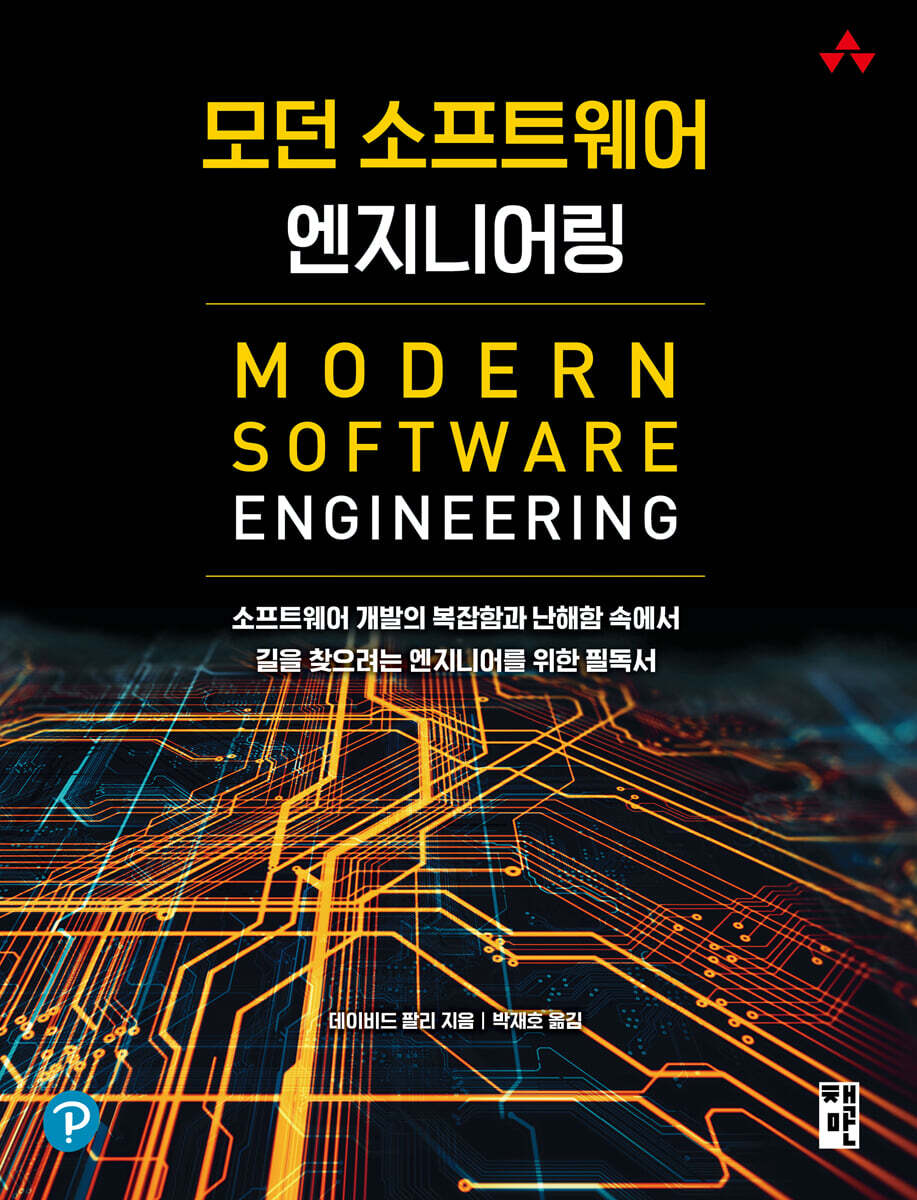
Modern Software Engineering
 |
Description
Book Introduction
Even with the AI craze, developers' skills and knowledge remain important.
This book will build a solid foundation and the strength to thrive as a software engineer! Discover the courage and wisdom to navigate the complexities and intricacies of software development. This book reinterprets and explains the essential software design principles essential to understanding TDD, DDD, and MSA in a modern way!
- You can preview some of the book's contents.
Preview
index
Part 1 | What is Software Engineering?
Chapter 1: Definition and History of Software Engineering
_Engineering is the practical application of science
_Redefining Software Engineering
_Again, 'software engineering'
___forward, forward
The Birth of Software Engineering
_Paradigm Shift
_organize
Chapter 2: The True Meaning of Software 'Engineering'
_Production is not our problem
_Engineering for design, not production
_Definition of Engineering for Practitioners
___Engineering != Code
_Crafts vs. Engineering
The Limits of 'Handcraft'
Precision and scalability
_Manage complexity
_Measurements must be repeatable and accurate.
_Engineering, Creativity, Craftsmanship
Why What We Do Is Not Software Engineering
The Tradeoffs of Software Development: Coupling is Key
The illusion of technological progress
_A Journey from Craft to Engineering
_Handcrafts alone are not enough
_What should we be concerned about now?
_organize
Chapter 3: Basics for Understanding Software Engineering
The software industry that only pursues new things
Measurement of (non-functional elements) is important
Increase productivity with stability and throughput.
_In which field should we become experts?
___Learning Expert
___Expert in managing complexity
_organize
Part 2 | Concrete Action Plans for Software Process Improvement
Chapter 4 Iteration for Improvement
_The complex and subtle advantages of repetitive tasks
_Iteration as a defensive design strategy
The temptation of planning
___The reality of repetitive tasks
_organize
Chapter 5: Feedback: Essentials for Good Decision Making
_A concrete example showing the importance of feedback
_Coding Feedback
_Integrated Process Feedback
_Design Feedback
_Architecture Feedback
_The faster the feedback, the better
_Product Design Feedback
_Organizational and Cultural Feedback
_organize
Chapter 6: Gradualism: Little by Little, Forward
_Modularity as an example of a spaceship
_The Secret to Building an Efficient Organization
_Practical tools for applying gradualism
_Let's minimize the side effects of changes
_Incremental design
_organize
Chapter 7: Empiricism: Be Aware of Reality
_Dream high, but keep your feet on the ground
_Experimentation and experience must be separated.
_“I know this bug!”
_Self-deception is our enemy
Let's invent a reality that fits our claims.
Experimentation over Conjecture: Empiricism Based on Reality
_organize
Chapter 8 Experimentalism: Scientific Thinking and Practice
Learning 'Experimentalism' from physicist Feynman
___Feedback: Principle 1 for Experimentalism
___Hypothesis: Principle 2 for Experimentalism
Measurement: Principle 3 for Experimentalism
Controlling Variables: Principle 4 for Experimentalism
_Automated Testing Learned from TDD
_Testing is a source of new knowledge
_One example of applying TDD to improve quality
_organize
Part 3 | Five Fundamental Principles for Managing Software Complexity
Chapter 9 Modularity: Criteria for Separation and Recombination
_Typical characteristics of modularity
_Design is always important
_TDD Lesson: If Testing is Hard, It's a Design Problem
_Let's strengthen modularity with TDD
_Let's strengthen modularity with REST API.
_Let's strengthen modularity with a distribution pipeline.
_The scale of modularity is neither large nor small.
_Characteristics of a High-Performance Development Organization: Modular
_organize
Chapter 10 Cohesion: Related elements of the software are in one place.
Modularity and Cohesion: The Foundations of Design
_One example of refactoring to improve cohesion
Improving cohesion by leveraging the context of _DDD
_What does 'high performance' mean in software?
_The relationship between coupling and cohesion
_Let's increase cohesion with TDD
_To create cohesive software
The price to pay for lack of cohesion
The Importance of Cohesion from a Development Organization Perspective
_organize
Chapter 11 Separation of Concerns: The Most Important Attribute of High-Quality Code
_Dependency Injection
_Let's separate essential complexity from accidental complexity.
_DDD is important: Top-down separation of concerns using bounded contexts.
_Easy to test code = Code with separated concerns
_Hexagonal Architecture: Ports and Adapters
When should ports and adapters be adopted?
_Why APIs aren't just function calls
Bottom-up separation of concerns using TDD
_organize
Chapter 12: Information Hiding and Abstraction: Friend or Foe?
Information hiding and abstraction are one and the same.
_Finding the cause of the code that became a 'big mud pit'
___Organizational and cultural issues
___Technical and design issues
___Concerns about over-engineering
_To increase abstraction, write test code first.
_Good abstraction is key
_Abstract with holes
_Learning abstraction techniques through analogies of world maps and subway maps
_Achieving abstraction with event storming
_Abstracted accidental complexity
_Isolate third-party systems and third-party code
_Trade-off between abstraction and concreteness
_organize
Chapter 13 Coupling: The Level of Interrelationship Between Software Modules
_It's a problem if it's too loose or too tight
_Coupling is essential for vertical scaling
Microservices: An Effective Way to Decouple
The Price of Loose Coupling: Bigger and More Code
_There is more than one type of coupling model
_Anyway, loose coupling is better than tight coupling
The Correlation Between Loose Coupling and Separation of Concerns
_DRY is too simple
_Asynchronous implementation for loose coupling
Design for loose coupling
_Large organizations that suffer eternally from strong coupling
_organize
Part 4 | Ideas for Software Engineers
Chapter 14: Software Engineering in Practice
_The Truth About Software Development
_Testable Code Example 1
_The system must be measurable
_Testable Code Case 2
_Test: Starting the system
_Deployment: System Completion
Speed of Feedback: A Key to Better Quality and Results
_Control variables throughout the entire system.
_Don't forget continuous distribution
_Questions to Consider in Software
_organize
Chapter 15: Becoming a Modern Software Engineer
_Don't forget that teams and organizations are also subject to complexity management.
_Let's pursue a digitally disruptive organization.
Outcome vs. Mechanism: Which is More Important?
Software engineering principles also apply to machine learning systems.
_The core idea of modern software engineering
_organize
Detailed image

Publisher's Review
√ Five philosophies on 'learning': scientifically formulating hypotheses and conducting experiments to gradually improve your capabilities!
#Iteration #Feedback #Incrementalism #Experimentation #Empiricalism
√ Five software design principles to 'manage' the 'complexity' that exists in the problems at hand and the software solutions themselves!
#Modularity #Cohesion #Loose Coupling #Separation of Concerns #Abstraction
│ What this book covers │
ㆍ Clearly define the goals you want to achieve.
ㆍ Let's choose tools based on reasonable criteria.
ㆍ Let's structure our work and systems to promote continuous and progressive development.
Rather than simply mass-producing "legacy code," let's evaluate progress with the goal of a continuously evolving system.
ㆍ Let's get more value from experimentalism and empiricism.
Maintain control even as systems become increasingly complex.
Be strict and systematic, but avoid excessive rigidity and inflexibility.
ㆍ Learn from history and experience
ㆍ Let's distinguish between 'good' and 'bad' software development ideas.
│ Target audience for this book │
Developers, architects, engineers, technical leaders, and managers who want to understand the complexity and difficulty of software development and further enhance their skills by solving various problems and difficulties.
│ Structure of this book │
Part 1, "What is Software Engineering?", begins by examining what engineering actually means in the context of software.
Explains the principles and philosophy of engineering and how these ideas can be applied to software.
This is a technical philosophy for software development.
Part 2, "Specific Action Plans for Software Process Improvement," explores how to structure your work so you can make progress in small steps.
Let's explore how we can assess whether we're making good progress or simply building tomorrow's legacy systems today.
Part 3, "Five Fundamental Principles for Managing Software Complexity," explores the principles and techniques needed to manage complexity.
Here, we examine each of these principles in detail, exploring their meaning and applicability in creating high-quality software, whatever their nature.
Part 4, "Ideas for Software Engineers," describes ideas and approaches that maximize learning opportunities, encourage progress in small steps, and foster the ability to manage complexity as systems grow.
[Opening remarks]
Dave clearly explains why we have misconceptions about 'real' engineering.
He shows that while engineering is a science-based discipline, it doesn't have to be rigid.
We explore how scientific principles and engineering techniques apply to software development, and discuss why the production-based techniques we consider engineering are not well-suited to software development.
What I love about Dave's work in this book is that it shows how to bring abstract concepts that might be difficult to apply to the actual code we're working on into our work and use them as tools for thinking about concrete problems.
This book embraces the confusing reality of code development, or rather software engineering: there is no single right answer.
Things will change.
What was right at one point can soon become very wrong.
The first half of this book offers practical solutions for not only surviving but thriving in this reality.
The second half covers topics that might be considered abstract or academic and shows how they can be applied to design better (e.g., more robust, more maintainable, or otherwise 'better') code.
Design here doesn't necessarily mean a ton of design documents or UML diagrams, but can be as simple as "thinking about the code before or while you write it." (One thing I noticed while programming with Dave is that he actually types code quite a bit.)
It turns out that thinking about what you're going to write before you write it can actually save you a lot of time and effort.
Dave doesn't try to avoid or excuse the contradictions that might arise when these conventions are used together, or the potential confusion that individual conventions might cause.
Instead, by taking the time to talk about the pros and cons and common areas of confusion, I came to understand for the first time that it was the balance and tension between these conventions that made for a "better" system.
Instead of accepting them as black-and-white logic or dichotomous rules of right and wrong, it's important to understand that these are guidelines, understand the costs and benefits associated with them, and use them as a lens through which to view your code/design/architecture, or sometimes as a dial that can be adjusted.
While working with Dave, reading this book helped me understand why we were so successful and satisfied as 'software engineers'.
I hope that by reading this book, you too can leverage Dave's experience and advice for your own company or team, without having to hire him.
May you grow into a happy engineer!
- Trisha Gee / Technology Evangelist and Java Champion
[Author's Note]
This book returns the essence of 'engineering' to 'software engineering'.
In this book, I describe a practical approach to software development that consciously applies rational, scientific thinking to problem solving.
This idea comes from consistently applying what we've learned about software development over the past several decades.
My goal with this book is to convince you that engineering is not what you think, and that it is completely appropriate and effective when applied to software development.
Then, we'll explain the foundations of this engineering approach to software and how and why it works.
This isn't about the latest fad in processes or technologies, but about practical approaches proven by data that show what works and what doesn't.
Working in small, iterative steps is much more effective than not.
By structuring your work into a series of small, informal experiments and gathering feedback to learn from them, you can work much more thoughtfully and explore problems and solutions.
By compartmentalizing your work so that each part is focused, clear, and understandable, you can safely and carefully develop your system even if you don't understand your destination before you begin.
This approach provides guidance on where and what to focus on, even when we don't know the answer.
This increases our chances of success, whatever the nature of the task given to us.
This book defines a model for how we should structure ourselves to create great software and how to build software efficiently at any scale, in both simple and truly complex systems.
[Translator's Note]
When I decided to translate this book and read it for the first time, I was a little worried.
Although it is more practical than the numerous books published previously on software engineering, it seems to lack a powerful solution that can effectively resolve the problems of the headache-inducing development process.
I, too, must confess that I wish this book had outlined a comprehensive methodology and a set of rules in advance, along with techniques for writing code accordingly.
But as I read the manuscript again for revision before submitting it to the publisher, the book's true colors began to gradually come into view.
In particular, I found the interrelationships between the various development-related technologies and software design principles explained in Parts 1 and 2 very interesting, as I noticed how the excellent software design principles introduced in Part 3 connected with the foreshadowing carefully laid in the beginning.
The biggest problem facing modern software engineering isn't a perfect theory, a great tool, or a proven development methodology.
In some ways, it seems like these are misunderstandings and conflicts that stem from the reality of still being lost and wandering in the process of transitioning from the existing production-centered engineering to design-centered engineering.
To address this, this book emphasizes "learning," a process of scientifically formulating hypotheses, conducting experiments, and gradually improving capabilities based on the results obtained.
It also suggests that we must become experts in managing the 'complexity' of the various problems we face and the solutions to solve them.
If you understand the philosophy of iteration, feedback, incrementality, experimentation, and empiricism and become an expert in learning, and upgrade yourself to an expert in managing complexity by properly understanding modularity, cohesion, separation of concerns, abstraction, and loose coupling from a learning perspective, you will be fully prepared to put the software engineering advocated in this book into practice.
This book begins by acknowledging that anyone can make mistakes, that situations are always changing, and that there are trade-offs and tensions between solutions.
The slight regret that this book did not unfold anything exciting stems from this very point.
As Frederick Brooks stated in his 1986 paper, "No Silver Bullet - Essence and Accidents of Software Engineering," when it comes to the essence of software development, there is no single silver bullet, no single tool or methodology that can save developers from the complexities that inevitably arise during the software development process.
So, what can we do to unravel the complexities and intricacies of software development, when there's no silver bullet? Surrounded by legacy on one side and emerging technologies on the other, this book aims to help developers navigate the engineering quandary by focusing on the most fundamental ideas that have endured and proven themselves over decades.
In other words, in order to plan happily, develop happily, and use happily, we select optimization ideas that should be commonly applied to all software development, from requirements definition to design and development and distribution, and explain the issues that should be considered for proper use in reality by connecting them to various software engineering concepts and methodologies.
Based on the author's experience, this book delves into core ideas from all angles, from the architecture establishment and design stages to the testing and implementation stages.
If you've ever read a book on software architecture and design, you're probably already familiar with the methodology and practices, but this book gives them new meaning, transforming static software engineering theory into dynamic software engineering practices.
It organizes modularity from the perspective of testability and deployment, gives meaning to cohesion and separation of concerns from the perspective of DDD (Design-Driven Development) and TDD (Test-Driven Development), suggests a way to choose information hiding and the level of abstraction by considering the trade-off between organizational and cultural issues and technical or design issues, and provides food for thought by linking the difficulty of coupling with separation of concerns from the perspective of microservices.
Readers who have previously encountered these design principles at the design and code level will find that this book provides a higher-level engineering perspective, understanding what these design principles actually mean in the real world and how to embrace them.
In today's rapidly changing world, meticulous planning from the outset, meticulously executing every step of the way, and meticulously verifying each intermediate outcome to ensure it's accurate before finalizing the finished product, doesn't guarantee success.
Conversely, by breaking software development down into small, iterative steps (as often mentioned in agile methodologies), experimenting to gather feedback, build learning capacity, and increase understanding of the system, we can safely and carefully scale the system, increasing our chances of success.
Instead of becoming complacent and building programs the same way every day, only to regret it months later, what's crucial to quickly and accurately solving pressing problems and building on those successes? After reading this book from cover to cover, I encourage you to reflect on this question.
GOODS SPECIFICS
- Date of issue: April 9, 2025
- Page count, weight, size: 336 pages | 560g | 172*225*16mm
- ISBN13: 9791189909857
- ISBN10: 1189909855
You may also like
카테고리
korean


korean


