

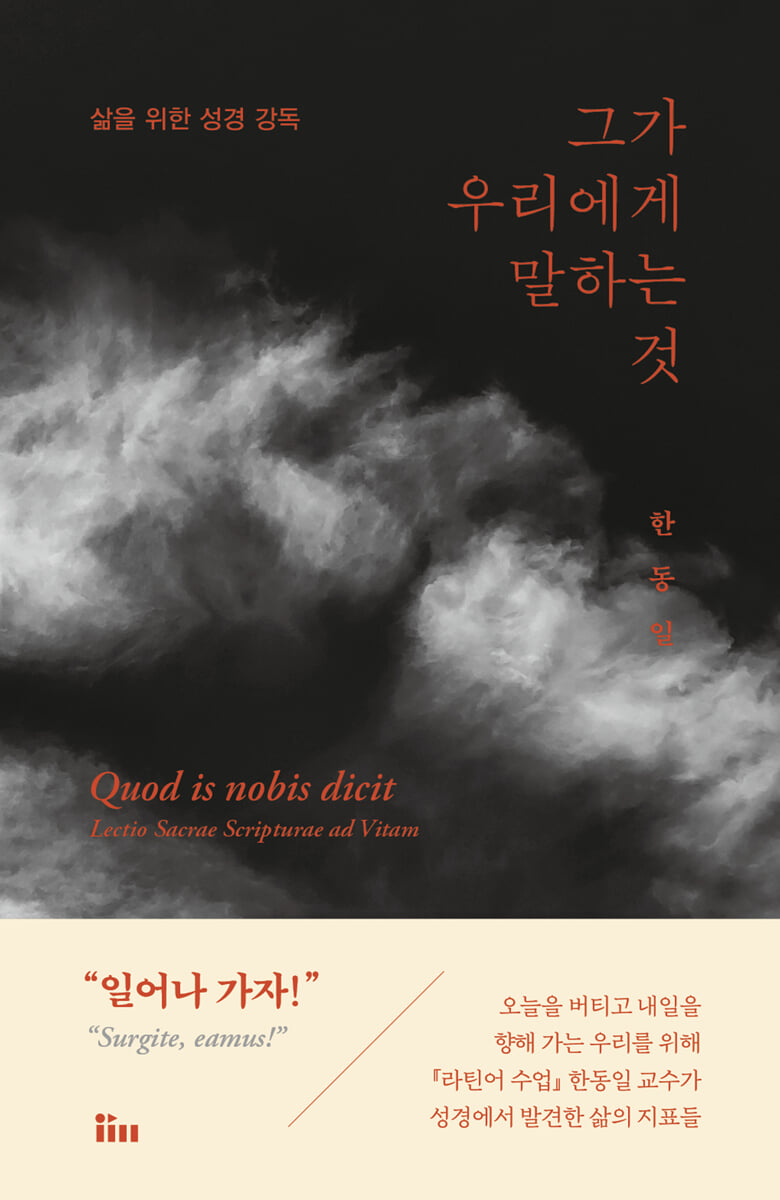
What he tells us
 |
Description
Book Introduction
A new book by Han Dong-il, author of "Latin Lessons"
The images of ourselves and ourselves encountered in the Bible
A new work by author Dong-il Han, whose book "Latin Lessons" has reached 100 editions, has been published.
Author Han Dong-il, known as the first Korean and the first East Asian lawyer in the 700-year history of the Vatican's Supreme Court, the 'Rota Romana,' describes himself as a 'studying worker,' but he was also a Catholic priest for a long time.
However, he stepped down from the priesthood in 2021 and made this known in his book, “On the Believer.”
This new work, "What He Tells Us," is a story about himself and us that the author encountered in the Bible, as he returned to being an ordinary person and an ordinary believer.
He says the book is “like a written version of the sermons I was unable to deliver during the 21 years I spent as a priest, and a struggle to find joy in the familiar.”
He included Bible verses and stories that touched his heart, his past and present experiences from those verses, and topics for the religious community to think about together.
Moreover, the author, who understands and knows the Bible well, does not simply convey his thoughts through Bible verses, but also conveys the knowledge contained in those verses.
The images of ourselves and ourselves encountered in the Bible
A new work by author Dong-il Han, whose book "Latin Lessons" has reached 100 editions, has been published.
Author Han Dong-il, known as the first Korean and the first East Asian lawyer in the 700-year history of the Vatican's Supreme Court, the 'Rota Romana,' describes himself as a 'studying worker,' but he was also a Catholic priest for a long time.
However, he stepped down from the priesthood in 2021 and made this known in his book, “On the Believer.”
This new work, "What He Tells Us," is a story about himself and us that the author encountered in the Bible, as he returned to being an ordinary person and an ordinary believer.
He says the book is “like a written version of the sermons I was unable to deliver during the 21 years I spent as a priest, and a struggle to find joy in the familiar.”
He included Bible verses and stories that touched his heart, his past and present experiences from those verses, and topics for the religious community to think about together.
Moreover, the author, who understands and knows the Bible well, does not simply convey his thoughts through Bible verses, but also conveys the knowledge contained in those verses.
- You can preview some of the book's contents.
Preview
index
Starting the story
I.
To us who look ahead in loneliness and pain
In the beginning was the Word / For when I am weak, then I am strong / What you loose on earth will be loosed in heaven / I came to set the earth on fire / My soul is so sorrowful that I almost die / I rejoice in God my Savior / Life is not measured by the number of years / Not by seven times, but by seventy-seven times / Whoever has, more will be given, and they will have an abundance / No one knows the day or the hour / Could not watch for one hour? / He who sows sparingly will also reap sparingly / Jesus, weary, sat down by the well / I am not worthy to have you under my roof / It is impossible that I should not cause others to sin / Now is the time / It is good for us to stay here / He who puts his hand to the plow and looks back / You have been faithful in a few things / Holy, holy, holy is He / Do you want to be healed? / What are you seeking? / For in the future you will be called Cephas / Watch and pray so that you will not fall into temptation / Do you love Me? / Do not be afraid / You too must be holy / No, I am not / The Word became flesh and made his dwelling among us / How cramped it is and few find it / When an unclean spirit comes out of a person / Believe that you have received it / Rejoice, you who are full of grace
II.
For us who are creating a better world
Rise, let us go / The seventh day is for rest / No one should separate / Let him who is without sin be the first to throw a stone at her / A prophet is held in high esteem everywhere / But a little while longer and you will see me / He is a glutton and a winebibber, a friend of tax collectors and sinners / As he passed by, he saw a man blind from birth / A city set on a hill cannot be hidden / Give them something to eat / With all your heart, with all your soul, and with all your mind / Who are my mother, and who are my brothers? / You will never wash my feet / Do not be discouraged / If salt has lost its saltiness, how can its flavor be restored? / If even a poor man named Lazarus, full of sores / Should acknowledge me before the people / For this very purpose I have come / For what is hidden must be made known / 'Ephphatha!' That is, 'Be opened!'
In closing
I.
To us who look ahead in loneliness and pain
In the beginning was the Word / For when I am weak, then I am strong / What you loose on earth will be loosed in heaven / I came to set the earth on fire / My soul is so sorrowful that I almost die / I rejoice in God my Savior / Life is not measured by the number of years / Not by seven times, but by seventy-seven times / Whoever has, more will be given, and they will have an abundance / No one knows the day or the hour / Could not watch for one hour? / He who sows sparingly will also reap sparingly / Jesus, weary, sat down by the well / I am not worthy to have you under my roof / It is impossible that I should not cause others to sin / Now is the time / It is good for us to stay here / He who puts his hand to the plow and looks back / You have been faithful in a few things / Holy, holy, holy is He / Do you want to be healed? / What are you seeking? / For in the future you will be called Cephas / Watch and pray so that you will not fall into temptation / Do you love Me? / Do not be afraid / You too must be holy / No, I am not / The Word became flesh and made his dwelling among us / How cramped it is and few find it / When an unclean spirit comes out of a person / Believe that you have received it / Rejoice, you who are full of grace
II.
For us who are creating a better world
Rise, let us go / The seventh day is for rest / No one should separate / Let him who is without sin be the first to throw a stone at her / A prophet is held in high esteem everywhere / But a little while longer and you will see me / He is a glutton and a winebibber, a friend of tax collectors and sinners / As he passed by, he saw a man blind from birth / A city set on a hill cannot be hidden / Give them something to eat / With all your heart, with all your soul, and with all your mind / Who are my mother, and who are my brothers? / You will never wash my feet / Do not be discouraged / If salt has lost its saltiness, how can its flavor be restored? / If even a poor man named Lazarus, full of sores / Should acknowledge me before the people / For this very purpose I have come / For what is hidden must be made known / 'Ephphatha!' That is, 'Be opened!'
In closing
Detailed image
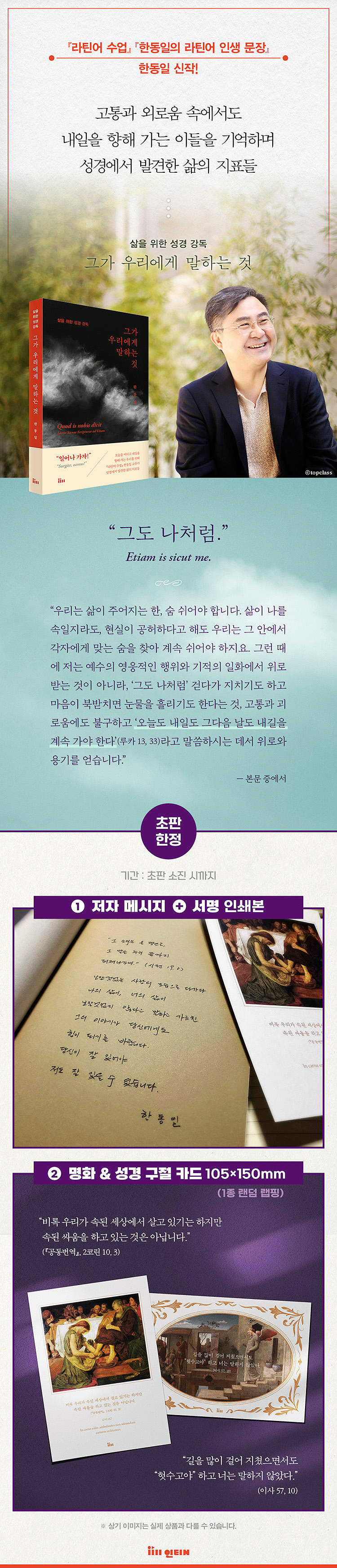
Into the book
Perhaps the greatest offering a human being can offer to God is the repeated failure of resolutions made every moment of every day.
The sacrifices acceptable to God are a broken spirit, a contrite and broken heart, O God, you will not despise.
(Psalm 51:19) Only a broken spirit, a broken and contrite heart could be offered to God.
And God did not despise me for that.
In that sense, I wrote this article because I, who can only reveal my extreme shame, human weaknesses, and immaturity, was reminded of the saying, "When I am weak, I am actually strong."
--- p.21
In the way Jesus acts like a human being, lamenting, “How much I will be crushed until all this is accomplished!” (Luke 12:50), I see that Jesus understands the human condition better than anyone else.
And that fact is a comfort to me, a mere human being.
I get courage from the fact that he, like me, struggles, wanders, and struggles.
Not only that, but I like Jesus because he shows weaknesses just like us, but his attitude toward weaknesses is different.
--- p.32
An undesirable reality does not mean that it is okay to live in despair.
You can only achieve hope if you don't give up.
So maybe I have to prove to myself that life isn't measured by the number of years I live.
That proof will soon become my life.
Let me say this again: life is not measured by the number of years lived.
--- p.50
As we live, there are so many things that make us think, 'This is all there is to it,' and leave us breathless.
Forgiveness may be like that too.
Understanding and tolerating the weakness of others and of one's own weakness and incompetence may mean not just shouting "this far" seven times, but seventy-seven times—in other words, pledging with all my heart, all my life, and all my mind not to give up.
--- p.55
Humans are beings who can think about what is their duty and what is not their right.
This is the right and duty given to ordinary human beings.
I must know what my duty is and be able to do it, and I must know what my right is not and be able to refrain from doing it.
So, “to rule oneself is the best rule (Imperare sibi maximum imperium est, Imperare sibi maximum imperium est).”
--- p.104
Just as it takes time and effort for humans to meet God, it also takes time and effort for humans to meet humans.
Among them, meeting oneself is more important than meeting anyone else.
--- p.119
We must confront the aspects of ourselves that we do not want to face.
Of course, it can be a brutally painful experience, bringing up painful times and memories.
But we know that the reason we face it is not simply to dwell on past times and memories.
So we go deep, but this is to come out again.
--- p.135
Becoming a holy person involves constant conflict and struggle between the self that wants to belong to the past and the self that wants to take a new path.
The divinity within us does not shine in itself, but is revealed through this process.
What I look like now isn't everything.
There is a divine aspect to me that I do not even know about.
--- p.139
The fact that the church was built on the rock through Simon Peter and expanded and grew means that through Simon Peter, we were able to properly look at each individual and grow.
Humans feel the thorns under their own fingernails much more acutely than the pain of others, but such human tendencies and conditions are neither criticized nor condemned.
It's just human, extremely human.
But still, we are asked again about the meaning of human existence.
When we are together, my failures and your failures have meaning, and even when life is difficult, it has meaning.
The sacrifices acceptable to God are a broken spirit, a contrite and broken heart, O God, you will not despise.
(Psalm 51:19) Only a broken spirit, a broken and contrite heart could be offered to God.
And God did not despise me for that.
In that sense, I wrote this article because I, who can only reveal my extreme shame, human weaknesses, and immaturity, was reminded of the saying, "When I am weak, I am actually strong."
--- p.21
In the way Jesus acts like a human being, lamenting, “How much I will be crushed until all this is accomplished!” (Luke 12:50), I see that Jesus understands the human condition better than anyone else.
And that fact is a comfort to me, a mere human being.
I get courage from the fact that he, like me, struggles, wanders, and struggles.
Not only that, but I like Jesus because he shows weaknesses just like us, but his attitude toward weaknesses is different.
--- p.32
An undesirable reality does not mean that it is okay to live in despair.
You can only achieve hope if you don't give up.
So maybe I have to prove to myself that life isn't measured by the number of years I live.
That proof will soon become my life.
Let me say this again: life is not measured by the number of years lived.
--- p.50
As we live, there are so many things that make us think, 'This is all there is to it,' and leave us breathless.
Forgiveness may be like that too.
Understanding and tolerating the weakness of others and of one's own weakness and incompetence may mean not just shouting "this far" seven times, but seventy-seven times—in other words, pledging with all my heart, all my life, and all my mind not to give up.
--- p.55
Humans are beings who can think about what is their duty and what is not their right.
This is the right and duty given to ordinary human beings.
I must know what my duty is and be able to do it, and I must know what my right is not and be able to refrain from doing it.
So, “to rule oneself is the best rule (Imperare sibi maximum imperium est, Imperare sibi maximum imperium est).”
--- p.104
Just as it takes time and effort for humans to meet God, it also takes time and effort for humans to meet humans.
Among them, meeting oneself is more important than meeting anyone else.
--- p.119
We must confront the aspects of ourselves that we do not want to face.
Of course, it can be a brutally painful experience, bringing up painful times and memories.
But we know that the reason we face it is not simply to dwell on past times and memories.
So we go deep, but this is to come out again.
--- p.135
Becoming a holy person involves constant conflict and struggle between the self that wants to belong to the past and the self that wants to take a new path.
The divinity within us does not shine in itself, but is revealed through this process.
What I look like now isn't everything.
There is a divine aspect to me that I do not even know about.
--- p.139
The fact that the church was built on the rock through Simon Peter and expanded and grew means that through Simon Peter, we were able to properly look at each individual and grow.
Humans feel the thorns under their own fingernails much more acutely than the pain of others, but such human tendencies and conditions are neither criticized nor condemned.
It's just human, extremely human.
But still, we are asked again about the meaning of human existence.
When we are together, my failures and your failures have meaning, and even when life is difficult, it has meaning.
--- p.262
Publisher's Review
After Han Dong-il, author of "Latin Lessons," gave up his priestly status,
The images of ourselves and ourselves encountered in the Bible
Author Han Dong-il, author of the best-selling book “Latin Lessons” and well-known as the first Korean lawyer in East Asia in the 700-year history of the Vatican’s Supreme Court, the “Rota Romana,” was also a Catholic priest in the past.
However, he has been a scholar rather than a priest for a long time, and he has described himself as a 'studying worker'.
And in 2021, after much deliberation, the author resigned from the priesthood he had held for 21 years.
This new work is a reflection of his new identity as an ordinary person, in which he once again looks into the Bible and writes down his thoughts and feelings.
The author says about the Bible, “The Bible is a book written from around 1,000 BC to the 2nd century AD. Before it was a scripture of a specific religion, it was a document that allowed us to look deeply into humans, communities, and society. The stories in the Bible are not stories limited to a specific religion, but stories for me, us, and human society living today.”
He also confesses, “Personally, looking at Jesus, his disciples, and other figures in the Bible was like looking into a mirror.”
The Bible verses he held in his heart and the stories he told are not only his own but also reach us as we endure and live in this harsh world.
“Now that I am living the life of an ordinary person, I feel that if I do not have the will to change, the world will not change either.
And through prayer, I realize that it is not others who change, but myself.
So I pray.
I have been running breathlessly for a long time without even resting, so I want to be able to walk slowly and look around and observe.
“Conscious of that, I take slow, sluggish steps today as well.” (p. 202)
To us who endure today in pain and loneliness
The comfort and encouragement he conveys in the Bible
The thirty-three Bible verses and stories contained in Chapter 1 are stories of author Han Dong-il reflecting on himself as a human being, looking back on his past and present.
As he has revealed in several of his books, his family was not well-off during his childhood, and he had a difficult time in pain and loneliness when he went to study in Rome and prepared for the Rota Romana bar exam, the Vatican's Supreme Court, which has a pass rate of only 5-6%, when he stepped down from the Catholic priesthood in 2021, and when he faced the unfamiliar world again as a layperson.
He says that in every moment of his wandering, he found comfort in Jesus, who was tormented by the words, “My soul is overwhelmed with sorrow, even to death” (Matthew 26:38), and “How heavy will I be until all this is accomplished?” (Luke 12:50).
Note that in the Bible, Jesus, like himself, was a mere human being, wandering and struggling.
“My heart was in great pain as I wandered and hovered on the edge of frustration.
To me, the Bible verse, “My heart is so sorrowful that I could die,” was a great comfort.
“The fact that he, like me, suffered and was in pain ‘ad mortem’ has comforted me countless times” (p. 36)
Moreover, looking at Peter, an imperfect being, he talks about how he was a human being who constantly reflected despite trials, failures, and mistakes, and what meaning that can convey to us.
Through the stories of Jesus and other figures in the Bible, the author reflects on the origins of human existence and how we can make good choices.
I share the message of reconciliation with others and with myself, and the strength to move forward despite repeated failures.
“I see that failure is not over just because it has passed.
It leaves a trace as it passes by.
“It is up to us whether we accept those traces as wounds or as growth.” (p. 124)
In a world where the words of the powerful overflow but do not reach
What does a voice that transcends time and boundaries say?
The 20 verses in Chapter 2 are about what the faith community, the church, and our society should consider and move forward.
The first verse that opens that door is “Rise and let us go” (Matthew 26:46), where he speaks of the “connected suffering” that forms the basis of chapter 2.
When the author visited Jacob's Well in 1999, he witnessed the manager driving out a rich man with his sick son because he was Muslim.
As the author observes this scene, he is reminded of the story in the Bible about the Jews persecuting the Samaritans, and laments the fact that the way humans differentiate and guard against each other remains the same now as it did two thousand years ago.
And then ask again.
What if the well-keeper had seen the suffering of a father who wanted his son to be better than religion, and had connected his suffering to his own?
Through this story, author Han Dong-il says that if we want to become better people and create a better society, we must experience pain connected to the suffering of others.
“From the moment I opened my eyes from my own loneliness and pain to see the loneliness and pain of others, the room of my loneliness and pain began to shrink.
“It wasn’t that I could see how happy I was by looking at the misfortune of others, but rather that I could see, hear, and understand the suffering of others, and a sense of empathy and sympathy arose in my heart, and my pain connected to them was gradually healed little by little.” (p. 181)
According to the author, “For six days you shall work, and on the seventh day you shall rest.
“This is so that your ox and your donkey may rest, and the son of your bondwoman and the foreigner may breathe” (Exodus 23:12) What Jesus was trying to say is that the reason why modern people need rest in their daily lives is because of the ‘humility’ of humbling oneself and elevating others.
He also points out that the 'woman caught in adultery' in the Gospel of John makes us think about how humans should treat each other through Jesus' attitude toward a person full of shame.
Going further, through verses like “A city set on a hill cannot be hidden” (Matthew 5:14) and “But if salt has lost its saltiness, how can its flavor be restored?” (Mark 9:50), it speaks of the need for religion and the church in modern society to reflect on what they should do for people and how they should do it.
In a time when the words of the powerful overflow but fail to reach people's hearts and bring about even the slightest change, author Han Dong-il's new book makes us consider why the words of Jesus, a young man of humble origins, remain relevant today, transcending time.
The images of ourselves and ourselves encountered in the Bible
Author Han Dong-il, author of the best-selling book “Latin Lessons” and well-known as the first Korean lawyer in East Asia in the 700-year history of the Vatican’s Supreme Court, the “Rota Romana,” was also a Catholic priest in the past.
However, he has been a scholar rather than a priest for a long time, and he has described himself as a 'studying worker'.
And in 2021, after much deliberation, the author resigned from the priesthood he had held for 21 years.
This new work is a reflection of his new identity as an ordinary person, in which he once again looks into the Bible and writes down his thoughts and feelings.
The author says about the Bible, “The Bible is a book written from around 1,000 BC to the 2nd century AD. Before it was a scripture of a specific religion, it was a document that allowed us to look deeply into humans, communities, and society. The stories in the Bible are not stories limited to a specific religion, but stories for me, us, and human society living today.”
He also confesses, “Personally, looking at Jesus, his disciples, and other figures in the Bible was like looking into a mirror.”
The Bible verses he held in his heart and the stories he told are not only his own but also reach us as we endure and live in this harsh world.
“Now that I am living the life of an ordinary person, I feel that if I do not have the will to change, the world will not change either.
And through prayer, I realize that it is not others who change, but myself.
So I pray.
I have been running breathlessly for a long time without even resting, so I want to be able to walk slowly and look around and observe.
“Conscious of that, I take slow, sluggish steps today as well.” (p. 202)
To us who endure today in pain and loneliness
The comfort and encouragement he conveys in the Bible
The thirty-three Bible verses and stories contained in Chapter 1 are stories of author Han Dong-il reflecting on himself as a human being, looking back on his past and present.
As he has revealed in several of his books, his family was not well-off during his childhood, and he had a difficult time in pain and loneliness when he went to study in Rome and prepared for the Rota Romana bar exam, the Vatican's Supreme Court, which has a pass rate of only 5-6%, when he stepped down from the Catholic priesthood in 2021, and when he faced the unfamiliar world again as a layperson.
He says that in every moment of his wandering, he found comfort in Jesus, who was tormented by the words, “My soul is overwhelmed with sorrow, even to death” (Matthew 26:38), and “How heavy will I be until all this is accomplished?” (Luke 12:50).
Note that in the Bible, Jesus, like himself, was a mere human being, wandering and struggling.
“My heart was in great pain as I wandered and hovered on the edge of frustration.
To me, the Bible verse, “My heart is so sorrowful that I could die,” was a great comfort.
“The fact that he, like me, suffered and was in pain ‘ad mortem’ has comforted me countless times” (p. 36)
Moreover, looking at Peter, an imperfect being, he talks about how he was a human being who constantly reflected despite trials, failures, and mistakes, and what meaning that can convey to us.
Through the stories of Jesus and other figures in the Bible, the author reflects on the origins of human existence and how we can make good choices.
I share the message of reconciliation with others and with myself, and the strength to move forward despite repeated failures.
“I see that failure is not over just because it has passed.
It leaves a trace as it passes by.
“It is up to us whether we accept those traces as wounds or as growth.” (p. 124)
In a world where the words of the powerful overflow but do not reach
What does a voice that transcends time and boundaries say?
The 20 verses in Chapter 2 are about what the faith community, the church, and our society should consider and move forward.
The first verse that opens that door is “Rise and let us go” (Matthew 26:46), where he speaks of the “connected suffering” that forms the basis of chapter 2.
When the author visited Jacob's Well in 1999, he witnessed the manager driving out a rich man with his sick son because he was Muslim.
As the author observes this scene, he is reminded of the story in the Bible about the Jews persecuting the Samaritans, and laments the fact that the way humans differentiate and guard against each other remains the same now as it did two thousand years ago.
And then ask again.
What if the well-keeper had seen the suffering of a father who wanted his son to be better than religion, and had connected his suffering to his own?
Through this story, author Han Dong-il says that if we want to become better people and create a better society, we must experience pain connected to the suffering of others.
“From the moment I opened my eyes from my own loneliness and pain to see the loneliness and pain of others, the room of my loneliness and pain began to shrink.
“It wasn’t that I could see how happy I was by looking at the misfortune of others, but rather that I could see, hear, and understand the suffering of others, and a sense of empathy and sympathy arose in my heart, and my pain connected to them was gradually healed little by little.” (p. 181)
According to the author, “For six days you shall work, and on the seventh day you shall rest.
“This is so that your ox and your donkey may rest, and the son of your bondwoman and the foreigner may breathe” (Exodus 23:12) What Jesus was trying to say is that the reason why modern people need rest in their daily lives is because of the ‘humility’ of humbling oneself and elevating others.
He also points out that the 'woman caught in adultery' in the Gospel of John makes us think about how humans should treat each other through Jesus' attitude toward a person full of shame.
Going further, through verses like “A city set on a hill cannot be hidden” (Matthew 5:14) and “But if salt has lost its saltiness, how can its flavor be restored?” (Mark 9:50), it speaks of the need for religion and the church in modern society to reflect on what they should do for people and how they should do it.
In a time when the words of the powerful overflow but fail to reach people's hearts and bring about even the slightest change, author Han Dong-il's new book makes us consider why the words of Jesus, a young man of humble origins, remain relevant today, transcending time.
GOODS SPECIFICS
- Date of issue: March 29, 2024
- Page count, weight, size: 288 pages | 406g | 130*200*17mm
- ISBN13: 9791193740026
- ISBN10: 1193740029
You may also like
카테고리
korean


korean

![GQ KOREA Mark (Monthly): December [2025]](http://librairie.coreenne.fr/cdn/shop/files/8ef265dbbfbf186523ed75ba7319009d.jpg?v=1765340328&width=3840)


