

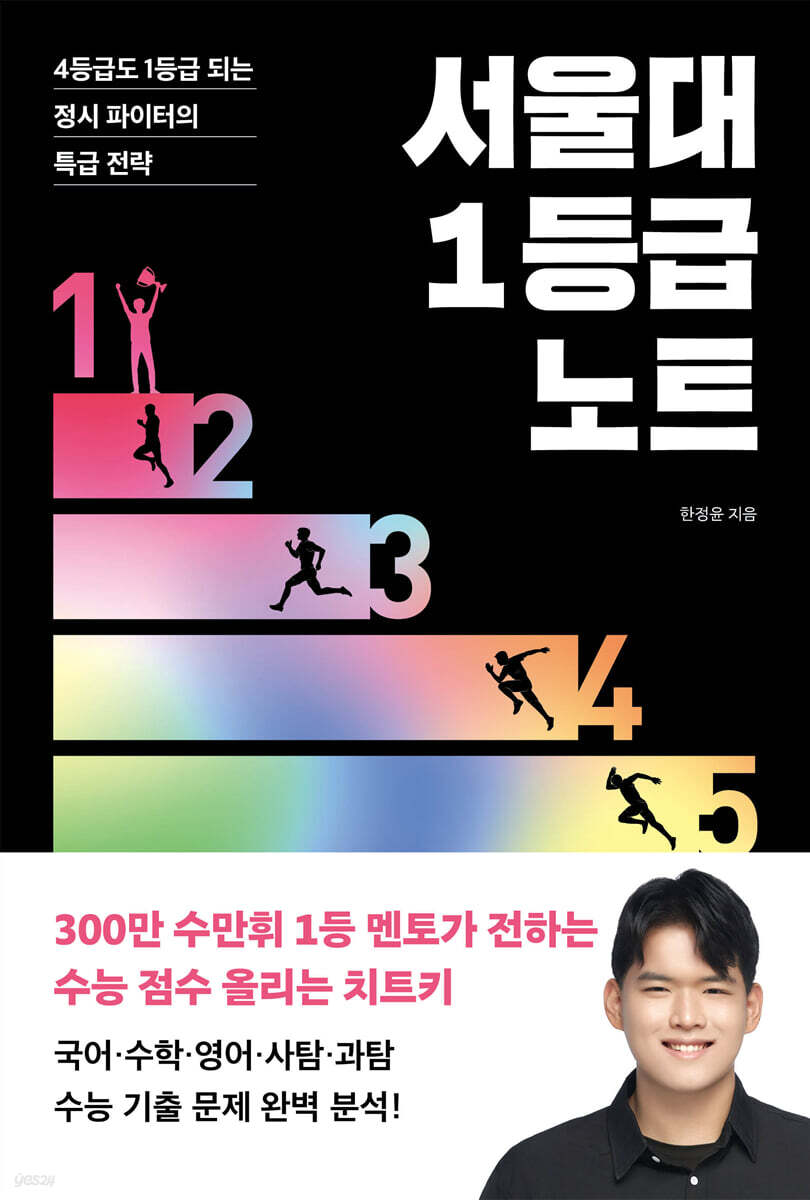
Seoul National University Grade 1 Notes
 |
Description
Book Introduction
3 million Sumanhwi 1st place mentor tells
Cheat keys to raise your CSAT score
Korean, Math, English, Social Studies, Science
Complete analysis of past college entrance exam questions!
On-time fighter.
This is a term for students who go 'all in' on the CSAT for various reasons, such as because their grades are not good, because they did not graduate from high school, or because their mock exam scores are better.
The author of this book, Han Jeong-yun, was also a regular fighter.
After experiencing the bitter taste of his first year of high school grades, he decides to focus on the college entrance exam.
And without private tutoring, I discovered my own study methods and know-how through intense thinking and research on my own.
As a result, my grades, which were at level 4, rose vertically to level 1, and I was finally able to enter Seoul National University as I ranked in the top 0.03% of the humanities department in the 2021 CSAT.
After entering university, he worked as a mentor and shared his study tips as a named columnist named 'HeadMaster' at 'Sumanhwi', a representative study cafe with 3 million members.
His writings have accumulated over 30 million views, and he has been flooded with requests from students and parents to publish his study methods in a book.
The book he wrote in response to this is ‘Seoul National University 1st Grade Notes’.
The author says that the CSAT is ultimately just a type of test, and that since there are techniques for doing well on the test, the test scores of students who know this and those who don't are bound to differ significantly.
And in this book, he has compiled and meticulously compiled the 'cheat keys' for the CSAT that he acquired through intense thought during his three years of high school.
Cheat keys to raise your CSAT score
Korean, Math, English, Social Studies, Science
Complete analysis of past college entrance exam questions!
On-time fighter.
This is a term for students who go 'all in' on the CSAT for various reasons, such as because their grades are not good, because they did not graduate from high school, or because their mock exam scores are better.
The author of this book, Han Jeong-yun, was also a regular fighter.
After experiencing the bitter taste of his first year of high school grades, he decides to focus on the college entrance exam.
And without private tutoring, I discovered my own study methods and know-how through intense thinking and research on my own.
As a result, my grades, which were at level 4, rose vertically to level 1, and I was finally able to enter Seoul National University as I ranked in the top 0.03% of the humanities department in the 2021 CSAT.
After entering university, he worked as a mentor and shared his study tips as a named columnist named 'HeadMaster' at 'Sumanhwi', a representative study cafe with 3 million members.
His writings have accumulated over 30 million views, and he has been flooded with requests from students and parents to publish his study methods in a book.
The book he wrote in response to this is ‘Seoul National University 1st Grade Notes’.
The author says that the CSAT is ultimately just a type of test, and that since there are techniques for doing well on the test, the test scores of students who know this and those who don't are bound to differ significantly.
And in this book, he has compiled and meticulously compiled the 'cheat keys' for the CSAT that he acquired through intense thought during his three years of high school.
- You can preview some of the book's contents.
Preview
index
Prologue The driving force that led me to study
Chapter 1.
Encounter
to encounter (especially something unpleasant)
01 10 Study Commandments High School Students Should Know
02 Six Mistakes Frequently Made by Novices
03 To be admitted on a rolling basis or on a regular basis, that is the question.
04 Lecture vs.
Academy vs.
Criteria for selecting a private tutor
05 Mind Setting for Test Takers
06 Previewing the Optimal Study Routine for the First Year of High School
07 Things to finish before becoming a high school senior
[Reading for College Entrance Exam Takers] 365 Days Until the CSAT: What It Means
Chapter 2.
Withstand
endure [overcome]
08 All About the Action Area
09 Laying the Foundation for Studying Korean for the College Scholastic Ability Test
10 Laying the Foundation for CSAT Math Study
11 Laying the Foundation for English Study for the College Scholastic Ability Test
12 Laying the Foundation for Studying Social Studies for the College Scholastic Ability Test
13 Laying the Foundation for Studying Science for the College Scholastic Ability Test
14 Usefulness of past exam questions and direction of past exam study
15 Usefulness of N-type and Direction of N-type Learning
16. Usefulness of mock exams and direction of mock exam learning
17. How to distribute study among past exam questions, N-type questions, and mock exams
18 Tips for a Wise Vacation Life
4 Ways to Avoid Mistakes That Cost You 19 Points
20 Frequently Asked Study Questions and Answers
[Reading before the June mock exam] The turning point is already upon us.
Chapter 3.
Climax
(in a certain time or day) reach a climax
21 How to Get the Most Out of Your Lightning Strike
Things to do after the mock exam in September 22
The lifestyle pattern I followed from 23 D-100 until the CSAT
24 Finals, the end of everything
25 Checklist for Using Practice Exams
[Reading after the September mock exam] What's left after the mock exam
Chapter 4.
Finale
The last part (of a work, etc.), conclusion [final chapter]
26 Questions About the College Scholastic Ability Test That Are Not So Minor
27 The code of conduct I took with me to the CSAT test center
28 Optimal Test Management Routine on CSAT Day
29 Other CSAT Tips from Experienced Test Takers
[Reading before the CSAT] 'Conformity' is about to end.
Epilogue To those of you who are moving forward into a new world
Chapter 1.
Encounter
to encounter (especially something unpleasant)
01 10 Study Commandments High School Students Should Know
02 Six Mistakes Frequently Made by Novices
03 To be admitted on a rolling basis or on a regular basis, that is the question.
04 Lecture vs.
Academy vs.
Criteria for selecting a private tutor
05 Mind Setting for Test Takers
06 Previewing the Optimal Study Routine for the First Year of High School
07 Things to finish before becoming a high school senior
[Reading for College Entrance Exam Takers] 365 Days Until the CSAT: What It Means
Chapter 2.
Withstand
endure [overcome]
08 All About the Action Area
09 Laying the Foundation for Studying Korean for the College Scholastic Ability Test
10 Laying the Foundation for CSAT Math Study
11 Laying the Foundation for English Study for the College Scholastic Ability Test
12 Laying the Foundation for Studying Social Studies for the College Scholastic Ability Test
13 Laying the Foundation for Studying Science for the College Scholastic Ability Test
14 Usefulness of past exam questions and direction of past exam study
15 Usefulness of N-type and Direction of N-type Learning
16. Usefulness of mock exams and direction of mock exam learning
17. How to distribute study among past exam questions, N-type questions, and mock exams
18 Tips for a Wise Vacation Life
4 Ways to Avoid Mistakes That Cost You 19 Points
20 Frequently Asked Study Questions and Answers
[Reading before the June mock exam] The turning point is already upon us.
Chapter 3.
Climax
(in a certain time or day) reach a climax
21 How to Get the Most Out of Your Lightning Strike
Things to do after the mock exam in September 22
The lifestyle pattern I followed from 23 D-100 until the CSAT
24 Finals, the end of everything
25 Checklist for Using Practice Exams
[Reading after the September mock exam] What's left after the mock exam
Chapter 4.
Finale
The last part (of a work, etc.), conclusion [final chapter]
26 Questions About the College Scholastic Ability Test That Are Not So Minor
27 The code of conduct I took with me to the CSAT test center
28 Optimal Test Management Routine on CSAT Day
29 Other CSAT Tips from Experienced Test Takers
[Reading before the CSAT] 'Conformity' is about to end.
Epilogue To those of you who are moving forward into a new world
Detailed image
.jpg)
Into the book
When I was a senior in high school, I received consistently poor grades on mock exams administered after September.
There's no need to explain the pressure and burden I felt at the time, and the desperation that arose from it.
But at that time, I used that desperation as a driving force to study.
I spent more time studying and solved more worksheets than before.
In this way, I was able to achieve the result of being admitted to Seoul National University through regular admission.
The driving force that enabled me to improve my grades is the same strength that all of you students reading this article now possess.
The urgency of not having much time left.
Transform the anxiety and fear you feel now, and the desperation that arises from them, into a driving force for your studies.
--- p.86
Especially in these times when there is so much confusion and uncertainty about the CSAT, it is even more important to prepare response plans in advance.
Beyond the format of the test, you can also prepare for non-question elements related to the test, such as how to effectively mark the correct answers, how to allocate time to each section, and how to deal with problems when you get stuck, by setting up a behavioral area.
In terms of how to effectively choose the correct answer, you can create action areas such as 'count all the multiple choice answers and choose the number with the least number' or 'look at the structure of the options for ㉠㉡㉢ questions and choose'. In terms of time distribution for each part, you can create action areas such as 'spend 40 minutes on non-literature, 25 minutes on literature, and 15 minutes on electives'. In cases where you cannot solve a problem, you can create action areas such as 'if no idea comes to you after 1 minute, move on to the next problem'.
--- p.95
Prose literature, by its nature, has a main event that is treated as a 'main plot' in the content, and it is best to read the text focusing on how that event unfolds.
If a description of the event is given in the example, read the passage focusing on which part of the event described in the example you are currently reading about. If not, read the passage focusing on understanding what event is happening.
--- p.101
Of course, it is important to find your weaknesses and study to improve them in any subject, but this is especially important in English.
This is because the interconnectedness between each element that makes up English (vocabulary, grammar, reading, problem solving) is significantly greater than that of other subjects.
In the case of Korean, if someone shows weakness in non-literature, there is no guarantee that he or she will also show weakness in literature or elective subjects.
However, in English, if your vocabulary and grammar are weak, your reading comprehension will inevitably be weak, and if your reading comprehension is weak, your problem-solving skills will inevitably be weak. This is because of the interconnectedness of the elements that make up English mentioned above.
--- p.139
The CSAT places a considerable physical burden on students, as students must arrive by 8:10 AM, the first test begins at 8:40 AM, and the last test ends at 4:37 PM (or 5:45 PM).
Of course, there are breaks here and there, but since you're taking a test that will determine your entire life that day, the chances of you being able to relax comfortably during these times are close to zero.
Maintaining the stamina to endure the 8-hour, 27-minute battle for one's life is a crucial aspect for students taking the CSAT.
And in order to maintain the stamina to stay mentally alert during this time, it is important to make our bodies recognize that time as the time when the body should be awake in the first place.
--- p.258
1.
While checking the sample, I check which number range of questions the weak type (in my case, shape) was in.
2.
When the weak type is presented in the number range after the mid-4th point, solve it last.
3.
Solve the problems in the order presented, but if the idea for the problem does not come to mind for more than a minute, skip that problem.
4.
Carefully review the question's introduction and carefully check each piece of information provided (to reduce mistakes caused by not reading the question properly).
--- p.334
The CSAT is held in November, and the weather during that time will be considerably colder than you might expect.
If your feet get cold, it will be difficult to concentrate on the test, so it's a good idea to bring an extra pair of socks just in case.
You might think, 'Isn't it okay since there's a heater?', but the warm air heated by the heater rises, leaving only cold air at the floor.
That's why your feet feel colder than other parts of your body.
That's why I recommend bringing an extra pair of socks.
--- p.349
Conformity is about to end.
I hope you all do well.
I encourage you to not only guess the correct answer, but also put an end to this system of conformity and write a new second act of the story.
I hope you all stick together well.
I hope you not only get into college, but also take on everything that's holding you back.
Conformity is about to end.
I sincerely hope that you will become wonderful adults and college students who can now overcome all the constraints placed on you.
There's no need to explain the pressure and burden I felt at the time, and the desperation that arose from it.
But at that time, I used that desperation as a driving force to study.
I spent more time studying and solved more worksheets than before.
In this way, I was able to achieve the result of being admitted to Seoul National University through regular admission.
The driving force that enabled me to improve my grades is the same strength that all of you students reading this article now possess.
The urgency of not having much time left.
Transform the anxiety and fear you feel now, and the desperation that arises from them, into a driving force for your studies.
--- p.86
Especially in these times when there is so much confusion and uncertainty about the CSAT, it is even more important to prepare response plans in advance.
Beyond the format of the test, you can also prepare for non-question elements related to the test, such as how to effectively mark the correct answers, how to allocate time to each section, and how to deal with problems when you get stuck, by setting up a behavioral area.
In terms of how to effectively choose the correct answer, you can create action areas such as 'count all the multiple choice answers and choose the number with the least number' or 'look at the structure of the options for ㉠㉡㉢ questions and choose'. In terms of time distribution for each part, you can create action areas such as 'spend 40 minutes on non-literature, 25 minutes on literature, and 15 minutes on electives'. In cases where you cannot solve a problem, you can create action areas such as 'if no idea comes to you after 1 minute, move on to the next problem'.
--- p.95
Prose literature, by its nature, has a main event that is treated as a 'main plot' in the content, and it is best to read the text focusing on how that event unfolds.
If a description of the event is given in the example, read the passage focusing on which part of the event described in the example you are currently reading about. If not, read the passage focusing on understanding what event is happening.
--- p.101
Of course, it is important to find your weaknesses and study to improve them in any subject, but this is especially important in English.
This is because the interconnectedness between each element that makes up English (vocabulary, grammar, reading, problem solving) is significantly greater than that of other subjects.
In the case of Korean, if someone shows weakness in non-literature, there is no guarantee that he or she will also show weakness in literature or elective subjects.
However, in English, if your vocabulary and grammar are weak, your reading comprehension will inevitably be weak, and if your reading comprehension is weak, your problem-solving skills will inevitably be weak. This is because of the interconnectedness of the elements that make up English mentioned above.
--- p.139
The CSAT places a considerable physical burden on students, as students must arrive by 8:10 AM, the first test begins at 8:40 AM, and the last test ends at 4:37 PM (or 5:45 PM).
Of course, there are breaks here and there, but since you're taking a test that will determine your entire life that day, the chances of you being able to relax comfortably during these times are close to zero.
Maintaining the stamina to endure the 8-hour, 27-minute battle for one's life is a crucial aspect for students taking the CSAT.
And in order to maintain the stamina to stay mentally alert during this time, it is important to make our bodies recognize that time as the time when the body should be awake in the first place.
--- p.258
1.
While checking the sample, I check which number range of questions the weak type (in my case, shape) was in.
2.
When the weak type is presented in the number range after the mid-4th point, solve it last.
3.
Solve the problems in the order presented, but if the idea for the problem does not come to mind for more than a minute, skip that problem.
4.
Carefully review the question's introduction and carefully check each piece of information provided (to reduce mistakes caused by not reading the question properly).
--- p.334
The CSAT is held in November, and the weather during that time will be considerably colder than you might expect.
If your feet get cold, it will be difficult to concentrate on the test, so it's a good idea to bring an extra pair of socks just in case.
You might think, 'Isn't it okay since there's a heater?', but the warm air heated by the heater rises, leaving only cold air at the floor.
That's why your feet feel colder than other parts of your body.
That's why I recommend bringing an extra pair of socks.
--- p.349
Conformity is about to end.
I hope you all do well.
I encourage you to not only guess the correct answer, but also put an end to this system of conformity and write a new second act of the story.
I hope you all stick together well.
I hope you not only get into college, but also take on everything that's holding you back.
Conformity is about to end.
I sincerely hope that you will become wonderful adults and college students who can now overcome all the constraints placed on you.
--- p.355
Publisher's Review
How long will you only motivate people?
What we need now is a technique to raise our score immediately!
Many study books, videos, and articles on the market only emphasize motivation.
They say that if you 'work hard' and 'make an effort', anyone can get the results they want.
But the idea that you can do anything with just a mindset is just wishful thinking.
Just because you have the will doesn't mean you'll get into Seoul National University.
If you study hard, you will go to Seoul National University.
Here's what's special about this book.
The point is that it is full of really specific and realistic methodologies told by a senior who was accepted to Seoul National University.
This book is packed full of techniques and know-how that can be applied starting today, starting with this mock exam.
What students need now is not motivation, but the skills to actually raise their scores by even just 10 points.
From the basics of studying to subject-specific study methods and exam tips
The real college entrance exam study that no school, no academy, and no mom knows about
"Seoul National University Grade 1 Notes" contains literally "everything you need to do well on the CSAT," including solutions to past exam questions, strategies for each type, a study planner, how to write an error note, and even test-room tips.
The author divided the know-how he accumulated into four stages and included them in each chapter.
Chapter 1 provides study-related knowledge that you need to know before starting to prepare for the CSAT in earnest.
Chapter 2 provides detailed explanations of study methods for each subject and how to utilize learning tools such as past exam questions, mock exams, and N-type questions, analyzing past CSAT questions.
Chapter 3 presents the final checklist and lifestyle patterns before the exam.
Chapter 4 provides answers to questions you may have had but had no one to ask on the day of the CSAT, and provides guidance on the optimal test-taking routine.
Students who simply 'study hard' may end up missing important points because of it.
If you regret it after the CSAT and realize what you didn't know, it's too late.
Rather than solving one more workbook, it would be a much more efficient and desirable choice to thoroughly read the "Seoul National University Grade 1 Notes."
This book, filled with the author's practical know-how for getting into Seoul National University on time without private tutoring, will serve as the ultimate reference for students and their parents, providing them with the immediate help they need.
What we need now is a technique to raise our score immediately!
Many study books, videos, and articles on the market only emphasize motivation.
They say that if you 'work hard' and 'make an effort', anyone can get the results they want.
But the idea that you can do anything with just a mindset is just wishful thinking.
Just because you have the will doesn't mean you'll get into Seoul National University.
If you study hard, you will go to Seoul National University.
Here's what's special about this book.
The point is that it is full of really specific and realistic methodologies told by a senior who was accepted to Seoul National University.
This book is packed full of techniques and know-how that can be applied starting today, starting with this mock exam.
What students need now is not motivation, but the skills to actually raise their scores by even just 10 points.
From the basics of studying to subject-specific study methods and exam tips
The real college entrance exam study that no school, no academy, and no mom knows about
"Seoul National University Grade 1 Notes" contains literally "everything you need to do well on the CSAT," including solutions to past exam questions, strategies for each type, a study planner, how to write an error note, and even test-room tips.
The author divided the know-how he accumulated into four stages and included them in each chapter.
Chapter 1 provides study-related knowledge that you need to know before starting to prepare for the CSAT in earnest.
Chapter 2 provides detailed explanations of study methods for each subject and how to utilize learning tools such as past exam questions, mock exams, and N-type questions, analyzing past CSAT questions.
Chapter 3 presents the final checklist and lifestyle patterns before the exam.
Chapter 4 provides answers to questions you may have had but had no one to ask on the day of the CSAT, and provides guidance on the optimal test-taking routine.
Students who simply 'study hard' may end up missing important points because of it.
If you regret it after the CSAT and realize what you didn't know, it's too late.
Rather than solving one more workbook, it would be a much more efficient and desirable choice to thoroughly read the "Seoul National University Grade 1 Notes."
This book, filled with the author's practical know-how for getting into Seoul National University on time without private tutoring, will serve as the ultimate reference for students and their parents, providing them with the immediate help they need.
GOODS SPECIFICS
- Date of issue: September 11, 2024
- Page count, weight, size: 360 pages | 628g | 152*225*21mm
- ISBN13: 9791193506813
You may also like
카테고리
korean


korean

![GQ KOREA Mark (Monthly): December [2025]](http://librairie.coreenne.fr/cdn/shop/files/8ef265dbbfbf186523ed75ba7319009d.jpg?v=1765340328&width=3840)


