

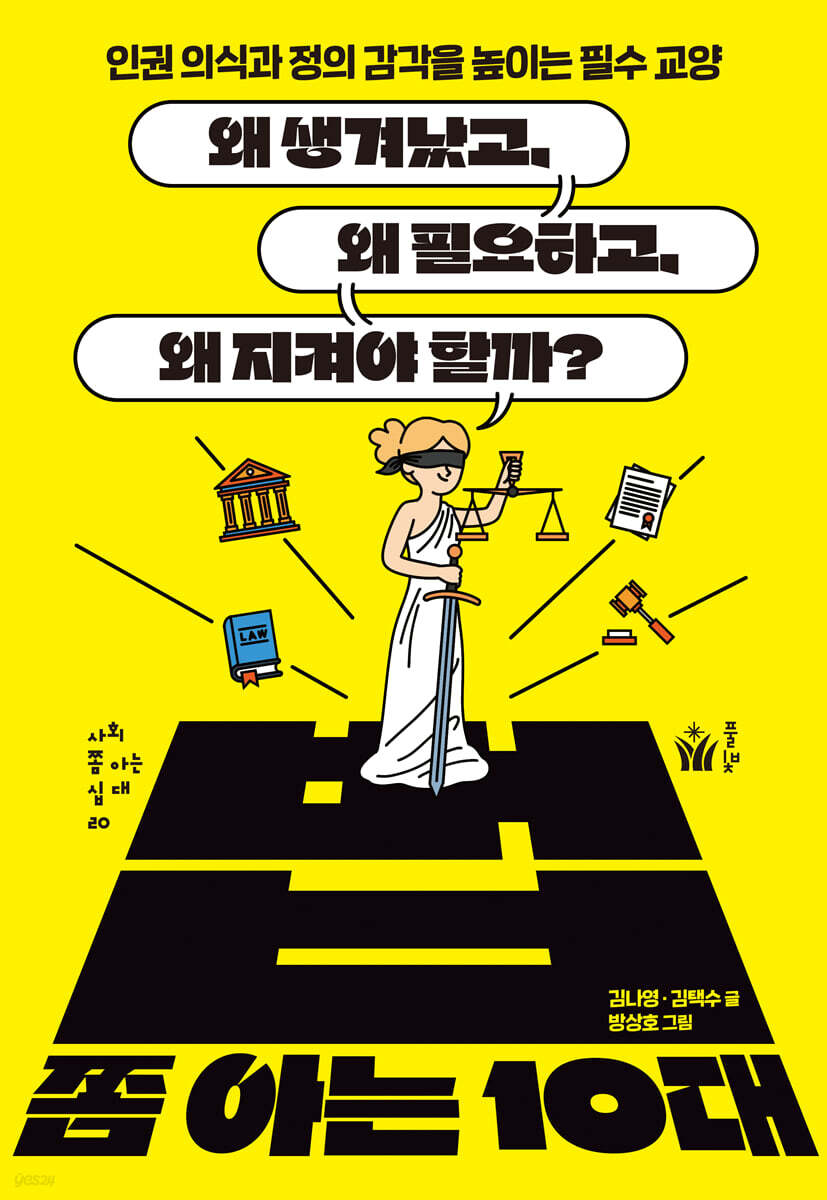
A teenager who knows a little about the law
 |
Description
Book Introduction
Why did the law come into existence, why is it necessary, and why must it be followed? Customized reading that completes subject comprehension, essay writing, and special skills all at once What if we viewed every incident through the lens of the law, through the lens of a judge? Social norms include customs, morals, and law. Among these, there is no compulsion in customs, which are patterns of behavior that have been repeatedly observed in a society for a long time, and in morals based on conscience, which are the duties that humans should follow. However, the 'law', which is a social promise that members of society agree to keep, is binding and if violated, the state imposes sanctions. So we must know the law well, follow it, and never take it for granted. In this way, the law is closely connected to our daily lives, so 'studying law' is not something only for those who dream of becoming judges, but rather it is essential knowledge that everyone must know to protect and safeguard their freedom and rights. The most fun way to learn law is through real-life cases (stories). This book is designed to help a father, a judge, and his middle school daughter (currently a social studies teacher) understand 'why the law was created, why it is necessary, and why it must be followed' by discussing movies, novels, and major events. "Top 10 Law Knowledgeable Teens" not only contains legal knowledge information for understanding the subject, but also covers topics such as "What attitude should a judge maintain?", "Is the majority opinion always just?", and "What is the justice pursued by law?", so you can prepare for your school report card, essay, and special admissions test all at once by reading just this one book. The delightful illustrations, which especially aid comprehension of the text, help teenagers understand legal terms, case law, and constitutional rights that may be difficult for them in an easy and fun way. |
- You can preview some of the book's contents.
Preview
index
Prologue: Why should we know the law?
Chapter 1: Why did the law come into existence?
1.
What would a society without law look like?
A society without law, "Lord of the Flies"
People who survived a shipwreck by eating people
2.
Law, limiting arbitrary royal power
Robin Hood, King John, and Magna Carta
Civil revolutions occur: the Glorious Revolution in England, the American Revolution, and the French Revolution.
Chapter 2.
Law and the Birth of Modern Society
1.
The ideological underpinning of the civil revolution: the social contract theory
Hobbes: The king's power is granted by a promise to society.
Locke: A Social Contract for Private Property
Rousseau: A social contract between individuals and the communities to which they belong.
2.
What did modern society look like after the civil revolution?
Ensure maximum individual freedom
Guarantee at least the right to live like a human being.
The economy is early capitalism, politics is a night watchman state.
Chapter 3.
Our rights protected by law
1.
Civil and social rights
Freedom: Leave me alone
Social rights: Guarantee a minimum human life
Between civil rights and social rights
2.
Right to equality, equality before the law
Right to Equality: Everyone is equal before the law.
The trial must be fair
Equality of Employment vs. Freedom of Employment
3.
The right to vote, a sign of recognition as a subject of society
History of guaranteeing suffrage
Until everyone has the right to vote
4.
Claim, defend my rights
Means for guaranteeing basic rights
Constitutional petition
Chapter 4.
The purpose pursued by the law
1.
What is the ‘justice’ that the law pursues?
Aristotle: To each his own!
Bentham: The greatest happiness for the greatest number
Kant: There are universal rights that cannot be violated.
Rolls: We must agree behind a veil of ignorance.
2.
Why Separation of Powers is Necessary
A society where the law is unjust, what is the cause?
State power must be shared: separation of powers
3.
Is the majority opinion always right?
: If the minority is sacrificed by the majority
Plessy v. Ferguson: Separate but Equal
The Carrie Buck Case: The Sacrifice of the Minority by Eugenics
The Dreyfus Affair: Just because he was Jewish
Chapter 5.
Crime and Punishment
1.
What is the purpose of punishment?
An eye for an eye, a tooth for a tooth
Punishment for Prevention and Rehabilitation: Benefits from Crime + α
2.
Difficulty of punishment
Crime and Punishment: What is real punishment?
Adolf Eichmann: Guilty or Innocent?
3.
Law and Justice in Life
School Violence: Causes and Solutions to Bullying
Principles that judges must observe when looking at a case
Epilogue: The law is the key to finding hidden things!
Chapter 1: Why did the law come into existence?
1.
What would a society without law look like?
A society without law, "Lord of the Flies"
People who survived a shipwreck by eating people
2.
Law, limiting arbitrary royal power
Robin Hood, King John, and Magna Carta
Civil revolutions occur: the Glorious Revolution in England, the American Revolution, and the French Revolution.
Chapter 2.
Law and the Birth of Modern Society
1.
The ideological underpinning of the civil revolution: the social contract theory
Hobbes: The king's power is granted by a promise to society.
Locke: A Social Contract for Private Property
Rousseau: A social contract between individuals and the communities to which they belong.
2.
What did modern society look like after the civil revolution?
Ensure maximum individual freedom
Guarantee at least the right to live like a human being.
The economy is early capitalism, politics is a night watchman state.
Chapter 3.
Our rights protected by law
1.
Civil and social rights
Freedom: Leave me alone
Social rights: Guarantee a minimum human life
Between civil rights and social rights
2.
Right to equality, equality before the law
Right to Equality: Everyone is equal before the law.
The trial must be fair
Equality of Employment vs. Freedom of Employment
3.
The right to vote, a sign of recognition as a subject of society
History of guaranteeing suffrage
Until everyone has the right to vote
4.
Claim, defend my rights
Means for guaranteeing basic rights
Constitutional petition
Chapter 4.
The purpose pursued by the law
1.
What is the ‘justice’ that the law pursues?
Aristotle: To each his own!
Bentham: The greatest happiness for the greatest number
Kant: There are universal rights that cannot be violated.
Rolls: We must agree behind a veil of ignorance.
2.
Why Separation of Powers is Necessary
A society where the law is unjust, what is the cause?
State power must be shared: separation of powers
3.
Is the majority opinion always right?
: If the minority is sacrificed by the majority
Plessy v. Ferguson: Separate but Equal
The Carrie Buck Case: The Sacrifice of the Minority by Eugenics
The Dreyfus Affair: Just because he was Jewish
Chapter 5.
Crime and Punishment
1.
What is the purpose of punishment?
An eye for an eye, a tooth for a tooth
Punishment for Prevention and Rehabilitation: Benefits from Crime + α
2.
Difficulty of punishment
Crime and Punishment: What is real punishment?
Adolf Eichmann: Guilty or Innocent?
3.
Law and Justice in Life
School Violence: Causes and Solutions to Bullying
Principles that judges must observe when looking at a case
Epilogue: The law is the key to finding hidden things!
Detailed image

Into the book
When you hear the phrase "lawless" what kind of person comes to mind? Probably a good person who doesn't harm others.
This is because we only consider the part of the law that punishes evil deeds.
In fact, good people cannot live well without the law.
There are many ways in which the law protects us.
The law is very closely connected to our lives.
Law is the minimum set of rules that must be observed for society to be maintained.
The law protects the freedom and rights of all by preventing a few people from taking away the freedom and rights of others, and it also plays a role in creating a just society by fairly resolving disputes that arise among people.
--- From "Why Should We Know the Law?"
For a long time, people of color, such as black people, were excluded from politics.
Do you know when slaves were freed in America? It was during the American Civil War.
The North advocated for the abolition of slavery, but the South, which supported slavery, declared independence from the United States, which led to the war.
The long war ended with the Confederacy surrendering.
It ended in a victory for the North, and the slaves were freed.
But the surprising thing is that women actively participated in the slave liberation movement.
Why was that? Because at the time, women weren't given the right to participate in politics.
Olympe de Gouges, a French civil rights activist who cried out for women to have the right to vote while watching male citizens march into parliament during the French Revolution, was beheaded in 1793.
"For the crime of abandoning the virtues of womanhood!" she cried out before the guillotine.
“If a woman can stand on the scaffold, she should be able to stand on the podium (in parliament) too.”
--- From "The Right to Vote, a Sign of Recognition as a Subject of Society"
Imagine you're driving a tank going 100 kilometers per hour.
But the tank's brakes broke.
There are five workers working on the railroad right in front of us, and if we continue straight ahead, all five of them will lose their lives.
But there is only one worker working on the emergency line next to it.
If we turn the tank this way, the number of casualties will be reduced to one.
Which choice do you think you would make? This is a problem known as the "trolley dilemma."
It was first proposed by British philosopher Philippa Foot and became famous when Harvard University professor Michael Sandel introduced it in Chapter 1 of his book Justice: What's the Right Thing to Do?
--- From "What is the 'justice' pursued by the law?"
Eyewitness testimony is used as evidence, but it is not absolute truth.
So, we need to carefully consider other circumstances and evidence before making a judgment.
Because the testimonies from both sides often tell completely different stories.
You also understand that when I testify, I must be careful about what I say, because what I say could be used as incriminating evidence against someone else.
The role of the law is important not only to punish those who have committed crimes and to prevent them from committing them again, but also to prevent those who have been wronged from being wronged.
Let's not forget that the law must guarantee everyone's freedom and rights!
This is because we only consider the part of the law that punishes evil deeds.
In fact, good people cannot live well without the law.
There are many ways in which the law protects us.
The law is very closely connected to our lives.
Law is the minimum set of rules that must be observed for society to be maintained.
The law protects the freedom and rights of all by preventing a few people from taking away the freedom and rights of others, and it also plays a role in creating a just society by fairly resolving disputes that arise among people.
--- From "Why Should We Know the Law?"
For a long time, people of color, such as black people, were excluded from politics.
Do you know when slaves were freed in America? It was during the American Civil War.
The North advocated for the abolition of slavery, but the South, which supported slavery, declared independence from the United States, which led to the war.
The long war ended with the Confederacy surrendering.
It ended in a victory for the North, and the slaves were freed.
But the surprising thing is that women actively participated in the slave liberation movement.
Why was that? Because at the time, women weren't given the right to participate in politics.
Olympe de Gouges, a French civil rights activist who cried out for women to have the right to vote while watching male citizens march into parliament during the French Revolution, was beheaded in 1793.
"For the crime of abandoning the virtues of womanhood!" she cried out before the guillotine.
“If a woman can stand on the scaffold, she should be able to stand on the podium (in parliament) too.”
--- From "The Right to Vote, a Sign of Recognition as a Subject of Society"
Imagine you're driving a tank going 100 kilometers per hour.
But the tank's brakes broke.
There are five workers working on the railroad right in front of us, and if we continue straight ahead, all five of them will lose their lives.
But there is only one worker working on the emergency line next to it.
If we turn the tank this way, the number of casualties will be reduced to one.
Which choice do you think you would make? This is a problem known as the "trolley dilemma."
It was first proposed by British philosopher Philippa Foot and became famous when Harvard University professor Michael Sandel introduced it in Chapter 1 of his book Justice: What's the Right Thing to Do?
--- From "What is the 'justice' pursued by the law?"
Eyewitness testimony is used as evidence, but it is not absolute truth.
So, we need to carefully consider other circumstances and evidence before making a judgment.
Because the testimonies from both sides often tell completely different stories.
You also understand that when I testify, I must be careful about what I say, because what I say could be used as incriminating evidence against someone else.
The role of the law is important not only to punish those who have committed crimes and to prevent them from committing them again, but also to prevent those who have been wronged from being wronged.
Let's not forget that the law must guarantee everyone's freedom and rights!
--- From "Principles to be observed by judges looking at cases"
Publisher's Review
All About Understanding 'Story' and 'Conversation'
Into essential liberal arts that enhance human rights awareness and a sense of justice!
According to one paper, an analysis of middle school social studies units shows that the law unit has more learning volume and is more frequently tested than the social studies and culture units.
So, it is a time when a law study book for teenagers to read along with textbooks to help them understand the subject for their grades, prepare for essays, and prepare for special student records is absolutely necessary, and just in time, such a book, "Teenagers Who Know a Little About Law," has been published.
When you ask teenagers, “What comes to mind first when you hear the word ‘law’?” most kids say words like ‘lawsuit,’ ‘punishment,’ ‘something scary,’ and ‘prison.’
This is because they only think of the law as something 'necessary to punish wrongdoers'.
However, the law also serves to 'guarantee the freedom and rights' of all people, and to 'fairly resolve disputes that arise among people' to create a just society.
We all live under the protection of the law, even when we are not aware of it.
In other words, the law is the minimum set of rules that must be observed for society to be maintained, and at the same time, it is a tool that protects us.
Therefore, the essence of law, the rights protected by law, the justice pursued by law, the purpose of punishment and punishment, and the principles that judges must observe when looking at cases, all contained in the book, are of great help in understanding the law.
The appeal of this book lies in its use of a 'conversational' approach and the 'power of story' to convey legal knowledge in an easy-to-understand manner.
From movies like "Lord of the Flies," "Robin Hood," and "Animal Farm" to real-life cases like the Mignonette case, Plessy v. Ferguson, the Carrie Buck case, and the Dreyfus Affair, it helps readers understand the law as essential knowledge in a fun way and apply it to their daily lives.
“Is a person who can live without the law a good person?”
“Which is more important: freedom or social rights?”
“How much should we trust eyewitness accounts?”
Excellent questions that broaden your perspective and expand your thinking!
The law has a positive function of protecting human rights, life, and property, but if misused, it can cause enormous, irreparable damage to some.
Therefore, because it is most important to know and apply the law properly, judges cannot help but be careful in applying the law.
This is why the process of punishment and punishment is becoming increasingly more careful and complex.
The law changes with the times, and the application and interpretation of the law change, and existing laws are sometimes revised or abolished through constitutional petitions.
Because law is a discipline that lives and moves within human life, it is necessary to understand it well and apply it properly, as well as to consider it from various perspectives with new perspectives.
This is because in this way, violations of an individual's basic rights will no longer occur and unjust sacrifices will not occur.
Let's fall in love with the 'charm of law' through the various incidents and episodes introduced in the book.
By answering the questions in each chapter titled [Share Your Thoughts with Teacher Nayoung!], you will broaden your perspective on the world and develop a better understanding of systems and laws.
Into essential liberal arts that enhance human rights awareness and a sense of justice!
According to one paper, an analysis of middle school social studies units shows that the law unit has more learning volume and is more frequently tested than the social studies and culture units.
So, it is a time when a law study book for teenagers to read along with textbooks to help them understand the subject for their grades, prepare for essays, and prepare for special student records is absolutely necessary, and just in time, such a book, "Teenagers Who Know a Little About Law," has been published.
When you ask teenagers, “What comes to mind first when you hear the word ‘law’?” most kids say words like ‘lawsuit,’ ‘punishment,’ ‘something scary,’ and ‘prison.’
This is because they only think of the law as something 'necessary to punish wrongdoers'.
However, the law also serves to 'guarantee the freedom and rights' of all people, and to 'fairly resolve disputes that arise among people' to create a just society.
We all live under the protection of the law, even when we are not aware of it.
In other words, the law is the minimum set of rules that must be observed for society to be maintained, and at the same time, it is a tool that protects us.
Therefore, the essence of law, the rights protected by law, the justice pursued by law, the purpose of punishment and punishment, and the principles that judges must observe when looking at cases, all contained in the book, are of great help in understanding the law.
The appeal of this book lies in its use of a 'conversational' approach and the 'power of story' to convey legal knowledge in an easy-to-understand manner.
From movies like "Lord of the Flies," "Robin Hood," and "Animal Farm" to real-life cases like the Mignonette case, Plessy v. Ferguson, the Carrie Buck case, and the Dreyfus Affair, it helps readers understand the law as essential knowledge in a fun way and apply it to their daily lives.
“Is a person who can live without the law a good person?”
“Which is more important: freedom or social rights?”
“How much should we trust eyewitness accounts?”
Excellent questions that broaden your perspective and expand your thinking!
The law has a positive function of protecting human rights, life, and property, but if misused, it can cause enormous, irreparable damage to some.
Therefore, because it is most important to know and apply the law properly, judges cannot help but be careful in applying the law.
This is why the process of punishment and punishment is becoming increasingly more careful and complex.
The law changes with the times, and the application and interpretation of the law change, and existing laws are sometimes revised or abolished through constitutional petitions.
Because law is a discipline that lives and moves within human life, it is necessary to understand it well and apply it properly, as well as to consider it from various perspectives with new perspectives.
This is because in this way, violations of an individual's basic rights will no longer occur and unjust sacrifices will not occur.
Let's fall in love with the 'charm of law' through the various incidents and episodes introduced in the book.
By answering the questions in each chapter titled [Share Your Thoughts with Teacher Nayoung!], you will broaden your perspective on the world and develop a better understanding of systems and laws.
GOODS SPECIFICS
- Date of issue: August 26, 2024
- Page count, weight, size: 172 pages | 262g | 140*203*11mm
- ISBN13: 9791161729411
- ISBN10: 1161729410
You may also like
카테고리
korean


korean

![GQ KOREA Mark (Monthly): December [2025]](http://librairie.coreenne.fr/cdn/shop/files/8ef265dbbfbf186523ed75ba7319009d.jpg?v=1765340328&width=3840)


