

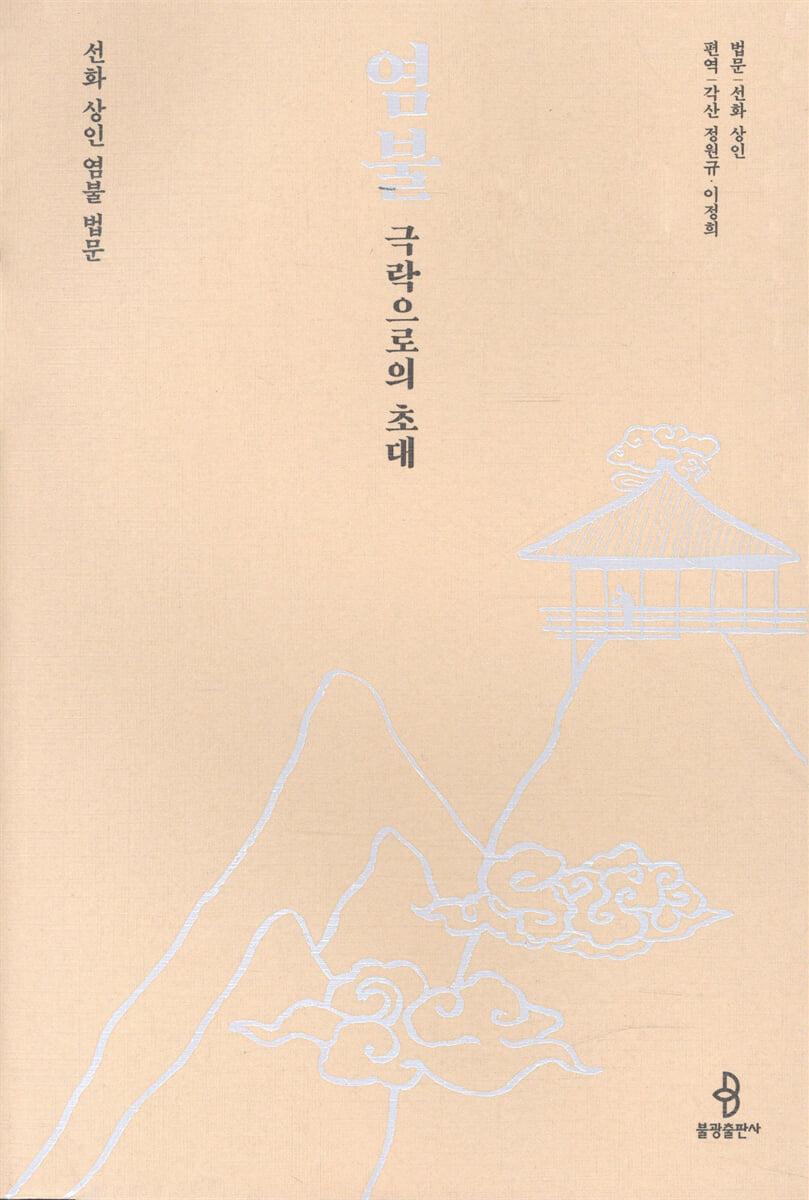
Chanting the Buddha's Name, an Invitation to Paradise
 |
Description
Book Introduction
Say less,
Chant it one more time!
The most sublime path to rebirth in paradise
Turning painful reality into paradise
The mysterious power of chanting!
When I first saw this book, I was overwhelmed with emotion and joy.
The words of truth spoken by the prophets shine brighter than jewels.
I believe this book will be an excellent guide to entering the gates of paradise at the school of enlightenment.
- From the recommendation of Monk Gwangwoo (host of BTN Buddhist TV's "Monk Gwangwoo's Pine Tree")
“In the Dharma-ending Age, hundreds of millions of people will practice, but not a single one will attain the Way. Only by reciting the Buddha’s name can one cross the line between life and death.” This is a quote from the Great Collection of Sutras, in which Shakyamuni Buddha explains the Mahayana Dharma to the Buddhas and Bodhisattvas.
The Dharma-ending Age refers to the period of decline in Buddhism ten thousand years after the Buddha's death.
Even if hundreds of millions of people practice, it is difficult for even one person to attain the Way, and it is a time when arrogance and jealousy abound.
But what power lies in chanting that makes it the only recourse for those living in these difficult times? How would chanting change our lives? Has anyone actually benefited from it?
All the answers are in this book, “Chanting the Buddha’s Name, an Invitation to Paradise.”
This is a collection of the most representative Buddhist chanting sermons of Shanhua, the 9th generation descendant of the Weiyang sect in China and the one who built a Buddhist temple in the United States and spread Buddhism from 1962.
The Buddhist sermons of the Sunhwa merchant are detailed and easy to understand, aimed at American Buddhists who are just beginning to learn Buddhism.
After reading about the purpose and method of chanting, its merits, and even the stories of people who have found blessings through chanting, you will naturally begin chanting with both hands and heart.
Chant it one more time!
The most sublime path to rebirth in paradise
Turning painful reality into paradise
The mysterious power of chanting!
When I first saw this book, I was overwhelmed with emotion and joy.
The words of truth spoken by the prophets shine brighter than jewels.
I believe this book will be an excellent guide to entering the gates of paradise at the school of enlightenment.
- From the recommendation of Monk Gwangwoo (host of BTN Buddhist TV's "Monk Gwangwoo's Pine Tree")
“In the Dharma-ending Age, hundreds of millions of people will practice, but not a single one will attain the Way. Only by reciting the Buddha’s name can one cross the line between life and death.” This is a quote from the Great Collection of Sutras, in which Shakyamuni Buddha explains the Mahayana Dharma to the Buddhas and Bodhisattvas.
The Dharma-ending Age refers to the period of decline in Buddhism ten thousand years after the Buddha's death.
Even if hundreds of millions of people practice, it is difficult for even one person to attain the Way, and it is a time when arrogance and jealousy abound.
But what power lies in chanting that makes it the only recourse for those living in these difficult times? How would chanting change our lives? Has anyone actually benefited from it?
All the answers are in this book, “Chanting the Buddha’s Name, an Invitation to Paradise.”
This is a collection of the most representative Buddhist chanting sermons of Shanhua, the 9th generation descendant of the Weiyang sect in China and the one who built a Buddhist temple in the United States and spread Buddhism from 1962.
The Buddhist sermons of the Sunhwa merchant are detailed and easy to understand, aimed at American Buddhists who are just beginning to learn Buddhism.
After reading about the purpose and method of chanting, its merits, and even the stories of people who have found blessings through chanting, you will naturally begin chanting with both hands and heart.
index
The West Gate, the Western Paradise, is your home
Recommendation
Chapter 1: The Buddhist Dharma Dharma that Can Help Anyone Reach the Pure Land
Why should we chant?
Recite the Buddha's name faithfully
Chanting is like making a phone call
Immigrate to paradise
Amitabha Buddha is the Great Dharma King
Four Ways of Chanting
Faith, aspiration, and practice are the three qualities.
Achieve your own paradise
Chanting Samadhi
The Buddhist chanting sermon praised by many great bodhisattvas
When you reach the Western Pure Land, you will end life and death.
The Great Bodhisattva's Buddhist Prayer Tube
When the lotus blooms, I see the Buddha and realize the law of non-existence.
The one who chants is the Buddha.
You must recite the Buddha's name regularly to achieve a peaceful death.
Chapter 2: The Western Paradise is Your Home
Call it with your mouth and recite it with your heart, and make it come true.
If you let go of a tainted relationship, it will soon be a non-relationship.
A pine-like sunset illuminates California.
Both cold and hunger are tests.
Red lotuses bloom all over the land
How can truth be revealed without lies?
Chant and let go of your body and mind.
Recite well and do not recite in vain.
Reaching Peace through Buddhist Chanting (1)
Reaching Peace through Buddhist Chanting (2)
Knowing the original power, spread the righteous law
To seek rebirth in the Pure Land, recite the Buddha's name diligently.
The light of one thought is Buddha.
Questions and Answers on the Practice of Recitation
Chapter 3: The Land Where Buddha's Roots Are Planted
Let's plant the roots of Buddha
The merits of chanting
Ten Recitation Methods for Morning and Evening
The story of curing a dog's illness through chanting
The response and perception of chanting
All things in the world speak the wonderful law.
Amitabha's original power is a magnet that absorbs iron.
Chapter 4: The True Meaning of Heaven
The agony of death
Three ghosts at the time of death
The way of heaven
The sublime virtues of chanting
The true meaning of heaven
The scriptures of the Heavenly Way
Appendix: The Journey of the Merchant of the Sunflower
The 18 members of the Seonhwa Merchant
Guide to the Buddhist General Assembly of the Dharma Realm
Amitabha Buddha and the Buddhist Chanting Ceremony
Translator's Note: My Buddhist practice and my connection with the Seonhwa merchant Doryang _Lee Jeong-hee
Let's return to our original homeland, the Pure Land of Bliss _Jeong Won-gyu
Recommendation
Chapter 1: The Buddhist Dharma Dharma that Can Help Anyone Reach the Pure Land
Why should we chant?
Recite the Buddha's name faithfully
Chanting is like making a phone call
Immigrate to paradise
Amitabha Buddha is the Great Dharma King
Four Ways of Chanting
Faith, aspiration, and practice are the three qualities.
Achieve your own paradise
Chanting Samadhi
The Buddhist chanting sermon praised by many great bodhisattvas
When you reach the Western Pure Land, you will end life and death.
The Great Bodhisattva's Buddhist Prayer Tube
When the lotus blooms, I see the Buddha and realize the law of non-existence.
The one who chants is the Buddha.
You must recite the Buddha's name regularly to achieve a peaceful death.
Chapter 2: The Western Paradise is Your Home
Call it with your mouth and recite it with your heart, and make it come true.
If you let go of a tainted relationship, it will soon be a non-relationship.
A pine-like sunset illuminates California.
Both cold and hunger are tests.
Red lotuses bloom all over the land
How can truth be revealed without lies?
Chant and let go of your body and mind.
Recite well and do not recite in vain.
Reaching Peace through Buddhist Chanting (1)
Reaching Peace through Buddhist Chanting (2)
Knowing the original power, spread the righteous law
To seek rebirth in the Pure Land, recite the Buddha's name diligently.
The light of one thought is Buddha.
Questions and Answers on the Practice of Recitation
Chapter 3: The Land Where Buddha's Roots Are Planted
Let's plant the roots of Buddha
The merits of chanting
Ten Recitation Methods for Morning and Evening
The story of curing a dog's illness through chanting
The response and perception of chanting
All things in the world speak the wonderful law.
Amitabha's original power is a magnet that absorbs iron.
Chapter 4: The True Meaning of Heaven
The agony of death
Three ghosts at the time of death
The way of heaven
The sublime virtues of chanting
The true meaning of heaven
The scriptures of the Heavenly Way
Appendix: The Journey of the Merchant of the Sunflower
The 18 members of the Seonhwa Merchant
Guide to the Buddhist General Assembly of the Dharma Realm
Amitabha Buddha and the Buddhist Chanting Ceremony
Translator's Note: My Buddhist practice and my connection with the Seonhwa merchant Doryang _Lee Jeong-hee
Let's return to our original homeland, the Pure Land of Bliss _Jeong Won-gyu
Into the book
“Those who practice Zen and the Pure Land will become teachers of people in this life, like a tiger with horns, and in the next life they will become Buddhas and Patriarchs.
“If there is only Zen practice and no Pure Land practice, nine out of ten people will go astray. If there is no Zen practice but Pure Land practice is practiced, ten thousand people will recite the Buddha’s name and all ten thousand will be reborn in the Pure Land.”
--- p.5
The merit of chanting is inconceivable, and every time you chant, your body will radiate light.
Ah! When light shines like this, evil spirits and ghosts run away far away.
Therefore, the merit of chanting is very mysterious.
--- p.6
For that reason, this dharma is difficult for ordinary people to believe, but it is actually the most direct and most appropriate dharma.
(…) That is, regardless of whether you are a smart person or a foolish person, everyone can become a Buddha.
--- p.38~39
Chanting the Buddha's name means putting into practice the three things: faith, aspiration, and practice. This is the true cost of travel and provision for rebirth in the Pure Land.
--- p.50
People's minds are so busy that they don't know how to rest, looking for things to do all day long.
Therefore, if you do not give our mind something to do, it will always be at a loss, so we must seek out 'Namu Amitabha Buddha'.
This one phrase, the Buddha's name, is also Zen meditation.
You should not think that Zen is only about sitting with your eyes closed and pretending to be sitting.
You can meditate with your eyes open.
--- p.61
You chant too, I chant too,
Why do you and I chant?
After completing life and death, I changed my Sabbath.
Amitabha Buddha of the Pure Land is everywhere.
--- p.68
When you recite the Buddha, the Buddha will return to your mind, so there is no need to look outside.
Chanting the Buddha's name means becoming one with the Buddha, and thus you will definitely be reborn in the Western Paradise.
If you remember the Buddha and the Buddha remembers you, you will eventually become a Buddha.
--- p.88
Everything in this world is not constant and can change.
For example, we are not originally qualified to be reborn in the Western Pure Land because of our deep karma, but if we recite the Buddha's name with all our heart, we may be reborn.
On the other hand, if you do not recite the Buddha's name, you will end up not being able to be reborn in the Pure Land, even though you were originally destined to be reborn in the Pure Land.
That is why it is said, “All laws are undefined and are created only by the mind.”
--- p.106
If a person is old and has little time left, it is a good time to recite the Buddha's name.
If a person is young and has a bright future ahead of him/her, it is even better to recite the Buddha's name.
If a person is sick, / the illness is suffering, so he should immediately recite the Buddha's name.
If a person is free from illness / and is at peace and happy, he should recite the Buddha's name even more.
--- p.133
If we chant 'Amitabha Buddha' once, we will hear the sound of the chant once in the place where Amitabha Buddha resides. If we chant 'Namu Amitabha Buddha' ten times, we will hear the sound of the chant ten times in the place where Amitabha Buddha resides.
If you continue to recite the Buddha's name a hundred, a thousand, ten thousand, or a hundred million times, Amitabha Buddha will record it, saying, "I will definitely welcome this person when he or she dies."
That is, remember your work.
--- p.162
Whether we achieve Buddhahood or fall into hell depends entirely on this one thought.
Therefore, we must always manage this mind well at all times to avoid the wild temper of the mind and the delusions of the foolish mind.
--- p.168
The origin is like a light on the road ahead.
It is much easier to follow the path when there is a light to illuminate the way.
“If there is only Zen practice and no Pure Land practice, nine out of ten people will go astray. If there is no Zen practice but Pure Land practice is practiced, ten thousand people will recite the Buddha’s name and all ten thousand will be reborn in the Pure Land.”
--- p.5
The merit of chanting is inconceivable, and every time you chant, your body will radiate light.
Ah! When light shines like this, evil spirits and ghosts run away far away.
Therefore, the merit of chanting is very mysterious.
--- p.6
For that reason, this dharma is difficult for ordinary people to believe, but it is actually the most direct and most appropriate dharma.
(…) That is, regardless of whether you are a smart person or a foolish person, everyone can become a Buddha.
--- p.38~39
Chanting the Buddha's name means putting into practice the three things: faith, aspiration, and practice. This is the true cost of travel and provision for rebirth in the Pure Land.
--- p.50
People's minds are so busy that they don't know how to rest, looking for things to do all day long.
Therefore, if you do not give our mind something to do, it will always be at a loss, so we must seek out 'Namu Amitabha Buddha'.
This one phrase, the Buddha's name, is also Zen meditation.
You should not think that Zen is only about sitting with your eyes closed and pretending to be sitting.
You can meditate with your eyes open.
--- p.61
You chant too, I chant too,
Why do you and I chant?
After completing life and death, I changed my Sabbath.
Amitabha Buddha of the Pure Land is everywhere.
--- p.68
When you recite the Buddha, the Buddha will return to your mind, so there is no need to look outside.
Chanting the Buddha's name means becoming one with the Buddha, and thus you will definitely be reborn in the Western Paradise.
If you remember the Buddha and the Buddha remembers you, you will eventually become a Buddha.
--- p.88
Everything in this world is not constant and can change.
For example, we are not originally qualified to be reborn in the Western Pure Land because of our deep karma, but if we recite the Buddha's name with all our heart, we may be reborn.
On the other hand, if you do not recite the Buddha's name, you will end up not being able to be reborn in the Pure Land, even though you were originally destined to be reborn in the Pure Land.
That is why it is said, “All laws are undefined and are created only by the mind.”
--- p.106
If a person is old and has little time left, it is a good time to recite the Buddha's name.
If a person is young and has a bright future ahead of him/her, it is even better to recite the Buddha's name.
If a person is sick, / the illness is suffering, so he should immediately recite the Buddha's name.
If a person is free from illness / and is at peace and happy, he should recite the Buddha's name even more.
--- p.133
If we chant 'Amitabha Buddha' once, we will hear the sound of the chant once in the place where Amitabha Buddha resides. If we chant 'Namu Amitabha Buddha' ten times, we will hear the sound of the chant ten times in the place where Amitabha Buddha resides.
If you continue to recite the Buddha's name a hundred, a thousand, ten thousand, or a hundred million times, Amitabha Buddha will record it, saying, "I will definitely welcome this person when he or she dies."
That is, remember your work.
--- p.162
Whether we achieve Buddhahood or fall into hell depends entirely on this one thought.
Therefore, we must always manage this mind well at all times to avoid the wild temper of the mind and the delusions of the foolish mind.
--- p.168
The origin is like a light on the road ahead.
It is much easier to follow the path when there is a light to illuminate the way.
--- p.210
Publisher's Review
Teachings from the great masters of our time
Recall Buddha with all your heart!
One of the Buddhist practices, chanting, involves recalling the image of Buddha or chanting his name.
The ultimate goal of chanting is to abandon afflictions and enter nirvana.
It is a practice method that is especially important in the Pure Land faith because the goal is to be reborn in the Pure Land, the world of Buddha, after death.
In the 『Contemplation of Infinite Life Sutra』, one of the three Pure Land Sutras, it is said, “A person who chants Buddha’s name is like a white lotus flower.”
It is said to be the 'white lotus [芬陀利華]', which is considered the most noble of lotus flowers, so it cannot be anything but a compliment.
The sermons of the great Buddhist monk Seonhwa, who encouraged such sublime Buddhist practice, have been compiled into one volume.
The merchant Seonhwa was well-versed in Buddhist scriptures and doctrines and was well-versed in Buddhist practices.
Since 1962, he has established Buddhist schools in various locations in the United States and held numerous Buddhist ceremonies.
This book contains a selection of representative Buddhist scriptures on chanting.
The Buddhist monk Seonhwa's sermons utilize a variety of anecdotes and specific metaphors, making them easy to understand even for Westerners unfamiliar with Buddhism.
Therefore, it will be helpful not only to those who are new to the practice of chanting, but also to all Buddhists who want to strengthen their faith again.
Recommended for sentient beings who wish to be reborn in paradise
The simplest, most direct, and most appropriate practice
The six letters of 'Namu Amitabha Buddha' are a prayer that even those who are not familiar with Buddhism know.
Repeating and memorizing these six letters is a practice method that corresponds to the 'name-based chanting' method in the chanting practice.
This originates from the vow made by Amitabha Buddha in the distant past: “If any living being cannot be reborn in the Pure Land by calling out my name, I will not attain enlightenment.”
The phrase 'to attain enlightenment' means to attain the truth.
The spirit of saving sentient beings is contained in the vow to give up even the truth if one cannot lead sentient beings who call out to one's name in search of salvation to the paradise.
On the one hand, it means that you can be reborn in paradise just by calling the name of Amitabha Buddha. There is no other practice method that is as easy and intuitive as this.
The merchant Seonhwa says.
“That is why this Dharma is difficult for ordinary people to believe, but it is actually the most direct and most appropriate Dharma.
The Buddhist chanting method can be applied to all three faculties: upper, middle, and lower, and it also accepts both the yin and yang faculties.
In other words, regardless of whether you are a smart or a foolish person, everyone can become a Buddha.” Merchant Seonhwa explains the purpose of this Buddha’s practice, the correct method, and the three qualities of faith, aspiration, and practice.
In addition, through various anecdotes of people receiving blessings through chanting, it proves that chanting is helpful not only in the afterlife but also in this life.
If you follow the teachings of the merchant Seonhwa and recite the Buddha's name with all your heart, your worries and karma will disappear, and you will come one step closer to paradise.
Recall Buddha with all your heart!
One of the Buddhist practices, chanting, involves recalling the image of Buddha or chanting his name.
The ultimate goal of chanting is to abandon afflictions and enter nirvana.
It is a practice method that is especially important in the Pure Land faith because the goal is to be reborn in the Pure Land, the world of Buddha, after death.
In the 『Contemplation of Infinite Life Sutra』, one of the three Pure Land Sutras, it is said, “A person who chants Buddha’s name is like a white lotus flower.”
It is said to be the 'white lotus [芬陀利華]', which is considered the most noble of lotus flowers, so it cannot be anything but a compliment.
The sermons of the great Buddhist monk Seonhwa, who encouraged such sublime Buddhist practice, have been compiled into one volume.
The merchant Seonhwa was well-versed in Buddhist scriptures and doctrines and was well-versed in Buddhist practices.
Since 1962, he has established Buddhist schools in various locations in the United States and held numerous Buddhist ceremonies.
This book contains a selection of representative Buddhist scriptures on chanting.
The Buddhist monk Seonhwa's sermons utilize a variety of anecdotes and specific metaphors, making them easy to understand even for Westerners unfamiliar with Buddhism.
Therefore, it will be helpful not only to those who are new to the practice of chanting, but also to all Buddhists who want to strengthen their faith again.
Recommended for sentient beings who wish to be reborn in paradise
The simplest, most direct, and most appropriate practice
The six letters of 'Namu Amitabha Buddha' are a prayer that even those who are not familiar with Buddhism know.
Repeating and memorizing these six letters is a practice method that corresponds to the 'name-based chanting' method in the chanting practice.
This originates from the vow made by Amitabha Buddha in the distant past: “If any living being cannot be reborn in the Pure Land by calling out my name, I will not attain enlightenment.”
The phrase 'to attain enlightenment' means to attain the truth.
The spirit of saving sentient beings is contained in the vow to give up even the truth if one cannot lead sentient beings who call out to one's name in search of salvation to the paradise.
On the one hand, it means that you can be reborn in paradise just by calling the name of Amitabha Buddha. There is no other practice method that is as easy and intuitive as this.
The merchant Seonhwa says.
“That is why this Dharma is difficult for ordinary people to believe, but it is actually the most direct and most appropriate Dharma.
The Buddhist chanting method can be applied to all three faculties: upper, middle, and lower, and it also accepts both the yin and yang faculties.
In other words, regardless of whether you are a smart or a foolish person, everyone can become a Buddha.” Merchant Seonhwa explains the purpose of this Buddha’s practice, the correct method, and the three qualities of faith, aspiration, and practice.
In addition, through various anecdotes of people receiving blessings through chanting, it proves that chanting is helpful not only in the afterlife but also in this life.
If you follow the teachings of the merchant Seonhwa and recite the Buddha's name with all your heart, your worries and karma will disappear, and you will come one step closer to paradise.
GOODS SPECIFICS
- Date of issue: February 6, 2024
- Page count, weight, size: 288 pages | 438g | 152*225*20mm
- ISBN13: 9791193454473
- ISBN10: 1193454476
You may also like
카테고리
korean


korean

![GQ KOREA Mark (Monthly): December [2025]](http://librairie.coreenne.fr/cdn/shop/files/8ef265dbbfbf186523ed75ba7319009d.jpg?v=1765340328&width=3840)


