

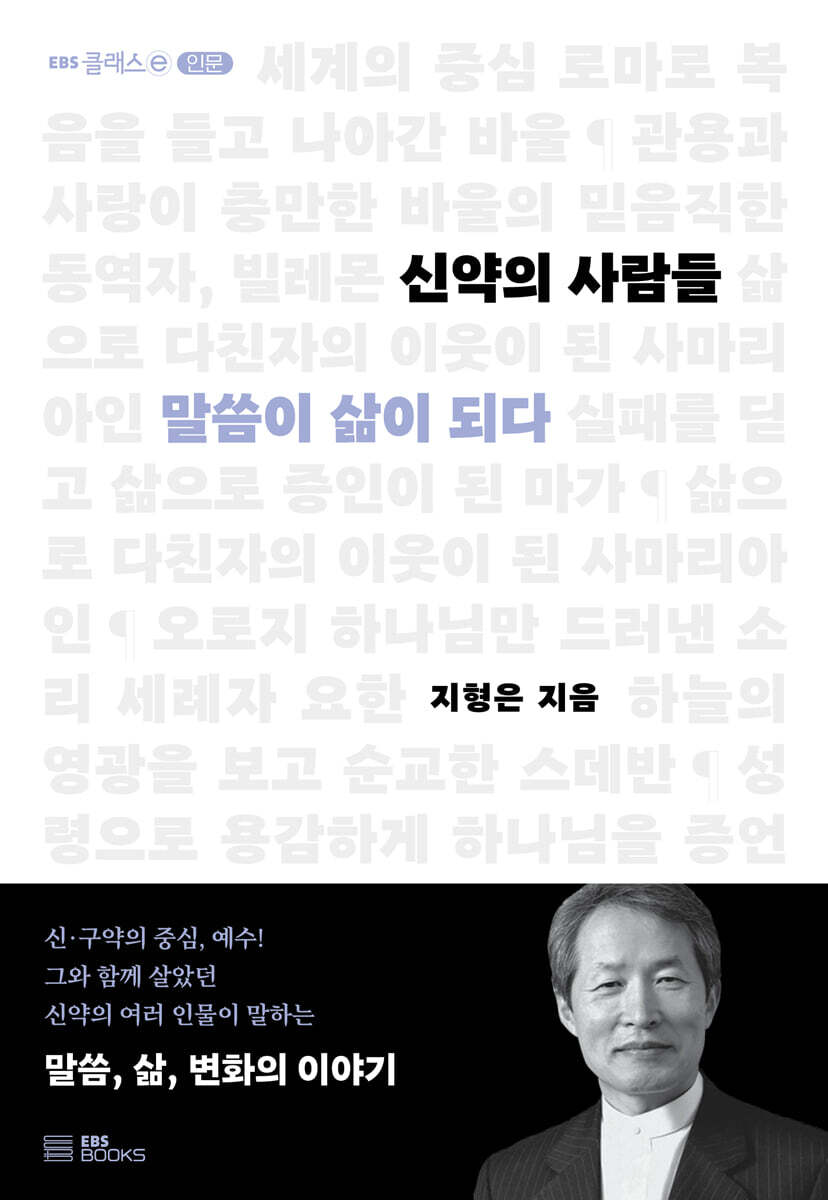
People of the New Testament
 |
Description
Book Introduction
The best knowledge lecture EBS Classⓔ famous lecture!
Why did those who met Jesus become witnesses?
Stories of Words, Life, and Transformation from the People of the New Testament
The Bible, the world's greatest bestseller.
The Bible has been adapted into many works of classical art, literature, and music.
Why do the Bible, and especially the lives of its characters, continue to inspire countless works of art? It's because it contains a powerful message that addresses fundamental questions shared by humanity, and because it portrays Jesus and his people.
The two books that make up the Bible, the Old Testament and the New Testament.
Among them, the New Testament does not portray 'God' as a great conqueror and shining saints.
Rather, it depicts the story of Jesus, the God who lowered himself to human form, and the ordinary people who met him, full of mistakes.
Jesus, the son of a carpenter, born in a horse trough, as a citizen of a Roman colony.
He was condemned as a traitor and crucified for preaching a message so different from the religious leaders of his time.
However, those who met him confess that he is the 'Christ, the fulfillment of prophecy' that has been passed down for thousands of years, and the 'Word' that will provide the answer to the fundamental problems of humanity.
They became 'witnesses' of Jesus and the message he delivered in that era.
He brought the church into the world by preaching the life, death, resurrection, and ascension of Jesus.
And they, who became the church, overcame all the hardships and conflicts among people that occurred under Roman rule.
They were nothing special.
He was a 'witness' rather than a 'saint'.
They could not help but speak of what they had seen and heard, and they tried to live out the words of Jesus that they had seen, heard, and encountered, because they demanded a 'fundamental change in life.'
Pastor Ji-Hyeong, who studied church history and doctrine at the University of Bochum in Germany and has been a pastor for the past 40 years, has delved deeper into the Bible than anyone else. In this book, he unravels the stories of various witnesses in the New Testament with his extensive knowledge and holy imagination.
"People of the New Testament" strongly conveys to the Korean church, which has become distant from the essence of Christianity despite the crosses hanging in every church building, that "the Word becoming life is the essence of Christian faith."
If you want to join the lives of the 'People of Jesus' witnesses, open this book now.
Why did those who met Jesus become witnesses?
Stories of Words, Life, and Transformation from the People of the New Testament
The Bible, the world's greatest bestseller.
The Bible has been adapted into many works of classical art, literature, and music.
Why do the Bible, and especially the lives of its characters, continue to inspire countless works of art? It's because it contains a powerful message that addresses fundamental questions shared by humanity, and because it portrays Jesus and his people.
The two books that make up the Bible, the Old Testament and the New Testament.
Among them, the New Testament does not portray 'God' as a great conqueror and shining saints.
Rather, it depicts the story of Jesus, the God who lowered himself to human form, and the ordinary people who met him, full of mistakes.
Jesus, the son of a carpenter, born in a horse trough, as a citizen of a Roman colony.
He was condemned as a traitor and crucified for preaching a message so different from the religious leaders of his time.
However, those who met him confess that he is the 'Christ, the fulfillment of prophecy' that has been passed down for thousands of years, and the 'Word' that will provide the answer to the fundamental problems of humanity.
They became 'witnesses' of Jesus and the message he delivered in that era.
He brought the church into the world by preaching the life, death, resurrection, and ascension of Jesus.
And they, who became the church, overcame all the hardships and conflicts among people that occurred under Roman rule.
They were nothing special.
He was a 'witness' rather than a 'saint'.
They could not help but speak of what they had seen and heard, and they tried to live out the words of Jesus that they had seen, heard, and encountered, because they demanded a 'fundamental change in life.'
Pastor Ji-Hyeong, who studied church history and doctrine at the University of Bochum in Germany and has been a pastor for the past 40 years, has delved deeper into the Bible than anyone else. In this book, he unravels the stories of various witnesses in the New Testament with his extensive knowledge and holy imagination.
"People of the New Testament" strongly conveys to the Korean church, which has become distant from the essence of Christianity despite the crosses hanging in every church building, that "the Word becoming life is the essence of Christian faith."
If you want to join the lives of the 'People of Jesus' witnesses, open this book now.
- You can preview some of the book's contents.
Preview
index
Recommendation
Prologue | Memory and Testimony
Where the testimony points
He ran away naked.
John returned to Jerusalem
The beginning of the gospel is like this.
I am not the Christ
May it be done to me according to your word.
God becomes human
The Word lived among us.
He will send you another Comforter,
Baptize them and teach them to obey.
To weave together a story about what happened
Satan, get behind me.
Jesus' teachings
I have never given you even a single kid.
A Samaritan was walking along the road,
What is written and how do you read it?
He who has ears, let him hear.
You are the salt and light of the world.
Now I give you a new commandment.
Witnesses begin to testify
Covered in the first book
When the Holy Spirit comes down, you will be my witnesses.
Why do you look at us?
We can't help but say
During this period, the number of disciples increased.
The word of God grew stronger and stronger
Jesus' people
Early in the morning the women went to the tomb.
I see the Son of Man standing there
He went to Tarsus to look for Saul.
I am who I am today by grace.
This man came to Jesus at night
Let's go across the sea
The Life of Jesus
I am among you as one who serves.
Eloi Eloi Lema Sabachthani
Yes, I will go soon.
He rather empties himself
We set out as the Lord had told us.
Epilogue | 'Word of Life Movement'
I express my gratitude
Prologue | Memory and Testimony
Where the testimony points
He ran away naked.
John returned to Jerusalem
The beginning of the gospel is like this.
I am not the Christ
May it be done to me according to your word.
God becomes human
The Word lived among us.
He will send you another Comforter,
Baptize them and teach them to obey.
To weave together a story about what happened
Satan, get behind me.
Jesus' teachings
I have never given you even a single kid.
A Samaritan was walking along the road,
What is written and how do you read it?
He who has ears, let him hear.
You are the salt and light of the world.
Now I give you a new commandment.
Witnesses begin to testify
Covered in the first book
When the Holy Spirit comes down, you will be my witnesses.
Why do you look at us?
We can't help but say
During this period, the number of disciples increased.
The word of God grew stronger and stronger
Jesus' people
Early in the morning the women went to the tomb.
I see the Son of Man standing there
He went to Tarsus to look for Saul.
I am who I am today by grace.
This man came to Jesus at night
Let's go across the sea
The Life of Jesus
I am among you as one who serves.
Eloi Eloi Lema Sabachthani
Yes, I will go soon.
He rather empties himself
We set out as the Lord had told us.
Epilogue | 'Word of Life Movement'
I express my gratitude
Into the book
This New Testament document, written in the first century AD, is essentially a confession of faith and its testimony.
But at the same time, it is also historical material.
It is a record of life that contains the history and culture of that time.
Many people have meticulously and terribly trusted the New Testament.
The castle has been criticized and attacked.
Rigorous and objective criticism continued without end.
The Old and New Testaments of the Bible, as they exist today, are the texts that have withstood the most rigorous criticism among the historical documents of humankind.
The story of this book is developed around the records of the New Testament.
Because of the two thousand years of time and cultural differences, it was necessary to read between explicit records to find parts that were difficult to understand.
Reading between the lines.
In a religious interpretation, it can be expressed as holy imagination.
However, I was extremely careful not to let this work become a creative work like writing a novel.
I read the written text carefully and used my holy imagination reasonably enough within its scope.
Often, it is impossible to draw a clear line between sacred imagination and creation.
It did not go beyond the boundaries of the explicit text.
The work of interpreting the written text, including the use of holy imagination, is called 'meditation on the Word.'
--- From "Prologue / Memory and Testimony"
The era of the triumvirate began the following year after Caesar's assassination in 44 BC, when Caesar's adopted son Octavian formed a sort of political and military pact with Mark Antony and Lepidus.
Of these, Octavianus overpowers the other two and becomes the de facto sole ruler.
In 27 BC, when Octavianus received the title Augustus, meaning "the most honorable one," Rome entered an era ruled by de facto emperors.
From this time until 180 AD, for about 200 years, the Roman Empire enjoyed a peaceful era in terms of structural systems and external social order.
This period is called 'Pax Romana' (Roman Peace).
The emperor who guaranteed the peace of Rome was revered as a representative of God, and even went a step further and was the son of God or a god.
At that time, the Roman Empire was the civilized world, and the land outside it was the land of barbarians.
The land of the empire was the world itself.
The emperor was the 'savior of the world' and the subject of the gospel, who maintained peace in this realm and ensured order and safety.
However, the peace of Rome was enjoyed by those in power in the Roman Empire, or at least by those who held Roman citizenship.
Harsh ruling methods were often employed against slaves and subjugated peoples.
Political and military rebellions or those that shook the basic structure of the economy were brutally suppressed.
A famous method of killing rebels to make an example of them was crucifixion.
The peace of Rome was a peace of blood for the oppressed.
Mark's application of the word euangelion to Jesus Christ
It can be interpreted as overturning the fundamental framework of the Roman Empire.
The Roman emperor is not the son of God, but Jesus of Nazareth is the true God and the son of the one and only God.
The emperor is not the savior of the world.
Jesus is the Christ (Savior) of the world.
--- From "PART 1 Where the Testimony Points"
“Bring your Majesty here!”
By shouting this sound, you do not reveal yourself to those who hear you.
You shouldn't worry about how cool and beautiful your voice is or how clear and good your pronunciation is.
If people pay attention to the eunuch's voice or pay attention to the eunuch's excellence, it is considered disrespectful to the king.
It doesn't matter whether it comes out of the eunuch's neck or someone else's neck.
The 'sound' that comes out of the throat is important.
There is no eunuch or eunuch's voice.
There is only the transmitted sound.
The meaning is fulfilled by that sound.
John the Baptist called himself 'the voice'.
Jesus said that others should rise and he should decline, and he lived that way.
John lived out the words of God prophesied about him with his whole body.
How beautiful would it be if there were people like John who lived with this kind of self-awareness?
How much more mature would society become if more people like John were to appear in all areas of society, especially in the religious sphere?
How beautiful would the church be if Christian leaders, who should follow in John's footsteps, lived like this?
I miss the Johns of today, people who transcend the desire for fame and power and find deep happiness by contemplating the meaning of their existence.
--- From "PART 1 Where the Testimony Points"
In “The Root of Jesse,” Jesse is the father of King David.
Christ comes into the world in that spiritual stream, as God promised to David.
All people of the world, including Jews, find hope in him.
Paul is quoting Isaiah from the Old Testament.
The quoted passage is one of the two or three most famous passages about Christ (Messiah) in the Old Testament.
This is a prophecy that the captivity of the Israelites would end during the Babylonian captivity.
It is said that furthermore, the peace of salvation will come to all of humanity.
This passage has evoked images of peace and hope in people living in times of tragedy and despair in human history.
--- From "PART 2 God Becomes Man"
The Kingdom of God is at the heart of Jesus' message.
The time and space where God's will is accomplished is the Kingdom of God.
God's will is to save humanity and the world from the power of sin and from the path to eternal destruction.
To this end, God reveals His will through three different words.
The written word, the incarnate word, the proclaimed word.
The written word refers to the Old Testament and the New Testament.
The incarnate Word refers to Jesus Christ who became human and lived in the world.
The word that is proclaimed is a sermon that interprets the word based on the two types of words mentioned above.
If the two preceding words have already happened, then the words being proclaimed are in the present progressive tense.
In the content of the word that comes to people in three ways, the heart is the event of the cross.
In the life and ministry of Jesus, the kingdom of God is revealed and moved.
Jesus himself is the reality of the kingdom of God.
--- From "PART 2 God Becomes Man"
Jesus invites those who have failed, are discouraged, and are in despair, those who are branded sinners and have no hope of recovery, back to a meaningful life.
Whether it was due to one's own laziness, mistakes, or faults, or due to the social structure, the cause and the past process are irrelevant.
Anyone who is currently marginalized is invited
all.
The younger son in the story of the prodigal son is one such person.
The story of the prodigal son is a parable about the transformation of existence.
The fundamental condition of man is separation from God, the Father of mankind.
There is a way to resolve this fundamental alienation and restore humanity to its original state as created by God.
It's about going back to your father.
Father is always waiting.
The Father's embrace is boundless and vast beyond human imagination.
--- From "PART 3 The Teachings of Jesus"
A church in a certain region that continues to grow in numbers is not the kind of church that the Book of Acts describes.
There is no such church in the Acts of the Apostles.
Increasing the number of registered members and increasing available finances in a single church should not be the primary goal.
Jesus never taught or commanded anything like that.
Our goal and mission is to increase the number of people in the world God created who hear the gospel of Jesus Christ and become children of God.
The scope of 'Land's End' must not be lost sight of.
The ultimate goal is to go to the ends of the earth and spread the gospel of God to people in all cultures and societies, enabling them to live in love, peace, and justice, thus establishing the Kingdom of God.
If we forget this and focus on increasing our number of followers, we are not a biblical church.
What does the life of a true witness look like? They radiate the fragrance of Christ in their daily lives and personalities.
Of course.
Since Jesus told us to be “my witnesses,” we should be like Jesus to the bone.
It is natural that the personality of Jesus is revealed in the most ordinary aspects of life.
Almost all of the negative problems in the church are due to Christians not maturing as Christians.
So, the reason is that daily life and personality have not changed.
--- From "PART 4 Witnesses Begin to Testify"
Saul had a proactive personality.
This is clearly shown in the way Christians are persecuted.
Saul was well versed in the traditions of the Old Testament and the faith of Israel in God.
Barnabas and Saul, both Hellenistic Jews.
With this in mind, Barnabas must have thought that there was no one more suitable than Saul for the church community made up of Gentiles.
Barnabas was like a guardian to Saul.
He confirmed Saul's authenticity and status and appointed him to work in important ministries.
Barnabas' judgment and expectations were correct.
In Antioch, Saul worked diligently with Barnabas, and after about a year, the lives of the believers in the Antioch church were beautifully transformed.
Barnabas puts Paul in front and takes on a serving role.
Unlike the pastoral field of a local church, he judged that Paul was much more suitable than himself in the mission field where any situation could arise.
Everyone dreams of being number one, but Barnabas volunteered to be number two.
Yet Barnabas is a hidden leader.
Isn't this what it means to be like Jesus Christ?
--- From "PART 5 Jesus' People"
But overall, humanity has always lived with a constant desire to engage in economic activities for self-interest.
The expansion of economic scale that accelerated after the Industrial Revolution and the commercial activities of the colonial era became the foundation for this.
Since the last decade of the 20th century, neoliberalism, which had united the world as a single market, has been the stage for justifying limitless competition and the accumulation of astronomical amounts of wealth.
However, in the 21st century, the situation and perception have changed due to the climate and environmental crisis that humanity is currently facing.
In a reality where the world is returning to a single structure, the resources of this small planet Earth are being consumed to the point where they cannot withstand human desires and are being destroyed.
It has become widely recognized that unless humanity changes its attitude and way of living, it will face a dire crisis for its survival.
In this context, the concept of ‘emptiness’ resonates deeply in many ways.
The fundamental attitude and method of Jesus' life was emptiness.
The process of ascension to the highest level is led by the Heavenly Father.
God highly exalts Jesus Christ, who voluntarily emptied himself.
The consistent message of the Bible is that if we humble ourselves and live humbly, God will exalt us.
This clearly shows how Christians live differently from the world.
This core content in Christian faith ethics is based on kenotic Christology.
Humility is the bond that binds the church community together.
As beings living before God, Christians and the church follow God's will and standards, that is, God's Word, in all things.
That attitude and way of living is to humble and empty oneself like Jesus Christ.
This kind of life is not only essential in a religious community, but it is also a force that heals social conflicts and beautifies any society in which Christians and the church exist.
But at the same time, it is also historical material.
It is a record of life that contains the history and culture of that time.
Many people have meticulously and terribly trusted the New Testament.
The castle has been criticized and attacked.
Rigorous and objective criticism continued without end.
The Old and New Testaments of the Bible, as they exist today, are the texts that have withstood the most rigorous criticism among the historical documents of humankind.
The story of this book is developed around the records of the New Testament.
Because of the two thousand years of time and cultural differences, it was necessary to read between explicit records to find parts that were difficult to understand.
Reading between the lines.
In a religious interpretation, it can be expressed as holy imagination.
However, I was extremely careful not to let this work become a creative work like writing a novel.
I read the written text carefully and used my holy imagination reasonably enough within its scope.
Often, it is impossible to draw a clear line between sacred imagination and creation.
It did not go beyond the boundaries of the explicit text.
The work of interpreting the written text, including the use of holy imagination, is called 'meditation on the Word.'
--- From "Prologue / Memory and Testimony"
The era of the triumvirate began the following year after Caesar's assassination in 44 BC, when Caesar's adopted son Octavian formed a sort of political and military pact with Mark Antony and Lepidus.
Of these, Octavianus overpowers the other two and becomes the de facto sole ruler.
In 27 BC, when Octavianus received the title Augustus, meaning "the most honorable one," Rome entered an era ruled by de facto emperors.
From this time until 180 AD, for about 200 years, the Roman Empire enjoyed a peaceful era in terms of structural systems and external social order.
This period is called 'Pax Romana' (Roman Peace).
The emperor who guaranteed the peace of Rome was revered as a representative of God, and even went a step further and was the son of God or a god.
At that time, the Roman Empire was the civilized world, and the land outside it was the land of barbarians.
The land of the empire was the world itself.
The emperor was the 'savior of the world' and the subject of the gospel, who maintained peace in this realm and ensured order and safety.
However, the peace of Rome was enjoyed by those in power in the Roman Empire, or at least by those who held Roman citizenship.
Harsh ruling methods were often employed against slaves and subjugated peoples.
Political and military rebellions or those that shook the basic structure of the economy were brutally suppressed.
A famous method of killing rebels to make an example of them was crucifixion.
The peace of Rome was a peace of blood for the oppressed.
Mark's application of the word euangelion to Jesus Christ
It can be interpreted as overturning the fundamental framework of the Roman Empire.
The Roman emperor is not the son of God, but Jesus of Nazareth is the true God and the son of the one and only God.
The emperor is not the savior of the world.
Jesus is the Christ (Savior) of the world.
--- From "PART 1 Where the Testimony Points"
“Bring your Majesty here!”
By shouting this sound, you do not reveal yourself to those who hear you.
You shouldn't worry about how cool and beautiful your voice is or how clear and good your pronunciation is.
If people pay attention to the eunuch's voice or pay attention to the eunuch's excellence, it is considered disrespectful to the king.
It doesn't matter whether it comes out of the eunuch's neck or someone else's neck.
The 'sound' that comes out of the throat is important.
There is no eunuch or eunuch's voice.
There is only the transmitted sound.
The meaning is fulfilled by that sound.
John the Baptist called himself 'the voice'.
Jesus said that others should rise and he should decline, and he lived that way.
John lived out the words of God prophesied about him with his whole body.
How beautiful would it be if there were people like John who lived with this kind of self-awareness?
How much more mature would society become if more people like John were to appear in all areas of society, especially in the religious sphere?
How beautiful would the church be if Christian leaders, who should follow in John's footsteps, lived like this?
I miss the Johns of today, people who transcend the desire for fame and power and find deep happiness by contemplating the meaning of their existence.
--- From "PART 1 Where the Testimony Points"
In “The Root of Jesse,” Jesse is the father of King David.
Christ comes into the world in that spiritual stream, as God promised to David.
All people of the world, including Jews, find hope in him.
Paul is quoting Isaiah from the Old Testament.
The quoted passage is one of the two or three most famous passages about Christ (Messiah) in the Old Testament.
This is a prophecy that the captivity of the Israelites would end during the Babylonian captivity.
It is said that furthermore, the peace of salvation will come to all of humanity.
This passage has evoked images of peace and hope in people living in times of tragedy and despair in human history.
--- From "PART 2 God Becomes Man"
The Kingdom of God is at the heart of Jesus' message.
The time and space where God's will is accomplished is the Kingdom of God.
God's will is to save humanity and the world from the power of sin and from the path to eternal destruction.
To this end, God reveals His will through three different words.
The written word, the incarnate word, the proclaimed word.
The written word refers to the Old Testament and the New Testament.
The incarnate Word refers to Jesus Christ who became human and lived in the world.
The word that is proclaimed is a sermon that interprets the word based on the two types of words mentioned above.
If the two preceding words have already happened, then the words being proclaimed are in the present progressive tense.
In the content of the word that comes to people in three ways, the heart is the event of the cross.
In the life and ministry of Jesus, the kingdom of God is revealed and moved.
Jesus himself is the reality of the kingdom of God.
--- From "PART 2 God Becomes Man"
Jesus invites those who have failed, are discouraged, and are in despair, those who are branded sinners and have no hope of recovery, back to a meaningful life.
Whether it was due to one's own laziness, mistakes, or faults, or due to the social structure, the cause and the past process are irrelevant.
Anyone who is currently marginalized is invited
all.
The younger son in the story of the prodigal son is one such person.
The story of the prodigal son is a parable about the transformation of existence.
The fundamental condition of man is separation from God, the Father of mankind.
There is a way to resolve this fundamental alienation and restore humanity to its original state as created by God.
It's about going back to your father.
Father is always waiting.
The Father's embrace is boundless and vast beyond human imagination.
--- From "PART 3 The Teachings of Jesus"
A church in a certain region that continues to grow in numbers is not the kind of church that the Book of Acts describes.
There is no such church in the Acts of the Apostles.
Increasing the number of registered members and increasing available finances in a single church should not be the primary goal.
Jesus never taught or commanded anything like that.
Our goal and mission is to increase the number of people in the world God created who hear the gospel of Jesus Christ and become children of God.
The scope of 'Land's End' must not be lost sight of.
The ultimate goal is to go to the ends of the earth and spread the gospel of God to people in all cultures and societies, enabling them to live in love, peace, and justice, thus establishing the Kingdom of God.
If we forget this and focus on increasing our number of followers, we are not a biblical church.
What does the life of a true witness look like? They radiate the fragrance of Christ in their daily lives and personalities.
Of course.
Since Jesus told us to be “my witnesses,” we should be like Jesus to the bone.
It is natural that the personality of Jesus is revealed in the most ordinary aspects of life.
Almost all of the negative problems in the church are due to Christians not maturing as Christians.
So, the reason is that daily life and personality have not changed.
--- From "PART 4 Witnesses Begin to Testify"
Saul had a proactive personality.
This is clearly shown in the way Christians are persecuted.
Saul was well versed in the traditions of the Old Testament and the faith of Israel in God.
Barnabas and Saul, both Hellenistic Jews.
With this in mind, Barnabas must have thought that there was no one more suitable than Saul for the church community made up of Gentiles.
Barnabas was like a guardian to Saul.
He confirmed Saul's authenticity and status and appointed him to work in important ministries.
Barnabas' judgment and expectations were correct.
In Antioch, Saul worked diligently with Barnabas, and after about a year, the lives of the believers in the Antioch church were beautifully transformed.
Barnabas puts Paul in front and takes on a serving role.
Unlike the pastoral field of a local church, he judged that Paul was much more suitable than himself in the mission field where any situation could arise.
Everyone dreams of being number one, but Barnabas volunteered to be number two.
Yet Barnabas is a hidden leader.
Isn't this what it means to be like Jesus Christ?
--- From "PART 5 Jesus' People"
But overall, humanity has always lived with a constant desire to engage in economic activities for self-interest.
The expansion of economic scale that accelerated after the Industrial Revolution and the commercial activities of the colonial era became the foundation for this.
Since the last decade of the 20th century, neoliberalism, which had united the world as a single market, has been the stage for justifying limitless competition and the accumulation of astronomical amounts of wealth.
However, in the 21st century, the situation and perception have changed due to the climate and environmental crisis that humanity is currently facing.
In a reality where the world is returning to a single structure, the resources of this small planet Earth are being consumed to the point where they cannot withstand human desires and are being destroyed.
It has become widely recognized that unless humanity changes its attitude and way of living, it will face a dire crisis for its survival.
In this context, the concept of ‘emptiness’ resonates deeply in many ways.
The fundamental attitude and method of Jesus' life was emptiness.
The process of ascension to the highest level is led by the Heavenly Father.
God highly exalts Jesus Christ, who voluntarily emptied himself.
The consistent message of the Bible is that if we humble ourselves and live humbly, God will exalt us.
This clearly shows how Christians live differently from the world.
This core content in Christian faith ethics is based on kenotic Christology.
Humility is the bond that binds the church community together.
As beings living before God, Christians and the church follow God's will and standards, that is, God's Word, in all things.
That attitude and way of living is to humble and empty oneself like Jesus Christ.
This kind of life is not only essential in a religious community, but it is also a force that heals social conflicts and beautifies any society in which Christians and the church exist.
--- From "PART 6 The Life of Jesus"
Publisher's Review
You too will be my witnesses, because you have been with me from the beginning.
John 15:27
Jesus, who was prophesied through many people in the Old Testament, appears in the world in earnest through the New Testament.
The New Testament was not written during a time of peace and prosperity.
The people who wrote the New Testament were people living in colonies under Roman rule.
Above all, Jesus was a colony and a man who walked the way of the cross with his whole body.
So what was the teaching he imparted? What was it that transformed the countless people who encountered him? The story of Jesus transcends time, space, and culture, and still speaks to us today.
People of the New Testament is a story about Jesus, his teachings, and the people of Jesus who lived like him.
A 'peaceful Roman era' built on the blood of the oppressed
With the title of Augustus, Rome entered an era ruled by de facto emperors.
From this time until 180 AD, for about 200 years, the Roman Empire enjoyed a peaceful era in terms of structural systems and external social order.
The emperor who guaranteed the peace of Rome was revered as a representative of God, and even went a step further and was the son of God or a god.
At that time, the Roman Empire was the civilized world, and the land outside it was the land of barbarians.
The land of the empire was the world itself.
The emperor was the 'savior of the world' and the subject of the gospel, who maintained peace in this realm and ensured order and safety.
However, the peace of Rome was enjoyed by those in power in the Roman Empire, or at least by those who held Roman citizenship.
Harsh ruling methods were often employed against slaves and subjugated peoples.
Political and military rebellions or those that shook the basic structure of the economy were brutally suppressed.
A famous method of killing rebels to make an example of them was crucifixion.
The peace of Rome was a peace of blood for the oppressed.
The people who wrote the New Testament through their lives, and the stories of Jesus they testify to.
But in those days, there were people who stood on the opposite side.
The Jews, a people under Roman rule, and the people around them believed that the rebel who was 'crucified' was the master of their own lives and the 'savior of the world.'
Jesus was the son of a carpenter and was sometimes criticized as an illegitimate child.
These people met Jesus, talked with him, followed him, and became witnesses of his unjust death and resurrection.
They wrote the New Testament.
It didn't stop at just a record.
Live the life that Jesus showed and spoke about through his own life.
Even though they were oppressed and killed by the Romans and the established Jewish religious establishment, they did not bend their will.
When a plague broke out in Rome, he was the first to go and save people without discrimination, and he lived by sharing what he had with others and voluntarily giving up vested interests.
It had to be that way.
Because I experienced and came to know ‘true peace’, not ‘peace of blood.’
Witnesses of the gospel had to prove it with their lives so that their testimony would not remain mere hearsay.
The Bible, humanity's eternal bestseller, and the New Testament, which vividly tells the story of 'Jesus Christ' at its center.
This book, which delves into that time, deeply meditates on the Bible, and unfolds it with holy imagination, tells us the stories of people who lived in a way different from the world's during the most difficult times.
To our children and the next generation of witnesses
The church, once the hope of the world, has become a source of worry for the world.
The church that preached salvation to the world fell into a place in need of salvation because it strayed from its ‘essence.’
If the church is to become the hope of the sick and marginalized as it once was, it is not enough to simply engage in volunteer work or fulfill religious duties.
We need to properly understand what 'words' Jesus Christ spoke to his disciples and those who were with him, and what he expected of them. We need to have a strong conviction that he will protect us and be with us until the end of the world, just as he said, at this very moment.
Only by having that conviction can the essence change.
The next generation of witnesses will make the new era church a "light of hope" only by reexamining the "Word" conveyed through the countless witnesses of Jesus, and the lives of the witnesses who lived out that "Word" and then conveying it through their lives.
It is the only way to give them true hope and establish them as new witnesses.
John 15:27
Jesus, who was prophesied through many people in the Old Testament, appears in the world in earnest through the New Testament.
The New Testament was not written during a time of peace and prosperity.
The people who wrote the New Testament were people living in colonies under Roman rule.
Above all, Jesus was a colony and a man who walked the way of the cross with his whole body.
So what was the teaching he imparted? What was it that transformed the countless people who encountered him? The story of Jesus transcends time, space, and culture, and still speaks to us today.
People of the New Testament is a story about Jesus, his teachings, and the people of Jesus who lived like him.
A 'peaceful Roman era' built on the blood of the oppressed
With the title of Augustus, Rome entered an era ruled by de facto emperors.
From this time until 180 AD, for about 200 years, the Roman Empire enjoyed a peaceful era in terms of structural systems and external social order.
The emperor who guaranteed the peace of Rome was revered as a representative of God, and even went a step further and was the son of God or a god.
At that time, the Roman Empire was the civilized world, and the land outside it was the land of barbarians.
The land of the empire was the world itself.
The emperor was the 'savior of the world' and the subject of the gospel, who maintained peace in this realm and ensured order and safety.
However, the peace of Rome was enjoyed by those in power in the Roman Empire, or at least by those who held Roman citizenship.
Harsh ruling methods were often employed against slaves and subjugated peoples.
Political and military rebellions or those that shook the basic structure of the economy were brutally suppressed.
A famous method of killing rebels to make an example of them was crucifixion.
The peace of Rome was a peace of blood for the oppressed.
The people who wrote the New Testament through their lives, and the stories of Jesus they testify to.
But in those days, there were people who stood on the opposite side.
The Jews, a people under Roman rule, and the people around them believed that the rebel who was 'crucified' was the master of their own lives and the 'savior of the world.'
Jesus was the son of a carpenter and was sometimes criticized as an illegitimate child.
These people met Jesus, talked with him, followed him, and became witnesses of his unjust death and resurrection.
They wrote the New Testament.
It didn't stop at just a record.
Live the life that Jesus showed and spoke about through his own life.
Even though they were oppressed and killed by the Romans and the established Jewish religious establishment, they did not bend their will.
When a plague broke out in Rome, he was the first to go and save people without discrimination, and he lived by sharing what he had with others and voluntarily giving up vested interests.
It had to be that way.
Because I experienced and came to know ‘true peace’, not ‘peace of blood.’
Witnesses of the gospel had to prove it with their lives so that their testimony would not remain mere hearsay.
The Bible, humanity's eternal bestseller, and the New Testament, which vividly tells the story of 'Jesus Christ' at its center.
This book, which delves into that time, deeply meditates on the Bible, and unfolds it with holy imagination, tells us the stories of people who lived in a way different from the world's during the most difficult times.
To our children and the next generation of witnesses
The church, once the hope of the world, has become a source of worry for the world.
The church that preached salvation to the world fell into a place in need of salvation because it strayed from its ‘essence.’
If the church is to become the hope of the sick and marginalized as it once was, it is not enough to simply engage in volunteer work or fulfill religious duties.
We need to properly understand what 'words' Jesus Christ spoke to his disciples and those who were with him, and what he expected of them. We need to have a strong conviction that he will protect us and be with us until the end of the world, just as he said, at this very moment.
Only by having that conviction can the essence change.
The next generation of witnesses will make the new era church a "light of hope" only by reexamining the "Word" conveyed through the countless witnesses of Jesus, and the lives of the witnesses who lived out that "Word" and then conveying it through their lives.
It is the only way to give them true hope and establish them as new witnesses.
GOODS SPECIFICS
- Date of issue: October 31, 2023
- Page count, weight, size: 428 pages | 562g | 145*210*20mm
- ISBN13: 9788954779104
- ISBN10: 8954779107
You may also like
카테고리
korean


korean

![GQ KOREA Mark (Monthly): December [2025]](http://librairie.coreenne.fr/cdn/shop/files/8ef265dbbfbf186523ed75ba7319009d.jpg?v=1765340328&width=3840)


