

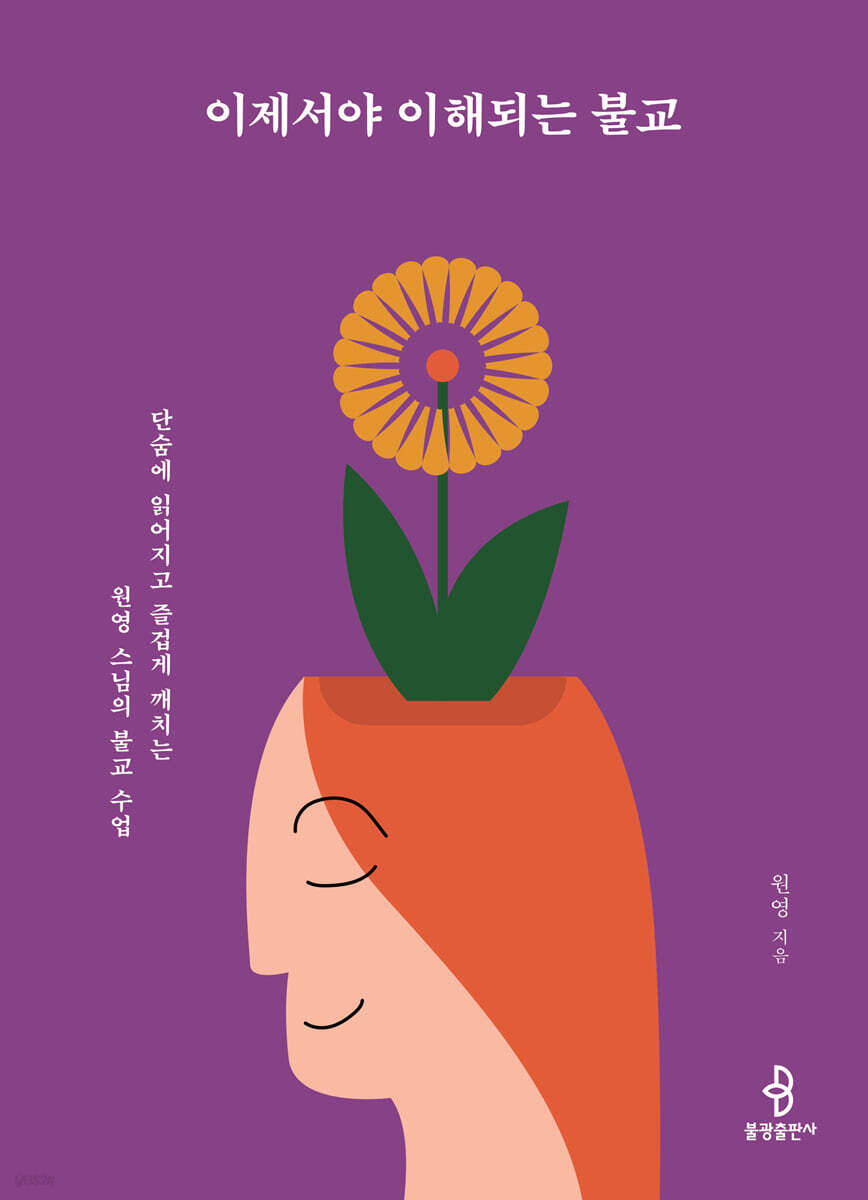
Buddhism that I only now understand
 |
Description
Book Introduction
“If life feels fleeting and meaningless,
“There is no better time to study Buddhism!”
For those who find studying Buddhism difficult
The world's friendliest and most entertaining introduction to Buddhism
As we go through life, we all face sad situations or difficult situations that are difficult to overcome on our own.
In most cases, things will return to normal after some time, but in some cases, this does not happen.
When something big happens suddenly to a loved one or friend, when something you have been working hard on for a long time is frustrated, when you get seriously ill, etc…
When faced with such things, we look for something to rely on.
And the representative thing that provides comfort to such people is Buddhism.
When our hearts are filled with joy and happiness, no matter how much we emphasize the good teachings, they won't go into our ears. However, at some point, we will reach a state that is perfect for studying Buddhism.
This book, written by Monk Won-young, the host of 『Monk Won-young's Buddhist Encyclopedia』 on the Buddhist Broadcasting System (BBS), which is a must-read for anyone studying Buddhism these days, is a compilation of only the core teachings of Buddhism, starting from the Three Dharma Seals and continuing to the Four Noble Truths, Dependent Origination, the Middle Path, and the Paramitas.
Because the 'doctrines', which can be somewhat difficult, are incorporated into various examples, scripture passages, and the monks' experiences, anyone, whether a beginner who is just beginning to study Buddhism or someone who is just now trying to study Buddhism, will be able to read them in one sitting and gain insight with enjoyment.
“There is no better time to study Buddhism!”
For those who find studying Buddhism difficult
The world's friendliest and most entertaining introduction to Buddhism
As we go through life, we all face sad situations or difficult situations that are difficult to overcome on our own.
In most cases, things will return to normal after some time, but in some cases, this does not happen.
When something big happens suddenly to a loved one or friend, when something you have been working hard on for a long time is frustrated, when you get seriously ill, etc…
When faced with such things, we look for something to rely on.
And the representative thing that provides comfort to such people is Buddhism.
When our hearts are filled with joy and happiness, no matter how much we emphasize the good teachings, they won't go into our ears. However, at some point, we will reach a state that is perfect for studying Buddhism.
This book, written by Monk Won-young, the host of 『Monk Won-young's Buddhist Encyclopedia』 on the Buddhist Broadcasting System (BBS), which is a must-read for anyone studying Buddhism these days, is a compilation of only the core teachings of Buddhism, starting from the Three Dharma Seals and continuing to the Four Noble Truths, Dependent Origination, the Middle Path, and the Paramitas.
Because the 'doctrines', which can be somewhat difficult, are incorporated into various examples, scripture passages, and the monks' experiences, anyone, whether a beginner who is just beginning to study Buddhism or someone who is just now trying to study Buddhism, will be able to read them in one sitting and gain insight with enjoyment.
- You can preview some of the book's contents.
Preview
index
· Publishing a book
Part 1: The Three Dharma Seals
1.
My current appearance
Is life a tragedy or a comedy?
The Three Characteristics of Dharma, the Three Dharma Seals
2.
Go - Ah, this is so painful
Life is suffering
There are different types of suffering: the four sufferings and the eight sufferings
The things that make me up, the five aggregates
3.
Free - everything is useless
Empty dreams, meaningless lives
· One more story!_King Ashoka's repentance
The truth of this vain world
Time and Death
Awareness of speed and gratuitousness
A mother who couldn't accept her son's death
The human body that returns to earth, water, fire, and wind
It's free, so keep working hard
The law of impermanence and birth and death
· One more story! Even Buddha grows old.
4.
Muah - What did I say?
The goblin deceives me, the fool
First of all, what is ‘Artman’!
If my mother had achieved her first love
All life is merely a combination of the five aggregates.
The relationship between apples and apple seeds
· Knowledge Note_Nirvana
Part 2: The Four Noble Truths
1.
Go - Life is hard, but still go
Four Noble Truths
The Holy Truth of Suffering
The principle of accumulating suffering
What are Tam, Jin, and Chi?
2.
Home - Is Good Really Good?
You have to know the cause of suffering
· Knowledge Note_Yuljang
The consequences of wrong choices
· One more story!_The grudge against the Shakyamuni family
3.
Destruction - Towards the world where I want to stay
If you blow away all your worries,
What's important?
The reason why Buddha preached the extinction of nature
4.
Tao - How to live?
The core of the Four Noble Truths is the Noble Truth of the Way
The Path to the Cessation of Suffering
· You should know this much!_A brief look at the life of Buddha
Part 3 postponement
1.
Acting - A Like-Dislike Relationship
If you understand the ways of the world
Understanding the Twelve Links of Dependent Origination
· The twelve links of dependent origination explained by an enlightened person
2.
Moderation - Beyond Right and Wrong
Don't lean to one side
The Middle Way and the Noble Eightfold Path
The middle of the middle is wide
I could be wrong
· Monk Seongcheol's Middle Way Dharma talk
Part 4: Six Perfections
1.
Baramil - The Path to Happiness Together
The perfection of Buddhism is practice
2.
Boshi - I'll give it to you with a smile
Give unconditionally with a compassionate heart.
The act of planting the seeds of happiness
How much is my merit?
3.
Jikji - My Shield
Not doing what you shouldn't do
Are the precepts and rules different?
The Three Pure Precepts, the Three Pure Precepts
4.
Insults - Let's endure it.
Just one more time!
Without anger, resentment, or arrogance
Patience has its own dignity
5.
Jeongjin - One step forward
'Consistency' is the most important
Even so, I have to keep trying
6.
Selection - Finding the quiet me
To calm your wavering mind
Sit quietly and gather your mind.
7.
Prajna - Wisdom Finally Encountered
Perfection of Paramita, Prajna Paramita
· Knowledge Note_Four Consciences
Ending the Book_The Beginning of the Path to Finding Myself
Part 1: The Three Dharma Seals
1.
My current appearance
Is life a tragedy or a comedy?
The Three Characteristics of Dharma, the Three Dharma Seals
2.
Go - Ah, this is so painful
Life is suffering
There are different types of suffering: the four sufferings and the eight sufferings
The things that make me up, the five aggregates
3.
Free - everything is useless
Empty dreams, meaningless lives
· One more story!_King Ashoka's repentance
The truth of this vain world
Time and Death
Awareness of speed and gratuitousness
A mother who couldn't accept her son's death
The human body that returns to earth, water, fire, and wind
It's free, so keep working hard
The law of impermanence and birth and death
· One more story! Even Buddha grows old.
4.
Muah - What did I say?
The goblin deceives me, the fool
First of all, what is ‘Artman’!
If my mother had achieved her first love
All life is merely a combination of the five aggregates.
The relationship between apples and apple seeds
· Knowledge Note_Nirvana
Part 2: The Four Noble Truths
1.
Go - Life is hard, but still go
Four Noble Truths
The Holy Truth of Suffering
The principle of accumulating suffering
What are Tam, Jin, and Chi?
2.
Home - Is Good Really Good?
You have to know the cause of suffering
· Knowledge Note_Yuljang
The consequences of wrong choices
· One more story!_The grudge against the Shakyamuni family
3.
Destruction - Towards the world where I want to stay
If you blow away all your worries,
What's important?
The reason why Buddha preached the extinction of nature
4.
Tao - How to live?
The core of the Four Noble Truths is the Noble Truth of the Way
The Path to the Cessation of Suffering
· You should know this much!_A brief look at the life of Buddha
Part 3 postponement
1.
Acting - A Like-Dislike Relationship
If you understand the ways of the world
Understanding the Twelve Links of Dependent Origination
· The twelve links of dependent origination explained by an enlightened person
2.
Moderation - Beyond Right and Wrong
Don't lean to one side
The Middle Way and the Noble Eightfold Path
The middle of the middle is wide
I could be wrong
· Monk Seongcheol's Middle Way Dharma talk
Part 4: Six Perfections
1.
Baramil - The Path to Happiness Together
The perfection of Buddhism is practice
2.
Boshi - I'll give it to you with a smile
Give unconditionally with a compassionate heart.
The act of planting the seeds of happiness
How much is my merit?
3.
Jikji - My Shield
Not doing what you shouldn't do
Are the precepts and rules different?
The Three Pure Precepts, the Three Pure Precepts
4.
Insults - Let's endure it.
Just one more time!
Without anger, resentment, or arrogance
Patience has its own dignity
5.
Jeongjin - One step forward
'Consistency' is the most important
Even so, I have to keep trying
6.
Selection - Finding the quiet me
To calm your wavering mind
Sit quietly and gather your mind.
7.
Prajna - Wisdom Finally Encountered
Perfection of Paramita, Prajna Paramita
· Knowledge Note_Four Consciences
Ending the Book_The Beginning of the Path to Finding Myself
Into the book
If you casually say, "Life is suffering," it might not resonate readily.
Now, think of the saddest and most painful scene in your life.
Maybe it's easy to understand.
In my case, the sight of my mother cursing in front of her dead son's memorial tablet was the saddest and most painful scene in my life.
My two older brothers passed away before me, and when my mother came to the funeral, she cursed at my dead brothers, calling them bad guys.
"How could you do this to your mother?" he asks, glaring at the portrait. I've never seen such a sad scene before.
It was such a painful and sad scene that no one could stop it, but perhaps it was also the scene that made us most desperately face the reality of the world we live in.
--- p.33
Just as Indians equated time with death, Europeans also evidently accepted and interpreted death and time together.
“You can wake up a sleeping person, but you can’t wake up a person who is pretending to be asleep.”
There's no use talking to someone who pretends not to hear you.
When you receive a wise message, don't pretend to be asleep, don't pretend not to hear, open your eyes and face the reality of 'emptiness'.
That's okay though.
Aren't you and I both living meaningless lives?
--- p.73
Even the beautiful clock hanging in Prague Square in the Czech Republic stops when its batteries run out.
Just as a clock stops when conditions change, everything also plays its role when conditions change.
The same goes for the emotions of love and hate, which have the greatest impact on our hearts in life.
--- p.119
When talking about Buddhist doctrines, we usually refer to the Three Dharma Seals, the Four Noble Truths, the Middle Path, the Noble Eightfold Path, dependent origination, etc.
An interesting thing I learned while studying Buddhism is that the Four Noble Truths include the Three Dharma Seals, Dependent Origination, the Noble Eightfold Path, and the Middle Way.
It is no exaggeration to say that all teachings are included in the Four Noble Truths, just as 'all the animal's footprints fit within the elephant's footprints.'
Therefore, we can say that just by knowing the Four Noble Truths well, we understand almost everything about Buddhism.
--- pp.132~133
When people feel pain, it may mean that there is hope.
Because you have to know that you are sick to think about getting treatment.
It would be nice if you didn't get sick, but not being able to feel pain can lead to very serious problems.
--- p.137
In Buddhism, the opposite of 'suffering' is not 'pleasure', but the world of tranquility, the world of peace, the world of nirvana.
The Buddhist way of thinking is that the opposite of suffering is a peaceful life without suffering.
Therefore, Buddhism teaches the way to Nirvana, the state of cessation of suffering.
The teachings of the Four Noble Truths explain the path that eliminates suffering and leads to happiness.
--- p.151
Pleasures that only like good things, such as the desire to remain in a state of quiet samadhi so strong that one does not want to be disturbed by anything, are also considered pursuits of pleasure.
In the case of 'samadhi' obtained through practice, it may not seem appropriate to consider it an immoral desire, but it is clear that no matter how noble a religious pleasure is, if it is excessively attached, it becomes an extreme pleasure.
The Buddha said that we must first let go of things that lead to the end of desire, including these things.
--- p.241
Whether one is blind or able-bodied, they are all the same in their attachment to their own views.
The same goes for the appearance of truth.
It is very cautious because you can only see and judge parts of something without seeing the whole thing.
Anyone who sees only a part and imagines the whole thing can be wrong.
The teachings of the Middle Way make it clear that our thinking can be wrong.
--- pp.258~259
Living in a turbid world, one cannot help but be swayed by countless temptations.
A temptation as powerful as that siren can shake the heart and confuse life.
Some roll around in the mud, and some rot like stagnant water.
Anger boils over, and delusions of turmoil grow like weeds or spread out like ivy.
To avoid this, you need a rope to tie yourself up.
That is the 'precept'.
Now, think of the saddest and most painful scene in your life.
Maybe it's easy to understand.
In my case, the sight of my mother cursing in front of her dead son's memorial tablet was the saddest and most painful scene in my life.
My two older brothers passed away before me, and when my mother came to the funeral, she cursed at my dead brothers, calling them bad guys.
"How could you do this to your mother?" he asks, glaring at the portrait. I've never seen such a sad scene before.
It was such a painful and sad scene that no one could stop it, but perhaps it was also the scene that made us most desperately face the reality of the world we live in.
--- p.33
Just as Indians equated time with death, Europeans also evidently accepted and interpreted death and time together.
“You can wake up a sleeping person, but you can’t wake up a person who is pretending to be asleep.”
There's no use talking to someone who pretends not to hear you.
When you receive a wise message, don't pretend to be asleep, don't pretend not to hear, open your eyes and face the reality of 'emptiness'.
That's okay though.
Aren't you and I both living meaningless lives?
--- p.73
Even the beautiful clock hanging in Prague Square in the Czech Republic stops when its batteries run out.
Just as a clock stops when conditions change, everything also plays its role when conditions change.
The same goes for the emotions of love and hate, which have the greatest impact on our hearts in life.
--- p.119
When talking about Buddhist doctrines, we usually refer to the Three Dharma Seals, the Four Noble Truths, the Middle Path, the Noble Eightfold Path, dependent origination, etc.
An interesting thing I learned while studying Buddhism is that the Four Noble Truths include the Three Dharma Seals, Dependent Origination, the Noble Eightfold Path, and the Middle Way.
It is no exaggeration to say that all teachings are included in the Four Noble Truths, just as 'all the animal's footprints fit within the elephant's footprints.'
Therefore, we can say that just by knowing the Four Noble Truths well, we understand almost everything about Buddhism.
--- pp.132~133
When people feel pain, it may mean that there is hope.
Because you have to know that you are sick to think about getting treatment.
It would be nice if you didn't get sick, but not being able to feel pain can lead to very serious problems.
--- p.137
In Buddhism, the opposite of 'suffering' is not 'pleasure', but the world of tranquility, the world of peace, the world of nirvana.
The Buddhist way of thinking is that the opposite of suffering is a peaceful life without suffering.
Therefore, Buddhism teaches the way to Nirvana, the state of cessation of suffering.
The teachings of the Four Noble Truths explain the path that eliminates suffering and leads to happiness.
--- p.151
Pleasures that only like good things, such as the desire to remain in a state of quiet samadhi so strong that one does not want to be disturbed by anything, are also considered pursuits of pleasure.
In the case of 'samadhi' obtained through practice, it may not seem appropriate to consider it an immoral desire, but it is clear that no matter how noble a religious pleasure is, if it is excessively attached, it becomes an extreme pleasure.
The Buddha said that we must first let go of things that lead to the end of desire, including these things.
--- p.241
Whether one is blind or able-bodied, they are all the same in their attachment to their own views.
The same goes for the appearance of truth.
It is very cautious because you can only see and judge parts of something without seeing the whole thing.
Anyone who sees only a part and imagines the whole thing can be wrong.
The teachings of the Middle Way make it clear that our thinking can be wrong.
--- pp.258~259
Living in a turbid world, one cannot help but be swayed by countless temptations.
A temptation as powerful as that siren can shake the heart and confuse life.
Some roll around in the mud, and some rot like stagnant water.
Anger boils over, and delusions of turmoil grow like weeds or spread out like ivy.
To avoid this, you need a rope to tie yourself up.
That is the 'precept'.
--- pp.296~297
Publisher's Review
“Studying Buddhism is not difficult!”
Anyone can understand and study
Buddhism, the natural law of all things in the world
‘Studying Buddhism is difficult.’ This is a thought that comes to mind for anyone who has studied Buddhism at all.
Buddhist terms that we commonly come across while studying, such as ‘Paramil (波羅蜜)’, ‘Prajna (般若)’, and ‘Nirvana (涅槃)’, are difficult to understand even when looking at the Chinese characters, and even when looking them up in a dictionary, there are only superficial explanations.
As a result, people who are unfamiliar with Buddhism will inevitably have to think about it more and have questions, rather than understanding it right away, no matter how many books they read or lectures they attend.
And that's not all.
As we move a little further and talk about doctrine, we begin to have deeper questions.
The more I try to understand why our lives are said to be 'suffering' when we are living happily and joyfully, and why we say there is no self, that is, 'I do not exist', the more confused I become.
But Buddhism is by no means something difficult to understand.
The reason we find it difficult to study Buddhism is because it originated in India, a country with a different language and culture, and was transmitted to us through China, and various terms and concepts were created in an attempt to make it easier and more accurate.
The reason we say that life is painful is because once we are born, we will eventually face illness, old age, and death, and even if we feel joy, it is only momentary and does not last forever. The teaching of anatta is not that there is no 'self', but it is simply a term chosen to convey the meaning that there is no such thing as an 'self' that is unchanging at all times.
If we understand it properly, we will realize that Buddhism is not something difficult to understand only for special people, but rather an obvious truth of the world that anyone living in the present can nod their head to.
“I finally found it!”
For those who find studying Buddhism difficult
The world's friendliest and most entertaining introduction to Buddhism!
This book is a fun introduction to Buddhism written in the world's friendliest language for those who have found studying Buddhism difficult due to these very barriers.
The author, Venerable Wonyoung, is a monk with extensive experience communicating with the public, having worked hard to make Buddhism more accessible and accessible through programs such as the BBS Buddhist Broadcasting radio program “Good Morning, This is Wonyoung” and the television program “Venerable Wonyoung’s Encyclopedia of Buddhism.”
And based on that experience, instead of difficult terms and complex explanations, he explains Buddhism in a way that makes it easy to understand, using simple language from everyday life, various relatable examples, and expressing concepts that may seem complicated in the form of tables and pictures.
At the same time, we are strengthening our substance by focusing on the 'doctrine', which can be said to be the core of Buddhist studies.
In addition, for those who are just beginning to study Buddhism, we have included some additional stories and concepts that would be helpful to know in a separate document.
This helps those who wish to study Buddhism overcome the difficulties they have experienced while also laying a solid foundation for further study.
This book, which satisfies all the shortcomings of previous introductory books, will remain a representative introductory book to Buddhism even after time has passed.
Knowing and realizing are two different things.
Buddhist lectures that lead to action in life rather than remaining as knowledge in the head
Just as I know that 'all living things die', but the death of a life I love is difficult to accept, knowing and experiencing are two different things.
If our study stops at ‘knowing’, it is no different from memorization.
However, only when you go beyond simply knowing something and become able to naturally reflect it in your life can you truly have a complete study that will be helpful to your life.
This is what I want to say in this book.
We talk about Buddhism, such as the Three Dharma Seals, the Four Noble Truths, the Eightfold Path, Dependent Origination, the Middle Path, and the Paramitas, but what it wants to tell us through this is 'how to live.'
This is because by studying the Three Dharma Causes and Dependent Origination, we learn the causes of suffering in our lives, learn the solutions to eliminate the causes of suffering through the Four Noble Truths and the Middle Path, and move on to the concrete practice of the Eightfold Path and the Perfections.
So, by applying the Buddha's teachings directly to life, we can go beyond simply knowing how to live freely without being swayed by the circumstances or environment around us and put it into action.
Through this, I will naturally learn how to live each moment that occurs in my life without being judged, but by being swept away by the flow and maintaining my own steadfastness.
Anyone can understand and study
Buddhism, the natural law of all things in the world
‘Studying Buddhism is difficult.’ This is a thought that comes to mind for anyone who has studied Buddhism at all.
Buddhist terms that we commonly come across while studying, such as ‘Paramil (波羅蜜)’, ‘Prajna (般若)’, and ‘Nirvana (涅槃)’, are difficult to understand even when looking at the Chinese characters, and even when looking them up in a dictionary, there are only superficial explanations.
As a result, people who are unfamiliar with Buddhism will inevitably have to think about it more and have questions, rather than understanding it right away, no matter how many books they read or lectures they attend.
And that's not all.
As we move a little further and talk about doctrine, we begin to have deeper questions.
The more I try to understand why our lives are said to be 'suffering' when we are living happily and joyfully, and why we say there is no self, that is, 'I do not exist', the more confused I become.
But Buddhism is by no means something difficult to understand.
The reason we find it difficult to study Buddhism is because it originated in India, a country with a different language and culture, and was transmitted to us through China, and various terms and concepts were created in an attempt to make it easier and more accurate.
The reason we say that life is painful is because once we are born, we will eventually face illness, old age, and death, and even if we feel joy, it is only momentary and does not last forever. The teaching of anatta is not that there is no 'self', but it is simply a term chosen to convey the meaning that there is no such thing as an 'self' that is unchanging at all times.
If we understand it properly, we will realize that Buddhism is not something difficult to understand only for special people, but rather an obvious truth of the world that anyone living in the present can nod their head to.
“I finally found it!”
For those who find studying Buddhism difficult
The world's friendliest and most entertaining introduction to Buddhism!
This book is a fun introduction to Buddhism written in the world's friendliest language for those who have found studying Buddhism difficult due to these very barriers.
The author, Venerable Wonyoung, is a monk with extensive experience communicating with the public, having worked hard to make Buddhism more accessible and accessible through programs such as the BBS Buddhist Broadcasting radio program “Good Morning, This is Wonyoung” and the television program “Venerable Wonyoung’s Encyclopedia of Buddhism.”
And based on that experience, instead of difficult terms and complex explanations, he explains Buddhism in a way that makes it easy to understand, using simple language from everyday life, various relatable examples, and expressing concepts that may seem complicated in the form of tables and pictures.
At the same time, we are strengthening our substance by focusing on the 'doctrine', which can be said to be the core of Buddhist studies.
In addition, for those who are just beginning to study Buddhism, we have included some additional stories and concepts that would be helpful to know in a separate document.
This helps those who wish to study Buddhism overcome the difficulties they have experienced while also laying a solid foundation for further study.
This book, which satisfies all the shortcomings of previous introductory books, will remain a representative introductory book to Buddhism even after time has passed.
Knowing and realizing are two different things.
Buddhist lectures that lead to action in life rather than remaining as knowledge in the head
Just as I know that 'all living things die', but the death of a life I love is difficult to accept, knowing and experiencing are two different things.
If our study stops at ‘knowing’, it is no different from memorization.
However, only when you go beyond simply knowing something and become able to naturally reflect it in your life can you truly have a complete study that will be helpful to your life.
This is what I want to say in this book.
We talk about Buddhism, such as the Three Dharma Seals, the Four Noble Truths, the Eightfold Path, Dependent Origination, the Middle Path, and the Paramitas, but what it wants to tell us through this is 'how to live.'
This is because by studying the Three Dharma Causes and Dependent Origination, we learn the causes of suffering in our lives, learn the solutions to eliminate the causes of suffering through the Four Noble Truths and the Middle Path, and move on to the concrete practice of the Eightfold Path and the Perfections.
So, by applying the Buddha's teachings directly to life, we can go beyond simply knowing how to live freely without being swayed by the circumstances or environment around us and put it into action.
Through this, I will naturally learn how to live each moment that occurs in my life without being judged, but by being swept away by the flow and maintaining my own steadfastness.
GOODS SPECIFICS
- Date of issue: May 23, 2023
- Page count, weight, size: 352 pages | 484g | 150*200*20mm
- ISBN13: 9791192997254
- ISBN10: 1192997255
You may also like
카테고리
korean


korean

![GQ KOREA Mark (Monthly): December [2025]](http://librairie.coreenne.fr/cdn/shop/files/8ef265dbbfbf186523ed75ba7319009d.jpg?v=1765340328&width=3840)


