

Essential Math for Developers
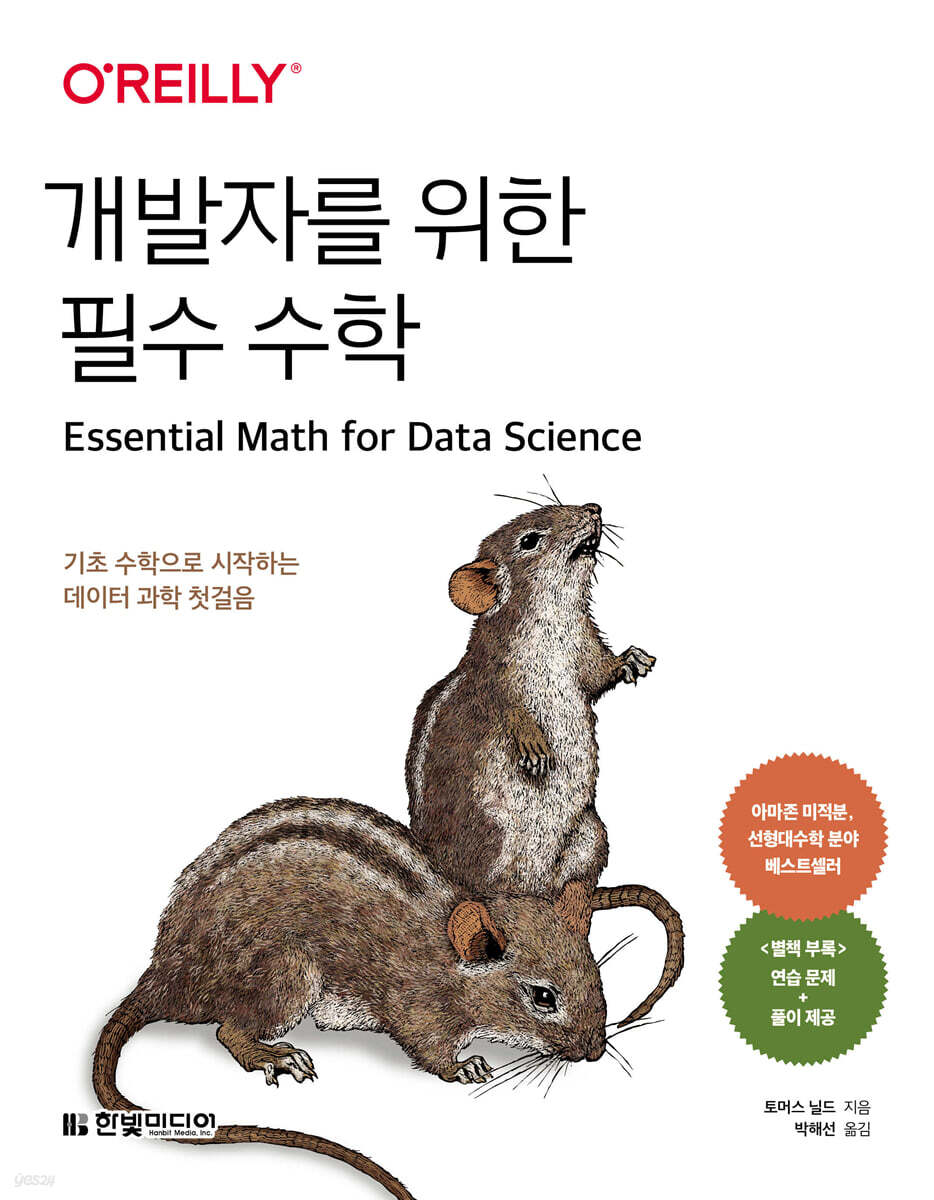 |
Description
Book Introduction
A Practical Guide to Math for Developers
From basic math to regression models, neural networks, and career advice.
Understand and master the math needed to excel in data science, machine learning, and statistics.
This book explains calculus, probability, statistics, and linear algebra, and shows how mathematics is applied to techniques such as linear regression, logistic regression, and neural networks.
In the process, you'll learn the current state of data science and gain practical insights on how to maximize your value.
From basic math to regression models, neural networks, and career advice.
Understand and master the math needed to excel in data science, machine learning, and statistics.
This book explains calculus, probability, statistics, and linear algebra, and shows how mathematics is applied to techniques such as linear regression, logistic regression, and neural networks.
In the process, you'll learn the current state of data science and gain practical insights on how to maximize your value.
- You can preview some of the book's contents.
Preview
index
Chapter 1: Basic Mathematics and Calculus
_1.1 Number Theory
_1.2 Operation order
_1.3 variables
_1.4 function
_1.5 Total
_1.6 power
_1.7 log
_1.8 Euler numbers and natural logarithms
_1.9 Extreme
_1.10 Differentiation
_1.11 Integration
_1.12 In conclusion
Chapter 2 Probability
_2.1 Understanding Probability
_2.2 Probability Calculation
_2.3 Binomial distribution
_2.4 Beta distribution
_2.5 In conclusion
Chapter 3 Descriptive and Inferential Statistics
_3.1 What is data?
_3.2 Descriptive and Inferential Statistics
_3.3 Population, Sample, and Bias
_3.4 Technical Statistics
_3.5 Inferential Statistics
_3.6 t distribution: Handling small samples
_3.7 Big Data Considerations and the Texas Sharpshooter Fallacy
_3.8 In conclusion
Chapter 4 Linear Algebra
_4.1 What is a vector?
_4.2 Linear transformation
_4.3 Matrix Multiplication
_4.4 Determinant
_4.5 Special matrices
_4.6 Simultaneous Equations and Inverse Matrices
_4.7 Eigenvectors and Eigenvalues
_4.8 In conclusion
Chapter 5 Linear Regression
_5.1 Basic Linear Regression
_5.2 Residuals and squared errors
_5.3 Finding the best straight line
_5.4 Overfitting and Variance
_5.5 Stochastic Gradient Descent
_5.6 Correlation coefficient
_5.7 Statistical significance
_5.8 Coefficient of Determination
_5.9 Estimated standard error
_5.10 Prediction Intervals
_5.11 Training/Test Split
_5.12 Multiple Linear Regression
_5.13 In closing
Chapter 6: Logistic Regression and Classification
_6.1 Understanding Logistic Regression
_6.2 Performing Logistic Regression
_6.3 Multivariate Logistic Regression
_6.4 Understanding Log Odds
_6.5 R2
_6.6 p value
_6.7 Training/Test Split
_6.8 Error matrix
_6.9 Bayes' theorem and classification
_6.10 ROC Curve and AUC
_6.11 Class Imbalance
_6.12 In closing
Chapter 7 Neural Networks
_7.1 When to use neural networks and deep learning?
_7.2 Simple Neural Networks
_7.3 Backpropagation
_7.4 Using scikit-learn
_7.5 Limitations of Neural Networks and Deep Learning
_7.6 In conclusion
Chapter 8 Career Advice and Future Paths
_8.1 Redefining Data Science
_8.2 A Brief History of Data Science
_8.3 Finding Your Own Strengths
_8.4 Things to watch out for in data science jobs
_8.5 Does your dream job not exist?
_8.6 Where should I go now?
_8.7 In conclusion
Appendix A Supplementary Learning
A.1 Expressing mathematical expressions with SymPy
A.2 Implementing the Binomial Distribution from Scratch
A.3 Implementing the Beta Distribution from Scratch
A.4 Deriving Bayes' Theorem
A.5 Implementing CDF and Inverse CDF from Scratch
A.6 Predicting event probabilities over time using e
A.7 Hill Climbing and Linear Regression
A.8 Hill Climbing and Logistic Regression
A.9 A Brief Introduction to Linear Programming
A.10 MNIST Classifier Using Scikit-Learn
〈Special Appendix〉 Workbook
_1.1 Number Theory
_1.2 Operation order
_1.3 variables
_1.4 function
_1.5 Total
_1.6 power
_1.7 log
_1.8 Euler numbers and natural logarithms
_1.9 Extreme
_1.10 Differentiation
_1.11 Integration
_1.12 In conclusion
Chapter 2 Probability
_2.1 Understanding Probability
_2.2 Probability Calculation
_2.3 Binomial distribution
_2.4 Beta distribution
_2.5 In conclusion
Chapter 3 Descriptive and Inferential Statistics
_3.1 What is data?
_3.2 Descriptive and Inferential Statistics
_3.3 Population, Sample, and Bias
_3.4 Technical Statistics
_3.5 Inferential Statistics
_3.6 t distribution: Handling small samples
_3.7 Big Data Considerations and the Texas Sharpshooter Fallacy
_3.8 In conclusion
Chapter 4 Linear Algebra
_4.1 What is a vector?
_4.2 Linear transformation
_4.3 Matrix Multiplication
_4.4 Determinant
_4.5 Special matrices
_4.6 Simultaneous Equations and Inverse Matrices
_4.7 Eigenvectors and Eigenvalues
_4.8 In conclusion
Chapter 5 Linear Regression
_5.1 Basic Linear Regression
_5.2 Residuals and squared errors
_5.3 Finding the best straight line
_5.4 Overfitting and Variance
_5.5 Stochastic Gradient Descent
_5.6 Correlation coefficient
_5.7 Statistical significance
_5.8 Coefficient of Determination
_5.9 Estimated standard error
_5.10 Prediction Intervals
_5.11 Training/Test Split
_5.12 Multiple Linear Regression
_5.13 In closing
Chapter 6: Logistic Regression and Classification
_6.1 Understanding Logistic Regression
_6.2 Performing Logistic Regression
_6.3 Multivariate Logistic Regression
_6.4 Understanding Log Odds
_6.5 R2
_6.6 p value
_6.7 Training/Test Split
_6.8 Error matrix
_6.9 Bayes' theorem and classification
_6.10 ROC Curve and AUC
_6.11 Class Imbalance
_6.12 In closing
Chapter 7 Neural Networks
_7.1 When to use neural networks and deep learning?
_7.2 Simple Neural Networks
_7.3 Backpropagation
_7.4 Using scikit-learn
_7.5 Limitations of Neural Networks and Deep Learning
_7.6 In conclusion
Chapter 8 Career Advice and Future Paths
_8.1 Redefining Data Science
_8.2 A Brief History of Data Science
_8.3 Finding Your Own Strengths
_8.4 Things to watch out for in data science jobs
_8.5 Does your dream job not exist?
_8.6 Where should I go now?
_8.7 In conclusion
Appendix A Supplementary Learning
A.1 Expressing mathematical expressions with SymPy
A.2 Implementing the Binomial Distribution from Scratch
A.3 Implementing the Beta Distribution from Scratch
A.4 Deriving Bayes' Theorem
A.5 Implementing CDF and Inverse CDF from Scratch
A.6 Predicting event probabilities over time using e
A.7 Hill Climbing and Linear Regression
A.8 Hill Climbing and Logistic Regression
A.9 A Brief Introduction to Linear Programming
A.10 MNIST Classifier Using Scikit-Learn
〈Special Appendix〉 Workbook
Detailed image

Publisher's Review
Amazon's best-selling linear algebra and calculus books
101 Math Concepts Every Developer Should Know!
Want to conquer the world of data science and machine learning? The first step on your journey is mathematics.
The core principles and algorithms of machine learning are actually rooted in mathematical concepts.
This book systematically guides you through the fundamentals of calculus, probability, statistics, and linear algebra, from their application to data science.
Through hands-on exercises using Python, you'll learn how mathematics is integrated into real-world applications, from linear regression to neural networks.
There's no more complete guide to start your journey as a data scientist.
Explore the endless possibilities of data science with this book.
Start your first step into data science with a solid understanding of mathematical concepts. Start now!
Target audience
Developers who want to understand the mathematical concepts, tools, and algorithms used in data science and machine learning.
● Data engineers, data scientists, machine learning engineers, and statisticians in charge of data analysis practices
Key Contents
● Basic mathematical concepts examined through Python code and libraries
● Interpreting p values and statistical significance using descriptive statistics and hypothesis testing
Applying mathematical concepts to linear regression, logistic regression, and neural networks
How to build a solid data science career and career advice
● Provides a workbook to review the concepts learned in each chapter
[Author's Note]
Over the past decade, there has been a growing interest in applying mathematics and statistics to everyday life and work.
As data availability increases, mathematics and statistics are gaining mainstream attention, and understanding this data requires mathematics, statistics, and machine learning.
It's easy to think that computers are smarter than us (and this idea is often used in marketing), but the reality may be the opposite.
These misconceptions can be quite dangerous.
What if algorithms or AI, whether making criminal judgments or driving cars, could not explain why they reached certain decisions, including their developers? Explainability is the next frontier in statistical computing and AI.
This is only possible when we open the black box and reveal the mathematics hidden beneath.
Because internet-connected devices are so ingrained in our daily lives, our data is collected frequently and on a massive scale.
We no longer use the Internet only on our desktop and laptop computers, but also on our smartphones, cars, and home appliances.
This phenomenon has undergone subtle changes over the past 20 years.
Data has evolved from an operational tool to an object to be collected and analyzed for more specific purposes.
As data availability increases, data science and machine learning have become in-demand careers.
The essential mathematics required to handle data intersects with probability, linear algebra, statistics, and machine learning.
If you want to pursue a career in data science, machine learning, or engineering, understanding this topic is essential.
This book introduces the mathematics, calculus, and statistics you need to better understand the content of the black box libraries you will encounter.
The goal of this book is to introduce you to a variety of mathematics, statistics, and machine learning topics that can be applied to real-world problems.
The first four chapters cover foundational mathematical concepts such as practical calculus, probability, linear algebra, and statistics.
The last three chapters introduce machine learning.
The ultimate goal of teaching machine learning is to integrate everything you've learned in the book, moving beyond a black-box understanding to provide practical insights into using machine learning and statistical libraries.
This book you have just opened will not make you an expert or give you PhD-level knowledge.
I have tried my best to avoid formulas full of Greek symbols and use common language in their place.
However, I hope this book will help you feel more comfortable talking about mathematics and statistics and give you the knowledge you need to successfully explore these fields.
I believe that the broadest path to success is not deep, specialized knowledge of one subject, but rather the exploration of a wide range of subjects and the acquisition of practical knowledge.
This is precisely the goal of this book.
You will learn enough to ask the important questions that were once difficult to even know, and that can be dangerous.
Well then, let's begin!
- Thomas Neild
[Translator's Note]
I often get questions like, "Do I need to know math to study artificial intelligence?" and "Do I need to study math first to learn machine learning?"
Ironically, the answer to that question can be either “yes” or “no.”
Math isn't necessarily required when you first learn machine learning.
But as you continue to study, you will naturally feel the need for math.
Conversely, if you start with a little understanding of mathematics, you'll have much more freedom to understand how machine learning models work.
There is no right answer, just choose the study method that works for you.
I've been trying to translate a book that explains mathematics in a practical way, but it's been hard to find a good book.
Fortunately, this book from O'Reilly fills this need perfectly.
It was fun to explore how mathematics is used in data analysis and machine learning, from vectors to machine learning.
I hope readers will enjoy this book.
- Park Hae-seon
101 Math Concepts Every Developer Should Know!
Want to conquer the world of data science and machine learning? The first step on your journey is mathematics.
The core principles and algorithms of machine learning are actually rooted in mathematical concepts.
This book systematically guides you through the fundamentals of calculus, probability, statistics, and linear algebra, from their application to data science.
Through hands-on exercises using Python, you'll learn how mathematics is integrated into real-world applications, from linear regression to neural networks.
There's no more complete guide to start your journey as a data scientist.
Explore the endless possibilities of data science with this book.
Start your first step into data science with a solid understanding of mathematical concepts. Start now!
Target audience
Developers who want to understand the mathematical concepts, tools, and algorithms used in data science and machine learning.
● Data engineers, data scientists, machine learning engineers, and statisticians in charge of data analysis practices
Key Contents
● Basic mathematical concepts examined through Python code and libraries
● Interpreting p values and statistical significance using descriptive statistics and hypothesis testing
Applying mathematical concepts to linear regression, logistic regression, and neural networks
How to build a solid data science career and career advice
● Provides a workbook to review the concepts learned in each chapter
[Author's Note]
Over the past decade, there has been a growing interest in applying mathematics and statistics to everyday life and work.
As data availability increases, mathematics and statistics are gaining mainstream attention, and understanding this data requires mathematics, statistics, and machine learning.
It's easy to think that computers are smarter than us (and this idea is often used in marketing), but the reality may be the opposite.
These misconceptions can be quite dangerous.
What if algorithms or AI, whether making criminal judgments or driving cars, could not explain why they reached certain decisions, including their developers? Explainability is the next frontier in statistical computing and AI.
This is only possible when we open the black box and reveal the mathematics hidden beneath.
Because internet-connected devices are so ingrained in our daily lives, our data is collected frequently and on a massive scale.
We no longer use the Internet only on our desktop and laptop computers, but also on our smartphones, cars, and home appliances.
This phenomenon has undergone subtle changes over the past 20 years.
Data has evolved from an operational tool to an object to be collected and analyzed for more specific purposes.
As data availability increases, data science and machine learning have become in-demand careers.
The essential mathematics required to handle data intersects with probability, linear algebra, statistics, and machine learning.
If you want to pursue a career in data science, machine learning, or engineering, understanding this topic is essential.
This book introduces the mathematics, calculus, and statistics you need to better understand the content of the black box libraries you will encounter.
The goal of this book is to introduce you to a variety of mathematics, statistics, and machine learning topics that can be applied to real-world problems.
The first four chapters cover foundational mathematical concepts such as practical calculus, probability, linear algebra, and statistics.
The last three chapters introduce machine learning.
The ultimate goal of teaching machine learning is to integrate everything you've learned in the book, moving beyond a black-box understanding to provide practical insights into using machine learning and statistical libraries.
This book you have just opened will not make you an expert or give you PhD-level knowledge.
I have tried my best to avoid formulas full of Greek symbols and use common language in their place.
However, I hope this book will help you feel more comfortable talking about mathematics and statistics and give you the knowledge you need to successfully explore these fields.
I believe that the broadest path to success is not deep, specialized knowledge of one subject, but rather the exploration of a wide range of subjects and the acquisition of practical knowledge.
This is precisely the goal of this book.
You will learn enough to ask the important questions that were once difficult to even know, and that can be dangerous.
Well then, let's begin!
- Thomas Neild
[Translator's Note]
I often get questions like, "Do I need to know math to study artificial intelligence?" and "Do I need to study math first to learn machine learning?"
Ironically, the answer to that question can be either “yes” or “no.”
Math isn't necessarily required when you first learn machine learning.
But as you continue to study, you will naturally feel the need for math.
Conversely, if you start with a little understanding of mathematics, you'll have much more freedom to understand how machine learning models work.
There is no right answer, just choose the study method that works for you.
I've been trying to translate a book that explains mathematics in a practical way, but it's been hard to find a good book.
Fortunately, this book from O'Reilly fills this need perfectly.
It was fun to explore how mathematics is used in data analysis and machine learning, from vectors to machine learning.
I hope readers will enjoy this book.
- Park Hae-seon
GOODS SPECIFICS
- Date of issue: June 3, 2024
- Page count, weight, size: 352 pages | 183*235*14mm
- ISBN13: 9791169212502
- ISBN10: 1169212506
You may also like
카테고리
korean


korean

![GQ KOREA Mark (Monthly): December [2025]](http://librairie.coreenne.fr/cdn/shop/files/8ef265dbbfbf186523ed75ba7319009d.jpg?v=1765340328&width=3840)


