

Secondary school required reading newspaper
 |
Description
Book Introduction
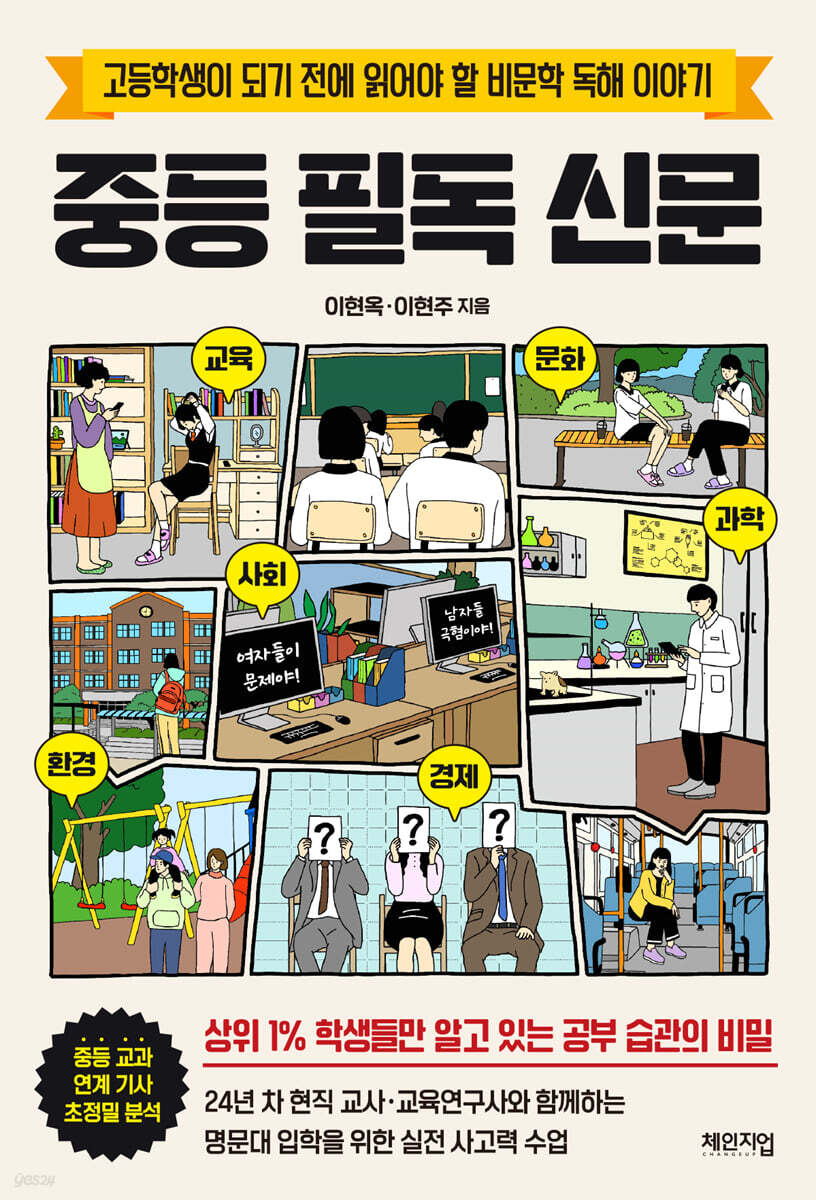
“The secret to study habits known only to the top 1% of students!” With a 24-year veteran teacher and educational researcher Practical thinking skills classes for admission to prestigious universities We live in a world where we're bombarded with countless pieces of information every minute and every second. On social media, filter bubbles and algorithms operate to tailor information to individual preferences, constantly producing biased knowledge and data. Due to this social phenomenon, people's critical judgment and discernment are gradually declining, and this is having a significant impact not only on adults but also on teenagers. This book uses newspaper articles to help teenagers develop critical thinking skills, a skill they need most, and to allow them to read a variety of topics and information from multiple perspectives and viewpoints. This book contains carefully selected articles related to secondary school curriculum to help students develop the literacy skills to read and understand long texts and the critical thinking skills to interpret the world with a broad perspective before entering high school. Following each passage, we cover how to think critically by topic, and by answering three questions, we help you think for yourself and organize your opinions with arguments and evidence. As test passages become longer and longer, and teenagers' literacy and critical thinking skills are declining, the ability to read long passages and discern what information to take from them and what to discard is essential before seriously preparing for the entrance exam. Additionally, you will need to properly learn the ability to interpret data and ask questions to gain deeper knowledge. In this way, this book aims to share with everyone the power of the top 1% of students to 'correct their thinking and think independently.' |
- You can preview some of the book's contents.
Preview
index
prolog
Chapter 1.
education
1.
School uniforms, do I really have to wear them?
2.
Are you telling me not to play games at all?
3.
He is not punished because he is a juvenile delinquent
4.
Can't I sleep in and go to school by 9?
5.
I'll take care of you at school until 8pm.
6.
Group project, I was the only one serious again
7.
If you do well, you get a reward, and if you do badly, you get a punishment.
8.
Discussion-style classes are difficult
9.
Do I really have to go to college?
10.
Lecture-style classes are boring
Chapter 2.
culture
1.
Social networking services capture teenagers' attention
2.
My dream is to be an idol!
3.
There's so much of me inside me, the golden age of sub-characters
4.
K-content that has captivated the world
5.
A contactless society where we don't have to meet
6.
Personalization and customization are the trend.
7.
You and I are influencers
8.
Large cafes are flocking to the suburbs of the city center.
9.
Diggers who enjoy happy immersion
10.
Don't skimp on new things
Chapter 3.
society
1.
The Dilemma of Legalizing Baby Boxes
2.
Debate over the closure of domestic heterosexual websites
3.
Should private life be made public for the public good?
4.
Are malicious comments also freedom of expression?
5.
Should the death penalty be abolished or retained?
6.
Is it preferential treatment or free riding?
7.
If I keep a pet, I have to pay taxes?
8.
It's money I earned, but when I pass it on, it's a tax bomb?
9.
Death also has the right to choose.
10.
How far can we go in protecting the human rights of criminals?
Chapter 4.
science
1.
Is animal testing a necessary evil?
2.
Artificial intelligence creates creations?
3. AI judges will make the decision.
4.
For sustainable space exploration
5.
Can Alzheimer's be conquered?
6.
The Future of Plastic: Bioplastics
7.
Am I ahead in the Web 3.0 era?
8.
Perovskite, the future of solar cells
9.
Connect to a new world with wearable devices.
10.
Protect human jobs by introducing a robot tax.
Chapter 5.
environment
1.
You can trade greenhouse gas emissions?
2.
Carbon neutrality is the only way to survive
3.
What is a Baoihacker?
4.
Stop dangerous nuclear power!
5.
Save the environment by recycling waste products
6.
Could a vegan diet help stop global warming?
7.
Can the Earth's food and water shortage problems be solved?
8.
Only companies that care about the environment will survive.
9.
Make it quickly, use it quickly, throw it away quickly
10.
Preserving the natural ecosystem through national parks
Chapter 6.
economy
1.
South Korea is already in the era of population onus
2.
Is investing in cryptocurrency safe?
3.
Is blind selection fair?
4.
Taxes vary depending on electricity usage?
5.
Is a short-selling ban really necessary?
6.
Fair Trade Promotion Creates Ethical Consumption
7.
Stagflation is coming
8.
Pay attention to the evolution of automobiles
9.
From economies of scale to economies of speed
10.
South Korea's Five Major Future Strategic Projects
Chapter 1.
education
1.
School uniforms, do I really have to wear them?
2.
Are you telling me not to play games at all?
3.
He is not punished because he is a juvenile delinquent
4.
Can't I sleep in and go to school by 9?
5.
I'll take care of you at school until 8pm.
6.
Group project, I was the only one serious again
7.
If you do well, you get a reward, and if you do badly, you get a punishment.
8.
Discussion-style classes are difficult
9.
Do I really have to go to college?
10.
Lecture-style classes are boring
Chapter 2.
culture
1.
Social networking services capture teenagers' attention
2.
My dream is to be an idol!
3.
There's so much of me inside me, the golden age of sub-characters
4.
K-content that has captivated the world
5.
A contactless society where we don't have to meet
6.
Personalization and customization are the trend.
7.
You and I are influencers
8.
Large cafes are flocking to the suburbs of the city center.
9.
Diggers who enjoy happy immersion
10.
Don't skimp on new things
Chapter 3.
society
1.
The Dilemma of Legalizing Baby Boxes
2.
Debate over the closure of domestic heterosexual websites
3.
Should private life be made public for the public good?
4.
Are malicious comments also freedom of expression?
5.
Should the death penalty be abolished or retained?
6.
Is it preferential treatment or free riding?
7.
If I keep a pet, I have to pay taxes?
8.
It's money I earned, but when I pass it on, it's a tax bomb?
9.
Death also has the right to choose.
10.
How far can we go in protecting the human rights of criminals?
Chapter 4.
science
1.
Is animal testing a necessary evil?
2.
Artificial intelligence creates creations?
3. AI judges will make the decision.
4.
For sustainable space exploration
5.
Can Alzheimer's be conquered?
6.
The Future of Plastic: Bioplastics
7.
Am I ahead in the Web 3.0 era?
8.
Perovskite, the future of solar cells
9.
Connect to a new world with wearable devices.
10.
Protect human jobs by introducing a robot tax.
Chapter 5.
environment
1.
You can trade greenhouse gas emissions?
2.
Carbon neutrality is the only way to survive
3.
What is a Baoihacker?
4.
Stop dangerous nuclear power!
5.
Save the environment by recycling waste products
6.
Could a vegan diet help stop global warming?
7.
Can the Earth's food and water shortage problems be solved?
8.
Only companies that care about the environment will survive.
9.
Make it quickly, use it quickly, throw it away quickly
10.
Preserving the natural ecosystem through national parks
Chapter 6.
economy
1.
South Korea is already in the era of population onus
2.
Is investing in cryptocurrency safe?
3.
Is blind selection fair?
4.
Taxes vary depending on electricity usage?
5.
Is a short-selling ban really necessary?
6.
Fair Trade Promotion Creates Ethical Consumption
7.
Stagflation is coming
8.
Pay attention to the evolution of automobiles
9.
From economies of scale to economies of speed
10.
South Korea's Five Major Future Strategic Projects
Detailed image

Into the book
To develop critical thinking skills, asking the question 'why?' is important.
Let's understand the issue of the Juvenile Offenders Act by asking the question, "Why?"
Why was the Juvenile Offenders System created? To protect minors and prevent repeat offenses.
The purpose is to increase effectiveness by teaching differently from adults.
This was taken into consideration because the brain development of minors is not yet complete, so their judgment ability is low.
It is difficult to apply the same results to children who are still immature as to adults.
The goal is to prevent crime and help minors quickly reintegrate into society by protecting and educating them.
It also contains the will to resolve the issue in a more mature way while respecting the human rights of minors.
Why did the Juvenile Delinquency System, which started with such a good purpose, become a problem?
--- p.24
When you use social networks, you can easily become absorbed in one point of view.
It's called 'confirmation bias'.
It refers to the cognitive tendency of an individual or group to accept only information that conforms to certain beliefs, hypotheses, or preconceptions.
When accepting new information, it is a characteristic of preferring information that is consistent with one's existing beliefs and ignoring or rejecting information that contradicts them.
Social networks accelerate this problem by connecting like-minded people and empowering them.
For example, if you connect with a friend who has a particular political stance, there is a problem that you may connect with other people who are more involved at a faster rate.
To think about this from a critical perspective, I need to analyze my own tendencies.
--- p.60
Rather than being led by the crowd mentality that 'studying is the only way to survive', let's take time to explore ourselves deeply.
When we are stuck in dogma, we face limitations and our choices are limited by the problems we cannot solve.
Only when you begin to explore yourself will you begin to discover what kind of person you are.
It is said that people have 3 to 5 jobs in their lifetime.
Sometimes, it can be a good idea to get hints about the right career path from adults who have experienced society before you, and it's clear that cultivating knowledge about various occupations will be effective in promoting "career flexibility."
--- p.62
'Privacy may also be violated for the public good.
There is an argument that private life can be made public for social benefit, to increase transparency, or to raise awareness of social issues.
Let's consider this controversial issue, along with the argument that 'sharing one's private life is a right no matter what.'
Public figures, such as politicians, celebrities, and people with social influence, sometimes have their private lives exposed, even if they don't want to.
Because their actions can have social implications.
Especially with the development of social media, it is common to see cases where even unwanted personal stories are publicly covered in news articles.
During the course of a criminal investigation, some of the criminal's private life may be disclosed for the public interest.
It is a means to solve and prevent crime, so I wonder if it is right that a person's private life should be made public just because they were a criminal.
What are the problems and benefits of exposing one's private life for the public good?
--- p.111
When receiving text or information through media, literacy is important.
Literacy is the ability to read and understand text or documents.
It goes beyond simply reading and interpreting sentences.
Literacy is the process of understanding context, extracting important information, and interpreting and inferring based on that information.
Literacy can be said to be the foundation of critical thinking skills.
If you cannot decipher and understand it accurately, you cannot carry out the next logical action.
You need to understand how the meaning of a sentence or word is being used.
You must be able to extract and identify key ideas or information.
You need to find the core concepts before you can begin to understand them logically.
You should be able to think critically about the content and determine whether there are any leaps in argument or logic.
--- p.169~170
It is important to practice reading and thinking critically when receiving text or information.
Critical reading improves your ability to understand and analyze the logical structure of sentences and paragraphs.
You can understand what the author's intention was and what message he or she wanted to convey.
This helps us to judge information more objectively than just accepting it unconditionally.
It's better to read while looking into the author's assumptions or biases.
It helps to isolate how assumptions and biases may be influencing the overall argument or content.
The author's evidence and arguments can also be evaluated.
Having a general understanding of this will help you organize your thoughts logically on the topic.
--- p.199
I learned about fair trade.
So, let's think about how we can connect this with fair trade and put it into practice in our daily lives.
When we obtain information, we must consider how the information can be connected to our lives.
If the information presented is reliable and usable, it is important to find ways to connect it with the data I use in my daily life.
Information should not remain as knowledge, but be utilized.
Through use, information becomes more expanded and meaningful.
Let's understand the issue of the Juvenile Offenders Act by asking the question, "Why?"
Why was the Juvenile Offenders System created? To protect minors and prevent repeat offenses.
The purpose is to increase effectiveness by teaching differently from adults.
This was taken into consideration because the brain development of minors is not yet complete, so their judgment ability is low.
It is difficult to apply the same results to children who are still immature as to adults.
The goal is to prevent crime and help minors quickly reintegrate into society by protecting and educating them.
It also contains the will to resolve the issue in a more mature way while respecting the human rights of minors.
Why did the Juvenile Delinquency System, which started with such a good purpose, become a problem?
--- p.24
When you use social networks, you can easily become absorbed in one point of view.
It's called 'confirmation bias'.
It refers to the cognitive tendency of an individual or group to accept only information that conforms to certain beliefs, hypotheses, or preconceptions.
When accepting new information, it is a characteristic of preferring information that is consistent with one's existing beliefs and ignoring or rejecting information that contradicts them.
Social networks accelerate this problem by connecting like-minded people and empowering them.
For example, if you connect with a friend who has a particular political stance, there is a problem that you may connect with other people who are more involved at a faster rate.
To think about this from a critical perspective, I need to analyze my own tendencies.
--- p.60
Rather than being led by the crowd mentality that 'studying is the only way to survive', let's take time to explore ourselves deeply.
When we are stuck in dogma, we face limitations and our choices are limited by the problems we cannot solve.
Only when you begin to explore yourself will you begin to discover what kind of person you are.
It is said that people have 3 to 5 jobs in their lifetime.
Sometimes, it can be a good idea to get hints about the right career path from adults who have experienced society before you, and it's clear that cultivating knowledge about various occupations will be effective in promoting "career flexibility."
--- p.62
'Privacy may also be violated for the public good.
There is an argument that private life can be made public for social benefit, to increase transparency, or to raise awareness of social issues.
Let's consider this controversial issue, along with the argument that 'sharing one's private life is a right no matter what.'
Public figures, such as politicians, celebrities, and people with social influence, sometimes have their private lives exposed, even if they don't want to.
Because their actions can have social implications.
Especially with the development of social media, it is common to see cases where even unwanted personal stories are publicly covered in news articles.
During the course of a criminal investigation, some of the criminal's private life may be disclosed for the public interest.
It is a means to solve and prevent crime, so I wonder if it is right that a person's private life should be made public just because they were a criminal.
What are the problems and benefits of exposing one's private life for the public good?
--- p.111
When receiving text or information through media, literacy is important.
Literacy is the ability to read and understand text or documents.
It goes beyond simply reading and interpreting sentences.
Literacy is the process of understanding context, extracting important information, and interpreting and inferring based on that information.
Literacy can be said to be the foundation of critical thinking skills.
If you cannot decipher and understand it accurately, you cannot carry out the next logical action.
You need to understand how the meaning of a sentence or word is being used.
You must be able to extract and identify key ideas or information.
You need to find the core concepts before you can begin to understand them logically.
You should be able to think critically about the content and determine whether there are any leaps in argument or logic.
--- p.169~170
It is important to practice reading and thinking critically when receiving text or information.
Critical reading improves your ability to understand and analyze the logical structure of sentences and paragraphs.
You can understand what the author's intention was and what message he or she wanted to convey.
This helps us to judge information more objectively than just accepting it unconditionally.
It's better to read while looking into the author's assumptions or biases.
It helps to isolate how assumptions and biases may be influencing the overall argument or content.
The author's evidence and arguments can also be evaluated.
Having a general understanding of this will help you organize your thoughts logically on the topic.
--- p.199
I learned about fair trade.
So, let's think about how we can connect this with fair trade and put it into practice in our daily lives.
When we obtain information, we must consider how the information can be connected to our lives.
If the information presented is reliable and usable, it is important to find ways to connect it with the data I use in my daily life.
Information should not remain as knowledge, but be utilized.
Through use, information becomes more expanded and meaningful.
--- p.271
Publisher's Review
“Education, culture, environment, economy… 60 interesting issues
“Developing literacy and critical thinking skills in teenagers!”
A real middle school newspaper that analyzes and publishes articles related to middle school curriculum.
'Juvenile offenders, Neulbom School, social networking services, non-face-to-face society, development of artificial intelligence, global warming, carbon neutrality, economy of speed...' These are the topics that are causing a stir in our society these days.
This book is not about simply acquiring knowledge, but rather about 'systematizing and organizing your thoughts' to figure out how you would think and act if the events in the article actually happened to you.
You can practice asking yourself, "Why?" for each issue, and thinking, "What could I do?" to generate creative ideas.
I hope this opportunity will allow you to build background knowledge through newly emerging terms and various social issues, and to cultivate common sense in areas such as education, culture, society, and economics that you may not normally encounter.
After reading the article, it helps you to summarize the article or organize your thoughts after you have sufficiently acquired 'critical thinking skills' and 'how to ask the right questions'.
By going through this process, you will not only be able to understand text, but also be able to express your thoughts fluently in speech or writing.
Especially for topics where opinions are divided, you can think about whether you are closer to being in favor or against it, and you can logically express your argument with supporting evidence.
After learning about different perspectives and viewpoints through this book, you will be able to objectively evaluate and question any information you encounter.
“Developing literacy and critical thinking skills in teenagers!”
A real middle school newspaper that analyzes and publishes articles related to middle school curriculum.
'Juvenile offenders, Neulbom School, social networking services, non-face-to-face society, development of artificial intelligence, global warming, carbon neutrality, economy of speed...' These are the topics that are causing a stir in our society these days.
This book is not about simply acquiring knowledge, but rather about 'systematizing and organizing your thoughts' to figure out how you would think and act if the events in the article actually happened to you.
You can practice asking yourself, "Why?" for each issue, and thinking, "What could I do?" to generate creative ideas.
I hope this opportunity will allow you to build background knowledge through newly emerging terms and various social issues, and to cultivate common sense in areas such as education, culture, society, and economics that you may not normally encounter.
After reading the article, it helps you to summarize the article or organize your thoughts after you have sufficiently acquired 'critical thinking skills' and 'how to ask the right questions'.
By going through this process, you will not only be able to understand text, but also be able to express your thoughts fluently in speech or writing.
Especially for topics where opinions are divided, you can think about whether you are closer to being in favor or against it, and you can logically express your argument with supporting evidence.
After learning about different perspectives and viewpoints through this book, you will be able to objectively evaluate and question any information you encounter.
GOODS SPECIFICS
- Date of issue: February 27, 2024
- Page count, weight, size: 292 pages | 550g | 153*225*20mm
- ISBN13: 9791191378498
- ISBN10: 1191378497
You may also like
카테고리
korean


korean

![GQ KOREA Mark (Monthly): December [2025]](http://librairie.coreenne.fr/cdn/shop/files/8ef265dbbfbf186523ed75ba7319009d.jpg?v=1765340328&width=3840)


