

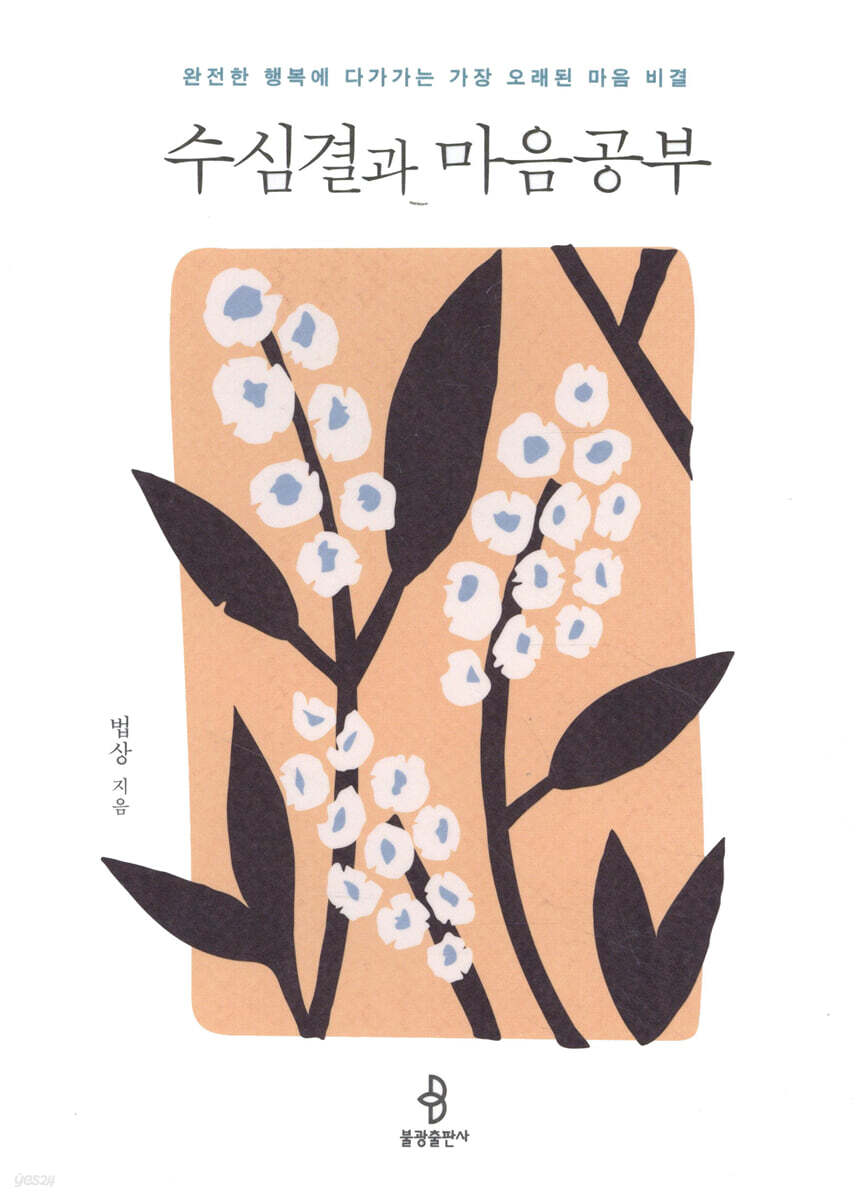
Deep learning and mind study
 |
Description
Book Introduction
The path to the cessation of suffering and complete happiness,
Find answers in practical mind training accessible to everyone!
The core ideas of the national teacher Jinul are embedded in it.
Korea's representative Zen book, 『Susimgyeol (修心訣)』
He is considered the kindest Dharma Master of our time.
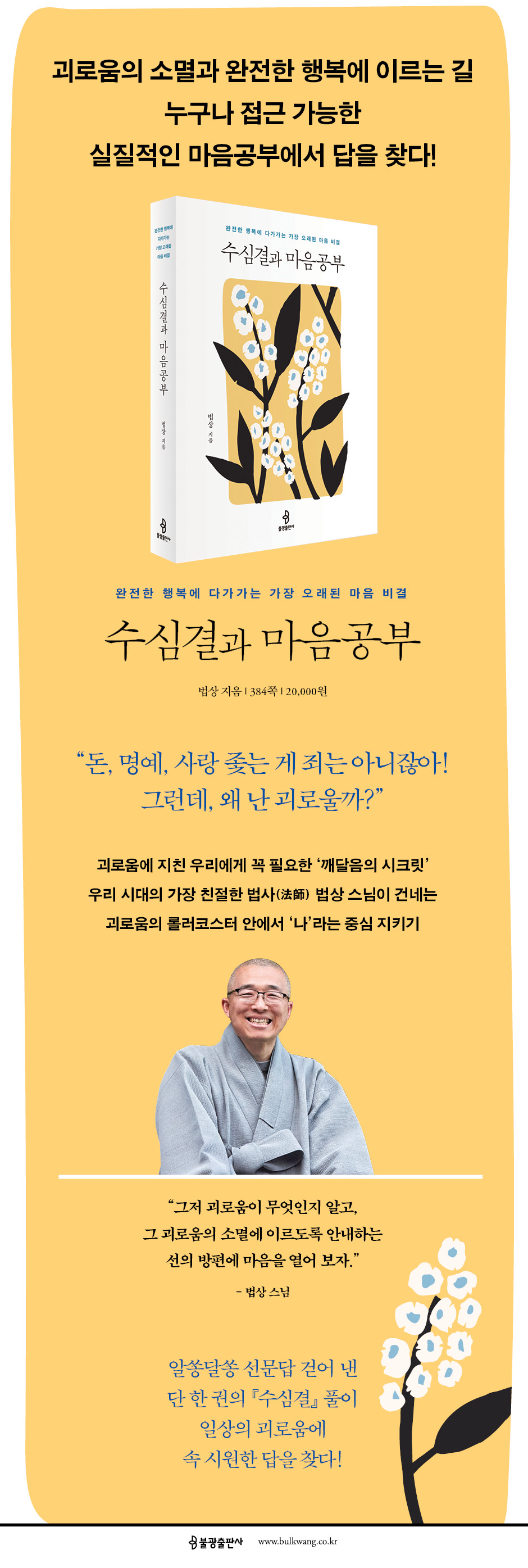
Meet the detailed and innovative commentary of Monk Beopsang!
This book, which explains the 『Susimgyeol (修心訣)』, is not a confusing Zen question and answer or an old story that seems familiar but not.
Monk Moktakso-ri Beopsang, considered the kindest Buddhist teacher of our time, has broken down the difficult subject of Zen Buddhism with easy yet profound, kind yet unconventional explanations.
In particular, it contains the core practices of goodness so that one can directly solve the real and specific problems of suffering that one is facing.
So this book is not a specialized book for outstanding performers.
This is an introductory book to studying the mind and a guide to happiness for everyone living in everyday life, whether at school, at work, or at home.
The Venerable Pomnyun says there is a way to break the roller coaster-like cycle of ups and downs between suffering and happiness.
Going one step further, he emphasizes that if you maintain the center of 'I', you will be comfortable even in the roller coaster of suffering and happiness.
This is because the path to ‘complete happiness’ through practical mind training that anyone can do was discovered in ‘Susimgyeol (修心訣)’.
『Susimgyeol (修心訣)』, which contains the core ideas of the national teacher Jinul, explains how to cultivate the mind and what the true 'self' and 'mind' are.
In particular, it is the best manual on the true 'self' and enlightenment as it explains in detail the method of purifying the mind and becoming a Buddha through nine questions and nine answers.
Monk Beopsang explains this 『Susimgyeol (修心訣)』 in an easy-to-understand way, kindly guiding anyone to begin practicing the mind.
Find answers in practical mind training accessible to everyone!
The core ideas of the national teacher Jinul are embedded in it.
Korea's representative Zen book, 『Susimgyeol (修心訣)』
He is considered the kindest Dharma Master of our time.
Meet the detailed and innovative commentary of Monk Beopsang!
This book, which explains the 『Susimgyeol (修心訣)』, is not a confusing Zen question and answer or an old story that seems familiar but not.
Monk Moktakso-ri Beopsang, considered the kindest Buddhist teacher of our time, has broken down the difficult subject of Zen Buddhism with easy yet profound, kind yet unconventional explanations.
In particular, it contains the core practices of goodness so that one can directly solve the real and specific problems of suffering that one is facing.
So this book is not a specialized book for outstanding performers.
This is an introductory book to studying the mind and a guide to happiness for everyone living in everyday life, whether at school, at work, or at home.
The Venerable Pomnyun says there is a way to break the roller coaster-like cycle of ups and downs between suffering and happiness.
Going one step further, he emphasizes that if you maintain the center of 'I', you will be comfortable even in the roller coaster of suffering and happiness.
This is because the path to ‘complete happiness’ through practical mind training that anyone can do was discovered in ‘Susimgyeol (修心訣)’.
『Susimgyeol (修心訣)』, which contains the core ideas of the national teacher Jinul, explains how to cultivate the mind and what the true 'self' and 'mind' are.
In particular, it is the best manual on the true 'self' and enlightenment as it explains in detail the method of purifying the mind and becoming a Buddha through nine questions and nine answers.
Monk Beopsang explains this 『Susimgyeol (修心訣)』 in an easy-to-understand way, kindly guiding anyone to begin practicing the mind.
- You can preview some of the book's contents.
Preview
index
introduction
For us today,
『Susimgyeol』 by Monk Bojojinul
Why it's needed
1.
The way out of suffering
2.
True heart is the foundation of the whole world
3.
Your own mind is the true Buddha
4.
Obtain Buddha automatically
5.
There is no Buddha who leaves his mind.
6.
Don't seek it from outside
7.
Why can't I see Buddha?
8.
The Buddha's nature lies in action.
9.
You are the Buddha
10.
How does it look?
11.
Enlightenment and supernatural powers
12.
Donohwa score
13.
Supernatural powers are just a strange, peripheral thing.
14.
Explaining Donohwa's score again
15.
Knowing that you don't know is seeing your true nature.
16.
A man who has finished all his work
17.
That's what I'm asking
18.
What do you hear when you listen?
19.
A public mind
20.
Why visibility is necessary
21.
The path of herding cattle after enlightenment
22.
Don't try to get rid of your delusions.
23.
The body and use of meditation and wisdom
24.
Dot-mon, practice of inferior foundation
25.
The wisdom of the enlightened one
26.
Dot, the wisdom of inferior foundation
27.
Questions about the Jeonghye of the Self-Sungmun and the Jeonghye of the Susangmun
28.
Jeong Hye of the Self-Sung and Susangmun Answers Questions
29.
Practice before enlightenment is not true practice.
30.
From an enlightened standpoint, even if you use expedient means, you are not contaminated.
31.
Unsurpassed enlightenment that is in harmony with the fundamentals
32.
The joy of meeting the law
33.
When you encounter the supreme Dharma, become enlightened.
34.
Rare study, pursue it bravely
For us today,
『Susimgyeol』 by Monk Bojojinul
Why it's needed
1.
The way out of suffering
2.
True heart is the foundation of the whole world
3.
Your own mind is the true Buddha
4.
Obtain Buddha automatically
5.
There is no Buddha who leaves his mind.
6.
Don't seek it from outside
7.
Why can't I see Buddha?
8.
The Buddha's nature lies in action.
9.
You are the Buddha
10.
How does it look?
11.
Enlightenment and supernatural powers
12.
Donohwa score
13.
Supernatural powers are just a strange, peripheral thing.
14.
Explaining Donohwa's score again
15.
Knowing that you don't know is seeing your true nature.
16.
A man who has finished all his work
17.
That's what I'm asking
18.
What do you hear when you listen?
19.
A public mind
20.
Why visibility is necessary
21.
The path of herding cattle after enlightenment
22.
Don't try to get rid of your delusions.
23.
The body and use of meditation and wisdom
24.
Dot-mon, practice of inferior foundation
25.
The wisdom of the enlightened one
26.
Dot, the wisdom of inferior foundation
27.
Questions about the Jeonghye of the Self-Sungmun and the Jeonghye of the Susangmun
28.
Jeong Hye of the Self-Sung and Susangmun Answers Questions
29.
Practice before enlightenment is not true practice.
30.
From an enlightened standpoint, even if you use expedient means, you are not contaminated.
31.
Unsurpassed enlightenment that is in harmony with the fundamentals
32.
The joy of meeting the law
33.
When you encounter the supreme Dharma, become enlightened.
34.
Rare study, pursue it bravely
Detailed image
Into the book
Is this something only Buddhists do? Is this a religion? It's neither a religion nor a philosophy.
It has nothing to do with what religion you believe in.
This is a problem of 'me' and it is a matter of whether or not 'my suffering' will be resolved.
Seeking Buddha is simply the way to resolve my own suffering and live freely.
--- pp.37~38
The 'secret of enlightenment', which had been kept secret for a long time or hidden from the light due to expedient means, is now being widely awakened.
The 'Secret of Enlightenment' is not just about healing, wellness, yoga, meditation, etc. that put your mind at ease.
It literally means becoming enlightened and becoming a Buddha.
Becoming a Buddha, you too can become a Buddha right here!
--- p.40
The waves can become violent or calm depending on the weather, but despite the countless waves that come and go and change, the sea always remains the same.
This fundamental nature, which is always the same and unchanging, is called “Yeo-yeo” or “Jin-yeo”.
--- p.67
The original mind is called the ground of the mind, or the heart ground, because it is the ground that causes all things to arise and disappear in the background.
All beings on earth arise and disappear, but just as the earth is the foundation of all things and always remains the same, so too does the original mind exist.
This original mind, the place where I came from, the place where I will return, this fundamental foundation, is called the Mind-Based Dharma Gate.
『Susimgyeol』 is the mind-body method.
--- pp.69~70
People mistakenly think that 'enlightenment' is like a lottery.
Once you realize this, you can expect a dazzling turnaround in your life, with your suffering ending in an instant and you gaining transcendent powers that are different from others and from before.
But contrary to our expectations, realizing this does not mean that all problems will be solved in one fell swoop.
In fact, true practice begins after enlightenment.
It is not that you realize by practicing, but that you realize first and then practice begins.
--- pp.92~93
When we are desperate and frustrated, we often say, "I am desperate," and identify with despair, but in fact, when we were desperate, there was a me who knew despair, and even after that despair and frustration left, there was still a me who knew that despair and frustration had left.
That 'I' did not leave.
Is this 'me' that does not come and go real? Can the emotions, feelings, thoughts, body, etc. that come and go above this 'me' be 'me'?
--- p.156
Enlightenment is not like this.
The wisdom about suffering and the cessation of suffering is enlightenment, but this supernatural ability to change is not the essence.
--- p.181
Studying the mind is similar to a treasure hunt.
It is a subject that anyone can challenge themselves with, as it is not math, English, physical education, or music.
Because everyone already has it.
This treasure hunt called mind study is not about a treasure hidden separately outside of me.
I am finding that I am the treasure.
Anyone can realize that I am a true treasure.
--- p.184
Even if I practice sorcery and supernatural powers with this body, if I am mired in the suffering of illness, aging, and death, how can that be truly supernatural? At the moment of awakening to one's true nature, the true practitioner does not gain supernatural powers, but rather suddenly escapes all suffering, including aging, illness, and death.
Old age, illness, and death will no longer be painful.
Isn't this true supernatural power?
--- p.207
A car traveling at a speed of over 100 km/h continues to move due to inertia even if you take your foot off the accelerator.
The speed will decrease, but it will take time to come to a complete stop.
If this is true for automobiles, what about the discerning habits of living beings that have persisted even longer?
It takes even longer to master this habit of discrimination.
…Of course, applying the brakes doesn’t mean you stop immediately.
It takes time to fully stand up.
This is precisely why, “If you attain enlightenment through enlightenment, you will be like Buddha, but the habits of many lives are deep.
It is as the saying goes, “The wind has stopped, but the waves still sway; the principle has appeared, but delusion still invades.”
--- p.277
Thoughts and delusions arise constantly.
There is nothing wrong with that.
If we do not know how to discern, we cannot live in this world.
Only by learning to think and discern can you know what building and unit your house is in, which bus number to take to get there, where your workplace is, and even recognize your coworkers. Without discernment, you can't even live.
So why try to eliminate discrimination and thinking? They cannot be eliminated, and neither should they be.
Rather than suppressing thoughts and discernment so that they do not arise, we just need to become aware of what they truly are.
All you have to do is realize that it is not a reality, and that the nature of discernment that distinguishes between good and evil, big and small, long and short, right and wrong, etc., is empty.
--- pp.288~289
In Buddhism, it is said that among the six paths of reincarnation, only humans can practice and attain enlightenment.
It is explained that creating karma is only possible in the human world, and in the other five worlds, one only receives karma.
Chew on these words.
Only in the human realm, only humans, only you here and now can create karma, break free from karma, cultivate the truth, and escape suffering.
This is something only you, me, right here, right now, can do.
It has nothing to do with what religion you believe in.
This is a problem of 'me' and it is a matter of whether or not 'my suffering' will be resolved.
Seeking Buddha is simply the way to resolve my own suffering and live freely.
--- pp.37~38
The 'secret of enlightenment', which had been kept secret for a long time or hidden from the light due to expedient means, is now being widely awakened.
The 'Secret of Enlightenment' is not just about healing, wellness, yoga, meditation, etc. that put your mind at ease.
It literally means becoming enlightened and becoming a Buddha.
Becoming a Buddha, you too can become a Buddha right here!
--- p.40
The waves can become violent or calm depending on the weather, but despite the countless waves that come and go and change, the sea always remains the same.
This fundamental nature, which is always the same and unchanging, is called “Yeo-yeo” or “Jin-yeo”.
--- p.67
The original mind is called the ground of the mind, or the heart ground, because it is the ground that causes all things to arise and disappear in the background.
All beings on earth arise and disappear, but just as the earth is the foundation of all things and always remains the same, so too does the original mind exist.
This original mind, the place where I came from, the place where I will return, this fundamental foundation, is called the Mind-Based Dharma Gate.
『Susimgyeol』 is the mind-body method.
--- pp.69~70
People mistakenly think that 'enlightenment' is like a lottery.
Once you realize this, you can expect a dazzling turnaround in your life, with your suffering ending in an instant and you gaining transcendent powers that are different from others and from before.
But contrary to our expectations, realizing this does not mean that all problems will be solved in one fell swoop.
In fact, true practice begins after enlightenment.
It is not that you realize by practicing, but that you realize first and then practice begins.
--- pp.92~93
When we are desperate and frustrated, we often say, "I am desperate," and identify with despair, but in fact, when we were desperate, there was a me who knew despair, and even after that despair and frustration left, there was still a me who knew that despair and frustration had left.
That 'I' did not leave.
Is this 'me' that does not come and go real? Can the emotions, feelings, thoughts, body, etc. that come and go above this 'me' be 'me'?
--- p.156
Enlightenment is not like this.
The wisdom about suffering and the cessation of suffering is enlightenment, but this supernatural ability to change is not the essence.
--- p.181
Studying the mind is similar to a treasure hunt.
It is a subject that anyone can challenge themselves with, as it is not math, English, physical education, or music.
Because everyone already has it.
This treasure hunt called mind study is not about a treasure hidden separately outside of me.
I am finding that I am the treasure.
Anyone can realize that I am a true treasure.
--- p.184
Even if I practice sorcery and supernatural powers with this body, if I am mired in the suffering of illness, aging, and death, how can that be truly supernatural? At the moment of awakening to one's true nature, the true practitioner does not gain supernatural powers, but rather suddenly escapes all suffering, including aging, illness, and death.
Old age, illness, and death will no longer be painful.
Isn't this true supernatural power?
--- p.207
A car traveling at a speed of over 100 km/h continues to move due to inertia even if you take your foot off the accelerator.
The speed will decrease, but it will take time to come to a complete stop.
If this is true for automobiles, what about the discerning habits of living beings that have persisted even longer?
It takes even longer to master this habit of discrimination.
…Of course, applying the brakes doesn’t mean you stop immediately.
It takes time to fully stand up.
This is precisely why, “If you attain enlightenment through enlightenment, you will be like Buddha, but the habits of many lives are deep.
It is as the saying goes, “The wind has stopped, but the waves still sway; the principle has appeared, but delusion still invades.”
--- p.277
Thoughts and delusions arise constantly.
There is nothing wrong with that.
If we do not know how to discern, we cannot live in this world.
Only by learning to think and discern can you know what building and unit your house is in, which bus number to take to get there, where your workplace is, and even recognize your coworkers. Without discernment, you can't even live.
So why try to eliminate discrimination and thinking? They cannot be eliminated, and neither should they be.
Rather than suppressing thoughts and discernment so that they do not arise, we just need to become aware of what they truly are.
All you have to do is realize that it is not a reality, and that the nature of discernment that distinguishes between good and evil, big and small, long and short, right and wrong, etc., is empty.
--- pp.288~289
In Buddhism, it is said that among the six paths of reincarnation, only humans can practice and attain enlightenment.
It is explained that creating karma is only possible in the human world, and in the other five worlds, one only receives karma.
Chew on these words.
Only in the human realm, only humans, only you here and now can create karma, break free from karma, cultivate the truth, and escape suffering.
This is something only you, me, right here, right now, can do.
--- pp.362~363
Publisher's Review
A clear explanation of enlightenment and the path thereafter.
The oldest secret of the mind, 『Susimgyeol (修心訣)』
Monk Beopsang, the epitome of "friendly sermons"
An explanation of the one and only 『Susimgyeol』 that clears away the confusing Zen questions and answers.
Find a refreshing answer to the hardships of everyday life!
It's okay if you don't know Buddha.
It doesn't matter if you don't know Buddhism.
Any religion is fine, or even no religion is fine.
However, if fulfilling your own happiness, such as money, fame, or love, is important, then just open this book.
Is this a self-help book? Half right, half wrong.
This is a gem of a book that discovers the 'heart' as the secret to happiness that is more valuable than the requirements for happiness that follow the ways of the world.
Money, fame, and love are sweet.
The temptation of happiness if you achieve this is also sweet.
As sweet as it is, the 'heart' also rots.
All the suffering we experience in the process of seeking happiness is only soothed by sweetness.
The fact that these things will inevitably disappear in less than 100 years leaves a bitter aftertaste.
Can we find the true happiness of our true "self" that never fades away? There's an age-old secret to achieving complete happiness.
If all the suffering in life is burdensome, if you are curious about the true nature of suffering and want to erase it from your life, and if you want to look into the real 'you' and 'your mind', then open this book.
This book is not about some grand thing called enlightenment.
Even the author doesn't know about the kind of enlightenment that comes only once in a hundred years.
One thing is certain.
Such enlightenment, which can only be attained after years of sitting in meditation without even lying down, is too difficult for ordinary people like us.
However, the way to eliminate suffering and the wisdom to discover ‘I’ and ‘mind’ is not difficult.
From the very first sentence, 『Susimgyeol』 presents a solution to escape suffering.
The best way to escape from a ‘burning house (=suffering)’ is to seek ‘Buddha (=mind)’.
The key is the method.
The author adds a word:
“Let us simply know what suffering is and open our minds to the good methods that lead to the cessation of suffering.”
A detailed interpretation of the Susimgyeol by the monk Beopsang, the "kindest monk."
Why is it called 『Susimgyeol』?
『Susimgyeol (修心訣)』 is a book written by the Goryeo Dynasty's national preceptor, Jinul, to explain how to cultivate the mind and what the mind is.
This book, considered an introductory book to Zen that contains clear instructions on enlightenment and the path thereafter, explains the methodology for cultivating the mind and becoming a Buddha through nine questions and nine answers.
The many questions and answers that permeate the most time-tested secret of the mind, 『Susimgyeol』, remain valid even in the 21st century.
What is Buddha, and what is enlightenment? They say this mind I possess is Buddha, but is it really? The answer offered by Venerable Jinul in "Susimgyeol" was easily explained by Venerable Beopsang, known as "the kindest Dharma teacher of our time," whose voice is known as Moktak Sori.
What does this have to do with me? We are rapidly entering an era where we live in a "society of suffering," comparable to a "society of fatigue."
Any pastor, priest, monk, philosopher, quantum physicist, or humanist can do it, as long as they have teachings that can solve their suffering.
The era of building walls based on affiliation or religion is over.
Escaping from the 'burning house (=suffering)' is an urgent task for everyone.
Is it possible to eradicate the fundamental suffering, rather than through temporary healing or a temporary remedy that replaces it with something sweet?
Monk Beopsang, who interpreted the Susimgyeol, is confident that “it is possible.”
The best way to escape from the endless cycle of suffering, that is, reincarnation, is to seek Buddha.
It's not a grand story about believing in a religion called Buddhism or becoming a Buddha.
The monk defines Buddha simply as “a person who has been freed from all suffering.”
He encourages everyone to realize that they are Buddha through the 'Secret of Enlightenment'.
In this book, the monk divides the questions and answers of 『Susimgyeol』 into 34 parts and kindly explains them.
It gradually answers our questions, starting with the path to freedom from suffering, the true identity of the 'mind' and Buddha nature, why the 'mind' is Buddha, the relationship between enlightenment and supernatural powers, why we cannot find the Buddha, and what our attitude should be after finding the 'mind'.
The Secret to Enlightenment? It's as Easy as a Treasure Hunt at a Picnic
There is one person here.
Is this person tall or short? Handsome or ugly? Male or female? You can't tell from just one person.
Only by comparing ourselves to others can we discern who is big and small, good and bad.
We call this division into two, comparison, understanding and understanding the object the mind.
But it is not the real 'heart'.
It is the mind of rebirth, the mind of discrimination, or the delusion of discrimination.
The monk Beopsang emphasizes that the desire to make what we like our own and to reject and push away what we dislike makes it difficult to find our true 'heart.'
It's painful when you don't have what you like, and it's also painful when things you hate keep appearing.
This discriminating mind is the cause of suffering.
The monk said that this false 'mind' is like a wave.
Waves rise and fall, becoming strong or calm depending on the weather, but the sea is always the same.
Did you notice? The monk says that the sea is truly the 'mind' and 'me'.
Realizing this is not difficult, says Venerable Beopsang.
It is said that only those with exceptional intelligence and those who have reached the extreme in their practice can realize this.
It's as fun and easy as a treasure hunt on a picnic.
Math or English competitions require talent in math and English, and talent shows or singing contests during picnics also require special talent.
But treasure hunting is different.
“Studying the mind is similar to a treasure hunt.
It is a subject that anyone can challenge themselves with, as it is not math, English, physical education, or music.
Because everyone already has it.
This treasure hunt called mind study is not about a treasure hidden separately outside of me.
I am finding that I am the treasure.
“Anyone can realize that I am a true treasure.”
The sermons of the Venerable Beopsang are detailed yet groundbreaking, easy yet profound and powerful.
Even if you are not told to do anything, just by listening to the Dharma, your suffering will naturally subside and your life will change.
We live in the present by receiving that difficult human body.
If we, who have accomplished such a difficult task, read it with our hearts and bodies, taking it into our own hands, we may suddenly discover our true selves.
The oldest secret of the mind, 『Susimgyeol (修心訣)』
Monk Beopsang, the epitome of "friendly sermons"
An explanation of the one and only 『Susimgyeol』 that clears away the confusing Zen questions and answers.
Find a refreshing answer to the hardships of everyday life!
It's okay if you don't know Buddha.
It doesn't matter if you don't know Buddhism.
Any religion is fine, or even no religion is fine.
However, if fulfilling your own happiness, such as money, fame, or love, is important, then just open this book.
Is this a self-help book? Half right, half wrong.
This is a gem of a book that discovers the 'heart' as the secret to happiness that is more valuable than the requirements for happiness that follow the ways of the world.
Money, fame, and love are sweet.
The temptation of happiness if you achieve this is also sweet.
As sweet as it is, the 'heart' also rots.
All the suffering we experience in the process of seeking happiness is only soothed by sweetness.
The fact that these things will inevitably disappear in less than 100 years leaves a bitter aftertaste.
Can we find the true happiness of our true "self" that never fades away? There's an age-old secret to achieving complete happiness.
If all the suffering in life is burdensome, if you are curious about the true nature of suffering and want to erase it from your life, and if you want to look into the real 'you' and 'your mind', then open this book.
This book is not about some grand thing called enlightenment.
Even the author doesn't know about the kind of enlightenment that comes only once in a hundred years.
One thing is certain.
Such enlightenment, which can only be attained after years of sitting in meditation without even lying down, is too difficult for ordinary people like us.
However, the way to eliminate suffering and the wisdom to discover ‘I’ and ‘mind’ is not difficult.
From the very first sentence, 『Susimgyeol』 presents a solution to escape suffering.
The best way to escape from a ‘burning house (=suffering)’ is to seek ‘Buddha (=mind)’.
The key is the method.
The author adds a word:
“Let us simply know what suffering is and open our minds to the good methods that lead to the cessation of suffering.”
A detailed interpretation of the Susimgyeol by the monk Beopsang, the "kindest monk."
Why is it called 『Susimgyeol』?
『Susimgyeol (修心訣)』 is a book written by the Goryeo Dynasty's national preceptor, Jinul, to explain how to cultivate the mind and what the mind is.
This book, considered an introductory book to Zen that contains clear instructions on enlightenment and the path thereafter, explains the methodology for cultivating the mind and becoming a Buddha through nine questions and nine answers.
The many questions and answers that permeate the most time-tested secret of the mind, 『Susimgyeol』, remain valid even in the 21st century.
What is Buddha, and what is enlightenment? They say this mind I possess is Buddha, but is it really? The answer offered by Venerable Jinul in "Susimgyeol" was easily explained by Venerable Beopsang, known as "the kindest Dharma teacher of our time," whose voice is known as Moktak Sori.
What does this have to do with me? We are rapidly entering an era where we live in a "society of suffering," comparable to a "society of fatigue."
Any pastor, priest, monk, philosopher, quantum physicist, or humanist can do it, as long as they have teachings that can solve their suffering.
The era of building walls based on affiliation or religion is over.
Escaping from the 'burning house (=suffering)' is an urgent task for everyone.
Is it possible to eradicate the fundamental suffering, rather than through temporary healing or a temporary remedy that replaces it with something sweet?
Monk Beopsang, who interpreted the Susimgyeol, is confident that “it is possible.”
The best way to escape from the endless cycle of suffering, that is, reincarnation, is to seek Buddha.
It's not a grand story about believing in a religion called Buddhism or becoming a Buddha.
The monk defines Buddha simply as “a person who has been freed from all suffering.”
He encourages everyone to realize that they are Buddha through the 'Secret of Enlightenment'.
In this book, the monk divides the questions and answers of 『Susimgyeol』 into 34 parts and kindly explains them.
It gradually answers our questions, starting with the path to freedom from suffering, the true identity of the 'mind' and Buddha nature, why the 'mind' is Buddha, the relationship between enlightenment and supernatural powers, why we cannot find the Buddha, and what our attitude should be after finding the 'mind'.
The Secret to Enlightenment? It's as Easy as a Treasure Hunt at a Picnic
There is one person here.
Is this person tall or short? Handsome or ugly? Male or female? You can't tell from just one person.
Only by comparing ourselves to others can we discern who is big and small, good and bad.
We call this division into two, comparison, understanding and understanding the object the mind.
But it is not the real 'heart'.
It is the mind of rebirth, the mind of discrimination, or the delusion of discrimination.
The monk Beopsang emphasizes that the desire to make what we like our own and to reject and push away what we dislike makes it difficult to find our true 'heart.'
It's painful when you don't have what you like, and it's also painful when things you hate keep appearing.
This discriminating mind is the cause of suffering.
The monk said that this false 'mind' is like a wave.
Waves rise and fall, becoming strong or calm depending on the weather, but the sea is always the same.
Did you notice? The monk says that the sea is truly the 'mind' and 'me'.
Realizing this is not difficult, says Venerable Beopsang.
It is said that only those with exceptional intelligence and those who have reached the extreme in their practice can realize this.
It's as fun and easy as a treasure hunt on a picnic.
Math or English competitions require talent in math and English, and talent shows or singing contests during picnics also require special talent.
But treasure hunting is different.
“Studying the mind is similar to a treasure hunt.
It is a subject that anyone can challenge themselves with, as it is not math, English, physical education, or music.
Because everyone already has it.
This treasure hunt called mind study is not about a treasure hidden separately outside of me.
I am finding that I am the treasure.
“Anyone can realize that I am a true treasure.”
The sermons of the Venerable Beopsang are detailed yet groundbreaking, easy yet profound and powerful.
Even if you are not told to do anything, just by listening to the Dharma, your suffering will naturally subside and your life will change.
We live in the present by receiving that difficult human body.
If we, who have accomplished such a difficult task, read it with our hearts and bodies, taking it into our own hands, we may suddenly discover our true selves.
GOODS SPECIFICS
- Date of issue: February 1, 2023
- Page count, weight, size: 384 pages | 562g | 150*210*23mm
- ISBN13: 9791192476858
- ISBN10: 1192476859
You may also like
카테고리
korean


korean

![GQ KOREA Mark (Monthly): December [2025]](http://librairie.coreenne.fr/cdn/shop/files/8ef265dbbfbf186523ed75ba7319009d.jpg?v=1765340328&width=3840)


