

Do it! Complete C++ Mastery
 |
Description
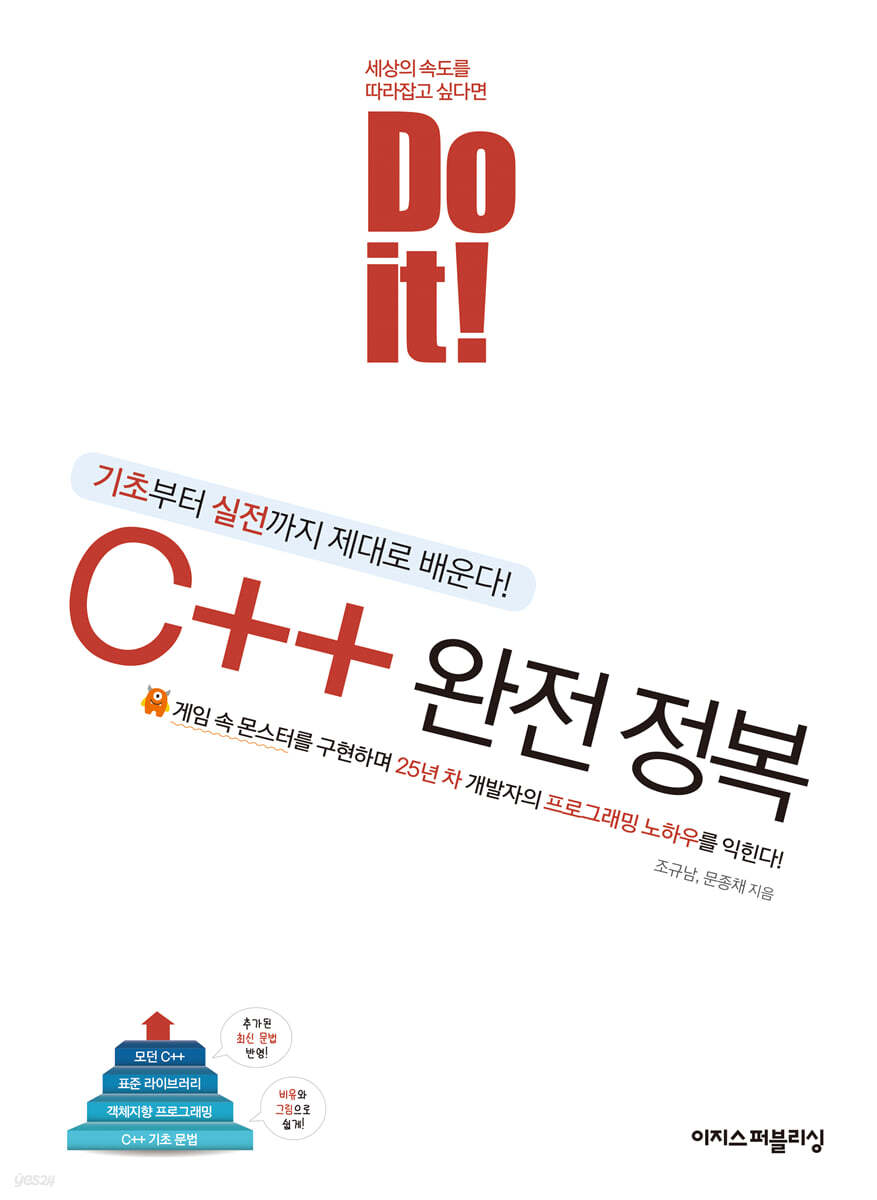
Book Introduction
C++ programming methods required in practice! Now, let's break away from the C language style and code in C++! An expert with a long career in C++ will guide readers learning object-oriented programming from its concepts to its application. The author explains the basic grammar of the C++ language in an easy-to-understand manner using diagrams and analogies, and shows how object-oriented programming is utilized in practice based on the author's experience programming in C++ today. We will explain in detail how to apply the four characteristics of object-oriented programming - abstraction, encapsulation, polymorphism, and inheritance - to source code, and we will write source code that applies SOLID design principles while implementing a monster in a game over hundreds of lines. You can review key concepts by taking quizzes in between, and improve your skills by solving review problems after completing a unit. In particular, the difficulty of the reflection questions has been adjusted to take into account readers preparing for coding tests, and high-quality solution code and explanations are provided separately. |
- You can preview some of the book's contents.
Preview
index
========================
First Yard C++ Programming Basics
========================
01 Getting Started with C++ Programming
01-1 Learning the C++ Language
01-2 Preparing the Development Environment
02 Variables and Operators
02-1 C++ Standard Input/Output
02-2 Data Format
02-3 Variable scope and type conversion
02-4 Keywords and Literals
02-5 Expressions and Operators
03 Pointers and Memory Structure
03-1 Pointers and Memory
03-2 Functions and Structures
03-3 Static and constant variables
03-4 Reference Variables
04 Execution Flow Control
04-1 Flow control with conditional statements
04-2 Flow control with loops
04-3 Differences between expressions and syntax
05 Handling Exceptions
05-1 Exception Handling Syntax
05-2 Omitting exception handling and responding to failures
=======================
Second Yard Object-Oriented Programming
=======================
06 Object-Oriented Programming and Classes
06-1 Programming paradigms before object-oriented
06-2 Object-Oriented Programming
06-3 Classes and Instances
07 Object-Oriented Programming Features
07-1 Abstraction and Encapsulation
07-2 Inheritance and Polymorphism
07-3 Constructors and Destructors
07-4 this pointer pointing to itself
07-5 Function and Operator Overloading
07-6 Access Specifiers and Friends
08 Functions that help object orientation
08-1 Composition and Aggregation
08-2 Virtual functions and dynamic binding
08-3 Abstract classes and static members
09 Object-Oriented Design Principles
09-1 Single Responsibility Principle (SRP)
09-2 Open Closed Principle (OCP)
09-3 Liskov Substitution Principle (LSP)
09-4 Interface Segregation Principle (ISP)
09-5 Dependency Inversion Principle (DIP)
10 templates
10-1 Function Template
10-2 Class Template
=======================
Third Yard Library Utilization
=======================
11 C++ Standard Library
11-1 Standard Library Configuration and Usage
11-2 String Library
11-3 File System
11-4 Other useful functions
12 STL Containers and Algorithms
12-1 Containers and Iterators
Algorithm 12-2
=======================
Fourth Yard Modern C++ Programming
=======================
13 Features added to Modern C++
13-1 Key Features by C++ Version
13-2 A Modern Perspective on C++
14 New data types and libraries
14-1 Formal deduction, enumerations, mathematical constants, null pointers, binary representation
14-2 Constant designator constexpr
14-3 function object
14-4 Smart Pointers
15 New Phrases 1
15-1 Tuples and Structural Bindings
15-2 Range-based for loop
15-3 Initialization syntax of control statements
15-4 Lambda Expressions
16 New Phrases 2
16-1 Fold Expression
16-2 Three-way comparison operator
16-3 using keywords
16-4 Function keywords (default, delete, override, final)
Search
First Yard C++ Programming Basics
========================
01 Getting Started with C++ Programming
01-1 Learning the C++ Language
01-2 Preparing the Development Environment
02 Variables and Operators
02-1 C++ Standard Input/Output
02-2 Data Format
02-3 Variable scope and type conversion
02-4 Keywords and Literals
02-5 Expressions and Operators
03 Pointers and Memory Structure
03-1 Pointers and Memory
03-2 Functions and Structures
03-3 Static and constant variables
03-4 Reference Variables
04 Execution Flow Control
04-1 Flow control with conditional statements
04-2 Flow control with loops
04-3 Differences between expressions and syntax
05 Handling Exceptions
05-1 Exception Handling Syntax
05-2 Omitting exception handling and responding to failures
=======================
Second Yard Object-Oriented Programming
=======================
06 Object-Oriented Programming and Classes
06-1 Programming paradigms before object-oriented
06-2 Object-Oriented Programming
06-3 Classes and Instances
07 Object-Oriented Programming Features
07-1 Abstraction and Encapsulation
07-2 Inheritance and Polymorphism
07-3 Constructors and Destructors
07-4 this pointer pointing to itself
07-5 Function and Operator Overloading
07-6 Access Specifiers and Friends
08 Functions that help object orientation
08-1 Composition and Aggregation
08-2 Virtual functions and dynamic binding
08-3 Abstract classes and static members
09 Object-Oriented Design Principles
09-1 Single Responsibility Principle (SRP)
09-2 Open Closed Principle (OCP)
09-3 Liskov Substitution Principle (LSP)
09-4 Interface Segregation Principle (ISP)
09-5 Dependency Inversion Principle (DIP)
10 templates
10-1 Function Template
10-2 Class Template
=======================
Third Yard Library Utilization
=======================
11 C++ Standard Library
11-1 Standard Library Configuration and Usage
11-2 String Library
11-3 File System
11-4 Other useful functions
12 STL Containers and Algorithms
12-1 Containers and Iterators
Algorithm 12-2
=======================
Fourth Yard Modern C++ Programming
=======================
13 Features added to Modern C++
13-1 Key Features by C++ Version
13-2 A Modern Perspective on C++
14 New data types and libraries
14-1 Formal deduction, enumerations, mathematical constants, null pointers, binary representation
14-2 Constant designator constexpr
14-3 function object
14-4 Smart Pointers
15 New Phrases 1
15-1 Tuples and Structural Bindings
15-2 Range-based for loop
15-3 Initialization syntax of control statements
15-4 Lambda Expressions
16 New Phrases 2
16-1 Fold Expression
16-2 Three-way comparison operator
16-3 using keywords
16-4 Function keywords (default, delete, override, final)
Search
Detailed image

Publisher's Review
▶ Learn the basic grammar of the C++ language quickly and easily.
The basic grammar of the C++ language is explained in an easy-to-understand way using pictures and analogies.
We've highlighted the differences compared to the C language to accommodate those who have already learned it, and even those who haven't learned it can quickly review the key points.
▶ Discover the true value of C++ by implementing the game's monster code.
Beyond just a snippet of code that explains object-oriented concepts, hundreds of lines apply design principles, design patterns, etc.
Let's implement a monster in the game with this code.
Execution results and class die along with source code
We've made it easy to understand the program's behavior and structure through agram.
▶ You can convert code written in C style to C++.
If you use C++ but still code in a C-style, this book is for you.
The practical source code in this book goes beyond simply introducing grammar. It naturally teaches you the know-how of 25 years of development experience, including easy-to-maintain and read code, and how to detect errors at the compile stage.
▶ You will also learn techniques frequently used in the standard library.
You can learn techniques that make development easier and more convenient, such as the string library, file system, and other useful functions supported by the C++ standard library.
You will also learn techniques frequently used when handling data, such as STL containers and algorithms.
▶ You can also check out the major changes in modern C++.
It also doesn't miss out on new features supported starting with C++11, the so-called 'modern C++'.
▶ OK to study alone, OK for short-term training
Whether you're self-studying or learning at a school or academy, write down your target dates on the progress chart provided in the book and learn C++ at your own pace.
Setting goals increases your chances of completing the book.
▶ Target audience for this book
- For those who are learning object-oriented programming languages for the first time
- Those who use object-oriented languages but want to reorganize the concepts and usage methods.
▶ Aegis Publishing Reader Learning Support
※ Author's GitHub for Q&A: github.com/mystous/DoItCPP/issues
※ Latest updates: Do it! Study Room (cafe.naver.com/doitstudyroom)
※ Join the [Do it! Study Group] operated by 'Do it! Study Room'.
If you study with this book and write your own study notes, you can receive other books published by Aegis Publishing as a gift.
The basic grammar of the C++ language is explained in an easy-to-understand way using pictures and analogies.
We've highlighted the differences compared to the C language to accommodate those who have already learned it, and even those who haven't learned it can quickly review the key points.
▶ Discover the true value of C++ by implementing the game's monster code.
Beyond just a snippet of code that explains object-oriented concepts, hundreds of lines apply design principles, design patterns, etc.
Let's implement a monster in the game with this code.
Execution results and class die along with source code
We've made it easy to understand the program's behavior and structure through agram.
▶ You can convert code written in C style to C++.
If you use C++ but still code in a C-style, this book is for you.
The practical source code in this book goes beyond simply introducing grammar. It naturally teaches you the know-how of 25 years of development experience, including easy-to-maintain and read code, and how to detect errors at the compile stage.
▶ You will also learn techniques frequently used in the standard library.
You can learn techniques that make development easier and more convenient, such as the string library, file system, and other useful functions supported by the C++ standard library.
You will also learn techniques frequently used when handling data, such as STL containers and algorithms.
▶ You can also check out the major changes in modern C++.
It also doesn't miss out on new features supported starting with C++11, the so-called 'modern C++'.
▶ OK to study alone, OK for short-term training
Whether you're self-studying or learning at a school or academy, write down your target dates on the progress chart provided in the book and learn C++ at your own pace.
Setting goals increases your chances of completing the book.
▶ Target audience for this book
- For those who are learning object-oriented programming languages for the first time
- Those who use object-oriented languages but want to reorganize the concepts and usage methods.
▶ Aegis Publishing Reader Learning Support
※ Author's GitHub for Q&A: github.com/mystous/DoItCPP/issues
※ Latest updates: Do it! Study Room (cafe.naver.com/doitstudyroom)
※ Join the [Do it! Study Group] operated by 'Do it! Study Room'.
If you study with this book and write your own study notes, you can receive other books published by Aegis Publishing as a gift.
GOODS SPECIFICS
- Date of issue: March 27, 2024
- Page count, weight, size: 600 pages | 1,200g | 188*257*25mm
- ISBN13: 9791163035695
You may also like
카테고리
korean


korean

![GQ KOREA Mark (Monthly): December [2025]](http://librairie.coreenne.fr/cdn/shop/files/8ef265dbbfbf186523ed75ba7319009d.jpg?v=1765340328&width=3840)


