

Eight blessings of deep reading
 |
Description
Book Introduction
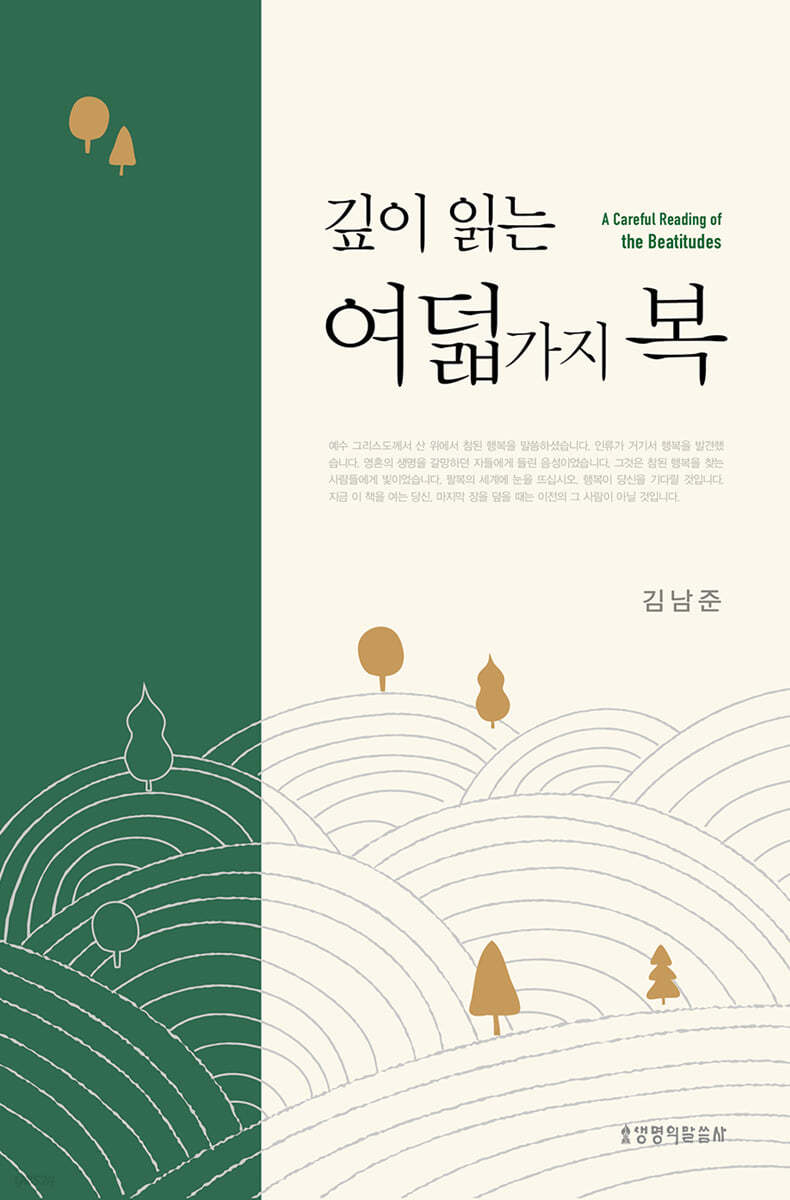
For the true happiness of Christians Pastor Kim Nam-joon's Understanding of the Eight Beatitudes of the Sermon on the Mount The Beatitudes reveal the character of Christ, worthy of imitation. The Beatitudes are eight statements about Jesus' character. An invitation to true happiness and satisfaction in Jesus Christ Everyone in the world wants to be happy, and they spend their entire lives searching for that happiness. No one becomes unhappy because they want to be unhappy. Those who are unhappy do not choose to be unhappy, but rather mistakenly believe that the path will lead to happiness. Modern people instinctively and willfully aim for material abundance and personal peace from birth and persistently pursue them, but they do not truly know what the essence of happiness is that they long for, yet it remains elusive. Because they consider themselves the center of everything, consider self-satisfaction to be their highest value, and only seek to achieve it, even if they finally achieve it, it is often nothing more than a vain and empty self-deception. Pastor Kim Nam-jun's other book on deep reading, "The Eight Beatitudes: A Deep Reading," discusses in detail the eight beatitudes proclaimed by Jesus Christ on the Mount of Beatitudes, helping us understand the true happiness and satisfaction that humans should desire. It does not lead to the temporary gains that we follow in vain, but to the incomparable true blessings that Jesus Christ, the only one who has experienced perfect and flawless happiness, spoke of and directly demonstrated through his own character. |
- You can preview some of the book's contents.
Preview
index
Author's Preface: Happiness is being human.
Chapter 1: Let's Climb Mount Palbok
Introduction | Beyond Healing | Looking at the Crowd | Opening His Mouth to Speak | Speaking from the Mountain | Conclusion
Chapter 2: The Poor in Spirit
Introduction | Human Happiness | What Is Poverty? | Poverty of Heart and Faith | The Happiness of the Poor in Spirit | Enjoying the Kingdom Now | Conclusion
Chapter 3: The Mourner
Introduction | Mourning for Sin | Mourning for the Kingdom of God | Blessings for Those Who Mourn | Conclusion
Chapter 4 The Meek
Introduction | What is Meekness? | Characteristics of the Meek | The Blessings of the Meek | Conclusion
Chapter 5: Those Who Hunger and Thirst for Righteousness
Introduction | What is righteousness? | Those who hunger and thirst for righteousness | Satisfaction for those who hunger and thirst for righteousness | Conclusion
Chapter 6: The Merciful
Introduction | What is Mercy? | The Life of One Who Is Indebted to Mercy | Show Heaven's Order Through Mercy | The Blessings of the Merciful | Conclusion
Chapter 7: The Pure in Heart
Introduction | What is Cleanliness? | The Path to Purity of Heart | The Happiness of the Pure in Heart | Conclusion
Chapter 8: The Peacemakers
Introduction | What is Peace? | Misconceptions about Peace | Broken Peace | Peacemakers | The Blessings of Peacemakers | Becoming a Son of God | Conclusion
Chapter 9: The Persecuted
Introduction | What is Persecution? | A World That Persecutes Believers | The Happiness of the Persecuted | Conclusion
Chapter 10: People Who Rejoice
Introduction | Jesus' Likeness and Suffering | How the World Persecutes | Suffering Prophets | Heaven's Rewards | The True Joy of the Saints | Conclusion
Epilogue
References
Bible Verse Index
Topic Index
Chapter 1: Let's Climb Mount Palbok
Introduction | Beyond Healing | Looking at the Crowd | Opening His Mouth to Speak | Speaking from the Mountain | Conclusion
Chapter 2: The Poor in Spirit
Introduction | Human Happiness | What Is Poverty? | Poverty of Heart and Faith | The Happiness of the Poor in Spirit | Enjoying the Kingdom Now | Conclusion
Chapter 3: The Mourner
Introduction | Mourning for Sin | Mourning for the Kingdom of God | Blessings for Those Who Mourn | Conclusion
Chapter 4 The Meek
Introduction | What is Meekness? | Characteristics of the Meek | The Blessings of the Meek | Conclusion
Chapter 5: Those Who Hunger and Thirst for Righteousness
Introduction | What is righteousness? | Those who hunger and thirst for righteousness | Satisfaction for those who hunger and thirst for righteousness | Conclusion
Chapter 6: The Merciful
Introduction | What is Mercy? | The Life of One Who Is Indebted to Mercy | Show Heaven's Order Through Mercy | The Blessings of the Merciful | Conclusion
Chapter 7: The Pure in Heart
Introduction | What is Cleanliness? | The Path to Purity of Heart | The Happiness of the Pure in Heart | Conclusion
Chapter 8: The Peacemakers
Introduction | What is Peace? | Misconceptions about Peace | Broken Peace | Peacemakers | The Blessings of Peacemakers | Becoming a Son of God | Conclusion
Chapter 9: The Persecuted
Introduction | What is Persecution? | A World That Persecutes Believers | The Happiness of the Persecuted | Conclusion
Chapter 10: People Who Rejoice
Introduction | Jesus' Likeness and Suffering | How the World Persecutes | Suffering Prophets | Heaven's Rewards | The True Joy of the Saints | Conclusion
Epilogue
References
Bible Verse Index
Topic Index
Into the book
It was when I turned from being an atheist to converting to Christianity.
I was so happy to have converted to Christ.
The whole world was like a picture book, and my life was like a novel.
Picture books showed me God, and novels told me the plan for my life.
I gave up all the literature, philosophy, and contemplation on life that I loved so much.
I thought that was faith.
But it was only for a moment that I felt that was right.
It wasn't long before things got confusing.
Because I didn't really know how to connect my Christian faith to my life.
People I had believed in for a long time didn't seem any different from me, who had just started believing.
I began to ponder what a living faith should be like.
Becoming a Christian is not about 'having' something, nor is it about 'doing' something.
To become a Christian is to 'become'.
It is about becoming personally like Christ.
Because He is the model of a true man, and therein lies happiness.
Believing in Jesus is to become a true human being, and becoming a human being is to live according to the purpose of creation and enjoy happiness.
From ‘doem’ comes ‘ham’, and from ‘ham’ comes ‘got’, which becomes meaningful.
Introduction
The life of Christ was a story of teaching the ignorant.
He taught on the road, by the sea, and in the synagogues.
He preached the word everywhere.
The teachings in this text are called the ‘Sermon on the Mount’ because they were given on the mountain.
The word 'Suhun' means 'a lesson that will be left for future generations.'
Through these words, He taught us who the citizens of heaven are and how they should live.
This reminds us of Moses, who received the law on Mount Sinai and taught the Israelites (Exodus 34:32).
Beyond healing
He began his public ministry by being baptized by John (Matthew 3:13-17).
After calling his disciples (Matthew 4:18-22), he went throughout Galilee, preaching the gospel.
He healed every disease and every sickness (Matthew 4:23).
The rumor spread throughout Syria.
Some of those who were healed returned home.
Because I got what I wanted.
But some people were not satisfied.
Because although the physical illness was cured, the spiritual problem still remained.
People from Galilee, Decapolis, Jerusalem, Judea, and the other side of the Jordan followed Jesus (Matthew 4:24-25).
It wasn't to see a miracle.
It was because I wanted to know the truth.
Getting rid of illness is an important thing.
It's also a good thing that your worries are resolved.
Have you experienced an amazing miracle? Have you been saved from a difficult time in life? Well done.
But that's just the beginning.
Humans were created as beings with body and soul (Genesis 2:7).
The life of the body is in the soul, and the life of the soul is in God.
To be happy, not only your body but also your soul must be in good condition.
Good condition means that they are functioning well for the purpose for which they were originally created.
To do this, the body and soul must be adequately supplied with what they need.
Body and soul are different things.
Their origins are different and they require different resources.
The body comes from the earth, it is material.
So it requires terrestrial resources.
We need shelter and clothing to protect us from cold and heat, and water and food to sustain our lives and vitality (Matthew 6:11).
In contrast, the soul comes from heaven and is not material (Gen. 2:7).
So we need celestial resources.
We need the word of truth, which is the food of the soul, and love, which is the life of the soul.
The resources of the body are material.
The world's resources are limited and human desires are infinite.
That's why we want to have more through fierce competition.
Humans are keenly aware of the lack of physical resources.
In contrast, the soul's resource is life.
It is spiritual life.
It is not something that can be taken from others.
The deficiency is not felt keenly.
Look at the crowd
He looked at the crowd that followed him.
You climbed the mountain.
The disciples came forward.
He taught the word.
He did not teach only to his disciples.
It was a sermon given to more people.
“When Jesus saw the crowds, he went up on a mountainside; and when he was seated, his disciples came to him” (Matthew 5:1).
The Greek word 'idon', translated 'see', does not mean only seeing with the physical eyes.
Rather, it means to see through and understand the background of things.
Here it means recognizing the state of the soul that cannot be seen with human eyes.
When you look at the crowd, your heart seems to be breaking.
Because they were harassed and helpless, like sheep without a shepherd (Matthew 9:36).
We think that what we can see with our physical eyes is all there is.
So, we only focus on physical matters.
The poor want to become rich, and the sick want to get well.
People whose relationships are broken want to recover.
Because I believe that then I will be happy.
To some extent, that is true.
Therefore, we must try to improve this situation.
We must feed the hungry, heal the sick, and befriend the lonely.
But that alone cannot lead to true happiness.
As soon as one problem is solved, another one comes up, so the suffering of life is endless.
It will always be like this as long as we live on this earth.
Because there are more unavoidable sad days than happy days that come naturally.
The fact that the Chinese character word 'happiness' (幸福) itself means 'unexpected good fortune' also speaks to this fact.
Human suffering has a fundamental cause.
Because our relationship with God is broken.
It was because of sin.
Broken relationships lead to a lack of resources.
It was a lack of resources for body and soul.
This made humans unhappy.
Sin also broke relationships between people.
So peace with people was broken, and their relationship with nature was also destroyed (Gen. 3:17-18).
Conflict arose, and humans had to struggle for survival.
It was because of sin.
True happiness could not be achieved without resolving sin.
Because there was no way to obtain the resources to live a happy life.
For this reason, God sent Christ.
He took our sins upon Himself and died on the cross, reconciling us to God (Romans 5:10, 2 Corinthians 5:18).
He healed my broken relationship with God.
By saving us, He has enabled us to be supplied with heavenly resources again.
He gave us life in our souls.
Open your mouth and speak
Christ spoke the word of truth.
It was to give us spiritual life and a more abundant life (John 10:10).
“He opened his mouth and taught them” (Matthew 5:2).
The Sermon on the Mount in the Gospel of Matthew is recorded over three chapters (Matthew 5:3-7:27).
But that's actually a summary of a long sermon you gave.
He must have poured out many teachings about the identity and life of the people of heaven.
The Sermon on the Mount is a distillation of its essence.
You opened your mouth.
The words poured out as if the floodgates of a dam had opened.
It poured out like a waterfall without any hesitation or faltering.
How could that be possible?
As the Son of God, he would have known the truth well.
Moreover, is he not the truth itself? (John 14:6) But there was another reason.
He loved and studied the Bible from a young age (Luke 2:52).
At the age of twelve, he already possessed a wisdom of speech that astonished even the teachers of the temple (Luke 2:44-47).
There is something striking about this.
The word that is proclaimed is experiential and personal.
He had neither a Bible nor a manuscript in his hands.
He preached not only with knowledge but also with experience.
It was a teaching of truth personified.
I felt an extraordinary authority.
He captured the hearts of the crowds that gathered around him (Matthew 7:28-29).
When he opened his mouth and spoke, people listened attentively to his words.
It was a longing for God's love.
If you long to meet God, you will long for His Word.
Just as a thirsty person in the scorching sun seeks water, or a person who has been hungry for several days seeks food, so too do we seek it.
Because the Word is the food of life and the wisdom of life.
What does it mean to live in dependence on God? Isn't it living with your heart held fast to the Word? Isn't the Bible absolutely influential on your character and life? Isn't it living under the influence of truth? What fills your heart? People want to know where to buy land to become rich, or which stocks to buy to make a fortune.
We must listen to the word with greater eagerness than that.
A person of Christ is a person of the Word.
We must become people who weep loudly like the Apostle John on the island of Patmos, longing to know God's will.
“And I wept bitterly, because no one was found worthy to open the scroll or to look into it” (Revelation 5:4).
Hear from the mountain
It was not a high mountain where the Sermon on the Mount resonated.
It was a hill-like place.
It wasn't a famous place.
Why wasn't it a crowded market street? Why wasn't it a synagogue, a favorite gathering place for Jews? Why did he go up to the mountain to preach? There were no miracles there.
But something bigger was happening than that.
“When Jesus finished saying these things, the crowds were amazed at his teaching, for he taught them as one who had authority, and not as their scribes” (Matthew 7:28-29).
You called me out from a busy street.
It was to help people take their minds off the messy affairs of the world.
Those who were not satisfied with just healing the sick followed.
He gathered together those who were thirsty for the word.
You helped me focus on your sermon.
[Omitted] To meet God in a special way, a separate place is needed.
To seek Him earnestly with a distinct heart.
So that you can focus there and not be disturbed.
There is a close connection between concentration of mind and the experience of grace.
When you focus on the word, you receive grace.
When you are willing to obey whatever word you receive, you will meet God.
When you decide to leave the world, you will have the heart to meet God.
You meet people climbing Mount Palbok like this.
Where is your heart now? Is it in the world? In a scattered heart, there is no echo of the Word.
How can we meet God with a mind torn by worldly love? We must do so with all our heart and soul (Deut. 4:29).
Take a moment to detach yourself from the fleeting affairs of this world.
Leave the world behind for a moment.
Climb Mount Palbok.
There you will meet Christ, who speaks of true happiness.
If you desire happiness but don't listen to the Word, how can your desire be genuine? There is hope for true happiness.
No matter how dark the night of reality may be, let it be a ray of light.
Abandon the foolishness of trying to be happy without God.
How much more miserable can you be? Climb Mount Palbok.
He will meet us with burning love.
He will have mercy on you (Hosea 11:8).
He will heal the root of our misfortunes.
Conclusion
How will you live your life? Will you live as you did before, without knowing God? Will you give up on happiness and live without truth? Will you live like this and die without regrets? He spoke of true happiness on that mountain.
Countless people have found a way to live there.
The words that resounded from Mount Palbok were not heard by those who only cared about physical needs.
It was a voice heard only by those who longed for the life of the soul.
It gave light to those who seek true happiness (John 21:19).
Our lives are precious.
Life is too short to live carelessly, and too long to live well.
Just as we are saved by the word, we attain true happiness through truth.
Open your eyes to the world of blessings.
May you be blessed by the word.
Happiness awaits you.
Because you, who are now opening this book and climbing Mount Palbok, will no longer be the same person you were before when you close the last chapter.
I was so happy to have converted to Christ.
The whole world was like a picture book, and my life was like a novel.
Picture books showed me God, and novels told me the plan for my life.
I gave up all the literature, philosophy, and contemplation on life that I loved so much.
I thought that was faith.
But it was only for a moment that I felt that was right.
It wasn't long before things got confusing.
Because I didn't really know how to connect my Christian faith to my life.
People I had believed in for a long time didn't seem any different from me, who had just started believing.
I began to ponder what a living faith should be like.
Becoming a Christian is not about 'having' something, nor is it about 'doing' something.
To become a Christian is to 'become'.
It is about becoming personally like Christ.
Because He is the model of a true man, and therein lies happiness.
Believing in Jesus is to become a true human being, and becoming a human being is to live according to the purpose of creation and enjoy happiness.
From ‘doem’ comes ‘ham’, and from ‘ham’ comes ‘got’, which becomes meaningful.
Introduction
The life of Christ was a story of teaching the ignorant.
He taught on the road, by the sea, and in the synagogues.
He preached the word everywhere.
The teachings in this text are called the ‘Sermon on the Mount’ because they were given on the mountain.
The word 'Suhun' means 'a lesson that will be left for future generations.'
Through these words, He taught us who the citizens of heaven are and how they should live.
This reminds us of Moses, who received the law on Mount Sinai and taught the Israelites (Exodus 34:32).
Beyond healing
He began his public ministry by being baptized by John (Matthew 3:13-17).
After calling his disciples (Matthew 4:18-22), he went throughout Galilee, preaching the gospel.
He healed every disease and every sickness (Matthew 4:23).
The rumor spread throughout Syria.
Some of those who were healed returned home.
Because I got what I wanted.
But some people were not satisfied.
Because although the physical illness was cured, the spiritual problem still remained.
People from Galilee, Decapolis, Jerusalem, Judea, and the other side of the Jordan followed Jesus (Matthew 4:24-25).
It wasn't to see a miracle.
It was because I wanted to know the truth.
Getting rid of illness is an important thing.
It's also a good thing that your worries are resolved.
Have you experienced an amazing miracle? Have you been saved from a difficult time in life? Well done.
But that's just the beginning.
Humans were created as beings with body and soul (Genesis 2:7).
The life of the body is in the soul, and the life of the soul is in God.
To be happy, not only your body but also your soul must be in good condition.
Good condition means that they are functioning well for the purpose for which they were originally created.
To do this, the body and soul must be adequately supplied with what they need.
Body and soul are different things.
Their origins are different and they require different resources.
The body comes from the earth, it is material.
So it requires terrestrial resources.
We need shelter and clothing to protect us from cold and heat, and water and food to sustain our lives and vitality (Matthew 6:11).
In contrast, the soul comes from heaven and is not material (Gen. 2:7).
So we need celestial resources.
We need the word of truth, which is the food of the soul, and love, which is the life of the soul.
The resources of the body are material.
The world's resources are limited and human desires are infinite.
That's why we want to have more through fierce competition.
Humans are keenly aware of the lack of physical resources.
In contrast, the soul's resource is life.
It is spiritual life.
It is not something that can be taken from others.
The deficiency is not felt keenly.
Look at the crowd
He looked at the crowd that followed him.
You climbed the mountain.
The disciples came forward.
He taught the word.
He did not teach only to his disciples.
It was a sermon given to more people.
“When Jesus saw the crowds, he went up on a mountainside; and when he was seated, his disciples came to him” (Matthew 5:1).
The Greek word 'idon', translated 'see', does not mean only seeing with the physical eyes.
Rather, it means to see through and understand the background of things.
Here it means recognizing the state of the soul that cannot be seen with human eyes.
When you look at the crowd, your heart seems to be breaking.
Because they were harassed and helpless, like sheep without a shepherd (Matthew 9:36).
We think that what we can see with our physical eyes is all there is.
So, we only focus on physical matters.
The poor want to become rich, and the sick want to get well.
People whose relationships are broken want to recover.
Because I believe that then I will be happy.
To some extent, that is true.
Therefore, we must try to improve this situation.
We must feed the hungry, heal the sick, and befriend the lonely.
But that alone cannot lead to true happiness.
As soon as one problem is solved, another one comes up, so the suffering of life is endless.
It will always be like this as long as we live on this earth.
Because there are more unavoidable sad days than happy days that come naturally.
The fact that the Chinese character word 'happiness' (幸福) itself means 'unexpected good fortune' also speaks to this fact.
Human suffering has a fundamental cause.
Because our relationship with God is broken.
It was because of sin.
Broken relationships lead to a lack of resources.
It was a lack of resources for body and soul.
This made humans unhappy.
Sin also broke relationships between people.
So peace with people was broken, and their relationship with nature was also destroyed (Gen. 3:17-18).
Conflict arose, and humans had to struggle for survival.
It was because of sin.
True happiness could not be achieved without resolving sin.
Because there was no way to obtain the resources to live a happy life.
For this reason, God sent Christ.
He took our sins upon Himself and died on the cross, reconciling us to God (Romans 5:10, 2 Corinthians 5:18).
He healed my broken relationship with God.
By saving us, He has enabled us to be supplied with heavenly resources again.
He gave us life in our souls.
Open your mouth and speak
Christ spoke the word of truth.
It was to give us spiritual life and a more abundant life (John 10:10).
“He opened his mouth and taught them” (Matthew 5:2).
The Sermon on the Mount in the Gospel of Matthew is recorded over three chapters (Matthew 5:3-7:27).
But that's actually a summary of a long sermon you gave.
He must have poured out many teachings about the identity and life of the people of heaven.
The Sermon on the Mount is a distillation of its essence.
You opened your mouth.
The words poured out as if the floodgates of a dam had opened.
It poured out like a waterfall without any hesitation or faltering.
How could that be possible?
As the Son of God, he would have known the truth well.
Moreover, is he not the truth itself? (John 14:6) But there was another reason.
He loved and studied the Bible from a young age (Luke 2:52).
At the age of twelve, he already possessed a wisdom of speech that astonished even the teachers of the temple (Luke 2:44-47).
There is something striking about this.
The word that is proclaimed is experiential and personal.
He had neither a Bible nor a manuscript in his hands.
He preached not only with knowledge but also with experience.
It was a teaching of truth personified.
I felt an extraordinary authority.
He captured the hearts of the crowds that gathered around him (Matthew 7:28-29).
When he opened his mouth and spoke, people listened attentively to his words.
It was a longing for God's love.
If you long to meet God, you will long for His Word.
Just as a thirsty person in the scorching sun seeks water, or a person who has been hungry for several days seeks food, so too do we seek it.
Because the Word is the food of life and the wisdom of life.
What does it mean to live in dependence on God? Isn't it living with your heart held fast to the Word? Isn't the Bible absolutely influential on your character and life? Isn't it living under the influence of truth? What fills your heart? People want to know where to buy land to become rich, or which stocks to buy to make a fortune.
We must listen to the word with greater eagerness than that.
A person of Christ is a person of the Word.
We must become people who weep loudly like the Apostle John on the island of Patmos, longing to know God's will.
“And I wept bitterly, because no one was found worthy to open the scroll or to look into it” (Revelation 5:4).
Hear from the mountain
It was not a high mountain where the Sermon on the Mount resonated.
It was a hill-like place.
It wasn't a famous place.
Why wasn't it a crowded market street? Why wasn't it a synagogue, a favorite gathering place for Jews? Why did he go up to the mountain to preach? There were no miracles there.
But something bigger was happening than that.
“When Jesus finished saying these things, the crowds were amazed at his teaching, for he taught them as one who had authority, and not as their scribes” (Matthew 7:28-29).
You called me out from a busy street.
It was to help people take their minds off the messy affairs of the world.
Those who were not satisfied with just healing the sick followed.
He gathered together those who were thirsty for the word.
You helped me focus on your sermon.
[Omitted] To meet God in a special way, a separate place is needed.
To seek Him earnestly with a distinct heart.
So that you can focus there and not be disturbed.
There is a close connection between concentration of mind and the experience of grace.
When you focus on the word, you receive grace.
When you are willing to obey whatever word you receive, you will meet God.
When you decide to leave the world, you will have the heart to meet God.
You meet people climbing Mount Palbok like this.
Where is your heart now? Is it in the world? In a scattered heart, there is no echo of the Word.
How can we meet God with a mind torn by worldly love? We must do so with all our heart and soul (Deut. 4:29).
Take a moment to detach yourself from the fleeting affairs of this world.
Leave the world behind for a moment.
Climb Mount Palbok.
There you will meet Christ, who speaks of true happiness.
If you desire happiness but don't listen to the Word, how can your desire be genuine? There is hope for true happiness.
No matter how dark the night of reality may be, let it be a ray of light.
Abandon the foolishness of trying to be happy without God.
How much more miserable can you be? Climb Mount Palbok.
He will meet us with burning love.
He will have mercy on you (Hosea 11:8).
He will heal the root of our misfortunes.
Conclusion
How will you live your life? Will you live as you did before, without knowing God? Will you give up on happiness and live without truth? Will you live like this and die without regrets? He spoke of true happiness on that mountain.
Countless people have found a way to live there.
The words that resounded from Mount Palbok were not heard by those who only cared about physical needs.
It was a voice heard only by those who longed for the life of the soul.
It gave light to those who seek true happiness (John 21:19).
Our lives are precious.
Life is too short to live carelessly, and too long to live well.
Just as we are saved by the word, we attain true happiness through truth.
Open your eyes to the world of blessings.
May you be blessed by the word.
Happiness awaits you.
Because you, who are now opening this book and climbing Mount Palbok, will no longer be the same person you were before when you close the last chapter.
---「Chapter 1.
From "Let's Climb Mount Palbok"
From "Let's Climb Mount Palbok"
Publisher's Review
For the true happiness of Christians
Pastor Kim Nam-joon's Understanding of the Eight Beatitudes of the Sermon on the Mount
The Beatitudes reveal the character of Christ, worthy of imitation.
The Beatitudes are eight statements about Jesus' character.
True happiness lies not in possessions but in being a person.
The eight blessings are the happiness we enjoy because of our humanity.
A person of the eight blessings is not one who has, but one who becomes.
Therefore, we must be like Jesus, who showed us that blessing through his own person.
An invitation to true happiness and satisfaction in Jesus Christ
Everyone in the world wants to be happy, and they spend their entire lives searching for that happiness.
No one becomes unhappy because they want to be unhappy.
Those who are unhappy do not choose to be unhappy, but rather mistakenly believe that the path will lead to happiness.
Modern people instinctively and willfully aim for material abundance and personal peace from birth and persistently pursue them, but they do not truly know what the essence of happiness is that they long for, yet it remains elusive.
Because they consider themselves the center of everything, consider self-satisfaction to be their highest value, and only seek to achieve it, even if they finally achieve it, it is often nothing more than a vain and empty self-deception.
Pastor Kim Nam-jun's other book on deep reading, "The Eight Beatitudes: A Deep Reading," discusses in detail the eight beatitudes proclaimed by Jesus Christ on the Mount of Beatitudes, helping us understand the true happiness and satisfaction that humans should desire.
It does not lead to the temporary gains that we follow in vain, but to the incomparable true blessings that Jesus Christ, the only one who has experienced perfect and flawless happiness, spoke of and directly demonstrated through his own character.
Jesus is the only one who came as a perfect man and lived a perfect life.
He was the one who had a perfect relationship with both God and people.
But He also experienced the same pain and trials we do: encounters and separations, and ultimately, death.
So, we who suffer on this earth can dare to dream of happiness.
The author says that the true happiness we should dream of is the Beatitudes spoken of by Jesus Christ, and explains that these Beatitudes are enjoyed not by possessing something, but by being human.
In other words, human happiness depends on one's existence, that is, on what kind of person one becomes.
The poor in spirit are those who do not possess anything, and those who mourn are those who do not occupy high positions.
Even the meek are not talented.
A person of the eight blessings is not a person who ‘has’ but a person who ‘is’.
Therefore, our duty is to contemplate deeply the character of God and become like Christ.
The words of Jesus Christ that resounded throughout the Mount of Beatitudes were a demonstration of the very personality of Christ that we should emulate.
In other words, the Beatitudes can be seen as eight declarations of Jesus' own character.
From the words Jesus spoke on the mountain, we can learn what true happiness is and how we can live without perishing, even though our relationship with God has been broken because of sin and we are left in all kinds of poverty, hardship, and misfortune.
We must remember that these words were not heard by those who desired only physical abundance, but by those who longed for spiritual life.
The words that gave hope to the countless people gathered on the mountain are also words of light to us, the poor and foolish people living today.
Pastor Kim Nam-jun, the author, hopes that our life path, which is too short to live but too long to live well, will lead us to true happiness that is unchanging and undistorted through this truth.
We are appealing to Jesus Christ, who already enjoys this happiness that comes from being human, and is inviting us to that happiness.
Through this book, which is imbued with the author's heartfelt sorrow and anguish for those who groan in unhappiness, I earnestly hope that we all become like our Savior Jesus and become people of the Eight Beatitudes, that we come to know what true happiness is, and that we all enjoy that blessing to the fullest.
Pastor Kim Nam-joon's Understanding of the Eight Beatitudes of the Sermon on the Mount
The Beatitudes reveal the character of Christ, worthy of imitation.
The Beatitudes are eight statements about Jesus' character.
True happiness lies not in possessions but in being a person.
The eight blessings are the happiness we enjoy because of our humanity.
A person of the eight blessings is not one who has, but one who becomes.
Therefore, we must be like Jesus, who showed us that blessing through his own person.
An invitation to true happiness and satisfaction in Jesus Christ
Everyone in the world wants to be happy, and they spend their entire lives searching for that happiness.
No one becomes unhappy because they want to be unhappy.
Those who are unhappy do not choose to be unhappy, but rather mistakenly believe that the path will lead to happiness.
Modern people instinctively and willfully aim for material abundance and personal peace from birth and persistently pursue them, but they do not truly know what the essence of happiness is that they long for, yet it remains elusive.
Because they consider themselves the center of everything, consider self-satisfaction to be their highest value, and only seek to achieve it, even if they finally achieve it, it is often nothing more than a vain and empty self-deception.
Pastor Kim Nam-jun's other book on deep reading, "The Eight Beatitudes: A Deep Reading," discusses in detail the eight beatitudes proclaimed by Jesus Christ on the Mount of Beatitudes, helping us understand the true happiness and satisfaction that humans should desire.
It does not lead to the temporary gains that we follow in vain, but to the incomparable true blessings that Jesus Christ, the only one who has experienced perfect and flawless happiness, spoke of and directly demonstrated through his own character.
Jesus is the only one who came as a perfect man and lived a perfect life.
He was the one who had a perfect relationship with both God and people.
But He also experienced the same pain and trials we do: encounters and separations, and ultimately, death.
So, we who suffer on this earth can dare to dream of happiness.
The author says that the true happiness we should dream of is the Beatitudes spoken of by Jesus Christ, and explains that these Beatitudes are enjoyed not by possessing something, but by being human.
In other words, human happiness depends on one's existence, that is, on what kind of person one becomes.
The poor in spirit are those who do not possess anything, and those who mourn are those who do not occupy high positions.
Even the meek are not talented.
A person of the eight blessings is not a person who ‘has’ but a person who ‘is’.
Therefore, our duty is to contemplate deeply the character of God and become like Christ.
The words of Jesus Christ that resounded throughout the Mount of Beatitudes were a demonstration of the very personality of Christ that we should emulate.
In other words, the Beatitudes can be seen as eight declarations of Jesus' own character.
From the words Jesus spoke on the mountain, we can learn what true happiness is and how we can live without perishing, even though our relationship with God has been broken because of sin and we are left in all kinds of poverty, hardship, and misfortune.
We must remember that these words were not heard by those who desired only physical abundance, but by those who longed for spiritual life.
The words that gave hope to the countless people gathered on the mountain are also words of light to us, the poor and foolish people living today.
Pastor Kim Nam-jun, the author, hopes that our life path, which is too short to live but too long to live well, will lead us to true happiness that is unchanging and undistorted through this truth.
We are appealing to Jesus Christ, who already enjoys this happiness that comes from being human, and is inviting us to that happiness.
Through this book, which is imbued with the author's heartfelt sorrow and anguish for those who groan in unhappiness, I earnestly hope that we all become like our Savior Jesus and become people of the Eight Beatitudes, that we come to know what true happiness is, and that we all enjoy that blessing to the fullest.
GOODS SPECIFICS
- Date of issue: January 5, 2023
- Format: Hardcover book binding method guide
- Page count, weight, size: 296 pages | 554g | 142*218*20mm
- ISBN13: 9788904168149
- ISBN10: 8904168147
You may also like
카테고리
korean


korean

![GQ KOREA Mark (Monthly): December [2025]](http://librairie.coreenne.fr/cdn/shop/files/8ef265dbbfbf186523ed75ba7319009d.jpg?v=1765340328&width=3840)


