

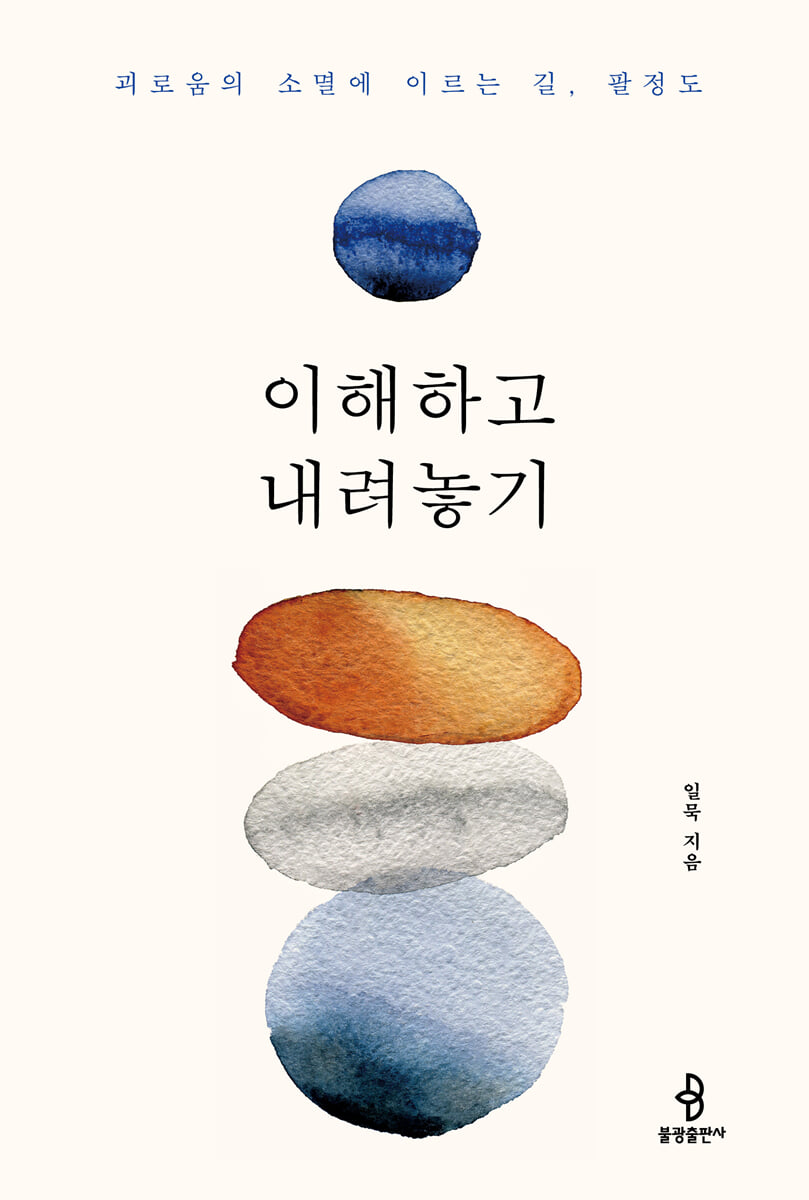
Understand and let go
 |
Description
Book Introduction
The classic teachings of Buddhism, which speak of the ultimate happiness of the mind.
The fourth Buddhist lecture by Monk Ilmok, a representative mentor of early Buddhist practice, who conveys systematic and vivid information.
For all those who want peace in life
The secret to studying the mind, everything about the Eightfold Path!
Everyone wants to be happy, but they live a life that doesn't allow them to be happy.
Whether we pursue wealth and fame, indulge in sexual pleasure and stimulating tastes, or try various methods to achieve peace of mind, the resulting happiness is only temporary, and life becomes miserable again.
So how can we attain true happiness? The answer lies in the Eightfold Path, or "Noble Eightfold Path," as taught by the Buddha.
This book is the masterpiece of Monk Ilmok, a representative mentor of early Buddhist practice who has guided us through the path to happiness conveyed by Buddhism through vivid lectures that serve as a standard for life and practice.
This book, which was published in 2013 and has been loved by many readers, talks about the 'Noble Eightfold Path', the right milestone toward happiness, and the 'middle path practice', which is the specific method of putting it into practice.
In particular, we have begun the process of revising and supplementing the content related to the practice of the middle path in the latter half of the book to clearly convey the method of practice by organizing it more systematically and correcting it. As a result, this book, which was difficult to obtain even after it went out of print, has been newly presented as a ‘completely revised edition.’
As the title suggests, the core of the Eightfold Path that the author wants to convey is to understand and recognize (understand) the harmful mind that causes suffering through the correct knowledge and understanding of suffering and its causes, the cessation of suffering, and the method leading to the cessation of suffering, and to let go of (let go of) the harmful mind that causes suffering.
Thus, it presents in detail the 'secret of studying with a firm mind' through the balanced development of the two wings of 'wisdom' and 'practice.'
If you are looking for complete peace and true happiness in life, open this book now.
You will discover a specific and definite path to happiness that you have never seen before.
The fourth Buddhist lecture by Monk Ilmok, a representative mentor of early Buddhist practice, who conveys systematic and vivid information.
For all those who want peace in life
The secret to studying the mind, everything about the Eightfold Path!
Everyone wants to be happy, but they live a life that doesn't allow them to be happy.
Whether we pursue wealth and fame, indulge in sexual pleasure and stimulating tastes, or try various methods to achieve peace of mind, the resulting happiness is only temporary, and life becomes miserable again.
So how can we attain true happiness? The answer lies in the Eightfold Path, or "Noble Eightfold Path," as taught by the Buddha.
This book is the masterpiece of Monk Ilmok, a representative mentor of early Buddhist practice who has guided us through the path to happiness conveyed by Buddhism through vivid lectures that serve as a standard for life and practice.
This book, which was published in 2013 and has been loved by many readers, talks about the 'Noble Eightfold Path', the right milestone toward happiness, and the 'middle path practice', which is the specific method of putting it into practice.
In particular, we have begun the process of revising and supplementing the content related to the practice of the middle path in the latter half of the book to clearly convey the method of practice by organizing it more systematically and correcting it. As a result, this book, which was difficult to obtain even after it went out of print, has been newly presented as a ‘completely revised edition.’
As the title suggests, the core of the Eightfold Path that the author wants to convey is to understand and recognize (understand) the harmful mind that causes suffering through the correct knowledge and understanding of suffering and its causes, the cessation of suffering, and the method leading to the cessation of suffering, and to let go of (let go of) the harmful mind that causes suffering.
Thus, it presents in detail the 'secret of studying with a firm mind' through the balanced development of the two wings of 'wisdom' and 'practice.'
If you are looking for complete peace and true happiness in life, open this book now.
You will discover a specific and definite path to happiness that you have never seen before.
- You can preview some of the book's contents.
Preview
index
Preface … Creating a New Path in the Heart
About the contents of this book
Part 1: The Eightfold Path
Chapter 1.
Buddha's practice and enlightenment
Chapter 2.
Merit and wisdom
Chapter 3.
body and mind
Chapter 4.
The Two Faces of the Mind
Chapter 5.
Feeling and perception
Chapter 6.
obstacle
Chapter 7.
Components of Enlightenment
Chapter 8.
The Twelve Links of Dependent Origination and Reincarnation
Chapter 9.
Eightfold Path
Part 2: Understanding and Letting Go
Chapter 1.
Understand and let go
Chapter 2.
Breathing practice and walking practice
Chapter 3.
Daily practice
Chapter 4.
Putting down the disability
Chapter 5.
Post-performance reflection
Chapter 6.
Representation and selection of breath
Chapter 7.
Maturity of wisdom
Chapter 8.
Wisdom of Enlightenment
Conclusion
About the contents of this book
Part 1: The Eightfold Path
Chapter 1.
Buddha's practice and enlightenment
Chapter 2.
Merit and wisdom
Chapter 3.
body and mind
Chapter 4.
The Two Faces of the Mind
Chapter 5.
Feeling and perception
Chapter 6.
obstacle
Chapter 7.
Components of Enlightenment
Chapter 8.
The Twelve Links of Dependent Origination and Reincarnation
Chapter 9.
Eightfold Path
Part 2: Understanding and Letting Go
Chapter 1.
Understand and let go
Chapter 2.
Breathing practice and walking practice
Chapter 3.
Daily practice
Chapter 4.
Putting down the disability
Chapter 5.
Post-performance reflection
Chapter 6.
Representation and selection of breath
Chapter 7.
Maturity of wisdom
Chapter 8.
Wisdom of Enlightenment
Conclusion
Detailed image
Into the book
The Middle Way is the practice of a good beginning, a good middle, and a good end, through the happiness that comes from abandoning one extreme of sensual desire and the other extreme of asceticism.
The Middle Way, in a word, refers to the Noble Eightfold Path, namely, right view, right thought, right speech, right action, right livelihood, right effort, right mindfulness, and right concentration.
--- p.38
Before the Buddha entered Nirvana, his last disciple, Subhadda, asked, “What teachings lead to enlightenment?”
To this, the Buddha said, “If there is the Eightfold Path in any teaching, there is enlightenment, and if there is not the Eightfold Path, there is no enlightenment.”
--- p.39
The core of the Buddha's teachings is dependent origination, which states that conditions are necessary for an outcome to occur.
For the wisdom of enlightenment to arise, the conditions for enlightenment must mature.
Otherwise, it is impossible for the wisdom of enlightenment to arise.
If you don't obsess over the results and gradually accumulate the merits that become the conditions for enlightenment, your wisdom will gradually mature and at some point, the wisdom of enlightenment will arise.
--- p.46
What we think of as 'me' is ultimately just five aggregates.
In other words, what we call 'I', 'self', 'soul', and 'true self' are merely concepts, and the 'I' is a combination of the five aggregates or matter and spirit.
--- p.63
The core of Buddha's teachings is to protect and guard the mind well.
Yet, we live without knowing much about the mind.
If we look back on our lives, we realize that we live our lives enjoying good things as our hearts desire, but we are not really aware of how our hearts move in our daily lives.
I don't pay attention to what kind of mind I have and how I live.
--- p.69
We often think of the mind as a mysterious, unchanging entity that we cannot understand.
But the Buddha simply said, “Knowing the object is the mind.”
Seeing, hearing, and thinking about an object is what the mind is.
--- p.70
In the Anguttara Nikaya, in the section “One Gathering,” the Buddha said this about the mind:
“I have never seen anything in this world change faster than the mind.
“It’s hard to even describe how quickly the mind changes.”
--- p.70
“Don’t look for it outside yourself.” This means that happiness doesn’t come from outside your heart.
No matter how much money or fame I have, if my heart is sad, I am unhappy, and no matter how little I have, if my heart is joyful, I am happy.
So, rather than seeking happiness outside, finding happiness by changing your mind is the core of Buddhist practice.
--- p.77
The most representative example of foolish inclination of mind is to incline the mind to 'consider the impermanent [無常] as the eternal [常], the painful [苦] as the happy [樂], and the non-self [無我] as the self [我].'
This means that you are unable to see the facts as they are.
It is when the mind is polluted by foolishness and greed, and one mistakenly believes and insists on doing what one wants, which is different from the truth.
--- p.84
To practice the Middle Way, a specific method is needed, and this is the practice of 'awareness'.
Mindfulness is the practice of knowing the four objects of matter [body], feeling [feeling], mind [heart], and dharma [dharma], or simply matter and mind, as they are, without attachment or aversion.
--- p.92
Ordinary practitioners tend to fall into two extremes: indulgence in sensual desires and self-abuse through asceticism.
However, the Buddha overcame both extremes and found the middle path, the Noble Eightfold Path.
By practicing this middle path, you eliminate craving and suffering.
This is the noble truth of the path that leads to the cessation of suffering, the Eightfold Path.
--- p.187
It is difficult to practice correctly if you do not establish the right view and understand the right direction and method of practice.
Although we cannot fully grasp the right view from the beginning, we must cultivate understanding through knowledge, and based on that right view, we must observe the precepts and cultivate samadhi, and ultimately, we will attain the wisdom of enlightenment.
In other words, the process of correct practice is to perfect the right view and realize the cessation of suffering.
Therefore, right view can be said to be the starting point and destination of practice.
--- pp.188~189
If we live by the precepts well, we will have no regrets in our hearts.
When regrets disappear, the mind becomes stable, and a stable mind becomes a good foundation for the practice of developing samadhi.
If right views and right thinking are said to provide the direction for practice, then right speech, right action, and right livelihood can be said to be the foundation and basis for practice.
--- p.198
The sutras describe the mind when one emerges from meditation as being free from any source of contamination, pure, clean, bright, soft, suitable, unshaken, and stable.
In this state of mind, your perspective on the world changes.
You can see the phenomenon as it is, without being bound by prejudice or stereotypes.
It's like objects are reflected as they are in clear, still water.
--- p.204
When right memory is established, wisdom becomes ever-present, allowing us to completely eliminate, extinguish, and let go of harmful thoughts like greed, anger, and foolishness.
This is the completion of 'understanding and letting go' as explained earlier.
In other words, the most important purpose of practicing mindfulness is to completely let go of harmful thoughts and extinguish suffering through right knowledge and right memory.
--- pp.224~225
By practicing awareness with the present body as the basic object, you can develop wisdom and samadhi in a balanced way.
In other words, by being aware of the 'present body' and the 'mind that moves without remaining in the body', we can develop wisdom and right memory about body and mind, and through this, by letting go of the obstacles that prevent us from remaining in the present body, we can develop right samadhi, which is the happiness of remaining in the present body, which is the object of awareness.
--- p.234
Breathing practices are utilized in many spiritual traditions outside of Buddhism.
However, Buddhist breathing practice is a practice to develop right samadhi, and right samadhi is samadhi developed based on the wisdom of the Four Noble Truths, the core of Buddhism, that is, right view.
This is how Buddhist breathing practice fundamentally differs from breathing practices in other traditions.
So, the breathing practice explained here was also practiced by the Buddha himself, and to make it clear that it is a Buddhist breathing practice method, I will call it ‘Buddha’s breathing practice.’
--- p.241
Let's look at some specific methods for practicing breathing.
As I explained earlier, first, try to be aware of your breath without forgetting it.
Even with such efforts, if there are obstacles such as sensual desires or anger, thoughts tend to wander to the past or future or to objects other than the breath.
When thoughts move like this, don't try to fight them. Just clearly notice what kind of obstructive thought they are, and then put that thought down as quickly as possible and become aware of your breath again.
--- p.252
If you focus on breathing through sitting meditation, your practice may stagnate or your body may become strained, which may lead to poor health.
So, it is good to practice walking together with sitting meditation.
In many sutras, the Buddha also recommended the harmonious combination of sitting meditation and walking meditation.
--- p.265
As we have seen, sitting meditation is not the only form of practice.
Practice is the process of letting go of the harmful thoughts that cause suffering.
However, harmful thoughts do not only arise during meditation.
It happens in all of our daily lives, regardless of time and place.
That is why, in addition to sitting meditation, walking meditation and daily practice are essential.
Keeping this in mind, we must cultivate a harmonious balance between sitting meditation, walking meditation, and daily practice.
--- p.269
We must continue to be mindful and discipline and protect our minds.
Just as a gatekeeper guards the door well.
If you control the sense doors through awareness, your mind will simply notice objects as they are, such as only seeing when you see them and only hearing when you hear them.
Thus, the mind is not contaminated by defilements, so there is no delusion.
The Middle Way, in a word, refers to the Noble Eightfold Path, namely, right view, right thought, right speech, right action, right livelihood, right effort, right mindfulness, and right concentration.
--- p.38
Before the Buddha entered Nirvana, his last disciple, Subhadda, asked, “What teachings lead to enlightenment?”
To this, the Buddha said, “If there is the Eightfold Path in any teaching, there is enlightenment, and if there is not the Eightfold Path, there is no enlightenment.”
--- p.39
The core of the Buddha's teachings is dependent origination, which states that conditions are necessary for an outcome to occur.
For the wisdom of enlightenment to arise, the conditions for enlightenment must mature.
Otherwise, it is impossible for the wisdom of enlightenment to arise.
If you don't obsess over the results and gradually accumulate the merits that become the conditions for enlightenment, your wisdom will gradually mature and at some point, the wisdom of enlightenment will arise.
--- p.46
What we think of as 'me' is ultimately just five aggregates.
In other words, what we call 'I', 'self', 'soul', and 'true self' are merely concepts, and the 'I' is a combination of the five aggregates or matter and spirit.
--- p.63
The core of Buddha's teachings is to protect and guard the mind well.
Yet, we live without knowing much about the mind.
If we look back on our lives, we realize that we live our lives enjoying good things as our hearts desire, but we are not really aware of how our hearts move in our daily lives.
I don't pay attention to what kind of mind I have and how I live.
--- p.69
We often think of the mind as a mysterious, unchanging entity that we cannot understand.
But the Buddha simply said, “Knowing the object is the mind.”
Seeing, hearing, and thinking about an object is what the mind is.
--- p.70
In the Anguttara Nikaya, in the section “One Gathering,” the Buddha said this about the mind:
“I have never seen anything in this world change faster than the mind.
“It’s hard to even describe how quickly the mind changes.”
--- p.70
“Don’t look for it outside yourself.” This means that happiness doesn’t come from outside your heart.
No matter how much money or fame I have, if my heart is sad, I am unhappy, and no matter how little I have, if my heart is joyful, I am happy.
So, rather than seeking happiness outside, finding happiness by changing your mind is the core of Buddhist practice.
--- p.77
The most representative example of foolish inclination of mind is to incline the mind to 'consider the impermanent [無常] as the eternal [常], the painful [苦] as the happy [樂], and the non-self [無我] as the self [我].'
This means that you are unable to see the facts as they are.
It is when the mind is polluted by foolishness and greed, and one mistakenly believes and insists on doing what one wants, which is different from the truth.
--- p.84
To practice the Middle Way, a specific method is needed, and this is the practice of 'awareness'.
Mindfulness is the practice of knowing the four objects of matter [body], feeling [feeling], mind [heart], and dharma [dharma], or simply matter and mind, as they are, without attachment or aversion.
--- p.92
Ordinary practitioners tend to fall into two extremes: indulgence in sensual desires and self-abuse through asceticism.
However, the Buddha overcame both extremes and found the middle path, the Noble Eightfold Path.
By practicing this middle path, you eliminate craving and suffering.
This is the noble truth of the path that leads to the cessation of suffering, the Eightfold Path.
--- p.187
It is difficult to practice correctly if you do not establish the right view and understand the right direction and method of practice.
Although we cannot fully grasp the right view from the beginning, we must cultivate understanding through knowledge, and based on that right view, we must observe the precepts and cultivate samadhi, and ultimately, we will attain the wisdom of enlightenment.
In other words, the process of correct practice is to perfect the right view and realize the cessation of suffering.
Therefore, right view can be said to be the starting point and destination of practice.
--- pp.188~189
If we live by the precepts well, we will have no regrets in our hearts.
When regrets disappear, the mind becomes stable, and a stable mind becomes a good foundation for the practice of developing samadhi.
If right views and right thinking are said to provide the direction for practice, then right speech, right action, and right livelihood can be said to be the foundation and basis for practice.
--- p.198
The sutras describe the mind when one emerges from meditation as being free from any source of contamination, pure, clean, bright, soft, suitable, unshaken, and stable.
In this state of mind, your perspective on the world changes.
You can see the phenomenon as it is, without being bound by prejudice or stereotypes.
It's like objects are reflected as they are in clear, still water.
--- p.204
When right memory is established, wisdom becomes ever-present, allowing us to completely eliminate, extinguish, and let go of harmful thoughts like greed, anger, and foolishness.
This is the completion of 'understanding and letting go' as explained earlier.
In other words, the most important purpose of practicing mindfulness is to completely let go of harmful thoughts and extinguish suffering through right knowledge and right memory.
--- pp.224~225
By practicing awareness with the present body as the basic object, you can develop wisdom and samadhi in a balanced way.
In other words, by being aware of the 'present body' and the 'mind that moves without remaining in the body', we can develop wisdom and right memory about body and mind, and through this, by letting go of the obstacles that prevent us from remaining in the present body, we can develop right samadhi, which is the happiness of remaining in the present body, which is the object of awareness.
--- p.234
Breathing practices are utilized in many spiritual traditions outside of Buddhism.
However, Buddhist breathing practice is a practice to develop right samadhi, and right samadhi is samadhi developed based on the wisdom of the Four Noble Truths, the core of Buddhism, that is, right view.
This is how Buddhist breathing practice fundamentally differs from breathing practices in other traditions.
So, the breathing practice explained here was also practiced by the Buddha himself, and to make it clear that it is a Buddhist breathing practice method, I will call it ‘Buddha’s breathing practice.’
--- p.241
Let's look at some specific methods for practicing breathing.
As I explained earlier, first, try to be aware of your breath without forgetting it.
Even with such efforts, if there are obstacles such as sensual desires or anger, thoughts tend to wander to the past or future or to objects other than the breath.
When thoughts move like this, don't try to fight them. Just clearly notice what kind of obstructive thought they are, and then put that thought down as quickly as possible and become aware of your breath again.
--- p.252
If you focus on breathing through sitting meditation, your practice may stagnate or your body may become strained, which may lead to poor health.
So, it is good to practice walking together with sitting meditation.
In many sutras, the Buddha also recommended the harmonious combination of sitting meditation and walking meditation.
--- p.265
As we have seen, sitting meditation is not the only form of practice.
Practice is the process of letting go of the harmful thoughts that cause suffering.
However, harmful thoughts do not only arise during meditation.
It happens in all of our daily lives, regardless of time and place.
That is why, in addition to sitting meditation, walking meditation and daily practice are essential.
Keeping this in mind, we must cultivate a harmonious balance between sitting meditation, walking meditation, and daily practice.
--- p.269
We must continue to be mindful and discipline and protect our minds.
Just as a gatekeeper guards the door well.
If you control the sense doors through awareness, your mind will simply notice objects as they are, such as only seeing when you see them and only hearing when you hear them.
Thus, the mind is not contaminated by defilements, so there is no delusion.
--- p.274
Publisher's Review
A life that has never gone the way I wanted, people who don't agree with me,
Feelings that surge without warning… 'Can I ever truly be happy?'
The 'true Eightfold Path', which is a condensation of correct knowledge and practice, is the path to happiness.
This is the most specific and rational 'secret to studying with a strong mind'!
Everyone wants to live a happy life.
So, each person lives by making efforts in their own way.
But there are more miserable people in the world than happy people.
The reason is that they have the wrong idea about how to become happy.
Buddhism, a religion and philosophy that has long discussed true happiness, says that the answer to happiness lies solely in the 'mind.'
Fortunately, many people these days are seeking the answer to happiness in the heart, not in material things.
So, the words ‘practice’ and ‘healing’ have become part of everyday language, and the methods to help achieve peace of mind have also diversified.
However, for many, it only provides temporary comfort, and those who seek true happiness face difficulties.
In an age where there are numerous teachings and methods for studying and practicing the mind.
So why are we still not happy? The author of this book argues that it's because "we don't truly understand the true nature of the suffering we experience and don't know how to overcome it."
Perhaps our efforts with the mind are nothing more than simple techniques that skip over the basic background, or like a one-time diet to temporarily relieve the emotions that bother us.
A lecture on the Eightfold Path by Monk Ilmok, a representative mentor of early Buddhist practice.
This book is the first and representative work of Monk Ilmok, a representative mentor of early Buddhist practice who has guided us through the path to true happiness conveyed by Buddhism through vivid lectures that serve as the standard for life and practice.
This book, which has been loved by many readers since its publication in 2013, presents the 'Eightfold Path' as another keyword for the milestone toward happiness, along with 'Reincarnation' ('The Story of Reincarnation in Early Buddhism by Monk Ilmok'), 'The Four Noble Truths' ('The Four Noble Truths'), and 'The Three Poisons' ('Anger, When Understood, Disappears').
In particular, the content of 'Middle Way Practice', which is the specific practice method of the Eightfold Path located in the latter half of the book, has been corrected and supplemented to more systematically organize and clearly convey the method of practice.
As a result, this book, which had been difficult to obtain even as a used copy after going out of print, was able to be republished as a 'completely revised edition' nine and a half years after its first publication.
Proven Guide to Studying with a Strong Mind
The right direction for studying the mind, the Eightfold Path, presented by the author in this book is a practice method that has been verified by countless people for thousands of years.
Specifically, it is to understand and put aside (let go of) the harmful mind that causes suffering through right knowledge and understanding of suffering and its causes, the cessation of suffering and the way leading to the cessation of suffering.
Just as a patient can become healthy by understanding his or her illness, its causes, its elimination, and the path to its elimination, through 'understanding and letting go,' one can escape suffering and realize true happiness, which is 'good in the beginning, good in the middle, and good in the end.'
However, many people begin their practice without a basic understanding of suffering and its causes.
The author, as if to warn against such tendencies, shows the 'stages' of practice from the very structure of this book.
In other words, it is a system that starts from the basic knowledge that serves as the basis for practice and moves toward practice based on that knowledge.
Thus, the author helps develop a balanced mind by providing a 'sure and proven guide' for correct knowledge and practice.
How the Eightfold Path Becomes a Milestone for a Happy Life
As the subtitle of the book suggests, the Eightfold Path is the 'path that leads to the cessation of suffering.'
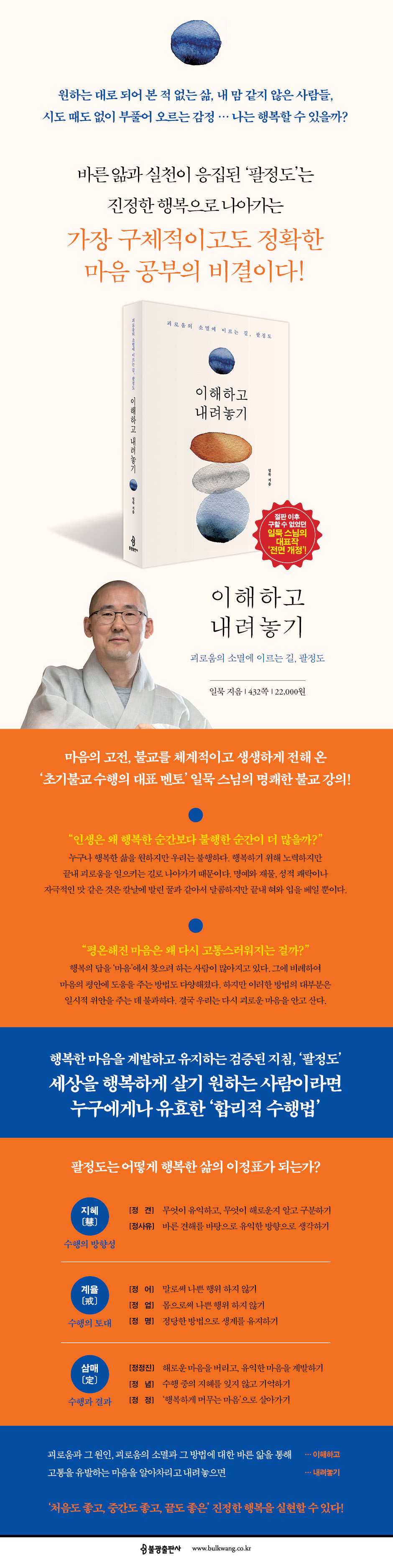
The Eightfold Path, consisting of right view, right thought, right speech, right action, right livelihood, right effort, right memory, and right samadhi, provides a foundation for each other and enables us to develop and maintain a pure, clear, calm, and concentrated state of mind.
It is a ‘mind that remains happy’ that has purified the mind that has become clouded by harmful psychological effects.
To have a 'happy mind', wisdom is needed above all else.
It is the wisdom [right view] to know and distinguish between what is a happy mind and what is a painful mind, and based on that, to think in a beneficial direction [right thinking].
If you have the right direction for practice, you should speak correctly [right speech], act correctly [right action], and make a living correctly [right livelihood].
This way, you will not be criticized by the world, you will have no regrets, your mind will be at peace, and this will become a good foundation for practice.
If you have the right direction and foundation for practice, you can make efforts to discard harm and develop beneficial practices [right diligence].
In this revised edition, half of the volume is devoted to the detailed introduction of the Buddha's breathing practice, walking practice, and daily practice as a specific method of practicing the Eightfold Path (middle path practice), namely, right diligence.
Simply put, this means recognizing the harmful mind during practice and naturally letting go of it through the wisdom of deeply understanding its harmfulness and how to let go of it.
On the other hand, memory (correct memory) is as important as wisdom.
By remembering and not forgetting the right knowledge that has arisen through diligence, we can become aware of the harmful thoughts that arise without warning, as if filtering them out through a finer sieve, and our wisdom becomes sharper.
Thus, one ultimately reaches the final element of the Eightfold Path, the right samadhi, which is the ‘mind that abides happily.’
The only thing we must protect is our heart
Part I of this book consists of nine chapters on what the Eightfold Path is and its relationship to each other, that is, the structure of the Eightfold Path.
Here, by systematically organizing the Buddhist teachings essential for understanding and practicing the Eightfold Path, we can draw the core doctrines of Buddhism, such as the Four Noble Truths, Dependent Origination, the Five Aggregates, and the Three Dharma Seals, into a single organic structure.
Part 2 consists of guidance on the Middle Way, which is a specific method of practicing the Eightfold Path, namely the Buddha's breathing practice, walking practice, and daily practice.
Starting with a general explanation of the middle path practice, which can be said to be 'understanding and letting go', the structure and principles of the practice, as well as the methods, are organized.
As the author states in the preface, the Eightfold Path is valid not only for Buddhists but also for anyone who wishes to live happily in this world.
This is because the Eightfold Path is not a concept summarized in a few lines, but rather a rational and specific method of practice, a wisdom that transcends religion and a teaching that anyone can agree with.
‘Why are there more unhappy moments than happy moments in my life?’, ‘Why does my mind, which has become peaceful, become painful again?’… .
If you have such thoughts, we just need to follow the path this book guides us on, as the Buddha said, and keep only one thing in mind.
“If you can protect just one thing, you can forget everything else.
“Just protect your heart.”
Feelings that surge without warning… 'Can I ever truly be happy?'
The 'true Eightfold Path', which is a condensation of correct knowledge and practice, is the path to happiness.
This is the most specific and rational 'secret to studying with a strong mind'!
Everyone wants to live a happy life.
So, each person lives by making efforts in their own way.
But there are more miserable people in the world than happy people.
The reason is that they have the wrong idea about how to become happy.
Buddhism, a religion and philosophy that has long discussed true happiness, says that the answer to happiness lies solely in the 'mind.'
Fortunately, many people these days are seeking the answer to happiness in the heart, not in material things.
So, the words ‘practice’ and ‘healing’ have become part of everyday language, and the methods to help achieve peace of mind have also diversified.
However, for many, it only provides temporary comfort, and those who seek true happiness face difficulties.
In an age where there are numerous teachings and methods for studying and practicing the mind.
So why are we still not happy? The author of this book argues that it's because "we don't truly understand the true nature of the suffering we experience and don't know how to overcome it."
Perhaps our efforts with the mind are nothing more than simple techniques that skip over the basic background, or like a one-time diet to temporarily relieve the emotions that bother us.
A lecture on the Eightfold Path by Monk Ilmok, a representative mentor of early Buddhist practice.
This book is the first and representative work of Monk Ilmok, a representative mentor of early Buddhist practice who has guided us through the path to true happiness conveyed by Buddhism through vivid lectures that serve as the standard for life and practice.
This book, which has been loved by many readers since its publication in 2013, presents the 'Eightfold Path' as another keyword for the milestone toward happiness, along with 'Reincarnation' ('The Story of Reincarnation in Early Buddhism by Monk Ilmok'), 'The Four Noble Truths' ('The Four Noble Truths'), and 'The Three Poisons' ('Anger, When Understood, Disappears').
In particular, the content of 'Middle Way Practice', which is the specific practice method of the Eightfold Path located in the latter half of the book, has been corrected and supplemented to more systematically organize and clearly convey the method of practice.
As a result, this book, which had been difficult to obtain even as a used copy after going out of print, was able to be republished as a 'completely revised edition' nine and a half years after its first publication.
Proven Guide to Studying with a Strong Mind
The right direction for studying the mind, the Eightfold Path, presented by the author in this book is a practice method that has been verified by countless people for thousands of years.
Specifically, it is to understand and put aside (let go of) the harmful mind that causes suffering through right knowledge and understanding of suffering and its causes, the cessation of suffering and the way leading to the cessation of suffering.
Just as a patient can become healthy by understanding his or her illness, its causes, its elimination, and the path to its elimination, through 'understanding and letting go,' one can escape suffering and realize true happiness, which is 'good in the beginning, good in the middle, and good in the end.'
However, many people begin their practice without a basic understanding of suffering and its causes.
The author, as if to warn against such tendencies, shows the 'stages' of practice from the very structure of this book.
In other words, it is a system that starts from the basic knowledge that serves as the basis for practice and moves toward practice based on that knowledge.
Thus, the author helps develop a balanced mind by providing a 'sure and proven guide' for correct knowledge and practice.
How the Eightfold Path Becomes a Milestone for a Happy Life
As the subtitle of the book suggests, the Eightfold Path is the 'path that leads to the cessation of suffering.'
The Eightfold Path, consisting of right view, right thought, right speech, right action, right livelihood, right effort, right memory, and right samadhi, provides a foundation for each other and enables us to develop and maintain a pure, clear, calm, and concentrated state of mind.
It is a ‘mind that remains happy’ that has purified the mind that has become clouded by harmful psychological effects.
To have a 'happy mind', wisdom is needed above all else.
It is the wisdom [right view] to know and distinguish between what is a happy mind and what is a painful mind, and based on that, to think in a beneficial direction [right thinking].
If you have the right direction for practice, you should speak correctly [right speech], act correctly [right action], and make a living correctly [right livelihood].
This way, you will not be criticized by the world, you will have no regrets, your mind will be at peace, and this will become a good foundation for practice.
If you have the right direction and foundation for practice, you can make efforts to discard harm and develop beneficial practices [right diligence].
In this revised edition, half of the volume is devoted to the detailed introduction of the Buddha's breathing practice, walking practice, and daily practice as a specific method of practicing the Eightfold Path (middle path practice), namely, right diligence.
Simply put, this means recognizing the harmful mind during practice and naturally letting go of it through the wisdom of deeply understanding its harmfulness and how to let go of it.
On the other hand, memory (correct memory) is as important as wisdom.
By remembering and not forgetting the right knowledge that has arisen through diligence, we can become aware of the harmful thoughts that arise without warning, as if filtering them out through a finer sieve, and our wisdom becomes sharper.
Thus, one ultimately reaches the final element of the Eightfold Path, the right samadhi, which is the ‘mind that abides happily.’
The only thing we must protect is our heart
Part I of this book consists of nine chapters on what the Eightfold Path is and its relationship to each other, that is, the structure of the Eightfold Path.
Here, by systematically organizing the Buddhist teachings essential for understanding and practicing the Eightfold Path, we can draw the core doctrines of Buddhism, such as the Four Noble Truths, Dependent Origination, the Five Aggregates, and the Three Dharma Seals, into a single organic structure.
Part 2 consists of guidance on the Middle Way, which is a specific method of practicing the Eightfold Path, namely the Buddha's breathing practice, walking practice, and daily practice.
Starting with a general explanation of the middle path practice, which can be said to be 'understanding and letting go', the structure and principles of the practice, as well as the methods, are organized.
As the author states in the preface, the Eightfold Path is valid not only for Buddhists but also for anyone who wishes to live happily in this world.
This is because the Eightfold Path is not a concept summarized in a few lines, but rather a rational and specific method of practice, a wisdom that transcends religion and a teaching that anyone can agree with.
‘Why are there more unhappy moments than happy moments in my life?’, ‘Why does my mind, which has become peaceful, become painful again?’… .
If you have such thoughts, we just need to follow the path this book guides us on, as the Buddha said, and keep only one thing in mind.
“If you can protect just one thing, you can forget everything else.
“Just protect your heart.”
GOODS SPECIFICS
- Publication date: December 17, 2022
- Page count, weight, size: 432 pages | 618g | 145*215*30mm
- ISBN13: 9791192476711
- ISBN10: 1192476719
You may also like
카테고리
korean


korean

![GQ KOREA Mark (Monthly): December [2025]](http://librairie.coreenne.fr/cdn/shop/files/8ef265dbbfbf186523ed75ba7319009d.jpg?v=1765340328&width=3840)


