

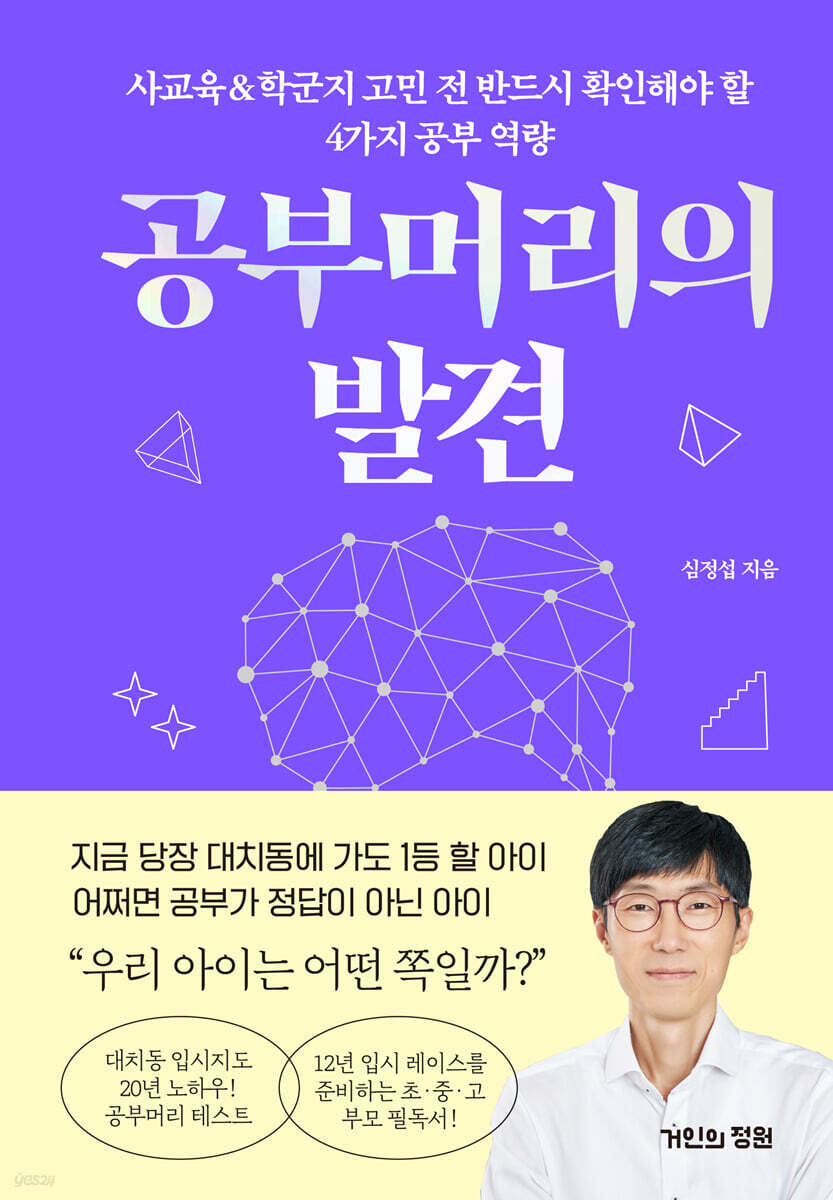
Discovery of a study brain
 |
Description
Book Introduction
- The best educational compass for your child, from school districts and private education to study methods and career paths!
- The 'Study Mind Test' method discovered through 20 years of college entrance exam guidance in Gangnam
A child's education is divided into before and after discovering their talent for studying!
The "Study Spotting Method" that Will Save Parents Facing South Korea's College Entrance Exams
"Is my child lacking effort? Is he lacking in academics?", "Should I send him to a different school district or find a good academy to supplement his lack of academics?", "With the competition for college entrance exams becoming fiercer, what should I do to ensure my child doesn't fall behind?" Raising children involves facing these and countless other educational issues.
It is difficult for parents to be sure that their decision is the right one.
How can one make the right decision? Author Sim Jeong-seop, who has coached high school seniors and transfer students in Gangnam for over 20 years, emphasizes to parents that "accurate information about your child" is the most powerful force in the competitive college admissions landscape.
Accordingly, you can find not only the optimal entrance exam roadmap for your child, but also strategies for choosing various career paths other than studying.
[Study Aptitude Test - Multiple Intelligence Test - Resilience Test - DiSC Behavioral Type Test] is a test that examines a child's study aptitude, innate talent, mental ability, learning and career tendencies, etc.
After taking these four tests, parents can determine their child's academic ability and design a plan to guide their child's studies. If their child does not have academic ability, they can design a specific plan for learning and career guidance.
- The 'Study Mind Test' method discovered through 20 years of college entrance exam guidance in Gangnam
A child's education is divided into before and after discovering their talent for studying!
The "Study Spotting Method" that Will Save Parents Facing South Korea's College Entrance Exams
"Is my child lacking effort? Is he lacking in academics?", "Should I send him to a different school district or find a good academy to supplement his lack of academics?", "With the competition for college entrance exams becoming fiercer, what should I do to ensure my child doesn't fall behind?" Raising children involves facing these and countless other educational issues.
It is difficult for parents to be sure that their decision is the right one.
How can one make the right decision? Author Sim Jeong-seop, who has coached high school seniors and transfer students in Gangnam for over 20 years, emphasizes to parents that "accurate information about your child" is the most powerful force in the competitive college admissions landscape.
Accordingly, you can find not only the optimal entrance exam roadmap for your child, but also strategies for choosing various career paths other than studying.
[Study Aptitude Test - Multiple Intelligence Test - Resilience Test - DiSC Behavioral Type Test] is a test that examines a child's study aptitude, innate talent, mental ability, learning and career tendencies, etc.
After taking these four tests, parents can determine their child's academic ability and design a plan to guide their child's studies. If their child does not have academic ability, they can design a specific plan for learning and career guidance.
- You can preview some of the book's contents.
Preview
index
Chapter 1.
Things to Consider Before Jumping into the College Entrance Exam Race
01 The Reality of College Entrance Exams You Need to Know Before Considering School Districts and Private Education
02 Don't let private education end at the precipice of a population cliff (especially for parents of elementary and kindergarten students)
03 In the age of artificial intelligence, children scoring 3rd to 6th on the CSAT are most at risk.
04 Should all children be obsessed with solving problems?
05 The time to spend real money is not during kindergarten or elementary school.
Chapter 2.
Test your child's college entrance exam competitiveness with the "Study Aptitude Test."
06 What is the 'Study Brain Test'?
07 Children who are motivated to study are active in the 'Study Aptitude Test'.
08 High School Selection Worries Solved with the 'Study Aptitude Test'
Teacher Sim's Tip | Find past exam questions from specialized and private high schools
09 Middle school grades can predict high school grades.
Teacher Sim's Tip | A website where you can find past exam questions from middle and high schools nationwide.
10. A Study Test for Upper Elementary School Students
Teacher Sim's Tip | Get the Most Out of the "School Information" Site
11. Study Aptitude Test for Toddlers & Elementary School Students
12 How to Intuitively Know Which College Your Child Will Go to in 7-8 Years
If you study by solving 13 problem sets, Korean entrance exam education is not bad for the price.
14. Children who lack the aptitude for study should focus on reading wisdom in the humanities.
15 | Study Mind Test Counseling Case 1 | If only I had taken the 'Study Mind Test' before coming to Daechi-dong.
16 | Study Mind Test Counseling Case 2 | Even if you can raise your score with private tutoring, it's difficult to change your grade.
Chapter 3.
Test your college entrance competitiveness and strengths with multiple intelligences.
17. Using Multiple Intelligences in College Entrance Exams and Career Decisions
18. Understanding the Intelligence Strengths of Early Childhood and Elementary School Students
19 Strength-building career guidance for students struggling with math 20 Let's also teach English while considering strengths and intelligence
From a 21-Year-Old Victim of School Bullying to a YouTuber with 1.5 Million Subscribers (Strategy to Strengthen Foreign Language Skills)
22 | Multiple Intelligence Counseling Case 1 | Predicting the Upper Limit of College Scholastic Ability Test Scores Using Multiple Intelligence Tests
23 | Multiple Intelligence Counseling Case 2 | The Widest Path to Medical School for Students with Low Verbal Intelligence 188
Teacher Sim's Tip | Regional Medical Schools Select Local Talent
Chapter 4: Check Your Resilience and Develop Mental Strength
24 The key to success in college entrance exams is a child's mentality.
25 When you have a strong mentality, information becomes a weapon.
26 Mental Strengthening Training to Improve Problem Solving Skills
27 The Concept of Resilience and the Korean Resilience Index KRQ-53
28 Understanding Children's Mental Health Using the Korean Resilience Index
29 Observe and record the resilience of elementary school children annually.
Teacher Sim's Tips | 7 Parenting Practices to Build Resilience in Preschool and Elementary School Children
30 Immediately Putting It into Practice: Strengthening Your Mind and Resilience
Teacher Sim's Tip: Avoid using digital devices at night for a full night's sleep.
31 Build Your Life-Changing Mental Strength with 15-Minute Writing
Teacher Sim's Tip | Self-Affirmation Writing for Teens and Adults
32 | Resilience Counseling Case 1 | A Child with Low Self-Esteem at a Private Elementary School
33 | Resilience Counseling Case Study 2 | Don't Focus on Studying, Read Your Child's Mind First
Chapter 5.
Use DiSC to find your optimal career path and study method.
34 DiSC Tests More Useful Than MBTI
35 High School, University, and Career Guidance Using DiSC
36 | Student Guidance Case Study 1 Using DiSC | D (Proactive)
37 | Student Guidance Case Study 2 Using DiSC | I (Social)
38 | Student Guidance Case Study 3 Using DiSC | S (Stable)
39 | Student Guidance Case Study 4 Using DiSC | C (Cautionary)
Chapter 6.
The unchanging essence of college entrance exams in a changing system
40 How should I help a child who develops study goals late in life?
41. College Entrance Exam and Career Roadmap After Spending Childhood in Nature
42 How do I guide a child without dreams or goals?
Career guidance (especially in the humanities) in an era when countries and companies struggle to provide jobs
44 Let's hold a family seminar to prepare for your child's future during the holiday season (Bohol Project)
There is no right answer to raising children; each family must find its own solution.
46 If your child's studies are uncertain, let's work together as a family to achieve financial freedom.
47 Amazing results for families where parents studied instead of going all-in on their children's education
supplement.
Sample Results of 6 Tools to Discover Your Aptitude for Studying
1.
Bummer test results record sheet
2.
Multiple Intelligence Test Results Record Sheet
3.
Resilience Test Record Sheet
4.
DiSC Test Record Sheet
5.
Self-Affirmation Writing
6.
Study Goals and Current Study Time Record Sheet
Things to Consider Before Jumping into the College Entrance Exam Race
01 The Reality of College Entrance Exams You Need to Know Before Considering School Districts and Private Education
02 Don't let private education end at the precipice of a population cliff (especially for parents of elementary and kindergarten students)
03 In the age of artificial intelligence, children scoring 3rd to 6th on the CSAT are most at risk.
04 Should all children be obsessed with solving problems?
05 The time to spend real money is not during kindergarten or elementary school.
Chapter 2.
Test your child's college entrance exam competitiveness with the "Study Aptitude Test."
06 What is the 'Study Brain Test'?
07 Children who are motivated to study are active in the 'Study Aptitude Test'.
08 High School Selection Worries Solved with the 'Study Aptitude Test'
Teacher Sim's Tip | Find past exam questions from specialized and private high schools
09 Middle school grades can predict high school grades.
Teacher Sim's Tip | A website where you can find past exam questions from middle and high schools nationwide.
10. A Study Test for Upper Elementary School Students
Teacher Sim's Tip | Get the Most Out of the "School Information" Site
11. Study Aptitude Test for Toddlers & Elementary School Students
12 How to Intuitively Know Which College Your Child Will Go to in 7-8 Years
If you study by solving 13 problem sets, Korean entrance exam education is not bad for the price.
14. Children who lack the aptitude for study should focus on reading wisdom in the humanities.
15 | Study Mind Test Counseling Case 1 | If only I had taken the 'Study Mind Test' before coming to Daechi-dong.
16 | Study Mind Test Counseling Case 2 | Even if you can raise your score with private tutoring, it's difficult to change your grade.
Chapter 3.
Test your college entrance competitiveness and strengths with multiple intelligences.
17. Using Multiple Intelligences in College Entrance Exams and Career Decisions
18. Understanding the Intelligence Strengths of Early Childhood and Elementary School Students
19 Strength-building career guidance for students struggling with math 20 Let's also teach English while considering strengths and intelligence
From a 21-Year-Old Victim of School Bullying to a YouTuber with 1.5 Million Subscribers (Strategy to Strengthen Foreign Language Skills)
22 | Multiple Intelligence Counseling Case 1 | Predicting the Upper Limit of College Scholastic Ability Test Scores Using Multiple Intelligence Tests
23 | Multiple Intelligence Counseling Case 2 | The Widest Path to Medical School for Students with Low Verbal Intelligence 188
Teacher Sim's Tip | Regional Medical Schools Select Local Talent
Chapter 4: Check Your Resilience and Develop Mental Strength
24 The key to success in college entrance exams is a child's mentality.
25 When you have a strong mentality, information becomes a weapon.
26 Mental Strengthening Training to Improve Problem Solving Skills
27 The Concept of Resilience and the Korean Resilience Index KRQ-53
28 Understanding Children's Mental Health Using the Korean Resilience Index
29 Observe and record the resilience of elementary school children annually.
Teacher Sim's Tips | 7 Parenting Practices to Build Resilience in Preschool and Elementary School Children
30 Immediately Putting It into Practice: Strengthening Your Mind and Resilience
Teacher Sim's Tip: Avoid using digital devices at night for a full night's sleep.
31 Build Your Life-Changing Mental Strength with 15-Minute Writing
Teacher Sim's Tip | Self-Affirmation Writing for Teens and Adults
32 | Resilience Counseling Case 1 | A Child with Low Self-Esteem at a Private Elementary School
33 | Resilience Counseling Case Study 2 | Don't Focus on Studying, Read Your Child's Mind First
Chapter 5.
Use DiSC to find your optimal career path and study method.
34 DiSC Tests More Useful Than MBTI
35 High School, University, and Career Guidance Using DiSC
36 | Student Guidance Case Study 1 Using DiSC | D (Proactive)
37 | Student Guidance Case Study 2 Using DiSC | I (Social)
38 | Student Guidance Case Study 3 Using DiSC | S (Stable)
39 | Student Guidance Case Study 4 Using DiSC | C (Cautionary)
Chapter 6.
The unchanging essence of college entrance exams in a changing system
40 How should I help a child who develops study goals late in life?
41. College Entrance Exam and Career Roadmap After Spending Childhood in Nature
42 How do I guide a child without dreams or goals?
Career guidance (especially in the humanities) in an era when countries and companies struggle to provide jobs
44 Let's hold a family seminar to prepare for your child's future during the holiday season (Bohol Project)
There is no right answer to raising children; each family must find its own solution.
46 If your child's studies are uncertain, let's work together as a family to achieve financial freedom.
47 Amazing results for families where parents studied instead of going all-in on their children's education
supplement.
Sample Results of 6 Tools to Discover Your Aptitude for Studying
1.
Bummer test results record sheet
2.
Multiple Intelligence Test Results Record Sheet
3.
Resilience Test Record Sheet
4.
DiSC Test Record Sheet
5.
Self-Affirmation Writing
6.
Study Goals and Current Study Time Record Sheet
Detailed image

Into the book
So how can we know whether our child will excel at solving problems that place them in the top 10-20% of students? The most obvious criterion for determining this is the "Study Aptitude Test" introduced in this book.
The Study Brain Test not only shows your child's current ability, but also the upper limit of the score he or she can achieve if he or she puts his or her mind to studying.
These test results provide clear guidance for determining whether your child should focus solely on solving problems in the future, or whether he or she should end this type of study to a certain extent and strategically pursue a different path.
--- p.27
After introducing the concept of a study test and conducting an actual test with students who wanted to study, some students got an A of 50 points, while others got a B of 80 points.
I could tell this student that if he memorized enough English words, improved his reading speed, and practiced problem solving for a year, he would be able to pass the transfer entrance exam with his existing study skills.
However, some students' A scores were in the 30s to 40s and B scores did not exceed 60s to 70s.
Even if these students memorize the words, they cannot interpret them because they do not know the structure. Even if they know the structure, they cannot understand the text because they do not have the background knowledge. Even if they force themselves to interpret everything, they cannot figure out the intention of the question and thus cannot find the correct answer.
If this is the case, no matter how much you study for the transfer exam for a year, you will not be able to get the results you want.
This is because, regardless of the university, you need to score at least 80 points on the university's previous exam questions to have a chance of being accepted in the actual entrance exam.
--- p..70
In so-called prestigious school districts, parents have good self-esteem and mentality, but children often suffer from severe competition for entrance exams at school or academies, resulting in significantly lowered self-esteem and mentality.
So, I don't recommend that even children who are good at studying enter competitive, prestigious school districts too early.
It is advisable to achieve first place in a prestigious or semi-prestigious school district and then enter a more competitive environment after building up some self-esteem in academics.
--- p.219
In Korea, DiSC is not as well known as MBTI or Enneagram, but in actual counseling, DiSC has been more useful than any other psychological test tool.
First of all, DiSC is simpler to test and identify tendencies than other psychological testing tools.
It has the advantage of being able to understand the content in a short period of time and apply it to real life, focusing on the four main types: D (initiative), I (sociable), S (stable), and C (cautious).
If you are going to a high school with fierce competition for grades, such as a specialized high school, a private high school, or a general high school in Gangnam, having a high D (initiative) tendency will be advantageous.
A characteristic of students with a high D tendency is that they have a strong competitive spirit.
When these students encounter a strong opponent, they may feel a desire to compete.
If you try something yourself and decide that it won't work out, you also have the flexibility to immediately change direction and consider a new path.
--- p.264
“The first option, as many families choose, is to go to a large city or prestigious school district and begin competing for college entrance from middle school.
There are several candidate locations, but places like Daechi-dong and Mok-dong have high housing prices and excessive private education, which can discourage children or prevent them from finding their own pace. Therefore, a place with a certain level of educational infrastructure and moderate competition may be a good choice.
Recommended areas include Junggye-dong in Seoul, Dunsan-dong in Daejeon, Haeundae in Busan, Bongseon-dong in Gwangju, Yeongtong in Suwon, Ilsan in northern Gyeonggi Province, Nohyeong-dong in Jeju, and Bupyeong and Bucheon in Incheon.”
--- p.307
From this perspective, I offer this advice to young, awake parents:
In an era where graduating from a four-year university doesn't guarantee employment, rather than pouring tens of millions of won into private education with uncertain outcomes, let's focus on providing public education to children who are not good at solving problems from a young age.
Instead, let's think about how the whole family can work together to build a proper business, or if business is a difficult task for a family, how to create a "pipeline" that can lead to financial freedom.
And let's set the goal of our children's education not to get into a prestigious university in their 20s, but to have financial freedom in their 30s and 40s, and to build a life where they can do what they want and live without worrying about money.
I will introduce specific examples in the next chapter, but this is a goal that many families can easily achieve by clearly focusing on education from an early age and avoiding spending on unnecessary private education.
The Study Brain Test not only shows your child's current ability, but also the upper limit of the score he or she can achieve if he or she puts his or her mind to studying.
These test results provide clear guidance for determining whether your child should focus solely on solving problems in the future, or whether he or she should end this type of study to a certain extent and strategically pursue a different path.
--- p.27
After introducing the concept of a study test and conducting an actual test with students who wanted to study, some students got an A of 50 points, while others got a B of 80 points.
I could tell this student that if he memorized enough English words, improved his reading speed, and practiced problem solving for a year, he would be able to pass the transfer entrance exam with his existing study skills.
However, some students' A scores were in the 30s to 40s and B scores did not exceed 60s to 70s.
Even if these students memorize the words, they cannot interpret them because they do not know the structure. Even if they know the structure, they cannot understand the text because they do not have the background knowledge. Even if they force themselves to interpret everything, they cannot figure out the intention of the question and thus cannot find the correct answer.
If this is the case, no matter how much you study for the transfer exam for a year, you will not be able to get the results you want.
This is because, regardless of the university, you need to score at least 80 points on the university's previous exam questions to have a chance of being accepted in the actual entrance exam.
--- p..70
In so-called prestigious school districts, parents have good self-esteem and mentality, but children often suffer from severe competition for entrance exams at school or academies, resulting in significantly lowered self-esteem and mentality.
So, I don't recommend that even children who are good at studying enter competitive, prestigious school districts too early.
It is advisable to achieve first place in a prestigious or semi-prestigious school district and then enter a more competitive environment after building up some self-esteem in academics.
--- p.219
In Korea, DiSC is not as well known as MBTI or Enneagram, but in actual counseling, DiSC has been more useful than any other psychological test tool.
First of all, DiSC is simpler to test and identify tendencies than other psychological testing tools.
It has the advantage of being able to understand the content in a short period of time and apply it to real life, focusing on the four main types: D (initiative), I (sociable), S (stable), and C (cautious).
If you are going to a high school with fierce competition for grades, such as a specialized high school, a private high school, or a general high school in Gangnam, having a high D (initiative) tendency will be advantageous.
A characteristic of students with a high D tendency is that they have a strong competitive spirit.
When these students encounter a strong opponent, they may feel a desire to compete.
If you try something yourself and decide that it won't work out, you also have the flexibility to immediately change direction and consider a new path.
--- p.264
“The first option, as many families choose, is to go to a large city or prestigious school district and begin competing for college entrance from middle school.
There are several candidate locations, but places like Daechi-dong and Mok-dong have high housing prices and excessive private education, which can discourage children or prevent them from finding their own pace. Therefore, a place with a certain level of educational infrastructure and moderate competition may be a good choice.
Recommended areas include Junggye-dong in Seoul, Dunsan-dong in Daejeon, Haeundae in Busan, Bongseon-dong in Gwangju, Yeongtong in Suwon, Ilsan in northern Gyeonggi Province, Nohyeong-dong in Jeju, and Bupyeong and Bucheon in Incheon.”
--- p.307
From this perspective, I offer this advice to young, awake parents:
In an era where graduating from a four-year university doesn't guarantee employment, rather than pouring tens of millions of won into private education with uncertain outcomes, let's focus on providing public education to children who are not good at solving problems from a young age.
Instead, let's think about how the whole family can work together to build a proper business, or if business is a difficult task for a family, how to create a "pipeline" that can lead to financial freedom.
And let's set the goal of our children's education not to get into a prestigious university in their 20s, but to have financial freedom in their 30s and 40s, and to build a life where they can do what they want and live without worrying about money.
I will introduce specific examples in the next chapter, but this is a goal that many families can easily achieve by clearly focusing on education from an early age and avoiding spending on unnecessary private education.
--- p.353
Publisher's Review
What on earth is a studious mind, and how do you discover one?
Author Sim Jeong-seop defines cognitive aptitude as 'the (exam) results that can be achieved when one puts in maximum effort.'
Therefore, in Korea's college entrance exam system, which focuses on solving problems, understanding students' study skills is more important than anything else in creating a short-term and long-term education roadmap.
This is why we need to focus on information about our children, not on a good academy, a teacher who can improve their grades, or the latest workbook.
"Discovering Your Aptitude for Studying" presents four tests that can help you identify your child's aptitude for study and talent from elementary school through high school.
These include the Study Brain Test, which can help you determine your child's test competitiveness, the Multiple Intelligence Test, which can help you identify your strengths, the Resilience Test, which can help you objectively assess your mental and emotional strength, and the DiSC Behavioral Type Test, which can help you identify your behavioral tendencies and help you find the right career path and study method for you.
Once you figure out who you are in relation to your studies, amazing results will come out!
The reason why discovering a child's talent is important is because it creates an efficient learning roadmap from an early age, and by discovering their strengths early, they are equipped with a unique weapon.
The book provides specific instructions for parents and children to discover study skills at home, and explains them step-by-step in detail so that anyone can easily follow them.
In the process of discovering a child's talent for studying, practical know-how and advice from 20 years of experience in entrance exam guidance are poured out, such as when and which school district a child with a talent for studying should move to, how to manage their mental health, and how to develop an entrance exam strategy.
Here, you can find useful tips such as a website that provides information on each middle and high school's internal exam and mock exam questions, and a method for comparing middle and high school internal exams.
It's like killing three birds with one stone: being able to easily receive college entrance and career consulting, which used to cost a fortune in Daechi-dong, from the comfort of my own home whenever I want.
Early Childhood Education maximizes talent and creates a unique career path!
When it comes to a child's education, the first design is important.
This is because it is a stage where talents are properly identified and what studies to pursue and to what extent.
In that sense, elementary school is the best time to discover your talent for studying.
You can decide the level of private education based on your child's academic aptitude and mentality, and choose an academy that is suitable for the school district.
Also, discovering a child's talent for studying in early childhood is a good time to maximize the child's innate strengths, such as a child who likes to talk, a child who has particularly good relationships with friends, or a child with good observation skills, and develop them into a career.
Designing the ultimate customized study roadmap for middle and high school students!
In middle and high school, you can discover your child's study skills and test them to see how much they can improve their scores in the future.
Accordingly, we not only teach you how to choose a school where your child can get good grades, but also how to strengthen your mentality so that you can take the entrance exam with high confidence.
Additionally, by analyzing your innate temperament and tendencies, you can easily resolve realistic educational concerns such as which subjects you are strong in, which department you should enroll in, and which career field you should aim for.
Why You Shouldn't Worry If You're Not a Student
It is an absurd reality that all children are only focused on solving problems.
The author helps parents overcome the fear of failure and the pressure to be perfectionists by discovering the power of study.
Moreover, it offers a unique alternative to studying humanities for children who are not good at studying, and financial freedom for parents.
Through examples of children who have successfully pioneered new fields in bold and creative ways, this book realistically shows how to develop talents in areas other than academics and where parents should direct their studies.
Author Sim Jeong-seop defines cognitive aptitude as 'the (exam) results that can be achieved when one puts in maximum effort.'
Therefore, in Korea's college entrance exam system, which focuses on solving problems, understanding students' study skills is more important than anything else in creating a short-term and long-term education roadmap.
This is why we need to focus on information about our children, not on a good academy, a teacher who can improve their grades, or the latest workbook.
"Discovering Your Aptitude for Studying" presents four tests that can help you identify your child's aptitude for study and talent from elementary school through high school.
These include the Study Brain Test, which can help you determine your child's test competitiveness, the Multiple Intelligence Test, which can help you identify your strengths, the Resilience Test, which can help you objectively assess your mental and emotional strength, and the DiSC Behavioral Type Test, which can help you identify your behavioral tendencies and help you find the right career path and study method for you.
Once you figure out who you are in relation to your studies, amazing results will come out!
The reason why discovering a child's talent is important is because it creates an efficient learning roadmap from an early age, and by discovering their strengths early, they are equipped with a unique weapon.
The book provides specific instructions for parents and children to discover study skills at home, and explains them step-by-step in detail so that anyone can easily follow them.
In the process of discovering a child's talent for studying, practical know-how and advice from 20 years of experience in entrance exam guidance are poured out, such as when and which school district a child with a talent for studying should move to, how to manage their mental health, and how to develop an entrance exam strategy.
Here, you can find useful tips such as a website that provides information on each middle and high school's internal exam and mock exam questions, and a method for comparing middle and high school internal exams.
It's like killing three birds with one stone: being able to easily receive college entrance and career consulting, which used to cost a fortune in Daechi-dong, from the comfort of my own home whenever I want.
Early Childhood Education maximizes talent and creates a unique career path!
When it comes to a child's education, the first design is important.
This is because it is a stage where talents are properly identified and what studies to pursue and to what extent.
In that sense, elementary school is the best time to discover your talent for studying.
You can decide the level of private education based on your child's academic aptitude and mentality, and choose an academy that is suitable for the school district.
Also, discovering a child's talent for studying in early childhood is a good time to maximize the child's innate strengths, such as a child who likes to talk, a child who has particularly good relationships with friends, or a child with good observation skills, and develop them into a career.
Designing the ultimate customized study roadmap for middle and high school students!
In middle and high school, you can discover your child's study skills and test them to see how much they can improve their scores in the future.
Accordingly, we not only teach you how to choose a school where your child can get good grades, but also how to strengthen your mentality so that you can take the entrance exam with high confidence.
Additionally, by analyzing your innate temperament and tendencies, you can easily resolve realistic educational concerns such as which subjects you are strong in, which department you should enroll in, and which career field you should aim for.
Why You Shouldn't Worry If You're Not a Student
It is an absurd reality that all children are only focused on solving problems.
The author helps parents overcome the fear of failure and the pressure to be perfectionists by discovering the power of study.
Moreover, it offers a unique alternative to studying humanities for children who are not good at studying, and financial freedom for parents.
Through examples of children who have successfully pioneered new fields in bold and creative ways, this book realistically shows how to develop talents in areas other than academics and where parents should direct their studies.
GOODS SPECIFICS
- Date of issue: August 16, 2023
- Format: Hardcover book binding method guide
- Page count, weight, size: 384 pages | 140*205*30mm
- ISBN13: 9791198252425
- ISBN10: 1198252421
You may also like
카테고리
korean


korean

![GQ KOREA Mark (Monthly): December [2025]](http://librairie.coreenne.fr/cdn/shop/files/8ef265dbbfbf186523ed75ba7319009d.jpg?v=1765340328&width=3840)


