

Korean Church Trends 2023
 |
Description
Book Introduction
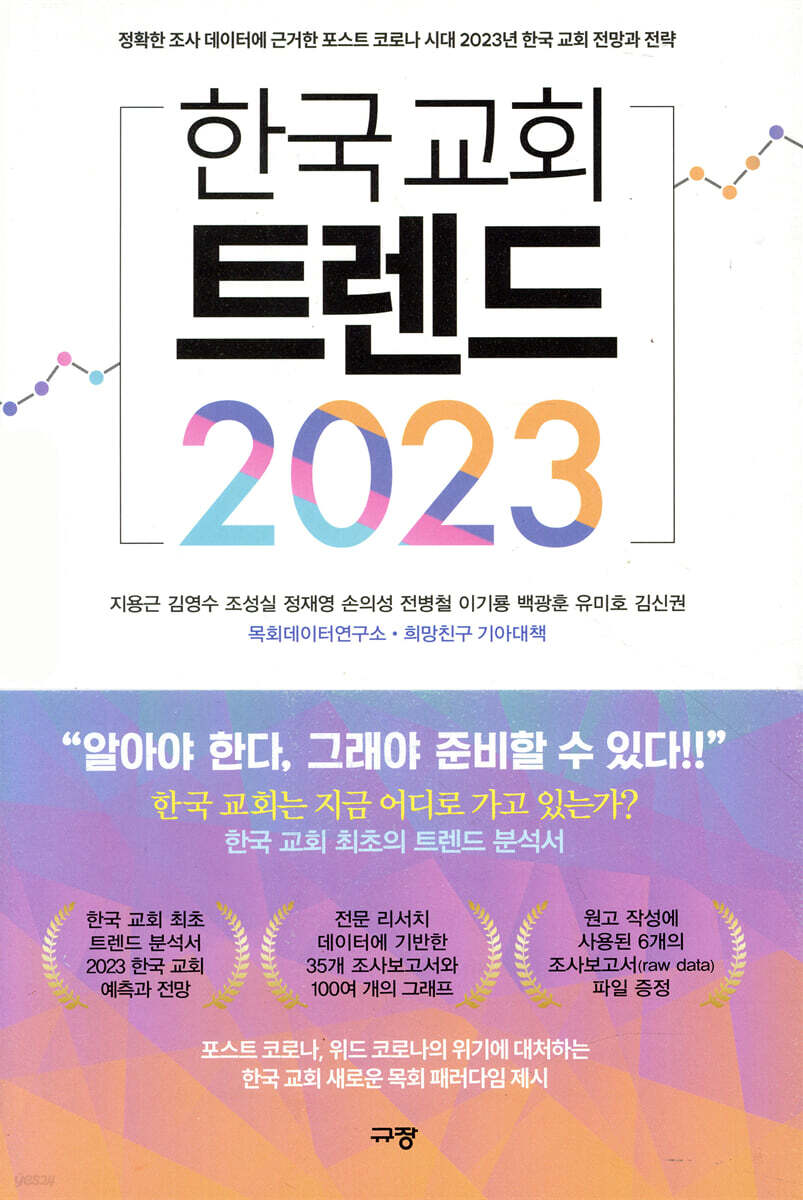
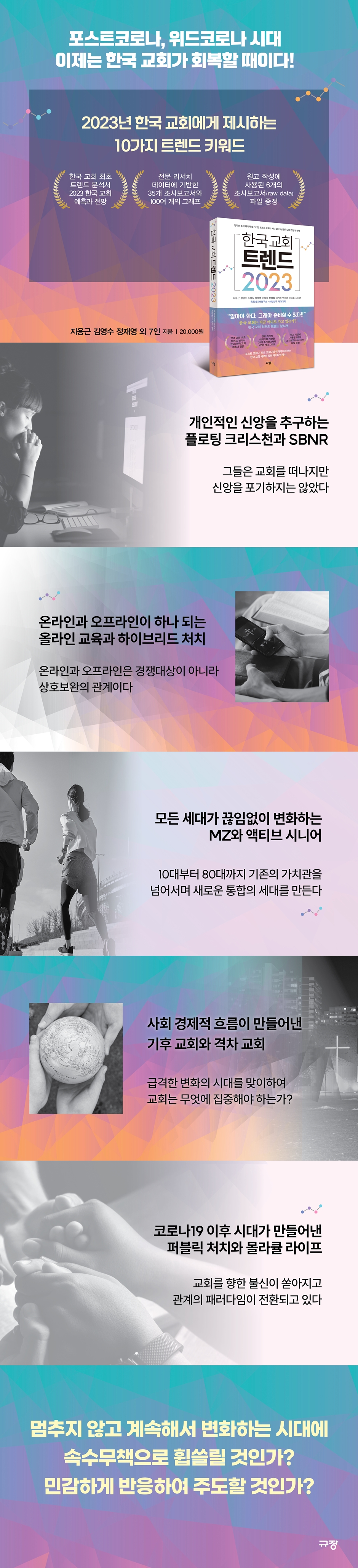
“You need to know so you can prepare!!” Where is the Korean church headed now? The first trend analysis book on the Korean church We prepare for a new trend in the Korean church with accurate information, not subjective judgment! The Korean church has been going through a very difficult and gloomy period since the pandemic lasted over two years. Although many gatherings have disappeared and in-person worship services have been converted to virtual ones, we have been waiting for the time when they will recover again. And finally, the Korean church began to take steps toward recovery. In line with this movement, the first trend analysis book analyzing and presenting trends in the Korean church, "Korean Church Trends 2023," has been published for the first time in Korea. This book introduces 10 trend keywords that the Korean church should pay attention to and the flow of American Christianity, and predicts and forecasts the Korean church in 2023. Because it analyzes the current state of the Korean church based on professional research data, it is of great help in establishing objective pastoral strategies. This book, jointly planned and published by the Pastoral Data Research Institute, Korea's only Christian non-profit research institute specializing in statistics, and the Hope Friends anti-hunger mission NGO, will serve as a valuable guide for pastors, church officials, and church leaders who are setting the direction of ministry and contemplating the future direction of the church in this rapidly changing era. |
- You can preview some of the book's contents.
Preview
index
Preface
Recommendation
Introduction 1
Introduction 2
01 Floating Christian
02 Spiritual but Not Religious SBNR
03 Hybrid Church
04 Molecule Life
05 Active Senior
06 MZ: The generation that runs away when chased
07 All-Line Education
08 Public Church
09 Polarization of Church, Survival Ministry
10 Climate Church
11 Current Trends in American Christianity
Americas
Appendix (Author's Note and Sources)
Recommendation
Introduction 1
Introduction 2
01 Floating Christian
02 Spiritual but Not Religious SBNR
03 Hybrid Church
04 Molecule Life
05 Active Senior
06 MZ: The generation that runs away when chased
07 All-Line Education
08 Public Church
09 Polarization of Church, Survival Ministry
10 Climate Church
11 Current Trends in American Christianity
Americas
Appendix (Author's Note and Sources)
Detailed image
Into the book
The meaning of 'our church' is changing among some Christians.
Before COVID-19, our church meant a church where I felt a sense of belonging, a church where I worshipped, and a church where I was active. However, it is difficult to expect that kind of sense of belonging from the floating Christians of Bupyeong Elementary School, who have emerged since COVID-19.
They can easily change churches as needed.
All I need to do is just worship.
--- p.40
Christians in Korean churches want to have spiritual experiences.
Spiritual orientation is not just a desire of SBNR.
The church must be concerned with the spiritual needs of modern Koreans.
Some of the SBNRs that have rapidly expanded due to COVID-19 are likely not to return even after the pandemic ends.
Even in 2023, a significant number of SBNRs are likely to continue their religious life alone, not attending church.
Nevertheless, their spiritual pursuit will not stop.
--- p.75
Churchgoers do not believe that all religious activities can be conducted online.
For example, when asked whether they prefer 'in-person spiritual conversations' or 'online spiritual conversations' when having 'spiritual conversations' with pastors and church members, most church members showed a strong preference for 'in-person spiritual conversations' (58.8%) over 'online spiritual conversations' (8%).
This tendency is especially pronounced as age increases.
--- p.79
What people ultimately want is 'community'.
However, these communities are different from traditional communities.
A new community that recognizes individual discretion and agency, rather than belonging to a uniform and authoritarian group, while also being there when needed and forming emotional support and empathy—this is the image of "molecule life," which will emerge as a significant trend in the post-COVID era.
--- pp.114~115
The same survey also asked how many young people who actually attend church would like to leave.
When asked about their church attendance in the next 10 years, 64.0% of young people, or about 2 out of 3, said they would “continue attending church while maintaining their Christian faith.”
The remaining 36.0% responded that they would either move to Canaan or abandon their Christian faith altogether.
More than one-third of current churchgoing youth are considering leaving the church in the future.
--- pp.175~176
During the COVID-19 pandemic, Korean churches faced significant attacks from the general public.
This is because the response to COVID-19 was wrong.
In an April 2022 survey by the Kukmin Ilbo, 79.3% of the general public responded that “Protestants are not interested in the safety of the people and are only interested in their own religious activities.”
When looking at this by religion, only 51.7% of Protestants responded “yes,” while a whopping 85.0% of non-Protestants responded “yes.”
--- p.223
It suggests that the roles of spiritual needs and religion in American lives are beginning to separate.
There is a growing recognition that institutional religion cannot satisfy the spiritual and religious needs of individuals.
As a result, the influence of institutional religion in the lives of ordinary people is gradually diminishing.
Before COVID-19, our church meant a church where I felt a sense of belonging, a church where I worshipped, and a church where I was active. However, it is difficult to expect that kind of sense of belonging from the floating Christians of Bupyeong Elementary School, who have emerged since COVID-19.
They can easily change churches as needed.
All I need to do is just worship.
--- p.40
Christians in Korean churches want to have spiritual experiences.
Spiritual orientation is not just a desire of SBNR.
The church must be concerned with the spiritual needs of modern Koreans.
Some of the SBNRs that have rapidly expanded due to COVID-19 are likely not to return even after the pandemic ends.
Even in 2023, a significant number of SBNRs are likely to continue their religious life alone, not attending church.
Nevertheless, their spiritual pursuit will not stop.
--- p.75
Churchgoers do not believe that all religious activities can be conducted online.
For example, when asked whether they prefer 'in-person spiritual conversations' or 'online spiritual conversations' when having 'spiritual conversations' with pastors and church members, most church members showed a strong preference for 'in-person spiritual conversations' (58.8%) over 'online spiritual conversations' (8%).
This tendency is especially pronounced as age increases.
--- p.79
What people ultimately want is 'community'.
However, these communities are different from traditional communities.
A new community that recognizes individual discretion and agency, rather than belonging to a uniform and authoritarian group, while also being there when needed and forming emotional support and empathy—this is the image of "molecule life," which will emerge as a significant trend in the post-COVID era.
--- pp.114~115
The same survey also asked how many young people who actually attend church would like to leave.
When asked about their church attendance in the next 10 years, 64.0% of young people, or about 2 out of 3, said they would “continue attending church while maintaining their Christian faith.”
The remaining 36.0% responded that they would either move to Canaan or abandon their Christian faith altogether.
More than one-third of current churchgoing youth are considering leaving the church in the future.
--- pp.175~176
During the COVID-19 pandemic, Korean churches faced significant attacks from the general public.
This is because the response to COVID-19 was wrong.
In an April 2022 survey by the Kukmin Ilbo, 79.3% of the general public responded that “Protestants are not interested in the safety of the people and are only interested in their own religious activities.”
When looking at this by religion, only 51.7% of Protestants responded “yes,” while a whopping 85.0% of non-Protestants responded “yes.”
--- p.223
It suggests that the roles of spiritual needs and religion in American lives are beginning to separate.
There is a growing recognition that institutional religion cannot satisfy the spiritual and religious needs of individuals.
As a result, the influence of institutional religion in the lives of ordinary people is gradually diminishing.
--- p.306
Publisher's Review
We prepare for a new trend in the Korean church with accurate information, not subjective judgment!
The Korean church has been going through a very difficult and gloomy period since the pandemic lasted over two years.
Although many gatherings have disappeared and in-person worship services have been converted to virtual ones, we have been waiting for the time when they will recover.
And finally, the Korean church began to take steps toward recovery.
In line with this movement, the first trend analysis book analyzing and presenting trends in the Korean church, “Korean Church Trends 2023,” has been published for the first time in Korea.
This book introduces 10 trend keywords that the Korean church should pay attention to and the flow of American Christianity, and predicts and forecasts the Korean church in 2023.
Because it analyzes the current state of the Korean church based on professional research data, it is of great help in establishing objective pastoral strategies.
This book, jointly planned and published by the Pastoral Data Research Institute, Korea's only Christian non-profit research institute specializing in statistics, and the Hope Friends anti-hunger mission NGO, will serve as a valuable guide for pastors, church officials, and church leaders who are setting the direction of ministry and contemplating the future direction of the church in this rapidly changing era.
The Korean church has been going through a very difficult and gloomy period since the pandemic lasted over two years.
Although many gatherings have disappeared and in-person worship services have been converted to virtual ones, we have been waiting for the time when they will recover.
And finally, the Korean church began to take steps toward recovery.
In line with this movement, the first trend analysis book analyzing and presenting trends in the Korean church, “Korean Church Trends 2023,” has been published for the first time in Korea.
This book introduces 10 trend keywords that the Korean church should pay attention to and the flow of American Christianity, and predicts and forecasts the Korean church in 2023.
Because it analyzes the current state of the Korean church based on professional research data, it is of great help in establishing objective pastoral strategies.
This book, jointly planned and published by the Pastoral Data Research Institute, Korea's only Christian non-profit research institute specializing in statistics, and the Hope Friends anti-hunger mission NGO, will serve as a valuable guide for pastors, church officials, and church leaders who are setting the direction of ministry and contemplating the future direction of the church in this rapidly changing era.
GOODS SPECIFICS
- Date of issue: September 14, 2022
- Page count, weight, size: 328 pages | 596g | 152*225*20mm
- ISBN13: 9791165043599
- ISBN10: 1165043599
You may also like
카테고리
korean


korean

![GQ KOREA Mark (Monthly): December [2025]](http://librairie.coreenne.fr/cdn/shop/files/8ef265dbbfbf186523ed75ba7319009d.jpg?v=1765340328&width=3840)


