

The real way to study math
 |
Description
Book Introduction
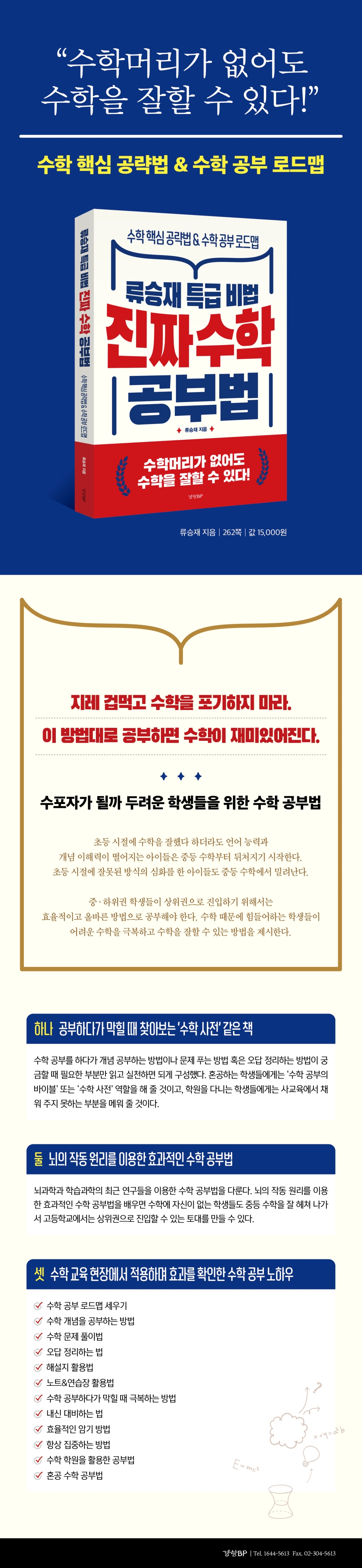
A book like a 'math dictionary' that you can look up when you get stuck while studying. Even if children are good at math in elementary school, they begin to fall behind in math in middle school due to poor language skills and conceptual understanding. Children who study math incorrectly in elementary school also fall behind in middle school math. In order for middle and lower-ranking students to advance to the top ranks, they must study in an efficient and correct manner. This book contains specific information on how to study mathematics, as well as general information related to study methods. This book deals with studying, especially how to study well in math, which is the subject that students find most difficult. When you are studying math and are curious about how to study concepts, solve problems, or organize incorrect answers, it is organized so that you can read and practice only the necessary parts. It is not a book that you simply read once and put to rest, but rather a guidebook or manual that you can read and put into practice whenever you have questions. For students studying alone, it will serve as a 'math study bible' or 'math dictionary', and for students attending private academies, it will fill in the gaps that private education cannot. |
- You can preview some of the book's contents.
Preview
index
preface
Chapter 1: The Brain That's Good at Math
01 Knowing how the brain works can help you excel at math.
02 How to study math concepts effectively
03 Why do we quickly forget what we learn?
04 Does getting enough sleep help you study math?
05 If you hate studying so much
06 Don't trust yourself
07 How can I improve my concentration?
08 Is math something only smart kids are good at?
09 How do we strengthen the brain networks needed to excel at math?
10 Effective Note-Taking Techniques
Key points
Chapter 2: Things You Must Know to Be Good at Math
01 Why should we study math?
02 Why You Need to Develop Mathematical Thinking Skills
03 Why is math difficult, boring, and uninteresting?
04 Learning Attitude for Doing Well in Middle and High School Mathematics
The fundamental reason why middle and high school students are bad at math
Conceptual learning attitudes that should be acquired from elementary school
05 Math study sequence to build skills
How to overcome obstacles while studying math
06 Math Study and Metacognition
Key points
Chapter 3: Real Math Study Methods That Get You Scores
01 How to study math concepts
Concepts and Principles
If you don't study the concepts properly
Different ways to study concepts
02 How to solve math problems
Basic problem
Type problem
Advanced problems
03 How to organize incorrect answers
The need to organize incorrect answers
Organizing your error notes is not organizing your errors.
How to organize incorrect answers correctly
04 How to read multiple times
05 How to use the commentary
06 How to Use Notes & Practice Books
07 How to prepare for the internal exam
08 Study Methods for Students Who Struggle with Math
Concept Study Method: Review one workbook three times.
Problem-solving method: Review one workbook three times.
09 Creating a Math Study Roadmap
Progress chart by level (regular goals)
Balancing prerequisites and advanced study (regular goals)
Classification of middle and high school textbooks by difficulty level and selection method for textbooks by level
Build your skills through in-depth study (goal of regular admission)
10 Tips to Help You Study Math
How to avoid a slump
Effective memorization method
How to always stay focused
How to Create Study Habits
Key points
Chapter 4: Application of Real Math Study Methods
01 Study method using math academy
lecture-style academy
Customized academy
02 Study Method for Mathematics in a Mixed-Gong Environment
Concept learning
Problem solving practice
Review
Preparing for the internal exam
Establishing a roadmap
03 Correcting Incorrect Math Study Methods
Group A, 3rd year of middle school | Language ability (lower), learning ability (lower), and conscientiousness (lower), expected to score 6-7
Group B, 2nd year of middle school | Language skills (medium), learning ability (low), and conscientiousness (low), expected to be grades 5-6
Group C, 3rd year of middle school | Language ability (high), learning ability (medium), and conscientiousness (medium), expected to be graded 4-5
D, 2nd year middle school student | Expected grades 3-4 in language ability (high), learning ability (medium), and conscientiousness (medium)
F, 1st year middle school student | Language ability (high), learning ability (high), sincerity (high), general high school grade 2
Middle school 2nd grade student G | Language skills (medium), learning ability (medium), and conscientiousness (low), expected to be grade 4
High School 1st grade student E | Language ability (high), learning ability (high), sincerity (high), 4th grade in specialized high school
04 Middle School Math Advanced Challenge
A timid female student's Black Label challenge
A student who is studying alone takes on the challenge of Black Label, a non-face-to-face class.
05 Ryu Seung-jae's method of meditation
What made me study hard in elementary school?
Establishing a study routine during middle school
In high school, English and math become difficult.
Self-studying math
How I Stayed Focused While Studying 14-16 Hours a Day
How to study for a math test
A special reason for the marriage
Advantages of Honkong
Key points
Chapter 5: Essential elementary and middle school math concepts required for middle and high school courses
01 Elementary mathematics concepts essential for secondary education
Numbers and Operations
regularity
02 Secondary mathematics concepts essential for high school courses
Numbers and Operations
Characters and expressions
function
diagram
Appendix: Summary of Key Math Study Methods
Chapter 1: The Brain That's Good at Math
01 Knowing how the brain works can help you excel at math.
02 How to study math concepts effectively
03 Why do we quickly forget what we learn?
04 Does getting enough sleep help you study math?
05 If you hate studying so much
06 Don't trust yourself
07 How can I improve my concentration?
08 Is math something only smart kids are good at?
09 How do we strengthen the brain networks needed to excel at math?
10 Effective Note-Taking Techniques
Key points
Chapter 2: Things You Must Know to Be Good at Math
01 Why should we study math?
02 Why You Need to Develop Mathematical Thinking Skills
03 Why is math difficult, boring, and uninteresting?
04 Learning Attitude for Doing Well in Middle and High School Mathematics
The fundamental reason why middle and high school students are bad at math
Conceptual learning attitudes that should be acquired from elementary school
05 Math study sequence to build skills
How to overcome obstacles while studying math
06 Math Study and Metacognition
Key points
Chapter 3: Real Math Study Methods That Get You Scores
01 How to study math concepts
Concepts and Principles
If you don't study the concepts properly
Different ways to study concepts
02 How to solve math problems
Basic problem
Type problem
Advanced problems
03 How to organize incorrect answers
The need to organize incorrect answers
Organizing your error notes is not organizing your errors.
How to organize incorrect answers correctly
04 How to read multiple times
05 How to use the commentary
06 How to Use Notes & Practice Books
07 How to prepare for the internal exam
08 Study Methods for Students Who Struggle with Math
Concept Study Method: Review one workbook three times.
Problem-solving method: Review one workbook three times.
09 Creating a Math Study Roadmap
Progress chart by level (regular goals)
Balancing prerequisites and advanced study (regular goals)
Classification of middle and high school textbooks by difficulty level and selection method for textbooks by level
Build your skills through in-depth study (goal of regular admission)
10 Tips to Help You Study Math
How to avoid a slump
Effective memorization method
How to always stay focused
How to Create Study Habits
Key points
Chapter 4: Application of Real Math Study Methods
01 Study method using math academy
lecture-style academy
Customized academy
02 Study Method for Mathematics in a Mixed-Gong Environment
Concept learning
Problem solving practice
Review
Preparing for the internal exam
Establishing a roadmap
03 Correcting Incorrect Math Study Methods
Group A, 3rd year of middle school | Language ability (lower), learning ability (lower), and conscientiousness (lower), expected to score 6-7
Group B, 2nd year of middle school | Language skills (medium), learning ability (low), and conscientiousness (low), expected to be grades 5-6
Group C, 3rd year of middle school | Language ability (high), learning ability (medium), and conscientiousness (medium), expected to be graded 4-5
D, 2nd year middle school student | Expected grades 3-4 in language ability (high), learning ability (medium), and conscientiousness (medium)
F, 1st year middle school student | Language ability (high), learning ability (high), sincerity (high), general high school grade 2
Middle school 2nd grade student G | Language skills (medium), learning ability (medium), and conscientiousness (low), expected to be grade 4
High School 1st grade student E | Language ability (high), learning ability (high), sincerity (high), 4th grade in specialized high school
04 Middle School Math Advanced Challenge
A timid female student's Black Label challenge
A student who is studying alone takes on the challenge of Black Label, a non-face-to-face class.
05 Ryu Seung-jae's method of meditation
What made me study hard in elementary school?
Establishing a study routine during middle school
In high school, English and math become difficult.
Self-studying math
How I Stayed Focused While Studying 14-16 Hours a Day
How to study for a math test
A special reason for the marriage
Advantages of Honkong
Key points
Chapter 5: Essential elementary and middle school math concepts required for middle and high school courses
01 Elementary mathematics concepts essential for secondary education
Numbers and Operations
regularity
02 Secondary mathematics concepts essential for high school courses
Numbers and Operations
Characters and expressions
function
diagram
Appendix: Summary of Key Math Study Methods
Detailed image
Into the book
When you read the concepts on your own, you can proactively organize the concepts and control your pace, but when you listen to a lecture, you become passive because you listen to the lecture at the instructor's pace.
Moreover, speaking while listening is difficult because it interferes with listening.
In times like these, it's okay to pause the lecture for a moment, summarize the lecture content verbally, write it down in a notebook, or explain it to someone next to you.
--- p.20
Rather than simply memorizing formulas and accepting concepts, it is necessary to wonder why they hold true.
The act of asking and thinking about the question “Why?” is more than twice as effective in helping you remember a concept.
--- p.24
To avoid forgetting what you have studied, you need to repeat and review it several times before going to bed.
If you review what you studied every day, your brain will store what you studied every time you sleep.
In particular, if you keep pulling out certain information from your head, you will eventually reach a stage where it will come to mind naturally.
--- p.27
Mathematics is a subject that requires a focus on building strong brain networks through repetitive and consistent practice and memorization, which leads to a deeper understanding.
Therefore, in-depth learning that allows you to fully master the concepts step by step is more important than quick learning.
Through these exercises, various mathematically related networks become firmly established in the brain, giving you the ability to study more mathematics and become better at it.
--- p.38
Just watching someone else let go doesn't strengthen your brain connections.
You must actively solve all problems or study on your own initiative.
--- p.41
Students who do not learn to accurately understand concepts and principles and understand why things work the way they do in elementary school end up studying that way in middle and high school and end up not being good at math.
Therefore, in order to overcome it, we need to understand and study the 'why' from now on, and we need to be able to derive all the formulas one by one.
--- p.63
Simply finding a school or teacher who provides good explanations and is willing to answer questions will only serve as a much-needed oxygen supply for students who are weak in math.
What's the point of failing in high school? I hope I can learn how to overcome it on my own and improve my learning ability by studying step by step.
--- p.65
The most important reason why problems are not solved is because the concepts are not sufficiently stored in long-term memory.
Review the concepts relevant to the problem and listen to the lecture on the concepts again to organize the concepts.
It is better to explain the concept by writing it down on a worksheet.
--- pp.67~68
If you are aiming for the top level, I recommend solving advanced problems using only basic concepts rather than solving problems using advanced concepts.
In particular, the college entrance exam, the CSAT, presents unstructured questions (unfamiliar questions that you have never seen before), so studying and mastering advanced concepts is not very helpful.
--- p.78
Students who are bad at math mainly study 'what'.
In other words, there is a high possibility that you will only memorize and study what the formula is, what the theorem is, and what the definition is.
However, mathematics should be studied not about 'what' but about 'why' and 'how'.
In other words, you can be good at math only if you know why it is established and how it is derived.
--- p.83
Most students solve problems without thinking, make mistakes, and correct them without even understanding the concept.
That's why I'm bad at math.
If you organize your wrong answers while forgetting the concept, you will not be able to solve the problem accurately, and your correct answer rate will inevitably become uneven.
--- p.84
Most problems you can't solve in the textbook are because you've forgotten the concepts, so it's important to look up and review the concepts related to the problem rather than thinking about them for a long time.
I recommend reviewing the concepts naturally in this way while solving the problems, and learning the concepts along with the problems.
--- p.88
Opening a concept book and looking at the contents and explaining them is not well stored in the mind.
After familiarizing yourself with the contents of the concept book, you should explain it while recalling it in your head so that you can understand and memorize the concept well.
The advantage of explaining is that it helps me memorize, but it's also effective in helping me figure out what I didn't quite understand.
--- p.91
If you get stuck while solving a problem, always go back to the concept.
Getting stuck while solving a problem means you've missed a concept.
Reread the concepts and check if there are any concepts you don't understand.
Then try to solve the problem again.
--- pp.94~95
Many students misunderstand that the act of listening to an explanation or looking at an explanation and then writing down the solution in a notebook when they come across a problem they don't know is "correcting their mistakes."
But this is just a simple summary.
Doing this will not solve similar types of problems.
The true solution to wrong answers is to solve the problem repeatedly enough and internalize the solution to the problem.
Moreover, speaking while listening is difficult because it interferes with listening.
In times like these, it's okay to pause the lecture for a moment, summarize the lecture content verbally, write it down in a notebook, or explain it to someone next to you.
--- p.20
Rather than simply memorizing formulas and accepting concepts, it is necessary to wonder why they hold true.
The act of asking and thinking about the question “Why?” is more than twice as effective in helping you remember a concept.
--- p.24
To avoid forgetting what you have studied, you need to repeat and review it several times before going to bed.
If you review what you studied every day, your brain will store what you studied every time you sleep.
In particular, if you keep pulling out certain information from your head, you will eventually reach a stage where it will come to mind naturally.
--- p.27
Mathematics is a subject that requires a focus on building strong brain networks through repetitive and consistent practice and memorization, which leads to a deeper understanding.
Therefore, in-depth learning that allows you to fully master the concepts step by step is more important than quick learning.
Through these exercises, various mathematically related networks become firmly established in the brain, giving you the ability to study more mathematics and become better at it.
--- p.38
Just watching someone else let go doesn't strengthen your brain connections.
You must actively solve all problems or study on your own initiative.
--- p.41
Students who do not learn to accurately understand concepts and principles and understand why things work the way they do in elementary school end up studying that way in middle and high school and end up not being good at math.
Therefore, in order to overcome it, we need to understand and study the 'why' from now on, and we need to be able to derive all the formulas one by one.
--- p.63
Simply finding a school or teacher who provides good explanations and is willing to answer questions will only serve as a much-needed oxygen supply for students who are weak in math.
What's the point of failing in high school? I hope I can learn how to overcome it on my own and improve my learning ability by studying step by step.
--- p.65
The most important reason why problems are not solved is because the concepts are not sufficiently stored in long-term memory.
Review the concepts relevant to the problem and listen to the lecture on the concepts again to organize the concepts.
It is better to explain the concept by writing it down on a worksheet.
--- pp.67~68
If you are aiming for the top level, I recommend solving advanced problems using only basic concepts rather than solving problems using advanced concepts.
In particular, the college entrance exam, the CSAT, presents unstructured questions (unfamiliar questions that you have never seen before), so studying and mastering advanced concepts is not very helpful.
--- p.78
Students who are bad at math mainly study 'what'.
In other words, there is a high possibility that you will only memorize and study what the formula is, what the theorem is, and what the definition is.
However, mathematics should be studied not about 'what' but about 'why' and 'how'.
In other words, you can be good at math only if you know why it is established and how it is derived.
--- p.83
Most students solve problems without thinking, make mistakes, and correct them without even understanding the concept.
That's why I'm bad at math.
If you organize your wrong answers while forgetting the concept, you will not be able to solve the problem accurately, and your correct answer rate will inevitably become uneven.
--- p.84
Most problems you can't solve in the textbook are because you've forgotten the concepts, so it's important to look up and review the concepts related to the problem rather than thinking about them for a long time.
I recommend reviewing the concepts naturally in this way while solving the problems, and learning the concepts along with the problems.
--- p.88
Opening a concept book and looking at the contents and explaining them is not well stored in the mind.
After familiarizing yourself with the contents of the concept book, you should explain it while recalling it in your head so that you can understand and memorize the concept well.
The advantage of explaining is that it helps me memorize, but it's also effective in helping me figure out what I didn't quite understand.
--- p.91
If you get stuck while solving a problem, always go back to the concept.
Getting stuck while solving a problem means you've missed a concept.
Reread the concepts and check if there are any concepts you don't understand.
Then try to solve the problem again.
--- pp.94~95
Many students misunderstand that the act of listening to an explanation or looking at an explanation and then writing down the solution in a notebook when they come across a problem they don't know is "correcting their mistakes."
But this is just a simple summary.
Doing this will not solve similar types of problems.
The true solution to wrong answers is to solve the problem repeatedly enough and internalize the solution to the problem.
--- p.98
Publisher's Review
Don't be scared and give up on math.
If you study this way, math becomes fun.
A Math Study Guide for Students Afraid of Being a Math Fail
Effective Math Study Methods Using Brain Functions
This book presents methods for students who struggle with math to overcome the difficulty and become good at it.
Top students with excellent grades learn efficient and correct study methods on their own as they study, but middle and lower-ranking students do not know how to study at all, so they waste time inefficiently and do not see their grades improve in proportion to the effort they put in.
Some of these students may end up as dropouts, while others may become average students who maintain mid- to low-level skills.
However, there is no need to give up in advance if you missed math in elementary school.
If you study math the right way, even starting in middle school, you can catch up before going to high school.
This book covers math study methods that utilize recent research in brain science and learning science.
By learning effective math study methods that utilize the brain's working principles, even students who lack confidence in math can build a foundation for successfully navigating middle school math and reaching the top of their class in high school.
Math study know-how proven effective through application in math education
The author has introduced the know-how related to studying math that he has applied while teaching students in the field of math education for a long time, such as how to overcome obstacles while studying math, various ways to study math concepts, how to solve math problems, how to organize wrong answers, how to use answer sheets, how to use notes and workbooks, how to prepare for internal exams, how to create a roadmap for studying math, how to avoid falling into a slump, efficient memorization methods, how to always concentrate, how to create study habits, how to study using math academies, and how to study math alone.
We have described study methods as easily and specifically as possible so that middle and high school students, from the upper grades of elementary school onwards, can read the book and put it into practice one by one. We have also organized the key contents of math study methods separately in each chapter so that you can easily check the main contents whenever you need them after reading the book.
In addition, we introduce real-life examples of students at various levels who improved their grades by practicing real math study methods, helping readers not to give up and to gradually improve their grades even if their current grades are low.
Structure of this book
Chapter 1 explains the most effective study methods proven in education, cognitive psychology, brain science, and learning science.
In addition, we presented a method to simultaneously pursue both advanced and advanced skills by presenting specific math study methods to excel in math and an efficient learning roadmap to catch up with the top students.
Chapter 2 describes the reasons why children are bad at math, how to overcome them, and how to broaden their understanding of the subject of math.
Chapter 3 presents a roadmap for studying mathematics and how to apply the study methods introduced in Chapter 1 to actual mathematics studies.
Chapter 4 outlines how to apply the math study methods presented in Chapter 3 to your own situation.
If you are attending a math academy, we will introduce how to choose a math academy and how to attend it well, and if you are studying alone, we will describe the roadmap to follow.
Chapter 5 summarizes the core elementary and middle school mathematics concepts that students must know to study advanced mathematics.
If you study this way, math becomes fun.
A Math Study Guide for Students Afraid of Being a Math Fail
Effective Math Study Methods Using Brain Functions
This book presents methods for students who struggle with math to overcome the difficulty and become good at it.
Top students with excellent grades learn efficient and correct study methods on their own as they study, but middle and lower-ranking students do not know how to study at all, so they waste time inefficiently and do not see their grades improve in proportion to the effort they put in.
Some of these students may end up as dropouts, while others may become average students who maintain mid- to low-level skills.
However, there is no need to give up in advance if you missed math in elementary school.
If you study math the right way, even starting in middle school, you can catch up before going to high school.
This book covers math study methods that utilize recent research in brain science and learning science.
By learning effective math study methods that utilize the brain's working principles, even students who lack confidence in math can build a foundation for successfully navigating middle school math and reaching the top of their class in high school.
Math study know-how proven effective through application in math education
The author has introduced the know-how related to studying math that he has applied while teaching students in the field of math education for a long time, such as how to overcome obstacles while studying math, various ways to study math concepts, how to solve math problems, how to organize wrong answers, how to use answer sheets, how to use notes and workbooks, how to prepare for internal exams, how to create a roadmap for studying math, how to avoid falling into a slump, efficient memorization methods, how to always concentrate, how to create study habits, how to study using math academies, and how to study math alone.
We have described study methods as easily and specifically as possible so that middle and high school students, from the upper grades of elementary school onwards, can read the book and put it into practice one by one. We have also organized the key contents of math study methods separately in each chapter so that you can easily check the main contents whenever you need them after reading the book.
In addition, we introduce real-life examples of students at various levels who improved their grades by practicing real math study methods, helping readers not to give up and to gradually improve their grades even if their current grades are low.
Structure of this book
Chapter 1 explains the most effective study methods proven in education, cognitive psychology, brain science, and learning science.
In addition, we presented a method to simultaneously pursue both advanced and advanced skills by presenting specific math study methods to excel in math and an efficient learning roadmap to catch up with the top students.
Chapter 2 describes the reasons why children are bad at math, how to overcome them, and how to broaden their understanding of the subject of math.
Chapter 3 presents a roadmap for studying mathematics and how to apply the study methods introduced in Chapter 1 to actual mathematics studies.
Chapter 4 outlines how to apply the math study methods presented in Chapter 3 to your own situation.
If you are attending a math academy, we will introduce how to choose a math academy and how to attend it well, and if you are studying alone, we will describe the roadmap to follow.
Chapter 5 summarizes the core elementary and middle school mathematics concepts that students must know to study advanced mathematics.
GOODS SPECIFICS
- Date of issue: January 25, 2023
- Page count, weight, size: 262 pages | 462g | 152*225*16mm
- ISBN13: 9788969525307
- ISBN10: 8969525300
You may also like
카테고리
korean


korean

![GQ KOREA Mark (Monthly): December [2025]](http://librairie.coreenne.fr/cdn/shop/files/8ef265dbbfbf186523ed75ba7319009d.jpg?v=1765340328&width=3840)


