

Product Manager Principles
 |
Description
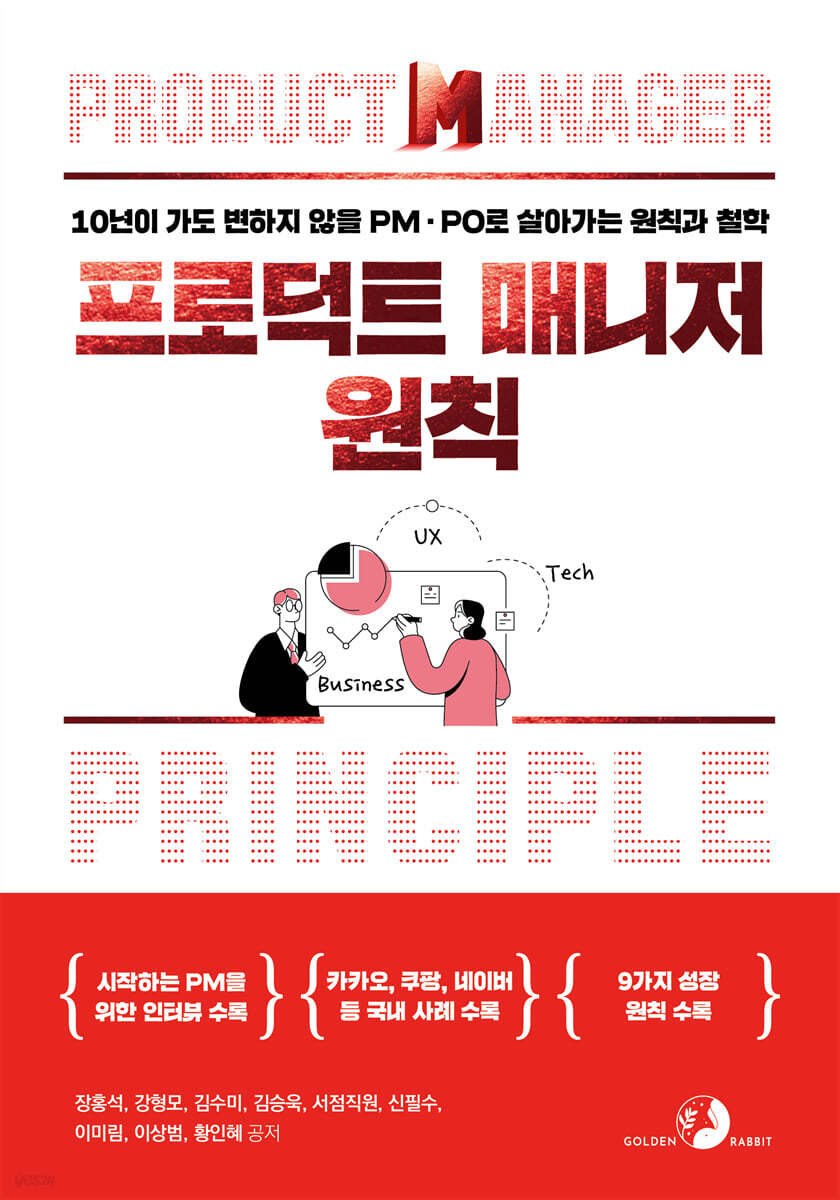
Book Introduction
- If you dream of growing into a better PM/PO
- Find the answer in the principles of our predecessors who have overcome it first.
"Can I become a PM/PO? How can I grow like my seniors? Will I be able to create a product that is loved by many people in 3 or 10 years? What should a PM/PO major in? How do I kick off a project? How do I achieve teamwork?" Nine current and former PM/POs from Coupang, Yanolja, Kakao Style, Interpark, Remember, Cremon, Encar.com, Energy X, Line, KB Kookmin Card, and Naver answer these questions for those who aspire to become PM/POs and those who are living as PM/POs.
Find your own answers in the principles of survival and growth you've never encountered before.
* Principle: The equation of karma discovered by a senior with prior experience that will not change even after 10 years.
- Find the answer in the principles of our predecessors who have overcome it first.
"Can I become a PM/PO? How can I grow like my seniors? Will I be able to create a product that is loved by many people in 3 or 10 years? What should a PM/PO major in? How do I kick off a project? How do I achieve teamwork?" Nine current and former PM/POs from Coupang, Yanolja, Kakao Style, Interpark, Remember, Cremon, Encar.com, Energy X, Line, KB Kookmin Card, and Naver answer these questions for those who aspire to become PM/POs and those who are living as PM/POs.
Find your own answers in the principles of survival and growth you've never encountered before.
* Principle: The equation of karma discovered by a senior with prior experience that will not change even after 10 years.
index
3 Questions and Answers with Seniors for PMs Starting at 00
__3 Questions and Answers with 'Senior Shin Pil-soo'
__3 Questions and Answers with Senior 'Kim Soo-mi'
__3 Questions and Answers with Senior 'Imirim'
__3 Questions and Answers with Senior 'Kim Seung-wook'
__3 Questions and Answers with Senior 'Hwang In-hye'
__3 Questions and Answers with Senior Kang Hyung-mo
__3 Questions and Answers with a Senior 'Bookstore Employee'
__3 Questions and Answers with Senior Lee Sang-beom
__3 Questions and Answers with Senior 'Jang Hong-seok'
01 5 Skills for Beginning PMs
__Writing and speaking skills
__ownership
__english
__Curiosity and a willingness to learn
__A personality that fits with a variety of people
02 Kickoff technology that makes a bigger difference
__Why Kickoff is Important
__Two things to get from the kickoff
__Synchronize properly at kickoff
__Building Teamwork at Kickoff
__4 Tips for a Successful Kickoff
03 Service Review New Tech
__Why should I take it apart?
__How should I open it?
__How should I apply it?
04 Solve the essential problem in the right way
__Product Improvement Cycle
__PIC Step 1: Seizing the Opportunity
__PIC Step 2: Hypothesis Development
__PIC Step 3: Execute
__PIC Step 4: Hypothesis Testing
05 Finding the 'Aha Moment'
__Always start with the customer
__In search of the 'Aha Moment'
__'Aha Moments' and 'Retention'
__The fastest and easiest way to an 'aha moment'
__Spreading the word about 'Aha Moments'
__Think about the easiest and fastest way for customers to reach their 'aha moment'
__Aha Moment Again
06 Doubt and doubt again.
Even the devil laughs like an angel
__Indicator: If you're not sure, don't bet.
__Interview: Understanding Needs
__Analysis: Finding 'Aha Moments' Through User Behavior
__Hypothesis & Experiment: Think and Act
07 Focus on 'Why It Doesn't Work'
__The problems that arise when creating a product without understanding the business
__The problem of cost-benefit
__Problems that arise when the subject and object are reversed
__Not by feeling and intuition, but by field and data
__Should I really do this?
08 Understand the 'Product Terroir'
__Do you know 'product terroir'?
__What kind of wine do you want to make?
__Are you concerned about the utility value of wine?
Making Wine Using Prepaid Grapes from __Easy Payment Service
Making Wine Using __Commerce's "Prepaid" Grapes
Comparing the taste of wine made from 'prepaid' grapes
09 Ask yourself “Why”
__PM is a journey to find the endless Why
__Understanding the Product: Why should the product exist?
__Understanding PM: Why Should PMs Exist?
__PM Growth: How to Build Your Thinking Muscle
__3 Questions and Answers with 'Senior Shin Pil-soo'
__3 Questions and Answers with Senior 'Kim Soo-mi'
__3 Questions and Answers with Senior 'Imirim'
__3 Questions and Answers with Senior 'Kim Seung-wook'
__3 Questions and Answers with Senior 'Hwang In-hye'
__3 Questions and Answers with Senior Kang Hyung-mo
__3 Questions and Answers with a Senior 'Bookstore Employee'
__3 Questions and Answers with Senior Lee Sang-beom
__3 Questions and Answers with Senior 'Jang Hong-seok'
01 5 Skills for Beginning PMs
__Writing and speaking skills
__ownership
__english
__Curiosity and a willingness to learn
__A personality that fits with a variety of people
02 Kickoff technology that makes a bigger difference
__Why Kickoff is Important
__Two things to get from the kickoff
__Synchronize properly at kickoff
__Building Teamwork at Kickoff
__4 Tips for a Successful Kickoff
03 Service Review New Tech
__Why should I take it apart?
__How should I open it?
__How should I apply it?
04 Solve the essential problem in the right way
__Product Improvement Cycle
__PIC Step 1: Seizing the Opportunity
__PIC Step 2: Hypothesis Development
__PIC Step 3: Execute
__PIC Step 4: Hypothesis Testing
05 Finding the 'Aha Moment'
__Always start with the customer
__In search of the 'Aha Moment'
__'Aha Moments' and 'Retention'
__The fastest and easiest way to an 'aha moment'
__Spreading the word about 'Aha Moments'
__Think about the easiest and fastest way for customers to reach their 'aha moment'
__Aha Moment Again
06 Doubt and doubt again.
Even the devil laughs like an angel
__Indicator: If you're not sure, don't bet.
__Interview: Understanding Needs
__Analysis: Finding 'Aha Moments' Through User Behavior
__Hypothesis & Experiment: Think and Act
07 Focus on 'Why It Doesn't Work'
__The problems that arise when creating a product without understanding the business
__The problem of cost-benefit
__Problems that arise when the subject and object are reversed
__Not by feeling and intuition, but by field and data
__Should I really do this?
08 Understand the 'Product Terroir'
__Do you know 'product terroir'?
__What kind of wine do you want to make?
__Are you concerned about the utility value of wine?
Making Wine Using Prepaid Grapes from __Easy Payment Service
Making Wine Using __Commerce's "Prepaid" Grapes
Comparing the taste of wine made from 'prepaid' grapes
09 Ask yourself “Why”
__PM is a journey to find the endless Why
__Understanding the Product: Why should the product exist?
__Understanding PM: Why Should PMs Exist?
__PM Growth: How to Build Your Thinking Muscle
Detailed image

Publisher's Review
A book filled with the know-how of seniors for dreamers _Wanted Hwang Ri-geon
A book for those who create products that will remain in users' hearts forever. _Line Kim Young-jae
Recommended by Hwang Ri-geon, co-founder of Wanted, who read it before publication.
“It covers in detail, based on real-world experience, what aspiring PMs need to learn in the process and how to build their capabilities.
We hope that the authors' experiences and know-how will provide you with valuable insights.”
Recommended by Kim Young-jae, LINE's technical director.
"I hope this book will help you create products that will remain in the hearts of users forever, and furthermore, products that will become part of the culture of any country."
Includes real domestic cases such as KuO, YaOO, KakaOOOO, LeeOO, K-O, EnOOcom, LaO, and NeOO!
We show you the actual scene as it is, so realistically that you might wonder, “Is it okay to reveal everything like this?”
This book realistically showcases the case studies of leading domestic companies across diverse categories, including fintech, open markets, lodging, recruiting, talent donation, and used cars.
By understanding the strategies and perspectives that vary across industries and examining how senior PMs and POs navigated them, you'll gain powerful indirect experience.
Included in "3 Questions and Answers with Seniors for Beginning PMs"!
We asked and answered questions from nine experienced seniors for PM/POs who are just starting out.
_1.
Please write about your experience as a PM/PO so far.
_2.
Please define what I think PM/PO is.
_3.
Please guide me on how to become a PM/PO.
I asked how to become a PM/PO (or what you need to have).
Compared to the developer in the previous book, "Developer Principles," or the data scientist in "Data Scientist Principles," the path to becoming a product manager is relatively vague.
To put it simply, computer engineering is the major that comes to mind for developers, and statistics is the major that comes to mind for data scientists.
But, I can't think of a specific major for product manager.
There are certainly ways to become a PM or PO, but how they come to be is a mystery! Here are nine ways to do so.
There are 9 PM/PO principles that work in practice!?
Schopenhauer says:
“Truth is not made or created by one person.
It is a garden where all mankind can reach through roads and roads.
“You must not forget that.”
To borrow Schopenhauer's words, “Truth is not made or created by one person.
It is a garden where all mankind can reach through the connection of principles and principles.
Let's apply it to "don't forget it".
Principles are not truths.
More principles and principles must follow.
This is also why this book contains principles based on a variety of experiences.
This book is filled with principles that are sometimes contradictory, overlapping, and unfamiliar.
Yet, the reason each of these principles is meaningful is because they help us naturally reach the garden through a vortex of rejection and fusion.
And it is entirely up to each individual reader to create their own garden.
Target audience for this book
_Those who dream of becoming PM/PO
_Those who dream of becoming junior PM/PO
_Those who want to grow their production
_Startup CTO who wants to grow the organization
_People who have many concerns about organizational life and job changes
_People who are concerned about how to work efficiently
01_ 5 Skills for Beginning PMs (New Essentials_ OP.GG Ad Specialist)
“If you want to grow as a PM, build communication skills, trust, and knowledge.”
I work as an Ad Specialist at OP.GG, a service famous for its League of Legends record search service.
I am responsible for monetizing the service by placing banners and video ads throughout the service.
If you ever experience any inconvenience due to advertisements while using Office Jiji, feel free to swear at me.
Are you the type of person who unconsciously organizes and systems? Do you have the ability to extract only the essentials? Do you enjoy working with diverse people? And perhaps, do you have a penchant for repeatedly harassing developers and designers? If that sounds like you, I'll show you the surefire way to become a PM.
02_ Kickoff Technology that Makes a Big Difference (Kim Soo-mi_ (Former) Musinsa Product Leader)
“Become a product manager who makes a difference from the get-go.”
Starting with SI, I have been solving problems for product teams at various commerce service and logistics platform companies.
A product manager is responsible for the entire life cycle.
To achieve the goal of solving problems and ultimately creating a great product, all stakeholders must share the same goal and focus on their respective roles.
Therefore, it is the responsibility of product managers to invest more energy than anyone else in the kickoff phase of problem-solving and build teamwork with a clear, unified goal.
A good product manager should be able to leverage these differences in kickoffs to create differences in process and outcomes.
We'll introduce what roles you should play and what you need to be clear about at the kickoff, the starting point that makes a difference.
03_ Service Review (Imirim_ Kakao Style PO)
"Let's learn the 'Teardown Principle,' from how to choose a service to benchmark to how to apply it to your own company."
I started my career as a development intern, transitioned to a planner, and have been happily working there for over 12 years, captivated by the allure of planning.
I am currently working as a PO at Kakao Style.
After reflecting on my experiences and learnings from companies in various industries and thinking about how to share information, I would like to share the "benchmarking method" that all planners have experienced or are experiencing.
As a PO in charge of the product and a user of the service, I introduce the 'new art of dissecting' the question 'How to benchmark a service?'
You will see that even with the same function, different results can be derived depending on the business model, service nature, and user characteristics.
Additionally, as your understanding of the product gradually increases, you will experience growth for both yourself and your company.
04_ Solve the essential problem, in the right way (Kim Seung-wook (CK) _ Remember, Director of Product)
I work as the Director of Product at Remember.
We identify customer problems that bring significant value to both customers and businesses, lead hypothesis testing processes, and drive product and business growth.
As you work in the product industry, you will face countless crossroads where you have to make choices.
There were far more situations where it was difficult to decide which option was better than those where it was easy.
Information is always insufficient and there is not enough time to think leisurely.
It's always unclear whether a decision is worth considering, whether we have gathered and digested enough information to make a decision, and what criteria should be used to make that decision.
At times like these, when I looked back at the customer problem I was trying to solve and its core cause, the thick fog would often clear and I would see the path I needed to take.
There are also cases where we forget the customer problem and cause we are trying to solve and continue to wander in the fog.
Let's go back in time and look at the failures I've made, using principles as a yardstick to see what was lacking.
05_ In Search of the 'Aha Moment' (Hwang In-hye, Cremon Product Director)
“Find the ‘aha moment’—the moment when users realize the true value of your product and are ready to return!”
Starting my product career at Coupang, I now work as a Product Director at Cremon, a freelance open market platform.
Having worked on various products and businesses at Coupang in the past, and now leading products at Cremong, the most important work principle is 'working backwards from the customer,' or in Korean, 'always starting with the customer.'
POs put a lot of thought into providing the best possible experience to customers who use our products.
And you'll experience the process of listening to customers, verifying with data, and unraveling their problems and finding solutions.
In this process, we would like to introduce the "Aha Moment," the moment when customers realize the value of our product and, furthermore, become loyal customers.
I've prepared a guide to what an "aha moment" is, how to define it, what to do after finding it, and how my principles work.
06_ Doubt and doubt again.
Even the devil laughs like an angel (Hyungmo Kang, Product Owner Lead, Enka.com)
“Practice skepticism and analysis to grow incrementally.
“Careful judgment is the key to success.”
Managing platforms and products is not a simple task.
Even seemingly attractive opportunities can have unexpected consequences if not carefully analyzed and considered.
For over 20 years, I have worked in Korea and Japan, experiencing various domains such as O2O, IoT, and games.
Currently, I'm growing with my amazing colleagues in the Platform Communications Lab at Enca.com, practicing skepticism and analysis to research the growth of our platform and products.
To achieve platform and product success, you must carefully consider the opportunities presented, be skeptical, and, through that process, develop the right strategies and methods. A project manager's judgment can play a crucial role in the team's success, or vice versa.
Experience can be a driving force for growth.
Through a process of questioning and re-questioning indicators, analysis, hypotheses, experiments, and even customer interviews, I'll discuss the principles of a PO who avoids the risks of poor judgment and grows.
07_ Focus on 'Why It Doesn't Work' (Bookstore Employee_ Freelance Product Planner)
“Every problem has a cause.
Problem solving starts with finding the cause of why it doesn't work."
I am a planner with 10 years of experience, accompanying you on your journey from project start to finish, from establishing business strategies to launching services.
As you progress with your project, you will encounter various problems.
Some issues can be resolved with a simple fix, but others cannot.
When faced with a problem, it's not easy to determine whether it's solvable or something that can't be solved or should be postponed.
We often get caught up in the problem itself, misinterpreting the phenomenon as the cause and suggesting the wrong solution.
A planner's key competency is the ability to solve problems by identifying the cause of the problem and prescribing an appropriate treatment.
Problem solving must begin with finding the cause of 'why it doesn't work'.
I will introduce my own problem-solving principles in the process of finding the cause of a problem by using various examples.
08_ Understand the 'Product Terroir' (Lee Sang-beom, CPO, Energy X)
“Planning a product requires both the ideals of a scholar and the practicality of a merchant.
“This is the moment when we need to understand the ‘product terroir’!”
I started my career as a researcher at a telecommunications company and worked in product planning for companies in various industries, including telecommunications, finance, IT, commerce, and O2O.
In this process, I gained experience in balancing the pursuit of user value and business value.
Currently, as the CPO of EnergyX, I am working to establish an organizational culture that can create good products.
What does it mean to build a good product? Ultimately, it means creating a product that satisfies the value of customers who use it (growth potential) while also contributing to the company's sales and cash flow (sustainability).
Of course, it is not an easy task, but it is possible if you have a good understanding of the product-related environment.
Take a close look at the product terroir (the environment in which the product is grown).
The level of product planning will improve, and the probability of business success through the product will increase.
09_ Ask yourself, “Why?” (Jang Hong-seok_ (former) Delicious Co-CEO/CPO)
“To become a growing PM, always ask yourself:
“Why?”
A career that started as a PM led to becoming the CEO of a startup that received 82.5 billion won in investment.
I love solving problems and adding value to the world through products.
So I think there is nothing more fun and engaging than being a PM.
But every PM is always concerned about work and growth.
I've always been like that too.
Fortunately, we have someone who can help us solve that problem.
It is 'myself' who is reading this book.
No, what are you talking about all of a sudden?
Please trust me and continue to follow me.
After 20 years of making products, I've realized one principle for PMs:
It is only by asking yourself the question “Why?” that a PM can grow.
You can definitely be a great PM.
Because the answer is already within you.
A book for those who create products that will remain in users' hearts forever. _Line Kim Young-jae
Recommended by Hwang Ri-geon, co-founder of Wanted, who read it before publication.
“It covers in detail, based on real-world experience, what aspiring PMs need to learn in the process and how to build their capabilities.
We hope that the authors' experiences and know-how will provide you with valuable insights.”
Recommended by Kim Young-jae, LINE's technical director.
"I hope this book will help you create products that will remain in the hearts of users forever, and furthermore, products that will become part of the culture of any country."
Includes real domestic cases such as KuO, YaOO, KakaOOOO, LeeOO, K-O, EnOOcom, LaO, and NeOO!
We show you the actual scene as it is, so realistically that you might wonder, “Is it okay to reveal everything like this?”
This book realistically showcases the case studies of leading domestic companies across diverse categories, including fintech, open markets, lodging, recruiting, talent donation, and used cars.
By understanding the strategies and perspectives that vary across industries and examining how senior PMs and POs navigated them, you'll gain powerful indirect experience.
Included in "3 Questions and Answers with Seniors for Beginning PMs"!
We asked and answered questions from nine experienced seniors for PM/POs who are just starting out.
_1.
Please write about your experience as a PM/PO so far.
_2.
Please define what I think PM/PO is.
_3.
Please guide me on how to become a PM/PO.
I asked how to become a PM/PO (or what you need to have).
Compared to the developer in the previous book, "Developer Principles," or the data scientist in "Data Scientist Principles," the path to becoming a product manager is relatively vague.
To put it simply, computer engineering is the major that comes to mind for developers, and statistics is the major that comes to mind for data scientists.
But, I can't think of a specific major for product manager.
There are certainly ways to become a PM or PO, but how they come to be is a mystery! Here are nine ways to do so.
There are 9 PM/PO principles that work in practice!?
Schopenhauer says:
“Truth is not made or created by one person.
It is a garden where all mankind can reach through roads and roads.
“You must not forget that.”
To borrow Schopenhauer's words, “Truth is not made or created by one person.
It is a garden where all mankind can reach through the connection of principles and principles.
Let's apply it to "don't forget it".
Principles are not truths.
More principles and principles must follow.
This is also why this book contains principles based on a variety of experiences.
This book is filled with principles that are sometimes contradictory, overlapping, and unfamiliar.
Yet, the reason each of these principles is meaningful is because they help us naturally reach the garden through a vortex of rejection and fusion.
And it is entirely up to each individual reader to create their own garden.
Target audience for this book
_Those who dream of becoming PM/PO
_Those who dream of becoming junior PM/PO
_Those who want to grow their production
_Startup CTO who wants to grow the organization
_People who have many concerns about organizational life and job changes
_People who are concerned about how to work efficiently
01_ 5 Skills for Beginning PMs (New Essentials_ OP.GG Ad Specialist)
“If you want to grow as a PM, build communication skills, trust, and knowledge.”
I work as an Ad Specialist at OP.GG, a service famous for its League of Legends record search service.
I am responsible for monetizing the service by placing banners and video ads throughout the service.
If you ever experience any inconvenience due to advertisements while using Office Jiji, feel free to swear at me.
Are you the type of person who unconsciously organizes and systems? Do you have the ability to extract only the essentials? Do you enjoy working with diverse people? And perhaps, do you have a penchant for repeatedly harassing developers and designers? If that sounds like you, I'll show you the surefire way to become a PM.
02_ Kickoff Technology that Makes a Big Difference (Kim Soo-mi_ (Former) Musinsa Product Leader)
“Become a product manager who makes a difference from the get-go.”
Starting with SI, I have been solving problems for product teams at various commerce service and logistics platform companies.
A product manager is responsible for the entire life cycle.
To achieve the goal of solving problems and ultimately creating a great product, all stakeholders must share the same goal and focus on their respective roles.
Therefore, it is the responsibility of product managers to invest more energy than anyone else in the kickoff phase of problem-solving and build teamwork with a clear, unified goal.
A good product manager should be able to leverage these differences in kickoffs to create differences in process and outcomes.
We'll introduce what roles you should play and what you need to be clear about at the kickoff, the starting point that makes a difference.
03_ Service Review (Imirim_ Kakao Style PO)
"Let's learn the 'Teardown Principle,' from how to choose a service to benchmark to how to apply it to your own company."
I started my career as a development intern, transitioned to a planner, and have been happily working there for over 12 years, captivated by the allure of planning.
I am currently working as a PO at Kakao Style.
After reflecting on my experiences and learnings from companies in various industries and thinking about how to share information, I would like to share the "benchmarking method" that all planners have experienced or are experiencing.
As a PO in charge of the product and a user of the service, I introduce the 'new art of dissecting' the question 'How to benchmark a service?'
You will see that even with the same function, different results can be derived depending on the business model, service nature, and user characteristics.
Additionally, as your understanding of the product gradually increases, you will experience growth for both yourself and your company.
04_ Solve the essential problem, in the right way (Kim Seung-wook (CK) _ Remember, Director of Product)
I work as the Director of Product at Remember.
We identify customer problems that bring significant value to both customers and businesses, lead hypothesis testing processes, and drive product and business growth.
As you work in the product industry, you will face countless crossroads where you have to make choices.
There were far more situations where it was difficult to decide which option was better than those where it was easy.
Information is always insufficient and there is not enough time to think leisurely.
It's always unclear whether a decision is worth considering, whether we have gathered and digested enough information to make a decision, and what criteria should be used to make that decision.
At times like these, when I looked back at the customer problem I was trying to solve and its core cause, the thick fog would often clear and I would see the path I needed to take.
There are also cases where we forget the customer problem and cause we are trying to solve and continue to wander in the fog.
Let's go back in time and look at the failures I've made, using principles as a yardstick to see what was lacking.
05_ In Search of the 'Aha Moment' (Hwang In-hye, Cremon Product Director)
“Find the ‘aha moment’—the moment when users realize the true value of your product and are ready to return!”
Starting my product career at Coupang, I now work as a Product Director at Cremon, a freelance open market platform.
Having worked on various products and businesses at Coupang in the past, and now leading products at Cremong, the most important work principle is 'working backwards from the customer,' or in Korean, 'always starting with the customer.'
POs put a lot of thought into providing the best possible experience to customers who use our products.
And you'll experience the process of listening to customers, verifying with data, and unraveling their problems and finding solutions.
In this process, we would like to introduce the "Aha Moment," the moment when customers realize the value of our product and, furthermore, become loyal customers.
I've prepared a guide to what an "aha moment" is, how to define it, what to do after finding it, and how my principles work.
06_ Doubt and doubt again.
Even the devil laughs like an angel (Hyungmo Kang, Product Owner Lead, Enka.com)
“Practice skepticism and analysis to grow incrementally.
“Careful judgment is the key to success.”
Managing platforms and products is not a simple task.
Even seemingly attractive opportunities can have unexpected consequences if not carefully analyzed and considered.
For over 20 years, I have worked in Korea and Japan, experiencing various domains such as O2O, IoT, and games.
Currently, I'm growing with my amazing colleagues in the Platform Communications Lab at Enca.com, practicing skepticism and analysis to research the growth of our platform and products.
To achieve platform and product success, you must carefully consider the opportunities presented, be skeptical, and, through that process, develop the right strategies and methods. A project manager's judgment can play a crucial role in the team's success, or vice versa.
Experience can be a driving force for growth.
Through a process of questioning and re-questioning indicators, analysis, hypotheses, experiments, and even customer interviews, I'll discuss the principles of a PO who avoids the risks of poor judgment and grows.
07_ Focus on 'Why It Doesn't Work' (Bookstore Employee_ Freelance Product Planner)
“Every problem has a cause.
Problem solving starts with finding the cause of why it doesn't work."
I am a planner with 10 years of experience, accompanying you on your journey from project start to finish, from establishing business strategies to launching services.
As you progress with your project, you will encounter various problems.
Some issues can be resolved with a simple fix, but others cannot.
When faced with a problem, it's not easy to determine whether it's solvable or something that can't be solved or should be postponed.
We often get caught up in the problem itself, misinterpreting the phenomenon as the cause and suggesting the wrong solution.
A planner's key competency is the ability to solve problems by identifying the cause of the problem and prescribing an appropriate treatment.
Problem solving must begin with finding the cause of 'why it doesn't work'.
I will introduce my own problem-solving principles in the process of finding the cause of a problem by using various examples.
08_ Understand the 'Product Terroir' (Lee Sang-beom, CPO, Energy X)
“Planning a product requires both the ideals of a scholar and the practicality of a merchant.
“This is the moment when we need to understand the ‘product terroir’!”
I started my career as a researcher at a telecommunications company and worked in product planning for companies in various industries, including telecommunications, finance, IT, commerce, and O2O.
In this process, I gained experience in balancing the pursuit of user value and business value.
Currently, as the CPO of EnergyX, I am working to establish an organizational culture that can create good products.
What does it mean to build a good product? Ultimately, it means creating a product that satisfies the value of customers who use it (growth potential) while also contributing to the company's sales and cash flow (sustainability).
Of course, it is not an easy task, but it is possible if you have a good understanding of the product-related environment.
Take a close look at the product terroir (the environment in which the product is grown).
The level of product planning will improve, and the probability of business success through the product will increase.
09_ Ask yourself, “Why?” (Jang Hong-seok_ (former) Delicious Co-CEO/CPO)
“To become a growing PM, always ask yourself:
“Why?”
A career that started as a PM led to becoming the CEO of a startup that received 82.5 billion won in investment.
I love solving problems and adding value to the world through products.
So I think there is nothing more fun and engaging than being a PM.
But every PM is always concerned about work and growth.
I've always been like that too.
Fortunately, we have someone who can help us solve that problem.
It is 'myself' who is reading this book.
No, what are you talking about all of a sudden?
Please trust me and continue to follow me.
After 20 years of making products, I've realized one principle for PMs:
It is only by asking yourself the question “Why?” that a PM can grow.
You can definitely be a great PM.
Because the answer is already within you.
GOODS SPECIFICS
- Date of issue: December 10, 2023
- Page count, weight, size: 304 pages | 438g | 147*210*16mm
- ISBN13: 9791191905571
You may also like
카테고리
korean


korean

![GQ KOREA Mark (Monthly): December [2025]](http://librairie.coreenne.fr/cdn/shop/files/8ef265dbbfbf186523ed75ba7319009d.jpg?v=1765340328&width=3840)


