

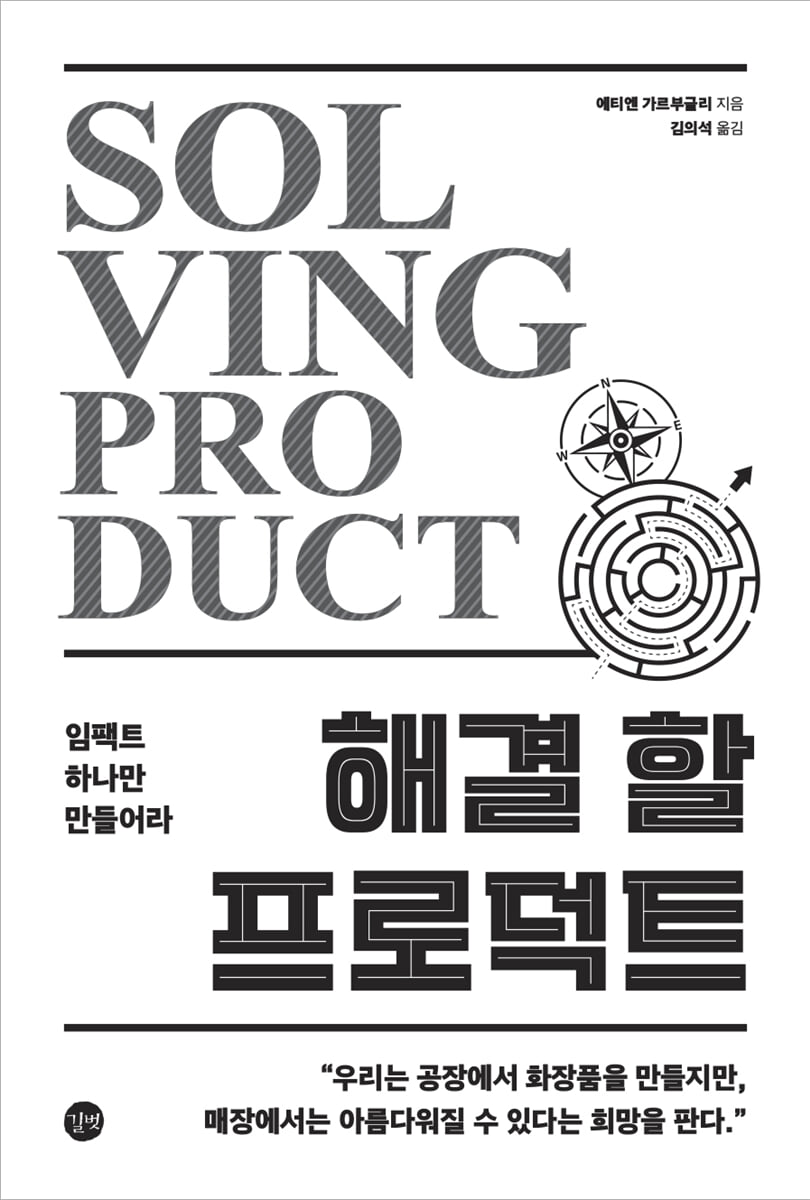
Product to be solved
 |
Description
Book Introduction
Discover the gap between your business model and your customers. An action plan you can implement based on the five stages of a product. Customer learning starts with the right customer research techniques. How to identify factors that are stalling growth and drive new growth. Plan a clear action plan to solve problems. How to create a customer-centric organization. Advice from hundreds of product leaders and customer research experts. Contains over 25 case studies.
- You can preview some of the book's contents.
Preview
index
01 Introduction
__1.1 Hockey Stick Growth? Lie!
__1.2 Why growth stops
02 Problem Derivation
__2.1 Impact of defects
__2.2 Visualizing Defects
__2.3 How clear is your secret to growth?
03 The Right Questions
__3.1 Reducing the Problem Scope
Step I: Idea
__Is this an idea worth pursuing?
__challenge
__The Rubik's Cube Dilemma
__Business-Driven Design
__Exact direction
04 Discovering Customer Core Tasks
__4.1 Discovering Customer Core Tasks
__4.2 Available Techniques
__4.3 Learning through Sales Safari
__4.4 Learning through Customer Discovery Interviews
__4.5 Learning through situational questions
__4.6 Developing
__4.7 Case Study - How did Statflow discover the opportunity?
__4.8 Take Action
05 Finding a Competitive Advantage
__5.1 Available Techniques
__5.2 Picnic at the Grave
__5.3 Product Review Analysis
__5.4 Learning from Competitive Product User Testing
__5.5 Learning through selling third-party products
__5.6 Learning through Conversations with Competitors
__5.7 Developing
__5.8 Case Study - How Did Hiten Shah and Marie Prokopet Learn from Their Competitors?
__5.9 Take Action
06 Creating Value
__6.1 Available Techniques
__6.2 Strategic Positioning Analysis
__6.3 Developing
__6.4 Case Study - How LinkedIn Sales Navigator Found Their Value Proposition
__6.5 Take action
07 Product Idea Validation
__7.1 Available Techniques
__7.2 Verifying Products Through Pre-Orders
__7.3 Developing
__7.4 Case Study - How did Drift do pre-sales?
__7.5 Take Action
Phase II: Startup
__Will it be okay?
__challenge
__opportunity
__Develop
__Creating and Maintaining Momentum
08 Evaluating the Value Provision
__8.1 Creating customer proximity
__8.2 Available Techniques
__8.3 Small Customer Retention Analysis
__8.4 Learning through follow-up emails
__8.5 Learning through Customer Interviews and Demos
__8.6 Developing
__8.7 Case Study - How did Jim Fuel close the gap with its customers?
__8.8 Take action
09 Refining Your Ideal Customer Profile
__9.1 Available Techniques
__9.2 Finding High Expectation Customers
__9.3 Developing
__9.4 Case Study - How Superhuman Focused on High Expectation Customers
__9.5 Take action
10 Repeated evaluation and improvement of customer value
__10.1 Available Techniques
__10.2 Visitor Record Analysis
__10.3 Learning through Dog Pudding
__10.4 Learning through the Customer Advisory Board
__10.5 Developing
__10.6 Case Study - How Did Flowtown Reduce Initial Obstacles?
__10.7 Take Action
11 Product Market Fit Assessment
__11.1 Available Techniques
__11.2 Customer Retention Analysis
__11.3 Product Market Fit Survey
__11.4 Developing
__11.5 Case Study - Discovering PayPal's Product-Market Fit
__11.6 Take Action
Stage III: Growth
Can we scale up to __?
__challenge
__What made you who you are today does not make you who you will be tomorrow.
Case Study - Why Statflow Changed Its Customer Research Strategy
__opportunity
__clear action
12 Finding Leaks in Your Funnel
__12.1 Available Techniques
__12.2 Secure - Traffic Analysis
__12.3 Language/Market Fit Testing
__12.4 Sales - Learning from the Sales Process
__12.5 Negative Opinion Analysis
__12.6 Retention - Learning from Customer Success
__12.7 Key Behavior Analysis
__12.8 Functional Engagement Analysis
__12.9 Product Substitution Behavior Analysis
__12.10 Joy Analysis
__12.11 Customer Support Conversation Analysis
__12.12 Recommendation - Product-Related Word-of-Mouth Analysis
__12.13 When the Net Promoter Score fails
__12.14 Developing
__12.15 Case Study - How Grubhub Created Product Usage Habits
__12.16 Take action
13 Understand Why Customers Buy Your Products
__13.1 Available Techniques
__13.2 Learning through Behavioral Segmentation
__13.3 Understanding the True Value of a Product
__13.4 Developing
__13.5 Case Study - How Clarity Learned Why Their Best Customers Buy Their Products
__13.6 Take Action
14 Matching the Products You Sell with Your Sales Methods
__14.1 Available Techniques
__14.2 Analysis of reasons for membership registration
__14.3 Time to Value Analysis
__14.4 Developing
__14.5 Case Study - How Pandadog Found the Best Message
__14.6 Take Action
15 Discover the Best Customer Acquisition Channels for Expansion
__15.1 Available Techniques
__15.2 Customer Acquisition Channel Analysis
__15.3 Analysis of Free Premium Potential
__15.4 Developing
__15.5 Case Study - How Did Brandisti Get the Model Market Fit Wrong?
__15.6 Take Action
Stage IV 4: Expansion
__How big can it be?
__challenge
__Where new growth comes
__opportunity
__Developing your business
16 Discovering Valuable Product Improvements
__16.1 Available Techniques
__16.2 Function Usage Context Analysis
__16.3 Analysis of customer churn reasons
__16.4 Value Factor Analysis
__16.5 Learning through Functional Experiments
__16.6 Purchase Intention Analysis
__16.7 Developing
__16.8 Case Study - How Hiten Shah and Marie Prokopet Improved FYI
__16.9 Take Action
17 Discovering Other Segments
__17.1 Available Techniques
__17.2 Analysis of the attractiveness of other markets
__17.3 Learning from Customer Interviews
__17.4 Selling or advertising to new market segments
__17.5 Developing
__17.6 Case Study - How did Popullo go from a red ocean to a blue ocean?
__17.7 Take Action
18 Product Improvement to Acquire New Customers
__18.1 Available Techniques
__18.2 Analysis of spontaneous feedback
__18.3 Learning from External Customers
__18.4 Needs Satisfaction Analysis
__18.5 Developing
__18.6 Case Study - How Did Lander Expand Its Market?
__18.7 Take Action
19 Discovering new product development opportunities
__19.1 Available Techniques
__19.2 Developing
__19.3 Case Study - How ProfitWell Expanded Its Product Lineup
__19.4 Take Action
Stage V 5: Maturity
__Can you find additional growth opportunities?
Case Study - Avoiding User Experience Degradation at VWO
__challenge
__opportunity
__Welfare Victory
20 Compound Growth Through Rapid Experimentation
__20.1 Available Techniques
__20.2 Learning through A/B Testing
__20.3 Learning from Brand Removal Testing
__20.4 Developing
__20.5 Case Study - How Rocket Trip Deviated from Its Goal
__20.6 Take action
21 Maximizing Product Suitability and Effectiveness
__21.1 Available Techniques
__21.2 Core Task Success Analysis
__21.3 Learning through Field Research
__21.4 Value Suitability Analysis
__21.5 Developing
__21.6 Case Study - How Has the Market Changed for Basecamp?
__21.7 Take Action
22 Assessing Remaining Growth Opportunities
__22.1 Available Techniques
__22.2 Segment analysis within the user base
__22.3 Brand Awareness Assessment
__22.4 Developing
__22.5 Case Study - How MailChimp Used Onboarding to Segment Users
__22.6 Take action
23 Maximizing Sales and Profits
__23.1 Available Techniques
__23.2 Analysis of One-Time and Recurring Fee Payments
__23.3 Studying the Results of Price Research
__23.4 Developing
__23.5 Case Study - How Book & Bloom Expanded Internationally
__23.6 Take action
VI Retrospective
24 Adjust learning objectives
__24.1 Continuous Learning = Continuous Growth
__24.2 Finding the gap between knowledge and reality in the answer
__24.3 Case Study - How did Sachin and his team refine their assumptions about the market?
__24.4 Developing
25 companies to operate
__25.1 Company Diagnosis
__25.2 Making Customer Research Easier Within Your Company
__25.3 Case Study - How did Dr. Sam Lardner lead change internally?
__25.4 Discovering Customer Research Opportunities
__25.5 Defining the Research Question
__25.6 Bringing consensus within the team
__25.7 Case Study - How Statflow Created Matches?
__25.8 Developing
26 Conclusion
__26.1 A few caveats
__26.2 Final Request
building blocks
__1.
Finding early adopters
__2.
Recruiting potential customers for interviews
__3.
Recruiting users and customers to interview
__4.
Preparing for Customer Interviews
__5.
Conduct user and customer interviews
__6.
Defining tasks for user testing
__7.
Conduct user testing
__8.
Preparing an Effective Survey
__9.
North Star Index Definition
__10.
Case Study - Company to Company to Consumer
__11.
Acting on customer insights
__12.
Case Study - Managing Customer Expectations at Feather
__13.
Putting customer insights into action
__14.
Case Study - How Guillaume Cabanet Takes Learning to the Next Level
Appendix A Acknowledgments
Appendix B Next Steps
__1.1 Hockey Stick Growth? Lie!
__1.2 Why growth stops
02 Problem Derivation
__2.1 Impact of defects
__2.2 Visualizing Defects
__2.3 How clear is your secret to growth?
03 The Right Questions
__3.1 Reducing the Problem Scope
Step I: Idea
__Is this an idea worth pursuing?
__challenge
__The Rubik's Cube Dilemma
__Business-Driven Design
__Exact direction
04 Discovering Customer Core Tasks
__4.1 Discovering Customer Core Tasks
__4.2 Available Techniques
__4.3 Learning through Sales Safari
__4.4 Learning through Customer Discovery Interviews
__4.5 Learning through situational questions
__4.6 Developing
__4.7 Case Study - How did Statflow discover the opportunity?
__4.8 Take Action
05 Finding a Competitive Advantage
__5.1 Available Techniques
__5.2 Picnic at the Grave
__5.3 Product Review Analysis
__5.4 Learning from Competitive Product User Testing
__5.5 Learning through selling third-party products
__5.6 Learning through Conversations with Competitors
__5.7 Developing
__5.8 Case Study - How Did Hiten Shah and Marie Prokopet Learn from Their Competitors?
__5.9 Take Action
06 Creating Value
__6.1 Available Techniques
__6.2 Strategic Positioning Analysis
__6.3 Developing
__6.4 Case Study - How LinkedIn Sales Navigator Found Their Value Proposition
__6.5 Take action
07 Product Idea Validation
__7.1 Available Techniques
__7.2 Verifying Products Through Pre-Orders
__7.3 Developing
__7.4 Case Study - How did Drift do pre-sales?
__7.5 Take Action
Phase II: Startup
__Will it be okay?
__challenge
__opportunity
__Develop
__Creating and Maintaining Momentum
08 Evaluating the Value Provision
__8.1 Creating customer proximity
__8.2 Available Techniques
__8.3 Small Customer Retention Analysis
__8.4 Learning through follow-up emails
__8.5 Learning through Customer Interviews and Demos
__8.6 Developing
__8.7 Case Study - How did Jim Fuel close the gap with its customers?
__8.8 Take action
09 Refining Your Ideal Customer Profile
__9.1 Available Techniques
__9.2 Finding High Expectation Customers
__9.3 Developing
__9.4 Case Study - How Superhuman Focused on High Expectation Customers
__9.5 Take action
10 Repeated evaluation and improvement of customer value
__10.1 Available Techniques
__10.2 Visitor Record Analysis
__10.3 Learning through Dog Pudding
__10.4 Learning through the Customer Advisory Board
__10.5 Developing
__10.6 Case Study - How Did Flowtown Reduce Initial Obstacles?
__10.7 Take Action
11 Product Market Fit Assessment
__11.1 Available Techniques
__11.2 Customer Retention Analysis
__11.3 Product Market Fit Survey
__11.4 Developing
__11.5 Case Study - Discovering PayPal's Product-Market Fit
__11.6 Take Action
Stage III: Growth
Can we scale up to __?
__challenge
__What made you who you are today does not make you who you will be tomorrow.
Case Study - Why Statflow Changed Its Customer Research Strategy
__opportunity
__clear action
12 Finding Leaks in Your Funnel
__12.1 Available Techniques
__12.2 Secure - Traffic Analysis
__12.3 Language/Market Fit Testing
__12.4 Sales - Learning from the Sales Process
__12.5 Negative Opinion Analysis
__12.6 Retention - Learning from Customer Success
__12.7 Key Behavior Analysis
__12.8 Functional Engagement Analysis
__12.9 Product Substitution Behavior Analysis
__12.10 Joy Analysis
__12.11 Customer Support Conversation Analysis
__12.12 Recommendation - Product-Related Word-of-Mouth Analysis
__12.13 When the Net Promoter Score fails
__12.14 Developing
__12.15 Case Study - How Grubhub Created Product Usage Habits
__12.16 Take action
13 Understand Why Customers Buy Your Products
__13.1 Available Techniques
__13.2 Learning through Behavioral Segmentation
__13.3 Understanding the True Value of a Product
__13.4 Developing
__13.5 Case Study - How Clarity Learned Why Their Best Customers Buy Their Products
__13.6 Take Action
14 Matching the Products You Sell with Your Sales Methods
__14.1 Available Techniques
__14.2 Analysis of reasons for membership registration
__14.3 Time to Value Analysis
__14.4 Developing
__14.5 Case Study - How Pandadog Found the Best Message
__14.6 Take Action
15 Discover the Best Customer Acquisition Channels for Expansion
__15.1 Available Techniques
__15.2 Customer Acquisition Channel Analysis
__15.3 Analysis of Free Premium Potential
__15.4 Developing
__15.5 Case Study - How Did Brandisti Get the Model Market Fit Wrong?
__15.6 Take Action
Stage IV 4: Expansion
__How big can it be?
__challenge
__Where new growth comes
__opportunity
__Developing your business
16 Discovering Valuable Product Improvements
__16.1 Available Techniques
__16.2 Function Usage Context Analysis
__16.3 Analysis of customer churn reasons
__16.4 Value Factor Analysis
__16.5 Learning through Functional Experiments
__16.6 Purchase Intention Analysis
__16.7 Developing
__16.8 Case Study - How Hiten Shah and Marie Prokopet Improved FYI
__16.9 Take Action
17 Discovering Other Segments
__17.1 Available Techniques
__17.2 Analysis of the attractiveness of other markets
__17.3 Learning from Customer Interviews
__17.4 Selling or advertising to new market segments
__17.5 Developing
__17.6 Case Study - How did Popullo go from a red ocean to a blue ocean?
__17.7 Take Action
18 Product Improvement to Acquire New Customers
__18.1 Available Techniques
__18.2 Analysis of spontaneous feedback
__18.3 Learning from External Customers
__18.4 Needs Satisfaction Analysis
__18.5 Developing
__18.6 Case Study - How Did Lander Expand Its Market?
__18.7 Take Action
19 Discovering new product development opportunities
__19.1 Available Techniques
__19.2 Developing
__19.3 Case Study - How ProfitWell Expanded Its Product Lineup
__19.4 Take Action
Stage V 5: Maturity
__Can you find additional growth opportunities?
Case Study - Avoiding User Experience Degradation at VWO
__challenge
__opportunity
__Welfare Victory
20 Compound Growth Through Rapid Experimentation
__20.1 Available Techniques
__20.2 Learning through A/B Testing
__20.3 Learning from Brand Removal Testing
__20.4 Developing
__20.5 Case Study - How Rocket Trip Deviated from Its Goal
__20.6 Take action
21 Maximizing Product Suitability and Effectiveness
__21.1 Available Techniques
__21.2 Core Task Success Analysis
__21.3 Learning through Field Research
__21.4 Value Suitability Analysis
__21.5 Developing
__21.6 Case Study - How Has the Market Changed for Basecamp?
__21.7 Take Action
22 Assessing Remaining Growth Opportunities
__22.1 Available Techniques
__22.2 Segment analysis within the user base
__22.3 Brand Awareness Assessment
__22.4 Developing
__22.5 Case Study - How MailChimp Used Onboarding to Segment Users
__22.6 Take action
23 Maximizing Sales and Profits
__23.1 Available Techniques
__23.2 Analysis of One-Time and Recurring Fee Payments
__23.3 Studying the Results of Price Research
__23.4 Developing
__23.5 Case Study - How Book & Bloom Expanded Internationally
__23.6 Take action
VI Retrospective
24 Adjust learning objectives
__24.1 Continuous Learning = Continuous Growth
__24.2 Finding the gap between knowledge and reality in the answer
__24.3 Case Study - How did Sachin and his team refine their assumptions about the market?
__24.4 Developing
25 companies to operate
__25.1 Company Diagnosis
__25.2 Making Customer Research Easier Within Your Company
__25.3 Case Study - How did Dr. Sam Lardner lead change internally?
__25.4 Discovering Customer Research Opportunities
__25.5 Defining the Research Question
__25.6 Bringing consensus within the team
__25.7 Case Study - How Statflow Created Matches?
__25.8 Developing
26 Conclusion
__26.1 A few caveats
__26.2 Final Request
building blocks
__1.
Finding early adopters
__2.
Recruiting potential customers for interviews
__3.
Recruiting users and customers to interview
__4.
Preparing for Customer Interviews
__5.
Conduct user and customer interviews
__6.
Defining tasks for user testing
__7.
Conduct user testing
__8.
Preparing an Effective Survey
__9.
North Star Index Definition
__10.
Case Study - Company to Company to Consumer
__11.
Acting on customer insights
__12.
Case Study - Managing Customer Expectations at Feather
__13.
Putting customer insights into action
__14.
Case Study - How Guillaume Cabanet Takes Learning to the Next Level
Appendix A Acknowledgments
Appendix B Next Steps
Detailed image
.jpg)
Publisher's Review
5 Steps to Product Development Starting with Customer Research
1.
Many companies claim to be customer-centric.
2.
However, many companies fail to distinguish between customer-focused and customer-centric.
3.
They tout customer satisfaction and customer first, but these are customer-centric perspectives and cannot escape from a product-centric mindset.
4.
They claim to distinguish between customer wants and needs, but they fail to properly understand customer needs.
5.
Although we focus on what the product does for the customer, this is a customer-centric mindset.
6.
Customer-centricity is not about technology, but about what we need to know from our customers, the 'customer experience'.
Steve Jobs said this:
“We need to start with the customer experience and move on to technology.
It shouldn't be the other way around."
7.
'We do whatever the customer wants' is not a customer-centric mindset.
It is a customer-centric mindset.
8.
There is no product that satisfies all of a customer's needs.
It's not important to satisfy every customer.
What matters is whether you can satisfy the small number of customers who actually pay money.
Most people underestimate the value of customer learning through these small groups.
9.
People who are accustomed to identifying customer needs through customer interviews often neglect experiments and quantitative research.
10.
Clearly, the early teams have done a tremendous job of validating customer needs, creating valuable technology, building the brand, and attracting capital.
And growth was expected.
11.
Business seems to be growing, and employees are always busy working.
Hiring, marketing, development—everything seems to be going well, but growth is stagnant.
12.
The number of users has increased, and sales and profits have also increased significantly.
But no amount of work or achievement contributes to customer retention.
13.
The investment is running out, and customer retention is a concern, but I don't think it's a problem because new customers are increasing.
14.
We conducted behind-the-scenes customer interviews, analyzed customer feedback, researched competitors, and reviewed years of customer inquiries.
15.
Investigate and prioritize product improvements to increase customer retention.
But there is no new information.
16.
Customers clearly loved our product.
There were some issues with the product, but that's normal.
However, it does not appear that growth has stagnated.
17.
There is no hockey stick growth.
The founders are mistaken.
It is rare for a company to achieve rapid growth with just one strategy.
18.
Growth stalls because you're trying to grow your company using outdated and incomplete models of your product, users, markets, and customers.
19.
You can grow even if you initially have an imperfect understanding of the business.
But after growth stops, you have to find your own secret to growth.
20.
There may be some misunderstanding about the secrets to growth so far.
You've misunderstood why customers buy and use your product, you've acquired the wrong users and customers, you've added too many unnecessary features that customers don't want, you've got all these problems, and there's a whole other problem.
21.
We need to find the core problem here.
We need to reexamine customer needs through customer research.
22.
When growth stagnates, the cause is not internal factors such as average revenue per user (ARPU) or retention.
It lies in external factors such as customer needs, JTBD, and competitors.
23.
You can't grow by focusing on improving internal business processes and focusing on performance and efficiency without understanding your customers.
24.
Because they don't understand their customers, they end up relying on good ideas, great execution, hacks, imitation of competitors, or stopgap growth strategies.
It might work for a while, but eventually your growth will slow down and you will be left with little know-how about how to grow your company.
25.
You need to figure out what makes your company special.
The starting point is customer research.
26.
You need to find ideas through customer research and then decide whether those ideas are worth implementing.
Without this judgment, a company's resources are depleted as a variety of ideas flow through the development pipeline, forcing it to make bets on multiple fronts.
27.
"Products to Solve" is not a book to be read from beginning to end.
You can start by looking for the necessary parts according to the 5 stages of the product growth cycle.
Each chapter is filled with immediately actionable tips and tactics.
Always keep it within reach.
Key points of this book
- Discover the gap between your business model and your customers.
- Action plan that can be implemented according to the 5 steps of the product
- Customer learning starts with the right customer research techniques.
- How to identify factors that contribute to stagnant growth and promote new growth
- Plan a clear action plan to solve the problem.
How to Create a Customer-Centric Organization
- Advice from hundreds of product leaders and customer research experts
- Over 25 case studies
1.
Many companies claim to be customer-centric.
2.
However, many companies fail to distinguish between customer-focused and customer-centric.
3.
They tout customer satisfaction and customer first, but these are customer-centric perspectives and cannot escape from a product-centric mindset.
4.
They claim to distinguish between customer wants and needs, but they fail to properly understand customer needs.
5.
Although we focus on what the product does for the customer, this is a customer-centric mindset.
6.
Customer-centricity is not about technology, but about what we need to know from our customers, the 'customer experience'.
Steve Jobs said this:
“We need to start with the customer experience and move on to technology.
It shouldn't be the other way around."
7.
'We do whatever the customer wants' is not a customer-centric mindset.
It is a customer-centric mindset.
8.
There is no product that satisfies all of a customer's needs.
It's not important to satisfy every customer.
What matters is whether you can satisfy the small number of customers who actually pay money.
Most people underestimate the value of customer learning through these small groups.
9.
People who are accustomed to identifying customer needs through customer interviews often neglect experiments and quantitative research.
10.
Clearly, the early teams have done a tremendous job of validating customer needs, creating valuable technology, building the brand, and attracting capital.
And growth was expected.
11.
Business seems to be growing, and employees are always busy working.
Hiring, marketing, development—everything seems to be going well, but growth is stagnant.
12.
The number of users has increased, and sales and profits have also increased significantly.
But no amount of work or achievement contributes to customer retention.
13.
The investment is running out, and customer retention is a concern, but I don't think it's a problem because new customers are increasing.
14.
We conducted behind-the-scenes customer interviews, analyzed customer feedback, researched competitors, and reviewed years of customer inquiries.
15.
Investigate and prioritize product improvements to increase customer retention.
But there is no new information.
16.
Customers clearly loved our product.
There were some issues with the product, but that's normal.
However, it does not appear that growth has stagnated.
17.
There is no hockey stick growth.
The founders are mistaken.
It is rare for a company to achieve rapid growth with just one strategy.
18.
Growth stalls because you're trying to grow your company using outdated and incomplete models of your product, users, markets, and customers.
19.
You can grow even if you initially have an imperfect understanding of the business.
But after growth stops, you have to find your own secret to growth.
20.
There may be some misunderstanding about the secrets to growth so far.
You've misunderstood why customers buy and use your product, you've acquired the wrong users and customers, you've added too many unnecessary features that customers don't want, you've got all these problems, and there's a whole other problem.
21.
We need to find the core problem here.
We need to reexamine customer needs through customer research.
22.
When growth stagnates, the cause is not internal factors such as average revenue per user (ARPU) or retention.
It lies in external factors such as customer needs, JTBD, and competitors.
23.
You can't grow by focusing on improving internal business processes and focusing on performance and efficiency without understanding your customers.
24.
Because they don't understand their customers, they end up relying on good ideas, great execution, hacks, imitation of competitors, or stopgap growth strategies.
It might work for a while, but eventually your growth will slow down and you will be left with little know-how about how to grow your company.
25.
You need to figure out what makes your company special.
The starting point is customer research.
26.
You need to find ideas through customer research and then decide whether those ideas are worth implementing.
Without this judgment, a company's resources are depleted as a variety of ideas flow through the development pipeline, forcing it to make bets on multiple fronts.
27.
"Products to Solve" is not a book to be read from beginning to end.
You can start by looking for the necessary parts according to the 5 stages of the product growth cycle.
Each chapter is filled with immediately actionable tips and tactics.
Always keep it within reach.
Key points of this book
- Discover the gap between your business model and your customers.
- Action plan that can be implemented according to the 5 steps of the product
- Customer learning starts with the right customer research techniques.
- How to identify factors that contribute to stagnant growth and promote new growth
- Plan a clear action plan to solve the problem.
How to Create a Customer-Centric Organization
- Advice from hundreds of product leaders and customer research experts
- Over 25 case studies
GOODS SPECIFICS
- Publication date: November 24, 2023
- Page count, weight, size: 576 pages | 842g | 152*225*35mm
- ISBN13: 9791140707140
You may also like
카테고리
korean


korean

![GQ KOREA Mark (Monthly): December [2025]](http://librairie.coreenne.fr/cdn/shop/files/8ef265dbbfbf186523ed75ba7319009d.jpg?v=1765340328&width=3840)


