

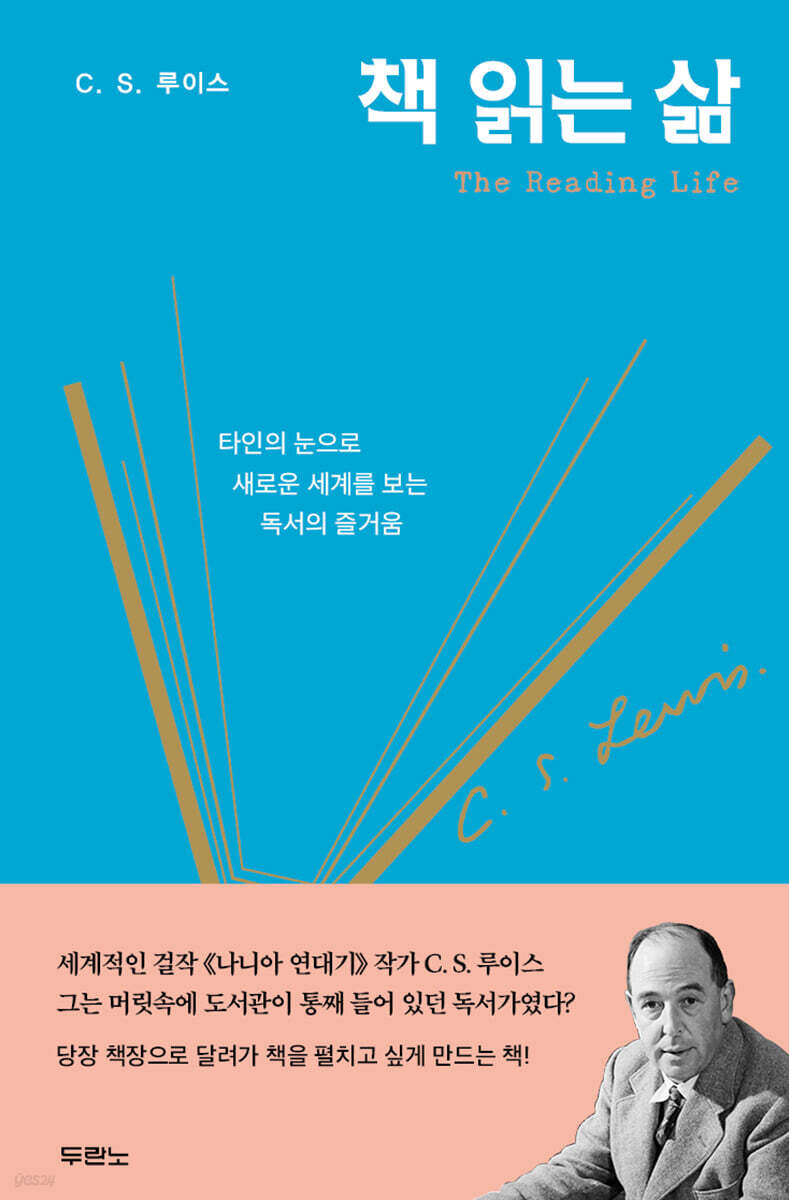
A life of reading books
 |
Description
Book Introduction
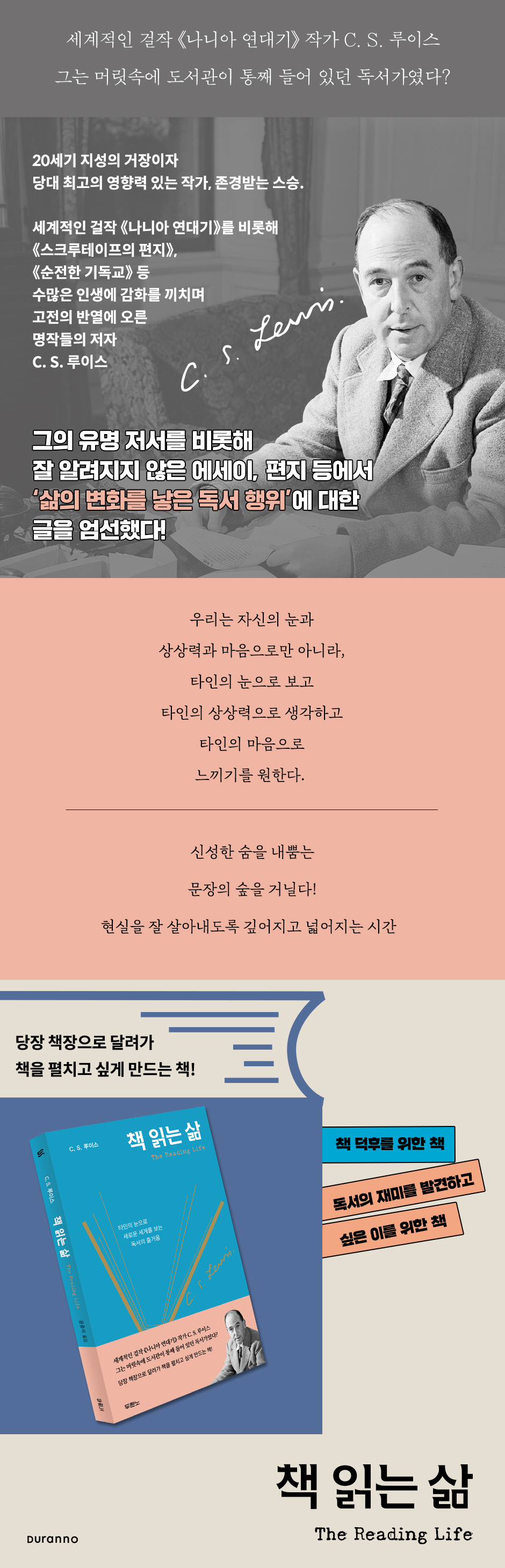
C., author of the world-famous masterpiece 『The Chronicles of Narnia』 S. Lewis Was he a reader who had an entire library in his head? C., author of masterpieces that have influenced countless lives and become classics, including The Chronicles of Narnia, The Screwtape Letters, and Mere Christianity, and a respected teacher who taught English literature at Oxford and Cambridge for a long time, is praised as the greatest Christian apologist of the 20th century. S. Lewis. He was a man who read books for eight hours every day. A book has been published that contains a selection of Lewis's writings on 'the life-changing act of reading' from his famous works as well as lesser-known essays and letters. In these days when video content dominates the world, "A Life of Reading" is a collection of interesting, original, and wise writings that will capture the attention of those who share a love of reading. |
- You can preview some of the book's contents.
Preview
index
The editor's writing.
Reading a book that expands your inner world
Part 1.
What a precious reading!
: The art of reading, its joy
Why do we read books? / Am I a true reader? / Fairy tales are not just for children / Literature is time travel / Fairy tales add a new dimension of depth to the real world / You must read old books / The role of 'strange phenomena' in stories / Growing up in a sea of books / The moment you first met your favorite author / Why movies sometimes ruin books / How to kill words / Rescue words from the abyss of praise / J.
RR
Tolkien's exploits / The dangers of confusing sagas with actual history / Two ways to travel, two ways to read
Part 2.
To a place of reading where life blossoms
: Thoughts that will give wings to your reading
The combination of words, the charm of poetry / Truth and writing talent / The power of style / What comes 'through' a book, not 'in' a book / A book for 'fun' / If you want originality / The myth of believing in the 'latest' / Keeping up with the times? / The meaning of 'broad taste' / A person who truly enjoys books / The snobs of the literary world / You should reread your favorite books every ten years / Rich indirect experience through books / You don't have to read them all / For the freedom to read books / Huckleberry Finn / The glory of childhood / Jane Austen / For art and literature to be healthy / Art work / Look, listen, receive / Talking about books you've read / The good things about writing letters / In praise of Dante / Alexandre Dumas / An unexpected gift from fairy tales / The language of commentary / To communicate the essence of life / My own secret to enhancing the taste of reading / Plato and Aristotle / Poetry, a small incarnation / If you read a little more / Shakespeare / The unique flavor of Hamlet / Leo Tolstoy / Advice for writing / Good reading
supplement.
Time to look back on my reading life
Reading a book that expands your inner world
Part 1.
What a precious reading!
: The art of reading, its joy
Why do we read books? / Am I a true reader? / Fairy tales are not just for children / Literature is time travel / Fairy tales add a new dimension of depth to the real world / You must read old books / The role of 'strange phenomena' in stories / Growing up in a sea of books / The moment you first met your favorite author / Why movies sometimes ruin books / How to kill words / Rescue words from the abyss of praise / J.
RR
Tolkien's exploits / The dangers of confusing sagas with actual history / Two ways to travel, two ways to read
Part 2.
To a place of reading where life blossoms
: Thoughts that will give wings to your reading
The combination of words, the charm of poetry / Truth and writing talent / The power of style / What comes 'through' a book, not 'in' a book / A book for 'fun' / If you want originality / The myth of believing in the 'latest' / Keeping up with the times? / The meaning of 'broad taste' / A person who truly enjoys books / The snobs of the literary world / You should reread your favorite books every ten years / Rich indirect experience through books / You don't have to read them all / For the freedom to read books / Huckleberry Finn / The glory of childhood / Jane Austen / For art and literature to be healthy / Art work / Look, listen, receive / Talking about books you've read / The good things about writing letters / In praise of Dante / Alexandre Dumas / An unexpected gift from fairy tales / The language of commentary / To communicate the essence of life / My own secret to enhancing the taste of reading / Plato and Aristotle / Poetry, a small incarnation / If you read a little more / Shakespeare / The unique flavor of Hamlet / Leo Tolstoy / Advice for writing / Good reading
supplement.
Time to look back on my reading life
Detailed image
Into the book
“The person who read the most books in his time.
“A man who reads everything and remembers everything he reads.” William Empson, a renowned critic, said of C.
S. Lewis commented:
It may seem like a bit of an exaggeration, but in the realm of literature, philosophy, and classics, it is closer to the truth.
Lewis read John Milton's Paradise Lost when he was ten, and by the time he was eleven he was already writing letters quoting passages from the Bible and Shakespeare.
The habit continued throughout his life.
By my mid-teens I was reading classical and modern works in Greek, Latin, French, German, and Italian.
Besides, Lewis seemed to remember most of what he read.
According to one of his students' memoirs, if someone quoted any passage from Paradise Lost, Lewis would recall it and recite the rest of the story.
Another disciple testified that he would take any book from Lewis's shelf, open it to any page, and begin reading; Lewis would then summarize the rest of the page, always with great accuracy.
--- pp.8-9
Those of us who have been true readers our entire lives often fail to fully appreciate it, but it is thanks to writers that our existence has expanded so enormously.
This point really comes across when talking to a friend who rarely reads books.
He is a very kind person and has a lot of discernment, but unfortunately the world he lives in is too small.
If we were in there, we would probably suffocate.
A person who is satisfied with only himself and ends up being below his ego is like being locked in a prison.
But since my own eyes are not enough, I will also see with the eyes of others.
Even if we look at it through the eyes of many people, reality alone is not enough, so we will also see the fictional world created by others.
It is not enough even for the eyes of all mankind.
I find it a pity that animals can't write books.
If animals wrote books, they would enjoy learning how things appear to mice and bees, and they would enjoy exploring the olfactory world of dogs, which is full of all kinds of information and emotions.
Literary experience heals the wounds of individuality without compromising the privilege of individuality.
--- pp.21-22
The true goal of teaching literature is to enable students to shed their narrow perspectives by “touring” through most, if not all, of “periods and realities.”
By learning from good (and naturally differing) teachers and encountering the past in the only place where it still lives (literature), students (even young ones) are able to break free from the confines of their own time and class and enter a more public world.
By properly studying Hegel's "Phenomenology of Spirit," we open our eyes to various aspects of human nature.
“History” alone won’t do it.
This is because history studies the past mainly through secondary sources.
You may not know what it was like to “study history” for years and still end up living as an Anglo-Saxon count, knight, or 18th-century provincial landowner.
The true nature of something, which cannot be known by just looking at its appearance, can almost only be seen in literature.
--- p.38
Fairytale lands stir children (and enrich them for life) by stimulating a vague sense that there is something beyond their reach, and far from dulling or blinding them to the real world, they add a new dimension of depth to it.
Just because a child reads a story about a magical forest, it doesn't mean he or she will despise the real forest.
Rather, reading adds a bit of magic to every real forest.
This is a special longing.
A child who reads the aforementioned type of school novel longs for success, but (when the book is over) is unhappy.
Because he cannot achieve that success.
But the child who reads fairy tales is happy just by the fact that he or she longs.
Because, unlike most realistic novels, the thoughts are not focused on oneself.
That doesn't mean we shouldn't write school novels for boys and girls.
It's just that school novels are much more likely to be "fantasy" in the strict sense of the word than fantasy (literature).
--- p.44
As an English literature professor, I often see students who want to learn Plato's philosophy, but they never bother to pick up Plato's Symposium from the library shelf, even in a translated version.
Instead, we read modern books that are ten times thicker and more boring, full of descriptions of various "isms" and their influences, and where Plato's actual words are rarely mentioned.
I feel somewhat sympathetic towards it because it is a mistake born from humility.
The student is secretly afraid of meeting the great philosopher face to face.
I think that I am too weak to understand what Plato is saying.
But if you know it, it is much easier to understand this great man than modern commentators.
It's not great for nothing.
Even the most ignorant student can understand most of Plato's words, even if he doesn't know them all, but some modern books on Plato's philosophy are difficult for anyone to understand.
So, as a professor, there is something I always tell my students.
Direct knowledge is not only more valuable than indirect knowledge, but it is also usually much easier and more enjoyable to acquire.
--- pp.51-52
These days, books, if they are correct, only give us a vague understanding of the truth we already knew, and if they are wrong, they only aggravate our already serious errors.
The only palliative is to keep our minds breathing the 'cool sea breeze of history', and for that we must read old books.
Of course, there is no magic in the past.
In ancient times, humans were not as smart as we are now, and they made as many mistakes as we do.
But it wasn't the same mistake as now.
They do not flatter us about our past mistakes, and their mistakes, now exposed, do not endanger us.
Two are better than one not because one is perfect, but because it is difficult for two to go down the same wrong path.
Of course, the books of the future will correct us just as well as the books of the past, but unfortunately, we have no way of getting our hands on the books of the future now.
--- pp.56-57
Myths take everything we know and bring to life a richness of meaning that was previously “familiar and invisible.”
That is the value of myth.
The child enjoys the cold (and bland) meat, thinking it is the buffalo he just shot with his bow.
He's a smart kid.
It's real meat, but it becomes even more delicious when immersed in a story.
Now I finally know if it's real meat.
If you are tired of the scenery of reality, look in the mirror.
When we immerse bread, gold, horses, apples, or roads in myth, we do not escape reality, but rediscover it.
As long as this story remains in our hearts, reality becomes more real.
This book makes us see not only bread and apples, but also good and evil, our endless dangers, anguish, and joy.
Immersed in myth, it becomes clearer.
If not this way, he could not have done it in any other way.
--- p.113
Speaking of which, what's the point of trying to keep up with the times? Why should we read books by authors we don't even like just because they're contemporary? If we're going to be that nitpicky, we should also read the books of everyone who has the same job, hair color, income, or chest size as us.
--- p.136
The idea that you should never “skip” a book is absolutely foolish.
Any sensible person will not hesitate to skip over a chapter that is of no use to them.
--- p.144
Of all the poetry I've ever read, Dante's is generally the best.
Yet, when the brilliance of his poetry reaches its highest peak, Dante seems to be doing little.
I have a strange feeling that great poetry is being written on its own.
At best, the poet plays a minimal role, simply touching on the direction of the energy here and there, and for the most part, the energy gathers on its own and develops exquisitely into the Divine Comedy (La Divina Commedia).
… … (omitted) … … In short, the highest level in the art of poetry is ultimately a kind of retreat.
To get there, the entire world seen through the poet's eyes must be deeply ingrained in his mind.
Then all the poet has to do now is get out of the way.
If you stay still, waves will crash, mountains will shake their leaves, light will shine through, and celestial bodies will rotate.
All of these are not just materials needed to write poetry, but are poetry in themselves.
--- pp.156-157
To fully enjoy such a book, you need to treat reading as a hobby and approach it seriously.
First, I draw a map on the blank pages at the very back, then I make a family tree or two, and finally, I make an index at the end of every paragraph that I underlined for whatever reason.
Considering how many people enjoy developing photos or scrapbooking, I often wonder why so few people take up reading as a hobby.
I've enjoyed reading many boring books this way, even those that I absolutely had to read.
I'm talking about holding a fine brush in my hand.
It's always about creating something.
A book read this way retains its charm and becomes like a toy.
“A man who reads everything and remembers everything he reads.” William Empson, a renowned critic, said of C.
S. Lewis commented:
It may seem like a bit of an exaggeration, but in the realm of literature, philosophy, and classics, it is closer to the truth.
Lewis read John Milton's Paradise Lost when he was ten, and by the time he was eleven he was already writing letters quoting passages from the Bible and Shakespeare.
The habit continued throughout his life.
By my mid-teens I was reading classical and modern works in Greek, Latin, French, German, and Italian.
Besides, Lewis seemed to remember most of what he read.
According to one of his students' memoirs, if someone quoted any passage from Paradise Lost, Lewis would recall it and recite the rest of the story.
Another disciple testified that he would take any book from Lewis's shelf, open it to any page, and begin reading; Lewis would then summarize the rest of the page, always with great accuracy.
--- pp.8-9
Those of us who have been true readers our entire lives often fail to fully appreciate it, but it is thanks to writers that our existence has expanded so enormously.
This point really comes across when talking to a friend who rarely reads books.
He is a very kind person and has a lot of discernment, but unfortunately the world he lives in is too small.
If we were in there, we would probably suffocate.
A person who is satisfied with only himself and ends up being below his ego is like being locked in a prison.
But since my own eyes are not enough, I will also see with the eyes of others.
Even if we look at it through the eyes of many people, reality alone is not enough, so we will also see the fictional world created by others.
It is not enough even for the eyes of all mankind.
I find it a pity that animals can't write books.
If animals wrote books, they would enjoy learning how things appear to mice and bees, and they would enjoy exploring the olfactory world of dogs, which is full of all kinds of information and emotions.
Literary experience heals the wounds of individuality without compromising the privilege of individuality.
--- pp.21-22
The true goal of teaching literature is to enable students to shed their narrow perspectives by “touring” through most, if not all, of “periods and realities.”
By learning from good (and naturally differing) teachers and encountering the past in the only place where it still lives (literature), students (even young ones) are able to break free from the confines of their own time and class and enter a more public world.
By properly studying Hegel's "Phenomenology of Spirit," we open our eyes to various aspects of human nature.
“History” alone won’t do it.
This is because history studies the past mainly through secondary sources.
You may not know what it was like to “study history” for years and still end up living as an Anglo-Saxon count, knight, or 18th-century provincial landowner.
The true nature of something, which cannot be known by just looking at its appearance, can almost only be seen in literature.
--- p.38
Fairytale lands stir children (and enrich them for life) by stimulating a vague sense that there is something beyond their reach, and far from dulling or blinding them to the real world, they add a new dimension of depth to it.
Just because a child reads a story about a magical forest, it doesn't mean he or she will despise the real forest.
Rather, reading adds a bit of magic to every real forest.
This is a special longing.
A child who reads the aforementioned type of school novel longs for success, but (when the book is over) is unhappy.
Because he cannot achieve that success.
But the child who reads fairy tales is happy just by the fact that he or she longs.
Because, unlike most realistic novels, the thoughts are not focused on oneself.
That doesn't mean we shouldn't write school novels for boys and girls.
It's just that school novels are much more likely to be "fantasy" in the strict sense of the word than fantasy (literature).
--- p.44
As an English literature professor, I often see students who want to learn Plato's philosophy, but they never bother to pick up Plato's Symposium from the library shelf, even in a translated version.
Instead, we read modern books that are ten times thicker and more boring, full of descriptions of various "isms" and their influences, and where Plato's actual words are rarely mentioned.
I feel somewhat sympathetic towards it because it is a mistake born from humility.
The student is secretly afraid of meeting the great philosopher face to face.
I think that I am too weak to understand what Plato is saying.
But if you know it, it is much easier to understand this great man than modern commentators.
It's not great for nothing.
Even the most ignorant student can understand most of Plato's words, even if he doesn't know them all, but some modern books on Plato's philosophy are difficult for anyone to understand.
So, as a professor, there is something I always tell my students.
Direct knowledge is not only more valuable than indirect knowledge, but it is also usually much easier and more enjoyable to acquire.
--- pp.51-52
These days, books, if they are correct, only give us a vague understanding of the truth we already knew, and if they are wrong, they only aggravate our already serious errors.
The only palliative is to keep our minds breathing the 'cool sea breeze of history', and for that we must read old books.
Of course, there is no magic in the past.
In ancient times, humans were not as smart as we are now, and they made as many mistakes as we do.
But it wasn't the same mistake as now.
They do not flatter us about our past mistakes, and their mistakes, now exposed, do not endanger us.
Two are better than one not because one is perfect, but because it is difficult for two to go down the same wrong path.
Of course, the books of the future will correct us just as well as the books of the past, but unfortunately, we have no way of getting our hands on the books of the future now.
--- pp.56-57
Myths take everything we know and bring to life a richness of meaning that was previously “familiar and invisible.”
That is the value of myth.
The child enjoys the cold (and bland) meat, thinking it is the buffalo he just shot with his bow.
He's a smart kid.
It's real meat, but it becomes even more delicious when immersed in a story.
Now I finally know if it's real meat.
If you are tired of the scenery of reality, look in the mirror.
When we immerse bread, gold, horses, apples, or roads in myth, we do not escape reality, but rediscover it.
As long as this story remains in our hearts, reality becomes more real.
This book makes us see not only bread and apples, but also good and evil, our endless dangers, anguish, and joy.
Immersed in myth, it becomes clearer.
If not this way, he could not have done it in any other way.
--- p.113
Speaking of which, what's the point of trying to keep up with the times? Why should we read books by authors we don't even like just because they're contemporary? If we're going to be that nitpicky, we should also read the books of everyone who has the same job, hair color, income, or chest size as us.
--- p.136
The idea that you should never “skip” a book is absolutely foolish.
Any sensible person will not hesitate to skip over a chapter that is of no use to them.
--- p.144
Of all the poetry I've ever read, Dante's is generally the best.
Yet, when the brilliance of his poetry reaches its highest peak, Dante seems to be doing little.
I have a strange feeling that great poetry is being written on its own.
At best, the poet plays a minimal role, simply touching on the direction of the energy here and there, and for the most part, the energy gathers on its own and develops exquisitely into the Divine Comedy (La Divina Commedia).
… … (omitted) … … In short, the highest level in the art of poetry is ultimately a kind of retreat.
To get there, the entire world seen through the poet's eyes must be deeply ingrained in his mind.
Then all the poet has to do now is get out of the way.
If you stay still, waves will crash, mountains will shake their leaves, light will shine through, and celestial bodies will rotate.
All of these are not just materials needed to write poetry, but are poetry in themselves.
--- pp.156-157
To fully enjoy such a book, you need to treat reading as a hobby and approach it seriously.
First, I draw a map on the blank pages at the very back, then I make a family tree or two, and finally, I make an index at the end of every paragraph that I underlined for whatever reason.
Considering how many people enjoy developing photos or scrapbooking, I often wonder why so few people take up reading as a hobby.
I've enjoyed reading many boring books this way, even those that I absolutely had to read.
I'm talking about holding a fine brush in my hand.
It's always about creating something.
A book read this way retains its charm and becomes like a toy.
--- p.162
Publisher's Review
C., author of the world-famous masterpiece The Chronicles of Narnia
S. Lewis
Was he a reader who had an entire library in his head?
C., author of classic works that have influenced countless lives, including The Chronicles of Narnia, The Screwtape Letters, and Mere Christianity, and a respected teacher who taught English literature at Oxford and Cambridge for a long time, and praised as the greatest Christian apologist of the 20th century.
S. Lewis.
He was a man who read books for eight hours every day.
A book has been published that contains a selection of Lewis's writings on 'the life-changing act of reading' from his famous works as well as lesser-known essays and letters.
In these days when video content dominates the world, "A Life of Reading" is a collection of interesting, original, and wise writings that will capture the attention of those who share a love of reading.
A book that makes you want to run to the bookshelf and open it right away!
“You should alternate between reading modern and old books,” “Fairy tales are not just for children,” “It is important to choose books to read for fun,” etc. It contains Lewis’s interesting and colorful wisdom on the reading life in general, focusing on reading literature, and introduces book reviews and thoughts on books and authors that have influenced him.
Why do we read? What books do we read to our children? What books impressed me most as a child? Awaken the true joy and profound meaning of reading literature!
“I realized that books were a gateway to another world.
“He never forgot the joy of his childhood.”
Stroll through the forest of sentences that breathe divine breath!
A time to deepen and broaden to better live in reality
Reading serves as a moral compass in our daily lives and also brings us joy.
Lewis was a passionate reader and read deeply.
Fellow scholars testify that he would sit in the library for hours, poring over books and absorbing their contents, oblivious to what was going on around him.
When I read books in my home study, I usually took notes in the margins and even created an index inside the book.
He also had his own know-how for enjoying reading, such as writing “Never read this again” on the inside back cover if he thought the book was useless.
Those who planned and compiled this book said, “For Lewis, reading was a noble calling and a source of endless satisfaction.
If he just held a book in his hand, it would be impossible to tell whether he was reading books as a hobby or as a profession.
“His world view and emotions were formed through all the books he read,” he comments.
We invite you to the reading life that shaped Lewis's life.
Join the joy of seeing a new world through the eyes of others!
S. Lewis
Was he a reader who had an entire library in his head?
C., author of classic works that have influenced countless lives, including The Chronicles of Narnia, The Screwtape Letters, and Mere Christianity, and a respected teacher who taught English literature at Oxford and Cambridge for a long time, and praised as the greatest Christian apologist of the 20th century.
S. Lewis.
He was a man who read books for eight hours every day.
A book has been published that contains a selection of Lewis's writings on 'the life-changing act of reading' from his famous works as well as lesser-known essays and letters.
In these days when video content dominates the world, "A Life of Reading" is a collection of interesting, original, and wise writings that will capture the attention of those who share a love of reading.
A book that makes you want to run to the bookshelf and open it right away!
“You should alternate between reading modern and old books,” “Fairy tales are not just for children,” “It is important to choose books to read for fun,” etc. It contains Lewis’s interesting and colorful wisdom on the reading life in general, focusing on reading literature, and introduces book reviews and thoughts on books and authors that have influenced him.
Why do we read? What books do we read to our children? What books impressed me most as a child? Awaken the true joy and profound meaning of reading literature!
“I realized that books were a gateway to another world.
“He never forgot the joy of his childhood.”
Stroll through the forest of sentences that breathe divine breath!
A time to deepen and broaden to better live in reality
Reading serves as a moral compass in our daily lives and also brings us joy.
Lewis was a passionate reader and read deeply.
Fellow scholars testify that he would sit in the library for hours, poring over books and absorbing their contents, oblivious to what was going on around him.
When I read books in my home study, I usually took notes in the margins and even created an index inside the book.
He also had his own know-how for enjoying reading, such as writing “Never read this again” on the inside back cover if he thought the book was useless.
Those who planned and compiled this book said, “For Lewis, reading was a noble calling and a source of endless satisfaction.
If he just held a book in his hand, it would be impossible to tell whether he was reading books as a hobby or as a profession.
“His world view and emotions were formed through all the books he read,” he comments.
We invite you to the reading life that shaped Lewis's life.
Join the joy of seeing a new world through the eyes of others!
GOODS SPECIFICS
- Publication date: July 14, 2021
- Page count, weight, size: 180 pages | 200g | 125*190*20mm
- ISBN13: 9788953140271
- ISBN10: 8953140277
You may also like
카테고리
korean


korean

![GQ KOREA Mark (Monthly): December [2025]](http://librairie.coreenne.fr/cdn/shop/files/8ef265dbbfbf186523ed75ba7319009d.jpg?v=1765340328&width=3840)


