

Claim your rights
 |
Description
Book Introduction
- A word from MD
-
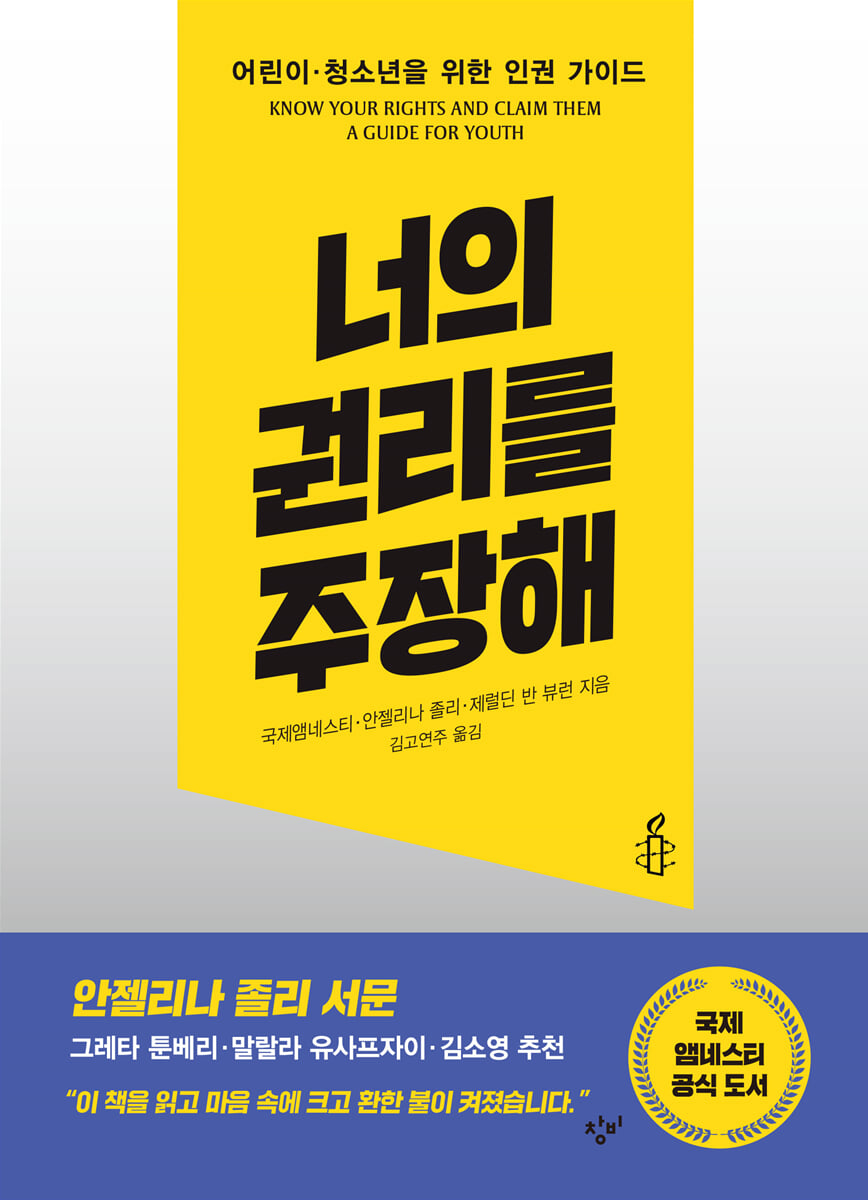
A Story to Share Now for Children's RightsA human rights guide written by Amnesty International and Angelina Jolie.
“Assert your rights” refers to the rights of children and adolescents based on the UN Convention on the Rights of the Child.
A book that shares specific stories about how it is used in reality, how children claim it, and how those around them can respect and protect it.May 10, 2022. Youth PD Park Hyung-wook
Human Rights Sensitivity Class for Global Citizens
A must-read for human rights written by Amnesty International and Angelina Jolie
The book, "Assert Your Rights," which serves as a solid guide for children and youth contemplating a better world and reminds adults of the promise of children's rights, has been published as the 41st book in the [Changbi Youth Library].
It was co-written by Amnesty International, the world's largest human rights organization, actress and human rights activist Angelina Jolie, and lawyer Geraldine Van Buren, one of the drafters of the UN Convention on the Rights of the Child.
This book is based on the UN Convention on the Rights of the Child adopted in 1989, and helps children and adolescents know, understand, and assert their rights.
Part 1 talks about what children's rights are and why they were created.
Part 2 explains the key aspects of children's rights, divided into 15 topics including safety, participation, education, and play. It then examines the reality of rights violations and introduces child and youth activists from around the world who are fighting against them, thereby enhancing understanding of the reality.
Part 3 provides children and young people with the knowledge they need to protect themselves and others, and guides them on how to assert their rights safely and wisely.
“If all governments kept their promises and all adults respected the rights of children and young people, this book wouldn’t be needed,” Angelina Jolie said in the foreword.
The UN Convention on the Rights of the Child is the world's most ratified human rights treaty, with nearly every government committing to upholding children's rights.
However, in many countries, violations of children's rights still occur routinely.
Some children lack legal status because their births are not registered, and child sexual exploitation is becoming more sophisticated and vicious through online platforms.
Worldwide, more than 61 million children are out of school, and as of 2019, one in six children lived in extreme poverty.
This number has risen significantly during the COVID-19 pandemic.
That's why the authors of this book say now is the time to remind the world of its commitment to protecting children's rights.
A must-read for human rights written by Amnesty International and Angelina Jolie
The book, "Assert Your Rights," which serves as a solid guide for children and youth contemplating a better world and reminds adults of the promise of children's rights, has been published as the 41st book in the [Changbi Youth Library].
It was co-written by Amnesty International, the world's largest human rights organization, actress and human rights activist Angelina Jolie, and lawyer Geraldine Van Buren, one of the drafters of the UN Convention on the Rights of the Child.
This book is based on the UN Convention on the Rights of the Child adopted in 1989, and helps children and adolescents know, understand, and assert their rights.
Part 1 talks about what children's rights are and why they were created.
Part 2 explains the key aspects of children's rights, divided into 15 topics including safety, participation, education, and play. It then examines the reality of rights violations and introduces child and youth activists from around the world who are fighting against them, thereby enhancing understanding of the reality.
Part 3 provides children and young people with the knowledge they need to protect themselves and others, and guides them on how to assert their rights safely and wisely.
“If all governments kept their promises and all adults respected the rights of children and young people, this book wouldn’t be needed,” Angelina Jolie said in the foreword.
The UN Convention on the Rights of the Child is the world's most ratified human rights treaty, with nearly every government committing to upholding children's rights.
However, in many countries, violations of children's rights still occur routinely.
Some children lack legal status because their births are not registered, and child sexual exploitation is becoming more sophisticated and vicious through online platforms.
Worldwide, more than 61 million children are out of school, and as of 2019, one in six children lived in extreme poverty.
This number has risen significantly during the COVID-19 pandemic.
That's why the authors of this book say now is the time to remind the world of its commitment to protecting children's rights.
- You can preview some of the book's contents.
Preview
index
Introduction - Angelina Jolie
Part 1: Know Your Rights
Your rights
Who is the child?
A Brief History of Children's Rights
UN Convention on the Rights of the Child
Basic principles
The rights you have
Optional Protocol
Part 2: Understanding Your Rights
Life, Dignity, Health
Equality and non-discrimination
participation
station in life
safe space
Protection from danger
Body preservation
Protection from armed violence
Criminal Justice System and Freedom
private life
Rights of Minorities and Indigenous Peoples
education
play
freedom of thought
Voices and Peaceful Protests
Part 3: Claiming Your Rights
First step
Physical safety check
Actions against physical or sexual abuse
Understanding your personal situation
Making a difference where you live
Learn useful skills
Becoming an activist
How to act to assert your rights
Understanding Digital Safety
Review the relevant laws
Taking care of your mental health
Part 4 References and Information
Related terms
Related organizations
References
Acknowledgements
Part 1: Know Your Rights
Your rights
Who is the child?
A Brief History of Children's Rights
UN Convention on the Rights of the Child
Basic principles
The rights you have
Optional Protocol
Part 2: Understanding Your Rights
Life, Dignity, Health
Equality and non-discrimination
participation
station in life
safe space
Protection from danger
Body preservation
Protection from armed violence
Criminal Justice System and Freedom
private life
Rights of Minorities and Indigenous Peoples
education
play
freedom of thought
Voices and Peaceful Protests
Part 3: Claiming Your Rights
First step
Physical safety check
Actions against physical or sexual abuse
Understanding your personal situation
Making a difference where you live
Learn useful skills
Becoming an activist
How to act to assert your rights
Understanding Digital Safety
Review the relevant laws
Taking care of your mental health
Part 4 References and Information
Related terms
Related organizations
References
Acknowledgements
Detailed image

Publisher's Review
Children's Rights to Protect Children and Adolescents
Promises made by governments around the world
Why are there special rights specifically for children? This book answers this question by showing the origins of children's rights.
In 1948, world leaders agreed on the Universal Declaration of Human Rights, stating that “all human beings are born free and equal in dignity and rights” (Article 1).
However, some people treated the human rights of children and adolescents as if they were exceptions.
Because the practice of thinking that children and adolescents can only have their rights later, when they become adults, despite being the same people, was widespread, the 'Children's Rights' were specifically designed to protect children and adolescents.
The UN Convention on the Rights of the Child is significant because it “marks the first time in history that governments around the world have agreed that children should be granted the same rights as adults” (p. 31).
Meanwhile, the book points out that children may be at risk of having their rights violated because they depend on adults.
Because while dependence can help children, it can also make them vulnerable.
Because of these characteristics, the UN Convention on the Rights of the Child imposes a duty and responsibility not only on governments but also on all parents and guardians to protect and ensure the rights of children.
Ultimately, this passage makes us realize that in order for children's rights to be properly protected, the efforts of not only the government but also parents, guardians, and surrounding citizens are essential.
The basic principle makes it clear that children are not property to be obeyed by adults.
You can participate in decision-making with your parents or other adults.
You are human beings with equal dignity and deserve to be treated with respect.
People tend to talk about children in the future tense.
As if the right to participate in decision-making is only possible later.
“When you grow up, you can do it.” But the Convention on the Rights of the Child recognizes that if the world only focuses on the adult perspective, it misses the child’s perspective.
Children and adolescents possess valid, unique, and important insights right now. (p. 35)
“The eyes of future generations are watching you.”
The Brave Voices of Children and Youth Activists
"Assert Your Rights" examines the 54 articles of the UN Convention on the Rights of the Child, categorizing them into 15 key themes.
〈Life, Dignity, and Health〉 〈Equality and Non-Discrimination〉 〈Participation〉 〈Status〉 〈Safe Spaces〉 〈Protection from Harm〉 〈Body Integrity〉 〈Protection from Armed Violence〉 〈Criminal Justice System and Freedom〉 〈Privacy〉 〈Rights of Minorities and Indigenous Peoples〉 〈Education〉 〈Play〉 〈Freedom of Thought〉 〈Voice and Peaceful Protest〉.
It goes beyond explaining what each right means, and also closely examines the gap between ideals and reality.
A particularly shining part is the story of child and youth activists around the world who are taking action against violations of children's rights.
The true stories of children and young people from all over the world, facing their own unique circumstances and striving to make the world we live in a better place, are deeply moving and resonate.
Aisha Saleh of Nigeria launched a campaign to help young girls who were unable to attend school during their periods due to poverty and lack of access to sanitary pads, leading to a nationwide drive for sanitary pad donations.
Francia Simon from the Dominican Republic helped over 900 Haitian refugees who were denied basic rights because their births were not registered, ensuring that birth certificates were issued to 900 children and that they could attend school.
While these stories contain valuable achievements, there are also stories of young activists facing dire realities, such as Alex (not his real name) in Hong Kong, who was arrested for posting political views online that were deemed to violate the new national security law, and Muhammad Najem, who uses social media to report on the armed conflict in Syria.
The attitude of those who never despair and speak of hope even in difficult situations leaves the readers of this book with the task of 'solidarity.'
“To change the current situation, it is important to study hard to become an influential person in school or society.
Nevertheless, to make change, someone has to make a sacrifice.
All it takes is one of us to stand up and take action.
Then the rest of the people will follow.
The Hong Kong democracy movement gave me solidarity and hope.
“I know I am not alone.” (Alex, Hong Kong youth activist, p. 142)
“I stand in solidarity with all children around the world.”
How to assert my rights
The authors strive to ensure that children and young readers not only learn about children's rights through this book, but also learn how to assert their rights safely and wisely, and are encouraged to take action for their own rights.
Only then can children and young people participate in important decisions about the world they live in and the world they will live in, and propose necessary agendas.
As evidenced by the petition of 16 young people to the UN Committee on the Rights of the Child in 2019, claiming that “the failure of UN member states to intervene in the climate crisis is a violation of children’s rights” (p. 251), this book hopes to encourage children and young people to more actively assert their rights for future generations.
Young people who want to take action for change and become human rights activists will find invaluable advice.
This book provides practical tips on how to communicate with politicians, utilize social media, and run nonviolent campaigns, as well as useful techniques and necessary procedures.
However, we must not forget that, depending on your personal circumstances or where you live, asking for your rights can be risky.
Above all, we emphasize that the safety of children and adolescents is paramount and urge them to be cautious in their actions.
Before embarking on any activism to assert your rights, it is important to consider your physical and mental safety, as well as your digital safety.
Each action, however small, when combined with the actions of others, has a ripple effect and ultimately creates huge change.
Positive change is often attributed to politicians and other leaders, but it is almost always the result of dedicated, passionate, and hard work over time by ordinary people.
(Page 202)
Let me introduce you to the activist method.
However, the activity can be dangerous, so please review the safety guidelines closely.
There are also ways to operate very quietly, out of sight.
But remember, every action matters.
Even if it takes time, you can succeed in making real changes for yourself and others.
Even if you don't succeed, your efforts will bring hope and inspiration.
Remember, small actions create ripples.
(Page 203)
Praise for this book
“Only when we understand our rights can we claim them.
This book is a guide for all children and young people who believe in freedom, equality, and a better world for all.”
- Malala Yousafzai (human rights activist)
“Children are the future.
This book is perfect for children and young adults who are interested in the world and want to make a difference.”
- Greta Thunberg (youth climate activist)
“A book that equips children and young people with the knowledge to safely stand up to injustice.”
- Reuters
“It teaches readers how to stand up for their rights.”
- People
“A solid guide for the next generation of human rights activists.”
- Kirkus Review
“An excellent book that will be helpful to teenagers, conscious educators, and leaders.”
- School Library Journal
“This book contains concrete ways to recognize and improve the problems surrounding your life—in other words, practical life-changing techniques.
There is no one who does not need that.
I read it carefully, making sure not to miss even a single sentence.
There are many things I want to do with children and teenagers after reading this book.
I would like to spread out a world map and mark the areas where human rights activists are active.
I'd like to share stories about things I didn't know about, things I want to know more about, and things that overlap with my own situation.
“After reading this book, a big, bright light was lit in my heart.”
- Kim So-young (author, The World of Children)
"I hope that through the voices of the courageous youth activists so abundantly contained in this book, we all understand that we are precious beings. I look forward to a day when all children and youth can enjoy their human rights and live happily in more places."
- Yoon Ji-hyun (Director of Amnesty International Korea)
“This book is about the rights of children, that is, children and adolescents under the age of 18.
It clearly states that children's rights are not requests or demands, but 'rights', and that schools and societies that do not guarantee them are wrong.
It teaches you how to take action for change and gives you courage.
It guides you to protect yourself and act without blindly pushing others away.
So this book is needed in schools.
'Education' is the process of leading to action through learning.
We call people who know what their rights are and take action to obtain them 'citizens'.
“If schools are to truly practice ‘democratic citizenship education,’ they must learn and teach about rights.”
- Yoo Si-kyung (teacher at Seoul Shindo High School)
“As an adult and as a teacher, it makes me reflect on what I was missing.
This book teaches us how to connect with and support young activists who are calling for change in the world.
This is why adults who interact with children and adolescents every day in the classroom or at home, such as teachers and parents, should definitely read this book.
I had a dream.
I want to read this book with children and youth who feel a clear anger at the injustice of the world and desire change, and take action together.
This book kindly guides you on what to do and how to do it.
“I look forward to the world and ourselves changing as we move forward.”
- Lee Eun-jin (teacher at Seoul Balsan Elementary School)
The book has been published in the UK, the US, Australia, New Zealand, Greece, and other countries, and will soon be published in Denmark and Germany, following Korea.
The Korean edition will be published on Children's Day, May 5, in collaboration with Amnesty International Korea, which is celebrating its 50th anniversary in 2022, and Changbi Publishing.
Promises made by governments around the world
Why are there special rights specifically for children? This book answers this question by showing the origins of children's rights.
In 1948, world leaders agreed on the Universal Declaration of Human Rights, stating that “all human beings are born free and equal in dignity and rights” (Article 1).
However, some people treated the human rights of children and adolescents as if they were exceptions.
Because the practice of thinking that children and adolescents can only have their rights later, when they become adults, despite being the same people, was widespread, the 'Children's Rights' were specifically designed to protect children and adolescents.
The UN Convention on the Rights of the Child is significant because it “marks the first time in history that governments around the world have agreed that children should be granted the same rights as adults” (p. 31).
Meanwhile, the book points out that children may be at risk of having their rights violated because they depend on adults.
Because while dependence can help children, it can also make them vulnerable.
Because of these characteristics, the UN Convention on the Rights of the Child imposes a duty and responsibility not only on governments but also on all parents and guardians to protect and ensure the rights of children.
Ultimately, this passage makes us realize that in order for children's rights to be properly protected, the efforts of not only the government but also parents, guardians, and surrounding citizens are essential.
The basic principle makes it clear that children are not property to be obeyed by adults.
You can participate in decision-making with your parents or other adults.
You are human beings with equal dignity and deserve to be treated with respect.
People tend to talk about children in the future tense.
As if the right to participate in decision-making is only possible later.
“When you grow up, you can do it.” But the Convention on the Rights of the Child recognizes that if the world only focuses on the adult perspective, it misses the child’s perspective.
Children and adolescents possess valid, unique, and important insights right now. (p. 35)
“The eyes of future generations are watching you.”
The Brave Voices of Children and Youth Activists
"Assert Your Rights" examines the 54 articles of the UN Convention on the Rights of the Child, categorizing them into 15 key themes.
〈Life, Dignity, and Health〉 〈Equality and Non-Discrimination〉 〈Participation〉 〈Status〉 〈Safe Spaces〉 〈Protection from Harm〉 〈Body Integrity〉 〈Protection from Armed Violence〉 〈Criminal Justice System and Freedom〉 〈Privacy〉 〈Rights of Minorities and Indigenous Peoples〉 〈Education〉 〈Play〉 〈Freedom of Thought〉 〈Voice and Peaceful Protest〉.
It goes beyond explaining what each right means, and also closely examines the gap between ideals and reality.
A particularly shining part is the story of child and youth activists around the world who are taking action against violations of children's rights.
The true stories of children and young people from all over the world, facing their own unique circumstances and striving to make the world we live in a better place, are deeply moving and resonate.
Aisha Saleh of Nigeria launched a campaign to help young girls who were unable to attend school during their periods due to poverty and lack of access to sanitary pads, leading to a nationwide drive for sanitary pad donations.
Francia Simon from the Dominican Republic helped over 900 Haitian refugees who were denied basic rights because their births were not registered, ensuring that birth certificates were issued to 900 children and that they could attend school.
While these stories contain valuable achievements, there are also stories of young activists facing dire realities, such as Alex (not his real name) in Hong Kong, who was arrested for posting political views online that were deemed to violate the new national security law, and Muhammad Najem, who uses social media to report on the armed conflict in Syria.
The attitude of those who never despair and speak of hope even in difficult situations leaves the readers of this book with the task of 'solidarity.'
“To change the current situation, it is important to study hard to become an influential person in school or society.
Nevertheless, to make change, someone has to make a sacrifice.
All it takes is one of us to stand up and take action.
Then the rest of the people will follow.
The Hong Kong democracy movement gave me solidarity and hope.
“I know I am not alone.” (Alex, Hong Kong youth activist, p. 142)
“I stand in solidarity with all children around the world.”
How to assert my rights
The authors strive to ensure that children and young readers not only learn about children's rights through this book, but also learn how to assert their rights safely and wisely, and are encouraged to take action for their own rights.
Only then can children and young people participate in important decisions about the world they live in and the world they will live in, and propose necessary agendas.
As evidenced by the petition of 16 young people to the UN Committee on the Rights of the Child in 2019, claiming that “the failure of UN member states to intervene in the climate crisis is a violation of children’s rights” (p. 251), this book hopes to encourage children and young people to more actively assert their rights for future generations.
Young people who want to take action for change and become human rights activists will find invaluable advice.
This book provides practical tips on how to communicate with politicians, utilize social media, and run nonviolent campaigns, as well as useful techniques and necessary procedures.
However, we must not forget that, depending on your personal circumstances or where you live, asking for your rights can be risky.
Above all, we emphasize that the safety of children and adolescents is paramount and urge them to be cautious in their actions.
Before embarking on any activism to assert your rights, it is important to consider your physical and mental safety, as well as your digital safety.
Each action, however small, when combined with the actions of others, has a ripple effect and ultimately creates huge change.
Positive change is often attributed to politicians and other leaders, but it is almost always the result of dedicated, passionate, and hard work over time by ordinary people.
(Page 202)
Let me introduce you to the activist method.
However, the activity can be dangerous, so please review the safety guidelines closely.
There are also ways to operate very quietly, out of sight.
But remember, every action matters.
Even if it takes time, you can succeed in making real changes for yourself and others.
Even if you don't succeed, your efforts will bring hope and inspiration.
Remember, small actions create ripples.
(Page 203)
Praise for this book
“Only when we understand our rights can we claim them.
This book is a guide for all children and young people who believe in freedom, equality, and a better world for all.”
- Malala Yousafzai (human rights activist)
“Children are the future.
This book is perfect for children and young adults who are interested in the world and want to make a difference.”
- Greta Thunberg (youth climate activist)
“A book that equips children and young people with the knowledge to safely stand up to injustice.”
- Reuters
“It teaches readers how to stand up for their rights.”
- People
“A solid guide for the next generation of human rights activists.”
- Kirkus Review
“An excellent book that will be helpful to teenagers, conscious educators, and leaders.”
- School Library Journal
“This book contains concrete ways to recognize and improve the problems surrounding your life—in other words, practical life-changing techniques.
There is no one who does not need that.
I read it carefully, making sure not to miss even a single sentence.
There are many things I want to do with children and teenagers after reading this book.
I would like to spread out a world map and mark the areas where human rights activists are active.
I'd like to share stories about things I didn't know about, things I want to know more about, and things that overlap with my own situation.
“After reading this book, a big, bright light was lit in my heart.”
- Kim So-young (author, The World of Children)
"I hope that through the voices of the courageous youth activists so abundantly contained in this book, we all understand that we are precious beings. I look forward to a day when all children and youth can enjoy their human rights and live happily in more places."
- Yoon Ji-hyun (Director of Amnesty International Korea)
“This book is about the rights of children, that is, children and adolescents under the age of 18.
It clearly states that children's rights are not requests or demands, but 'rights', and that schools and societies that do not guarantee them are wrong.
It teaches you how to take action for change and gives you courage.
It guides you to protect yourself and act without blindly pushing others away.
So this book is needed in schools.
'Education' is the process of leading to action through learning.
We call people who know what their rights are and take action to obtain them 'citizens'.
“If schools are to truly practice ‘democratic citizenship education,’ they must learn and teach about rights.”
- Yoo Si-kyung (teacher at Seoul Shindo High School)
“As an adult and as a teacher, it makes me reflect on what I was missing.
This book teaches us how to connect with and support young activists who are calling for change in the world.
This is why adults who interact with children and adolescents every day in the classroom or at home, such as teachers and parents, should definitely read this book.
I had a dream.
I want to read this book with children and youth who feel a clear anger at the injustice of the world and desire change, and take action together.
This book kindly guides you on what to do and how to do it.
“I look forward to the world and ourselves changing as we move forward.”
- Lee Eun-jin (teacher at Seoul Balsan Elementary School)
The book has been published in the UK, the US, Australia, New Zealand, Greece, and other countries, and will soon be published in Denmark and Germany, following Korea.
The Korean edition will be published on Children's Day, May 5, in collaboration with Amnesty International Korea, which is celebrating its 50th anniversary in 2022, and Changbi Publishing.
GOODS SPECIFICS
- Date of issue: May 5, 2022
- Page count, weight, size: 284 pages | 468g | 152*210*16mm
- ISBN13: 9788936452414
- ISBN10: 893645241X
You may also like
카테고리
korean


korean

![GQ KOREA Mark (Monthly): December [2025]](http://librairie.coreenne.fr/cdn/shop/files/8ef265dbbfbf186523ed75ba7319009d.jpg?v=1765340328&width=3840)


