

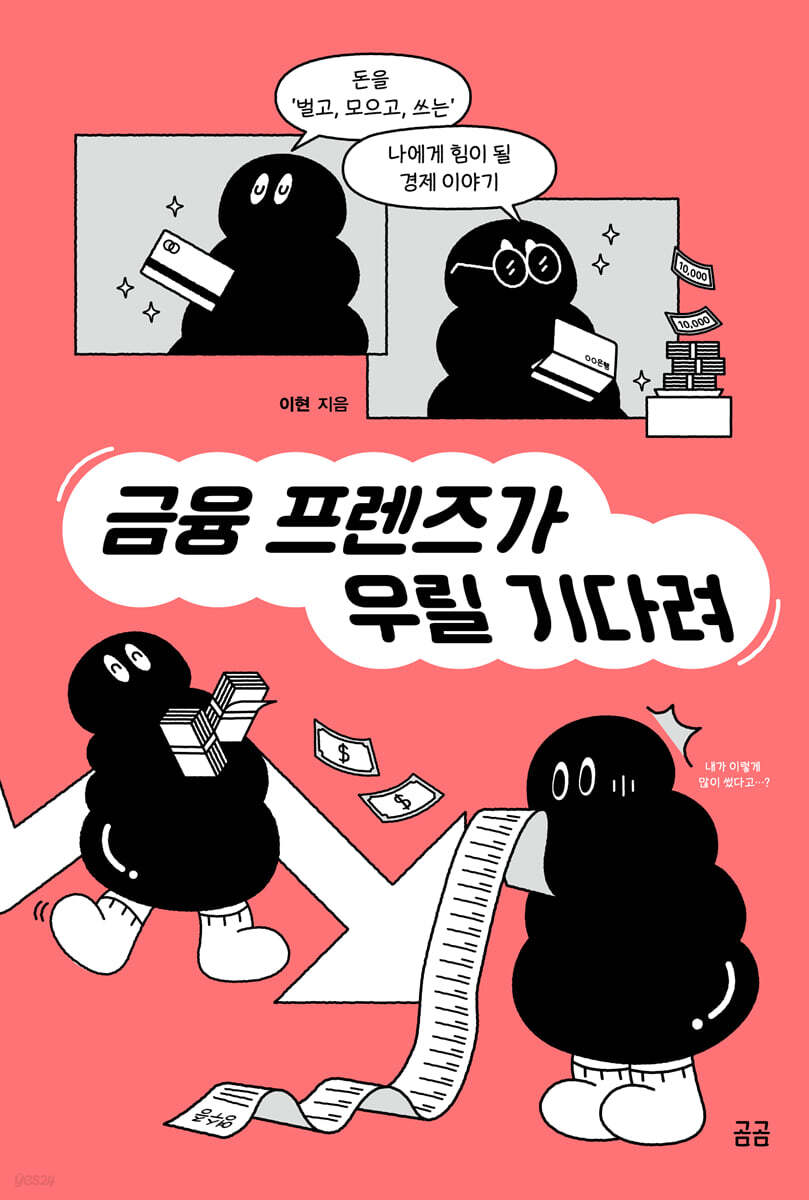
Financial Friends are waiting for us
 |
Description
Book Introduction
Reporter Lee Hyeon from 'Listen Up' reports Financial stories that will empower you to take charge of your life. Reporter Lee Hyeon, who has worked as an economics reporter and host of the podcast "Listen to Current Issues" and has created numerous economic-related content, has published an introductory book on finance. "Financial Friends Are Waiting for Us" is a book that can be read by everyone from teenagers preparing for independence to young adults just starting out in society and managing their own money. The author, who has personally accessed and introduced various economic content such as articles, podcasts, and YouTube videos, says that he feels the importance of 'content that explains the basics.' This is because it is so basic that it is not even mentioned by those who are interested in financial management, but it is important to those who are at the starting line of financial independence. Money that is easy to spend but difficult to earn and save. Knowing the basics of finance will help you manage your life more effectively. "Financial Friends Wait for Us" guides you through the basic principles of economics and basic financial knowledge, using interesting case studies and the author's vivid experiences to help you easily enter the financial life that shapes your life. From attitudes toward money to valuable information for those about to become independent, this introductory financial guide will empower you today and tomorrow. |
- You can preview some of the book's contents.
Preview
index
Introduction: Meet the "Financial Friends" to Lead a Self-Directed Life (Part 4)
1.
What is money?_The value of currency 10
2.
Life is a series of choices_Opportunity Cost 22
3.
Money has a price?_Interest Rate 34
4.
Why do direct purchase sneaker prices keep fluctuating? _Exchange Rate 46
5.
Each bank has its own mission: The role of banks 60
6.
What are stocks?_Corporations, joint stock companies, listed companies 68
7.
How Does the Stock Market Work?_Stock Market 80
8.
Basket for picking, filling, and sharing_Fund 96
9.
It's useful, but if you look at it lightly, you'll get a big nose_Loan 110
10.
If you want to ease your anxiety, Insurance 124
11.
Smart Finance Experts and Responsible Economists_Tax 136
12.
Payment methods are evolving: credit cards, cryptocurrencies, and more.
13.
There's No Such Thing as "Always the Same" in the Economy_Economy and Prices 162
14.
Three Global Financial Crises: 1997, 2008, and 2020 (176)
15.
What will the future of finance look like? Trust is the key. 194
Note 208 of the text
References 211
1.
What is money?_The value of currency 10
2.
Life is a series of choices_Opportunity Cost 22
3.
Money has a price?_Interest Rate 34
4.
Why do direct purchase sneaker prices keep fluctuating? _Exchange Rate 46
5.
Each bank has its own mission: The role of banks 60
6.
What are stocks?_Corporations, joint stock companies, listed companies 68
7.
How Does the Stock Market Work?_Stock Market 80
8.
Basket for picking, filling, and sharing_Fund 96
9.
It's useful, but if you look at it lightly, you'll get a big nose_Loan 110
10.
If you want to ease your anxiety, Insurance 124
11.
Smart Finance Experts and Responsible Economists_Tax 136
12.
Payment methods are evolving: credit cards, cryptocurrencies, and more.
13.
There's No Such Thing as "Always the Same" in the Economy_Economy and Prices 162
14.
Three Global Financial Crises: 1997, 2008, and 2020 (176)
15.
What will the future of finance look like? Trust is the key. 194
Note 208 of the text
References 211
Detailed image

Into the book
The value of money changes depending on economic conditions and trustworthiness.
Its usefulness can end or its value can increase depending on various circumstances, such as whether people recognize and accept money as a medium of economic activity, whether there is too much money compared to goods and services, and whether the country that guarantees the value of money is strong.
So when it comes to financial life, it's really important to determine the true value of money rather than its face value.
How do you decide? I'll explain that in more detail in the next chapter.
--- p.20
In Korean society, there is a tendency to negatively describe people who are good at calculating opportunity costs as “calculating” or “quick at calculating.”
However, I believe that being able to calculate well when faced with important choices is an essential skill for becoming a good adult.
If you calculate well, you won't have any regrets, and if you calculate well, you'll be able to see that other people have given up something to do something good for you.
It's not that being careful about opportunity costs is bad, but it's being too selfish and thinking only of yourself that's bad.
--- p.33
Interest rates, simply put, are the value of money.
What do you mean, money itself has a price? More precisely, it's the price paid when lending or borrowing money.
Interest rates are also expressed in other words.
When we lend money to a bank (savings or deposits) or borrow money from a bank (loan), it is called an interest rate, and in the bond market, it is called a discount rate, and both are interest rates.
If the term 'interest rate' is difficult, there is no big problem if you just think of it as interest rate.
--- p.38
In the stock market, there is no beginner league or expert league.
Investors of different levels move in the same market: a novice investor buying stocks for the first time, a fund manager who studies only how to generate returns all day, and a wealthy person who has already made a fortune in stocks and is sunbathing in his Greek villa.
Remember that stock investing is something you don't need to be too scared of, but you also shouldn't be overconfident.
Newton said he could know the positions of the planets, but not the future price of stocks. I hope you all become wonderful "ants" who invest based on your own judgment, unswayed by the current market.
--- p.94
Humans inevitably prefer the comfortable side.
Paying by credit card is easier than paying by cash.
It is more convenient to use automatic transfer than to check the monthly bill and deposit the correct amount, and to pay in advance rather than paying every time.
But there is one truth you must know.
Companies that create and sell goods and services, as well as payment service providers, want us to spend more money.
That's how the company's profits are maximized.
So, businesses are evolving their payment processes to make it more convenient to get people to spend more money.
This means you can just grab your items without having to check your spending amount every time you make a purchase, or without having to open your wallet or check your bank balance.
It also makes spending more ‘fun’ by awarding points every time you spend, just like in a game.
As technology advances, we will live in a world where we spend money without even realizing it, but let's stay focused and only spend as much as we need and avoid creating unnecessary debt.
Its usefulness can end or its value can increase depending on various circumstances, such as whether people recognize and accept money as a medium of economic activity, whether there is too much money compared to goods and services, and whether the country that guarantees the value of money is strong.
So when it comes to financial life, it's really important to determine the true value of money rather than its face value.
How do you decide? I'll explain that in more detail in the next chapter.
--- p.20
In Korean society, there is a tendency to negatively describe people who are good at calculating opportunity costs as “calculating” or “quick at calculating.”
However, I believe that being able to calculate well when faced with important choices is an essential skill for becoming a good adult.
If you calculate well, you won't have any regrets, and if you calculate well, you'll be able to see that other people have given up something to do something good for you.
It's not that being careful about opportunity costs is bad, but it's being too selfish and thinking only of yourself that's bad.
--- p.33
Interest rates, simply put, are the value of money.
What do you mean, money itself has a price? More precisely, it's the price paid when lending or borrowing money.
Interest rates are also expressed in other words.
When we lend money to a bank (savings or deposits) or borrow money from a bank (loan), it is called an interest rate, and in the bond market, it is called a discount rate, and both are interest rates.
If the term 'interest rate' is difficult, there is no big problem if you just think of it as interest rate.
--- p.38
In the stock market, there is no beginner league or expert league.
Investors of different levels move in the same market: a novice investor buying stocks for the first time, a fund manager who studies only how to generate returns all day, and a wealthy person who has already made a fortune in stocks and is sunbathing in his Greek villa.
Remember that stock investing is something you don't need to be too scared of, but you also shouldn't be overconfident.
Newton said he could know the positions of the planets, but not the future price of stocks. I hope you all become wonderful "ants" who invest based on your own judgment, unswayed by the current market.
--- p.94
Humans inevitably prefer the comfortable side.
Paying by credit card is easier than paying by cash.
It is more convenient to use automatic transfer than to check the monthly bill and deposit the correct amount, and to pay in advance rather than paying every time.
But there is one truth you must know.
Companies that create and sell goods and services, as well as payment service providers, want us to spend more money.
That's how the company's profits are maximized.
So, businesses are evolving their payment processes to make it more convenient to get people to spend more money.
This means you can just grab your items without having to check your spending amount every time you make a purchase, or without having to open your wallet or check your bank balance.
It also makes spending more ‘fun’ by awarding points every time you spend, just like in a game.
As technology advances, we will live in a world where we spend money without even realizing it, but let's stay focused and only spend as much as we need and avoid creating unnecessary debt.
--- p.159
Publisher's Review
1.
Reporter Lee Hyeon from 'Listen Up' reports
Financial stories that will empower you to take charge of your life.
- What is important at the starting point of economic independence?
Basic knowledge of finance!
Reporter Lee Hyeon, who has worked as an economics reporter and host of the podcast "Listen to Current Issues" and has created numerous economic-related content, has published an introductory book on finance.
"Financial Friends Are Waiting for Us" is a book that can be read by everyone from teenagers preparing for independence to young adults just starting out in society and managing their own money.
The author, who has personally accessed and introduced various economic content such as articles, podcasts, and YouTube videos, says that he feels the importance of 'content that explains the basics.'
This is because it is so basic that it is not even mentioned by those who are interested in financial management, but it is important to those who are at the starting line of financial independence.
Money that is easy to spend but difficult to earn and save.
Knowing the basics of finance will help you manage your life more effectively.
"Financial Friends Are Waiting for Us" guides readers through the basic principles of economics and basic financial knowledge, using interesting cases and the author's vivid experiences to help them easily enter the financial life that shapes their lives.
From attitudes toward money to valuable information for those about to become independent, this introductory financial guide will empower you today and tomorrow.
2.
From attitudes toward money to economic common sense,
Pay attention to reporter Hyun's vivid report!
- From price fluctuations to various financial products,
From historical financial crises to hot economic issues
A financial report at eye level, with vivid examples.
This book covers fifteen keywords, including interest rates, exchange rates, stocks, funds, loans, insurance, taxes, cryptocurrencies, the economy and prices, and the future of finance.
In each episode, reporters Hyun and Anchor Geum, who cover financial events across time and borders, appear to share various moments in economic history and the background of financial issues.
From the Namhae Shipping Company to the Plaza Accord, from the Tea Party to the COVID-19 financial crisis, readers can learn various economic concepts easily and enjoyably by following the vivid, on-the-spot reporting.
Why do direct-purchase sneaker prices keep fluctuating? What happens to my money when a bank fails? How does the stock market work, and what should I be wary of when borrowing money? What are the backgrounds of the three global financial crises, and what will the future of finance look like? From the questions that arise when facing the realities of finance to the keywords for a healthy financial life, this book, written by an economics reporter with 12 years of experience, offers concise and clear explanations, brimming with information and entertainment.
In short, it is a book that can capture both practicality and culture.
The author shares his own experiences, from his childhood memories of saving New Year's money, to his opportunity cost when choosing a career as a journalist, to his thoughts on money as he saved and grew, helping readers naturally think about how to manage their financial lives.
3.
To become a 'good adult'
I need time to think about money
- I need to know what values I value
You can spend and save money 'well'
Being a good adult is not proportional to school grades.
You can only become a 'real adult' if you have sufficient thought about what kind of person you are and what kind of life you will live.
One of those concerns is one's sense of money and attitude toward money.
Knowing myself well, what I like and what values I value most, will help me spend money where I need to and save money when I need to.
You need to develop an eye to judge whether it is better to spend money 'now' or to save or roll it over and use it 'in the future'.
That way, the money I have becomes more powerful.
The world is changing little by little even at this moment.
No one knows what money will be made from or how money will be spent in 10 or 20 years.
However, if you learn about finance, which is essential for managing your economic life now, and meet with it often as a friend, it can be a lifelong strength.
The author said, “I do not consider people who depend on their parents’ financial resources even after becoming adults as ‘independent adults.’
Conversely, even if I was born into a poor family, it is not my fault.
From now on, I just have to draw my life differently.
“No matter what your current circumstances are, I hope you will gradually get to know ‘financial friends’ that will help you manage your life proactively with the mindset that ‘the real game starts at the age of 20.’”
《Financial Friends Waiting for Us》 will be your precious friend to take that first step with you.
Reporter Lee Hyeon from 'Listen Up' reports
Financial stories that will empower you to take charge of your life.
- What is important at the starting point of economic independence?
Basic knowledge of finance!
Reporter Lee Hyeon, who has worked as an economics reporter and host of the podcast "Listen to Current Issues" and has created numerous economic-related content, has published an introductory book on finance.
"Financial Friends Are Waiting for Us" is a book that can be read by everyone from teenagers preparing for independence to young adults just starting out in society and managing their own money.
The author, who has personally accessed and introduced various economic content such as articles, podcasts, and YouTube videos, says that he feels the importance of 'content that explains the basics.'
This is because it is so basic that it is not even mentioned by those who are interested in financial management, but it is important to those who are at the starting line of financial independence.
Money that is easy to spend but difficult to earn and save.
Knowing the basics of finance will help you manage your life more effectively.
"Financial Friends Are Waiting for Us" guides readers through the basic principles of economics and basic financial knowledge, using interesting cases and the author's vivid experiences to help them easily enter the financial life that shapes their lives.
From attitudes toward money to valuable information for those about to become independent, this introductory financial guide will empower you today and tomorrow.
2.
From attitudes toward money to economic common sense,
Pay attention to reporter Hyun's vivid report!
- From price fluctuations to various financial products,
From historical financial crises to hot economic issues
A financial report at eye level, with vivid examples.
This book covers fifteen keywords, including interest rates, exchange rates, stocks, funds, loans, insurance, taxes, cryptocurrencies, the economy and prices, and the future of finance.
In each episode, reporters Hyun and Anchor Geum, who cover financial events across time and borders, appear to share various moments in economic history and the background of financial issues.
From the Namhae Shipping Company to the Plaza Accord, from the Tea Party to the COVID-19 financial crisis, readers can learn various economic concepts easily and enjoyably by following the vivid, on-the-spot reporting.
Why do direct-purchase sneaker prices keep fluctuating? What happens to my money when a bank fails? How does the stock market work, and what should I be wary of when borrowing money? What are the backgrounds of the three global financial crises, and what will the future of finance look like? From the questions that arise when facing the realities of finance to the keywords for a healthy financial life, this book, written by an economics reporter with 12 years of experience, offers concise and clear explanations, brimming with information and entertainment.
In short, it is a book that can capture both practicality and culture.
The author shares his own experiences, from his childhood memories of saving New Year's money, to his opportunity cost when choosing a career as a journalist, to his thoughts on money as he saved and grew, helping readers naturally think about how to manage their financial lives.
3.
To become a 'good adult'
I need time to think about money
- I need to know what values I value
You can spend and save money 'well'
Being a good adult is not proportional to school grades.
You can only become a 'real adult' if you have sufficient thought about what kind of person you are and what kind of life you will live.
One of those concerns is one's sense of money and attitude toward money.
Knowing myself well, what I like and what values I value most, will help me spend money where I need to and save money when I need to.
You need to develop an eye to judge whether it is better to spend money 'now' or to save or roll it over and use it 'in the future'.
That way, the money I have becomes more powerful.
The world is changing little by little even at this moment.
No one knows what money will be made from or how money will be spent in 10 or 20 years.
However, if you learn about finance, which is essential for managing your economic life now, and meet with it often as a friend, it can be a lifelong strength.
The author said, “I do not consider people who depend on their parents’ financial resources even after becoming adults as ‘independent adults.’
Conversely, even if I was born into a poor family, it is not my fault.
From now on, I just have to draw my life differently.
“No matter what your current circumstances are, I hope you will gradually get to know ‘financial friends’ that will help you manage your life proactively with the mindset that ‘the real game starts at the age of 20.’”
《Financial Friends Waiting for Us》 will be your precious friend to take that first step with you.
GOODS SPECIFICS
- Date of issue: May 9, 2022
- Pages, weight, size: 212 pages | 308g | 135*200*14mm
- ISBN13: 9791160808469
- ISBN10: 1160808465
- KC Certification: Certification Type: Conformity Confirmation
You may also like
카테고리
korean


korean

![GQ KOREA Mark (Monthly): December [2025]](http://librairie.coreenne.fr/cdn/shop/files/8ef265dbbfbf186523ed75ba7319009d.jpg?v=1765340328&width=3840)


