

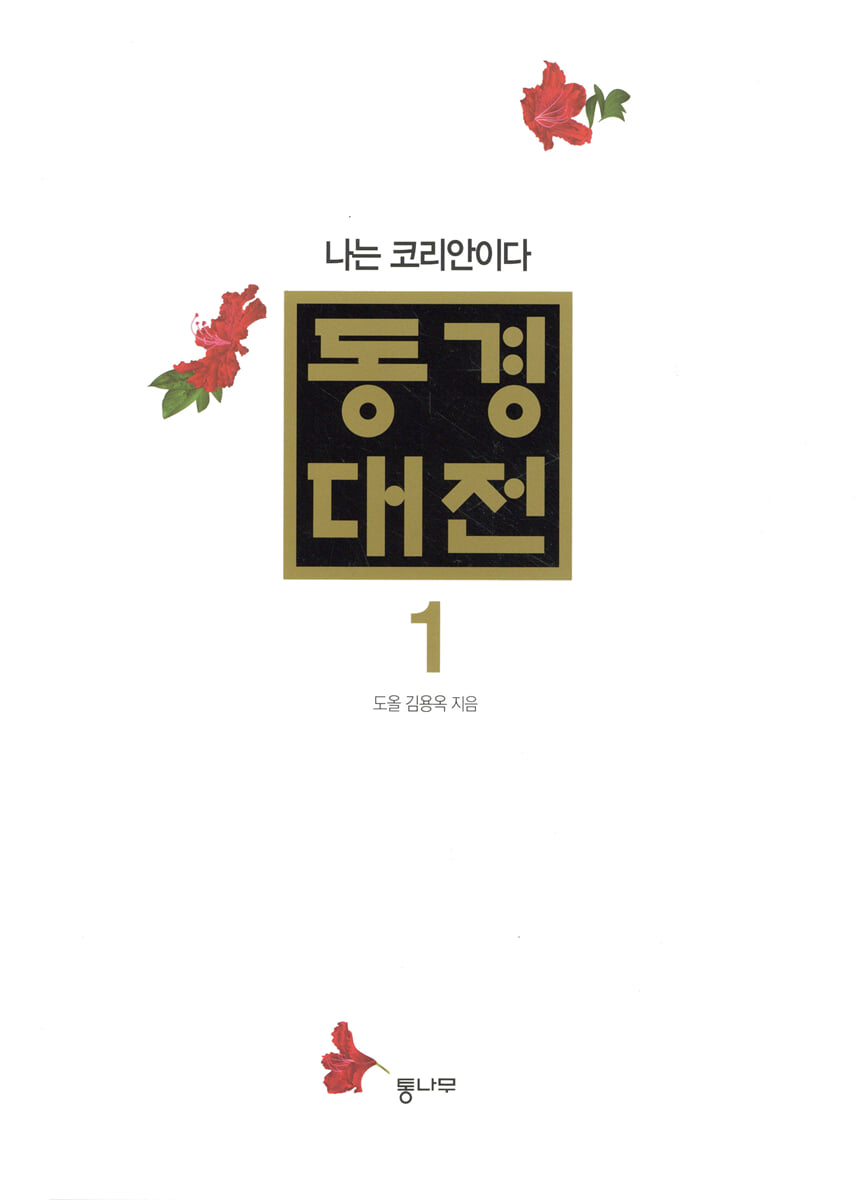
Tokyo Grand Prix 1
 |
Description
Book Introduction
Dool Kim Yong-ok finally completes the translation of [Donggyeong Daejeon]!
Donghak is the sum total of our long-standing civilization and the future ideal of humanity!
Who is Choi Su-un? What exactly is Donghak?
These two books explain it in detail!
Suun Choi Je-woo, in the desperate 19th century Joseon
The seeds of a vision for humanity in the 21st century have been planted!
Dool Kim Yong-ok completed the most monumental masterpiece of his academic life.
It is about Donghak, the founder of Donghak, Suun Choi Je-u, and [Donggyeong Daejeon], which is a collection of Suun's thoughts.
Why Donghak now? Because it excels at solving the problems of our time.
Dool says that Donghak is the most excellent ideological system created by mankind, capable of overcoming human error and the resulting evils of civilization.
In his previous work, [Laozi Was Right], he had already called for an urgent change in direction for the current civilization, which is mired in growthism, using the wisdom of Laozi.
Here, Donghak presents a more concrete and practical vision, and is an ideology deeply imbued with the unique spirit of our people.
This teaching of Donghak resonates even more powerfully through this book, which highlights author Do-ol's insight and eloquent prose, and will lead us to a new transformation in our lives.
This book is a masterpiece that describes in detail who Suun Choi Je-woo was and what Donghak is, by translating and annotating [Donggyeong Daejeon], written by Suun Choi Je-woo himself, and [Daeseonsaeng Jumunjip], a biography of Suun, with great care by Dool.
This book also contains a large-scale essay titled “A Brief Overview of Joseon Thought History,” which summarizes the major streams of our ideological history that lead to Donghak ideology.
And the shocking story about the [Donggyeong Daejeon] edition unfolds, and important [Donggyeong Daejeon] editions are included in their original form.
Readers will understand why when they read this book, but it is a book that Dool wrote with blood.
Donghak is the sum total of our long-standing civilization and the future ideal of humanity!
Who is Choi Su-un? What exactly is Donghak?
These two books explain it in detail!
Suun Choi Je-woo, in the desperate 19th century Joseon
The seeds of a vision for humanity in the 21st century have been planted!
Dool Kim Yong-ok completed the most monumental masterpiece of his academic life.
It is about Donghak, the founder of Donghak, Suun Choi Je-u, and [Donggyeong Daejeon], which is a collection of Suun's thoughts.
Why Donghak now? Because it excels at solving the problems of our time.
Dool says that Donghak is the most excellent ideological system created by mankind, capable of overcoming human error and the resulting evils of civilization.
In his previous work, [Laozi Was Right], he had already called for an urgent change in direction for the current civilization, which is mired in growthism, using the wisdom of Laozi.
Here, Donghak presents a more concrete and practical vision, and is an ideology deeply imbued with the unique spirit of our people.
This teaching of Donghak resonates even more powerfully through this book, which highlights author Do-ol's insight and eloquent prose, and will lead us to a new transformation in our lives.
This book is a masterpiece that describes in detail who Suun Choi Je-woo was and what Donghak is, by translating and annotating [Donggyeong Daejeon], written by Suun Choi Je-woo himself, and [Daeseonsaeng Jumunjip], a biography of Suun, with great care by Dool.
This book also contains a large-scale essay titled “A Brief Overview of Joseon Thought History,” which summarizes the major streams of our ideological history that lead to Donghak ideology.
And the shocking story about the [Donggyeong Daejeon] edition unfolds, and important [Donggyeong Daejeon] editions are included in their original form.
Readers will understand why when they read this book, but it is a book that Dool wrote with blood.
- You can preview some of the book's contents.
Preview
index
Volume 1
Celebration of the Opening of the Sutra 9
Ⅰ.
Preface 13
13 Relationships That Led to Writing This Book
15th Tokyo Grand Prix Seminar, 4th in a row
Park Maeng-su and Seong Ju-hyeon 19
The process of engraving the Mokcheon edition of [Donggyeong Daejeon] 20
Let's remember Kim Yong-hee and Kim Hwa-seong! 22
Mokcheonpan [Donggyeong Daejeon]: Haewol's Tearful Preface 22
Suun was both Jesus and the author of the Gospel, Mark 25
The most important secret agreement between Suun and Haewol:
Publication of [Donggyeong Daejeon] 26
The Sea and Moon's Dobari: The Greatest Event in 19th-Century Korean History 27
30 royalties to the teacher of the saint Haewol, Suun
Water Clouds and the Sea Moon 31
From Yongdam to Daehae! 33
The only way to create a religion that is not a religion:
Leave the original source of enlightenment! 34
The Reality of Woodblock Printing: Understanding Joseon Printing History 35
Lightning Engraving 38
New fact: Almost all editions of [Donggyeong Daejeon] are not woodblocks but movable type editions.
Haewol accurately preserved Suun's manuscript 41
The song did not exist 44
Lee Pil-je is not a “general of writing”!
The first Donghak Revolution leader, 49
In 1880, Inje printed,
The 50th chapter of the courageous decision of Haewol, who knows the time
The appearance of the first edition of Inje Gyeongjin:
51 Landmark Events in Our Modern History
If there had been no Donghak, our history in the 20th and 21st centuries would have been
No enterprising spirit 53
My tears over the first edition
Appraisal as a Professional 54
The first edition of Gyeongjin takes precedence over all other editions:
Principle 57 of Sympathetics
[Donggyeong Daejeon], [Daeseonsaeng Jumunjip], and [Dowon Giseo] 58
Preface 61 of the first edition of the Gyeongjin edition included in [Peach Blossom Spring]
The Department of Philosophy at Korea University, the home of Donghak studies
Poet Cho Ji-hoon's Roar 63
Jacob and Dool 66
Problem 69 of Kim Sang-gi's "Suun Haengnok"
The Suunhaengnok does not exist:
It is just a distorted version of [The Great Teacher's Order Collection] 71
Kangsu completed [Peach Blossom Spring] by inheriting [Daeseonsaeng Jumunjip], not [Suunhaengnok].
Yeonghaehyangjeon and Park Ha-sun 74
Haewol left after asking Park Ha-seon to write [The Great Teacher's Order Collection] just before Suun's execution.
The will left to me by Master Samamjang Pyo Yeong-sam 79
Ⅱ.
The Great Teacher's Collected Works, Vol. 83
Ⅲ.
A Comprehensive View of Joseon Thought History 247
Is Donghak really the starting point of our nation's modernity? 248
What is Modernity? 250
The Backwardness of the Concept of Modernity: Descartes' Apology 255
Dominating the entire history of Western thought
Nonsense 261 on the concept of "substance"
Hyegang and Seonsan 262
Science is a metaphysical tension
Not asking for 264
The Three Elements of Modernity 265
The French Revolution: The Beginning of Modernity? 266
Characteristics of Greek Direct Democracy 268
Pletarchia: Unique to our people
The Principle of “People-Oriented” 272
Mencius and the American Declaration of Independence 274
The Condition of People's Religion: Replace God! 278
Feuerbach and Nietzsche 280
Does human dignity truly come from divine authority? 281
The Pros and Cons of Pletarchia 283
Jeong Do-jeon's Revolutionary Plan 286
Structural Limitations of the Joseon Dynasty's Royal Authority 288
Donghak, the Fruit of a History of Steadfast Civil Rights Growth 290
Characteristics of Buddhism 291
The Proclamation of Zen Buddhism: Life and Death are Nirvana 295
Theory of the Mind: The Fusion of Eastern and Western Civilizations 296
The Rise of the Joseon Dynasty Sarim 297
The Four Seven Arguments: The Deep Structure of Joseon Confucianism 299
Gobong is actually the orthodox runner 300
The mainstream of Joseon Neo-Confucianism and its complex nature 300
Yulgok and Toegye 301
Horak Debate 302
Green Moon Im Seong-ju 306
From Toegye's Haircut to Nokmun's Life 307
Yesong, Twilight of Joseon 308
Namin and Seohak, Donghak 309, born in the hometown of Namin
Distinct currents in the history of Korean thought:
Western learning must be overcome 312
Dasan's Forced Justification of Western Learning 313
Dasan is the final chapter of the old era 315
Hong Su-jeon's Health 316
Hong Xiuquan's Compensation Ceremony, Taiping Army Enters Nanjing in 319
Differences between the Taiping Heavenly Kingdom and Donghak 320
Joseon's 20th-Century Religious History: Western Learning or Eastern Learning? 334
The Development of Pletarchy, Up to Donghak 335
Rationality and Coherence 336
Cooperation, not freedom, a sense of peace 339
Ⅳ.
About Heavenly Father, 341
V.
Suun, About That Person 351
Ⅵ.
[Donggyeong Daejeon] Regarding the Edition 391
Ⅶ.
"Yongdam Yusa" is "Yongdam Sarang" 424
[Donggyeong Daejeon]
Inje Gyeongjin First Edition, 553-493
Mokcheon Gye-mi Jungchun Pan 491-472
Gyeongju-gye-mi-jung-ha-pan 471-458
Injemujagyechunpan 457-442
Shinmyojungchunjungganpan 441-426
Search 554
Celebration of the Opening of the Sutra 9
Ⅰ.
Preface 13
13 Relationships That Led to Writing This Book
15th Tokyo Grand Prix Seminar, 4th in a row
Park Maeng-su and Seong Ju-hyeon 19
The process of engraving the Mokcheon edition of [Donggyeong Daejeon] 20
Let's remember Kim Yong-hee and Kim Hwa-seong! 22
Mokcheonpan [Donggyeong Daejeon]: Haewol's Tearful Preface 22
Suun was both Jesus and the author of the Gospel, Mark 25
The most important secret agreement between Suun and Haewol:
Publication of [Donggyeong Daejeon] 26
The Sea and Moon's Dobari: The Greatest Event in 19th-Century Korean History 27
30 royalties to the teacher of the saint Haewol, Suun
Water Clouds and the Sea Moon 31
From Yongdam to Daehae! 33
The only way to create a religion that is not a religion:
Leave the original source of enlightenment! 34
The Reality of Woodblock Printing: Understanding Joseon Printing History 35
Lightning Engraving 38
New fact: Almost all editions of [Donggyeong Daejeon] are not woodblocks but movable type editions.
Haewol accurately preserved Suun's manuscript 41
The song did not exist 44
Lee Pil-je is not a “general of writing”!
The first Donghak Revolution leader, 49
In 1880, Inje printed,
The 50th chapter of the courageous decision of Haewol, who knows the time
The appearance of the first edition of Inje Gyeongjin:
51 Landmark Events in Our Modern History
If there had been no Donghak, our history in the 20th and 21st centuries would have been
No enterprising spirit 53
My tears over the first edition
Appraisal as a Professional 54
The first edition of Gyeongjin takes precedence over all other editions:
Principle 57 of Sympathetics
[Donggyeong Daejeon], [Daeseonsaeng Jumunjip], and [Dowon Giseo] 58
Preface 61 of the first edition of the Gyeongjin edition included in [Peach Blossom Spring]
The Department of Philosophy at Korea University, the home of Donghak studies
Poet Cho Ji-hoon's Roar 63
Jacob and Dool 66
Problem 69 of Kim Sang-gi's "Suun Haengnok"
The Suunhaengnok does not exist:
It is just a distorted version of [The Great Teacher's Order Collection] 71
Kangsu completed [Peach Blossom Spring] by inheriting [Daeseonsaeng Jumunjip], not [Suunhaengnok].
Yeonghaehyangjeon and Park Ha-sun 74
Haewol left after asking Park Ha-seon to write [The Great Teacher's Order Collection] just before Suun's execution.
The will left to me by Master Samamjang Pyo Yeong-sam 79
Ⅱ.
The Great Teacher's Collected Works, Vol. 83
Ⅲ.
A Comprehensive View of Joseon Thought History 247
Is Donghak really the starting point of our nation's modernity? 248
What is Modernity? 250
The Backwardness of the Concept of Modernity: Descartes' Apology 255
Dominating the entire history of Western thought
Nonsense 261 on the concept of "substance"
Hyegang and Seonsan 262
Science is a metaphysical tension
Not asking for 264
The Three Elements of Modernity 265
The French Revolution: The Beginning of Modernity? 266
Characteristics of Greek Direct Democracy 268
Pletarchia: Unique to our people
The Principle of “People-Oriented” 272
Mencius and the American Declaration of Independence 274
The Condition of People's Religion: Replace God! 278
Feuerbach and Nietzsche 280
Does human dignity truly come from divine authority? 281
The Pros and Cons of Pletarchia 283
Jeong Do-jeon's Revolutionary Plan 286
Structural Limitations of the Joseon Dynasty's Royal Authority 288
Donghak, the Fruit of a History of Steadfast Civil Rights Growth 290
Characteristics of Buddhism 291
The Proclamation of Zen Buddhism: Life and Death are Nirvana 295
Theory of the Mind: The Fusion of Eastern and Western Civilizations 296
The Rise of the Joseon Dynasty Sarim 297
The Four Seven Arguments: The Deep Structure of Joseon Confucianism 299
Gobong is actually the orthodox runner 300
The mainstream of Joseon Neo-Confucianism and its complex nature 300
Yulgok and Toegye 301
Horak Debate 302
Green Moon Im Seong-ju 306
From Toegye's Haircut to Nokmun's Life 307
Yesong, Twilight of Joseon 308
Namin and Seohak, Donghak 309, born in the hometown of Namin
Distinct currents in the history of Korean thought:
Western learning must be overcome 312
Dasan's Forced Justification of Western Learning 313
Dasan is the final chapter of the old era 315
Hong Su-jeon's Health 316
Hong Xiuquan's Compensation Ceremony, Taiping Army Enters Nanjing in 319
Differences between the Taiping Heavenly Kingdom and Donghak 320
Joseon's 20th-Century Religious History: Western Learning or Eastern Learning? 334
The Development of Pletarchy, Up to Donghak 335
Rationality and Coherence 336
Cooperation, not freedom, a sense of peace 339
Ⅳ.
About Heavenly Father, 341
V.
Suun, About That Person 351
Ⅵ.
[Donggyeong Daejeon] Regarding the Edition 391
Ⅶ.
"Yongdam Yusa" is "Yongdam Sarang" 424
[Donggyeong Daejeon]
Inje Gyeongjin First Edition, 553-493
Mokcheon Gye-mi Jungchun Pan 491-472
Gyeongju-gye-mi-jung-ha-pan 471-458
Injemujagyechunpan 457-442
Shinmyojungchunjungganpan 441-426
Search 554
Into the book
I have become convinced that the [Daeseonsaengjumunjip] collected in the Kyujanggak Library is the first biography, or biography, of Suun, compiled in the late 1860s.
---p.14
Suun was both Jesus and Paul.
Haewol was not an interpreter like Paul.
Haewol was not a theoretical commentator, but a man of action who put Suun's ideas into practice.
---p.25
The ignorant and superficial views on history, based on the absurd and expedient later descriptions of “Namjeop” and “Bukjeop,” as if the leader of Bukjeop was Haewol and the leader of Namjeop was Nokdu and that these two were in conflict, should be completely dispelled.
---p.29
The Japanese invasion may have brought an end to the Joseon monarchy, but the Joseon Dynasty's mentality could not be broken.
If there had been no Donghak, would we have been able to end Japanese colonial rule and establish our own independent “nation”?
---p.53
This shows that the “Daeseonsaengjumunjip” is a rough and sloppy draft that is not very well-prepared.
Compared to this, the Peach Blossom Spring is a refined draft with no particular flaws in the composition of its sentences, but it actually has many errors in the content of its sentences.
This shows that the refined version was created after seeing the rough draft.
---p.84
The great cool-headedness of Donghak, which never left the embrace of human common sense, was embodied in Suun's teenage "ideological wandering experience."
---p.93
To overcome this loneliness, Su-un initially indulges in miscellaneous books, gossip, and fortune telling.
Then he laughs it off and devotes himself to martial arts.
---p.99
Finally, Su-un meets God in a very profound way at Yeosibawi Valley in Ulsan.
His search for God continued.
Suun called that exploration “prayer.”
---p.111
Su-un thought like this and offered his wisdom for 49 days.
…there were no results, only illusions.
It was a fantasy that my uncle had passed away.
---p.112
The year of Gimi was the year before Suun attained enlightenment.
But exactly one year later, our people were engulfed in the fervor of the March 1st Independence Revolution.
---p.123
Suun's desire to meet the Lord of the universe, Heaven, in person lasted for five years, from the spring of the year of Eulmyo (1855) to April of the year of Gyeongsin (1860).
---p.133
Being a celestial being does not mean that I am a noble being who serves the Supreme Being.
This means that God must be incarnated into my entire being.
---pp.140,141
At this time, Choi Gyeong-sang made a new blanket and a set of fluffy clothes with a quilted top and bottom and gave them to the teacher.
… “You are a poor scholar who is usually extremely poor, so why are you bleeding so much?” [Original text-14]
---p.186
One day, the teacher suddenly issued a notice declaring the end of the priesthood system.
The teacher set the date of the wedding as July 23, 1863.
[Original text-18]
---p.208
The reason we call the Gap-o Donghak Peasant Revolution (1894) the Donghak Revolution is because, although it ended in political failure, it systematically presented a new perspective on humanity that shifted the axis of monarchy to the axis of democracy.
---p.14
Suun was both Jesus and Paul.
Haewol was not an interpreter like Paul.
Haewol was not a theoretical commentator, but a man of action who put Suun's ideas into practice.
---p.25
The ignorant and superficial views on history, based on the absurd and expedient later descriptions of “Namjeop” and “Bukjeop,” as if the leader of Bukjeop was Haewol and the leader of Namjeop was Nokdu and that these two were in conflict, should be completely dispelled.
---p.29
The Japanese invasion may have brought an end to the Joseon monarchy, but the Joseon Dynasty's mentality could not be broken.
If there had been no Donghak, would we have been able to end Japanese colonial rule and establish our own independent “nation”?
---p.53
This shows that the “Daeseonsaengjumunjip” is a rough and sloppy draft that is not very well-prepared.
Compared to this, the Peach Blossom Spring is a refined draft with no particular flaws in the composition of its sentences, but it actually has many errors in the content of its sentences.
This shows that the refined version was created after seeing the rough draft.
---p.84
The great cool-headedness of Donghak, which never left the embrace of human common sense, was embodied in Suun's teenage "ideological wandering experience."
---p.93
To overcome this loneliness, Su-un initially indulges in miscellaneous books, gossip, and fortune telling.
Then he laughs it off and devotes himself to martial arts.
---p.99
Finally, Su-un meets God in a very profound way at Yeosibawi Valley in Ulsan.
His search for God continued.
Suun called that exploration “prayer.”
---p.111
Su-un thought like this and offered his wisdom for 49 days.
…there were no results, only illusions.
It was a fantasy that my uncle had passed away.
---p.112
The year of Gimi was the year before Suun attained enlightenment.
But exactly one year later, our people were engulfed in the fervor of the March 1st Independence Revolution.
---p.123
Suun's desire to meet the Lord of the universe, Heaven, in person lasted for five years, from the spring of the year of Eulmyo (1855) to April of the year of Gyeongsin (1860).
---p.133
Being a celestial being does not mean that I am a noble being who serves the Supreme Being.
This means that God must be incarnated into my entire being.
---pp.140,141
At this time, Choi Gyeong-sang made a new blanket and a set of fluffy clothes with a quilted top and bottom and gave them to the teacher.
… “You are a poor scholar who is usually extremely poor, so why are you bleeding so much?” [Original text-14]
---p.186
One day, the teacher suddenly issued a notice declaring the end of the priesthood system.
The teacher set the date of the wedding as July 23, 1863.
[Original text-18]
---p.208
The reason we call the Gap-o Donghak Peasant Revolution (1894) the Donghak Revolution is because, although it ended in political failure, it systematically presented a new perspective on humanity that shifted the axis of monarchy to the axis of democracy.
---p.249
Publisher's Review
Let’s “reopen” human civilization!
Donghak is our ideology and our philosophy!
Now anyone can understand [The Great Battle of Donggyeong] with this book!
Our humanism and people-centered spirit, deeply rooted in our history spanning half a millennium, gave birth to Donghak.
Donghak is a philosophy that was newly created among the people of this land by Suun Choi Je-u 160 years ago based on this Korean spirit.
Donghak sought to be thoroughly implemented and perfected not only in ideology but also in the realm of practice.
Donghak means “learning” (學).
Those who participated in Donghak did not say they “believed in” Donghak, but rather “followed Donghak,” which is expressed in the fact that it was a learning process that aimed for concrete practice.
At that time, the atmosphere of the declining Joseon society was growing stronger internally, and it was a time of crisis with the invasion of Western imperialism externally.
Suun accurately recognized the internal and external troubles and, in response, brought about a new awakening and a revolution in the lives of our people.
The idea was to “re-open” the world.
Suun confronted the dangers of the vertical, transcendental God promoted by the incoming Western learning, and presented an egalitarian idea of God who accompanies all life over time.
And it revived the spirituality of our people who viewed the great nature of heaven and earth as divine.
Choi Su-un wrote down the ideas of Donghak himself.
[Donggyeong Daejeon] is written in Chinese characters, and [Yongdam Yusa] is written in Korean lyrics.
All of them are shining scriptures of our people.
This great [Daejeon of Donggyeong] has not been properly known to many people until now.
Through this book, translated and commented by Dool Kim Yong-ok, readers will finally understand the meaning of [Donggyeong Daejeon].
From the 21st century onwards, human civilization must change.
The profound intellect and spirituality of Donghak must now extend to a vision for the future of all humanity.
The author Dool Kim Yong-ok and Donghak have a long history,
[Donggyeong Daejeon] The translator's lifelong philosophical challenge!
Do-ol Kim Yong-ok, a philosopher of this land who lived in our time, was already exposed to the essence of Donghak when he entered the Department of Philosophy at Korea University.
At that time, professors of philosophy were developing a Korean ideological movement centered around Donghak with the support of Cheondoism.
When Do-ol encountered Donghak in his twenties, he established the belief that Donghak was the culmination of the national learning tradition that had been passed down since Gojoseon and that it was the axis of a new era that overcame monarchy.
However, in order to concretize that belief, he devotes himself to the study of Western and Chinese philosophy.
After completing his degrees at National Taiwan University, the University of Tokyo, and Harvard University, he established a new paradigm in Korean academia through his works of over 80 volumes.
In the process, Dool meets Pyo Yeong-sam, a saint of Donghak who inherited the vivid spirit of the first generation of Donghak, and from him inherits the correct view of Donghak's history, people, customs, scriptures, records, and relics.
Dool says: “Master Samamjang Pyo Yeong-sam was the bridge that connected me to the living Suun and Haewol.”
"The Donghak Revolution is still ongoing.
Donghak is tears.
Anyone who can sense tears before the true description of Donghak as it is must now break free from all the childishness that has engulfed existing world civilization.
Our religion, our scholarship, our politics, and our science must establish a new identity.
The path to establishing this new and true identity begins with a proper understanding of Donghak, the learning of Joseon.
Because Donghak is the sum total of the long-standing Joseon civilization and the ideal of the future of humanity."
― Dool Kim Yong-ok, from Gaegyeongjichuk ―
The work of standardizing [Daeseonsaeng's Order Collection] and detailed translation!
The life story of genius thinker Suun Choi Je-woo!
The core of this book [Donggyeong Daejeon - Volume 1] lies in the fact that in Chapter 2, the material called [Daeseonsaeng Jumunjip] is illuminated from a new perspective, revealing the entire life of Suun Choi Je-woo in a vivid manner.
[The Great Teacher's Collection of Writings] is now called [The Great Teacher's Collection of Writings] in Korean.
This is a document written as a biography of the great teacher Choi Su-un.
The fact that a realistic biography of Choi Su-un was written immediately after his death shows just how great a person he was.
Everyone who came into contact with our teacher had the mission of leaving the life of our teacher, who passed away unjustly, on this earth.
This second chapter is the first canonicalization of [Daeseonsaengjumunjip] undertaken by Dool, and is also a detailed commentary.
[The Great Teacher's Order Collection] is a very plain record that begins with, "Our teacher's surname is Choi, and his given name is Je-u (先生, 姓崔氏, 諱濟愚,)" and ends with, "The teacher's body was buried on the hill west of Yongdam (安葬于龍潭西原.)."
Su-un was born into a scholar's family, but lost his parents when he was a teenager and had to carve out his own destiny.
He lived a fiery life as a man of action who founded Donghak and was executed at a young age as a traitor.
In this collection of essays translated by Dool, readers can sense Suun's personality, academic depth, and unparalleled spiritual strength.
When you get to know Suun's life and the person he was, it becomes easier to understand Suun's thoughts contained in [Donggyeong Daejeon].
A shocking story about the edition of [Donggyeong Daejeon]!
Suun desperately wanted his writings to be published.
Haewol carried out his purpose perfectly even in difficult circumstances!
Chapter 6 of this book, “On the Edition of the Donggyeong Daejeon,” is a report on the professional edition studies and literary criticism of Gyeongcheon Dongji, which overturns all common-sense assumptions about the Donggyeong Daejeon known up to now.
Su-un was convinced that his thoughts would inevitably be distorted after his death because his thought system was so different from the common sense of the time.
So, he had a mission to leave his thoughts as they were among the people of Joseon by writing them himself and printing and publishing them by any means necessary.
He passed on the teachings to the person who could complete the mission, and that person was Haewol Choi Si-hyeong.
After nearly 20 years of struggle, Haewol succeeded in publishing his collection of Suun's writings in woodblock printing in Inje, Gangwon-do.
A dramatic story unfolds about this publishing process and the surviving editions.
Also, at the end of this book, five original editions of the 『Donggyeong Daejeon』, which are difficult for the general public to access, are included in their original form.
In search of the main vein of our ideological history that continues to Donghak,
Let's organize the history of Joseon thought from the perspective of people's nature!
Chapter 3 of this book, “A Brief Overview of Joseon Ideology,” presents the author’s unique perspective on the history of our ideology.
Author Dool argues that we should not force the Western concept of modernity onto our history.
He came up with a new concept called plethargy to replace the framework of modernity or democracy.
“Pletarkia,” as he defined it, is the principle of people-centeredness unique to our people.
In this third chapter, Dool fiercely describes the history of our thought by reexamining it as a process of expanding the popular nature of Pletarchia.
This is an essential task for correctly understanding Donghak.
This includes not only Confucianism but also Buddhist thought.
In particular, the process of starting with Sam Bong Jeong Do-jeon, going through the great debates of Joseon Seongrihak, the Fourfold Seven Emotions Debate and the Horak Debate of the theory of human nature and character, and converging on Hyegang Choi Han-gi's Gihak and Suun Choi Je-u's Donghak is persistently and persuasively unfolded.
Donghak is our ideology and our philosophy!
Now anyone can understand [The Great Battle of Donggyeong] with this book!
Our humanism and people-centered spirit, deeply rooted in our history spanning half a millennium, gave birth to Donghak.
Donghak is a philosophy that was newly created among the people of this land by Suun Choi Je-u 160 years ago based on this Korean spirit.
Donghak sought to be thoroughly implemented and perfected not only in ideology but also in the realm of practice.
Donghak means “learning” (學).
Those who participated in Donghak did not say they “believed in” Donghak, but rather “followed Donghak,” which is expressed in the fact that it was a learning process that aimed for concrete practice.
At that time, the atmosphere of the declining Joseon society was growing stronger internally, and it was a time of crisis with the invasion of Western imperialism externally.
Suun accurately recognized the internal and external troubles and, in response, brought about a new awakening and a revolution in the lives of our people.
The idea was to “re-open” the world.
Suun confronted the dangers of the vertical, transcendental God promoted by the incoming Western learning, and presented an egalitarian idea of God who accompanies all life over time.
And it revived the spirituality of our people who viewed the great nature of heaven and earth as divine.
Choi Su-un wrote down the ideas of Donghak himself.
[Donggyeong Daejeon] is written in Chinese characters, and [Yongdam Yusa] is written in Korean lyrics.
All of them are shining scriptures of our people.
This great [Daejeon of Donggyeong] has not been properly known to many people until now.
Through this book, translated and commented by Dool Kim Yong-ok, readers will finally understand the meaning of [Donggyeong Daejeon].
From the 21st century onwards, human civilization must change.
The profound intellect and spirituality of Donghak must now extend to a vision for the future of all humanity.
The author Dool Kim Yong-ok and Donghak have a long history,
[Donggyeong Daejeon] The translator's lifelong philosophical challenge!
Do-ol Kim Yong-ok, a philosopher of this land who lived in our time, was already exposed to the essence of Donghak when he entered the Department of Philosophy at Korea University.
At that time, professors of philosophy were developing a Korean ideological movement centered around Donghak with the support of Cheondoism.
When Do-ol encountered Donghak in his twenties, he established the belief that Donghak was the culmination of the national learning tradition that had been passed down since Gojoseon and that it was the axis of a new era that overcame monarchy.
However, in order to concretize that belief, he devotes himself to the study of Western and Chinese philosophy.
After completing his degrees at National Taiwan University, the University of Tokyo, and Harvard University, he established a new paradigm in Korean academia through his works of over 80 volumes.
In the process, Dool meets Pyo Yeong-sam, a saint of Donghak who inherited the vivid spirit of the first generation of Donghak, and from him inherits the correct view of Donghak's history, people, customs, scriptures, records, and relics.
Dool says: “Master Samamjang Pyo Yeong-sam was the bridge that connected me to the living Suun and Haewol.”
"The Donghak Revolution is still ongoing.
Donghak is tears.
Anyone who can sense tears before the true description of Donghak as it is must now break free from all the childishness that has engulfed existing world civilization.
Our religion, our scholarship, our politics, and our science must establish a new identity.
The path to establishing this new and true identity begins with a proper understanding of Donghak, the learning of Joseon.
Because Donghak is the sum total of the long-standing Joseon civilization and the ideal of the future of humanity."
― Dool Kim Yong-ok, from Gaegyeongjichuk ―
The work of standardizing [Daeseonsaeng's Order Collection] and detailed translation!
The life story of genius thinker Suun Choi Je-woo!
The core of this book [Donggyeong Daejeon - Volume 1] lies in the fact that in Chapter 2, the material called [Daeseonsaeng Jumunjip] is illuminated from a new perspective, revealing the entire life of Suun Choi Je-woo in a vivid manner.
[The Great Teacher's Collection of Writings] is now called [The Great Teacher's Collection of Writings] in Korean.
This is a document written as a biography of the great teacher Choi Su-un.
The fact that a realistic biography of Choi Su-un was written immediately after his death shows just how great a person he was.
Everyone who came into contact with our teacher had the mission of leaving the life of our teacher, who passed away unjustly, on this earth.
This second chapter is the first canonicalization of [Daeseonsaengjumunjip] undertaken by Dool, and is also a detailed commentary.
[The Great Teacher's Order Collection] is a very plain record that begins with, "Our teacher's surname is Choi, and his given name is Je-u (先生, 姓崔氏, 諱濟愚,)" and ends with, "The teacher's body was buried on the hill west of Yongdam (安葬于龍潭西原.)."
Su-un was born into a scholar's family, but lost his parents when he was a teenager and had to carve out his own destiny.
He lived a fiery life as a man of action who founded Donghak and was executed at a young age as a traitor.
In this collection of essays translated by Dool, readers can sense Suun's personality, academic depth, and unparalleled spiritual strength.
When you get to know Suun's life and the person he was, it becomes easier to understand Suun's thoughts contained in [Donggyeong Daejeon].
A shocking story about the edition of [Donggyeong Daejeon]!
Suun desperately wanted his writings to be published.
Haewol carried out his purpose perfectly even in difficult circumstances!
Chapter 6 of this book, “On the Edition of the Donggyeong Daejeon,” is a report on the professional edition studies and literary criticism of Gyeongcheon Dongji, which overturns all common-sense assumptions about the Donggyeong Daejeon known up to now.
Su-un was convinced that his thoughts would inevitably be distorted after his death because his thought system was so different from the common sense of the time.
So, he had a mission to leave his thoughts as they were among the people of Joseon by writing them himself and printing and publishing them by any means necessary.
He passed on the teachings to the person who could complete the mission, and that person was Haewol Choi Si-hyeong.
After nearly 20 years of struggle, Haewol succeeded in publishing his collection of Suun's writings in woodblock printing in Inje, Gangwon-do.
A dramatic story unfolds about this publishing process and the surviving editions.
Also, at the end of this book, five original editions of the 『Donggyeong Daejeon』, which are difficult for the general public to access, are included in their original form.
In search of the main vein of our ideological history that continues to Donghak,
Let's organize the history of Joseon thought from the perspective of people's nature!
Chapter 3 of this book, “A Brief Overview of Joseon Ideology,” presents the author’s unique perspective on the history of our ideology.
Author Dool argues that we should not force the Western concept of modernity onto our history.
He came up with a new concept called plethargy to replace the framework of modernity or democracy.
“Pletarkia,” as he defined it, is the principle of people-centeredness unique to our people.
In this third chapter, Dool fiercely describes the history of our thought by reexamining it as a process of expanding the popular nature of Pletarchia.
This is an essential task for correctly understanding Donghak.
This includes not only Confucianism but also Buddhist thought.
In particular, the process of starting with Sam Bong Jeong Do-jeon, going through the great debates of Joseon Seongrihak, the Fourfold Seven Emotions Debate and the Horak Debate of the theory of human nature and character, and converging on Hyegang Choi Han-gi's Gihak and Suun Choi Je-u's Donghak is persistently and persuasively unfolded.
GOODS SPECIFICS
- Publication date: April 11, 2021
- Format: Hardcover book binding method guide
- Page count, weight, size: 504 pages | 1,160g | 175*244*40mm
- ISBN13: 9788982641497
- ISBN10: 8982641491
You may also like
카테고리
korean


korean

![GQ KOREA Mark (Monthly): December [2025]](http://librairie.coreenne.fr/cdn/shop/files/8ef265dbbfbf186523ed75ba7319009d.jpg?v=1765340328&width=3840)


