

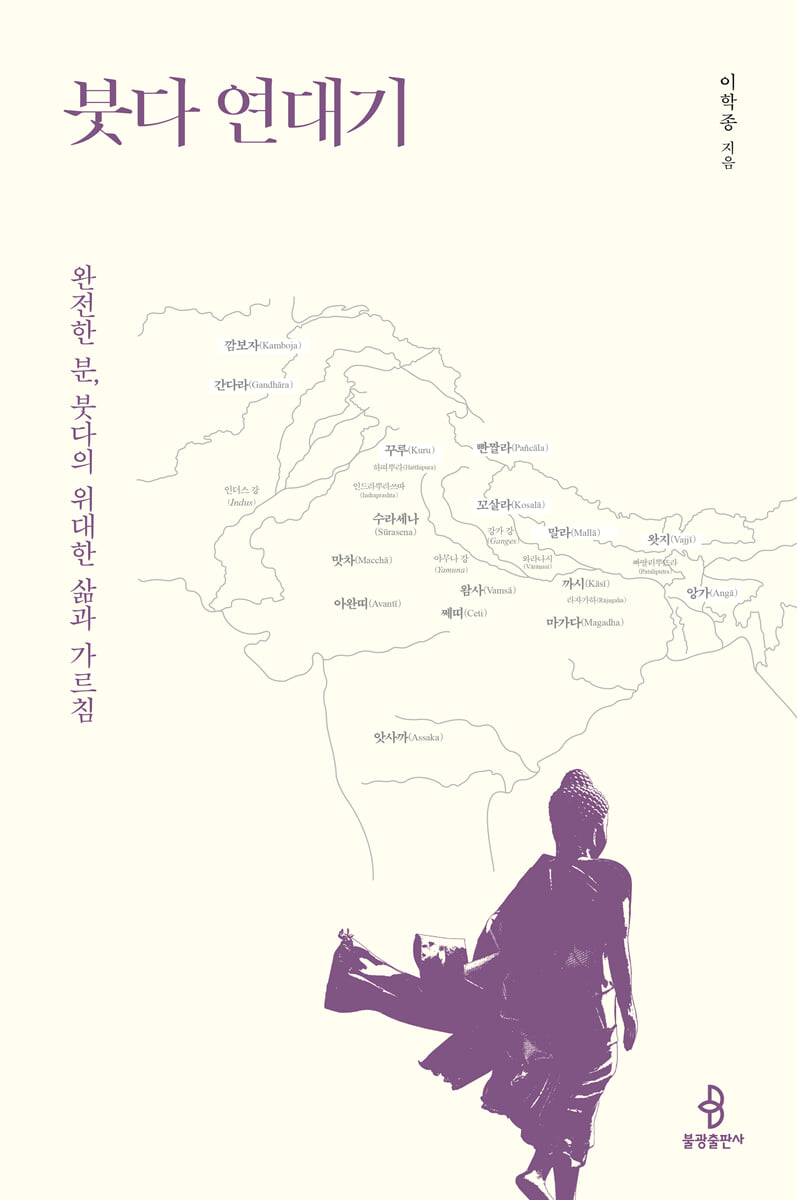
Buddha's Chronicles
 |
Description
Book Introduction
The most extensive volume of 'The Life of Buddha' ever written in Korea
Just before entering nirvana at the age of 80, the Buddha had to witness the nirvana of his two favorite disciples, Sariputta and Moggallana.
When he heard the news of the two disciples' nirvana, he said, "Since we were born and formed existence, we must disintegrate someday. How could we not leave our side?" However, throughout the sutras, the loneliness and emptiness of the Buddha who sent his two disciples away first are expressed through his actions and words.
The nirvana of Sariputta and Moggallana was one of the greatest events in the Buddha's later years.
This part is also inserted in most biographies of Buddha.
However, there are few books that deal with the nirvana of Gotami, who became the adoptive mother of Buddha in place of his mother who passed away in the same year as his birth, raised him, and established the ordination of women and became the first nun.
In the same year, Rahula, the Buddha's lay son, also entered nirvana.
There are almost no biographies of Buddha that describe this in domestic literature.
Finally, in the same year, Yasodhara, who was the Buddha's wife before he became a monk, also entered nirvana.
There are no domestic publications describing this.
No, there is not even a biography of the Buddha that tells of Yasodhara's ordination, and many people do not even know that she became a monk.
Most biographies of the Buddha, which are about 300 or 400 pages long, have limitations in describing all the events that occurred around the Buddha over the 80 years from his birth to his nirvana.
I had to cut back and cut back.
As a result, it met readers with a lot of the ‘context’ omitted.
This book restores a significant portion of the previously unknown events and omitted 'context'.
If you skip the plot, you can see that he was a god, but when you figure out the 'why' and 'how', he was human, and when you bring to life the social and historical aspects, the myth becomes history.
One of the most brilliant passages is the detailed description of female monks, who have been so often neglected in biographies and accounts of the Buddha's life.
Of the eight chapters, one is devoted to female practitioners, and other chapters also delve into the practice and enlightenment of female practitioners.
There are stories of great women who became nuns after ordaining themselves as monks, such as the Buddha's lay wife Gotamina, the famous courtesan Amba Pali, as well as Queen Khema of King Bimbisara, and Dhammadinna, who excelled in preaching, and great female laywomen like Visakha.
This book is based on the Nikaya, an early Buddhist scripture, and was created by referencing later commentaries.
However, rather than simply copying the scriptures as they are, the focus was on increasing readability by organizing the contents of the scriptures so that readers can understand them more easily.
There was no biography of Buddha of this magnitude in Korea.
Of course, there are more extensive works abroad than 『Buddha Chronicles』.
Sayadaw Mingun's Maha Buddhavamsa is a monumental work of over 3,000 pages.
However, among the books on the life of Buddha written in Korea so far, this book, 『Buddha Chronology』, is the most extensive.
Just before entering nirvana at the age of 80, the Buddha had to witness the nirvana of his two favorite disciples, Sariputta and Moggallana.
When he heard the news of the two disciples' nirvana, he said, "Since we were born and formed existence, we must disintegrate someday. How could we not leave our side?" However, throughout the sutras, the loneliness and emptiness of the Buddha who sent his two disciples away first are expressed through his actions and words.
The nirvana of Sariputta and Moggallana was one of the greatest events in the Buddha's later years.
This part is also inserted in most biographies of Buddha.
However, there are few books that deal with the nirvana of Gotami, who became the adoptive mother of Buddha in place of his mother who passed away in the same year as his birth, raised him, and established the ordination of women and became the first nun.
In the same year, Rahula, the Buddha's lay son, also entered nirvana.
There are almost no biographies of Buddha that describe this in domestic literature.
Finally, in the same year, Yasodhara, who was the Buddha's wife before he became a monk, also entered nirvana.
There are no domestic publications describing this.
No, there is not even a biography of the Buddha that tells of Yasodhara's ordination, and many people do not even know that she became a monk.
Most biographies of the Buddha, which are about 300 or 400 pages long, have limitations in describing all the events that occurred around the Buddha over the 80 years from his birth to his nirvana.
I had to cut back and cut back.
As a result, it met readers with a lot of the ‘context’ omitted.
This book restores a significant portion of the previously unknown events and omitted 'context'.
If you skip the plot, you can see that he was a god, but when you figure out the 'why' and 'how', he was human, and when you bring to life the social and historical aspects, the myth becomes history.
One of the most brilliant passages is the detailed description of female monks, who have been so often neglected in biographies and accounts of the Buddha's life.
Of the eight chapters, one is devoted to female practitioners, and other chapters also delve into the practice and enlightenment of female practitioners.
There are stories of great women who became nuns after ordaining themselves as monks, such as the Buddha's lay wife Gotamina, the famous courtesan Amba Pali, as well as Queen Khema of King Bimbisara, and Dhammadinna, who excelled in preaching, and great female laywomen like Visakha.
This book is based on the Nikaya, an early Buddhist scripture, and was created by referencing later commentaries.
However, rather than simply copying the scriptures as they are, the focus was on increasing readability by organizing the contents of the scriptures so that readers can understand them more easily.
There was no biography of Buddha of this magnitude in Korea.
Of course, there are more extensive works abroad than 『Buddha Chronicles』.
Sayadaw Mingun's Maha Buddhavamsa is a monumental work of over 3,000 pages.
However, among the books on the life of Buddha written in Korea so far, this book, 『Buddha Chronology』, is the most extensive.
- You can preview some of the book's contents.
Preview
index
1 From birth to leaving home
Jambudipa enters a period of transformation
Kingdom of Sakya
The Birth of Siddhartha
Siddhartha, a sensitive boy
Learning of one's biological mother's death
Selection under the Jambu tree
I want to get out, but…
Become a crown prince and receive training as a successor
The agony deepens…
Hear about a new world
Compassion sprouts
Young Siddhartha learns the art
fateful encounter
Marriage, what to do
Yasodhara
Obtain permission from Suddhodana
Yasodhara received permission from her parents
marriage
“Indulge in pleasure”
The Temptation of Beauties
Udayn's advice
Criticizing the Kshatriyas
Suffering outside the city gates
meditation practice
Find a hermitage and meditate
Rahula, you troublemaker!
resolve
Leave everything behind and go to the East Gate
2 The Path of Asceticism and the Path of Liberation
Enter the path of salvation
Park Ga, the master of asceticism and other paths
Learn to practice selection
Promise with King Bimbisara
We reached the emergency emergency room, but…
Heading to Uruwela
6 years of hardship
What to do now?
Ah, meditation under the zelkova tree!
Receive Sujata's offerings
Laying out auspicious grass under the Ajapalla tree…
Great awakening
The joy of liberation, and…
The joy of liberation
3 The Wheel of Dharma Rolls and a Sect Appears
Will anyone understand?
I will preach the truth
Organize your enlightenment
First Turning of the Dharma Wheel
What is anatta?
The appearance of the Three Jewels
Nalaka, ask the way of the saint
Yasa, Meet the Buddha
The first lay practitioner
The first female layperson is born
Go out on a journey to spread the truth
To subdue the princes of Kosala
The conversion incident that shook the kingdom of Magadha
Accepting Bimbisara's invitation
The Fire Dharma at Sangdusan Mountain
The ideal ruler Mahasammata
The refuge of Sariputta and Moggallana
Two disciples become arhats
Maha Kassapa's refuge
Build a temple in a bamboo forest
Anathapindika's refuge
Establishment of Giwonjeongsa Temple
Subhuti's refuge
Set out to establish rules
4. Visiting hometowns and the departure of relatives
Invitation from Suddhodana
In search of my hometown, Kapilavatthu
Reunion with Yasodhara
To ordain Nanda
Rahula's Inheritance
Gotami, offering lyrics
The Barber and the Princes of the Sakya Tribe
5 Everyone is equal before the law.
Convert the pagans
The refuge of the simple Brahmins
A flawless daily routine of the Buddha
Eliminating the plague of Wesali
General Siha's conversion
King Pasenadi's refuge
Water fight between the Sakya and Koliya tribes
The Death of Suddhodana and Gotami's Request
A Sermon for the Craftsman Subpabuddha
Women who set out on a mission
Buddha rebukes Nanda for his laziness
The Challenge of the Disciples of Nigantha Nattaputta
Ambarali's proposal
“Rahula, what is the lie of a practitioner?”
Queen Khema's Ordination 559
Dhammadinna, the first nun to preach the Dhamma, 567
Kosambi's Three Love Affairs
Hate is not hatred!
Samavati and Kutjuttara
Spreading the Truth to Southern Awanthi
Like playing an instrument
Preaching the truth in Trayastrimsa Heaven
Parents from past lives
The Gates of Happiness and Destruction
The slander of the pagans
The dispute among the Kosambi monks
“I too plow the field and sow seeds.”
Retreat in Weranza
I have already stopped, Angulimala!
You held on well.
Angulimala!
Needy, you idiot
Human, all too human…
A lowly person
6 Great Female Practitioners
Visakha, the first female lay elder
Compassion for Women Gives Birth to the Great Dharma Master
This strange fate of being born as a human!
Rahula becomes an arhat
All are equal before the truth
What about humans in the vast universe?
I left to practice alone, but…
Sariputta's death
The emergence of female arhats one after another
Suba: "Sensual pleasure is the devil's net."
Upalavanna: "How terrible! The desire for sensual pleasure."
Kisagottami: “I would rather live a hundred years without seeing the truth…”
I ran away after meeting the servant's eyes.
Subdue the yakshas
A monk who fell in love with a parasite becomes a saint.
Five Clues to the Truth
Language is always floating in the flow of change.
7 Compassion and Repentance
The reunion with the two great Maha Kassapas
Ajatashatti's grudge
Devadatta's conspiracy
The conversion of the pagan prince Abaya
Devadatta's miserable end
Compassion for the homeless
Hearing King Pasenadi's confession
Pasenadi meets a tragic end
Admonitions from Rajagaha Eagle Peak
Ajatashatru's repentance
The destruction of the Sakya tribe
Faster than an arrow
Hair stands up all over my body…
Meeting my old teacher, Park Ga-wa
8 Everything disappears
Parting with the woolen Gotami
Final greetings with Yasodhara
Rahula passed away before Buddha
Moggallana's Parinirvana
Sariputta enters nirvana
Embark on the final journey
The Enlightenment of Ambappali, the Flower of Seed
The old cart heads towards the Himalayas
The highest point possible
Reflecting on one's life
Last offering
Ah, Kushina!
Ananda's Tears
Subhadda becomes the last bhikkhu
“There’s no time, ask quickly.”
Mahanirvana
“At the moment of nirvana, the hairs on my body stood on end!”
funeral
Distribution of sari
Author's Note
Main characters
References
Into the book
Ramaputta was secretly happy to have accepted Siddhartha, who at first glance seemed to have an extraordinary aura, as his disciple.
He began to teach the meditation techniques he had been practicing with great care.
Siddhartha soon discovered that the method of practice taught by Uddaka Ramaputta was essentially the same as that of Alara Kalama, except that it was one step further.
So, while Alara Kalama achieved the state of nothingness (the state of non-possession) and stopped practicing further, Uddaka Ramaputta had reached the state of 'neither consciousness nor non-consciousness (the state of neither consciousness nor non-consciousness).'
But this state was ultimately achieved by the same principles that Alara Kalama had adopted to transcend the first two stages.
In other words, it was not much different from the method used by Alara Kalama to transcend space and consciousness and reach the state of non-possession.
However, while Alara Kalama recognized the state of non-possession as the ultimate absolute state, Uddaka Ramaputta went a step further and analyzed the state of non-possession itself to determine whether it was a real state.
But since he could not find any substance there, Uddaka Ramaputta went beyond it and thought that the ultimate state of meditation is neither consciousness in any form nor non-consciousness at the same time.
Therefore, Uddaka Ramaputta regarded this state, the state of non-perception and non-perception, as an absolute state that transcends all ordinary knowledge.
However, there was a slight difference in breathing method.
While Alara Kalama was maintaining a similar ratio of inhalation, holding, and exhalation, Uddaka Ramaputta was maintaining a ratio of Kumbhaka (holding the breath: the act of stopping breathing).
That is, when dividing the stages of breathing into three stages of inhalation, holding the breath, and exhalation, Alara Kalama's meditation method had an equal ratio, whereas Uddaka Ramaputta's meditation technique had a relatively high ratio of time spent holding the breath.
Under the guidance of the sage Ramaputta, Siddhartha thought:
'The practice of Uddaka Ramaputta, like that of Alara Kalama, is not the ultimate state that I wish to attain.
It also does not lead to defilement, it does not lead to the fading of greed, it does not lead to extinction, it does not lead to tranquility, it does not lead to the highest wisdom, it does not lead to right enlightenment, and it does not lead to nirvana.
This law may also temporarily bring about a state of high ecstasy, but it does not allow for the freedom to continue until the end.
If I let go for a moment, I will be bound again by desire, anxiety, and pain, so this is not the perfect refuge I seek.
--- pp.207~209
King Suddhodana took the hand of his beloved son, whom he respected and loved, and placed it on his chest, smiling brightly.
“Now my wish has come true.
“I am happy to be on my last journey to see the Buddha like this.”
King Suddhodana lay down, put his hands together in prayer, and quietly closed his eyes.
The ceremony was over.
The Sakya doctor who had been caring for the king washed the king's body with perfume, wrapped it in cotton, fur, and silk, and placed it in a coffin.
It was time to move the body to the lion's seat in the crematorium.
“I will carry the coffin from the front.”
When the Buddha said this, his relatives tried to stop him.
“The World-Honored One is the most honorable being above and below the heavens.
No matter how deep our predestined connection is, I cannot allow the teacher of Incheon to bear the burden of human suffering.”
“I understand your intentions.
But if I do not carry the bier, there will be those who will criticize me, saying that I do not know the kindness of my parents.”
After some scuffles, the Buddha, instead of carrying the body, took the incense burner and led it to the crematorium. He sprinkled flowers as an offering and then lit a fire on the piled up firewood.
The Buddha spoke to the people who were crying as if they were running towards the blazing fire.
“This world is impermanent, and because it is impermanent, it is painful.
Since nothing is eternal, the body is also inherently fleeting.
Living in this world is like a fantasy, like a burning flame, like the moon's shadow reflected on water.
It just seems like everyone is like that for a while.
Life is a temporary existence with an impermanent body.
Look at that fierce fire, everyone, that consumes everything.
You may find this fire hot, but the fire of greed is hotter than this.
So, don't be lazy and practice diligently to save life and death.
“Get rid of the suffering and attain the joy of liberation.”
After the funeral of his father, King Suddhodana, the Buddha retired to Nigrodha Garden for a while.
He was very tired from the long journey and from watching over his father's funeral and cremation, so he needed some rest.
--- pp.508~510
Yasodhara, the woman whom Buddha loved most, if not only.
Although she did not receive ordination directly from the Buddha, she became a nun by becoming a disciple of Gotami, the Buddha's first nun disciple.
After Gotami became the first nun in Vesali, she was practicing asceticism in the Nigrodha Garden of Kapilavatthu when Yasodhara came to visit her and asked for permission to become a nun.
Afterwards, Yasodhara, who had been quietly practicing Buddhism, came to see the Buddha when she was 78 years old.
At that time, Buddha was 80 years old.
Yasodhara, who had come to see the Buddha, the beloved husband, the father of Rahula, the apple of his eye, and the supreme leader of the Sangha, told him that she would pass away that night.
However, Yasodhara did not ask the Buddha to allow her to enter nirvana like the other disciples.
She was that independent.
Even after becoming a nun, Yasodhara's independent and enterprising nature remained.
She said to the Buddha.
“World-Honored One, I did not become a monk directly under the World-Honored One.
I did not even receive the precepts from the Buddha.
I turned to myself.
And I took refuge in the teachings taught by the World-Honored One.”
The Buddha felt boundless compassion as he looked at Yasodhara, who had become increasingly weak.
Before or after becoming a monk, no, even after, the woman he loved the most, the woman who gave birth to his only blood relative, Rahula, the great woman who willingly allowed him to become a monk, provided him with spiritual nourishment so that he could live the life of a monk, and finally became a monk herself and achieved immortality, was a mixture of love, compassion, and respect in the Buddha's eyes as he looked at Yasodhara.
Yasodhara gathered her strength and said:
"Thank you.
Thank you.
Oh, World-Honored One.
The connection we had, the love we shared, and the years we spent together - none of them are unimportant.
It's all thanks to you.
Above all else
I have been able to live a life without regrets thanks to the great teachings you have given me.
And finally, I obtained the path to immortality.
I love you, World Honored One.
“Thank you for everything.”
He began to teach the meditation techniques he had been practicing with great care.
Siddhartha soon discovered that the method of practice taught by Uddaka Ramaputta was essentially the same as that of Alara Kalama, except that it was one step further.
So, while Alara Kalama achieved the state of nothingness (the state of non-possession) and stopped practicing further, Uddaka Ramaputta had reached the state of 'neither consciousness nor non-consciousness (the state of neither consciousness nor non-consciousness).'
But this state was ultimately achieved by the same principles that Alara Kalama had adopted to transcend the first two stages.
In other words, it was not much different from the method used by Alara Kalama to transcend space and consciousness and reach the state of non-possession.
However, while Alara Kalama recognized the state of non-possession as the ultimate absolute state, Uddaka Ramaputta went a step further and analyzed the state of non-possession itself to determine whether it was a real state.
But since he could not find any substance there, Uddaka Ramaputta went beyond it and thought that the ultimate state of meditation is neither consciousness in any form nor non-consciousness at the same time.
Therefore, Uddaka Ramaputta regarded this state, the state of non-perception and non-perception, as an absolute state that transcends all ordinary knowledge.
However, there was a slight difference in breathing method.
While Alara Kalama was maintaining a similar ratio of inhalation, holding, and exhalation, Uddaka Ramaputta was maintaining a ratio of Kumbhaka (holding the breath: the act of stopping breathing).
That is, when dividing the stages of breathing into three stages of inhalation, holding the breath, and exhalation, Alara Kalama's meditation method had an equal ratio, whereas Uddaka Ramaputta's meditation technique had a relatively high ratio of time spent holding the breath.
Under the guidance of the sage Ramaputta, Siddhartha thought:
'The practice of Uddaka Ramaputta, like that of Alara Kalama, is not the ultimate state that I wish to attain.
It also does not lead to defilement, it does not lead to the fading of greed, it does not lead to extinction, it does not lead to tranquility, it does not lead to the highest wisdom, it does not lead to right enlightenment, and it does not lead to nirvana.
This law may also temporarily bring about a state of high ecstasy, but it does not allow for the freedom to continue until the end.
If I let go for a moment, I will be bound again by desire, anxiety, and pain, so this is not the perfect refuge I seek.
--- pp.207~209
King Suddhodana took the hand of his beloved son, whom he respected and loved, and placed it on his chest, smiling brightly.
“Now my wish has come true.
“I am happy to be on my last journey to see the Buddha like this.”
King Suddhodana lay down, put his hands together in prayer, and quietly closed his eyes.
The ceremony was over.
The Sakya doctor who had been caring for the king washed the king's body with perfume, wrapped it in cotton, fur, and silk, and placed it in a coffin.
It was time to move the body to the lion's seat in the crematorium.
“I will carry the coffin from the front.”
When the Buddha said this, his relatives tried to stop him.
“The World-Honored One is the most honorable being above and below the heavens.
No matter how deep our predestined connection is, I cannot allow the teacher of Incheon to bear the burden of human suffering.”
“I understand your intentions.
But if I do not carry the bier, there will be those who will criticize me, saying that I do not know the kindness of my parents.”
After some scuffles, the Buddha, instead of carrying the body, took the incense burner and led it to the crematorium. He sprinkled flowers as an offering and then lit a fire on the piled up firewood.
The Buddha spoke to the people who were crying as if they were running towards the blazing fire.
“This world is impermanent, and because it is impermanent, it is painful.
Since nothing is eternal, the body is also inherently fleeting.
Living in this world is like a fantasy, like a burning flame, like the moon's shadow reflected on water.
It just seems like everyone is like that for a while.
Life is a temporary existence with an impermanent body.
Look at that fierce fire, everyone, that consumes everything.
You may find this fire hot, but the fire of greed is hotter than this.
So, don't be lazy and practice diligently to save life and death.
“Get rid of the suffering and attain the joy of liberation.”
After the funeral of his father, King Suddhodana, the Buddha retired to Nigrodha Garden for a while.
He was very tired from the long journey and from watching over his father's funeral and cremation, so he needed some rest.
--- pp.508~510
Yasodhara, the woman whom Buddha loved most, if not only.
Although she did not receive ordination directly from the Buddha, she became a nun by becoming a disciple of Gotami, the Buddha's first nun disciple.
After Gotami became the first nun in Vesali, she was practicing asceticism in the Nigrodha Garden of Kapilavatthu when Yasodhara came to visit her and asked for permission to become a nun.
Afterwards, Yasodhara, who had been quietly practicing Buddhism, came to see the Buddha when she was 78 years old.
At that time, Buddha was 80 years old.
Yasodhara, who had come to see the Buddha, the beloved husband, the father of Rahula, the apple of his eye, and the supreme leader of the Sangha, told him that she would pass away that night.
However, Yasodhara did not ask the Buddha to allow her to enter nirvana like the other disciples.
She was that independent.
Even after becoming a nun, Yasodhara's independent and enterprising nature remained.
She said to the Buddha.
“World-Honored One, I did not become a monk directly under the World-Honored One.
I did not even receive the precepts from the Buddha.
I turned to myself.
And I took refuge in the teachings taught by the World-Honored One.”
The Buddha felt boundless compassion as he looked at Yasodhara, who had become increasingly weak.
Before or after becoming a monk, no, even after, the woman he loved the most, the woman who gave birth to his only blood relative, Rahula, the great woman who willingly allowed him to become a monk, provided him with spiritual nourishment so that he could live the life of a monk, and finally became a monk herself and achieved immortality, was a mixture of love, compassion, and respect in the Buddha's eyes as he looked at Yasodhara.
Yasodhara gathered her strength and said:
"Thank you.
Thank you.
Oh, World-Honored One.
The connection we had, the love we shared, and the years we spent together - none of them are unimportant.
It's all thanks to you.
Above all else
I have been able to live a life without regrets thanks to the great teachings you have given me.
And finally, I obtained the path to immortality.
I love you, World Honored One.
“Thank you for everything.”
--- pp.845~846
Publisher's Review
What kind of practice did you do and what kind of enlightenment did you attain?
This book is not made up of just 'events'.
One of the things that often leaves me with a sense of emptiness while reading biographies of the Buddha is that there are often insufficient questions and answers about what Siddhartha was trying to achieve and how he was trying to achieve it, and what the Buddha achieved and at what stage he reached.
This book details the state of non-possession and non-non-perception that he attained while studying under Alara Kalama and Uddaka Ramaputta after becoming a saint, as well as the state of experience he gained while practicing asceticism.
He also detailed the process of practicing asceticism and eventually having to give it up, and what he focused on and realized in order to finally reach liberation.
This is completely different from most biographies that stop at 'I met someone', 'There was such and such an event', or explain it in one word, 'I had such and such an enlightenment'.
Rather than explaining the realm of experience that Siddhartha and Buddha attained in a single word, it reveals the content in as much detail as possible.
In particular, the detailed descriptions of the practices and experiences of the many disciples who practiced alongside the Buddha clearly reveal what the Buddha's life was aiming for.
Of course, this explanation was possible because the author himself had temporarily given up all his work and became a monk in the south.
For readers who are reading the life or biography of Buddha for the first time, this may be a bit overwhelming.
However, this is a book I would definitely recommend to those who want to know more in detail and look back at the life of Buddha that they may have missed.
This book is not made up of just 'events'.
One of the things that often leaves me with a sense of emptiness while reading biographies of the Buddha is that there are often insufficient questions and answers about what Siddhartha was trying to achieve and how he was trying to achieve it, and what the Buddha achieved and at what stage he reached.
This book details the state of non-possession and non-non-perception that he attained while studying under Alara Kalama and Uddaka Ramaputta after becoming a saint, as well as the state of experience he gained while practicing asceticism.
He also detailed the process of practicing asceticism and eventually having to give it up, and what he focused on and realized in order to finally reach liberation.
This is completely different from most biographies that stop at 'I met someone', 'There was such and such an event', or explain it in one word, 'I had such and such an enlightenment'.
Rather than explaining the realm of experience that Siddhartha and Buddha attained in a single word, it reveals the content in as much detail as possible.
In particular, the detailed descriptions of the practices and experiences of the many disciples who practiced alongside the Buddha clearly reveal what the Buddha's life was aiming for.
Of course, this explanation was possible because the author himself had temporarily given up all his work and became a monk in the south.
For readers who are reading the life or biography of Buddha for the first time, this may be a bit overwhelming.
However, this is a book I would definitely recommend to those who want to know more in detail and look back at the life of Buddha that they may have missed.
GOODS SPECIFICS
- Publication date: March 20, 2021
- Format: Hardcover book binding method guide
- Page count, weight, size: 952 pages | 1,462g | 152*225*40mm
- ISBN13: 9788974798963
- ISBN10: 8974798964
You may also like
카테고리
korean


korean

![GQ KOREA Mark (Monthly): December [2025]](http://librairie.coreenne.fr/cdn/shop/files/8ef265dbbfbf186523ed75ba7319009d.jpg?v=1765340328&width=3840)


