

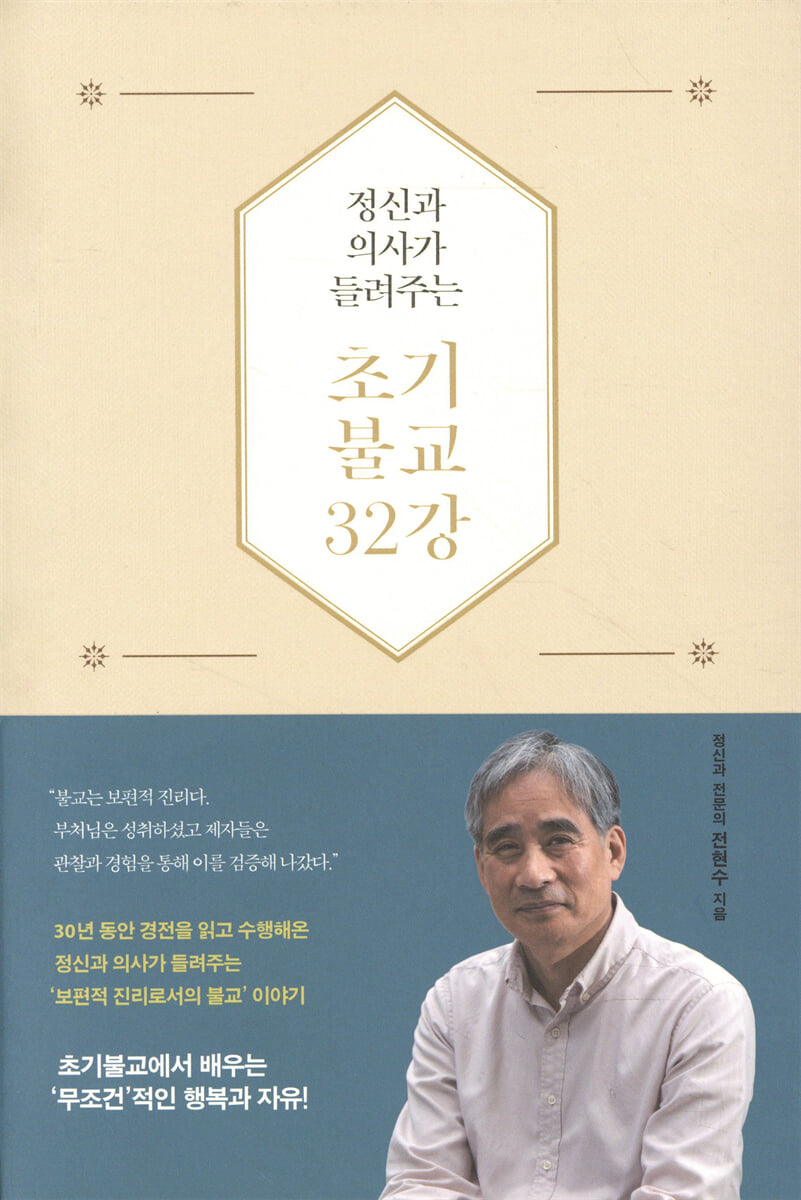
32 Lectures on Early Buddhism from a Psychiatrist
 |
Description
Book Introduction
This book is a compilation of lectures the author gave on a cable TV station over two years.
Although the topic is 'early Buddhism', it does not feature any difficult 'theories' such as mathematical formulas unique to early Buddhism.
This is because, while early Buddhism is one axis, the author, who is also a psychiatrist, also covers the ‘human wisdom’ that he experienced and learned while caring for patients.
In the Indian region, which was the arena of religious competition at the time, the book shows readers the core of the scriptures, such as the three dharma seals, the eightfold path, and the twelve links of dependent origination, by drawing them out against the backdrop of an era when Buddhism was expanding its religious sect while shining a bright light in competition with Brahmanism and the six non-Buddhist teachings, but does not insist on doctrine for the sake of doctrine.
What I am focusing on is the 'suffering' that happens to everyone, such as 'affliction', 'desire', and 'death'.
The author emphasizes the reader's experience, but he hopes that the experience begins with everyday things.
This book does not say that everyone should have ‘no possessions’ and ‘no desires’ like a monk or nun.
The Buddha emphasizes that he said, "If you really want to fulfill your desires, do so in the right way."
However, it tells a cautionary tale so that it does not become sensual or obsessive.
In short, this book can be said to kill two birds with one stone: early Buddhism and the wisdom of living as a human being.
That is why it shines brighter than any other commentary on the scriptures.
Although the topic is 'early Buddhism', it does not feature any difficult 'theories' such as mathematical formulas unique to early Buddhism.
This is because, while early Buddhism is one axis, the author, who is also a psychiatrist, also covers the ‘human wisdom’ that he experienced and learned while caring for patients.
In the Indian region, which was the arena of religious competition at the time, the book shows readers the core of the scriptures, such as the three dharma seals, the eightfold path, and the twelve links of dependent origination, by drawing them out against the backdrop of an era when Buddhism was expanding its religious sect while shining a bright light in competition with Brahmanism and the six non-Buddhist teachings, but does not insist on doctrine for the sake of doctrine.
What I am focusing on is the 'suffering' that happens to everyone, such as 'affliction', 'desire', and 'death'.
The author emphasizes the reader's experience, but he hopes that the experience begins with everyday things.
This book does not say that everyone should have ‘no possessions’ and ‘no desires’ like a monk or nun.
The Buddha emphasizes that he said, "If you really want to fulfill your desires, do so in the right way."
However, it tells a cautionary tale so that it does not become sensual or obsessive.
In short, this book can be said to kill two birds with one stone: early Buddhism and the wisdom of living as a human being.
That is why it shines brighter than any other commentary on the scriptures.
- You can preview some of the book's contents.
Preview
index
Chapter 1 Who is Buddha and what is Buddhism?
01 Faith
02 What is Buddhism?
03 Three kinds of extramarital affairs ①
04 Samjong Oedo ②
05 Up ①
06 Up ②
07 Eightfold Path
08 Who is Buddha?
09 Our Existence as Spoken by Buddha
10 Why is reincarnation central to Buddhism? ①
11 Why is reincarnation central to Buddhism? ②
Chapter 2: Practice and Practice as Told by the Buddha
12 Solving Afflictions ①
13 Resolving Afflictions ②
14 Overcoming Desire
15. See
16 A Life of True Blessing
17 Friendship Lessons from the Scriptures
18 The Path Beyond Fate
19 How to Overcome the Fear of Death
20 Buddhist Ways to Treat the Sick or Dying
Chapter 3: The Path of the Ordinary and the Saint
21 The Four Foods of Existence
22 The World Seen by Ordinary People, Confucianists, Arhats, and Tathagatas
23 The Path to Achieving the Fruit of Stream-entry
24 The Path to Arahat
Chapter 4: Buddha and His Disciples
25 Things We Can Learn from the Life of a Bodhisattva ①
26 What We Can Learn from the Life of a Bodhisattva ②
27 Sariputta's Sermon ①
28 Sariputta's Sermon ②
29 Stories of the Buddha's Disciples ①
30 Stories of the Buddha's Disciples ②
31 Conversation between King Milinda and Venerable Nagasena ①
32 Conversation between King Milinda and Venerable Nagasena ②
01 Faith
02 What is Buddhism?
03 Three kinds of extramarital affairs ①
04 Samjong Oedo ②
05 Up ①
06 Up ②
07 Eightfold Path
08 Who is Buddha?
09 Our Existence as Spoken by Buddha
10 Why is reincarnation central to Buddhism? ①
11 Why is reincarnation central to Buddhism? ②
Chapter 2: Practice and Practice as Told by the Buddha
12 Solving Afflictions ①
13 Resolving Afflictions ②
14 Overcoming Desire
15. See
16 A Life of True Blessing
17 Friendship Lessons from the Scriptures
18 The Path Beyond Fate
19 How to Overcome the Fear of Death
20 Buddhist Ways to Treat the Sick or Dying
Chapter 3: The Path of the Ordinary and the Saint
21 The Four Foods of Existence
22 The World Seen by Ordinary People, Confucianists, Arhats, and Tathagatas
23 The Path to Achieving the Fruit of Stream-entry
24 The Path to Arahat
Chapter 4: Buddha and His Disciples
25 Things We Can Learn from the Life of a Bodhisattva ①
26 What We Can Learn from the Life of a Bodhisattva ②
27 Sariputta's Sermon ①
28 Sariputta's Sermon ②
29 Stories of the Buddha's Disciples ①
30 Stories of the Buddha's Disciples ②
31 Conversation between King Milinda and Venerable Nagasena ①
32 Conversation between King Milinda and Venerable Nagasena ②
Into the book
Both good and bad deeds are intentional.
In beneficial karma, there are nineteen beautiful mental functions that are common to this beneficial karma, that is, the functions of the beautiful mind.
These are extremely powerful.
In contrast, there are only four common mental destructions of the harmful mind, the harmful mind rooted in greed, hatred, and ignorance.
It's nineteen to four.
So, first of all, in terms of numbers, there are more good minds than bad ones, and the good mind substitutions have a stronger power than the bad ones.
Therefore, if you continue to develop good karma and fill yourself with elements that function as a good mind, you can overcome harmful things.
For example, drop a drop of blue ink into a large basin of water.
Then the water will quickly turn blue.
But can we extract the ink from this water and make it clear again? No.
But if you keep pouring clear water, the blue color will gradually become lighter.
If you repeat this process countless times, the basin will be filled with clear water again.
The same goes for the relationship between good and bad karma.
If you have committed evil deeds that you cannot avoid, repent and continue to accumulate good deeds.
--- p.139, from “Up ②”
First of all, the way you look at suffering must change.
The eyes that see the afflictions must change, and we must always be awake to prevent the afflictions from settling in.
Delusions don't just come in from the beginning.
One guy comes in.
One guy comes in and if everything is okay, he brings another friend.
'Oh, there's not much of a boundary here now.
You come in too.' That's why it happens later.
The first one that comes in is easy for us to control.
But when there are too many, it becomes difficult to control them.
A single branch is easy to break.
But it's hard to break three, isn't it? The same goes for afflictions.
It must be well managed when it first appears.
When you have an idea, don't think, "This is my thought." Instead, think, "My head is on fire," or "An enemy has infiltrated."
Because most thoughts come from a lack of wisdom.
People who clearly know don't think or use their heads.
I'm trying to find it because I don't know, but it's not easy to find.
In beneficial karma, there are nineteen beautiful mental functions that are common to this beneficial karma, that is, the functions of the beautiful mind.
These are extremely powerful.
In contrast, there are only four common mental destructions of the harmful mind, the harmful mind rooted in greed, hatred, and ignorance.
It's nineteen to four.
So, first of all, in terms of numbers, there are more good minds than bad ones, and the good mind substitutions have a stronger power than the bad ones.
Therefore, if you continue to develop good karma and fill yourself with elements that function as a good mind, you can overcome harmful things.
For example, drop a drop of blue ink into a large basin of water.
Then the water will quickly turn blue.
But can we extract the ink from this water and make it clear again? No.
But if you keep pouring clear water, the blue color will gradually become lighter.
If you repeat this process countless times, the basin will be filled with clear water again.
The same goes for the relationship between good and bad karma.
If you have committed evil deeds that you cannot avoid, repent and continue to accumulate good deeds.
--- p.139, from “Up ②”
First of all, the way you look at suffering must change.
The eyes that see the afflictions must change, and we must always be awake to prevent the afflictions from settling in.
Delusions don't just come in from the beginning.
One guy comes in.
One guy comes in and if everything is okay, he brings another friend.
'Oh, there's not much of a boundary here now.
You come in too.' That's why it happens later.
The first one that comes in is easy for us to control.
But when there are too many, it becomes difficult to control them.
A single branch is easy to break.
But it's hard to break three, isn't it? The same goes for afflictions.
It must be well managed when it first appears.
When you have an idea, don't think, "This is my thought." Instead, think, "My head is on fire," or "An enemy has infiltrated."
Because most thoughts come from a lack of wisdom.
People who clearly know don't think or use their heads.
I'm trying to find it because I don't know, but it's not easy to find.
--- p.289, from “Resolving Afflictions ②”
Publisher's Review
Although it has one name, Buddhism, its form has been slightly different in each region and each era.
It's as if the same star appears different in brightness to us depending on whether we look at it from the south or the north, or in summer or winter.
The sects and doctrines that currently divide Buddhism in the world are Tibetan Buddhism, Zen Buddhism, Pure Land Buddhism, and Theravada (Southern) Buddhism.
Tibetan Buddhism, which originated in a small country with a population of 5 million, has deeply penetrated the hearts of modern people with a special emphasis on compassion and altruism, and its influence is growing, especially in the West.
Zen Buddhism, a stellar form of intense self-reflection, has been a cultural pillar for over two millennia in areas encompassing 30% of the world's land area and population, and continues to be a powerful force in those areas today.
Pure Land Buddhism, with its simple practice of chanting, also forms a major axis of world Buddhism, including in Japan and Taiwan.
And there is a Buddhism that surpasses these three in influence and scale: Theravada Buddhism.
It is the Buddhism most familiar to Westerners, having been transmitted not only to Southeast Asia, its main stage, but also to Europe at an early stage.
Over the past 50 years, countless seekers from all over the world have flocked to Sri Lanka, Thailand, and Myanmar to experience these teachings.
Another name for the doctrines of Theravada Buddhism is Early Buddhism.
Compared to Tibetan Buddhism, Zen Buddhism, and Pure Land Buddhism, which all branched out from the branch of Mahayana Buddhism, Theravada Buddhism is considered to have well preserved the teachings of the early Buddha and his disciples, hence the name.
The method of practice is also evaluated as being most similar to the practice method of the Buddha's time, rather than a method that has already been established in Mahayana Buddhism.
However, in Korea, where the influence of Zen Buddhism was strong, it was introduced later than in the West, Japan, Taiwan, etc.
It is relatively recent that the sutras and treatises have been translated and introduced into Korean, and the practice method that emphasizes breathing and the cultivation of loving-kindness, compared to Zen Buddhism, which emphasizes intuition, was also unfamiliar to those who had been exposed to Zen Buddhism.
But recently, it has been gaining popularity to the point of being considered a 'trend', and many monks and laypeople in Korea are also visiting the 'Nambang'.
However, there are some difficult aspects for beginners to study early Buddhism.
This is because of the complex theory of repeating numbers and networks.
For most people, reading the Pali scriptures compiled in the South is a difficult and complex problem, but if you go on to the Abhidhamma, the commentaries and treatises on the scriptures, you will feel that it is more difficult than some mathematical formulas.
Easy to understand early Buddhism
This book is a compilation of lectures the author gave on a cable TV station over two years.
Although the topic is 'early Buddhism', it does not feature any difficult 'theories' such as mathematical formulas unique to early Buddhism.
This is because, while early Buddhism is one axis, the author, who is also a psychiatrist, also covers the ‘human wisdom’ that he experienced and learned while caring for patients.
In the Indian region, which was the arena of religious competition at the time, the book shows readers the core of the scriptures, such as the three dharma seals, the eightfold path, and the twelve links of dependent origination, by drawing them out against the backdrop of an era when Buddhism was expanding its religious sect while shining a bright light in competition with Brahmanism and the six non-Buddhist teachings, but does not insist on doctrine for the sake of doctrine.
What I am focusing on is the 'suffering' that happens to everyone, such as 'affliction', 'desire', and 'death'.
The author emphasizes the reader's experience, but he hopes that the experience begins with everyday things.
This book does not say that everyone should have ‘no possessions’ and ‘no desires’ like a monk or nun.
The Buddha emphasizes that he said, "If you really want to fulfill your desires, do so in the right way."
However, it tells a cautionary tale so that it does not become sensual or obsessive.
For example, the Sutra of Stilling Thoughts explains how the Buddha can help practitioners, when they are practicing samadhi, to correct their unwholesome state of mind and enter samadhi.
However, the author explains it from a different perspective so that it can be used by ordinary people in their daily lives as a way to calm their afflictions and desires, rather than as a method for liberation.
Step 1 is to move the target.
If greedy, angry, or ignorant thoughts keep coming to you, I advise you to change the object of your thoughts.
If that doesn't work, go to step 2.
Step 2 is to think that it is harmful to me.
For example, if you have a lewd thought, you might think, 'Oh, I'm wasting my time.
This is what I realize: 'This is only bothering me.'
Step 3 is to not think about it at all.
Step 4 is to eliminate the rising force.
You could say it's letting go of your mind.
Step 5 is the last resort.
It is a force stronger than greed, anger, and foolishness, and it subdues life and death.
The sutras explain to the practitioners how the mind arises and how to control it according to the stage of practice, but the author also recommends that ordinary people memorize the five stages and practice them little by little to control their afflictions and anger.
One of the strengths of this book is that it distills the essence of the scriptures into a book that doesn't feel overwhelming.
The author's ability to offer such advice is based on his experience of occasionally closing the hospital and traveling to places like Myanmar and Malaysia to practice.
My experience in hospitals with patients struggling with mental health issues has also provided me with a solid foundation for understanding how Buddhism and the teachings of early Buddhism relate to us.
Buddhism is a universal truth
The author emphasizes throughout the book that Buddhism is a universal truth.
For example, a scientist made an observation, conducted an experiment, and obtained a certain result.
If later on, some people experiment with the same process and conditions and repeatedly obtain the same results, then that becomes the 'truth' and the 'law'.
Likewise, the Buddha allowed his disciples to experience the same practice of enlightenment that he had, and his disciples also experienced the same realm through the same practice as the Buddha.
If only God can do it and ordinary people cannot experience or feel it, it is difficult to call it a universal truth.
However, in the early days, the Buddha's experiences were constantly verified by his disciples, and for 2,600 years, countless practitioners have had similar experiences using the same methods.
If it were a realm that only Buddha Shakyamuni could reach, it would be difficult to call Buddhism a 'universal truth.'
The author also emphasizes that '(Buddhism's universal truth) comes from observation, not from reasoning.'
Although it is not revealed in the book, the author must have had a valuable experience himself.
And my experience as a psychiatrist made me think about how the practice and practice I had experienced could be 'realistic' for countless people who were heartbroken, angry, and suffering from anguish.
In short, this book can be said to kill two birds with one stone: early Buddhism and the wisdom of living as a human being.
That is why it shines brighter than any other commentary on the scriptures.
It's as if the same star appears different in brightness to us depending on whether we look at it from the south or the north, or in summer or winter.
The sects and doctrines that currently divide Buddhism in the world are Tibetan Buddhism, Zen Buddhism, Pure Land Buddhism, and Theravada (Southern) Buddhism.
Tibetan Buddhism, which originated in a small country with a population of 5 million, has deeply penetrated the hearts of modern people with a special emphasis on compassion and altruism, and its influence is growing, especially in the West.
Zen Buddhism, a stellar form of intense self-reflection, has been a cultural pillar for over two millennia in areas encompassing 30% of the world's land area and population, and continues to be a powerful force in those areas today.
Pure Land Buddhism, with its simple practice of chanting, also forms a major axis of world Buddhism, including in Japan and Taiwan.
And there is a Buddhism that surpasses these three in influence and scale: Theravada Buddhism.
It is the Buddhism most familiar to Westerners, having been transmitted not only to Southeast Asia, its main stage, but also to Europe at an early stage.
Over the past 50 years, countless seekers from all over the world have flocked to Sri Lanka, Thailand, and Myanmar to experience these teachings.
Another name for the doctrines of Theravada Buddhism is Early Buddhism.
Compared to Tibetan Buddhism, Zen Buddhism, and Pure Land Buddhism, which all branched out from the branch of Mahayana Buddhism, Theravada Buddhism is considered to have well preserved the teachings of the early Buddha and his disciples, hence the name.
The method of practice is also evaluated as being most similar to the practice method of the Buddha's time, rather than a method that has already been established in Mahayana Buddhism.
However, in Korea, where the influence of Zen Buddhism was strong, it was introduced later than in the West, Japan, Taiwan, etc.
It is relatively recent that the sutras and treatises have been translated and introduced into Korean, and the practice method that emphasizes breathing and the cultivation of loving-kindness, compared to Zen Buddhism, which emphasizes intuition, was also unfamiliar to those who had been exposed to Zen Buddhism.
But recently, it has been gaining popularity to the point of being considered a 'trend', and many monks and laypeople in Korea are also visiting the 'Nambang'.
However, there are some difficult aspects for beginners to study early Buddhism.
This is because of the complex theory of repeating numbers and networks.
For most people, reading the Pali scriptures compiled in the South is a difficult and complex problem, but if you go on to the Abhidhamma, the commentaries and treatises on the scriptures, you will feel that it is more difficult than some mathematical formulas.
Easy to understand early Buddhism
This book is a compilation of lectures the author gave on a cable TV station over two years.
Although the topic is 'early Buddhism', it does not feature any difficult 'theories' such as mathematical formulas unique to early Buddhism.
This is because, while early Buddhism is one axis, the author, who is also a psychiatrist, also covers the ‘human wisdom’ that he experienced and learned while caring for patients.
In the Indian region, which was the arena of religious competition at the time, the book shows readers the core of the scriptures, such as the three dharma seals, the eightfold path, and the twelve links of dependent origination, by drawing them out against the backdrop of an era when Buddhism was expanding its religious sect while shining a bright light in competition with Brahmanism and the six non-Buddhist teachings, but does not insist on doctrine for the sake of doctrine.
What I am focusing on is the 'suffering' that happens to everyone, such as 'affliction', 'desire', and 'death'.
The author emphasizes the reader's experience, but he hopes that the experience begins with everyday things.
This book does not say that everyone should have ‘no possessions’ and ‘no desires’ like a monk or nun.
The Buddha emphasizes that he said, "If you really want to fulfill your desires, do so in the right way."
However, it tells a cautionary tale so that it does not become sensual or obsessive.
For example, the Sutra of Stilling Thoughts explains how the Buddha can help practitioners, when they are practicing samadhi, to correct their unwholesome state of mind and enter samadhi.
However, the author explains it from a different perspective so that it can be used by ordinary people in their daily lives as a way to calm their afflictions and desires, rather than as a method for liberation.
Step 1 is to move the target.
If greedy, angry, or ignorant thoughts keep coming to you, I advise you to change the object of your thoughts.
If that doesn't work, go to step 2.
Step 2 is to think that it is harmful to me.
For example, if you have a lewd thought, you might think, 'Oh, I'm wasting my time.
This is what I realize: 'This is only bothering me.'
Step 3 is to not think about it at all.
Step 4 is to eliminate the rising force.
You could say it's letting go of your mind.
Step 5 is the last resort.
It is a force stronger than greed, anger, and foolishness, and it subdues life and death.
The sutras explain to the practitioners how the mind arises and how to control it according to the stage of practice, but the author also recommends that ordinary people memorize the five stages and practice them little by little to control their afflictions and anger.
One of the strengths of this book is that it distills the essence of the scriptures into a book that doesn't feel overwhelming.
The author's ability to offer such advice is based on his experience of occasionally closing the hospital and traveling to places like Myanmar and Malaysia to practice.
My experience in hospitals with patients struggling with mental health issues has also provided me with a solid foundation for understanding how Buddhism and the teachings of early Buddhism relate to us.
Buddhism is a universal truth
The author emphasizes throughout the book that Buddhism is a universal truth.
For example, a scientist made an observation, conducted an experiment, and obtained a certain result.
If later on, some people experiment with the same process and conditions and repeatedly obtain the same results, then that becomes the 'truth' and the 'law'.
Likewise, the Buddha allowed his disciples to experience the same practice of enlightenment that he had, and his disciples also experienced the same realm through the same practice as the Buddha.
If only God can do it and ordinary people cannot experience or feel it, it is difficult to call it a universal truth.
However, in the early days, the Buddha's experiences were constantly verified by his disciples, and for 2,600 years, countless practitioners have had similar experiences using the same methods.
If it were a realm that only Buddha Shakyamuni could reach, it would be difficult to call Buddhism a 'universal truth.'
The author also emphasizes that '(Buddhism's universal truth) comes from observation, not from reasoning.'
Although it is not revealed in the book, the author must have had a valuable experience himself.
And my experience as a psychiatrist made me think about how the practice and practice I had experienced could be 'realistic' for countless people who were heartbroken, angry, and suffering from anguish.
In short, this book can be said to kill two birds with one stone: early Buddhism and the wisdom of living as a human being.
That is why it shines brighter than any other commentary on the scriptures.
GOODS SPECIFICS
- Publication date: December 28, 2020
- Format: Hardcover book binding method guide
- Page count, weight, size: 704 pages | 1,112g | 152*225*40mm
- ISBN13: 9788974798772
- ISBN10: 8974798778
You may also like
카테고리
korean


korean

![GQ KOREA Mark (Monthly): December [2025]](http://librairie.coreenne.fr/cdn/shop/files/8ef265dbbfbf186523ed75ba7319009d.jpg?v=1765340328&width=3840)


