

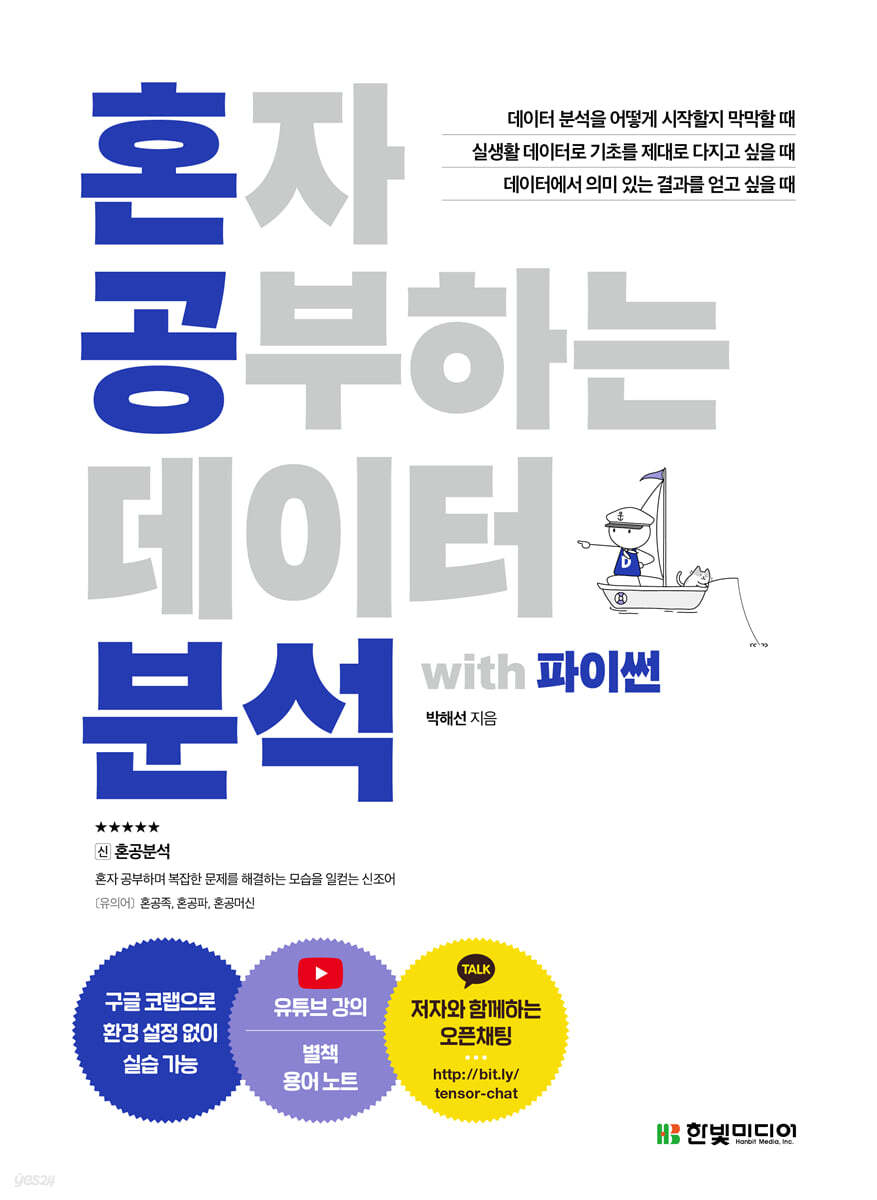
Self-study data analysis with Python
 |
Description
Book Introduction
Self-study is enough! Data analysis tutorial that teaches you how to do it yourself, like a one-on-one tutoring session. This book is designed to help beginners learning data analysis on their own learn the essentials. I fully empathize with the vague feelings of beginners who don't even know what they don't know, so I kindly point out only the key points, just like a private tutor would. From the moment you open the book to the last, you'll feel confident and assured that you can learn data analysis on your own! A beta-reader-verified, personalized book for beginners, created together. We worked with beta readers to consider the level of difficulty, length, and learning elements appropriate for beginners, and actively reflected these findings. Difficult terms and concepts are explained again, and complex explanations are explained with easy-to-see pictures. The greatest strength of this book is that the beginner's perspective and perspective of many beginners who have 'studied on their own' are reflected throughout the book. |
index
Chapter 01 Starting Data Analysis
01-1 What is data analysis?
__Data Analysis and Data Science
__Data Analyst
__Tools for data analysis
[Learn More] Data Mining and Machine Learning
[Key points summarized in three keywords]
[Key package essential for learning]
[Confirmation problem]
01-2 Google Colab and Jupyter Notebook
__Google Colab
__laptop
[Learn more] Markdown format
[Key Points Summarized in 5 Keywords]
[Text cell toolbar for organizing text into tables]
[Confirmation problem]
01-3 How popular will this book be?
__Find book data
__Checking data in Colab
__Outputting a CSV file with Python
__Working with DataFrames: Pandas
__[Problem Solving Process] Finding, uploading, and reading appropriate data
[Learn more] Representative sites for public datasets and popular forums
[Key Points Summarized in 5 Keywords]
[Key functions and methods summarized in a table]
[Confirmation problem]
Chapter 02 Collecting Data
02-1 Using the API
__What is API?
__Handling JSON Data in Python
__Handling XML Data in Python
Finding the Books Most Popular Among 20-Somethings with API
__[Troubleshooting Process] Retrieving Data from the Web with Public APIs
[Key points summarized in four keywords]
[Key functions and methods summarized in a table]
[Confirmation problem]
02-2 Using Web Scraping
__Find the page number of the book
__Get search results page
Extracting Data from HTML: Beautiful Soup
__Get the number of pages in the entire book
__Things to watch out for when scraping the web
__[Troubleshooting Process] Collecting HTML with Web Scraping
[Learn more] Parameters of the merge() function
[Key points summarized in two keywords]
[Key functions and methods summarized in a table]
[Confirmation problem]
Chapter 03 Data Cleaning
03-1 Deleting unnecessary data
Delete __column
Delete __ row
__Find duplicate rows
__Collect by group
__Update original data
__[Troubleshooting Process] Creating a Batch Processing Function
[Key Points Organized into 6 Keywords]
[Key functions and methods summarized in a table]
[Confirmation problem]
03-2 Correcting incorrect data
__Check the summary of data frame information
__Handling missing values
__Regular expression
__Replace incorrect values
__Fill in missing information
__[Problem-Solving Process] Understanding and Properly Refining Data
[Key points summarized in two keywords]
[Key functions and methods summarized in a table]
[Confirmation problem]
Chapter 04 Summarizing Data
04-1 Summary with statistics
__Get descriptive statistics
__Find the average
__Finding the median
__Finding the minimum and maximum values
Finding the __ mood
__Finding the variance
__Calculating the standard deviation
__Find the most frequent value
__[Problem-Solving Process] Obtaining Descriptive Statistics from a Data Frame
[Learn more] NumPy's descriptive statistics functions
[Key Points Organized into 6 Keywords]
[Key functions and methods summarized in a table]
[Confirmation problem]
04-2 Summarizing the distribution
__Drawing a scatter plot
__Drawing a histogram
Drawing a Box Beard
__[Problem-Solving Process] Visually Representing Statistics
[Learn more] Pandas graph functions
[Key Points Organized into 6 Keywords]
[Key functions and methods summarized in a table]
[Confirmation problem]
Chapter 05: Visualizing Data
05-1 Learn the basic elements of Matplotlib
__Figure object
__rcParams object
__Printing multiple subplots
[Key Points Summarized in 5 Keywords]
[Key functions and methods summarized in a table]
[Confirmation problem]
05-2 Drawing Line Graphs and Bar Graphs
__Calculate the number of books published by year
__Calculate the number of books by subject
__Drawing a line graph
__Drawing a bar graph
__[Problem-Solving Process] Drawing Line and Bar Graphs with Matplotlib
[Learn more (1)] Printing and saving images
[Learn more (2)] Saving a graph as an image
[Key points summarized in two keywords]
[Key functions and methods summarized in a table]
[Confirmation problem]
Chapter 06 Representing Complex Data
06-1 Decorating a Graph with an Object-Oriented API
__pyplot method and object-oriented API method
__Printing Korean on a graph
__Drawing a scatter plot of books published by publisher
__[Problem Solving Process] Improving Graphs with Matplotlib's Various Features
[Key points summarized in three keywords]
[Key functions and methods summarized in a table]
[Confirmation problem]
06-2 Learning advanced features of Matplotlib
__Preparing for the lab
__Drawing multiple line graphs on one figure
__Drawing multiple bar graphs on one figure
__Drawing a circle graph
__Drawing subplots with different types of graphs
__[Problem Solving Process] Drawing Complex Graphs with Matplotlib
[Learn More] Drawing Multiple Graphs with Pandas
[Key Points Summarized in 5 Keywords]
[Key functions and methods summarized in a table]
[Confirmation problem]
Chapter 07 Verifying and Predicting
07-1 Statistical Inference
__What is a parametric test?
__Calculating the standard score
__Learning the Central Limit Theorem
__Estimating the range of a population mean: confidence intervals
__Checking statistical significance: Hypothesis testing
__Testing Hypotheses When Distributions Are Not Normal: Permutation Tests
[Problem Solving Process] Deriving Decisions from Sample Data
[Key Points Organized into 6 Keywords]
[Key functions and methods summarized in a table]
[Confirmation problem]
07-2 Predicting with Machine Learning
__Machine Learning Terms You Should Know
__Training the model
__Evaluating the trained model: Coefficient of determination
__Predicting Continuous Values: Linear Regression
Predicting Categories: Logistic Regression
__[Problem Solving Process] Predicting the Number of Loans Based on the Number of Books
[Learn More] Evaluating Models with Mean Squared Error and Mean Absolute Error
[Key Points Organized into 8 Keywords]
[Key functions and methods summarized in a table]
Appendix A Going a Step Further: Databases and SQL
Appendix B Functions and Methods Learned in This Book
Appendix C Epilogue
__Check the correct answer to the question
__Find
01-1 What is data analysis?
__Data Analysis and Data Science
__Data Analyst
__Tools for data analysis
[Learn More] Data Mining and Machine Learning
[Key points summarized in three keywords]
[Key package essential for learning]
[Confirmation problem]
01-2 Google Colab and Jupyter Notebook
__Google Colab
__laptop
[Learn more] Markdown format
[Key Points Summarized in 5 Keywords]
[Text cell toolbar for organizing text into tables]
[Confirmation problem]
01-3 How popular will this book be?
__Find book data
__Checking data in Colab
__Outputting a CSV file with Python
__Working with DataFrames: Pandas
__[Problem Solving Process] Finding, uploading, and reading appropriate data
[Learn more] Representative sites for public datasets and popular forums
[Key Points Summarized in 5 Keywords]
[Key functions and methods summarized in a table]
[Confirmation problem]
Chapter 02 Collecting Data
02-1 Using the API
__What is API?
__Handling JSON Data in Python
__Handling XML Data in Python
Finding the Books Most Popular Among 20-Somethings with API
__[Troubleshooting Process] Retrieving Data from the Web with Public APIs
[Key points summarized in four keywords]
[Key functions and methods summarized in a table]
[Confirmation problem]
02-2 Using Web Scraping
__Find the page number of the book
__Get search results page
Extracting Data from HTML: Beautiful Soup
__Get the number of pages in the entire book
__Things to watch out for when scraping the web
__[Troubleshooting Process] Collecting HTML with Web Scraping
[Learn more] Parameters of the merge() function
[Key points summarized in two keywords]
[Key functions and methods summarized in a table]
[Confirmation problem]
Chapter 03 Data Cleaning
03-1 Deleting unnecessary data
Delete __column
Delete __ row
__Find duplicate rows
__Collect by group
__Update original data
__[Troubleshooting Process] Creating a Batch Processing Function
[Key Points Organized into 6 Keywords]
[Key functions and methods summarized in a table]
[Confirmation problem]
03-2 Correcting incorrect data
__Check the summary of data frame information
__Handling missing values
__Regular expression
__Replace incorrect values
__Fill in missing information
__[Problem-Solving Process] Understanding and Properly Refining Data
[Key points summarized in two keywords]
[Key functions and methods summarized in a table]
[Confirmation problem]
Chapter 04 Summarizing Data
04-1 Summary with statistics
__Get descriptive statistics
__Find the average
__Finding the median
__Finding the minimum and maximum values
Finding the __ mood
__Finding the variance
__Calculating the standard deviation
__Find the most frequent value
__[Problem-Solving Process] Obtaining Descriptive Statistics from a Data Frame
[Learn more] NumPy's descriptive statistics functions
[Key Points Organized into 6 Keywords]
[Key functions and methods summarized in a table]
[Confirmation problem]
04-2 Summarizing the distribution
__Drawing a scatter plot
__Drawing a histogram
Drawing a Box Beard
__[Problem-Solving Process] Visually Representing Statistics
[Learn more] Pandas graph functions
[Key Points Organized into 6 Keywords]
[Key functions and methods summarized in a table]
[Confirmation problem]
Chapter 05: Visualizing Data
05-1 Learn the basic elements of Matplotlib
__Figure object
__rcParams object
__Printing multiple subplots
[Key Points Summarized in 5 Keywords]
[Key functions and methods summarized in a table]
[Confirmation problem]
05-2 Drawing Line Graphs and Bar Graphs
__Calculate the number of books published by year
__Calculate the number of books by subject
__Drawing a line graph
__Drawing a bar graph
__[Problem-Solving Process] Drawing Line and Bar Graphs with Matplotlib
[Learn more (1)] Printing and saving images
[Learn more (2)] Saving a graph as an image
[Key points summarized in two keywords]
[Key functions and methods summarized in a table]
[Confirmation problem]
Chapter 06 Representing Complex Data
06-1 Decorating a Graph with an Object-Oriented API
__pyplot method and object-oriented API method
__Printing Korean on a graph
__Drawing a scatter plot of books published by publisher
__[Problem Solving Process] Improving Graphs with Matplotlib's Various Features
[Key points summarized in three keywords]
[Key functions and methods summarized in a table]
[Confirmation problem]
06-2 Learning advanced features of Matplotlib
__Preparing for the lab
__Drawing multiple line graphs on one figure
__Drawing multiple bar graphs on one figure
__Drawing a circle graph
__Drawing subplots with different types of graphs
__[Problem Solving Process] Drawing Complex Graphs with Matplotlib
[Learn More] Drawing Multiple Graphs with Pandas
[Key Points Summarized in 5 Keywords]
[Key functions and methods summarized in a table]
[Confirmation problem]
Chapter 07 Verifying and Predicting
07-1 Statistical Inference
__What is a parametric test?
__Calculating the standard score
__Learning the Central Limit Theorem
__Estimating the range of a population mean: confidence intervals
__Checking statistical significance: Hypothesis testing
__Testing Hypotheses When Distributions Are Not Normal: Permutation Tests
[Problem Solving Process] Deriving Decisions from Sample Data
[Key Points Organized into 6 Keywords]
[Key functions and methods summarized in a table]
[Confirmation problem]
07-2 Predicting with Machine Learning
__Machine Learning Terms You Should Know
__Training the model
__Evaluating the trained model: Coefficient of determination
__Predicting Continuous Values: Linear Regression
Predicting Categories: Logistic Regression
__[Problem Solving Process] Predicting the Number of Loans Based on the Number of Books
[Learn More] Evaluating Models with Mean Squared Error and Mean Absolute Error
[Key Points Organized into 8 Keywords]
[Key functions and methods summarized in a table]
Appendix A Going a Step Further: Databases and SQL
Appendix B Functions and Methods Learned in This Book
Appendix C Epilogue
__Check the correct answer to the question
__Find
Detailed image

Publisher's Review
Who is this book for?
Non-majors who are unsure of how to start data analysis
ㆍPython beginners who want to learn Python and then gain meaningful hands-on experience
Developers who know programming but need to understand analysis (statistics)
ㆍWorkers who want to derive meaningful results from data and apply them to planning or marketing.
Anyone interested in the careers of data analysts and data scientists
First, a solid learning design that systematically repeats the "7-step structure tailored for beginners"!
This book is structured to help you naturally memorize the core contents of data analysis by repeatedly learning them in seven steps.
In [Key Keywords] and [Before You Begin], we warm up with representative concepts for each section's topic, and after going through theory and practice, we review them all at once in the conclusion with [Key Points] and [Check Questions].
If you follow the curriculum, which allows you to study on your own, to the end, even beginners who are new to data analysis will be able to finish the book without difficulty!
Second, learn 'real' data analysis by solving problems in interesting stories that could actually happen!
We've designed this course to teach you how to handle data through vivid stories, allowing you to learn in an immersive way, even if you're unfamiliar with Python and data.
This book guides you through how to collect data directly from the world around you, including using APIs and web scraping to retrieve data from real-world libraries and online bookstore websites.
You can also learn coding skills by utilizing various Python libraries useful for data analysis, such as Pandas, NumPy, and Matplotlib, and build a solid foundation with core statistical knowledge.
Finally, you'll get a taste of machine learning, which predicts the future based on analysis, so you can learn data analysis from beginning to end.
Third, we provide video lectures and a learning site to empower you with the power of 'honkong'!
For beginners who still find it difficult to learn from books alone, we also provide videos of lectures directly from the author.
We also provide a learning site so that you can ask the author questions at any time while studying.
Not only will the author personally answer each question, you'll also gain access to the latest technology and information.
In addition, we run a self-study group for people who want to study alone but are not confident in doing so.
If you join the Honkong Study Group, you will be able to complete the course without giving up.
▶ https://hongong.hanbit.co.kr
▶ https://github.com/rickiepark/hg-da
Fourth, we provide a [Terminology Note] that you can easily look at anytime, anywhere!
We provide a [Terminology Note] that organizes only the key concepts and terms that you must remember.
The reason why beginners find programming difficult is because of the unfamiliar terminology.
However, it is not difficult, but rather confusing due to unfamiliarity, so whenever you have trouble remembering a term or concept, feel free to open the [Terminology Note].
In addition to the terms presented, you can also enjoy the process of completing your own glossary by adding new terms.
A word from beta readers who read it first
ㆍThe story unfolds along the actual data analysis process, making it easy to read, and the fictional case studies make it fun to read.
_Kim Jin-hyung
ㆍI liked how it explained in an easy-to-understand way what methods were used for data analysis.
The explanations and examples are so well done that I want to try making and applying the simple things myself.
_Doyoon
ㆍIt differentiates itself from other books by explaining API, JSON, and web scraping, and the examples are suitable for use in real-world environments.
_Kim Hyung-hoon
ㆍI was able to experience that even beginners can easily do it thanks to the friendly and easy explanations and intuitive diagrams.
_Lee Jong-won
ㆍKeywords and functions are summarized for each section, allowing you to review what you have learned so far and build a solid foundation.
_Jeon Ji-min
ㆍLearn Python data analysis with essential terms and concepts, visual explanations, and simple hand-coded code.
_Hong Chang-soo
Non-majors who are unsure of how to start data analysis
ㆍPython beginners who want to learn Python and then gain meaningful hands-on experience
Developers who know programming but need to understand analysis (statistics)
ㆍWorkers who want to derive meaningful results from data and apply them to planning or marketing.
Anyone interested in the careers of data analysts and data scientists
First, a solid learning design that systematically repeats the "7-step structure tailored for beginners"!
This book is structured to help you naturally memorize the core contents of data analysis by repeatedly learning them in seven steps.
In [Key Keywords] and [Before You Begin], we warm up with representative concepts for each section's topic, and after going through theory and practice, we review them all at once in the conclusion with [Key Points] and [Check Questions].
If you follow the curriculum, which allows you to study on your own, to the end, even beginners who are new to data analysis will be able to finish the book without difficulty!
Second, learn 'real' data analysis by solving problems in interesting stories that could actually happen!
We've designed this course to teach you how to handle data through vivid stories, allowing you to learn in an immersive way, even if you're unfamiliar with Python and data.
This book guides you through how to collect data directly from the world around you, including using APIs and web scraping to retrieve data from real-world libraries and online bookstore websites.
You can also learn coding skills by utilizing various Python libraries useful for data analysis, such as Pandas, NumPy, and Matplotlib, and build a solid foundation with core statistical knowledge.
Finally, you'll get a taste of machine learning, which predicts the future based on analysis, so you can learn data analysis from beginning to end.
Third, we provide video lectures and a learning site to empower you with the power of 'honkong'!
For beginners who still find it difficult to learn from books alone, we also provide videos of lectures directly from the author.
We also provide a learning site so that you can ask the author questions at any time while studying.
Not only will the author personally answer each question, you'll also gain access to the latest technology and information.
In addition, we run a self-study group for people who want to study alone but are not confident in doing so.
If you join the Honkong Study Group, you will be able to complete the course without giving up.
▶ https://hongong.hanbit.co.kr
▶ https://github.com/rickiepark/hg-da
Fourth, we provide a [Terminology Note] that you can easily look at anytime, anywhere!
We provide a [Terminology Note] that organizes only the key concepts and terms that you must remember.
The reason why beginners find programming difficult is because of the unfamiliar terminology.
However, it is not difficult, but rather confusing due to unfamiliarity, so whenever you have trouble remembering a term or concept, feel free to open the [Terminology Note].
In addition to the terms presented, you can also enjoy the process of completing your own glossary by adding new terms.
A word from beta readers who read it first
ㆍThe story unfolds along the actual data analysis process, making it easy to read, and the fictional case studies make it fun to read.
_Kim Jin-hyung
ㆍI liked how it explained in an easy-to-understand way what methods were used for data analysis.
The explanations and examples are so well done that I want to try making and applying the simple things myself.
_Doyoon
ㆍIt differentiates itself from other books by explaining API, JSON, and web scraping, and the examples are suitable for use in real-world environments.
_Kim Hyung-hoon
ㆍI was able to experience that even beginners can easily do it thanks to the friendly and easy explanations and intuitive diagrams.
_Lee Jong-won
ㆍKeywords and functions are summarized for each section, allowing you to review what you have learned so far and build a solid foundation.
_Jeon Ji-min
ㆍLearn Python data analysis with essential terms and concepts, visual explanations, and simple hand-coded code.
_Hong Chang-soo
GOODS SPECIFICS
- Date of issue: January 2, 2023
- Page count, weight, size: 496 pages | 1,050g | 188*257*22mm
- ISBN13: 9791169210287
- ISBN10: 1169210287
You may also like
카테고리
korean


korean

![GQ KOREA Mark (Monthly): December [2025]](http://librairie.coreenne.fr/cdn/shop/files/8ef265dbbfbf186523ed75ba7319009d.jpg?v=1765340328&width=3840)


