

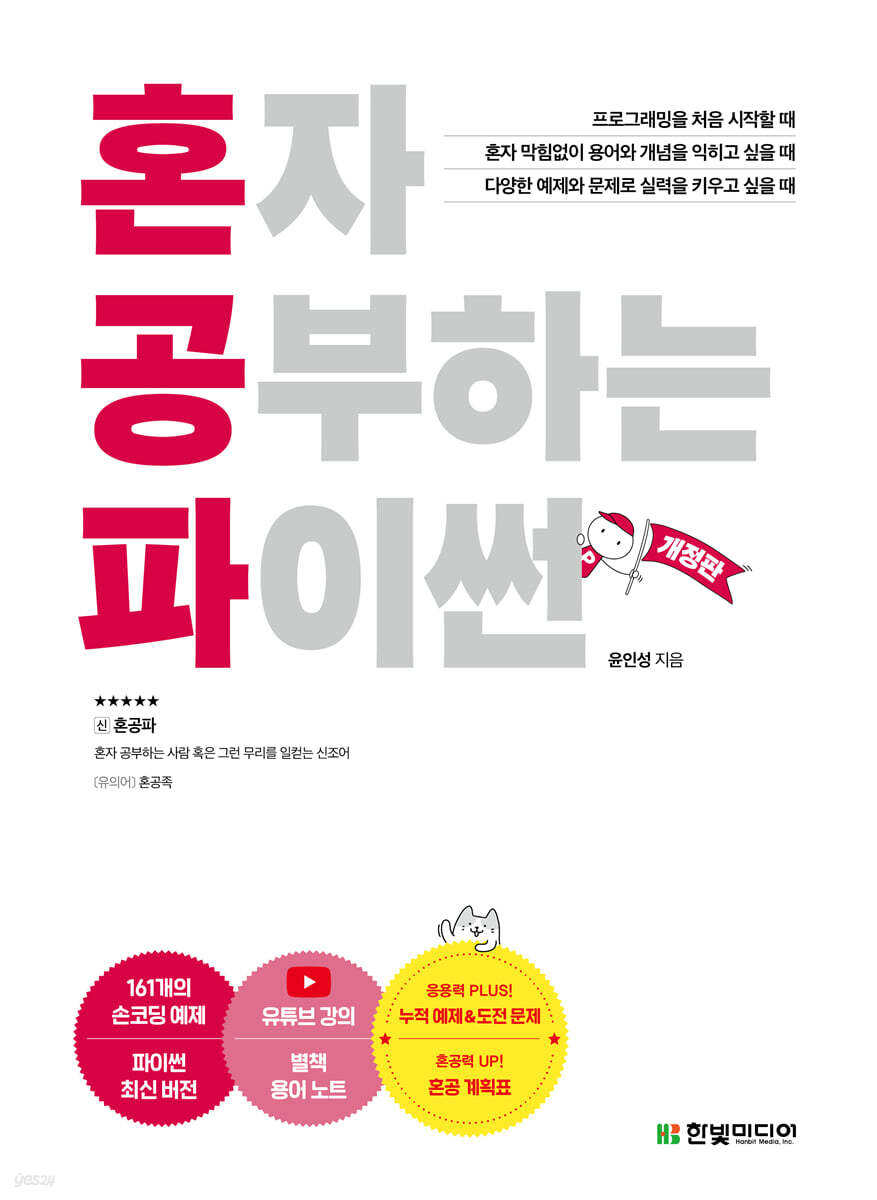
Studying Python on Your Own
 |
Description
Book Introduction
The revised edition of the best-selling introductory Python book, "Study Python on Your Own" (updated to version 3.10).
Includes a 'Study Schedule' to encourage study, and 'Cumulative Examples' and 'Challenge Problems' to raise your level of thinking!
"Study Python on Your Own" has been revised to make it more interesting and informative.
Even complete beginners can follow the friendly explanations and step-by-step learning methods, all the same! We've also added a new "Solo Study Plan" to help you plan your learning systematically, even when studying on your own.
Additionally, it provides frequently asked questions and troubleshooting tips for beginners, so that you can read through to the end without getting frustrated even if you encounter unexpected problems.
If you're tired of memorizing simple grammar and following along with coding, try a new approach: "Cumulative Examples" and "Challenge Problems" with a new team of learners. By chewing, dissecting, savoring, and enjoying what you've learned, you'll cultivate not only application skills but also algorithmic thinking, leading to a rapid growth in your coding skills.
Includes a 'Study Schedule' to encourage study, and 'Cumulative Examples' and 'Challenge Problems' to raise your level of thinking!
"Study Python on Your Own" has been revised to make it more interesting and informative.
Even complete beginners can follow the friendly explanations and step-by-step learning methods, all the same! We've also added a new "Solo Study Plan" to help you plan your learning systematically, even when studying on your own.
Additionally, it provides frequently asked questions and troubleshooting tips for beginners, so that you can read through to the end without getting frustrated even if you encounter unexpected problems.
If you're tired of memorizing simple grammar and following along with coding, try a new approach: "Cumulative Examples" and "Challenge Problems" with a new team of learners. By chewing, dissecting, savoring, and enjoying what you've learned, you'll cultivate not only application skills but also algorithmic thinking, leading to a rapid growth in your coding skills.
- You can preview some of the book's contents.
Preview
index
Chapter 01 Getting Started with Python
01-1 A very simple explanation to read before learning Python
__computer program
__programming language
__Programming language, Python
__Why Python is popular
[Key points summarized in three keywords]
[Confirmation question]
01-2 What you need to prepare to learn Python
__Installing Python
__Running Python: Python Interactive Shell
__Using a Text Editor (1): Python IDLE Editor
__Using a Text Editor (2): Visual Studio Code
[Learn More] How to Fix Common Mistakes Beginners Make in Python
[Learn More] Using the Code Runner: Windows PowerShell
[Key Points Summarized in 5 Keywords]
[Confirmation question]
01-3 Python terms frequently used in this book
__Expressions and Sentences
__Keyword
__identifier
__annotation
__operator and data
__Output: print()
[Key Points Summarized in 5 Keywords]
[Confirmation question]
Chapter 02 Data Types
02-1 Data types and strings
__Data types and basic data types
__Create a string
__string operator
__Find the length of a string
[Key Points Organized into 6 Keywords]
[Confirmation question]
02-2 number
__Types of numbers
__numeric operator
__Operator precedence
[Learn more] Precedence of string operators
[Key points summarized in four keywords]
[Confirmation question]
02-3 Variables and Input
__Creating/Using Variables
__Compound assignment operator
__User input: input()
__Convert string to number
__Convert numbers to strings
__[Cumulative Example] Converting inches to cm
[Learn More] Analyzing Code with Python Tutor
[Key Points Organized into 7 Keywords]
[Confirmation question]
02-4 Various functions of numbers and strings
__string's format() function
Various functions of the __format() function
__Case change: upper() and lower()
__Remove whitespace from both sides of a string: strip()
__Understanding the composition of a string: isOO()
__Finding Strings: find() and rfind()
__Strings and the in operator
__Truncate a string: split()
[Learn more] f-string
[Learn more] When is it better to use the format() function rather than f-strings?
[Key Points Organized into 8 Keywords]
[Confirmation question]
[Challenge Problem]
Chapter 03 Conditional Statements
03-1 Boolean data type and if conditional statement
__Making Fire: Comparison Operators
__Boolean Operations: Logical Operators
__Using logical operators
What is the __if conditional statement?
__Using date/time
__[Cumulative Example] Distinguishing between even and odd numbers
[Key points summarized in four keywords]
[Confirmation question]
03-2 if~else and elif statements
Utilizing the __else conditional statement
__elif statement
__[Cumulative Example] Using if Conditional Statements Efficiently
Values that convert to __False
__pass keyword
[Learn more] raise NotImplementError
[Key points summarized in four keywords]
[Confirmation question]
[Challenge Problem]
Chapter 04 Loops
04-1 Lists and Loops
__Declaring a list and accessing its elements
__List operators: concatenation (+), repetition (*), len()
__Adding elements to a list: append(), insert()
__Removing elements from a list
Checking if __ is inside a list: in/not in operators
__for loop
__for loop: Using with lists
__[Cumulative Example] Nested Lists and Nested Loops
[Learn more] Spread operator
[Key points summarized in four keywords]
[Confirmation question]
04-2 Dictionaries and Loops
__Declaring a dictionary
__Accessing elements of a dictionary
__Adding/removing values to a dictionary
__Check if a key exists in a dictionary
__for loop: Using with dictionaries
[Key points summarized in three keywords]
[Confirmation question]
04-3 Range data types and while loops
__range
__for loop: Using with ranges
__for loop: combining lists and ranges
__for loop: repeating in reverse
__[Cumulative Example] Creating a Pyramid with Nested Loops
__while loop
__while loop: Using it like a for loop
__while loop: Iterating based on status
__while loop: Iterating based on time
__while loop: break keyword/continue keyword
[Key points summarized in four keywords]
[Confirmation question]
04-4 Basic functions related to strings, lists, and dictionaries
__Basic functions that can be applied to lists: min(), max(), sum()
Reversing a list with the __reversed() function
Combining the __enumerate() function with loops
Combining the dictionary's items() function with a loop
__List comprehension
[Learn more] Problems with using multi-line strings inside a statement
[Learn more] Iterator
[Key points summarized in three keywords]
[Confirmation question]
[Challenge Problem]
Chapter 05 Functions
05-1 Creating a Function
__Function Basics
__Creating parameters in a function
__Variable parameters
__Default parameters
__keyword parameter
__return
__Using basic functions
[Key Points Summarized in 5 Keywords]
[Confirmation question]
05-2 Utilization of functions
__recursive function
__Problems with recursive functions
__Early return
__[Cumulative Example] Creating a Recursive Function to Flatten a List
[Learn more] Naming code
[Learn more] Code Maintenance
[Key points summarized in three keywords]
[Confirmation question]
05-3 Advanced Functions
__tuple
__Lambda
__file processing
[Learn more] Self-study Python Programming
[Learn more] Generator
[Learn more] Key keyword parameter of list function
[Learn more] Stack, Heap
[Learn more] Copying values and references of functions
[Key points summarized in three keywords]
[Confirmation question]
[Challenge Problem]
Chapter 06 Exception Handling
06-1 Syntax Errors and Exceptions
__Type of error
__Basic exception handling
__try except statement
__try except else statement
__finally syntax
[Key points summarized in four keywords]
[Confirmation question]
06-2 Exception Advanced
__Exception object
__Distinguishing exceptions
__Catch all exceptions
__raise syntax
[Learn more] Explore the code on GitHub
[Key points summarized in three keywords]
[Confirmation question]
Chapter 07 Module
07-1 Standard Module
__Module Basics: The math module
__random module
__sys module
__os module
__datetime module
__time module
__urllib module
[Learn more] operator.itemgetter() function
[Key points summarized in four keywords]
[Confirmation question]
07-2 External Module
Installing the __module
__Find Module
__Beautiful Soup module
__Flask module
__Libraries and Frameworks
[Learn more] Function decorators
[Key Points Summarized in 5 Keywords]
[Confirmation question]
07-3 Creating a Module
__Creating a module
__package
[Learn more] Text data
[Learn more] Binary data
[Key points summarized in three keywords]
[How to analyze a module]
Chapter 08 Class
Basics of Class 08-1
__object
__Declaring a class
__constructor
__method
[Key Points Organized into 7 Keywords]
[Confirmation question]
Additional syntax for class 08-2
__Check which class it is an instance of
__Methods with special names
__Class variables and methods
[Learn more] Garbage Collector
[Learn more] Private variables and getters/setters
[Learn more] Inheritance
[Key points summarized in four keywords]
[Confirmation question]
[Challenge Problem]
Appendix A macOS Terminal
Appendix B List Comprehension, Dictionary Comprehension, and Set Comprehension
__Correct answer
__Find
01-1 A very simple explanation to read before learning Python
__computer program
__programming language
__Programming language, Python
__Why Python is popular
[Key points summarized in three keywords]
[Confirmation question]
01-2 What you need to prepare to learn Python
__Installing Python
__Running Python: Python Interactive Shell
__Using a Text Editor (1): Python IDLE Editor
__Using a Text Editor (2): Visual Studio Code
[Learn More] How to Fix Common Mistakes Beginners Make in Python
[Learn More] Using the Code Runner: Windows PowerShell
[Key Points Summarized in 5 Keywords]
[Confirmation question]
01-3 Python terms frequently used in this book
__Expressions and Sentences
__Keyword
__identifier
__annotation
__operator and data
__Output: print()
[Key Points Summarized in 5 Keywords]
[Confirmation question]
Chapter 02 Data Types
02-1 Data types and strings
__Data types and basic data types
__Create a string
__string operator
__Find the length of a string
[Key Points Organized into 6 Keywords]
[Confirmation question]
02-2 number
__Types of numbers
__numeric operator
__Operator precedence
[Learn more] Precedence of string operators
[Key points summarized in four keywords]
[Confirmation question]
02-3 Variables and Input
__Creating/Using Variables
__Compound assignment operator
__User input: input()
__Convert string to number
__Convert numbers to strings
__[Cumulative Example] Converting inches to cm
[Learn More] Analyzing Code with Python Tutor
[Key Points Organized into 7 Keywords]
[Confirmation question]
02-4 Various functions of numbers and strings
__string's format() function
Various functions of the __format() function
__Case change: upper() and lower()
__Remove whitespace from both sides of a string: strip()
__Understanding the composition of a string: isOO()
__Finding Strings: find() and rfind()
__Strings and the in operator
__Truncate a string: split()
[Learn more] f-string
[Learn more] When is it better to use the format() function rather than f-strings?
[Key Points Organized into 8 Keywords]
[Confirmation question]
[Challenge Problem]
Chapter 03 Conditional Statements
03-1 Boolean data type and if conditional statement
__Making Fire: Comparison Operators
__Boolean Operations: Logical Operators
__Using logical operators
What is the __if conditional statement?
__Using date/time
__[Cumulative Example] Distinguishing between even and odd numbers
[Key points summarized in four keywords]
[Confirmation question]
03-2 if~else and elif statements
Utilizing the __else conditional statement
__elif statement
__[Cumulative Example] Using if Conditional Statements Efficiently
Values that convert to __False
__pass keyword
[Learn more] raise NotImplementError
[Key points summarized in four keywords]
[Confirmation question]
[Challenge Problem]
Chapter 04 Loops
04-1 Lists and Loops
__Declaring a list and accessing its elements
__List operators: concatenation (+), repetition (*), len()
__Adding elements to a list: append(), insert()
__Removing elements from a list
Checking if __ is inside a list: in/not in operators
__for loop
__for loop: Using with lists
__[Cumulative Example] Nested Lists and Nested Loops
[Learn more] Spread operator
[Key points summarized in four keywords]
[Confirmation question]
04-2 Dictionaries and Loops
__Declaring a dictionary
__Accessing elements of a dictionary
__Adding/removing values to a dictionary
__Check if a key exists in a dictionary
__for loop: Using with dictionaries
[Key points summarized in three keywords]
[Confirmation question]
04-3 Range data types and while loops
__range
__for loop: Using with ranges
__for loop: combining lists and ranges
__for loop: repeating in reverse
__[Cumulative Example] Creating a Pyramid with Nested Loops
__while loop
__while loop: Using it like a for loop
__while loop: Iterating based on status
__while loop: Iterating based on time
__while loop: break keyword/continue keyword
[Key points summarized in four keywords]
[Confirmation question]
04-4 Basic functions related to strings, lists, and dictionaries
__Basic functions that can be applied to lists: min(), max(), sum()
Reversing a list with the __reversed() function
Combining the __enumerate() function with loops
Combining the dictionary's items() function with a loop
__List comprehension
[Learn more] Problems with using multi-line strings inside a statement
[Learn more] Iterator
[Key points summarized in three keywords]
[Confirmation question]
[Challenge Problem]
Chapter 05 Functions
05-1 Creating a Function
__Function Basics
__Creating parameters in a function
__Variable parameters
__Default parameters
__keyword parameter
__return
__Using basic functions
[Key Points Summarized in 5 Keywords]
[Confirmation question]
05-2 Utilization of functions
__recursive function
__Problems with recursive functions
__Early return
__[Cumulative Example] Creating a Recursive Function to Flatten a List
[Learn more] Naming code
[Learn more] Code Maintenance
[Key points summarized in three keywords]
[Confirmation question]
05-3 Advanced Functions
__tuple
__Lambda
__file processing
[Learn more] Self-study Python Programming
[Learn more] Generator
[Learn more] Key keyword parameter of list function
[Learn more] Stack, Heap
[Learn more] Copying values and references of functions
[Key points summarized in three keywords]
[Confirmation question]
[Challenge Problem]
Chapter 06 Exception Handling
06-1 Syntax Errors and Exceptions
__Type of error
__Basic exception handling
__try except statement
__try except else statement
__finally syntax
[Key points summarized in four keywords]
[Confirmation question]
06-2 Exception Advanced
__Exception object
__Distinguishing exceptions
__Catch all exceptions
__raise syntax
[Learn more] Explore the code on GitHub
[Key points summarized in three keywords]
[Confirmation question]
Chapter 07 Module
07-1 Standard Module
__Module Basics: The math module
__random module
__sys module
__os module
__datetime module
__time module
__urllib module
[Learn more] operator.itemgetter() function
[Key points summarized in four keywords]
[Confirmation question]
07-2 External Module
Installing the __module
__Find Module
__Beautiful Soup module
__Flask module
__Libraries and Frameworks
[Learn more] Function decorators
[Key Points Summarized in 5 Keywords]
[Confirmation question]
07-3 Creating a Module
__Creating a module
__package
[Learn more] Text data
[Learn more] Binary data
[Key points summarized in three keywords]
[How to analyze a module]
Chapter 08 Class
Basics of Class 08-1
__object
__Declaring a class
__constructor
__method
[Key Points Organized into 7 Keywords]
[Confirmation question]
Additional syntax for class 08-2
__Check which class it is an instance of
__Methods with special names
__Class variables and methods
[Learn more] Garbage Collector
[Learn more] Private variables and getters/setters
[Learn more] Inheritance
[Key points summarized in four keywords]
[Confirmation question]
[Challenge Problem]
Appendix A macOS Terminal
Appendix B List Comprehension, Dictionary Comprehension, and Set Comprehension
__Correct answer
__Find
Detailed image

Publisher's Review
Self-study is enough! A Python programming tutorial that teaches you how to do it one-on-one.
This book is designed to help beginners learning Python on their own learn the essentials.
I completely sympathize with the vague feelings of beginners who don't even know what they don't know, so I kindly point out only the key points, just like a private tutor would.
From the moment you open the first page of the book to the last, you'll feel confident and assured that you can learn Python on your own!
A beta-reader-verified, personalized book for beginners, created together.
We actively reflected the difficulty level, length, and learning elements suitable for beginners together with the beta reader.
Difficult terms and concepts are explained again, and complex explanations are explained with easy-to-see pictures.
The greatest strength of this book is that the beginner's perspective and perspective of many beginners who have 'studied on their own' are reflected throughout the book.
Who is this book for?
● Beginners who are new to Python as a programming language
● Majors who have taken undergraduate courses but still have concerns about Python programming
● Non-majors who need to learn Python to learn data analysis or machine learning
● Junior developers who have difficulty writing advanced code due to a lack of understanding of the language.
Anyone interested in Python
Book Features
First, a solid learning design that systematically repeats the "7-step structure tailored for beginners"!
This book is structured to help you naturally memorize the core contents of Python by learning them repeatedly in seven steps.
After warming up with the representative concepts of each section's topic through [Key Keywords] and [Before You Begin], you will learn and practice the core Python theory in earnest.
In the conclusion, we review [Key Points] and [Confirmation Questions] at once.
If you follow the curriculum that allows you to study on your own, even a Python beginner who is learning programming for the first time will be able to finish the book without difficulty!
Second, learn the core grammar easily with 'eye coding', and get a real feel for it with 161 hands-on 'hand coding' exercises!
It contains 161 carefully selected practical examples so that you can read the core grammar and theory explanations with both eyes and mind, and learn the feel of Python coding through hands-on experience.
In particular, the revised edition includes [Cumulative Examples] and [Challenge Problems] to help develop application skills, fully satisfying the needs of readers who want a variety of examples and problems.
By doing the repetitive learning and coding practice that beginners need most, you can make the code in the book 'your own code'!
Third, we provide video lectures and a learning site to empower you with the power of 'honkong'!
For beginners who still find it difficult to learn from books alone, we also provide videos of lectures directly from the author.
We also provide a learning site so that you can ask the author questions at any time while studying.
The author personally answers each question, and you can also gain access to the latest Python-related technologies and information.
In addition, we run a self-study group for people who want to study alone but are not confident in doing so.
If you join the Honkong Study Group, you will be able to complete the course without giving up.
▶ https://hongong.hanbit.co.kr
▶ https://youtube.com/c/윤인성
Fourth, we provide a [Terminology Note] that you can easily look at anytime, anywhere!
We provide a [Terminology Note] that organizes only the key concepts and terms that you must remember.
The reason why beginners find programming difficult is because of the unfamiliar terminology.
However, it is not difficult, but rather confusing due to unfamiliarity, so whenever you have trouble remembering a term or concept, feel free to open the [Terminology Note].
In addition to the terms presented, you can also enjoy the process of completing your own glossary by adding new terms.
A word from beta readers who read it first
● Compared to the first edition, it has been enriched with practical and interesting examples and challenging problems, making me want to read it again.
_Choi Gyu-hyeok
● The code was divided appropriately, so it was easy to follow and practice.
_Kim Min-gyu
● This is a really good book for self-study.
It was great to be able to learn the basics of Python properly even though I'm not a major in it. _Choi Go-un
● It explains the basic knowledge required for coding in a very detailed and friendly manner.
_Lee Sang-yoon
● I liked that the parts that beginners are curious about or confused about were explained in detail. _Ban Bo-young
● It was great to be able to simply practice not only the basics of Python but also modules that are actually frequently used. _ Hong Su-bin
This book is designed to help beginners learning Python on their own learn the essentials.
I completely sympathize with the vague feelings of beginners who don't even know what they don't know, so I kindly point out only the key points, just like a private tutor would.
From the moment you open the first page of the book to the last, you'll feel confident and assured that you can learn Python on your own!
A beta-reader-verified, personalized book for beginners, created together.
We actively reflected the difficulty level, length, and learning elements suitable for beginners together with the beta reader.
Difficult terms and concepts are explained again, and complex explanations are explained with easy-to-see pictures.
The greatest strength of this book is that the beginner's perspective and perspective of many beginners who have 'studied on their own' are reflected throughout the book.
Who is this book for?
● Beginners who are new to Python as a programming language
● Majors who have taken undergraduate courses but still have concerns about Python programming
● Non-majors who need to learn Python to learn data analysis or machine learning
● Junior developers who have difficulty writing advanced code due to a lack of understanding of the language.
Anyone interested in Python
Book Features
First, a solid learning design that systematically repeats the "7-step structure tailored for beginners"!
This book is structured to help you naturally memorize the core contents of Python by learning them repeatedly in seven steps.
After warming up with the representative concepts of each section's topic through [Key Keywords] and [Before You Begin], you will learn and practice the core Python theory in earnest.
In the conclusion, we review [Key Points] and [Confirmation Questions] at once.
If you follow the curriculum that allows you to study on your own, even a Python beginner who is learning programming for the first time will be able to finish the book without difficulty!
Second, learn the core grammar easily with 'eye coding', and get a real feel for it with 161 hands-on 'hand coding' exercises!
It contains 161 carefully selected practical examples so that you can read the core grammar and theory explanations with both eyes and mind, and learn the feel of Python coding through hands-on experience.
In particular, the revised edition includes [Cumulative Examples] and [Challenge Problems] to help develop application skills, fully satisfying the needs of readers who want a variety of examples and problems.
By doing the repetitive learning and coding practice that beginners need most, you can make the code in the book 'your own code'!
Third, we provide video lectures and a learning site to empower you with the power of 'honkong'!
For beginners who still find it difficult to learn from books alone, we also provide videos of lectures directly from the author.
We also provide a learning site so that you can ask the author questions at any time while studying.
The author personally answers each question, and you can also gain access to the latest Python-related technologies and information.
In addition, we run a self-study group for people who want to study alone but are not confident in doing so.
If you join the Honkong Study Group, you will be able to complete the course without giving up.
▶ https://hongong.hanbit.co.kr
▶ https://youtube.com/c/윤인성
Fourth, we provide a [Terminology Note] that you can easily look at anytime, anywhere!
We provide a [Terminology Note] that organizes only the key concepts and terms that you must remember.
The reason why beginners find programming difficult is because of the unfamiliar terminology.
However, it is not difficult, but rather confusing due to unfamiliarity, so whenever you have trouble remembering a term or concept, feel free to open the [Terminology Note].
In addition to the terms presented, you can also enjoy the process of completing your own glossary by adding new terms.
A word from beta readers who read it first
● Compared to the first edition, it has been enriched with practical and interesting examples and challenging problems, making me want to read it again.
_Choi Gyu-hyeok
● The code was divided appropriately, so it was easy to follow and practice.
_Kim Min-gyu
● This is a really good book for self-study.
It was great to be able to learn the basics of Python properly even though I'm not a major in it. _Choi Go-un
● It explains the basic knowledge required for coding in a very detailed and friendly manner.
_Lee Sang-yoon
● I liked that the parts that beginners are curious about or confused about were explained in detail. _Ban Bo-young
● It was great to be able to simply practice not only the basics of Python but also modules that are actually frequently used. _ Hong Su-bin
GOODS SPECIFICS
- Date of issue: June 1, 2022
- Page count, weight, size: 552 pages | 1,160g | 188*257*24mm
- ISBN13: 9791162245651
- ISBN10: 1162245654
You may also like
카테고리
korean


korean

![GQ KOREA Mark (Monthly): December [2025]](http://librairie.coreenne.fr/cdn/shop/files/8ef265dbbfbf186523ed75ba7319009d.jpg?v=1765340328&width=3840)


