

What is enlightenment?
 |
Description
Book Introduction
About 'enlightenment' that no one can tell you clearly
Unvarnished answers from six of Japan's greatest monks!
Enlightenment is the ultimate value pursued by Buddhism and the greatest concern of all Buddhists.
However, it is not easy to find answers to the questions of what enlightenment is and how to attain it.
As a result, many people have a fixed idea that enlightenment is 'unrelated to my life' and 'not something that anyone can easily understand.'
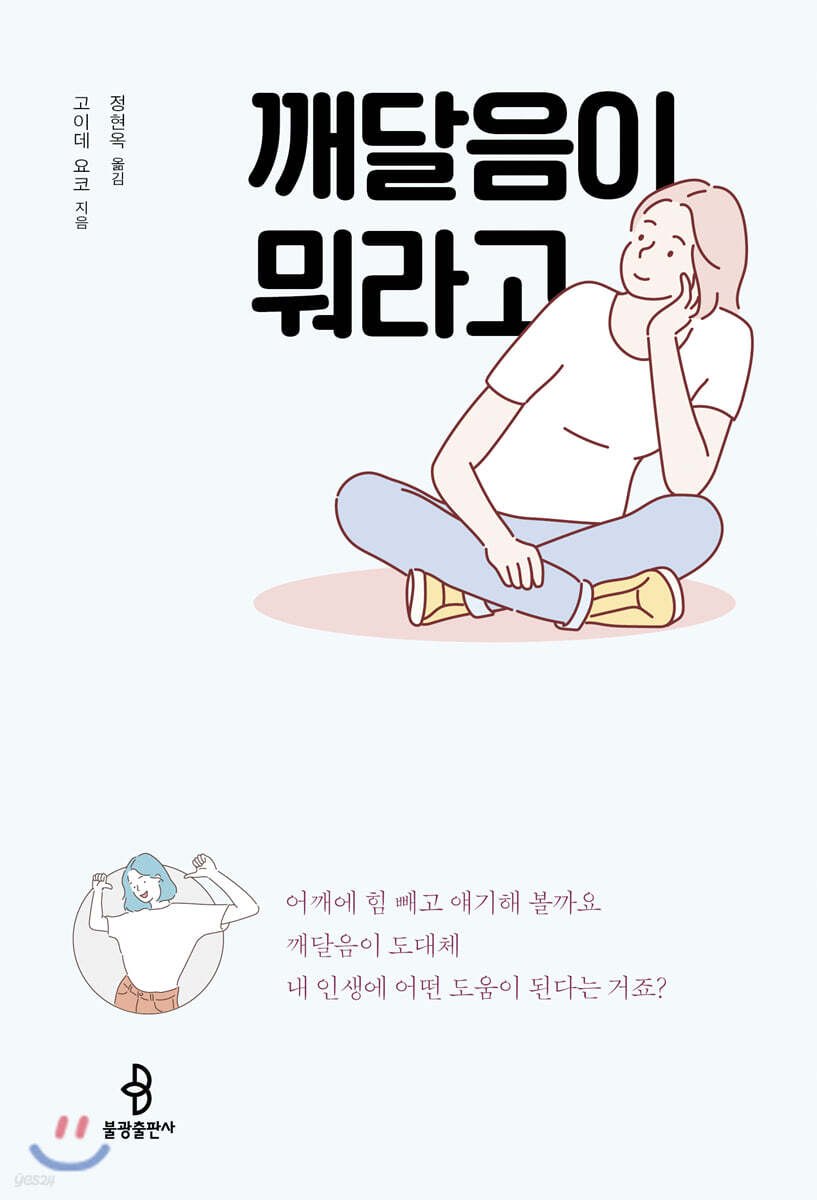
"What is Enlightenment?" is a compilation of conversations about enlightenment held by a thirty-two-year-old female Buddhist enthusiast with six representative Buddhist monks in Japan.
It talks about enlightenment in a daily and realistic way, not in a vague and vague way.
It answers the questions of what enlightenment is and how it can lead our lives in a better direction.
Unvarnished answers from six of Japan's greatest monks!
Enlightenment is the ultimate value pursued by Buddhism and the greatest concern of all Buddhists.
However, it is not easy to find answers to the questions of what enlightenment is and how to attain it.
As a result, many people have a fixed idea that enlightenment is 'unrelated to my life' and 'not something that anyone can easily understand.'
"What is Enlightenment?" is a compilation of conversations about enlightenment held by a thirty-two-year-old female Buddhist enthusiast with six representative Buddhist monks in Japan.
It talks about enlightenment in a daily and realistic way, not in a vague and vague way.
It answers the questions of what enlightenment is and how it can lead our lives in a better direction.
- You can preview some of the book's contents.
Preview
index
Entering
Chapter 1: Enjoying a Connected World_ Issho Fujita (Director of the Jo Dong-jong International Center)
Chapter 2: If You Realize It Was a Dream, Enjoy It - Yokota Nanrei (Director of the Rinzai Enkakuji School)
Chapter 3: Living in the Present in Peace_ Ryunosuke Koike (Former Chief Priest of Tsukuyomiji Temple)
Chapter 4: Living a Life as a Mud Buddha, Emptying Every Moment_Horisawa Somon (Sanzenin Monju)
Chapter 5: Living as a Story, Not the End_ Shaku Tesshu (Chief of Nyoraiji Temple, Professor at Soai University)
Chapter 6: The Voice of Buddha That Melts Me When I'm Frozen_ Akira Omine (Former Chief Priest of Senryuji Temple)
Going out
Chapter 1: Enjoying a Connected World_ Issho Fujita (Director of the Jo Dong-jong International Center)
Chapter 2: If You Realize It Was a Dream, Enjoy It - Yokota Nanrei (Director of the Rinzai Enkakuji School)
Chapter 3: Living in the Present in Peace_ Ryunosuke Koike (Former Chief Priest of Tsukuyomiji Temple)
Chapter 4: Living a Life as a Mud Buddha, Emptying Every Moment_Horisawa Somon (Sanzenin Monju)
Chapter 5: Living as a Story, Not the End_ Shaku Tesshu (Chief of Nyoraiji Temple, Professor at Soai University)
Chapter 6: The Voice of Buddha That Melts Me When I'm Frozen_ Akira Omine (Former Chief Priest of Senryuji Temple)
Going out
Into the book
When you hear the word "enlightenment," what image comes to mind? A special state only attainable by monks who have undergone rigorous training? A world entirely separate from our own? For those of us who aren't monks and live ordinary lives, these are the images that usually come to mind.
Honestly, I thought the same thing for a long time.
But as I met various people, I became more and more conscious of it.
"Enlightenment is definitely not a story from some distant land! It's my story, living here, right now!"
--- p.6
Some people think that if you don't do something special or out of the ordinary, it's not Buddhism, but that's not the case with Zen.
Because in Buddhism, it is important where you place your mind.
If you follow the path your heart leads you to, you will come to approach Buddhism in your daily life or anything else.
You could also say that you are adjusting your lifestyle to your purpose in life.
If that method is properly aligned with Buddhism, then the path you walk can become a Buddhist life.
--- p.15
I believe that if you live your life faithfully, you will surely gain insight into something, mature, and be able to purify yourself.
I'll wake up! I need to purify myself! I need to mature! It's not something you can solve by just squeezing in and burning your will like a homework assignment.
This isn't the unit objective of the study guide (laughs).
A much bigger, heartfelt wish that comes from the thought, 'I want to live properly since I was born in this life.'
If you live your life valuing such a wish, you will one day find yourself in a situation where you can be proud of having achieved it.
--- p.39
If you are sitting in meditation.
When lightning strikes, there are times when I tense up my shoulders and think, 'I need to get enlightened!'
Since there are people who have awakened after hearing the sound of thunder, everyone has developed an obsession to do the same.
What I'm saying is that such a misconception is wrong.
'Oh, the nobility of a human being who does not recognize lightning even when he sees it.' Aren't those who do not realize it also noble?
Let's look at it from this perspective.
I think it's much better to control your mind like that.
--- p.75
Life is the same.
Just because you know it's a dream doesn't mean you have to go into the mountains to escape it.
Just enjoy your dreams.
You can enjoy movies with peace of mind.
While watching, tears suddenly flow, I get angry, and start swearing at this bastard and that bastard.
But it's all a movie, so fundamentally, you can rest assured.
It's about living in this world with that kind of heart, dreaming good dreams and watching good movies.
--- p.110
The word 'go' (苦) has two meanings: suffering and emptiness.
In Western Buddhism, the word 'duṭṭha' is often interpreted as 'unsatisfactory'.
I think this is a very fitting interpretation.
Humans look at many things and expect that this is what will ultimately satisfy them.
But if you look closely, everything goes by very quickly.
It's something you can't rely on in the first place.
--- p.134
When you are moved by something that happened in the past and say, "I enjoyed it," or "I liked it," that information is stored very strongly in the hippocampus of the brain, and the neural circuits are patterned.
(…) We expect things like, ‘I’ll feel good if I eat this,’ ‘I’ll feel better if I see this,’ or ‘I’ll feel lighter if I listen to this,’ but in reality, we don’t feel much pleasure.
Even if you eat the same food, the value decreases each time, so the quality of pleasure gradually decreases with repetition.
To prevent this from happening, we must constantly wash away what is created.
Even the joys of pleasure and eating must all be let go at once.
You always have to reset.
--- p.151
In humans, the mind (consciousness) and body are often separated.
Especially these days, everyone spends all day looking at their smartphones and thinking about everything.
I'm not even aware of where I am right now.
We mistakenly believe that doing two or three different things at the same time is a skill.
But it only interferes with concentration.
Concentration is the unity of mind (consciousness) and body.
As long as you realize what you are doing, you are connected to it.
This is meditation.
It is said that Buddha Sakyamuni also meditated in that way.
--- p.170
Not everyone can experience enlightenment and emptiness.
Only a very small number of people are able to have such an experience.
But there's no need to be jealous.
The experience of empathy is enough.
As I said before, whether we experience emptiness or not, we are all just waves surging.
It may be a big wave or it may be a ripple.
It might be a clean wave or a murky wave.
But all those waves are just mud.
If you understand that it's all fundamentally water, then you've mastered it.
--- p.181
Our lives are also stories, and the fundamental questions of human existence, such as God, the afterlife, what happiness is, what is right and wrong, and what we live for, are also stories.
Buddhism is a terrible system that dismantles all meaning, but it is also a story with a plot.
--- p.210
It would be ideal to experience all the processes before choosing the path that is right for you.
But life is not that long.
Realistically, it's impossible.
Either way, it takes a lifetime.
However, if you walk with sincerity and earnestness, as long as the system is tied to Buddhism, the destination will be the same no matter which path you take.
So, first of all, I think that finding one's own path is the most desirable attitude for a Buddhist.
--- p.243
What did I come here for? Why was I born? Where am I? What is the meaning of living in the present? What is death like?… … .
If you've never had this natural doubt, I think there's something strange about being human.
This is a question about life itself.
It's not a question that just popped into my head, it's a question I had no choice but to ask.
It is a question that life itself has been asking from the very beginning.
It is not a question that the individual creates; the individual is simply caught up in it.
--- p.277
Wandering on the foundation of enlightenment.
This is the true wandering, the wandering that the Pure Land Sect speaks of.
The wanderings of an ordinary person are simple and remain in their own thoughts.
But if wandering is based on enlightenment, then even if you wander, it is necessarily the Buddha's will.
So you can rest assured.
Honestly, I thought the same thing for a long time.
But as I met various people, I became more and more conscious of it.
"Enlightenment is definitely not a story from some distant land! It's my story, living here, right now!"
--- p.6
Some people think that if you don't do something special or out of the ordinary, it's not Buddhism, but that's not the case with Zen.
Because in Buddhism, it is important where you place your mind.
If you follow the path your heart leads you to, you will come to approach Buddhism in your daily life or anything else.
You could also say that you are adjusting your lifestyle to your purpose in life.
If that method is properly aligned with Buddhism, then the path you walk can become a Buddhist life.
--- p.15
I believe that if you live your life faithfully, you will surely gain insight into something, mature, and be able to purify yourself.
I'll wake up! I need to purify myself! I need to mature! It's not something you can solve by just squeezing in and burning your will like a homework assignment.
This isn't the unit objective of the study guide (laughs).
A much bigger, heartfelt wish that comes from the thought, 'I want to live properly since I was born in this life.'
If you live your life valuing such a wish, you will one day find yourself in a situation where you can be proud of having achieved it.
--- p.39
If you are sitting in meditation.
When lightning strikes, there are times when I tense up my shoulders and think, 'I need to get enlightened!'
Since there are people who have awakened after hearing the sound of thunder, everyone has developed an obsession to do the same.
What I'm saying is that such a misconception is wrong.
'Oh, the nobility of a human being who does not recognize lightning even when he sees it.' Aren't those who do not realize it also noble?
Let's look at it from this perspective.
I think it's much better to control your mind like that.
--- p.75
Life is the same.
Just because you know it's a dream doesn't mean you have to go into the mountains to escape it.
Just enjoy your dreams.
You can enjoy movies with peace of mind.
While watching, tears suddenly flow, I get angry, and start swearing at this bastard and that bastard.
But it's all a movie, so fundamentally, you can rest assured.
It's about living in this world with that kind of heart, dreaming good dreams and watching good movies.
--- p.110
The word 'go' (苦) has two meanings: suffering and emptiness.
In Western Buddhism, the word 'duṭṭha' is often interpreted as 'unsatisfactory'.
I think this is a very fitting interpretation.
Humans look at many things and expect that this is what will ultimately satisfy them.
But if you look closely, everything goes by very quickly.
It's something you can't rely on in the first place.
--- p.134
When you are moved by something that happened in the past and say, "I enjoyed it," or "I liked it," that information is stored very strongly in the hippocampus of the brain, and the neural circuits are patterned.
(…) We expect things like, ‘I’ll feel good if I eat this,’ ‘I’ll feel better if I see this,’ or ‘I’ll feel lighter if I listen to this,’ but in reality, we don’t feel much pleasure.
Even if you eat the same food, the value decreases each time, so the quality of pleasure gradually decreases with repetition.
To prevent this from happening, we must constantly wash away what is created.
Even the joys of pleasure and eating must all be let go at once.
You always have to reset.
--- p.151
In humans, the mind (consciousness) and body are often separated.
Especially these days, everyone spends all day looking at their smartphones and thinking about everything.
I'm not even aware of where I am right now.
We mistakenly believe that doing two or three different things at the same time is a skill.
But it only interferes with concentration.
Concentration is the unity of mind (consciousness) and body.
As long as you realize what you are doing, you are connected to it.
This is meditation.
It is said that Buddha Sakyamuni also meditated in that way.
--- p.170
Not everyone can experience enlightenment and emptiness.
Only a very small number of people are able to have such an experience.
But there's no need to be jealous.
The experience of empathy is enough.
As I said before, whether we experience emptiness or not, we are all just waves surging.
It may be a big wave or it may be a ripple.
It might be a clean wave or a murky wave.
But all those waves are just mud.
If you understand that it's all fundamentally water, then you've mastered it.
--- p.181
Our lives are also stories, and the fundamental questions of human existence, such as God, the afterlife, what happiness is, what is right and wrong, and what we live for, are also stories.
Buddhism is a terrible system that dismantles all meaning, but it is also a story with a plot.
--- p.210
It would be ideal to experience all the processes before choosing the path that is right for you.
But life is not that long.
Realistically, it's impossible.
Either way, it takes a lifetime.
However, if you walk with sincerity and earnestness, as long as the system is tied to Buddhism, the destination will be the same no matter which path you take.
So, first of all, I think that finding one's own path is the most desirable attitude for a Buddhist.
--- p.243
What did I come here for? Why was I born? Where am I? What is the meaning of living in the present? What is death like?… … .
If you've never had this natural doubt, I think there's something strange about being human.
This is a question about life itself.
It's not a question that just popped into my head, it's a question I had no choice but to ask.
It is a question that life itself has been asking from the very beginning.
It is not a question that the individual creates; the individual is simply caught up in it.
--- p.277
Wandering on the foundation of enlightenment.
This is the true wandering, the wandering that the Pure Land Sect speaks of.
The wanderings of an ordinary person are simple and remain in their own thoughts.
But if wandering is based on enlightenment, then even if you wander, it is necessarily the Buddha's will.
So you can rest assured.
--- p.293
Publisher's Review
A straight pitch from a 32-year-old single woman!
Explain it to me with words, not with yelling and clubs!
What on earth is enlightenment?
A man went to see the great monk and asked him.
“Monk, what is enlightenment?” Instead of answering, the great monk shouted like lightning.
“Shout!” Another person went to another great monk and asked him the same question. What he got in return was not an answer about enlightenment or a shout, but a violent beating with a stick.
This story is a very famous anecdote about enlightenment handed down in Zen Buddhism.
The great monk who shouted was Monk Imje Ui-hyeon (臨濟義玄, ?-866), and the monk who immediately started beating him was Monk Deoksan Seon-gam (德山宣鑑 782-865).
Both of them were Zen monks during the Tang Dynasty who reached a high level of enlightenment.
Why did the two monks display such absurd behavior when asked about enlightenment? It's explained that enlightenment transcends language and cannot be expressed in words, or that it's meant to instantly shatter the foolishness and obsession of those seeking it. I nodded briefly when I heard this explanation, but I still couldn't understand.
“So what is enlightenment?” Many people who are curious about Buddhism and actually study it are gripped by this question.
I understand that Buddhism is a religion that pursues 'enlightenment', but what exactly is the true nature of that enlightenment?
Yoko Koide, a self-proclaimed Buddhist enthusiast, also suffered from 'enlightenment sickness'.
For a thirty-two-year-old woman who makes a living as a book editor and lives a life of both joy and sorrow as a single person, Buddhism is a tool that allows her to ask questions about life and understand the world around her.
In the process, she searched for the answer to the question, “What is enlightenment?” and searched through Buddhist books, meditated, and chanted.
After trying every possible method, she eventually ended up going to see the famous monks she admired.
And he asked directly.
“Monk, please teach me.
“What on earth is enlightenment?” She was always anxious as she waited for an answer from the monks she had admired and never dared to approach.
But the six monks' answers to that impudent question were cheerful, refreshing, and sometimes serious and surprising.
It wasn't a beating or a club.
Every time the author heard the answer, he was able to store in his mind a broad and serious perspective on life.
Story 1 told by six monks:
Enlightenment? Enjoy this life now!
The author, Yoko Koide, met six monks in total.
They are respected monks in the mainstream Japanese Buddhist sects, namely Soto, Rinzai, and Tendai.
These are people who have acquired their own way through difficult practices, such as going to India to meditate alone in a tiger-infested forest or practicing meditation facing a wall for nearly 20 years.
Among them is the monk Ryunosuke Koike, who is well known in Korea for his book “Practice of Letting Go of Thoughts.”
The conversation with the monk about enlightenment was serialized in the virtual temple 'Higanji' on the Internet, and was popular at the time of serialization.
The first person to answer questions about enlightenment, monk Fujita Issho (director of the Jodojong International Center), says, “Enlightenment is the realization that all beings are connected.”
However, this awareness is something that everyone experiences in their daily lives, so there is nothing special about it, and I would like to add that becoming aware of it does not significantly change your life.
What is more important than awareness, or enlightenment, is incorporating what you have realized into your actual life.
The point is that enlightenment becomes something valuable only when it is implemented in real life, not just as a one-time experience.
The monk's words that it is better to be a "human who is not enlightened" than a "human who is less than enlightened" calmly remind those who are struggling to pursue enlightenment that what is truly important is not "special enlightenment," but living each day "correctly."
Yokota Nanrei, the head monk of the Enkakuji branch of the Rinzai sect, goes even further, saying, “Enlightenment is knowing that there is nothing in the world to be realized.”
All life exists as one whole, influencing each other.
Living with a deep awareness of this natural harmony, which can be easily recognized by looking around, is nothing other than enlightenment.
The monk Ryunosuke Koike, who is widely known to domestic readers, also speaks in the same context.
“Enlightenment is good, after all, and it is important to live without getting hurt,” he says bluntly.
As we live, we come across experiences that can be called enlightenment, but once that moment passes, it becomes nothing more than the past.
Holding on to the past creates attachment, and attachment creates suffering.
So, he emphasizes that the key is to let go of everything called enlightenment and to strive to live faithfully in the present moment at every moment.
In addition, the monk Horisawa Somon (head monk of Sanzen-in Temple), who has studied various Buddhist sects in Japan and even completed the strict Noksan-yō (a Japanese Tendai sect training method that involves isolating oneself from the outside world and living in seclusion for 12 years, devoting oneself to meditation and study), confesses, “There is no such thing as enlightenment anywhere.”
It means that if you know that you are Buddha just as you are now, that is enough, so there is no need to seek enlightenment far away.
Lastly, the Jodo Shinshu monks Shaku Tesshu (chief priest of Nyoraiji Temple) and Akira Omine (former chief priest of Senryuji Temple) say that living according to the Buddha's teachings based on unshakable faith and devotion is enlightenment and salvation.
If you live by the truth, you will be able to follow your own path without being swayed by the troubles and suffering that will follow you throughout your life.
The answers given by the six monks regarding enlightenment are slightly different.
But if we delve a little deeper, we can see that enlightenment does not go beyond the everyday, but rather shares a perspective on 'what' is closely related to life.
At that point, the monks send a common message to those seeking enlightenment.
First, don't be obsessed with special enlightenment.
Second, rather than pursuing enlightenment, live faithfully in the present life that unfolds before your eyes.
The monks' unanimous teaching is that if you keep these two things in mind and live your life, you will eventually reach what can be called 'enlightenment'.
Story 2 told by six monks:
Is enlightenment really necessary to live?
The conversation with the monks, which began with ‘enlightenment,’ naturally led to the question of ‘life.’
Why do so many people strive for enlightenment? In short, it's to live better lives than they do now.
We strive to find enlightenment because we believe that if we achieve it, we will suffer less and be happier than we are now.
What answers did the monks give to these people's expectations? How can enlightenment truly improve our lives?
Just as the answers to the question of what enlightenment is vary greatly, the monks' answers to the question of how enlightenment can help our lives also vary greatly.
But there is a common denominator here too.
‘Connection’, ‘Presence’, ‘Meditation’.
These three are the key keywords.
First, enlightenment confirms that we are connected beings.
At this point, the connection can be discussed in two dimensions.
In a narrow sense, it is the connection between my body and mind, and in a broader sense, it is the connection between me and all living beings that are not me.
The reason it is important to realize this connection is because the root of our suffering lies in our sense of separation.
We treat our bodies and minds as if they were separate.
We often focus on our bodies and neglect our minds, and we end up ruining our bodies by taking care of our minds.
Also, they think of themselves as beings separate from the world, becoming indifferent to worldly affairs, or isolating themselves by drawing a boundary between themselves and others.
The monks say that this is the source of the loneliness that modern people experience, and the starting point of comparison, jealousy, and hatred.
Another thing, enlightenment allows us to live in the ‘present’.
In Buddhism, attachment is considered one of the causes of suffering in life.
Regrets about days gone by, worries about days yet to come, and the desire to keep joy and avoid sadness.
Enlightenment tells us that all of this is fleeting and nothing is permanent.
Knowing that, you don't have to cling to anything.
Because no matter how hard you try, it will soon disappear.
Based on this realization, if we can remain completely in the present without attachment, if we can simply let the phenomena that occur flow by without judging them as good or bad, then at that moment our lives become free.
It is said that the happiness skills of letting go and emptying can also be obtained by staying in the present.
In short, the power to restore connectivity and stay in the present.
These two are the significant values that enlightenment brings to our lives.
Additionally, monks emphasize the importance of consistently practicing meditation (practice).
This is because meditation paves the way for you to experience enlightenment more often and more easily in your daily life.
Everyone can have a moment of enlightenment in their life, but such moments do not come often.
Even if it comes, it is very likely that it will pass by as if being chased.
Practicing meditation and Buddhist practices in our daily lives is a conscious effort to open the door to enlightenment.
It is a voluntary and active effort to take care of one's own life.
Story 3 told by six monks:
“Monks Did It Too”: The Life Stories of Monks Through Ups and Downs
Another pleasure of reading this book is hearing the vivid life stories of the six monks.
It is interesting to look into the 'life of a monk', which is different from the ordinary life, such as what motivated him to become a monk, what his life was like after becoming a monk, and what beliefs he has as a Buddhist.
Additionally, you can also gain wisdom like Altolan, which monks who have practiced for a long time have acquired through their lives.
It is said that in their youth, Monks Fujita and Yokota were obsessed with the typical image of a monk and used to exert a lot of strength in their bodies.
He confesses that he lived his life distancing himself from people and whipping himself to the point of nerve paralysis, mistakenly believing that this was the attitude of a true practitioner.
As time passed and he realized how reckless and narrow-minded he had been, he was able to naturally relax his shoulders, and his attitude towards the world and his practice changed 180 degrees.
It is said that he was able to open himself to the outside world and enjoy the pleasure of sitting in meditation.
Monk Horisawa introduces the story of how he came to stand tall as the 'first' figure in the history of the Tendai sect of Japanese Buddhism.
He reveals that he is the first monk to complete the 12-year mountain retreat, which is considered the highest level of training in the Cheontae Order, which values tradition, and the first monk to get married.
The monk said that he was not swayed by worldly opinions, no matter what others said, and sought answers to the fundamental questions he had.
So, I interacted with various Buddhist sects in Japan, studied various Buddhist traditions, and even flew to India.
The life story of a monk who ran towards Buddhism without boundaries or restrictions throughout his life was a modern-day version of Mu-ae-haeng (a practice of freedom).
In addition, the book presents fascinating stories of Monk Shaku, who gained a firm belief in Buddhism after meeting a devout grandmother; Monk Omine, who overcame the fear of death that suddenly struck him in his early 40s; and Monk Koike, who developed his own unique awareness technique through his training.
The honest confessions of six monks about their lives show that the lives of monks, which seem different and special, are no different from our ordinary daily lives.
It also reminds us that no matter where or how we live, we must constantly refine ourselves to live a better life every day.
Perhaps it is telling us that only when we sincerely ask and answer questions about ourselves on our own paths in life will the 'door to enlightenment' toward a happy life open.
For those seeking enlightenment:
How was your day today?
The author concludes the book with these words:
Enlightenment is… … and there are probably no words that follow it.
After talking with monks about enlightenment, he says that although enlightenment is still out of reach, he no longer feels frustrated or uncomfortable about the situation.
Rather, it even makes me feel clear and bright.
This is because, through conversations with monks, I was able to shake off all my illusions and expectations about enlightenment, as well as my desire to reach it and then stop.
Readers of this book will also have the same experience.
As you listen carefully to the words of the six monks, your thoughts and perspectives on 'enlightenment' will gradually change.
Perhaps the six monks' answers about enlightenment may be disappointing and not the surprising story you expected.
But if Buddhism and the Buddha's teachings are not divorced from reality, shouldn't enlightenment also be discussed on the same level?
This may be the true value of Buddhism and enlightenment.
Buddhism does not ignore reality.
Enlightenment is everyday.
And living like Buddha means living each day well.
Interview with Monk Lee
■ Fujita Issho
Director of the Jo Dong-jong International Center.
Born in Ehime Prefecture (愛媛?) in 1954.
After graduating from Nada High School, he majored in developmental psychology at the graduate school of the Faculty of Education at the University of Tokyo.
I encountered Zen meditation during my graduate school days and became deeply absorbed in it.
He dropped out of his doctoral program at the age of 28, entered Seondojang, and attained enlightenment at the age of 29.
At the age of 33, he moved to the United States and taught Zen meditation at Valley Zendo in Charmont, Massachusetts for 17 and a half years.
He returned to Japan in 2005 and is currently focusing on Zen research and instruction at Jizanso (茅山?) in Kanagawa.
His publications include “Modern Zen Lectures - The Path of Just Observing and Sitting” and “Updating Buddhism” (co-authored).
Official site_ fujitaissho.info
■ Yokota Nanrei (?田南嶺)
Head of the Enkakuji branch of the Rinzai sect.
Born in Wakayama Prefecture in 1964.
While attending Tsukuba University, he became a monk and began training at the Kenninji Temple in Kyoto upon graduation.
He trained at the Enkaku-ji temple in 1991, and in 1999 he became the head monk of the temple at the same temple.
In 2010, he was appointed as the head of the Enkakuji branch of the Imje sect.
His books include “Prayer for the Prolongation of Life: Nineteen Guanyin Sutras” and “Learning Life Wisdom from a Master Zen Monk.”
■ Koike Ryunosuke (小池龍之介)
Born in Yamaguchi Prefecture (山口?) in 1978.
He graduated from the Faculty of Liberal Arts at the University of Tokyo and served as the chief priest of Tsukuyomiji Temple in Kamakura.
In 2019, he returned to secular life and changed the name of the temple to 'Tsukuyomi Meditation Research Association', and has continued to provide meditation and Zen training and lectures for the general public.
In 2003, he opened and operated the website 〈Iede Space (iede.cc)〉.
He has written many books, including “Practice of Letting Go of Thoughts,” “Practice of Not Getting Angry,” “Practice of Protecting Myself,” and “The Words of Buddha.”
■ Horisawa Somon (堀澤祖門)
Born in Niigata Prefecture in 1929.
The 62nd head of Sanzenin Temple.
While attending the Faculty of Economics at Kyoto University, he dropped out of school to study Buddhism more deeply after climbing Mount Hiei, the head temple of the Tendai sect.
He received the precepts from Enami Soken, a master of the Tendai sect who completed the Thousand-Day Circumnavigation of Mount Hiei (a practice of circling Mount Hiei for a thousand days at a designated location).
After becoming the first person to achieve 12 years of spiritual training after the war, he studied at Nihonzan Myohoji Temple in India (a religious corporation of the Hokke sect that carries out peace movements around the world) and Daitokuji Temple of the Rinzai sect, and interacted with people across sects, and also guided lay Buddhists.
From 2000, he served as the principal of Eizan School, which trains monks of the Tendai sect. In 2002, he served as a preacher of the "Tozu Sermon," a gateway to becoming the Tendai sect's head monk. In December 2013, he was appointed as the head monk of Sanzen-in Temple.
His books include “We Are All Buddhas (Lord?, Me Too?)”.
■ Shaku Tesshu (? 徹宗)
Born in Osaka in 1961.
Completed the doctoral course at Ryukoku University Graduate School and Osaka Prefecture University Graduate School.
Major in religious thought.
He is the head priest of Nyorai-ji Temple, a member of the Jodo Shinshu Honganji school, and a professor in the Faculty of Humanities at Osaka University of Science and Technology. He is also the representative of the NPO corporation “Relife” and operates “Harmony Community,” a group home for elderly dementia patients.
His books include “I Want to Write About Stories That Are Not the End of Death,” “Modern People’s Prayers: Curses and Blessings,” and “70?! On the Aging of People and Society.”
■ Akira Omine (大峯?)
Born in Nara Prefecture (奈良?) in 1929.
In 1959, he completed the doctoral course in the Graduate School of Literature at Kyoto University.
From 1971 to 1972, he studied abroad at Heidelberg University as a researcher at the Ministry of Education, Culture, Sports, Science and Technology. Afterwards, he served as a professor at Osaka University, a professor at Ryukoku University, and director of the Jodo Shin Institute for Religious Studies, and was appointed professor emeritus at Osaka University.
He was the former head priest of Senryuji Temple and also worked as a haiku writer.
His books include “Shinran’s Cosmology,” “Shinran’s Classes,” “Return to Yourself: A Dialogue on Knowledge and Faith,” and “One Life: Hints for Living Well.”
Explain it to me with words, not with yelling and clubs!
What on earth is enlightenment?
A man went to see the great monk and asked him.
“Monk, what is enlightenment?” Instead of answering, the great monk shouted like lightning.
“Shout!” Another person went to another great monk and asked him the same question. What he got in return was not an answer about enlightenment or a shout, but a violent beating with a stick.
This story is a very famous anecdote about enlightenment handed down in Zen Buddhism.
The great monk who shouted was Monk Imje Ui-hyeon (臨濟義玄, ?-866), and the monk who immediately started beating him was Monk Deoksan Seon-gam (德山宣鑑 782-865).
Both of them were Zen monks during the Tang Dynasty who reached a high level of enlightenment.
Why did the two monks display such absurd behavior when asked about enlightenment? It's explained that enlightenment transcends language and cannot be expressed in words, or that it's meant to instantly shatter the foolishness and obsession of those seeking it. I nodded briefly when I heard this explanation, but I still couldn't understand.
“So what is enlightenment?” Many people who are curious about Buddhism and actually study it are gripped by this question.
I understand that Buddhism is a religion that pursues 'enlightenment', but what exactly is the true nature of that enlightenment?
Yoko Koide, a self-proclaimed Buddhist enthusiast, also suffered from 'enlightenment sickness'.
For a thirty-two-year-old woman who makes a living as a book editor and lives a life of both joy and sorrow as a single person, Buddhism is a tool that allows her to ask questions about life and understand the world around her.
In the process, she searched for the answer to the question, “What is enlightenment?” and searched through Buddhist books, meditated, and chanted.
After trying every possible method, she eventually ended up going to see the famous monks she admired.
And he asked directly.
“Monk, please teach me.
“What on earth is enlightenment?” She was always anxious as she waited for an answer from the monks she had admired and never dared to approach.
But the six monks' answers to that impudent question were cheerful, refreshing, and sometimes serious and surprising.
It wasn't a beating or a club.
Every time the author heard the answer, he was able to store in his mind a broad and serious perspective on life.
Story 1 told by six monks:
Enlightenment? Enjoy this life now!
The author, Yoko Koide, met six monks in total.
They are respected monks in the mainstream Japanese Buddhist sects, namely Soto, Rinzai, and Tendai.
These are people who have acquired their own way through difficult practices, such as going to India to meditate alone in a tiger-infested forest or practicing meditation facing a wall for nearly 20 years.
Among them is the monk Ryunosuke Koike, who is well known in Korea for his book “Practice of Letting Go of Thoughts.”
The conversation with the monk about enlightenment was serialized in the virtual temple 'Higanji' on the Internet, and was popular at the time of serialization.
The first person to answer questions about enlightenment, monk Fujita Issho (director of the Jodojong International Center), says, “Enlightenment is the realization that all beings are connected.”
However, this awareness is something that everyone experiences in their daily lives, so there is nothing special about it, and I would like to add that becoming aware of it does not significantly change your life.
What is more important than awareness, or enlightenment, is incorporating what you have realized into your actual life.
The point is that enlightenment becomes something valuable only when it is implemented in real life, not just as a one-time experience.
The monk's words that it is better to be a "human who is not enlightened" than a "human who is less than enlightened" calmly remind those who are struggling to pursue enlightenment that what is truly important is not "special enlightenment," but living each day "correctly."
Yokota Nanrei, the head monk of the Enkakuji branch of the Rinzai sect, goes even further, saying, “Enlightenment is knowing that there is nothing in the world to be realized.”
All life exists as one whole, influencing each other.
Living with a deep awareness of this natural harmony, which can be easily recognized by looking around, is nothing other than enlightenment.
The monk Ryunosuke Koike, who is widely known to domestic readers, also speaks in the same context.
“Enlightenment is good, after all, and it is important to live without getting hurt,” he says bluntly.
As we live, we come across experiences that can be called enlightenment, but once that moment passes, it becomes nothing more than the past.
Holding on to the past creates attachment, and attachment creates suffering.
So, he emphasizes that the key is to let go of everything called enlightenment and to strive to live faithfully in the present moment at every moment.
In addition, the monk Horisawa Somon (head monk of Sanzen-in Temple), who has studied various Buddhist sects in Japan and even completed the strict Noksan-yō (a Japanese Tendai sect training method that involves isolating oneself from the outside world and living in seclusion for 12 years, devoting oneself to meditation and study), confesses, “There is no such thing as enlightenment anywhere.”
It means that if you know that you are Buddha just as you are now, that is enough, so there is no need to seek enlightenment far away.
Lastly, the Jodo Shinshu monks Shaku Tesshu (chief priest of Nyoraiji Temple) and Akira Omine (former chief priest of Senryuji Temple) say that living according to the Buddha's teachings based on unshakable faith and devotion is enlightenment and salvation.
If you live by the truth, you will be able to follow your own path without being swayed by the troubles and suffering that will follow you throughout your life.
The answers given by the six monks regarding enlightenment are slightly different.
But if we delve a little deeper, we can see that enlightenment does not go beyond the everyday, but rather shares a perspective on 'what' is closely related to life.
At that point, the monks send a common message to those seeking enlightenment.
First, don't be obsessed with special enlightenment.
Second, rather than pursuing enlightenment, live faithfully in the present life that unfolds before your eyes.
The monks' unanimous teaching is that if you keep these two things in mind and live your life, you will eventually reach what can be called 'enlightenment'.
Story 2 told by six monks:
Is enlightenment really necessary to live?
The conversation with the monks, which began with ‘enlightenment,’ naturally led to the question of ‘life.’
Why do so many people strive for enlightenment? In short, it's to live better lives than they do now.
We strive to find enlightenment because we believe that if we achieve it, we will suffer less and be happier than we are now.
What answers did the monks give to these people's expectations? How can enlightenment truly improve our lives?
Just as the answers to the question of what enlightenment is vary greatly, the monks' answers to the question of how enlightenment can help our lives also vary greatly.
But there is a common denominator here too.
‘Connection’, ‘Presence’, ‘Meditation’.
These three are the key keywords.
First, enlightenment confirms that we are connected beings.
At this point, the connection can be discussed in two dimensions.
In a narrow sense, it is the connection between my body and mind, and in a broader sense, it is the connection between me and all living beings that are not me.
The reason it is important to realize this connection is because the root of our suffering lies in our sense of separation.
We treat our bodies and minds as if they were separate.
We often focus on our bodies and neglect our minds, and we end up ruining our bodies by taking care of our minds.
Also, they think of themselves as beings separate from the world, becoming indifferent to worldly affairs, or isolating themselves by drawing a boundary between themselves and others.
The monks say that this is the source of the loneliness that modern people experience, and the starting point of comparison, jealousy, and hatred.
Another thing, enlightenment allows us to live in the ‘present’.
In Buddhism, attachment is considered one of the causes of suffering in life.
Regrets about days gone by, worries about days yet to come, and the desire to keep joy and avoid sadness.
Enlightenment tells us that all of this is fleeting and nothing is permanent.
Knowing that, you don't have to cling to anything.
Because no matter how hard you try, it will soon disappear.
Based on this realization, if we can remain completely in the present without attachment, if we can simply let the phenomena that occur flow by without judging them as good or bad, then at that moment our lives become free.
It is said that the happiness skills of letting go and emptying can also be obtained by staying in the present.
In short, the power to restore connectivity and stay in the present.
These two are the significant values that enlightenment brings to our lives.
Additionally, monks emphasize the importance of consistently practicing meditation (practice).
This is because meditation paves the way for you to experience enlightenment more often and more easily in your daily life.
Everyone can have a moment of enlightenment in their life, but such moments do not come often.
Even if it comes, it is very likely that it will pass by as if being chased.
Practicing meditation and Buddhist practices in our daily lives is a conscious effort to open the door to enlightenment.
It is a voluntary and active effort to take care of one's own life.
Story 3 told by six monks:
“Monks Did It Too”: The Life Stories of Monks Through Ups and Downs
Another pleasure of reading this book is hearing the vivid life stories of the six monks.
It is interesting to look into the 'life of a monk', which is different from the ordinary life, such as what motivated him to become a monk, what his life was like after becoming a monk, and what beliefs he has as a Buddhist.
Additionally, you can also gain wisdom like Altolan, which monks who have practiced for a long time have acquired through their lives.
It is said that in their youth, Monks Fujita and Yokota were obsessed with the typical image of a monk and used to exert a lot of strength in their bodies.
He confesses that he lived his life distancing himself from people and whipping himself to the point of nerve paralysis, mistakenly believing that this was the attitude of a true practitioner.
As time passed and he realized how reckless and narrow-minded he had been, he was able to naturally relax his shoulders, and his attitude towards the world and his practice changed 180 degrees.
It is said that he was able to open himself to the outside world and enjoy the pleasure of sitting in meditation.
Monk Horisawa introduces the story of how he came to stand tall as the 'first' figure in the history of the Tendai sect of Japanese Buddhism.
He reveals that he is the first monk to complete the 12-year mountain retreat, which is considered the highest level of training in the Cheontae Order, which values tradition, and the first monk to get married.
The monk said that he was not swayed by worldly opinions, no matter what others said, and sought answers to the fundamental questions he had.
So, I interacted with various Buddhist sects in Japan, studied various Buddhist traditions, and even flew to India.
The life story of a monk who ran towards Buddhism without boundaries or restrictions throughout his life was a modern-day version of Mu-ae-haeng (a practice of freedom).
In addition, the book presents fascinating stories of Monk Shaku, who gained a firm belief in Buddhism after meeting a devout grandmother; Monk Omine, who overcame the fear of death that suddenly struck him in his early 40s; and Monk Koike, who developed his own unique awareness technique through his training.
The honest confessions of six monks about their lives show that the lives of monks, which seem different and special, are no different from our ordinary daily lives.
It also reminds us that no matter where or how we live, we must constantly refine ourselves to live a better life every day.
Perhaps it is telling us that only when we sincerely ask and answer questions about ourselves on our own paths in life will the 'door to enlightenment' toward a happy life open.
For those seeking enlightenment:
How was your day today?
The author concludes the book with these words:
Enlightenment is… … and there are probably no words that follow it.
After talking with monks about enlightenment, he says that although enlightenment is still out of reach, he no longer feels frustrated or uncomfortable about the situation.
Rather, it even makes me feel clear and bright.
This is because, through conversations with monks, I was able to shake off all my illusions and expectations about enlightenment, as well as my desire to reach it and then stop.
Readers of this book will also have the same experience.
As you listen carefully to the words of the six monks, your thoughts and perspectives on 'enlightenment' will gradually change.
Perhaps the six monks' answers about enlightenment may be disappointing and not the surprising story you expected.
But if Buddhism and the Buddha's teachings are not divorced from reality, shouldn't enlightenment also be discussed on the same level?
This may be the true value of Buddhism and enlightenment.
Buddhism does not ignore reality.
Enlightenment is everyday.
And living like Buddha means living each day well.
Interview with Monk Lee
■ Fujita Issho
Director of the Jo Dong-jong International Center.
Born in Ehime Prefecture (愛媛?) in 1954.
After graduating from Nada High School, he majored in developmental psychology at the graduate school of the Faculty of Education at the University of Tokyo.
I encountered Zen meditation during my graduate school days and became deeply absorbed in it.
He dropped out of his doctoral program at the age of 28, entered Seondojang, and attained enlightenment at the age of 29.
At the age of 33, he moved to the United States and taught Zen meditation at Valley Zendo in Charmont, Massachusetts for 17 and a half years.
He returned to Japan in 2005 and is currently focusing on Zen research and instruction at Jizanso (茅山?) in Kanagawa.
His publications include “Modern Zen Lectures - The Path of Just Observing and Sitting” and “Updating Buddhism” (co-authored).
Official site_ fujitaissho.info
■ Yokota Nanrei (?田南嶺)
Head of the Enkakuji branch of the Rinzai sect.
Born in Wakayama Prefecture in 1964.
While attending Tsukuba University, he became a monk and began training at the Kenninji Temple in Kyoto upon graduation.
He trained at the Enkaku-ji temple in 1991, and in 1999 he became the head monk of the temple at the same temple.
In 2010, he was appointed as the head of the Enkakuji branch of the Imje sect.
His books include “Prayer for the Prolongation of Life: Nineteen Guanyin Sutras” and “Learning Life Wisdom from a Master Zen Monk.”
■ Koike Ryunosuke (小池龍之介)
Born in Yamaguchi Prefecture (山口?) in 1978.
He graduated from the Faculty of Liberal Arts at the University of Tokyo and served as the chief priest of Tsukuyomiji Temple in Kamakura.
In 2019, he returned to secular life and changed the name of the temple to 'Tsukuyomi Meditation Research Association', and has continued to provide meditation and Zen training and lectures for the general public.
In 2003, he opened and operated the website 〈Iede Space (iede.cc)〉.
He has written many books, including “Practice of Letting Go of Thoughts,” “Practice of Not Getting Angry,” “Practice of Protecting Myself,” and “The Words of Buddha.”
■ Horisawa Somon (堀澤祖門)
Born in Niigata Prefecture in 1929.
The 62nd head of Sanzenin Temple.
While attending the Faculty of Economics at Kyoto University, he dropped out of school to study Buddhism more deeply after climbing Mount Hiei, the head temple of the Tendai sect.
He received the precepts from Enami Soken, a master of the Tendai sect who completed the Thousand-Day Circumnavigation of Mount Hiei (a practice of circling Mount Hiei for a thousand days at a designated location).
After becoming the first person to achieve 12 years of spiritual training after the war, he studied at Nihonzan Myohoji Temple in India (a religious corporation of the Hokke sect that carries out peace movements around the world) and Daitokuji Temple of the Rinzai sect, and interacted with people across sects, and also guided lay Buddhists.
From 2000, he served as the principal of Eizan School, which trains monks of the Tendai sect. In 2002, he served as a preacher of the "Tozu Sermon," a gateway to becoming the Tendai sect's head monk. In December 2013, he was appointed as the head monk of Sanzen-in Temple.
His books include “We Are All Buddhas (Lord?, Me Too?)”.
■ Shaku Tesshu (? 徹宗)
Born in Osaka in 1961.
Completed the doctoral course at Ryukoku University Graduate School and Osaka Prefecture University Graduate School.
Major in religious thought.
He is the head priest of Nyorai-ji Temple, a member of the Jodo Shinshu Honganji school, and a professor in the Faculty of Humanities at Osaka University of Science and Technology. He is also the representative of the NPO corporation “Relife” and operates “Harmony Community,” a group home for elderly dementia patients.
His books include “I Want to Write About Stories That Are Not the End of Death,” “Modern People’s Prayers: Curses and Blessings,” and “70?! On the Aging of People and Society.”
■ Akira Omine (大峯?)
Born in Nara Prefecture (奈良?) in 1929.
In 1959, he completed the doctoral course in the Graduate School of Literature at Kyoto University.
From 1971 to 1972, he studied abroad at Heidelberg University as a researcher at the Ministry of Education, Culture, Sports, Science and Technology. Afterwards, he served as a professor at Osaka University, a professor at Ryukoku University, and director of the Jodo Shin Institute for Religious Studies, and was appointed professor emeritus at Osaka University.
He was the former head priest of Senryuji Temple and also worked as a haiku writer.
His books include “Shinran’s Cosmology,” “Shinran’s Classes,” “Return to Yourself: A Dialogue on Knowledge and Faith,” and “One Life: Hints for Living Well.”
GOODS SPECIFICS
- Date of issue: July 30, 2020
- Page count, weight, size: 320 pages | 402g | 135*200*20mm
- ISBN13: 9788974798352
- ISBN10: 8974798352
You may also like
카테고리
korean


korean

![GQ KOREA Mark (Monthly): December [2025]](http://librairie.coreenne.fr/cdn/shop/files/8ef265dbbfbf186523ed75ba7319009d.jpg?v=1765340328&width=3840)


