

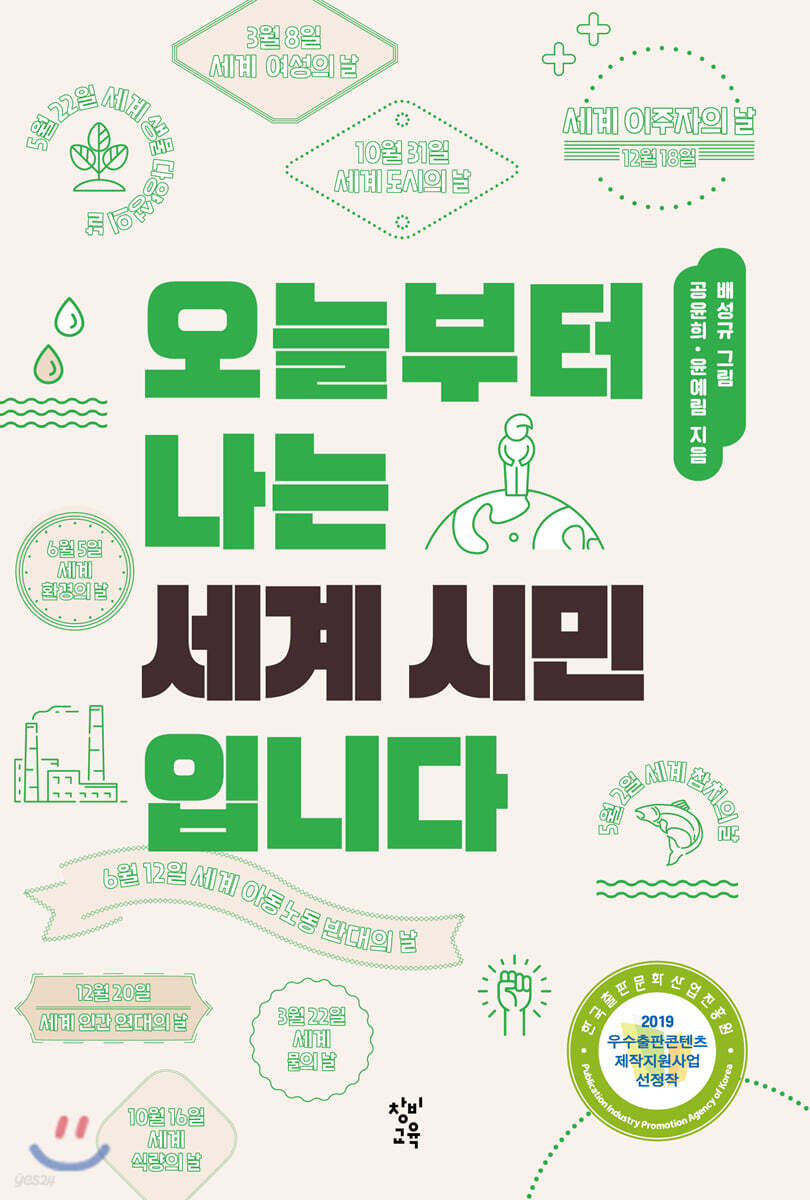
From today on, I am a citizen of the world.
 |
Description
Book Introduction
- A word from MD
-
A story of a sustainable world unfolding on a calendarThe Sustainable Development Goals (SDGs), established on the principle of "leaving no one behind," are explained, starting with various international commemorations designated by the UN.
In an era where poverty and environmental problems persist despite technological and economic advancements, this is a guidebook for "global citizens" who pledge to never "live well alone."
November 19, 2019. Youth PD Kim Do-hoon
Learning about UN World Days
A Guide to Using Earth for Cool Earthlings
Selected for the 2019 Excellent Publication Content Production Support Project.
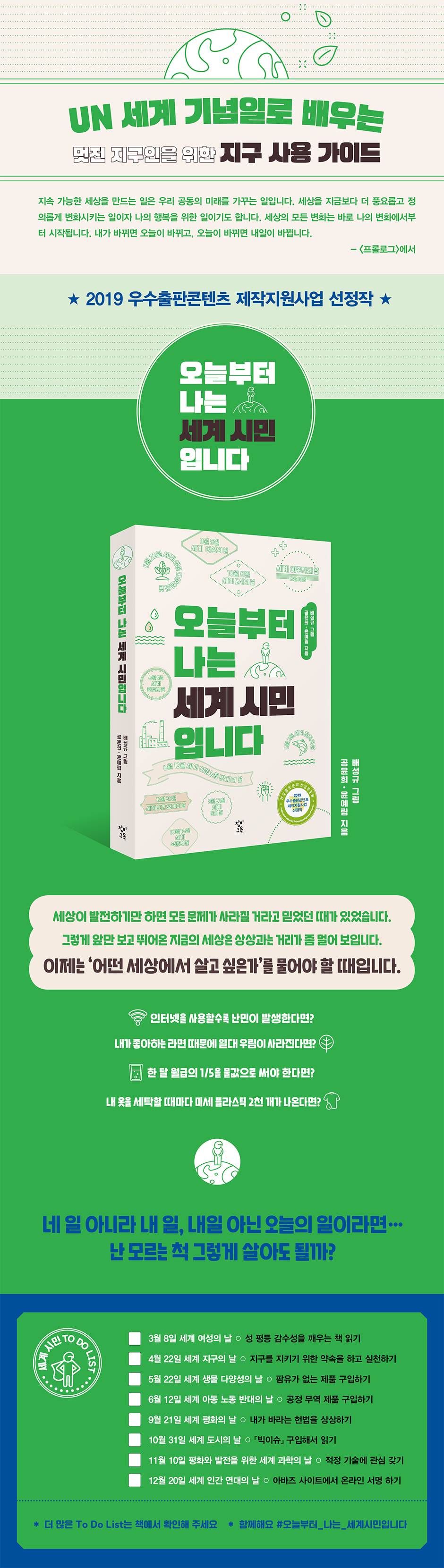
This book describes the 17 'Sustainable Development Goals' that the entire world must achieve together by 2030, starting with international commemorations designated by the UN, such as International Women's Day (March 8), Oceans Day (June 8), Cities Day (October 31), Migrants and Refugees Day (December 18), and Human Solidarity Day (December 20).
By posing questions that connect me, society, and the world, such as, "The more I use the Internet, the more refugees I create?" and "The more I eat ramen, the more tropical rainforests disappear?" and explaining these through various examples, it allows readers to easily and interestingly understand hot-button issues facing the world today, such as women, the environment, labor, discrimination, and hatred.
By suggesting a 'Global Citizen To Do List' at the end of each chapter, we hope to convey the message that change can be seen when each and every person fulfills their role as a global citizen, however small.
Authors Gong Yun-hee and Yoon Ye-rim founded the non-profit organization 'BoniTa, Global Citizenship Education', which aims to create a good globalization in everyday life.
A Guide to Using Earth for Cool Earthlings
Selected for the 2019 Excellent Publication Content Production Support Project.
This book describes the 17 'Sustainable Development Goals' that the entire world must achieve together by 2030, starting with international commemorations designated by the UN, such as International Women's Day (March 8), Oceans Day (June 8), Cities Day (October 31), Migrants and Refugees Day (December 18), and Human Solidarity Day (December 20).
By posing questions that connect me, society, and the world, such as, "The more I use the Internet, the more refugees I create?" and "The more I eat ramen, the more tropical rainforests disappear?" and explaining these through various examples, it allows readers to easily and interestingly understand hot-button issues facing the world today, such as women, the environment, labor, discrimination, and hatred.
By suggesting a 'Global Citizen To Do List' at the end of each chapter, we hope to convey the message that change can be seen when each and every person fulfills their role as a global citizen, however small.
Authors Gong Yun-hee and Yoon Ye-rim founded the non-profit organization 'BoniTa, Global Citizenship Education', which aims to create a good globalization in everyday life.
- You can preview some of the book's contents.
Preview
index
prolog
A story of a sustainable world unfolding on a calendar
March 8 | International Women's Day: Are Women Still Socially Vulnerable?
March 22 | World Water Day: Whoever has water rules the world.
April 7 | World Health Day: Why AIDS Will Never End
April 22 | Earth Day: Black Tears Flow Through the Amazon
May 2nd | World Tuna Day: The Sea That Lays Golden Eggs
May 22 | World Biodiversity Day: Can a Third Earth Succeed?
June 5 | World Environment Day: The Nightmare Before a White Christmas
June 8 | World Oceans Day: How Much Plastic Have You Consumed?
June 12 | World Day Against Child Labor: Why Globalization Matters
September 21 | World Peace Day: How Nations Become Leviathans
September 27th | World Tourism Day: Travel Stories You Must Know Before You Die
October 16th | World Food Day: Where Did All That Food Go?
October 17 | World Day for the Eradication of Poverty: Who Will Take on the Debt?
October 31st | World Cities Day: People Displaced from Their Nests
November 10 | World Science Day for Peace and Development: Scientists Need the Hippocratic Oath Too
December 18 | World Migrants' Day: Would You Live with Aliens?
December 20 | World Human Solidarity Day: When International Development Aid Becomes a Problem
A story of a sustainable world unfolding on a calendar
March 8 | International Women's Day: Are Women Still Socially Vulnerable?
March 22 | World Water Day: Whoever has water rules the world.
April 7 | World Health Day: Why AIDS Will Never End
April 22 | Earth Day: Black Tears Flow Through the Amazon
May 2nd | World Tuna Day: The Sea That Lays Golden Eggs
May 22 | World Biodiversity Day: Can a Third Earth Succeed?
June 5 | World Environment Day: The Nightmare Before a White Christmas
June 8 | World Oceans Day: How Much Plastic Have You Consumed?
June 12 | World Day Against Child Labor: Why Globalization Matters
September 21 | World Peace Day: How Nations Become Leviathans
September 27th | World Tourism Day: Travel Stories You Must Know Before You Die
October 16th | World Food Day: Where Did All That Food Go?
October 17 | World Day for the Eradication of Poverty: Who Will Take on the Debt?
October 31st | World Cities Day: People Displaced from Their Nests
November 10 | World Science Day for Peace and Development: Scientists Need the Hippocratic Oath Too
December 18 | World Migrants' Day: Would You Live with Aliens?
December 20 | World Human Solidarity Day: When International Development Aid Becomes a Problem
Detailed image
Into the book
There is a topic that follows gender equality issues like a related search term in our country.
Military and childcare.
For men who have not yet served in the military, the thought of military service, which they will have to perform someday, is etched in their minds like a burden.
For women who want to have children, the career break that comes with pregnancy, childbirth, and childcare is a major concern.
However, a crack has recently appeared in the social atmosphere where military and childcare were fixed as gender roles for men and women, respectively, and ran parallel.
As the low birth rate problem becomes more serious, voices are being raised that women should also serve in the military.
In addition, with Norway, Sweden, and the Netherlands implementing gender-based conscription systems, the view on women's military service is gradually changing to a more positive one.
However, in Korea, there are also loud voices of concern that it is premature.
Why are we struggling and they are able? …
The concerns that the low birth rate will lead to a decrease in the number of soldiers in the future are not simply groundless.
Everyone should defend their country if necessary, but there are some things to think about before doing so.
The current Korean military must reflect on whether it provides equal opportunities to both men and women and protects soldiers from sexual crimes and violence.
The solution to the low birth rate problem lies not in placing a heavy burden on women and men, but in creating a country where people want to have children and join the military.
--- p.25~26, 28, from “0308 International Women’s Day: Are Women Still the Socially Weak?”
In December 2013, images of Egypt covered in snow surfaced online.
A pure white landscape in Egypt, where it is impossible for it to snow, makes you wonder if it is a photoshopped image.
But it was proven that it wasn't a prank as photos of camels sitting quietly on snow and snow-covered pyramids began to appear one after another.
It actually snowed in Egypt for the first time in 112 years.
…IT technology is rapidly emerging as a solution to save the Earth.
A variety of technologies are being introduced, including navigation apps that help you reach your destination with less fuel, video conferencing programs that allow you to meet without having to travel, and smart water grids that monitor temperature and humidity to conserve water. Research has also shown that utilizing IT can reduce greenhouse gases by as much as 16.5%.
But before using the technology, there are questions to ask:
'Is the energy used in the technology environmentally friendly?'
It is self-evident that if the Earth's average temperature rises more than 2 degrees Celsius compared to pre-industrial levels, irreversible damage will occur to the ecosystem.
Now we are one degree away from the limit.
If you don't cut ties with coal, your white Christmas might turn into a nightmare.
--- p.128, from “0605 World Environment Day: The Nightmare of a White Christmas”
On average, tenants in our country stay in one house for 3 to 4 years.
In a reality where we move every three years, making neighbors is a difficult task.
Given the circumstances, owning a home is essential for a stable life in Korea.
But if Germans heard about this situation in Korea, they might be a little puzzled.
More than half of the population lives in other people's homes, but the average period of time they have lived in one home is more than 10 years.
There is a saying, 'The building owner is above the creator.'
This saying perfectly illustrates the heartbreaking situation of tenants in our country, who must vacate their homes when asked to do so and comply without complaint when asked to raise the rent.
But in Germany, even landlords cannot raise rents at will or evict tenants over these issues.
Both countries have clear limits on how much rents can be raised, but how they enforce them differs.
…a house is more than just a ‘building with a roof’.
After a hard day's work, just coming into the room and lighting a candle and a light makes me feel at ease, and just looking at the newly changed wallpaper brightens my mood. It's a treasure trove.
The numbers written on one side of the wallpaper remind me of my mother's hands measuring my height when I was a child, and the old curtains remind me of playing hide-and-seek behind them.
In other words, a home is also a space that records an individual's life.
Protecting space from being reduced to a means of making money is the way to create a stable city.
--- p.247~248, from “1031 World Cities Day: People Driven Out of Their Nests”
There used to be a comedy show called "Blanca."
It satirized Korean bosses who mistreat immigrant workers, and even popularized the phrase, "Boss, you're bad."
Although there were some exaggerated aspects due to the nature of the comedy genre, it became a hot topic because it dealt with the discriminatory views towards foreigners.
More than a decade after the program ended, has attitudes toward migrant workers changed? Unfortunately, countless people still struggle with discrimination.
Several people live and work long hours in small rooms without locks.
They do the work that Koreans are reluctant to do, but in return they are treated less than human.
Not only in Korea but also around the world, unfounded prejudice and hatred against immigrants still exist.
During his presidential campaign, President Trump said, "The Mexican government is sending a lot of troublesome people to the United States.
They are sexual offenders, and they are the main culprits who bring drugs and commit crimes into the United States.'
Additionally, one of the Harvard students caused controversy by writing an email saying, "Black people are genetically inferior to white people."
In England, there was even an incident where a Korean student was thrown a bottle of alcohol because he was Asian.
As director Neill Blomkamp said, the world seems to be moving more and more towards Johannesburg.
Military and childcare.
For men who have not yet served in the military, the thought of military service, which they will have to perform someday, is etched in their minds like a burden.
For women who want to have children, the career break that comes with pregnancy, childbirth, and childcare is a major concern.
However, a crack has recently appeared in the social atmosphere where military and childcare were fixed as gender roles for men and women, respectively, and ran parallel.
As the low birth rate problem becomes more serious, voices are being raised that women should also serve in the military.
In addition, with Norway, Sweden, and the Netherlands implementing gender-based conscription systems, the view on women's military service is gradually changing to a more positive one.
However, in Korea, there are also loud voices of concern that it is premature.
Why are we struggling and they are able? …
The concerns that the low birth rate will lead to a decrease in the number of soldiers in the future are not simply groundless.
Everyone should defend their country if necessary, but there are some things to think about before doing so.
The current Korean military must reflect on whether it provides equal opportunities to both men and women and protects soldiers from sexual crimes and violence.
The solution to the low birth rate problem lies not in placing a heavy burden on women and men, but in creating a country where people want to have children and join the military.
--- p.25~26, 28, from “0308 International Women’s Day: Are Women Still the Socially Weak?”
In December 2013, images of Egypt covered in snow surfaced online.
A pure white landscape in Egypt, where it is impossible for it to snow, makes you wonder if it is a photoshopped image.
But it was proven that it wasn't a prank as photos of camels sitting quietly on snow and snow-covered pyramids began to appear one after another.
It actually snowed in Egypt for the first time in 112 years.
…IT technology is rapidly emerging as a solution to save the Earth.
A variety of technologies are being introduced, including navigation apps that help you reach your destination with less fuel, video conferencing programs that allow you to meet without having to travel, and smart water grids that monitor temperature and humidity to conserve water. Research has also shown that utilizing IT can reduce greenhouse gases by as much as 16.5%.
But before using the technology, there are questions to ask:
'Is the energy used in the technology environmentally friendly?'
It is self-evident that if the Earth's average temperature rises more than 2 degrees Celsius compared to pre-industrial levels, irreversible damage will occur to the ecosystem.
Now we are one degree away from the limit.
If you don't cut ties with coal, your white Christmas might turn into a nightmare.
--- p.128, from “0605 World Environment Day: The Nightmare of a White Christmas”
On average, tenants in our country stay in one house for 3 to 4 years.
In a reality where we move every three years, making neighbors is a difficult task.
Given the circumstances, owning a home is essential for a stable life in Korea.
But if Germans heard about this situation in Korea, they might be a little puzzled.
More than half of the population lives in other people's homes, but the average period of time they have lived in one home is more than 10 years.
There is a saying, 'The building owner is above the creator.'
This saying perfectly illustrates the heartbreaking situation of tenants in our country, who must vacate their homes when asked to do so and comply without complaint when asked to raise the rent.
But in Germany, even landlords cannot raise rents at will or evict tenants over these issues.
Both countries have clear limits on how much rents can be raised, but how they enforce them differs.
…a house is more than just a ‘building with a roof’.
After a hard day's work, just coming into the room and lighting a candle and a light makes me feel at ease, and just looking at the newly changed wallpaper brightens my mood. It's a treasure trove.
The numbers written on one side of the wallpaper remind me of my mother's hands measuring my height when I was a child, and the old curtains remind me of playing hide-and-seek behind them.
In other words, a home is also a space that records an individual's life.
Protecting space from being reduced to a means of making money is the way to create a stable city.
--- p.247~248, from “1031 World Cities Day: People Driven Out of Their Nests”
There used to be a comedy show called "Blanca."
It satirized Korean bosses who mistreat immigrant workers, and even popularized the phrase, "Boss, you're bad."
Although there were some exaggerated aspects due to the nature of the comedy genre, it became a hot topic because it dealt with the discriminatory views towards foreigners.
More than a decade after the program ended, has attitudes toward migrant workers changed? Unfortunately, countless people still struggle with discrimination.
Several people live and work long hours in small rooms without locks.
They do the work that Koreans are reluctant to do, but in return they are treated less than human.
Not only in Korea but also around the world, unfounded prejudice and hatred against immigrants still exist.
During his presidential campaign, President Trump said, "The Mexican government is sending a lot of troublesome people to the United States.
They are sexual offenders, and they are the main culprits who bring drugs and commit crimes into the United States.'
Additionally, one of the Harvard students caused controversy by writing an email saying, "Black people are genetically inferior to white people."
In England, there was even an incident where a Korean student was thrown a bottle of alcohol because he was Asian.
As director Neill Blomkamp said, the world seems to be moving more and more towards Johannesburg.
--- p.275~276, from “1218 World Migrants’ Day: Would You Live with Aliens?”
Publisher's Review
I believed that as the world progressed, all problems would disappear.
There was a time when it was believed that the world would progress through advancements in learning and technology, and that many problems would be solved.
There were also expectations that as the world economy grew, the number of people living in poverty would decrease, and that the influx of financially powerful multinational corporations would lead to an increase in quality jobs.
It was believed that as science and technology advanced, humanity would not only be freed from disease but also overcome troubling environmental problems.
There was also hope that as information and communication technology became more sophisticated, citizen participation would increase and democracy would develop.
But what does the world look like when we only look ahead and run forward?
It seems far from the sweet image that mankind imagined.
The global economy is growing rapidly, but the gap between rich and poor between and within countries has emerged as a serious problem.
Indiscriminate development and consumption that emphasizes only convenience and efficiency have increased, causing the Earth to succumb to waste and now threaten the very survival of life.
In a world where travel has become easier than ever before, people live in fear to avoid life-threatening infectious diseases, and despite advancements in communication technology, dictatorial powers that suppress citizens' freedoms persist.
Now everyone must ask what kind of world we want to live in!
In today's world, where abundance and poverty, opportunity and crisis coexist, voices warning of crisis and the need for a new interpretation of "development" are beginning to erupt from all sides.
If you pay even a little attention, you'll see that news is very frequent about animals being found dead with their stomachs full of garbage, water being conserved as a public good rather than a private one, and a president who says he can kill people at will if he wages war against "evil."
This could also be seen as meaning that the Earth and its people have almost reached the limit of what they can endure.
Until now, the focus has been on 'how much will we develop?' Now, many people are finally starting to agree and take action to ask 'how will we develop?' and 'what kind of world do we want to live in?'
What if the issues we've long considered distant and unrelated to us are actually profound, affecting us and those around us? What if the issues we've been putting off, saying we'll think about tomorrow because we're too busy, are actually pressing issues that need to be addressed today? Can we continue to live as usual, pretending we don't know? We must now seriously consider and find solutions to the burning issues surrounding women, the environment, labor, discrimination, and hatred that plague our planet.
"From Today On, I Am a Global Citizen" is a book written by authors Gong Yun-hee and Yoon Ye-rim, which contains the results of their reflections on global issues and their studies on how to live as global citizens.
'The world is now, and I am!' as seen through the UN commemorative days spread across the calendar.
In 2015, the United Nations announced the Sustainable Development Goals (SDGs) with the core principle of “leaving no one behind.”
The SDGs, which the world must achieve together by 2030, include not only goals related to economic growth but also goals related to social inclusion, such as realizing gender equality, expanding quality jobs, ensuring the right to stable urban housing, and increasing fair trade, as well as environmental issues, including expanding clean and renewable energy, conserving land and marine resources, and responding to climate change.
In addition, governance for inclusive policies and systems has also emerged as a key axis.
It is also noteworthy that the SDGs emphasize the role of global citizens.
While governments were once viewed as the sole problem solvers, the new crises we face today are difficult to resolve without the participation of citizens.
As more and more global citizens understand how the world works, empathize with the values of the SDGs, take responsibility for their actions, and move toward change, a sustainable world will become closer.
Accordingly, this book is the result of my reflections on how to explain the 17 SDGs in an easy and interesting way, so that it can serve as a stepping stone for Korean citizens to grow into global citizens.
This book explains the SDGs through various international commemorations designated by the United Nations.
The calendar we use may seem ordinary, but it actually hides over 130 UN commemorative days.
In this book, the UN Memorial Day is a day that every citizen of the world should remember and a day when the world unites to solve problems.
It's not easy alone, but together, there's nothing we can't do.
By learning about the UN commemorative days spread out on the calendar each day, you will be able to encounter the true face of complex global issues.
It also asks questions that connect us to our own lives, such as, "Does the more we use the internet, the more refugees we create?", "How will the economic crisis take my job?", and "What if the more we eat ramen, the more tropical rainforests disappear?", connecting us to ourselves, our communities, and the world. Through various case studies, it explores the connection between the Sustainable Development Goals and our daily lives.
In addition, each chapter contains various methods and practices that can be implemented in daily life to create a sustainable world.
When one individual tries to live as a global citizen in the face of the world's enormous problems, there may be times when one feels helpless and wants to give up.
But we have witnessed many instances where history was changed by the initiative of one person.
Creating a sustainable world is about cultivating our common future.
It is a work that changes the world to be more prosperous and just than it is now, and it is also a work for my own happiness.
All changes in the world begin with my own changes.
If I change, today will change, and if today changes, tomorrow will change.
There was a time when it was believed that the world would progress through advancements in learning and technology, and that many problems would be solved.
There were also expectations that as the world economy grew, the number of people living in poverty would decrease, and that the influx of financially powerful multinational corporations would lead to an increase in quality jobs.
It was believed that as science and technology advanced, humanity would not only be freed from disease but also overcome troubling environmental problems.
There was also hope that as information and communication technology became more sophisticated, citizen participation would increase and democracy would develop.
But what does the world look like when we only look ahead and run forward?
It seems far from the sweet image that mankind imagined.
The global economy is growing rapidly, but the gap between rich and poor between and within countries has emerged as a serious problem.
Indiscriminate development and consumption that emphasizes only convenience and efficiency have increased, causing the Earth to succumb to waste and now threaten the very survival of life.
In a world where travel has become easier than ever before, people live in fear to avoid life-threatening infectious diseases, and despite advancements in communication technology, dictatorial powers that suppress citizens' freedoms persist.
Now everyone must ask what kind of world we want to live in!
In today's world, where abundance and poverty, opportunity and crisis coexist, voices warning of crisis and the need for a new interpretation of "development" are beginning to erupt from all sides.
If you pay even a little attention, you'll see that news is very frequent about animals being found dead with their stomachs full of garbage, water being conserved as a public good rather than a private one, and a president who says he can kill people at will if he wages war against "evil."
This could also be seen as meaning that the Earth and its people have almost reached the limit of what they can endure.
Until now, the focus has been on 'how much will we develop?' Now, many people are finally starting to agree and take action to ask 'how will we develop?' and 'what kind of world do we want to live in?'
What if the issues we've long considered distant and unrelated to us are actually profound, affecting us and those around us? What if the issues we've been putting off, saying we'll think about tomorrow because we're too busy, are actually pressing issues that need to be addressed today? Can we continue to live as usual, pretending we don't know? We must now seriously consider and find solutions to the burning issues surrounding women, the environment, labor, discrimination, and hatred that plague our planet.
"From Today On, I Am a Global Citizen" is a book written by authors Gong Yun-hee and Yoon Ye-rim, which contains the results of their reflections on global issues and their studies on how to live as global citizens.
'The world is now, and I am!' as seen through the UN commemorative days spread across the calendar.
In 2015, the United Nations announced the Sustainable Development Goals (SDGs) with the core principle of “leaving no one behind.”
The SDGs, which the world must achieve together by 2030, include not only goals related to economic growth but also goals related to social inclusion, such as realizing gender equality, expanding quality jobs, ensuring the right to stable urban housing, and increasing fair trade, as well as environmental issues, including expanding clean and renewable energy, conserving land and marine resources, and responding to climate change.
In addition, governance for inclusive policies and systems has also emerged as a key axis.
It is also noteworthy that the SDGs emphasize the role of global citizens.
While governments were once viewed as the sole problem solvers, the new crises we face today are difficult to resolve without the participation of citizens.
As more and more global citizens understand how the world works, empathize with the values of the SDGs, take responsibility for their actions, and move toward change, a sustainable world will become closer.
Accordingly, this book is the result of my reflections on how to explain the 17 SDGs in an easy and interesting way, so that it can serve as a stepping stone for Korean citizens to grow into global citizens.
This book explains the SDGs through various international commemorations designated by the United Nations.
The calendar we use may seem ordinary, but it actually hides over 130 UN commemorative days.
In this book, the UN Memorial Day is a day that every citizen of the world should remember and a day when the world unites to solve problems.
It's not easy alone, but together, there's nothing we can't do.
By learning about the UN commemorative days spread out on the calendar each day, you will be able to encounter the true face of complex global issues.
It also asks questions that connect us to our own lives, such as, "Does the more we use the internet, the more refugees we create?", "How will the economic crisis take my job?", and "What if the more we eat ramen, the more tropical rainforests disappear?", connecting us to ourselves, our communities, and the world. Through various case studies, it explores the connection between the Sustainable Development Goals and our daily lives.
In addition, each chapter contains various methods and practices that can be implemented in daily life to create a sustainable world.
When one individual tries to live as a global citizen in the face of the world's enormous problems, there may be times when one feels helpless and wants to give up.
But we have witnessed many instances where history was changed by the initiative of one person.
Creating a sustainable world is about cultivating our common future.
It is a work that changes the world to be more prosperous and just than it is now, and it is also a work for my own happiness.
All changes in the world begin with my own changes.
If I change, today will change, and if today changes, tomorrow will change.
GOODS SPECIFICS
- Date of publication: October 25, 2019
- Page count, weight, size: 328 pages | 594g | 153*224*20mm
- ISBN13: 9791189228637
- ISBN10: 1189228637
You may also like
카테고리
korean


korean

![GQ KOREA Mark (Monthly): December [2025]](http://librairie.coreenne.fr/cdn/shop/files/8ef265dbbfbf186523ed75ba7319009d.jpg?v=1765340328&width=3840)


