

An engineering student reading a science book
 |
Description
Book Introduction
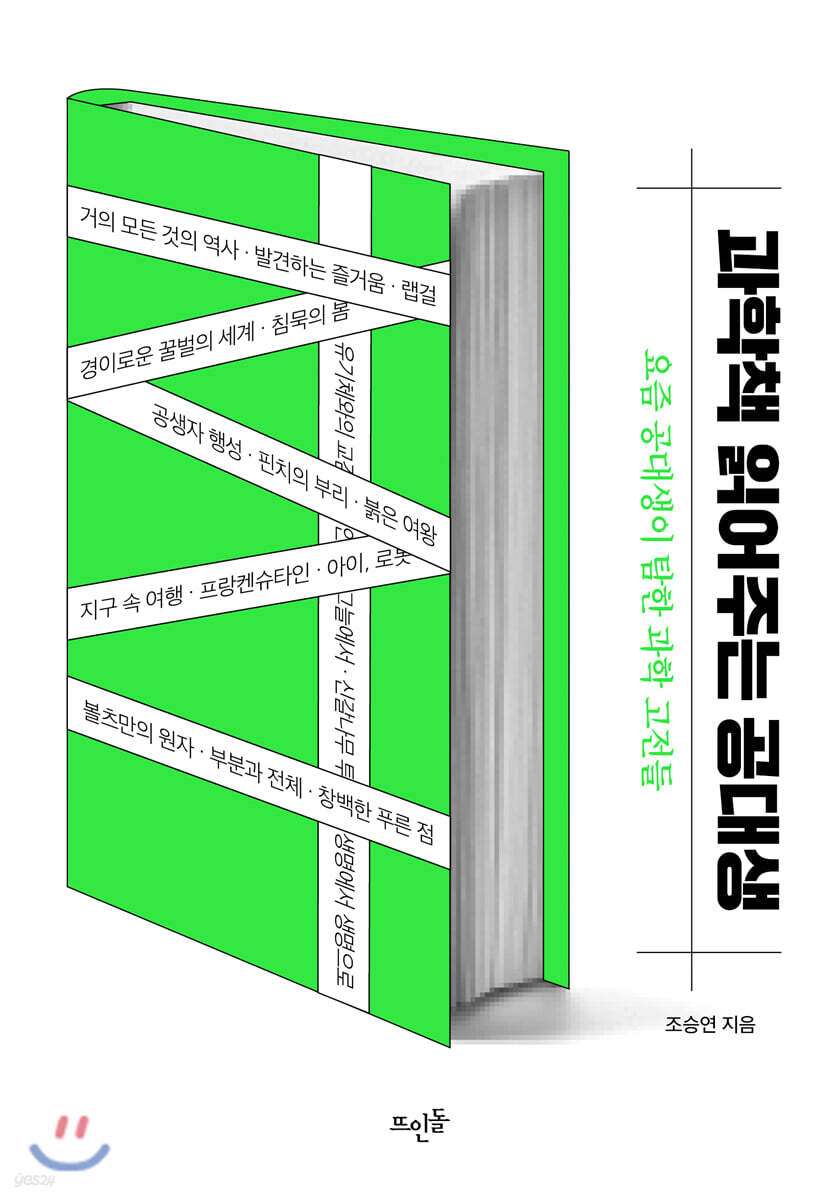
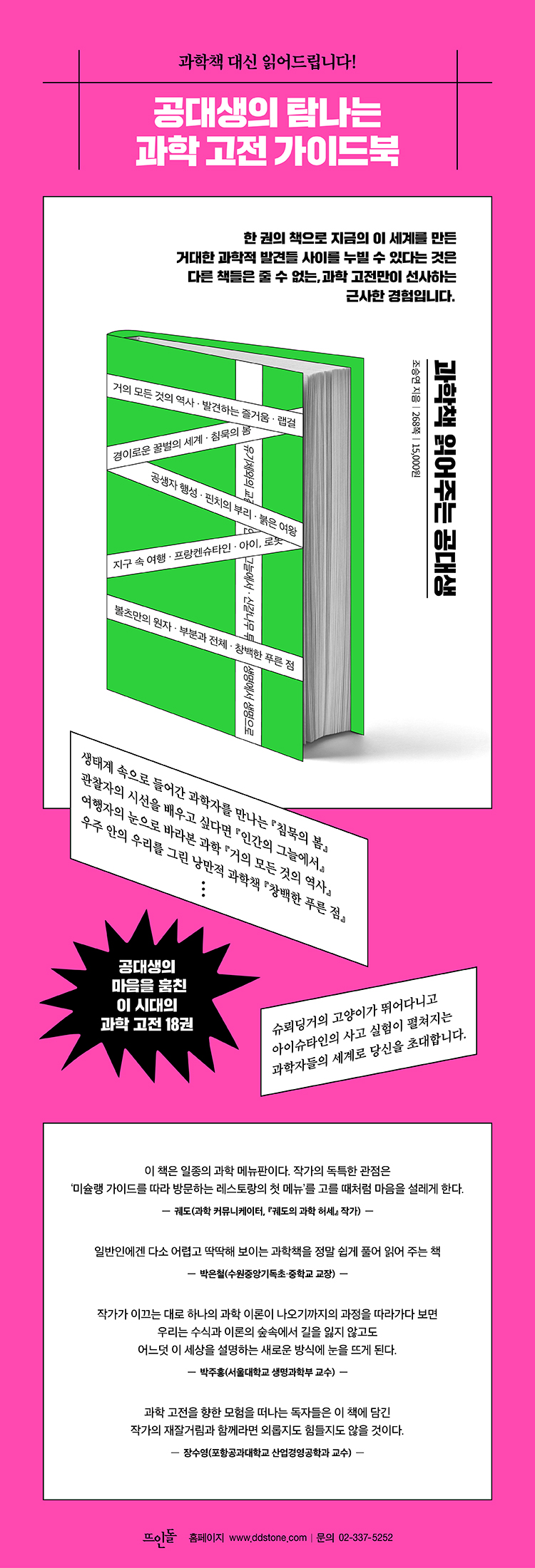
This guidebook introduces 18 science classics that have captured the hearts of today's engineering students! Science is a cutting-edge field, brimming with equations and theories. Yet, why do these classics, written decades or even centuries ago, capture the hearts of engineering students? Hidden within these classics are stories of unseen gems, from the humane stories of scientists to the momentous discoveries that shaped our world.
The author, who is well aware of the difficulties of reading scientific classics, meticulously explains 18 scientific books to avoid readers experiencing the same confusion as he did.
It provides detailed information about the author and historical background of the book being introduced, as well as explanations of scientific terms and concepts that may seem difficult.
You can also feel the bold and fresh ideas of engineering students.
Readers of this book, guided by a friendly engineering student, will not only acquire the vast scientific knowledge that shaped the world we live in today, but will also be able to glimpse into the fascinating world of scientists.
The author, who is well aware of the difficulties of reading scientific classics, meticulously explains 18 scientific books to avoid readers experiencing the same confusion as he did.
It provides detailed information about the author and historical background of the book being introduced, as well as explanations of scientific terms and concepts that may seem difficult.
You can also feel the bold and fresh ideas of engineering students.
Readers of this book, guided by a friendly engineering student, will not only acquire the vast scientific knowledge that shaped the world we live in today, but will also be able to glimpse into the fascinating world of scientists.
- You can preview some of the book's contents.
Preview
index
Chapter 1 If you want to learn the observer's perspective
A Quiet and Fierce Forest Epic: The Struggle of the Oak Tree
Meet Nature's Cleaners: From Life to Life
"In the Shadow of Humans": A Careful Look into the Life of Chimpanzees
(Engineering Student Diary) The Hidden Scientific Code in BTS's "Serendipity"
Chapter 2: Scientists, Reading Life
Science Through the Eyes of a Traveler: A Brief History of Nearly Everything
An Eccentric Scientist's Invitation to "The Joy of Discovery"
A History of Genetics Written Intuitively: "Communication with Organisms"
The Path of a Scientist: "Lab Girl"
(Engineering Student Diary) The daily life of a typical life science major
Chapter 3: Things You Didn't Know About Evolution
Evolution is live on 『Finch's Beak』
We Are Not the Protagonists of Earth: Symbiote Planet
The Secret of the Popular Guys: The Red Queen, Vol. 125
(Engineering Student Diary) Engineering students can't write?
Chapter 4 .
Scientists Enter the Ecosystem
The Moving Society of Bees: The Amazing World of Bees
If a world where birds don't sing even in spring comes, "Silent Spring"
(Engineering Student Diary) Entering the path of a lab girl
Chapter 5 .
Physics, a trendsetting era
The Small and Magnificent Life of a Scientist: Boltzmann's Atom
The People Who Gave Birth to the Physics of That Era: "The Part and the Whole"
Will I ever meet them? 『Pale Blue Dot』
Engineering Student Diary) A group chat for people who love science
Chapter 6 .
Science inspires fiction
A Taste of Pre-19th Century Scientific Imagination in Journey to the Center of the Earth
The tragic irony of the creator and his creation in Frankenstein
A Happy Ending for Robots and Humans in "I, Robot"
(Engineering Student Diary) Things that are responsible for the engineering school's sensibility
A Quiet and Fierce Forest Epic: The Struggle of the Oak Tree
Meet Nature's Cleaners: From Life to Life
"In the Shadow of Humans": A Careful Look into the Life of Chimpanzees
(Engineering Student Diary) The Hidden Scientific Code in BTS's "Serendipity"
Chapter 2: Scientists, Reading Life
Science Through the Eyes of a Traveler: A Brief History of Nearly Everything
An Eccentric Scientist's Invitation to "The Joy of Discovery"
A History of Genetics Written Intuitively: "Communication with Organisms"
The Path of a Scientist: "Lab Girl"
(Engineering Student Diary) The daily life of a typical life science major
Chapter 3: Things You Didn't Know About Evolution
Evolution is live on 『Finch's Beak』
We Are Not the Protagonists of Earth: Symbiote Planet
The Secret of the Popular Guys: The Red Queen, Vol. 125
(Engineering Student Diary) Engineering students can't write?
Chapter 4 .
Scientists Enter the Ecosystem
The Moving Society of Bees: The Amazing World of Bees
If a world where birds don't sing even in spring comes, "Silent Spring"
(Engineering Student Diary) Entering the path of a lab girl
Chapter 5 .
Physics, a trendsetting era
The Small and Magnificent Life of a Scientist: Boltzmann's Atom
The People Who Gave Birth to the Physics of That Era: "The Part and the Whole"
Will I ever meet them? 『Pale Blue Dot』
Engineering Student Diary) A group chat for people who love science
Chapter 6 .
Science inspires fiction
A Taste of Pre-19th Century Scientific Imagination in Journey to the Center of the Earth
The tragic irony of the creator and his creation in Frankenstein
A Happy Ending for Robots and Humans in "I, Robot"
(Engineering Student Diary) Things that are responsible for the engineering school's sensibility
Detailed image
Into the book
Scientific classics are like different planets, each containing the amazing ideas and discoveries of some scientist.
Each book is an adventure that transcends time, charting the course of a discovery.
Some books tell the story of discoverers who uncovered what happened inside cells over hundreds of millions of years, while others tell the story of an amateur scientist who, before the turn of the 19th century, foresaw in detail a future very similar to our own.
The fact that you can navigate the great scientific discoveries that shaped the world we live in through just one book.
That you can admire it.
It is an experience that only a science classic can provide, something that other books cannot.
… Every scientific classic tells us how a scientific claim overcame the opposition and conflicts it faced to reach its current position, and how scientists went through the trials and failures to arrive at a conclusion.
Therefore, we who read scientific classics may have to give up comfortable reading and read the book as if we were scientists.
But the intellectual experience this reading provides is simply amazing.
--- From the author's note
In this way, death is also a way of adaptation for living things.
When we encounter the wisdom of nature, which does not waste even the last bit of life, the foolishness of humans seems even greater.
Humans are heading towards their own destruction, ignorant of the impact they are having on the ecosystem.
Humans are the only animals like that.
Therefore, understanding the process of death and how nature reuses the resources obtained during this process is more important than any other knowledge we have today.
--- p.34, from 'Meeting Nature's Cleaners: From Life to Life'
[#232] ...
I became quite curious.
… Let’s talk about science for a moment while pondering the meaning of the lyrics.
First, let's talk about mold.
Penicillium is one of the most important bacterial strains to humans.
Because he is a major contributor to the discovery of the first antibiotic.
In the past, when there was no other way to treat a wound than to disinfect it, and additional bacterial infection could easily lead to death, the advent of antibiotics opened up new possibilities for wound treatment.
Do you know Alexander Fleming, the British bacteriologist who extracted penicillin, the first antibiotic, from blue mold?
But the important thing is that Fleming's discovery of the antibiotic from blue mold was purely accidental.
--- p.47, from 'The Hidden Scientific Code in BTS [Serendipity]'
Everyone learns science in regular classes starting in elementary school, but the science we learn in school doesn't always lead to interest.
He wanted to see if people who had been away from science for a long time could find enjoyment in it again, become masters of the knowledge they had gained through study, and pass that knowledge on to others.
This is why he began to study science in earnest by visiting scientists, reading books by science writers, and searching professional academic journals.
This book may have been written to introduce the process of an ordinary person 'reuniting' with science.
Let's take a closer look at the book.
As befitting a seasoned writer, Bill Bryson opens with an intriguing question.
The question is this:
'How do scientists find out scientific facts?'
--- p.55, from 'Science through the eyes of a traveler: A History of Nearly Everything'
Feynman's life, as told in his autobiography, is full of humor and pranks.
He was once invited to the Manhattan Project, a project to create an atomic bomb, and lived under the surveillance of the US Department of Defense. Whenever he had time, he would play around by finding out the safe's password.
He also did not hesitate to commit dangerous pranks, such as forging letters exchanged with his wife as if they were top-secret documents, thereby confusing Ministry of National Defense officials.
There was even a rumor that a warning was circulated saying, "Be careful when Feynman visits."
If the rumors were true, Feynman himself would have received them with great delight.
--- pp.63~64, from 'The Joy of Discovery: An Invitation from an Eccentric Scientist'
I think the "qualification" of a scientist that Hope Jahren talks about in her book is the ability to ask questions.
To scientists, the world is full of questions.
It cannot be denied that the willingness to get lost in the midst of countless questions and, ironically, to ask questions again is one of the greatest joys in a scientist's life.
--- p.96, from 'The Path of a Scientist's Creation, 'Lab Girl'
We were all once someone's first love.
And many of the great science fiction writers were once engineering students.
This fact is a pretty strong point of excitement.
Nevertheless, there is a rumor that engineering students are not good at writing.
Preconceptions like 'engineering students are far from books' are no longer surprising.
Are you saying that engineering students only need to be good at math?
Each book is an adventure that transcends time, charting the course of a discovery.
Some books tell the story of discoverers who uncovered what happened inside cells over hundreds of millions of years, while others tell the story of an amateur scientist who, before the turn of the 19th century, foresaw in detail a future very similar to our own.
The fact that you can navigate the great scientific discoveries that shaped the world we live in through just one book.
That you can admire it.
It is an experience that only a science classic can provide, something that other books cannot.
… Every scientific classic tells us how a scientific claim overcame the opposition and conflicts it faced to reach its current position, and how scientists went through the trials and failures to arrive at a conclusion.
Therefore, we who read scientific classics may have to give up comfortable reading and read the book as if we were scientists.
But the intellectual experience this reading provides is simply amazing.
--- From the author's note
In this way, death is also a way of adaptation for living things.
When we encounter the wisdom of nature, which does not waste even the last bit of life, the foolishness of humans seems even greater.
Humans are heading towards their own destruction, ignorant of the impact they are having on the ecosystem.
Humans are the only animals like that.
Therefore, understanding the process of death and how nature reuses the resources obtained during this process is more important than any other knowledge we have today.
--- p.34, from 'Meeting Nature's Cleaners: From Life to Life'
[#232] ...
I became quite curious.
… Let’s talk about science for a moment while pondering the meaning of the lyrics.
First, let's talk about mold.
Penicillium is one of the most important bacterial strains to humans.
Because he is a major contributor to the discovery of the first antibiotic.
In the past, when there was no other way to treat a wound than to disinfect it, and additional bacterial infection could easily lead to death, the advent of antibiotics opened up new possibilities for wound treatment.
Do you know Alexander Fleming, the British bacteriologist who extracted penicillin, the first antibiotic, from blue mold?
But the important thing is that Fleming's discovery of the antibiotic from blue mold was purely accidental.
--- p.47, from 'The Hidden Scientific Code in BTS [Serendipity]'
Everyone learns science in regular classes starting in elementary school, but the science we learn in school doesn't always lead to interest.
He wanted to see if people who had been away from science for a long time could find enjoyment in it again, become masters of the knowledge they had gained through study, and pass that knowledge on to others.
This is why he began to study science in earnest by visiting scientists, reading books by science writers, and searching professional academic journals.
This book may have been written to introduce the process of an ordinary person 'reuniting' with science.
Let's take a closer look at the book.
As befitting a seasoned writer, Bill Bryson opens with an intriguing question.
The question is this:
'How do scientists find out scientific facts?'
--- p.55, from 'Science through the eyes of a traveler: A History of Nearly Everything'
Feynman's life, as told in his autobiography, is full of humor and pranks.
He was once invited to the Manhattan Project, a project to create an atomic bomb, and lived under the surveillance of the US Department of Defense. Whenever he had time, he would play around by finding out the safe's password.
He also did not hesitate to commit dangerous pranks, such as forging letters exchanged with his wife as if they were top-secret documents, thereby confusing Ministry of National Defense officials.
There was even a rumor that a warning was circulated saying, "Be careful when Feynman visits."
If the rumors were true, Feynman himself would have received them with great delight.
--- pp.63~64, from 'The Joy of Discovery: An Invitation from an Eccentric Scientist'
I think the "qualification" of a scientist that Hope Jahren talks about in her book is the ability to ask questions.
To scientists, the world is full of questions.
It cannot be denied that the willingness to get lost in the midst of countless questions and, ironically, to ask questions again is one of the greatest joys in a scientist's life.
--- p.96, from 'The Path of a Scientist's Creation, 'Lab Girl'
We were all once someone's first love.
And many of the great science fiction writers were once engineering students.
This fact is a pretty strong point of excitement.
Nevertheless, there is a rumor that engineering students are not good at writing.
Preconceptions like 'engineering students are far from books' are no longer surprising.
Are you saying that engineering students only need to be good at math?
--- p.136, from 'Engineering students can't write?'
Publisher's Review
Schrödinger's cat is running around
Einstein's thought experiment unfolds
We invite you to the world of scientific classics!
Science classics coveted by engineering students today
In an age where everything changes rapidly, there are 'science classics' that have stolen the hearts of 'modern engineering students.'
The author, who realized the power of books early in middle school when she published "A Girl Exploring Appropriate Technology," was captivated by science classics while living as an engineering student.
Science is a cutting-edge field, brimming with equations and theories. Why, then, do classic science books written decades, or even centuries, capture the hearts of today's engineering students? Hidden within these classics lie unseen gems, from the humane stories of scientists to the momentous discoveries that shaped the world we know today.
The author, with the motto "Your and My Happiness," introduces 18 science classics that captivated him, believing that he cannot keep such interesting information to himself.
When we unpack the classic book, Silent Spring, whose title everyone has heard at least once, we are reminded of the weighty fact that thanks to this book, we are able to breathe and live in a relatively clean environment today. In Jane Goodall's Shadow of Man, we subtly recommend the secret pleasure of reading an observational journal.
Moreover, the author breaks the stereotype that science books are boring and writes a new definition of science classics by pointing out the modern-day reality that the first science novel written 200 years ago in 『Frankenstein』 hit the mark, and the beautiful and intense process of creating a scientist in 『Lab Girl』.
The world of scientists is so fascinating,
I find myself reaching for a science book without even realizing it!
Why are science classics so fascinating? The world we live in today was created by the accumulation of countless scientific discoveries.
The author says that reading a scientific classic is like traveling back in time to the moment of that great discovery.
In science, 'discovery' is possible because scientists look at the world in a 'new way'.
New methods and new discoveries are not always welcome.
What scientists have undertaken is a challenge that shatters existing perceptions and frozen thinking, and the classic science novels that depict this are more exciting than any thriller.
Also, classic science fiction contains human backstories of seemingly cool and rational scientists.
From the anecdote of Einstein, who turned the scientific world upside down with the 'Theory of Relativity', to how he suddenly became an 'uncommunicative established scientist' because he could not accept the uncertainty of quantum mechanics, to the difficulties that female scientists had to face, to the innocent boyish side of Carl Sagan, a cool-headed astronomer who imagined the existence of extraterrestrial beings, to Richard Feynman, who could live without a Nobel Prize but could not live without a joke, the author captures the human side of scientists hidden behind the images of formulas and equations in scientific classics.
As you follow the author's guidance and delve into the fascinating world of scientists, you'll find yourself wanting to read more science books.
A Coveted Science Classics Guidebook for Engineering Students
The author frankly admits that reading scientific classics is not an easy task.
He is well aware of the difficulties, so he carefully explains science books to avoid readers experiencing the same confusion as he did.
Scientific terms and concepts that may seem difficult are included in a separate tip box to help with understanding, and detailed information about the author and historical background of the book is included throughout the text.
The author possesses the friendliness of a common engineering student, but also has a fresh and bold voice that established writers and scientists cannot express.
He recommends science books to his professors, saying, “One of the reasons scientists should read science books is because they need to learn how to talk about science well.” He also points out the critical spirit as a great charm of science, saying, “Science should sometimes be able to criticize not only authoritative scholars but also oneself.”
Additionally, in the 'Engineering Student Diary' corner at the back of each chapter, you can fully experience the liveliness and imagination of college students through analysis of scientific codes contained in BTS's lyrics, realistic depictions of the daily lives of engineering students, and virtual conversations between scientists.
In short, this is a coveted classic science guidebook that will appeal to a wide range of readers, from professionals working in the scientific field to those still unfamiliar with science, to young people seeking information on essay writing or career paths.
Einstein's thought experiment unfolds
We invite you to the world of scientific classics!
Science classics coveted by engineering students today
In an age where everything changes rapidly, there are 'science classics' that have stolen the hearts of 'modern engineering students.'
The author, who realized the power of books early in middle school when she published "A Girl Exploring Appropriate Technology," was captivated by science classics while living as an engineering student.
Science is a cutting-edge field, brimming with equations and theories. Why, then, do classic science books written decades, or even centuries, capture the hearts of today's engineering students? Hidden within these classics lie unseen gems, from the humane stories of scientists to the momentous discoveries that shaped the world we know today.
The author, with the motto "Your and My Happiness," introduces 18 science classics that captivated him, believing that he cannot keep such interesting information to himself.
When we unpack the classic book, Silent Spring, whose title everyone has heard at least once, we are reminded of the weighty fact that thanks to this book, we are able to breathe and live in a relatively clean environment today. In Jane Goodall's Shadow of Man, we subtly recommend the secret pleasure of reading an observational journal.
Moreover, the author breaks the stereotype that science books are boring and writes a new definition of science classics by pointing out the modern-day reality that the first science novel written 200 years ago in 『Frankenstein』 hit the mark, and the beautiful and intense process of creating a scientist in 『Lab Girl』.
The world of scientists is so fascinating,
I find myself reaching for a science book without even realizing it!
Why are science classics so fascinating? The world we live in today was created by the accumulation of countless scientific discoveries.
The author says that reading a scientific classic is like traveling back in time to the moment of that great discovery.
In science, 'discovery' is possible because scientists look at the world in a 'new way'.
New methods and new discoveries are not always welcome.
What scientists have undertaken is a challenge that shatters existing perceptions and frozen thinking, and the classic science novels that depict this are more exciting than any thriller.
Also, classic science fiction contains human backstories of seemingly cool and rational scientists.
From the anecdote of Einstein, who turned the scientific world upside down with the 'Theory of Relativity', to how he suddenly became an 'uncommunicative established scientist' because he could not accept the uncertainty of quantum mechanics, to the difficulties that female scientists had to face, to the innocent boyish side of Carl Sagan, a cool-headed astronomer who imagined the existence of extraterrestrial beings, to Richard Feynman, who could live without a Nobel Prize but could not live without a joke, the author captures the human side of scientists hidden behind the images of formulas and equations in scientific classics.
As you follow the author's guidance and delve into the fascinating world of scientists, you'll find yourself wanting to read more science books.
A Coveted Science Classics Guidebook for Engineering Students
The author frankly admits that reading scientific classics is not an easy task.
He is well aware of the difficulties, so he carefully explains science books to avoid readers experiencing the same confusion as he did.
Scientific terms and concepts that may seem difficult are included in a separate tip box to help with understanding, and detailed information about the author and historical background of the book is included throughout the text.
The author possesses the friendliness of a common engineering student, but also has a fresh and bold voice that established writers and scientists cannot express.
He recommends science books to his professors, saying, “One of the reasons scientists should read science books is because they need to learn how to talk about science well.” He also points out the critical spirit as a great charm of science, saying, “Science should sometimes be able to criticize not only authoritative scholars but also oneself.”
Additionally, in the 'Engineering Student Diary' corner at the back of each chapter, you can fully experience the liveliness and imagination of college students through analysis of scientific codes contained in BTS's lyrics, realistic depictions of the daily lives of engineering students, and virtual conversations between scientists.
In short, this is a coveted classic science guidebook that will appeal to a wide range of readers, from professionals working in the scientific field to those still unfamiliar with science, to young people seeking information on essay writing or career paths.
GOODS SPECIFICS
- Date of publication: October 7, 2019
- Page count, weight, size: 268 pages | 346g | 140*200*20mm
- ISBN13: 9788958077275
- ISBN10: 8958077271
You may also like
카테고리
korean


korean

![GQ KOREA Mark (Monthly): December [2025]](http://librairie.coreenne.fr/cdn/shop/files/8ef265dbbfbf186523ed75ba7319009d.jpg?v=1765340328&width=3840)


