

Dalai Lama speaks of anger
 |
Description
Book Introduction
“All Buddhist teachings begin with the relationship between teacher and student.”
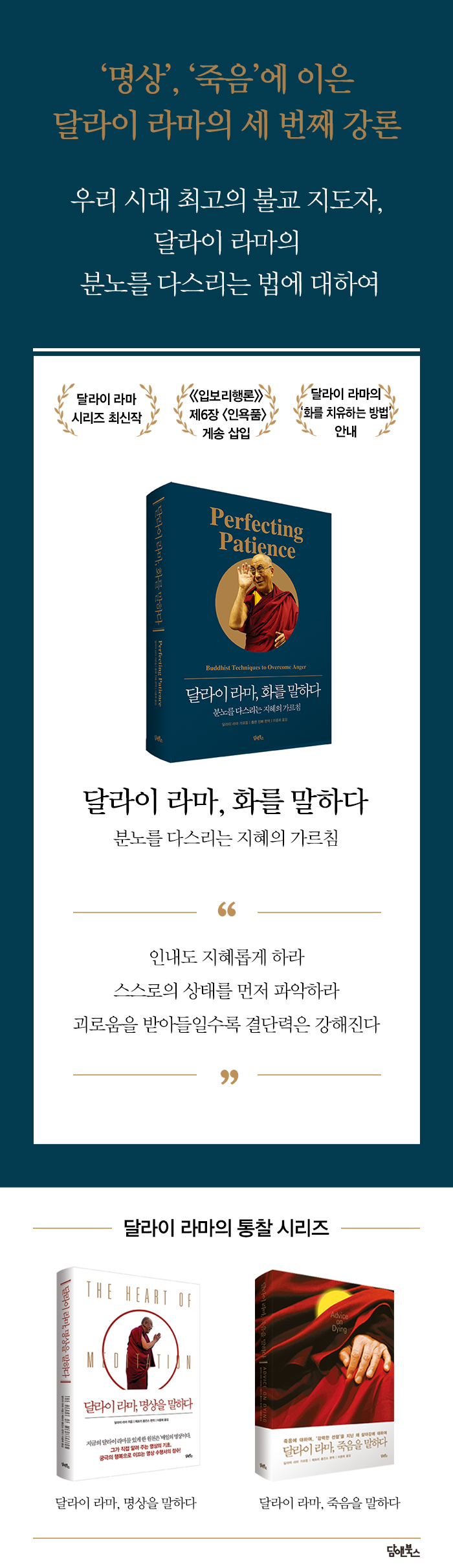
The Dalai Lama's teachings on patience, preached while communicating with the public
In 1993, in Arizona, USA, the Dalai Lama taught the public the sixth chapter, “The Book of Desires,” of the “Entry into the Bodhi Path” by Shantideva, a great teacher and monk from around the 8th century.
The first part of “Inyeopsipum” begins like this.
It is said that 'getting angry for a moment can destroy the blessings of a lifetime.'
So why did the Dalai Lama preach the teachings of patience? It was because of the self-hatred and self-loathing rampant in society, and because of his lament over a society where love, patience, and courtesy have faded.
The teachings on anger from the Dalai Lama, a revered Buddhist teacher, will bring peace to your daily life.
The Dalai Lama's teachings on patience, preached while communicating with the public
In 1993, in Arizona, USA, the Dalai Lama taught the public the sixth chapter, “The Book of Desires,” of the “Entry into the Bodhi Path” by Shantideva, a great teacher and monk from around the 8th century.
The first part of “Inyeopsipum” begins like this.
It is said that 'getting angry for a moment can destroy the blessings of a lifetime.'
So why did the Dalai Lama preach the teachings of patience? It was because of the self-hatred and self-loathing rampant in society, and because of his lament over a society where love, patience, and courtesy have faded.
The teachings on anger from the Dalai Lama, a revered Buddhist teacher, will bring peace to your daily life.
- You can preview some of the book's contents.
Preview
index
introduction
Acknowledgements
Translator's Preface: A Challenge to Patience
First day
First teaching
meditation
A conversation between the Dalai Lama and the audience
Second teaching
meditation
A conversation between the Dalai Lama and the audience
Second day
First teaching
meditation
A conversation between the Dalai Lama and the audience
Second teaching
meditation
A conversation between the Dalai Lama and the audience
Third day
First teaching
meditation
A conversation between the Dalai Lama and the audience
Second teaching
meditation
A conversation between the Dalai Lama and the audience
Fourth day
First teaching
meditation
A conversation between the Dalai Lama and the audience
Second teaching
Twelve Earthly Branches of Dependent Origination
meditation
supplement
Shantideva's "Theory of the Bodhi Path", Chapter 6, The Products of Desire
Glossary of Terms
Translator's Note
Acknowledgements
Translator's Preface: A Challenge to Patience
First day
First teaching
meditation
A conversation between the Dalai Lama and the audience
Second teaching
meditation
A conversation between the Dalai Lama and the audience
Second day
First teaching
meditation
A conversation between the Dalai Lama and the audience
Second teaching
meditation
A conversation between the Dalai Lama and the audience
Third day
First teaching
meditation
A conversation between the Dalai Lama and the audience
Second teaching
meditation
A conversation between the Dalai Lama and the audience
Fourth day
First teaching
meditation
A conversation between the Dalai Lama and the audience
Second teaching
Twelve Earthly Branches of Dependent Origination
meditation
supplement
Shantideva's "Theory of the Bodhi Path", Chapter 6, The Products of Desire
Glossary of Terms
Translator's Note
Detailed image
Into the book
37
Swayed by worries
Even killing one's beloved self,
How do they affect other living beings?
Wouldn't it be harmful?
--- p.153~154
I believe that the purpose of life is happiness.
So what is happiness? There are many stages to happiness.
The greatest happiness is Buddhahood.
The state of enlightenment is the stage that leads to the most profound happiness.
--- p.145
53
Insulting words and harsh words,
Words that make you feel bad
It can't harm your body,
Mind, why are you so angry?
--- p.170
When you think about your own suffering, your senses become numb and dull, and you become overwhelmed by that suffering.
But the discomfort we experience when we feel compassion and shoulder the suffering of others carries with it a potential sensitivity, a kind of sensitivity.
So the more suffering you accept from others, the stronger your awareness and resolve will become.
Swayed by worries
Even killing one's beloved self,
How do they affect other living beings?
Wouldn't it be harmful?
--- p.153~154
I believe that the purpose of life is happiness.
So what is happiness? There are many stages to happiness.
The greatest happiness is Buddhahood.
The state of enlightenment is the stage that leads to the most profound happiness.
--- p.145
53
Insulting words and harsh words,
Words that make you feel bad
It can't harm your body,
Mind, why are you so angry?
--- p.170
When you think about your own suffering, your senses become numb and dull, and you become overwhelmed by that suffering.
But the discomfort we experience when we feel compassion and shoulder the suffering of others carries with it a potential sensitivity, a kind of sensitivity.
So the more suffering you accept from others, the stronger your awareness and resolve will become.
--- p.217
Publisher's Review
spiritual leader of the Tibetan people
Nobel Peace Prize winner
peace activist
The Dalai Lama, the most revered Buddhist leader of our time
The third installment of the Insight series, following "Meditation" and "Death."
How to Control Anger According to the Dalai Lama
This book is a record of five days spent with the Dalai Lama and 1,600 people discussing Shantideva's teachings on patience and the path of life (Theory of the Beginning of the Bodhi Path).
Through lectures, meditations, and conversations with the audience, we shared and learned about Chapter 6, “The Products of Desire,” of the “Embrace of the Bodhi Path.”
Since its translation into Tibetan in the 11th century, the influence of the 『Encyclopedia of Bodhidhāra』 on Tibet has been enormous.
Not only did he produce extensive academic achievements related to the thought and practice of Mahayana Buddhism, he also played a major role in the rise of the Tibetan 'mind training' school.
In Tibet, it has become customary for Buddhist beginners to recite the verses of the "Entry into the Bodhi Path."
This commentary on the 『Embrace of the Bodhi Path』 and the Dalai Lama's lectures are in the form of verses and explanations, and will provide an opportunity to control anger and rage and think again about patience.
Where does the wisdom to control anger come from?
What is true patience?
The Dalai Lama's Buddhist Understanding and Teachings
The alms accumulated over a thousand kalpas
Offerings to Buddha, etc.
Even if it is (some) good deed
A single fire can destroy everything.
This is the first verse of Chapter 6, “The Chapter on Desires,” of the “Embodiment of the Bodhi Path.”
It is said that if you become angry or hateful, you can destroy the virtue you have accumulated over a thousand eons.
The second verse is as follows:
There is nothing as evil as hatred.
There is no hardship more difficult to endure than patience.
So, I will do my best and use every method
Patience must be practiced.
There are many afflictions that give rise to painful thoughts, such as pride, arrogance, and jealousy, but among these, hatred and anger are said to be the most evil.
The special saying, “Practice patience by all means” is the practice that those who are angry the most must strive for in reality.
In other words, practitioners must constantly strive to improve their ability to endure and persevere.
So where does hatred come from? The Dalai Lama says that from a Buddhist perspective, hatred has no origin.
The basic nature of consciousness itself is neutral, and the nature and quality that can purify or eliminate these negative emotions is called 'Buddha-nature'.
And that's not all.
You can get a glimpse into the practice of the mind from the perspective of the Dalai Lama, including 'how to deal with or cure pride', 'the role of forgiveness in raising patience', 'self-loathing', and 'the point of practice'.
"Dalai Lama, Speaking of Anger" is a book that allows you to enjoy the teachings of the Dalai Lama, the most respected Buddhist leader alive today, dating back to the 8th century.
Are you living a life filled with anger and hatred, or are you curious about the wisdom to control your anger?
If you are curious about how to learn and practice the virtue of enduring insults, this book will be helpful.
Nobel Peace Prize winner
peace activist
The Dalai Lama, the most revered Buddhist leader of our time
The third installment of the Insight series, following "Meditation" and "Death."
How to Control Anger According to the Dalai Lama
This book is a record of five days spent with the Dalai Lama and 1,600 people discussing Shantideva's teachings on patience and the path of life (Theory of the Beginning of the Bodhi Path).
Through lectures, meditations, and conversations with the audience, we shared and learned about Chapter 6, “The Products of Desire,” of the “Embrace of the Bodhi Path.”
Since its translation into Tibetan in the 11th century, the influence of the 『Encyclopedia of Bodhidhāra』 on Tibet has been enormous.
Not only did he produce extensive academic achievements related to the thought and practice of Mahayana Buddhism, he also played a major role in the rise of the Tibetan 'mind training' school.
In Tibet, it has become customary for Buddhist beginners to recite the verses of the "Entry into the Bodhi Path."
This commentary on the 『Embrace of the Bodhi Path』 and the Dalai Lama's lectures are in the form of verses and explanations, and will provide an opportunity to control anger and rage and think again about patience.
Where does the wisdom to control anger come from?
What is true patience?
The Dalai Lama's Buddhist Understanding and Teachings
The alms accumulated over a thousand kalpas
Offerings to Buddha, etc.
Even if it is (some) good deed
A single fire can destroy everything.
This is the first verse of Chapter 6, “The Chapter on Desires,” of the “Embodiment of the Bodhi Path.”
It is said that if you become angry or hateful, you can destroy the virtue you have accumulated over a thousand eons.
The second verse is as follows:
There is nothing as evil as hatred.
There is no hardship more difficult to endure than patience.
So, I will do my best and use every method
Patience must be practiced.
There are many afflictions that give rise to painful thoughts, such as pride, arrogance, and jealousy, but among these, hatred and anger are said to be the most evil.
The special saying, “Practice patience by all means” is the practice that those who are angry the most must strive for in reality.
In other words, practitioners must constantly strive to improve their ability to endure and persevere.
So where does hatred come from? The Dalai Lama says that from a Buddhist perspective, hatred has no origin.
The basic nature of consciousness itself is neutral, and the nature and quality that can purify or eliminate these negative emotions is called 'Buddha-nature'.
And that's not all.
You can get a glimpse into the practice of the mind from the perspective of the Dalai Lama, including 'how to deal with or cure pride', 'the role of forgiveness in raising patience', 'self-loathing', and 'the point of practice'.
"Dalai Lama, Speaking of Anger" is a book that allows you to enjoy the teachings of the Dalai Lama, the most respected Buddhist leader alive today, dating back to the 8th century.
Are you living a life filled with anger and hatred, or are you curious about the wisdom to control your anger?
If you are curious about how to learn and practice the virtue of enduring insults, this book will be helpful.
GOODS SPECIFICS
- Date of issue: June 15, 2020
- Format: Hardcover book binding method guide
- Page count, weight, size: 424 pages | 558g | 139*194*30mm
- ISBN13: 9791162012284
- ISBN10: 1162012285
You may also like
카테고리
korean


korean

![GQ KOREA Mark (Monthly): December [2025]](http://librairie.coreenne.fr/cdn/shop/files/8ef265dbbfbf186523ed75ba7319009d.jpg?v=1765340328&width=3840)


