

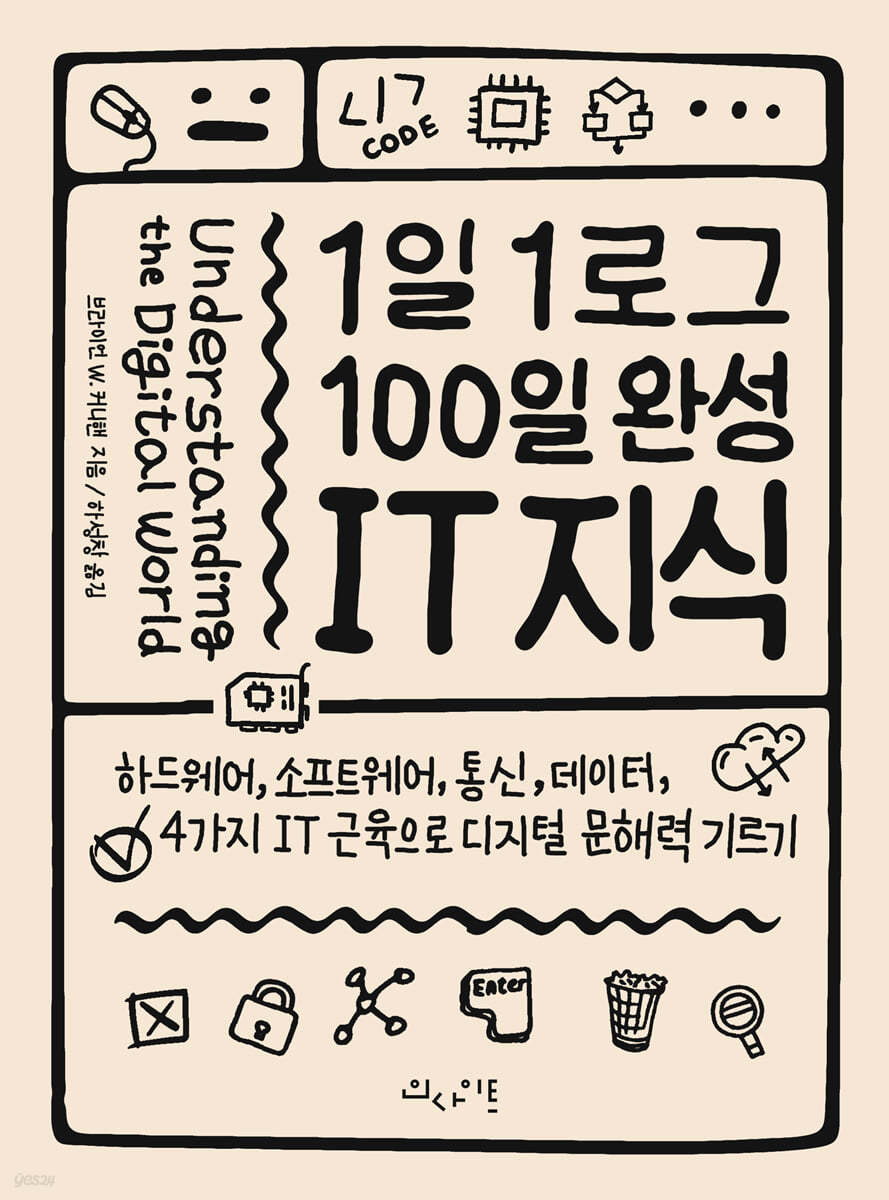
1 log per day, 100 days to complete IT knowledge
 |
Description
Book Introduction
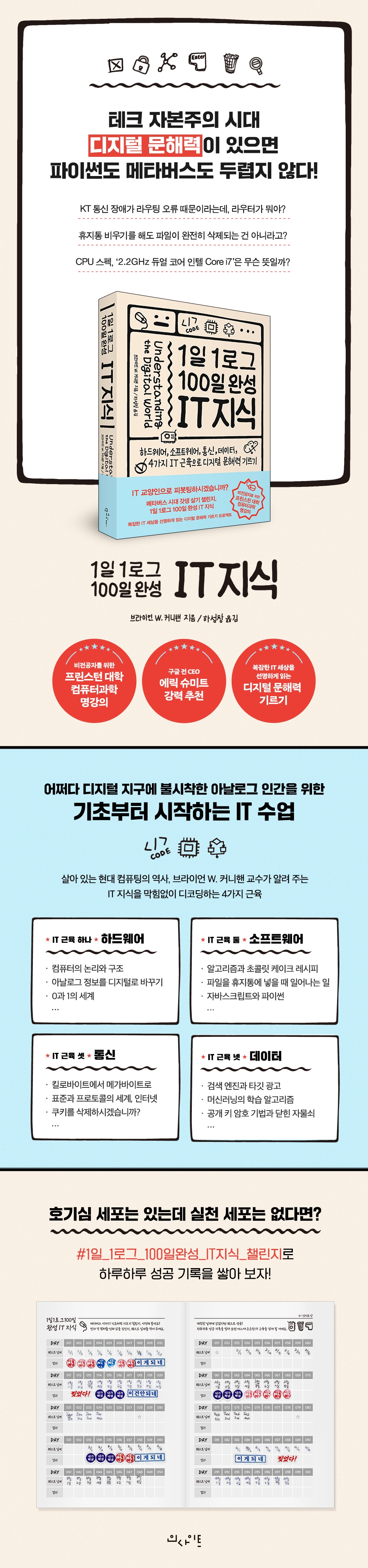
A challenge to cultivate digital literacy to clearly understand the complex IT world.
IT knowledge is certainly complex, but it's not as confusing as life.
By acquiring the necessary knowledge, you can free yourself from vague anxieties and proactively address the challenges and opportunities presented by the digital world.
Naver, Kakao, Coupang, Baedal Minjok, Carrot Market, Toss... IT companies that have quickly become part of our daily lives are constantly innovating and growing every minute, leveraging technologies like cloud computing, machine learning, and data mining.
Among them, the metaverse era has begun, with a global market expected to reach 300 trillion won by 2025, following the Internet and smartphones.
Fortunately, the basic idea of a digital system—a logical structure and physical implementation—remains the same, from the early computers weighing 30 tons to the metaverse we access with Microsoft's HoloLens.
Understanding the four core areas of computing—hardware, software, communications, and data—will help you develop digital literacy, enabling you to break down even complex digital systems into their business structures and flows.
If you have curiosity cells but no action cells, this book is for you.
In the '1 Log a Day, 100 Days IT Knowledge Challenge', let's write down the quest date and when we will read each section.
If you read it on the scheduled date, you've completed the quest! By building a daily record of success, you'll gain IT muscle that you can use for life, once you learn it.
IT knowledge is certainly complex, but it's not as confusing as life.
By acquiring the necessary knowledge, you can free yourself from vague anxieties and proactively address the challenges and opportunities presented by the digital world.
Naver, Kakao, Coupang, Baedal Minjok, Carrot Market, Toss... IT companies that have quickly become part of our daily lives are constantly innovating and growing every minute, leveraging technologies like cloud computing, machine learning, and data mining.
Among them, the metaverse era has begun, with a global market expected to reach 300 trillion won by 2025, following the Internet and smartphones.
Fortunately, the basic idea of a digital system—a logical structure and physical implementation—remains the same, from the early computers weighing 30 tons to the metaverse we access with Microsoft's HoloLens.
Understanding the four core areas of computing—hardware, software, communications, and data—will help you develop digital literacy, enabling you to break down even complex digital systems into their business structures and flows.
If you have curiosity cells but no action cells, this book is for you.
In the '1 Log a Day, 100 Days IT Knowledge Challenge', let's write down the quest date and when we will read each section.
If you read it on the scheduled date, you've completed the quest! By building a daily record of success, you'll gain IT muscle that you can use for life, once you learn it.
- You can preview some of the book's contents.
Preview
index
Entering
introduction
Part 1 [IT Muscle One] Hardware
001 Computer logic and structure
002 Processor speed and heart rate
003 Differences between HDD and SSD
004 1cm x 1cm processor chip
Moore's Law, which has lasted for over 50 years
006 Summary
007 Continuity and Discontinuity
008 Converting analog information to digital
009 The World of 0 and 1
010 Bit Moa Data
011 Summary
012 Differences between a processor and a calculator
013 Creating an Addition Program with a Model Computer
014 Is it always better if the processor is fast?
015 What is cache?
016 From supercomputers to the Internet of Things
017 Summary
Part 2 [IT Muscle 2] Software
018 Algorithm and Chocolate Cake Recipe
Finding the Tallest Person in Class 019: Linear Algorithm
Finding a Name in 1 Billion Phone Numbers: Binary Search
021 Sorting for Easy Searching: Selection Sort vs. Quick Sort
022 How to travel to 10 cities in the shortest distance
023 Summary
024 Algorithms are ideals, programming is reality
025 Program for processing other programs
026 From high-level language to program execution
027 Programming similar to writing
028 How do you develop a service like Google?
029 Google and Oracle's Copyright Lawsuit
030 The Importance of Technical Standards
031 Free software, open source
032 Summary
033 The operating system that makes the computer work
034 Virtual operating systems and virtual machines
035 How the operating system works
036 File System and Block
037 What happens when you put a file in the trash?
038 Applications that perform multiple tasks
039 Software Hierarchy
040 Summary
041 JavaScript and Python
042 Key Concepts of Programming Languages
043 Print "Hello, World" with JavaScript
044 Enter user name and print it out
045 Loops and Conditional Statements
046 Displaying Locations on Google Maps with JavaScript
047 How does JavaScript work?
048 Print "Hello, World" with Python
049 Creating a Plus Program
050 Drawing Graphs with Python
051 How does Python work?
052 Summary
Part 3 [IT Muscle Set] Communication
053 From Phone to Wi-Fi, the Basic Properties of Networks
054 Beep- Beep- The sound of a nostalgic modem
055 kilobytes to megabytes
056 Short-distance network, Ethernet used in schools and companies
057 WiFi is a brand name
058 Why is a mobile phone called a cellular phone in English?
059 3G, LTE, 4G, 5G
When compressing to a 060 ZIP file
061 Algorithm for detecting and correcting errors
062 Summary
063 The World of Standards and Protocols, the Internet
064 Internet-enabled mechanisms
065 What if I want my own domain?
066 Check the Internet route from departure to destination
067 TCP/IP, the core protocol for transmitting data
068 Top-Level Protocols: Mail Transfer and File Sharing
069 Digital Copyright Debate
070 IoT devices vulnerable to security
071 Summary
072 The World Wide Web is free
073 Meaning of URL
074 Creating a Simple Web Page with HTML and CSS
075 Do you want to delete cookies?
076 Why was Adobe Flash phased out?
077 Why You Shouldn't Carelessly Click on Email Attachments
078 Virus spread
079 Dangers lurking everywhere
080 3-Step Defense to Protect Yourself on the Web
081 Summary
Part 4 [IT Muscle Net] Data
082 The Zetabyte Era
083 Search Engines and Targeted Advertising
084 When I look at the Internet, the Internet looks at me.
085 Before posting a tweet
086 The Inconvenient Truth About Metadata
087 Cloud and Privacy
088 Summary
089 Computers Enter the Human Realm
090 Winter of Artificial Intelligence
091 Machine Learning Algorithms
092 Neural networks and deep learning that mimic the human brain
093 Can we distinguish between poetry written by artificial intelligence and poetry written by humans?
094 Summary
095 Is it okay if I have nothing to hide?
096 Secret key encryption technique shared only between two people
097 Public Key Cryptography and Closed Locks
098 Can I transact online without leaving a trace?
099 Summary
100 people don't change quickly
Glossary of Terms
Translator's Note
Search
introduction
Part 1 [IT Muscle One] Hardware
001 Computer logic and structure
002 Processor speed and heart rate
003 Differences between HDD and SSD
004 1cm x 1cm processor chip
Moore's Law, which has lasted for over 50 years
006 Summary
007 Continuity and Discontinuity
008 Converting analog information to digital
009 The World of 0 and 1
010 Bit Moa Data
011 Summary
012 Differences between a processor and a calculator
013 Creating an Addition Program with a Model Computer
014 Is it always better if the processor is fast?
015 What is cache?
016 From supercomputers to the Internet of Things
017 Summary
Part 2 [IT Muscle 2] Software
018 Algorithm and Chocolate Cake Recipe
Finding the Tallest Person in Class 019: Linear Algorithm
Finding a Name in 1 Billion Phone Numbers: Binary Search
021 Sorting for Easy Searching: Selection Sort vs. Quick Sort
022 How to travel to 10 cities in the shortest distance
023 Summary
024 Algorithms are ideals, programming is reality
025 Program for processing other programs
026 From high-level language to program execution
027 Programming similar to writing
028 How do you develop a service like Google?
029 Google and Oracle's Copyright Lawsuit
030 The Importance of Technical Standards
031 Free software, open source
032 Summary
033 The operating system that makes the computer work
034 Virtual operating systems and virtual machines
035 How the operating system works
036 File System and Block
037 What happens when you put a file in the trash?
038 Applications that perform multiple tasks
039 Software Hierarchy
040 Summary
041 JavaScript and Python
042 Key Concepts of Programming Languages
043 Print "Hello, World" with JavaScript
044 Enter user name and print it out
045 Loops and Conditional Statements
046 Displaying Locations on Google Maps with JavaScript
047 How does JavaScript work?
048 Print "Hello, World" with Python
049 Creating a Plus Program
050 Drawing Graphs with Python
051 How does Python work?
052 Summary
Part 3 [IT Muscle Set] Communication
053 From Phone to Wi-Fi, the Basic Properties of Networks
054 Beep- Beep- The sound of a nostalgic modem
055 kilobytes to megabytes
056 Short-distance network, Ethernet used in schools and companies
057 WiFi is a brand name
058 Why is a mobile phone called a cellular phone in English?
059 3G, LTE, 4G, 5G
When compressing to a 060 ZIP file
061 Algorithm for detecting and correcting errors
062 Summary
063 The World of Standards and Protocols, the Internet
064 Internet-enabled mechanisms
065 What if I want my own domain?
066 Check the Internet route from departure to destination
067 TCP/IP, the core protocol for transmitting data
068 Top-Level Protocols: Mail Transfer and File Sharing
069 Digital Copyright Debate
070 IoT devices vulnerable to security
071 Summary
072 The World Wide Web is free
073 Meaning of URL
074 Creating a Simple Web Page with HTML and CSS
075 Do you want to delete cookies?
076 Why was Adobe Flash phased out?
077 Why You Shouldn't Carelessly Click on Email Attachments
078 Virus spread
079 Dangers lurking everywhere
080 3-Step Defense to Protect Yourself on the Web
081 Summary
Part 4 [IT Muscle Net] Data
082 The Zetabyte Era
083 Search Engines and Targeted Advertising
084 When I look at the Internet, the Internet looks at me.
085 Before posting a tweet
086 The Inconvenient Truth About Metadata
087 Cloud and Privacy
088 Summary
089 Computers Enter the Human Realm
090 Winter of Artificial Intelligence
091 Machine Learning Algorithms
092 Neural networks and deep learning that mimic the human brain
093 Can we distinguish between poetry written by artificial intelligence and poetry written by humans?
094 Summary
095 Is it okay if I have nothing to hide?
096 Secret key encryption technique shared only between two people
097 Public Key Cryptography and Closed Locks
098 Can I transact online without leaving a trace?
099 Summary
100 people don't change quickly
Glossary of Terms
Translator's Note
Search
Detailed image
Into the book
In the late 19th century, Herman Hollerith worked with the U.S. Census Bureau to design and build a machine that could tabulate census information much faster than by hand.
Hollerith used the idea of the Jacquard loom to encode census data into a machine-processable form by punching holes in stiff paper cards.
Contrary to predictions that the 1890 census would take more than ten years, as the 1880 census had taken eight years to complete, Hollerith's punch cards and tabulation machines allowed it to be completed in just one year.
Hollerith later founded a company, which, through mergers and acquisitions, became 'International Business Machines' in 1924, which is the IBM we know today.
--- From "Part 1: Hardware Introduction"
Modern computers are truly complex things.
As seen in Figure I.4 (page 12), it includes many parts such as a processor, memory, auxiliary storage devices, display, and network interface.
To use components effectively, you need to be able to run multiple programs simultaneously.
Some of these are waiting for something to happen (like waiting for a web page to fully download), some require immediate responses (like tracking your mouse movements or updating your display when you play a game), and some interfere with other programs (like starting a new program that takes up space in your already overflowing memory).
It's incredibly complicated.
--- p.33 From “The operating system that makes the computer work”
The most prominent part of the Internet is the World Wide Web, now simply called "the Web."
Although there is a tendency to view the Internet and the Web as one, they are different.
The Internet is a communications infrastructure or sublayer that allows numerous computers around the world to easily exchange information with each other.
The web connects computers that provide information (servers) with computers that request information (clients like you and me).
The Web 'uses' the Internet to connect, transmit information, and provide an interface for accessing other Internet-based services.
--- p.72 From “The World Wide Web is Free”
As a test, I disabled all defenses and visited the Toyota website using Safari.
On my first visit, I downloaded cookies from 25 different sites, 45 images from various sites, and over 50 JavaScript programs, totaling over 10MB.
This page continued to generate network requests while I was there.
In fact, the page was doing so many background operations that Safari displayed a warning (Figure IV.4).
Hollerith used the idea of the Jacquard loom to encode census data into a machine-processable form by punching holes in stiff paper cards.
Contrary to predictions that the 1890 census would take more than ten years, as the 1880 census had taken eight years to complete, Hollerith's punch cards and tabulation machines allowed it to be completed in just one year.
Hollerith later founded a company, which, through mergers and acquisitions, became 'International Business Machines' in 1924, which is the IBM we know today.
--- From "Part 1: Hardware Introduction"
Modern computers are truly complex things.
As seen in Figure I.4 (page 12), it includes many parts such as a processor, memory, auxiliary storage devices, display, and network interface.
To use components effectively, you need to be able to run multiple programs simultaneously.
Some of these are waiting for something to happen (like waiting for a web page to fully download), some require immediate responses (like tracking your mouse movements or updating your display when you play a game), and some interfere with other programs (like starting a new program that takes up space in your already overflowing memory).
It's incredibly complicated.
--- p.33 From “The operating system that makes the computer work”
The most prominent part of the Internet is the World Wide Web, now simply called "the Web."
Although there is a tendency to view the Internet and the Web as one, they are different.
The Internet is a communications infrastructure or sublayer that allows numerous computers around the world to easily exchange information with each other.
The web connects computers that provide information (servers) with computers that request information (clients like you and me).
The Web 'uses' the Internet to connect, transmit information, and provide an interface for accessing other Internet-based services.
--- p.72 From “The World Wide Web is Free”
As a test, I disabled all defenses and visited the Toyota website using Safari.
On my first visit, I downloaded cookies from 25 different sites, 45 images from various sites, and over 50 JavaScript programs, totaling over 10MB.
This page continued to generate network requests while I was there.
In fact, the page was doing so many background operations that Safari displayed a warning (Figure IV.4).
--- p.84 From “When I look at the Internet, the Internet looks at me”
Publisher's Review
Are you looking to pivot to become an IT professional?
A Living History of Modern Computing, Brian W.
Professor Kernighan tells us
4 Muscles That Unleash Your IT Knowledge
IT knowledge is certainly complex, but it's not as confusing as life.
By acquiring the necessary knowledge, you can free yourself from vague anxieties and proactively address the challenges and opportunities presented by the digital world.
Naver, Kakao, Coupang, Baedal Minjok, Carrot Market, Toss... IT companies that have quickly become part of our daily lives are constantly innovating and growing every minute, leveraging technologies like cloud computing, machine learning, and data mining.
Among them, the metaverse era has begun, with a global market expected to reach 300 trillion won by 2025, following the Internet and smartphones.
Fortunately, the basic idea of a digital system—a logical structure and a physical implementation—remains the same, from the early computers weighing 30 tons to the metaverse we access with Microsoft's HoloLens.
Understanding the four core areas of computing—hardware, software, communications, and data—will help you develop digital literacy, enabling you to break down even complex digital systems into their business structures and flows.
Brian W., a living historian of modern computing and one of the most distinguished writers in computer science,
Professor Kernighan was inspired to write this book by Richard Mueller's book Physics for the President.
With tectonic shifts taking place in the digital world, including blockchain, NFTs, and the metaverse, that will shape the future economy, not only the president but even analog humans who crash-landed on the digital Earth must cultivate IT muscles capable of decoding the necessary knowledge.
If you have curiosity cells but no action cells, this book is for you.
In the '1 Log a Day, 100 Days IT Knowledge Challenge', let's write down the quest date and when we will read each section.
If you read it on the scheduled date, you've completed the quest! By building a daily record of success, you'll gain IT muscle that you can use for life, once you learn it.
They say the KT network outage is due to a routing error, but what is a router?
A project to foster digital literacy to clearly understand the complex IT world.
Recently, an article on social media about Generation Z finding files through search instead of saving them in folders has attracted a lot of attention.
The older generation, who are accustomed to the hierarchical structure of folders and files, and Generation Z, who put all their files in one large basket and retrieve them whenever needed, are having difficulty communicating because of this.
When the professor asked the students where they saved their files, they all looked puzzled and said, “What are you talking about?”
If you look at 'Computer Logic and Structure (001)' and 'File System and Block (036)' explained in this book, you can see that Generation Z's methods are interestingly similar to the physical structure of a computer.
This is because actual data is stored in blocks without hierarchies.
Parts 1 and 2, which cover hardware and software, are also packed with fascinating information, such as why computing uses binary instead of decimal, what a "2.2GHz Dual-Core Intel Core i7" CPU spec means, and how we can shop, search, and chat with friends on our computers and smartphones if processors are nothing more than programmable high-speed calculators.
Recently, due to a KT network failure, the internet was unavailable nationwide for over an hour.
Internet payments were unavailable at several stores, including restaurants. KakaoTalk and even voice call services were down due to increased traffic. The problem was caused by an incorrect command entered during a corporate network router replacement at KT's Busan office.
What is a router, what role does it play, and how can a single router's incorrect route update spread nationwide within 30 seconds? Part 3 of this book provides an easy-to-understand explanation of the fundamental properties of networks, from telephones to Wi-Fi, and the Internet, a world of standards and protocols.
In particular, you can clearly understand this network failure by reading 'Internet-enabled mechanisms (064)', 'What if you want to have your own domain? (065)', and 'Checking the Internet route from departure point to destination (066)'.
Global internet traffic is expected to reach 3 zettabytes in 2021.
How is all this data being exchanged and utilized? Can we transact online without leaving a trace? Part 4, Data, explores the basics of privacy, from the inconvenient truth about metadata to the principles of cryptography.
The author first saw the Web in action when he visited Cornell University in October 1992, and, embarrassingly, didn't find it particularly impressive at the time.
Less than six months later, a browser appeared that changed the world.
No matter what the world will be like in the next year, five years, or ten years, the IT muscles you build with this book will provide a solid foundation.
A Living History of Modern Computing, Brian W.
Professor Kernighan tells us
4 Muscles That Unleash Your IT Knowledge
IT knowledge is certainly complex, but it's not as confusing as life.
By acquiring the necessary knowledge, you can free yourself from vague anxieties and proactively address the challenges and opportunities presented by the digital world.
Naver, Kakao, Coupang, Baedal Minjok, Carrot Market, Toss... IT companies that have quickly become part of our daily lives are constantly innovating and growing every minute, leveraging technologies like cloud computing, machine learning, and data mining.
Among them, the metaverse era has begun, with a global market expected to reach 300 trillion won by 2025, following the Internet and smartphones.
Fortunately, the basic idea of a digital system—a logical structure and a physical implementation—remains the same, from the early computers weighing 30 tons to the metaverse we access with Microsoft's HoloLens.
Understanding the four core areas of computing—hardware, software, communications, and data—will help you develop digital literacy, enabling you to break down even complex digital systems into their business structures and flows.
Brian W., a living historian of modern computing and one of the most distinguished writers in computer science,
Professor Kernighan was inspired to write this book by Richard Mueller's book Physics for the President.
With tectonic shifts taking place in the digital world, including blockchain, NFTs, and the metaverse, that will shape the future economy, not only the president but even analog humans who crash-landed on the digital Earth must cultivate IT muscles capable of decoding the necessary knowledge.
If you have curiosity cells but no action cells, this book is for you.
In the '1 Log a Day, 100 Days IT Knowledge Challenge', let's write down the quest date and when we will read each section.
If you read it on the scheduled date, you've completed the quest! By building a daily record of success, you'll gain IT muscle that you can use for life, once you learn it.
They say the KT network outage is due to a routing error, but what is a router?
A project to foster digital literacy to clearly understand the complex IT world.
Recently, an article on social media about Generation Z finding files through search instead of saving them in folders has attracted a lot of attention.
The older generation, who are accustomed to the hierarchical structure of folders and files, and Generation Z, who put all their files in one large basket and retrieve them whenever needed, are having difficulty communicating because of this.
When the professor asked the students where they saved their files, they all looked puzzled and said, “What are you talking about?”
If you look at 'Computer Logic and Structure (001)' and 'File System and Block (036)' explained in this book, you can see that Generation Z's methods are interestingly similar to the physical structure of a computer.
This is because actual data is stored in blocks without hierarchies.
Parts 1 and 2, which cover hardware and software, are also packed with fascinating information, such as why computing uses binary instead of decimal, what a "2.2GHz Dual-Core Intel Core i7" CPU spec means, and how we can shop, search, and chat with friends on our computers and smartphones if processors are nothing more than programmable high-speed calculators.
Recently, due to a KT network failure, the internet was unavailable nationwide for over an hour.
Internet payments were unavailable at several stores, including restaurants. KakaoTalk and even voice call services were down due to increased traffic. The problem was caused by an incorrect command entered during a corporate network router replacement at KT's Busan office.
What is a router, what role does it play, and how can a single router's incorrect route update spread nationwide within 30 seconds? Part 3 of this book provides an easy-to-understand explanation of the fundamental properties of networks, from telephones to Wi-Fi, and the Internet, a world of standards and protocols.
In particular, you can clearly understand this network failure by reading 'Internet-enabled mechanisms (064)', 'What if you want to have your own domain? (065)', and 'Checking the Internet route from departure point to destination (066)'.
Global internet traffic is expected to reach 3 zettabytes in 2021.
How is all this data being exchanged and utilized? Can we transact online without leaving a trace? Part 4, Data, explores the basics of privacy, from the inconvenient truth about metadata to the principles of cryptography.
The author first saw the Web in action when he visited Cornell University in October 1992, and, embarrassingly, didn't find it particularly impressive at the time.
Less than six months later, a browser appeared that changed the world.
No matter what the world will be like in the next year, five years, or ten years, the IT muscles you build with this book will provide a solid foundation.
GOODS SPECIFICS
- Date of issue: December 31, 2021
- Page count, weight, size: 560 pages | 650g | 152*205*32mm
- ISBN13: 9788966263301
- ISBN10: 8966263305
You may also like
카테고리
korean


korean

![GQ KOREA Mark (Monthly): December [2025]](http://librairie.coreenne.fr/cdn/shop/files/8ef265dbbfbf186523ed75ba7319009d.jpg?v=1765340328&width=3840)


