

Paul's Biography
 |
Description
Book Introduction
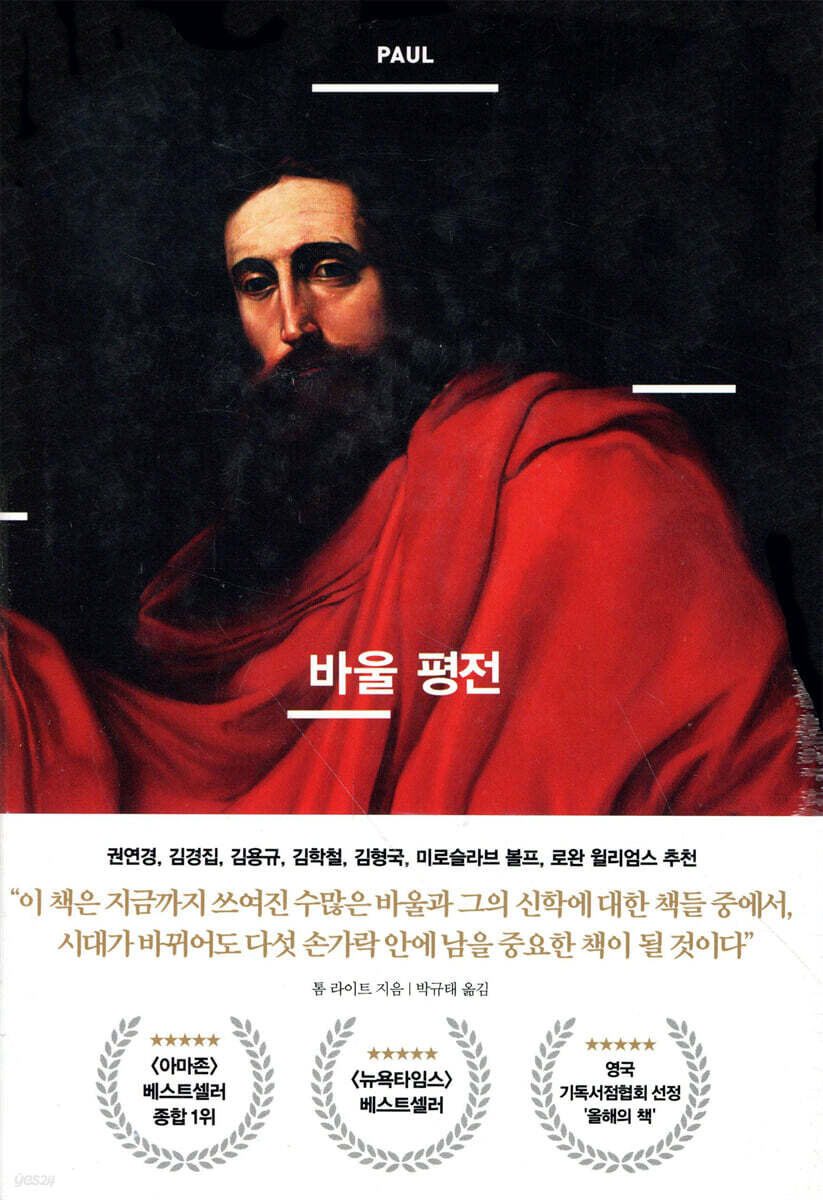
[Amazon] #1 Bestseller Overall [New York Times] Bestseller Book of the Year, selected by the UK Christian Booksellers Association Recommended by Kwon Yeon-kyung, Kim Kyung-jip, Kim Yong-gyu, Kim Hak-cheol, Kim Hyung-guk, Miroslav Volf, and Rowan Williams “This book is one of the many books written about Paul and his theology, “Even as times change, this will be an important book that will remain in the top five.” “A biography of Paul written by a brilliant and outstanding interpreter of Paul for our time!” The life and thought of Paul, a Jew, vividly depicted in the context of early first-century Christianity. How Saul the Jew Became Paul the Apostle The Apostle Paul, who dramatically transformed from a passionate Pharisee persecutor to a devoted follower of Jesus after his encounter with the light on the road to Damascus, has been by far the most widely cited of the early teachers of the church over the past several hundred years. But from the perspective of Tom Wright, a leading New Testament scholar and Anglican bishop, many biblical scholars and pastors have not fully understood what Paul was actually doing and what motivated him. As Wright argues by focusing on Paul's letters and theology, they have overlooked the essence of what Paul accomplished, not only in one man's life but also against the odds. In response, Wright offers a new way to understand Paul, one of the most famous yet misunderstood figures in Christian history. That is, we should pay attention to the human Paul. A man who survived several assassination attempts, several imprisonments, and a shipwreck in a storm. Throughout all this, he was a man who created new language and concepts to faithfully translate and convey the story of Jesus so that the Gentile world could understand it. In this groundbreaking new commentary, Wright not only celebrates Paul's humanity, but also argues that only by attending to it can we truly understand him and, ultimately, how he created the new paradigm for our understanding of Jesus. As Wright explains, the point is that “Paul is so central to our understanding of early Christianity that we cannot understand him properly unless we fully grasp that the Jewish faith and hope that Paul held before Christianity emerged was fulfilled in Jesus.” Only when we look at Paul in this way can we begin to understand how he was able to pave the way for Christianity to conquer the Roman world. |
- You can preview some of the book's contents.
Preview
index
List of maps
introduction
Introduction
Part 1: The Beginning
Chapter 1: Passion
Chapter 2 Damascus
Chapter 3 Arabia and Tarsus
Chapter 4 Antioch
Part 2: The King's Lion
Chapter 5 Cyprus and Galatia
Chapter 6: Antioch and Jerusalem
Chapter 7 To Europe
Chapter 8 Athens
Chapter 9 Corinthians 1
Chapter 10 Ephesus I
Chapter 11 Ephesus II
Chapter 12 Corinthians II
Chapter 13 Jerusalem Again
Part 3: The Sea, the Sea
Chapter 14 From Caesarea to Rome and Beyond
Chapter 15: Paul's Challenge
Translator's note
Timeline
main
Bible Index
Subject Index
introduction
Introduction
Part 1: The Beginning
Chapter 1: Passion
Chapter 2 Damascus
Chapter 3 Arabia and Tarsus
Chapter 4 Antioch
Part 2: The King's Lion
Chapter 5 Cyprus and Galatia
Chapter 6: Antioch and Jerusalem
Chapter 7 To Europe
Chapter 8 Athens
Chapter 9 Corinthians 1
Chapter 10 Ephesus I
Chapter 11 Ephesus II
Chapter 12 Corinthians II
Chapter 13 Jerusalem Again
Part 3: The Sea, the Sea
Chapter 14 From Caesarea to Rome and Beyond
Chapter 15: Paul's Challenge
Translator's note
Timeline
main
Bible Index
Subject Index
Into the book
Paul himself had times when he groped in the darkness.
Paul pondered these questions and came to a solid and sharp answer.
Yet these questions have continued to challenge readers and thinkers ever since, not least in the modern world, which is often bewildered by the many different aspects of human life, including those sometimes defined by the complex and nuanced term "religion."
Paul poses many questions and challenges not only to the world in which he lived, but also to the world in which we live.
This book, a biography of Paul, is an attempt to address these questions.
I hope this book will shed light on these difficult issues.
--- p.24
Today, most Westerners think of "religion" as a distinct sphere of life, a kind of private hobby enjoyed by those who like it separate from politics, public life, science, and technology, by definition (and in some countries by law).
In Paul's time, 'religion' meant almost the opposite of what I just said.
The Latin word religio has to do with 'binding' things together.
Worship, prayer, sacrifice, and other public rituals were designed to bind together the city's invisible inhabitants (the gods and perhaps the city's ancestors) with its visible inhabitants, the living, providing an indispensable framework for daily life, as well as for business, marriage, travel, and family life.
--- p.51
The Judaism referred to here is not a mere 'religion' as modern Westerners think of it, a system of piety and morality called 'Judaism', but rather it means actively spreading the way of life handed down from our ancestors, preserving that way of life against external attacks and internal corruption, and diligently advising other Jews on the traditions of the Torah, especially when other Jews seem to be abandoning and compromising with those traditions.
--- p.68~69
I suspect that Paul was deliberately seeking to emphasize the following fact: that there is one 'Lord', one Kyrios, and that Caesar (the Roman Emperor) is not that Lord.
The defining characteristic of the community of those who grew up through his proclamation of the Gospel and were faithful (again, pistis) to Jesus was precisely this profession of loyalty.
This confession was extremely simple and yet profound: Kyrios Ie.sous Christos, that is, “Jesus the Messiah is Lord.”
Paul would have known exactly how these words would sound to people's ears.
--- p.188
When people of our time wonder what made Paul a man and why his schemes ultimately succeeded, they often claim that he was a difficult, difficult, and stubborn customer who was always at odds with people.
He certainly deserves that impression.
This impression may have been especially strong when Paul demonstrated the ability to see through the lies and contradictions in what someone said, whether it was someone who had become an apostle before him, like Peter, or local officials, like the Philippian officials.
However—and perhaps it is important to emphasize this point before moving on to examine Paul's activities in southern Greece, where his personal relationships were not always smooth—all indications are that Paul quickly established long-lasting, deep-rooted bonds of mutual love and trust in the churches of northern Greece.
--- p.306~307
Was all that work in vain? Would the message of the one God and His Son forever remain a paltry, exclusive privilege, reserved for a small subset of the Jewish people—those who followed Jesus, the Messiah? Imagine him finally managing to shake off his friends and enter a theater to address a massive crowd.
Could he have done it well? Could he have found the words he needed at that moment? Would the Spirit have empowered him? Could he have spoken clearly and refreshingly about Jesus, the true Lord? That hadn't happened during his recent visit to Corinth.
What if it doesn't happen here? What if it doesn't happen again? It's a question I ask myself over and over again, but was it all for nothing?
--- p.421
Now imagine all the complex yet coherent Jewish thought Paul must have pondered and prayed over as he traveled, working in his stuffy, cramped workshop, staying in roadside inns, and teaching young Timothy about the vast world of the Bible, the place where he always felt most at home.
Imagine Paul, after seeing the gospel at work in present-day Turkey and Greece, returning to Jerusalem and praying deeply about it all right there in the temple.
Imagine Paul, in particular, here in the temple, discovering a fresh insight into how Jesus has now ascended to the throne as the focal point of all creation, the focal point of wisdom and mystery, the focal point of the profound meaning of what it means to be truly human, and the Lord of all the powers that can exist.
--- p.463
He prays and prays again with that prayer.
He prays that prayer in time with the rhythm of his breathing.
He prays that prayer, following the breath of the Spirit that resides in his deepest inner self.
He declares once again his pistis, his loyalty, his love.
I proclaim one God, one Lord.
Emphasize the word 'one'.
What he did throughout his life was to openly and boldly testify to everyone about the Kingdom of God and the Lord Jesus.
He still does it while praying, even as the executioner draws his sword.
He loves this one God with all his heart, mind, and strength.
And finally, he loves with his life.
Paul pondered these questions and came to a solid and sharp answer.
Yet these questions have continued to challenge readers and thinkers ever since, not least in the modern world, which is often bewildered by the many different aspects of human life, including those sometimes defined by the complex and nuanced term "religion."
Paul poses many questions and challenges not only to the world in which he lived, but also to the world in which we live.
This book, a biography of Paul, is an attempt to address these questions.
I hope this book will shed light on these difficult issues.
--- p.24
Today, most Westerners think of "religion" as a distinct sphere of life, a kind of private hobby enjoyed by those who like it separate from politics, public life, science, and technology, by definition (and in some countries by law).
In Paul's time, 'religion' meant almost the opposite of what I just said.
The Latin word religio has to do with 'binding' things together.
Worship, prayer, sacrifice, and other public rituals were designed to bind together the city's invisible inhabitants (the gods and perhaps the city's ancestors) with its visible inhabitants, the living, providing an indispensable framework for daily life, as well as for business, marriage, travel, and family life.
--- p.51
The Judaism referred to here is not a mere 'religion' as modern Westerners think of it, a system of piety and morality called 'Judaism', but rather it means actively spreading the way of life handed down from our ancestors, preserving that way of life against external attacks and internal corruption, and diligently advising other Jews on the traditions of the Torah, especially when other Jews seem to be abandoning and compromising with those traditions.
--- p.68~69
I suspect that Paul was deliberately seeking to emphasize the following fact: that there is one 'Lord', one Kyrios, and that Caesar (the Roman Emperor) is not that Lord.
The defining characteristic of the community of those who grew up through his proclamation of the Gospel and were faithful (again, pistis) to Jesus was precisely this profession of loyalty.
This confession was extremely simple and yet profound: Kyrios Ie.sous Christos, that is, “Jesus the Messiah is Lord.”
Paul would have known exactly how these words would sound to people's ears.
--- p.188
When people of our time wonder what made Paul a man and why his schemes ultimately succeeded, they often claim that he was a difficult, difficult, and stubborn customer who was always at odds with people.
He certainly deserves that impression.
This impression may have been especially strong when Paul demonstrated the ability to see through the lies and contradictions in what someone said, whether it was someone who had become an apostle before him, like Peter, or local officials, like the Philippian officials.
However—and perhaps it is important to emphasize this point before moving on to examine Paul's activities in southern Greece, where his personal relationships were not always smooth—all indications are that Paul quickly established long-lasting, deep-rooted bonds of mutual love and trust in the churches of northern Greece.
--- p.306~307
Was all that work in vain? Would the message of the one God and His Son forever remain a paltry, exclusive privilege, reserved for a small subset of the Jewish people—those who followed Jesus, the Messiah? Imagine him finally managing to shake off his friends and enter a theater to address a massive crowd.
Could he have done it well? Could he have found the words he needed at that moment? Would the Spirit have empowered him? Could he have spoken clearly and refreshingly about Jesus, the true Lord? That hadn't happened during his recent visit to Corinth.
What if it doesn't happen here? What if it doesn't happen again? It's a question I ask myself over and over again, but was it all for nothing?
--- p.421
Now imagine all the complex yet coherent Jewish thought Paul must have pondered and prayed over as he traveled, working in his stuffy, cramped workshop, staying in roadside inns, and teaching young Timothy about the vast world of the Bible, the place where he always felt most at home.
Imagine Paul, after seeing the gospel at work in present-day Turkey and Greece, returning to Jerusalem and praying deeply about it all right there in the temple.
Imagine Paul, in particular, here in the temple, discovering a fresh insight into how Jesus has now ascended to the throne as the focal point of all creation, the focal point of wisdom and mystery, the focal point of the profound meaning of what it means to be truly human, and the Lord of all the powers that can exist.
--- p.463
He prays and prays again with that prayer.
He prays that prayer in time with the rhythm of his breathing.
He prays that prayer, following the breath of the Spirit that resides in his deepest inner self.
He declares once again his pistis, his loyalty, his love.
I proclaim one God, one Lord.
Emphasize the word 'one'.
What he did throughout his life was to openly and boldly testify to everyone about the Kingdom of God and the Lord Jesus.
He still does it while praying, even as the executioner draws his sword.
He loves this one God with all his heart, mind, and strength.
And finally, he loves with his life.
--- p.686~687
Publisher's Review
The best biography of Paul written by the best living interpreter of Paul.
The fact that Tom Wright's biography of Paul, which combines both scholarship and popularity, became an Amazon bestseller and a New York Times bestseller immediately after its publication is proof that his new attempt (a biography of Paul, not a theology of Paul) and fresh interpretation (an exploration of the human Paul) appealed to readers.
There have not been many attempts to write a biography of Paul.
This is understandable, as there is not much biographical information available about his life, and most of the available references are from the Bible.
Therefore, the essential virtues required of a biographer writing a biography of Paul are a broad and deep historical perspective and understanding of the society and culture of the time, as well as a theological understanding that allows one to freely penetrate and connect the Old and New Testaments.
While the biography of Paul can easily end up being nothing more than a retelling of the Acts of the Apostles, this book is an outstanding biography that has been praised as “the best work that vividly and richly portrays Paul’s life and thoughts.”
This is where the passion and insight of historian and theologian Tom Wright shines.
Into the first-century Christian world, into the Jewish world that preceded it.
With Tom Wright, we finally get a glimpse into the world of first-century Christianity.
This incredibly knowledgeable guide, like Dante's Virgil, takes the reader into a first-century Christian world we have never visited.
It guides readers step by step into the life of Paul, a Pharisee who followed Judaism with more fervent zeal than anyone else in the Israeli society, which was dominated by Greco-Roman culture and where Judaism was considered the core of life rather than a religion.
Paul, who was vaguely portrayed as a 'great thinker who laid the foundation of Christianity,' is vividly restored as a three-dimensional historical figure who wrestled with the problems of his time, agonized, prayed, and moved forward step by step.
Tom Wright does a wonderful job of guiding us through Paul's life and explaining his complex thought process through this historical lens.
How Paul the Jew's Zeal for Jesus Made Him the Apostle
The Paul we discover with Light is Paul as a 'human'.
Before he was a Christian saint and great apostle, he was a Jew who longed for the fulfillment of the great promise of the Old Testament, a man who met Jesus on the road to Damascus and underwent a dramatic transformation from a persecutor of Jesus' followers to a devoted apostle of Jesus, a man who did his best to spread the word of Jesus, even through multiple imprisonments and near-death experiences.
Paul's transformation from persecutor to apostle may seem dramatic at first glance, but as we follow Wright, we see that Paul's transformation is neither sudden nor unexpected.
Rather, it is an inevitable result that a true person who was faithful to the Old Testament had no choice but to go.
For him, who was loyal to God's promises in the Old Testament, the realization and conviction that all the promises of the Old Testament were fulfilled in Jesus was a decisive factor in his abandoning the Jewish life he had lived until then and becoming an apostle who spread the way of Jesus to the Gentile world.
He lived a life consistently faithful to God and His Word.
Seeing Paul Properly: The Way to Properly Understand the Bible and the Way of Jesus
There has been much discussion and debate throughout history regarding Paul's theology.
There has been much discussion and heated debate over his interpretation of how one can be justified.
Wright subtly points out that while many theologians and pastors have delved into the letters Paul left behind to understand his thoughts, what they have missed is the human Paul.
This book, "A Biography of Paul," shows that only when we understand his multifaceted nature as a human, Jewish, and Christian can we truly understand the new framework and theology he presented for understanding Jesus.
When we truly know and understand Paul, we can truly know and understand the Jesus he presented, and ultimately, we can find a way to truly know and understand the legacy of the kingdom of God that has been passed down from the Old Testament to Jesus.
For those who ask who Paul was, what he did, and why he was successful, this book, "A Biography of Paul," will be a delightful and enriching guide that opens the way.
The fact that Tom Wright's biography of Paul, which combines both scholarship and popularity, became an Amazon bestseller and a New York Times bestseller immediately after its publication is proof that his new attempt (a biography of Paul, not a theology of Paul) and fresh interpretation (an exploration of the human Paul) appealed to readers.
There have not been many attempts to write a biography of Paul.
This is understandable, as there is not much biographical information available about his life, and most of the available references are from the Bible.
Therefore, the essential virtues required of a biographer writing a biography of Paul are a broad and deep historical perspective and understanding of the society and culture of the time, as well as a theological understanding that allows one to freely penetrate and connect the Old and New Testaments.
While the biography of Paul can easily end up being nothing more than a retelling of the Acts of the Apostles, this book is an outstanding biography that has been praised as “the best work that vividly and richly portrays Paul’s life and thoughts.”
This is where the passion and insight of historian and theologian Tom Wright shines.
Into the first-century Christian world, into the Jewish world that preceded it.
With Tom Wright, we finally get a glimpse into the world of first-century Christianity.
This incredibly knowledgeable guide, like Dante's Virgil, takes the reader into a first-century Christian world we have never visited.
It guides readers step by step into the life of Paul, a Pharisee who followed Judaism with more fervent zeal than anyone else in the Israeli society, which was dominated by Greco-Roman culture and where Judaism was considered the core of life rather than a religion.
Paul, who was vaguely portrayed as a 'great thinker who laid the foundation of Christianity,' is vividly restored as a three-dimensional historical figure who wrestled with the problems of his time, agonized, prayed, and moved forward step by step.
Tom Wright does a wonderful job of guiding us through Paul's life and explaining his complex thought process through this historical lens.
How Paul the Jew's Zeal for Jesus Made Him the Apostle
The Paul we discover with Light is Paul as a 'human'.
Before he was a Christian saint and great apostle, he was a Jew who longed for the fulfillment of the great promise of the Old Testament, a man who met Jesus on the road to Damascus and underwent a dramatic transformation from a persecutor of Jesus' followers to a devoted apostle of Jesus, a man who did his best to spread the word of Jesus, even through multiple imprisonments and near-death experiences.
Paul's transformation from persecutor to apostle may seem dramatic at first glance, but as we follow Wright, we see that Paul's transformation is neither sudden nor unexpected.
Rather, it is an inevitable result that a true person who was faithful to the Old Testament had no choice but to go.
For him, who was loyal to God's promises in the Old Testament, the realization and conviction that all the promises of the Old Testament were fulfilled in Jesus was a decisive factor in his abandoning the Jewish life he had lived until then and becoming an apostle who spread the way of Jesus to the Gentile world.
He lived a life consistently faithful to God and His Word.
Seeing Paul Properly: The Way to Properly Understand the Bible and the Way of Jesus
There has been much discussion and debate throughout history regarding Paul's theology.
There has been much discussion and heated debate over his interpretation of how one can be justified.
Wright subtly points out that while many theologians and pastors have delved into the letters Paul left behind to understand his thoughts, what they have missed is the human Paul.
This book, "A Biography of Paul," shows that only when we understand his multifaceted nature as a human, Jewish, and Christian can we truly understand the new framework and theology he presented for understanding Jesus.
When we truly know and understand Paul, we can truly know and understand the Jesus he presented, and ultimately, we can find a way to truly know and understand the legacy of the kingdom of God that has been passed down from the Old Testament to Jesus.
For those who ask who Paul was, what he did, and why he was successful, this book, "A Biography of Paul," will be a delightful and enriching guide that opens the way.
GOODS SPECIFICS
- Date of issue: May 7, 2020
- Format: Hardcover book binding method guide
- Page count, weight, size: 740 pages | 1,086g | 145*210*40mm
- ISBN13: 9791188255559
- ISBN10: 118825555X
You may also like
카테고리
korean


korean

![GQ KOREA Mark (Monthly): December [2025]](http://librairie.coreenne.fr/cdn/shop/files/8ef265dbbfbf186523ed75ba7319009d.jpg?v=1765340328&width=3840)


