

Again, to the Bible
 |
Description
Book Introduction
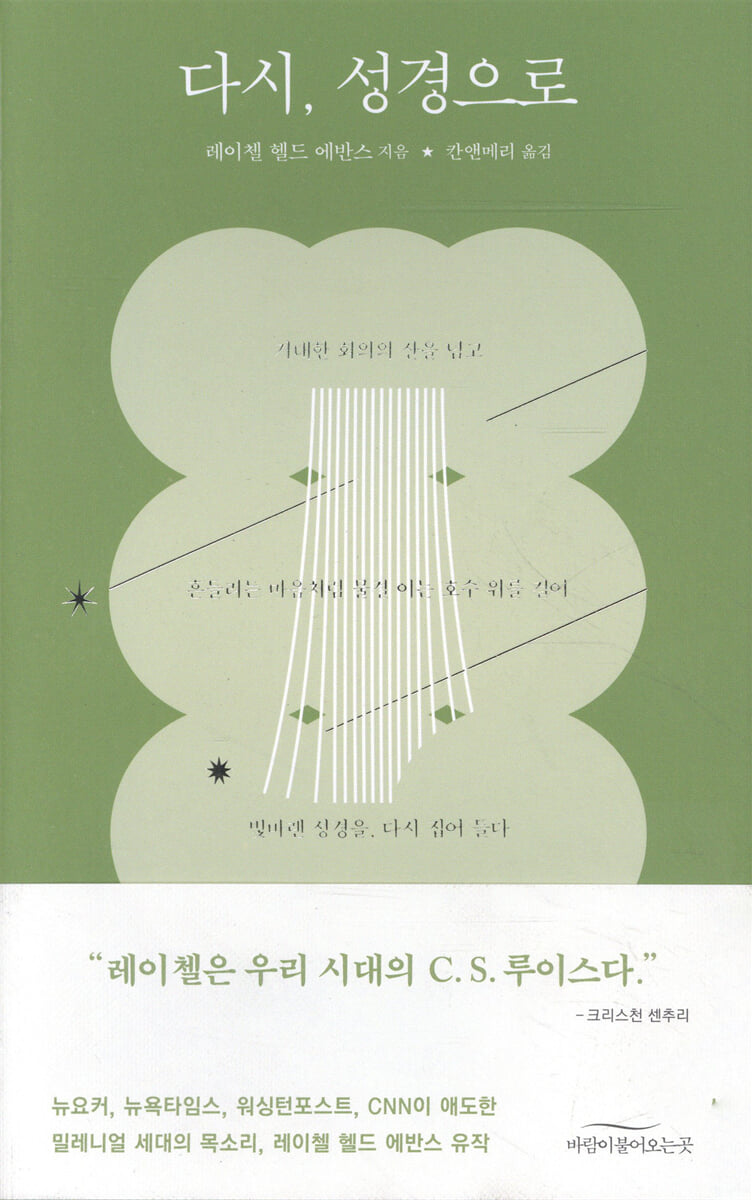
“Rachel is the C of our time.
“It’s S. Lewis.”
The New Yorker, New York Times, Washington Post, and CNN mourned
The Voice of Millennials: Rachel Held Evans's Posthumous Works
This is the story of Rachel Held Evans, a New York Times bestselling author who speaks for the younger generation leaving the church, and her journey to reread the Bible.
His journey begins when he goes from believing the Bible to a fun storybook, a guidebook that tells him what to do, and an answer sheet that offers alternatives to all his problems, to honestly questioning the Bible's incomprehensible contradictions and the image of God and faith it presents.
Those around him do not understand his questions and struggles, responding with comments like, "It's because you lack faith," "Just believe for now," or "You must be tempted." However, Rachel, who has decided to wrestle with the Bible and its subject, God, discovers the difficulty and beauty of reading the Bible, as well as new hope, through honest and intense questions.
“It’s S. Lewis.”
The New Yorker, New York Times, Washington Post, and CNN mourned
The Voice of Millennials: Rachel Held Evans's Posthumous Works
This is the story of Rachel Held Evans, a New York Times bestselling author who speaks for the younger generation leaving the church, and her journey to reread the Bible.
His journey begins when he goes from believing the Bible to a fun storybook, a guidebook that tells him what to do, and an answer sheet that offers alternatives to all his problems, to honestly questioning the Bible's incomprehensible contradictions and the image of God and faith it presents.
Those around him do not understand his questions and struggles, responding with comments like, "It's because you lack faith," "Just believe for now," or "You must be tempted." However, Rachel, who has decided to wrestle with the Bible and its subject, God, discovers the difficulty and beauty of reading the Bible, as well as new hope, through honest and intense questions.
- You can preview some of the book's contents.
Preview
index
Entering
sanctuary
1.
Origin story
well
2.
Salvation Story
rampart
3.
War stories
controversy
4.
Wisdom Stories
beast
5.
Resistance story
spring water
6.
Gospel Story
ocean
7.
Fish Story
letter
8.
Church Story
Going out
Acknowledgements
main
Reading Guide
sanctuary
1.
Origin story
well
2.
Salvation Story
rampart
3.
War stories
controversy
4.
Wisdom Stories
beast
5.
Resistance story
spring water
6.
Gospel Story
ocean
7.
Fish Story
letter
8.
Church Story
Going out
Acknowledgements
main
Reading Guide
Into the book
“A long time ago, but not too long ago... there was a girl who had a magic book.”
---From the "first sentence"
God's breath never stops.
The Bible, filled with inspiration, inspires us.
Hoist the mast and gather fire while waiting for the wind.
Let us debate and argue, like Jacob, who wrestled with the unknown until God blessed him.
If you look at the Bible with curiosity, you will learn something new.
But if you wrestle, you will breathe in the breath of God.
---From "Entering"
The God of relationship gave us the Bible to communicate with each other.
The moment we accept that truth, we realize that being a person of faith does not mean being righteous, but rather being a member of a community that seeks God and restoration.
Both Paul and Jesus understood the Bible this way.
Aren't they both Jewish?
---From "Origin Stories"
For me, asking the Bible to accept its war stories without any reservations was tantamount to asking me to give up being human.
“Being less human doesn’t make you more spiritual,” said Eugene Peterson.
If I have to read the Bible with my heart, soul, and intellect detached, how can I love God with all my heart, soul, mind, and strength? So I resolved.
With everything I have, I decided to boldly abandon my false self and half-baked beliefs and go into the wilderness.
And so began the wrestling with God.
---From "War Stories"
We can consider much of the Bible as resistance literature.
Resistance literature confronts empire head-on by challenging the notion that history is written by the brutal forces of wealth and power.
According to resistance literature, the ultimate victor is the God of the oppressed.
---From "Resistance Stories"
We can sit in the same church pews every Sunday for decades and still not know each other.
We can live like that without knowing or asking how each other became Christians.
You can go your whole life singing hymns and reading the Bible without ever honestly asking yourself, “Why am I a Christian?”
---From "Gospel Stories"
So, when we consider these letters of Paul, the question we should be asking is not, “Is it good or bad for women to cover their heads?”
Rather, at the time the epistles were written, the question was, “Was it helpful or a hindrance for women to cover their heads to spread the gospel and maintain the unity of the church?”
Of course, Paul is a man of the past.
But the important thing is that when God meets us, He comes into our situation.
The Holy Spirit is present in the midst of life.
---From "Church Stories"
We want answers, but God rarely gives them.
Instead, He holds us in His soft and comfortable embrace and speaks to us.
“Okay, let me tell you a story.”
---From the "first sentence"
God's breath never stops.
The Bible, filled with inspiration, inspires us.
Hoist the mast and gather fire while waiting for the wind.
Let us debate and argue, like Jacob, who wrestled with the unknown until God blessed him.
If you look at the Bible with curiosity, you will learn something new.
But if you wrestle, you will breathe in the breath of God.
---From "Entering"
The God of relationship gave us the Bible to communicate with each other.
The moment we accept that truth, we realize that being a person of faith does not mean being righteous, but rather being a member of a community that seeks God and restoration.
Both Paul and Jesus understood the Bible this way.
Aren't they both Jewish?
---From "Origin Stories"
For me, asking the Bible to accept its war stories without any reservations was tantamount to asking me to give up being human.
“Being less human doesn’t make you more spiritual,” said Eugene Peterson.
If I have to read the Bible with my heart, soul, and intellect detached, how can I love God with all my heart, soul, mind, and strength? So I resolved.
With everything I have, I decided to boldly abandon my false self and half-baked beliefs and go into the wilderness.
And so began the wrestling with God.
---From "War Stories"
We can consider much of the Bible as resistance literature.
Resistance literature confronts empire head-on by challenging the notion that history is written by the brutal forces of wealth and power.
According to resistance literature, the ultimate victor is the God of the oppressed.
---From "Resistance Stories"
We can sit in the same church pews every Sunday for decades and still not know each other.
We can live like that without knowing or asking how each other became Christians.
You can go your whole life singing hymns and reading the Bible without ever honestly asking yourself, “Why am I a Christian?”
---From "Gospel Stories"
So, when we consider these letters of Paul, the question we should be asking is not, “Is it good or bad for women to cover their heads?”
Rather, at the time the epistles were written, the question was, “Was it helpful or a hindrance for women to cover their heads to spread the gospel and maintain the unity of the church?”
Of course, Paul is a man of the past.
But the important thing is that when God meets us, He comes into our situation.
The Holy Spirit is present in the midst of life.
---From "Church Stories"
We want answers, but God rarely gives them.
Instead, He holds us in His soft and comfortable embrace and speaks to us.
“Okay, let me tell you a story.”
---From "Going Out"
Publisher's Review
I open the Bible again, which I had put aside for a long time.
With dozens of authors, conflicting accounts, and countless passages in the Old Testament that don't quite speak to the "goodness of God," Rachel embarks on a journey of biblical interpretation, drawing on the help of the Bible and various scholars.
In rejecting the clichéd, "just believe it, even if you don't understand it" response often given in church, and in seeking a reading of the Bible that makes sense to herself and others, she discovers two helpful resources.
One is to read the Bible by considering its literary form (genre), and the other is to read the Bible by considering the long-standing method of interpreting the Bible in church history.
When we read the Bible in light of its genre, we can avoid the error of absurd literalism.
Rachel also tells us in a lively and moving style that when we break away from the modern prejudice that thinks of the Bible as a collection of doctrines, a science book, or a book of laws and recover the way the church originally read the Bible, that is, when we read the Bible remembering that it is an invitation to conversation with God, the Bible can become a place of wrestling to hear God's message that comes to me today, rather than a story that has nothing to do with reality.
One thing that Rachel, especially having grown up in a conservative culture, found difficult about reading the Bible was that the church's answers to her questions were overly conservative, masculine, and pro-establishment.
Rachel questions and explores this traditional biblical interpretation of reality, questioning whether the Bible actually says so.
Does the Bible really make unscientific claims? Is it justifiable to cite the Bible as a basis for racial and minority discrimination? Was Paul a misogynist when he told women to be silent in church? Did the God of the Old Testament really command the extermination of Gentiles? Can such a God really be called a “God of love”? These are questions that an honest reader of the Bible inevitably faces. Rachel is not satisfied with the clichéd answers and seeks her own answers.
And we discover that such a process is a tradition that has been passed down throughout church history.
This is the moment when the Bible becomes a living book, a book “inspired by God,” as its original title suggests.
“A superb author who teaches a complex subject like the Bible in a brilliant and ingenious way!”
Rachel's journey from local newspaper reporter to blogger, national columnist, power blogger, and author was marked by a turning point in her life: blogging (and Twitter).
As an adult, he faced doubts and questions about his faith, and he found no answers in the conservative church he belonged to. It was online spaces that he began to share his concerns and thoughts.
As she confessed, for a young woman who grew up in a conservative rural village her entire life and lived there even after graduating from college, the online space was a new world where she could encounter the wider world.
As her writing, filled with her signature honesty and wit, gained more and more support and interaction, she began to form a kind of online community with people she met online.
The struggles of faith, skepticism about conservative Christian culture, the voices of the younger generation (millennials) leaving the church, and questions about the Bible, which (seems to) contain all the problems of Christianity.
Rachel's writing, which does not ignore reality, helped those who had been unable to find their place in the church and were marginalized find their voices.
It turns out that her worries and explorations were not just hers, but those of countless younger generations.
If you search the Twitter hashtag #becauseofRHE, you will find countless stories of people whose lives have been transformed because of her.
"This is a book for me." —Choi In-ah, CEO of Choi In-ah Bookstore
In her quest to understand the Bible, Rachel experiences many of life's contradictions and becomes involved in resolving them.
As she reads the Bible, Rachel confronts a church that never allows questions about faith or the Bible, a conservative Christian church that believes it is unbiblical for women to preach, and an American (and Christian) subculture where racial and ethnic discrimination still rages.
The establishment has cited the Bible as the basis for all its conservative values, but Rachel uses the Bible to oppose all of those values.
When confronted with conflicting views on the same Bible, the author suggests that it is better to ask, "What am I seeking?" rather than "Which side is right?" or "What does this passage mean?"
When we seek support in the Bible to defend our position, we are bound to find passages that support us.
Because the Bible, "whether we use its power for good or for evil, as an instrument of oppression or of liberation, is in our hands."
This is why Rachel recommends creative reading, dialogical reading, and wrestling reading, rather than a dogmatic reading of the Bible.
Because the Bible is a book that was originally meant to be read that way.
To those who ask, 'Do I need to read the Bible?'
For those who have been content with the church's answers to the Bible and those who want to know the Bible more deeply than the church's sermons, Rachel provides motivation and reasons to read and know the Bible more deeply.
This book also provides a reason and joy for those who have long since abandoned the Bible or have never read it before.
The writing style, which keeps the reader glued to the book and maintains a constant sense of liveliness and tension, suggests that this is an introductory book that anyone can read. However, Rachel's subject matter and the sources she cites and references (see 'Notes') reveal that her popular writing is quite strategic.
Rachel is a writer who knows how to convey deep and meaningful stories in a contemporary, lively and accessible language.
C., the greatest Christian apologist of the 20th century, who did not major in theology but was more theological than anyone else and conveyed even the deepest theological thoughts in a language that anyone could understand.
Like S. Lewis, Rachel was seen as a warrior who strives to stand on the side of the “God of love, fairness, and justice” to “her generation” – the millennials born after the 1980s, well-versed in IT and internet use, living with the anxiety of a low-growth society that has become the new normal around the world since the financial crisis, and those who are leaving traditional churches and Christianity because they cannot find answers to their questions, as a friend they can trust and open their hearts to, a sanctuary where they can rest, and fight for the public and on the side of the marginalized.
He was followed by numerous accolades, including "S. Lewis".
Perhaps her writings have touched and influenced the lives of countless people because she did not consider the Bible as an asset to fill her with knowledge or elevate herself, but rather because she sought to live her life to the extent that she knew and understood the Bible.
New York Times bestselling author
President Obama's Religious Affairs Advisor
Despite receiving much praise from prominent media outlets, Rachel continued to write from the margins and engage with those who were marginalized by the church.
Growing up and living her entire life in the "Bible Belt" of the American South, her journey of finding the true faith that the Bible teaches, coupled with skepticism from conservative churches, has borne fruit in four books.
From 『Unraveling Faith』 (2010), which documents the process of moving from a confident faith to a faith that accepts doubts and questions, to 『A Year Living as a Biblical Woman』 (2012), which is a record of an experiment in literally practicing a biblical lifestyle, to 『Finding Church』 (2015), which describes the process of leaving a traditional church and returning to it, to 『Back to the Bible』 (2018), which depicts a journey of reading and understanding the Bible, which is full of contradictions and paradoxes, with new eyes, Rachel has never lost her prophetic attitude of representing the voices of the minority rather than the majority, from the periphery rather than the center.
In this book, Rachel offers some subtle answers to the questions she raised in her previous three books.
He remains a remarkable writer, a voice from the margins, a friend to the oppressed, but as I read this book, steeped in her life, as one recommendation put it, "I feel as if I can sense his breath in the swaying breeze." In the spring of 2019, just as she was beginning her prosperous life as a writer and a Christian, she passed away suddenly from side effects of flu treatment.
The last post she left on her blog was a Lenten meditation titled "Death is a Part of Life."
With dozens of authors, conflicting accounts, and countless passages in the Old Testament that don't quite speak to the "goodness of God," Rachel embarks on a journey of biblical interpretation, drawing on the help of the Bible and various scholars.
In rejecting the clichéd, "just believe it, even if you don't understand it" response often given in church, and in seeking a reading of the Bible that makes sense to herself and others, she discovers two helpful resources.
One is to read the Bible by considering its literary form (genre), and the other is to read the Bible by considering the long-standing method of interpreting the Bible in church history.
When we read the Bible in light of its genre, we can avoid the error of absurd literalism.
Rachel also tells us in a lively and moving style that when we break away from the modern prejudice that thinks of the Bible as a collection of doctrines, a science book, or a book of laws and recover the way the church originally read the Bible, that is, when we read the Bible remembering that it is an invitation to conversation with God, the Bible can become a place of wrestling to hear God's message that comes to me today, rather than a story that has nothing to do with reality.
One thing that Rachel, especially having grown up in a conservative culture, found difficult about reading the Bible was that the church's answers to her questions were overly conservative, masculine, and pro-establishment.
Rachel questions and explores this traditional biblical interpretation of reality, questioning whether the Bible actually says so.
Does the Bible really make unscientific claims? Is it justifiable to cite the Bible as a basis for racial and minority discrimination? Was Paul a misogynist when he told women to be silent in church? Did the God of the Old Testament really command the extermination of Gentiles? Can such a God really be called a “God of love”? These are questions that an honest reader of the Bible inevitably faces. Rachel is not satisfied with the clichéd answers and seeks her own answers.
And we discover that such a process is a tradition that has been passed down throughout church history.
This is the moment when the Bible becomes a living book, a book “inspired by God,” as its original title suggests.
“A superb author who teaches a complex subject like the Bible in a brilliant and ingenious way!”
Rachel's journey from local newspaper reporter to blogger, national columnist, power blogger, and author was marked by a turning point in her life: blogging (and Twitter).
As an adult, he faced doubts and questions about his faith, and he found no answers in the conservative church he belonged to. It was online spaces that he began to share his concerns and thoughts.
As she confessed, for a young woman who grew up in a conservative rural village her entire life and lived there even after graduating from college, the online space was a new world where she could encounter the wider world.
As her writing, filled with her signature honesty and wit, gained more and more support and interaction, she began to form a kind of online community with people she met online.
The struggles of faith, skepticism about conservative Christian culture, the voices of the younger generation (millennials) leaving the church, and questions about the Bible, which (seems to) contain all the problems of Christianity.
Rachel's writing, which does not ignore reality, helped those who had been unable to find their place in the church and were marginalized find their voices.
It turns out that her worries and explorations were not just hers, but those of countless younger generations.
If you search the Twitter hashtag #becauseofRHE, you will find countless stories of people whose lives have been transformed because of her.
"This is a book for me." —Choi In-ah, CEO of Choi In-ah Bookstore
In her quest to understand the Bible, Rachel experiences many of life's contradictions and becomes involved in resolving them.
As she reads the Bible, Rachel confronts a church that never allows questions about faith or the Bible, a conservative Christian church that believes it is unbiblical for women to preach, and an American (and Christian) subculture where racial and ethnic discrimination still rages.
The establishment has cited the Bible as the basis for all its conservative values, but Rachel uses the Bible to oppose all of those values.
When confronted with conflicting views on the same Bible, the author suggests that it is better to ask, "What am I seeking?" rather than "Which side is right?" or "What does this passage mean?"
When we seek support in the Bible to defend our position, we are bound to find passages that support us.
Because the Bible, "whether we use its power for good or for evil, as an instrument of oppression or of liberation, is in our hands."
This is why Rachel recommends creative reading, dialogical reading, and wrestling reading, rather than a dogmatic reading of the Bible.
Because the Bible is a book that was originally meant to be read that way.
To those who ask, 'Do I need to read the Bible?'
For those who have been content with the church's answers to the Bible and those who want to know the Bible more deeply than the church's sermons, Rachel provides motivation and reasons to read and know the Bible more deeply.
This book also provides a reason and joy for those who have long since abandoned the Bible or have never read it before.
The writing style, which keeps the reader glued to the book and maintains a constant sense of liveliness and tension, suggests that this is an introductory book that anyone can read. However, Rachel's subject matter and the sources she cites and references (see 'Notes') reveal that her popular writing is quite strategic.
Rachel is a writer who knows how to convey deep and meaningful stories in a contemporary, lively and accessible language.
C., the greatest Christian apologist of the 20th century, who did not major in theology but was more theological than anyone else and conveyed even the deepest theological thoughts in a language that anyone could understand.
Like S. Lewis, Rachel was seen as a warrior who strives to stand on the side of the “God of love, fairness, and justice” to “her generation” – the millennials born after the 1980s, well-versed in IT and internet use, living with the anxiety of a low-growth society that has become the new normal around the world since the financial crisis, and those who are leaving traditional churches and Christianity because they cannot find answers to their questions, as a friend they can trust and open their hearts to, a sanctuary where they can rest, and fight for the public and on the side of the marginalized.
He was followed by numerous accolades, including "S. Lewis".
Perhaps her writings have touched and influenced the lives of countless people because she did not consider the Bible as an asset to fill her with knowledge or elevate herself, but rather because she sought to live her life to the extent that she knew and understood the Bible.
New York Times bestselling author
President Obama's Religious Affairs Advisor
Despite receiving much praise from prominent media outlets, Rachel continued to write from the margins and engage with those who were marginalized by the church.
Growing up and living her entire life in the "Bible Belt" of the American South, her journey of finding the true faith that the Bible teaches, coupled with skepticism from conservative churches, has borne fruit in four books.
From 『Unraveling Faith』 (2010), which documents the process of moving from a confident faith to a faith that accepts doubts and questions, to 『A Year Living as a Biblical Woman』 (2012), which is a record of an experiment in literally practicing a biblical lifestyle, to 『Finding Church』 (2015), which describes the process of leaving a traditional church and returning to it, to 『Back to the Bible』 (2018), which depicts a journey of reading and understanding the Bible, which is full of contradictions and paradoxes, with new eyes, Rachel has never lost her prophetic attitude of representing the voices of the minority rather than the majority, from the periphery rather than the center.
In this book, Rachel offers some subtle answers to the questions she raised in her previous three books.
He remains a remarkable writer, a voice from the margins, a friend to the oppressed, but as I read this book, steeped in her life, as one recommendation put it, "I feel as if I can sense his breath in the swaying breeze." In the spring of 2019, just as she was beginning her prosperous life as a writer and a Christian, she passed away suddenly from side effects of flu treatment.
The last post she left on her blog was a Lenten meditation titled "Death is a Part of Life."
GOODS SPECIFICS
- Date of issue: April 6, 2020
- Page count, weight, size: 404 pages | 476g | 132*210*30mm
- ISBN13: 9791196889203
- ISBN10: 1196889201
You may also like
카테고리
korean


korean

![GQ KOREA Mark (Monthly): December [2025]](http://librairie.coreenne.fr/cdn/shop/files/8ef265dbbfbf186523ed75ba7319009d.jpg?v=1765340328&width=3840)


