

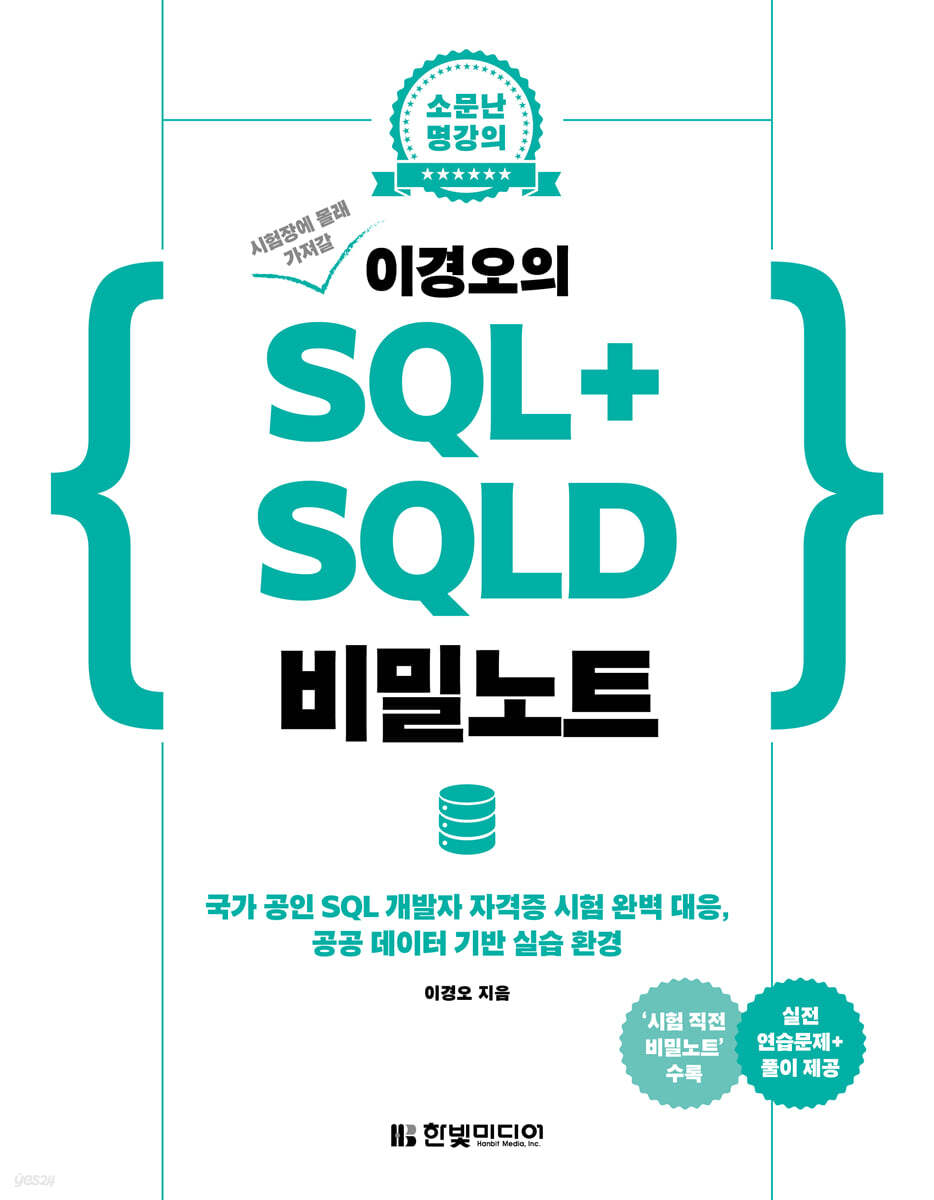
Lee Kyung-oh's SQL+SQLD Secret Note
 |
Description
Book Introduction
Complete everything from SQL basics to practical application and SQLD certification with public data!
This book is structured as follows to help even the general public, including IT majors, learn SQL more easily.
We will easily install Oracle DBMS using an easy installation environment and also install DBMS tools that can utilize the installed DBMS.
You can practice based on real-life data, which is public data closely related to daily life, such as nationwide commercial district information, subway station boarding and alighting information, and population information.
It provides the same theory and practice as the curriculum for the National Certified SQL Developer (SQLD) certification, so you can fully prepare for SQLD.
It is structured as a practice problem + solution structure that conducts theory and practice based on public data and deepens understanding through solving practice problems.
We provide a secret notebook that collects only the patterns that are easy to confuse, so you can organize the patterns that are easy to confuse when using SQL and maximize your practical skills.
This book is structured as follows to help even the general public, including IT majors, learn SQL more easily.
We will easily install Oracle DBMS using an easy installation environment and also install DBMS tools that can utilize the installed DBMS.
You can practice based on real-life data, which is public data closely related to daily life, such as nationwide commercial district information, subway station boarding and alighting information, and population information.
It provides the same theory and practice as the curriculum for the National Certified SQL Developer (SQLD) certification, so you can fully prepare for SQLD.
It is structured as a practice problem + solution structure that conducts theory and practice based on public data and deepens understanding through solving practice problems.
We provide a secret notebook that collects only the patterns that are easy to confuse, so you can organize the patterns that are easy to confuse when using SQL and maximize your practical skills.
- You can preview some of the book's contents.
Preview
index
Part 1.
Building a practical environment
Chapter 1.
Building an Oracle DBMS Practice Environment
1.1 Installing Oracle DBMS
1.2 Checking the Oracle DBMS Listener
1.3 Connecting to Oracle DBMS using SQL*Plus
1.4 Installing SQL Developer
1.5 Connecting to Oracle DBMS using SQL Developer
1.6 Installing DBeaver
1.7 Connecting to Oracle DBMS using DBeaver
Chapter 2.
Configure practice data
2.1 Creating user accounts and table spaces
2.2 Introduction to the Practical Data Model
2.3 Creating a table and entering data
2.4 Introduction to the SQL Practice Environment Construction Process
Part 2.
Understanding Data Modeling
Chapter 3.
Understanding Data Modeling
3.1 Understanding the Data Model
3.2 Entity
3.3 Properties
3.4 Relationships
3.5 Identifier
3.6 Practice Problems
3.7 Practice Problem Explanation
Chapter 4.
Data Model and Performance
4.1 Overview of Performance Data Modeling
4.2 Normalization and Performance
4.3 Denormalization and Performance
4.4 Performance with large amounts of data
4.5 Database Structure and Performance
4.6 Distributed Databases and Performance
4.7 Practice Problems
4.8 Practice Problem Explanation
Part 3. SQL Basics and Utilization
Chapter 5. SQL Basics
5.1 Overview of Relational Databases
5.2 DDL
5.3 DML
5.4 TCL
5.5 WHERE clause
5.6 Functions
5.7 GROUP BY, HAVING clauses
5.8 ORDER BY clause
5.9 Join
5.10 SQL Basics Practice
5.11 Practice Problems
5.12 Practice Problem Explanation
Chapter 6. Using SQL
6.1 Standard Joins
6.2 Set operators
6.3 Hierarchical Queries and Self-Joins
6.4 Subqueries
6.5 Group functions
6.6 Window Functions
6.7 DCL
6.8 Procedural SQL
6.9 SQL Utilization Practice
6.10 Practice Problems
6.11 Practice Problems and Solutions
Chapter 7. Basic Principles of SQL Optimization
7.1 Optimizer and Execution Plan
7.2 Index Basics
7.3 Join Execution Principle
7.4 Practice Problems
7.5 Practice Problems and Solutions
Chapter 8.
Secret notes right before the exam
8.1 SELECT statement
8.2 Aggregate functions
8.3 GROUP BY clause
8.4 Set operators
8.5 Hierarchical SQL Statements
8.6 JOIN
Building a practical environment
Chapter 1.
Building an Oracle DBMS Practice Environment
1.1 Installing Oracle DBMS
1.2 Checking the Oracle DBMS Listener
1.3 Connecting to Oracle DBMS using SQL*Plus
1.4 Installing SQL Developer
1.5 Connecting to Oracle DBMS using SQL Developer
1.6 Installing DBeaver
1.7 Connecting to Oracle DBMS using DBeaver
Chapter 2.
Configure practice data
2.1 Creating user accounts and table spaces
2.2 Introduction to the Practical Data Model
2.3 Creating a table and entering data
2.4 Introduction to the SQL Practice Environment Construction Process
Part 2.
Understanding Data Modeling
Chapter 3.
Understanding Data Modeling
3.1 Understanding the Data Model
3.2 Entity
3.3 Properties
3.4 Relationships
3.5 Identifier
3.6 Practice Problems
3.7 Practice Problem Explanation
Chapter 4.
Data Model and Performance
4.1 Overview of Performance Data Modeling
4.2 Normalization and Performance
4.3 Denormalization and Performance
4.4 Performance with large amounts of data
4.5 Database Structure and Performance
4.6 Distributed Databases and Performance
4.7 Practice Problems
4.8 Practice Problem Explanation
Part 3. SQL Basics and Utilization
Chapter 5. SQL Basics
5.1 Overview of Relational Databases
5.2 DDL
5.3 DML
5.4 TCL
5.5 WHERE clause
5.6 Functions
5.7 GROUP BY, HAVING clauses
5.8 ORDER BY clause
5.9 Join
5.10 SQL Basics Practice
5.11 Practice Problems
5.12 Practice Problem Explanation
Chapter 6. Using SQL
6.1 Standard Joins
6.2 Set operators
6.3 Hierarchical Queries and Self-Joins
6.4 Subqueries
6.5 Group functions
6.6 Window Functions
6.7 DCL
6.8 Procedural SQL
6.9 SQL Utilization Practice
6.10 Practice Problems
6.11 Practice Problems and Solutions
Chapter 7. Basic Principles of SQL Optimization
7.1 Optimizer and Execution Plan
7.2 Index Basics
7.3 Join Execution Principle
7.4 Practice Problems
7.5 Practice Problems and Solutions
Chapter 8.
Secret notes right before the exam
8.1 SELECT statement
8.2 Aggregate functions
8.3 GROUP BY clause
8.4 Set operators
8.5 Hierarchical SQL Statements
8.6 JOIN
Detailed image

Publisher's Review
In the era of the Data New Deal, a book on public data analysis using SQL has been published!
With the influx of data, SQL has become an essential skill that not only IT developers but also non-technical practitioners must learn.
This book allows even beginners without programming knowledge to easily utilize public data to learn the core concepts and principles of SQL, and even prepare for certification.
You'll become familiar with data through hands-on practice using data relevant to our daily lives, such as nationwide commercial district information, subway station boarding and alighting data, and population information. You'll also build your own database and get a feel for SQL and DB.
Additionally, it is designed to help you level up by improving your practical skills through writing your own queries.
If you need a related certification, this book is enough.
You can prepare perfectly with just the essential theory and practice problems.
Start right now with 『Famous Lecture: Lee Kyung-oh's SQL+SQLD Secret Notes』!
With the influx of data, SQL has become an essential skill that not only IT developers but also non-technical practitioners must learn.
This book allows even beginners without programming knowledge to easily utilize public data to learn the core concepts and principles of SQL, and even prepare for certification.
You'll become familiar with data through hands-on practice using data relevant to our daily lives, such as nationwide commercial district information, subway station boarding and alighting data, and population information. You'll also build your own database and get a feel for SQL and DB.
Additionally, it is designed to help you level up by improving your practical skills through writing your own queries.
If you need a related certification, this book is enough.
You can prepare perfectly with just the essential theory and practice problems.
Start right now with 『Famous Lecture: Lee Kyung-oh's SQL+SQLD Secret Notes』!
GOODS SPECIFICS
- Publication date: October 10, 2021
- Page count, weight, size: 556 pages | 188*235*35mm
- ISBN13: 9791162244364
- ISBN10: 1162244364
You may also like
카테고리
korean


korean

![GQ KOREA Mark (Monthly): December [2025]](http://librairie.coreenne.fr/cdn/shop/files/8ef265dbbfbf186523ed75ba7319009d.jpg?v=1765340328&width=3840)


