

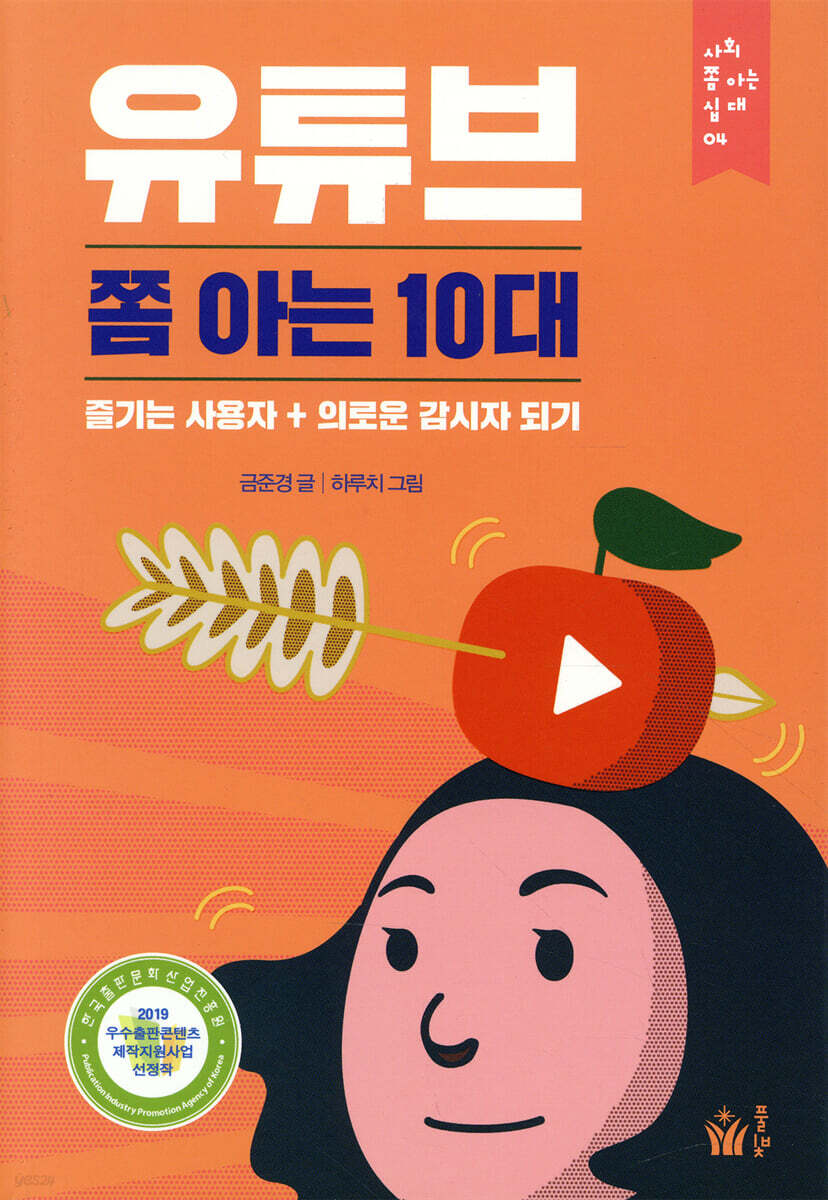
A teenager who knows a little about YouTube
 |
Description
Book Introduction
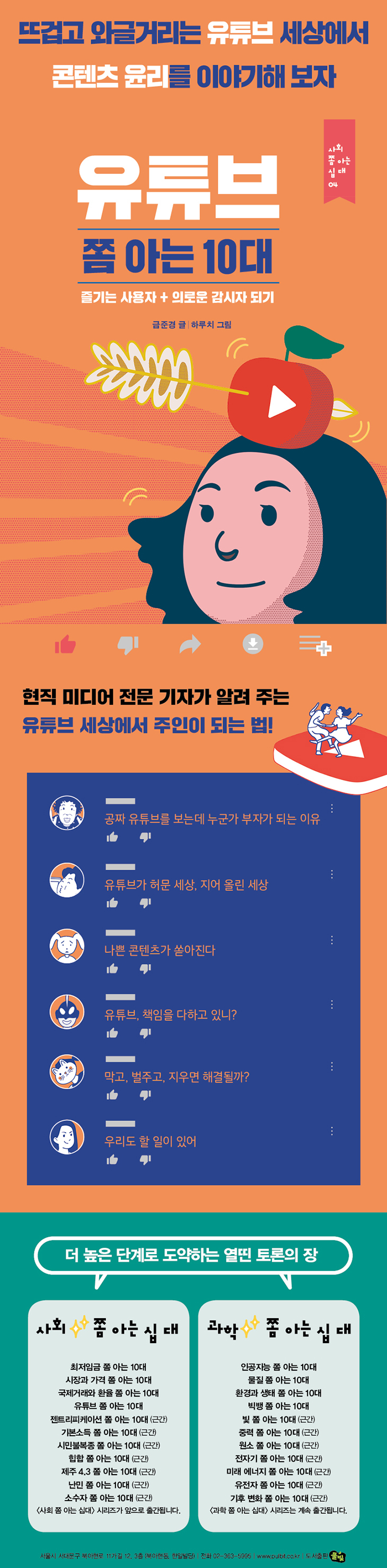
In the hot and bustling world of YouTube
Let's talk about content ethics
Please press the pause button and answer the questions below.
- Videos are free to watch, but how do YouTube and YouTubers make money?
-Why do we create fake news (false information)?
-Am I ready to filter out harmful information?
The fourth volume in the [Teenagers Who Know a Little About Society] series is "Teenagers Who Know a Little About YouTube," which deals with "YouTube," and in particular, "content ethics" necessary for a YouTube-led society.
It was planned to reflect on content ethics for teenagers, who are the main users of YouTube and will lead new communication methods and culture based on YouTube.
This work was selected for the 2019 Korea Creative Content Agency's 'Excellent Publication Content Production Support Project.'
As YouTube's influence grows, people are increasingly focused on new content from YouTubers or how to become a successful YouTube creator.
However, it rarely addresses the reasons why YouTube is criticized as a hotbed of false and harmful information and fake news, the price paid for enjoying YouTube, and the ethics that users should have.
"Teenagers Who Know a Little About YouTube" aims to examine content ethics issues from various perspectives, which are overlooked at school, discussed at home, and ultimately left undisclosed.
Reporter Geum Jun-kyung, who has been predicting changes in the media and analyzing current phenomena at Media Today, a media criticism media outlet, has filled this book with content that teenagers might be curious about and absolutely need, drawing on her own reporting and lecture experience.
It is composed of questions that any YouTube user would have and their answers, which adds to the reading experience, and it is also a device that allows users to quickly access the content they want, tailored to their characteristics.
YouTube is a platform where anyone can express their individuality and cultivate their own values, a place for learning from one another, and a broad medium that realizes democracy and conveys voices from all corners of society.
While not excluding the positive influence of YouTube, this book examines the conflicts and damages that society suffers due to discrimination, hate speech, and false information known as fake news.
How can we maintain YouTube's positive influence while filtering out bad content? Who will be given the reins of what people so easily call "regulation"? Following this discussion, readers will ultimately face themselves.
Because the path to positively nurturing the YouTube ecosystem lies within ourselves.
To do so, we must have a minimum level of civic awareness as producers and consumers and demand that the government and businesses implement appropriate regulations and investments.
Solutions suggested include media literacy education, companies' efforts to self-regulate their content, and the establishment of sound algorithms.
This will take time and is expected to be painful.
The author says:
Just as no one could have predicted YouTube would become such a powerful platform even a few years ago, no one knows what platform will emerge after YouTube.
What's important to us is an unwavering sense of ethics, no matter what powerful new platforms emerge.
There is no measure more specific and effective than fostering civic awareness!
Let's talk about content ethics
Please press the pause button and answer the questions below.
- Videos are free to watch, but how do YouTube and YouTubers make money?
-Why do we create fake news (false information)?
-Am I ready to filter out harmful information?
The fourth volume in the [Teenagers Who Know a Little About Society] series is "Teenagers Who Know a Little About YouTube," which deals with "YouTube," and in particular, "content ethics" necessary for a YouTube-led society.
It was planned to reflect on content ethics for teenagers, who are the main users of YouTube and will lead new communication methods and culture based on YouTube.
This work was selected for the 2019 Korea Creative Content Agency's 'Excellent Publication Content Production Support Project.'
As YouTube's influence grows, people are increasingly focused on new content from YouTubers or how to become a successful YouTube creator.
However, it rarely addresses the reasons why YouTube is criticized as a hotbed of false and harmful information and fake news, the price paid for enjoying YouTube, and the ethics that users should have.
"Teenagers Who Know a Little About YouTube" aims to examine content ethics issues from various perspectives, which are overlooked at school, discussed at home, and ultimately left undisclosed.
Reporter Geum Jun-kyung, who has been predicting changes in the media and analyzing current phenomena at Media Today, a media criticism media outlet, has filled this book with content that teenagers might be curious about and absolutely need, drawing on her own reporting and lecture experience.
It is composed of questions that any YouTube user would have and their answers, which adds to the reading experience, and it is also a device that allows users to quickly access the content they want, tailored to their characteristics.
YouTube is a platform where anyone can express their individuality and cultivate their own values, a place for learning from one another, and a broad medium that realizes democracy and conveys voices from all corners of society.
While not excluding the positive influence of YouTube, this book examines the conflicts and damages that society suffers due to discrimination, hate speech, and false information known as fake news.
How can we maintain YouTube's positive influence while filtering out bad content? Who will be given the reins of what people so easily call "regulation"? Following this discussion, readers will ultimately face themselves.
Because the path to positively nurturing the YouTube ecosystem lies within ourselves.
To do so, we must have a minimum level of civic awareness as producers and consumers and demand that the government and businesses implement appropriate regulations and investments.
Solutions suggested include media literacy education, companies' efforts to self-regulate their content, and the establishment of sound algorithms.
This will take time and is expected to be painful.
The author says:
Just as no one could have predicted YouTube would become such a powerful platform even a few years ago, no one knows what platform will emerge after YouTube.
What's important to us is an unwavering sense of ethics, no matter what powerful new platforms emerge.
There is no measure more specific and effective than fostering civic awareness!
- You can preview some of the book's contents.
Preview
index
1.
Why do people get rich while watching YouTube?
I'll explain it so even grandmas can understand: What is YouTube? | How do YouTubers make money? | How did YouTube become successful?
2.
The world YouTube destroyed, the world it built
Ordinary people becoming stars? | Breaking down borders | Contributing to democracy | Becoming a new educational platform
3.
YouTube, are you doing your part?
It's All Algorithms | Why Deliberations Fail | Privacy and Advertising
4.
Bad content is pouring out
Conspiracy theories and misinformation | Discrimination and hate speech | Provocative and sensational language | Clickbait content | Deceptive and sensational advertising | Copyright infringement
5.
Will blocking, punishing, and erasing solve the problem?
The Regulatory Dilemma | The Role of the State and Society | How YouTube Can Gain Trust
6.
We have work to do too
Don't Be Swayed by Conspiracy Theories and Misinformation | Fight Against Bad Representation | Protect Your Data Dominance
Why do people get rich while watching YouTube?
I'll explain it so even grandmas can understand: What is YouTube? | How do YouTubers make money? | How did YouTube become successful?
2.
The world YouTube destroyed, the world it built
Ordinary people becoming stars? | Breaking down borders | Contributing to democracy | Becoming a new educational platform
3.
YouTube, are you doing your part?
It's All Algorithms | Why Deliberations Fail | Privacy and Advertising
4.
Bad content is pouring out
Conspiracy theories and misinformation | Discrimination and hate speech | Provocative and sensational language | Clickbait content | Deceptive and sensational advertising | Copyright infringement
5.
Will blocking, punishing, and erasing solve the problem?
The Regulatory Dilemma | The Role of the State and Society | How YouTube Can Gain Trust
6.
We have work to do too
Don't Be Swayed by Conspiracy Theories and Misinformation | Fight Against Bad Representation | Protect Your Data Dominance
Detailed image
Publisher's Review
Why Some People Get Rich While Watching Free Content
Nowadays, when teenagers are given smartphones, YouTube is undoubtedly the platform they spend the most time on.
It is overflowing with new, fast, and stimulating information and entertainment that is completely different from traditional media such as television or newspapers.
And the world encourages teenagers even more.
‘You too, become a YouTuber!’, ‘The path to fame and riches is here!’
But it doesn't talk about why YouTube created such a playground, or what we pay for enjoying content there.
《10 Teens Who Know a Little About YouTube》 starts asking questions here.
"I'm just having fun, so why should someone else make money?" This is fraught with problems, including biased thinking, algorithms that exploit personal information for commercial purposes, and hateful content.
How do YouTube and YouTube creators (YouTubers) make money? The first clue that comes to mind is advertising.
Videos from YouTubers with a large number of subscribers have advertisements.
The revenue generated here is shared between YouTube and the YouTuber.
So what do content users pay in return? This is where things get complicated.
To put it bluntly, we pay for our information in exchange for enjoying content.
The 'information' referred to here includes not only information such as age and address, but also content usage patterns, consumption tendencies, and political positions.
This ultimately means that we may end up consuming in a way that is driven by corporations, and even our thoughts and perceptions may be controlled.
Personal information is used to target ads that users might be interested in, which leads YouTubers to create provocative videos that attract a lot of ads.
Companies store data on every interaction users have, from how long they view content to whether they make a purchase or search for related content after seeing an ad to which ads they click.
The extent to which this information is collected and how it is used is not disclosed.
Companies are more interested in designing algorithms to keep users engaged with content.
In addition to economic purposes, there are also political and social purposes.
Certain groups sometimes cleverly plant biased information in content to instill their own values.
Or, there are cases where political and economic goals are mixed.
There have been cases where fake political news content was created to increase advertising revenue, but this led to viewers becoming politically averse or even committing hate crimes.
In other words, this means that even if the content user does not pay immediately, they will have to pay in some way.
Neither YouTube nor any other internet company will tell you what the specific price is.
The light and shadow YouTube casts on the world
YouTube's influence on modern society is enormous.
According to data independently researched and published by YouTube, as of 2019, there were 1.9 billion users worldwide who used YouTube per month, and the total time they spent watching YouTube per day reached 1 billion hours.
Additionally, with services available in over 91 countries and 80 languages, 95 percent of the Internet-using population can access YouTube in their own language (p. 15). Therefore, the impact of a powerful message delivered through YouTube is almost unimaginable.
This influence also has a significant positive impact on society.
First, it became a window through which ordinary people could express their individuality.
Compared to the past, when media dictated trends and spread uniform values, the world of YouTube offers an alternative outlet where we can hear the diverse voices of diverse people.
Second, it has overcome the barrier of national borders and enabled people around the world to communicate with each other.
A world where language and nationality are no longer limitations has come to mean infinite possibilities.
Third, it has the characteristic of being able to spread messages very widely in a short period of time, and has become a channel for spreading the spirit of democracy whenever important issues arise in society.
In the past, when something happened in a society that seriously undermined democratic values, it was easy for citizens to become isolated within the walls of the state.
But YouTube is a platform for spreading important social issues and connecting with people around the world.
Fourth, it reminded us that learning is not something that happens only in a specific place or time, but is a value that can be enjoyed anywhere, at any time in life.
A phenomenon of sharing learning has emerged in an infinite range of areas, including lifestyle information such as cooking and home training, as well as language learning and academic studies.
But the greater the light, the greater the shadow.
Content that exploits YouTube's immense influence for political and economic purposes produces all sorts of conspiracy theories and misinformation, spreads discriminatory and hateful remarks against minorities, or spreads provocative and sensational expressions that can lead to discrimination and hatred.
Such expressions are more subtle and insidious than one might think, making them difficult for ordinary citizens to filter out. They have a particularly negative impact on the younger generation, gradually accustoming them to provocative expressions.
In particular, the problem of fake news (《10 Teens Who Know a Little About YouTube》 calls it 'false information') is a serious problem as it is becoming a major source of social conflict.
Why Fake News Has Become a Major Issue
Fake news is a translation of 'fake news' and can be defined as 'news that is not from the media but is spread by deceiving people into thinking it is from the media.'
However, this has limitations in revealing the characteristics of so-called ‘flyer information’, which has recently become a problem.
Because the sources of what we usually call 'fake news' are not always media outlets, but many people believe them.
Therefore, this book follows the view that rather than debating whether the content is true or not, it should be called 'false information' by focusing on the nature of the information.
The problem with misinformation isn't just that it's untrue.
It is dangerous because there is a clear political and economic purpose behind producing false information.
For example, if you show a video of a crime scene and frame it as a “refugee crime video,” people will feel more fearful of refugees.
Even if it is later revealed that the criminal in the video is not a refugee, the image once created is not easily changed.
This perception is very likely to lead to discrimination and hate crimes in the real world, ultimately leading to social conflict.
As misinformation evolves, people unknowingly adjust their perceptions in the direction desired by 'certain forces'.
If you don't have a specific stance on refugees and are repeatedly exposed to negative content about them, your prejudice against them will naturally be strengthened.
Such disinformation that incites social conflict primarily targets socially vulnerable groups, such as sexual minorities, people with disabilities, refugees, the poor, the elderly, children, and women.
Even though I may not be one of them right now, I could be one of those 'weak' people at any time.
When harmful content shakes society, you cannot be free from it alone.
There is no 'perfect law' that selectively punishes only the bad.
So why does YouTube seem to be turning a blind eye to its reputation as a hotbed of hate speech and a conduit for fake news? Why can't governments find ways to sanction these content creators? First, we must understand that YouTube's goal isn't to "show quality content," but to capture users' attention for a long time.
It is known through various channels, and YouTube has even acknowledged it, that they are building algorithms to expose users to increasingly provocative content.
YouTube generates advertising revenue and collects personal information by capturing users' attention and encouraging them to take action with provocative content.
This is the purpose of YouTube.
YouTube has no reason to self-regulate its content.
However, YouTube cannot ignore social demands and cannot be free from current laws.
So, we are making various efforts to increase the reliability of the information and maintain a certain level of content.
For historical events, reliable information is displayed at the top, and violent and harmful content is removed according to guidelines through review by AI computers and humans.
However, these policies are not implemented consistently in all countries, and the effectiveness of these policies is weak compared to the growing influence of YouTube. Therefore, various civic groups and the national level are demanding more specific measures.
The country is also in a difficult situation.
While there are growing calls for policies to punish fake news and hate speech, anyone can imagine the potential for political abuse if such regulations were to be implemented.
Compared to the past, when media was more like a public good using radio waves, now that anyone can become a one-person broadcaster via the Internet, establishing policies is not easy.
In fact, the Constitutional Court even ruled in a constitutional petition that individuals cannot be punished for spreading "false information" (p. 129). As such, there are limits to the state's legal regulation and the expectation that a private company like YouTube will make its own efforts.
It's not that the government has completely abandoned YouTube, but the reality is that it's difficult to regulate and develop it.
Therefore, the ones who can clearly play a role in rooting out misinformation and hateful content are ultimately content users and creators—that is, ourselves.
What should we, who make up the YouTube ecosystem, do?
YouTube created a platform where people could freely express their individuality, but it was the users, or citizens, who filled it with interesting content.
Therefore, it must be said that the most fundamental solution lies with the citizens.
Regulations may have immediate effects, but they don't change people's perceptions.
Education takes time and may not seem to have an immediate effect, but it is the most effective solution because it makes users think for themselves.
As part of this type of education, media literacy education, which teaches how to read and criticize media, has been recently discussed.
In advanced countries like the UK and France, media literacy education has already been introduced into public education, with students learning how to distinguish false information, protect personal information, and respect the dignity and privacy of others as regular subjects.
Although our country has not yet included media literacy education in the regular education curriculum, we are attempting to implement it through curriculum linkage.
What should media literacy education cover? Contrary to popular belief, there's no clear manual.
It is actually close to a universal value that can be applied anywhere in life.
These include 'listen to and synthesize the opinions of multiple people before making a judgment based on only one side', 'check whether the basis is clear', and 'look into who is harmed and who benefits from a certain claim'.
Rather than learning these things as 'skills', it would be more accurate to say that they are civic awareness that citizens should strengthen throughout their lives.
If a society matures enough to share a certain degree of universal values, it will be able to maintain its health even if some powerful platform, not just YouTube, emerges.
Perhaps someone might say this:
'So, is there no way to put this into practice right now?'
The author suggests the following as a method you can put into practice right now:
First, get into the habit of looking at the basis for any content.
At this time, we check to see if the voices of as many people as possible are reflected, and if there is information that is questionable, we hold it back for a while before 'spreading' it.
Second, actively reject bad content.
Content that promotes violence or hate, no matter how engaging, must be ignored, and sometimes reporting systems must be utilized.
Third, we protect personal information to the greatest extent possible to maintain control over your data.
One way is to configure your web browser or read the terms of use.
A heated social debate forum that leaps to a higher level [Teenagers who know a little about society]
[Teenagers with a Little Social Knowledge] is a series designed for teenagers, especially middle school students, who are struggling to find their way in the face of the vast mountain of knowledge between elementary and high school. It contains topics that are thought-provoking and will spark active discussion among various social issues, selected from each volume.
At a time when reading and discussion are increasingly becoming important goals of education, the [Teenagers Who Know a Little About Society] series has put its heart and soul into killing two birds with one stone: 'reading books' and 'discussing together.'
First, choose a topic.
The seemingly narrow topic of a book encompasses a wide range of fields, and it also helps us regain awareness of issues we have previously overlooked. It was selected as a topic for discussion, allowing young people to freely but logically exchange opinions by dissecting the issue from various perspectives, whether for or against.
Second, expertise.
It was written by an expert who has been thinking about, researching, and acting on the topic for a long time.
Third, reader friendliness.
Forcing yourself to read is impossible.
The joy of reading leads to the joy of knowing.
The [Teenagers Who Know a Little About Society] series was created by thinking about where teenagers can empathize and find fun, and trying to tell stories that are not distant stories but stories about teenagers, using teenagers' words as much as possible.
We included illustrations that bring the content to life in an appropriate amount, so that you can read the entire book in one sitting.
Fourth, a fun knowledge game.
Rather than just providing fragmented knowledge, we have applied that knowledge to real life and created a friendly framework for comprehensive understanding by connecting knowledge from one field to various fields.
Nowadays, when teenagers are given smartphones, YouTube is undoubtedly the platform they spend the most time on.
It is overflowing with new, fast, and stimulating information and entertainment that is completely different from traditional media such as television or newspapers.
And the world encourages teenagers even more.
‘You too, become a YouTuber!’, ‘The path to fame and riches is here!’
But it doesn't talk about why YouTube created such a playground, or what we pay for enjoying content there.
《10 Teens Who Know a Little About YouTube》 starts asking questions here.
"I'm just having fun, so why should someone else make money?" This is fraught with problems, including biased thinking, algorithms that exploit personal information for commercial purposes, and hateful content.
How do YouTube and YouTube creators (YouTubers) make money? The first clue that comes to mind is advertising.
Videos from YouTubers with a large number of subscribers have advertisements.
The revenue generated here is shared between YouTube and the YouTuber.
So what do content users pay in return? This is where things get complicated.
To put it bluntly, we pay for our information in exchange for enjoying content.
The 'information' referred to here includes not only information such as age and address, but also content usage patterns, consumption tendencies, and political positions.
This ultimately means that we may end up consuming in a way that is driven by corporations, and even our thoughts and perceptions may be controlled.
Personal information is used to target ads that users might be interested in, which leads YouTubers to create provocative videos that attract a lot of ads.
Companies store data on every interaction users have, from how long they view content to whether they make a purchase or search for related content after seeing an ad to which ads they click.
The extent to which this information is collected and how it is used is not disclosed.
Companies are more interested in designing algorithms to keep users engaged with content.
In addition to economic purposes, there are also political and social purposes.
Certain groups sometimes cleverly plant biased information in content to instill their own values.
Or, there are cases where political and economic goals are mixed.
There have been cases where fake political news content was created to increase advertising revenue, but this led to viewers becoming politically averse or even committing hate crimes.
In other words, this means that even if the content user does not pay immediately, they will have to pay in some way.
Neither YouTube nor any other internet company will tell you what the specific price is.
The light and shadow YouTube casts on the world
YouTube's influence on modern society is enormous.
According to data independently researched and published by YouTube, as of 2019, there were 1.9 billion users worldwide who used YouTube per month, and the total time they spent watching YouTube per day reached 1 billion hours.
Additionally, with services available in over 91 countries and 80 languages, 95 percent of the Internet-using population can access YouTube in their own language (p. 15). Therefore, the impact of a powerful message delivered through YouTube is almost unimaginable.
This influence also has a significant positive impact on society.
First, it became a window through which ordinary people could express their individuality.
Compared to the past, when media dictated trends and spread uniform values, the world of YouTube offers an alternative outlet where we can hear the diverse voices of diverse people.
Second, it has overcome the barrier of national borders and enabled people around the world to communicate with each other.
A world where language and nationality are no longer limitations has come to mean infinite possibilities.
Third, it has the characteristic of being able to spread messages very widely in a short period of time, and has become a channel for spreading the spirit of democracy whenever important issues arise in society.
In the past, when something happened in a society that seriously undermined democratic values, it was easy for citizens to become isolated within the walls of the state.
But YouTube is a platform for spreading important social issues and connecting with people around the world.
Fourth, it reminded us that learning is not something that happens only in a specific place or time, but is a value that can be enjoyed anywhere, at any time in life.
A phenomenon of sharing learning has emerged in an infinite range of areas, including lifestyle information such as cooking and home training, as well as language learning and academic studies.
But the greater the light, the greater the shadow.
Content that exploits YouTube's immense influence for political and economic purposes produces all sorts of conspiracy theories and misinformation, spreads discriminatory and hateful remarks against minorities, or spreads provocative and sensational expressions that can lead to discrimination and hatred.
Such expressions are more subtle and insidious than one might think, making them difficult for ordinary citizens to filter out. They have a particularly negative impact on the younger generation, gradually accustoming them to provocative expressions.
In particular, the problem of fake news (《10 Teens Who Know a Little About YouTube》 calls it 'false information') is a serious problem as it is becoming a major source of social conflict.
Why Fake News Has Become a Major Issue
Fake news is a translation of 'fake news' and can be defined as 'news that is not from the media but is spread by deceiving people into thinking it is from the media.'
However, this has limitations in revealing the characteristics of so-called ‘flyer information’, which has recently become a problem.
Because the sources of what we usually call 'fake news' are not always media outlets, but many people believe them.
Therefore, this book follows the view that rather than debating whether the content is true or not, it should be called 'false information' by focusing on the nature of the information.
The problem with misinformation isn't just that it's untrue.
It is dangerous because there is a clear political and economic purpose behind producing false information.
For example, if you show a video of a crime scene and frame it as a “refugee crime video,” people will feel more fearful of refugees.
Even if it is later revealed that the criminal in the video is not a refugee, the image once created is not easily changed.
This perception is very likely to lead to discrimination and hate crimes in the real world, ultimately leading to social conflict.
As misinformation evolves, people unknowingly adjust their perceptions in the direction desired by 'certain forces'.
If you don't have a specific stance on refugees and are repeatedly exposed to negative content about them, your prejudice against them will naturally be strengthened.
Such disinformation that incites social conflict primarily targets socially vulnerable groups, such as sexual minorities, people with disabilities, refugees, the poor, the elderly, children, and women.
Even though I may not be one of them right now, I could be one of those 'weak' people at any time.
When harmful content shakes society, you cannot be free from it alone.
There is no 'perfect law' that selectively punishes only the bad.
So why does YouTube seem to be turning a blind eye to its reputation as a hotbed of hate speech and a conduit for fake news? Why can't governments find ways to sanction these content creators? First, we must understand that YouTube's goal isn't to "show quality content," but to capture users' attention for a long time.
It is known through various channels, and YouTube has even acknowledged it, that they are building algorithms to expose users to increasingly provocative content.
YouTube generates advertising revenue and collects personal information by capturing users' attention and encouraging them to take action with provocative content.
This is the purpose of YouTube.
YouTube has no reason to self-regulate its content.
However, YouTube cannot ignore social demands and cannot be free from current laws.
So, we are making various efforts to increase the reliability of the information and maintain a certain level of content.
For historical events, reliable information is displayed at the top, and violent and harmful content is removed according to guidelines through review by AI computers and humans.
However, these policies are not implemented consistently in all countries, and the effectiveness of these policies is weak compared to the growing influence of YouTube. Therefore, various civic groups and the national level are demanding more specific measures.
The country is also in a difficult situation.
While there are growing calls for policies to punish fake news and hate speech, anyone can imagine the potential for political abuse if such regulations were to be implemented.
Compared to the past, when media was more like a public good using radio waves, now that anyone can become a one-person broadcaster via the Internet, establishing policies is not easy.
In fact, the Constitutional Court even ruled in a constitutional petition that individuals cannot be punished for spreading "false information" (p. 129). As such, there are limits to the state's legal regulation and the expectation that a private company like YouTube will make its own efforts.
It's not that the government has completely abandoned YouTube, but the reality is that it's difficult to regulate and develop it.
Therefore, the ones who can clearly play a role in rooting out misinformation and hateful content are ultimately content users and creators—that is, ourselves.
What should we, who make up the YouTube ecosystem, do?
YouTube created a platform where people could freely express their individuality, but it was the users, or citizens, who filled it with interesting content.
Therefore, it must be said that the most fundamental solution lies with the citizens.
Regulations may have immediate effects, but they don't change people's perceptions.
Education takes time and may not seem to have an immediate effect, but it is the most effective solution because it makes users think for themselves.
As part of this type of education, media literacy education, which teaches how to read and criticize media, has been recently discussed.
In advanced countries like the UK and France, media literacy education has already been introduced into public education, with students learning how to distinguish false information, protect personal information, and respect the dignity and privacy of others as regular subjects.
Although our country has not yet included media literacy education in the regular education curriculum, we are attempting to implement it through curriculum linkage.
What should media literacy education cover? Contrary to popular belief, there's no clear manual.
It is actually close to a universal value that can be applied anywhere in life.
These include 'listen to and synthesize the opinions of multiple people before making a judgment based on only one side', 'check whether the basis is clear', and 'look into who is harmed and who benefits from a certain claim'.
Rather than learning these things as 'skills', it would be more accurate to say that they are civic awareness that citizens should strengthen throughout their lives.
If a society matures enough to share a certain degree of universal values, it will be able to maintain its health even if some powerful platform, not just YouTube, emerges.
Perhaps someone might say this:
'So, is there no way to put this into practice right now?'
The author suggests the following as a method you can put into practice right now:
First, get into the habit of looking at the basis for any content.
At this time, we check to see if the voices of as many people as possible are reflected, and if there is information that is questionable, we hold it back for a while before 'spreading' it.
Second, actively reject bad content.
Content that promotes violence or hate, no matter how engaging, must be ignored, and sometimes reporting systems must be utilized.
Third, we protect personal information to the greatest extent possible to maintain control over your data.
One way is to configure your web browser or read the terms of use.
A heated social debate forum that leaps to a higher level [Teenagers who know a little about society]
[Teenagers with a Little Social Knowledge] is a series designed for teenagers, especially middle school students, who are struggling to find their way in the face of the vast mountain of knowledge between elementary and high school. It contains topics that are thought-provoking and will spark active discussion among various social issues, selected from each volume.
At a time when reading and discussion are increasingly becoming important goals of education, the [Teenagers Who Know a Little About Society] series has put its heart and soul into killing two birds with one stone: 'reading books' and 'discussing together.'
First, choose a topic.
The seemingly narrow topic of a book encompasses a wide range of fields, and it also helps us regain awareness of issues we have previously overlooked. It was selected as a topic for discussion, allowing young people to freely but logically exchange opinions by dissecting the issue from various perspectives, whether for or against.
Second, expertise.
It was written by an expert who has been thinking about, researching, and acting on the topic for a long time.
Third, reader friendliness.
Forcing yourself to read is impossible.
The joy of reading leads to the joy of knowing.
The [Teenagers Who Know a Little About Society] series was created by thinking about where teenagers can empathize and find fun, and trying to tell stories that are not distant stories but stories about teenagers, using teenagers' words as much as possible.
We included illustrations that bring the content to life in an appropriate amount, so that you can read the entire book in one sitting.
Fourth, a fun knowledge game.
Rather than just providing fragmented knowledge, we have applied that knowledge to real life and created a friendly framework for comprehensive understanding by connecting knowledge from one field to various fields.
GOODS SPECIFICS
- Date of issue: July 15, 2019
- Page count, weight, size: 184 pages | 280g | 140*203*13mm
- ISBN13: 9791161727431
- ISBN10: 1161727434
You may also like
카테고리
korean


korean

![GQ KOREA Mark (Monthly): December [2025]](http://librairie.coreenne.fr/cdn/shop/files/8ef265dbbfbf186523ed75ba7319009d.jpg?v=1765340328&width=3840)


