

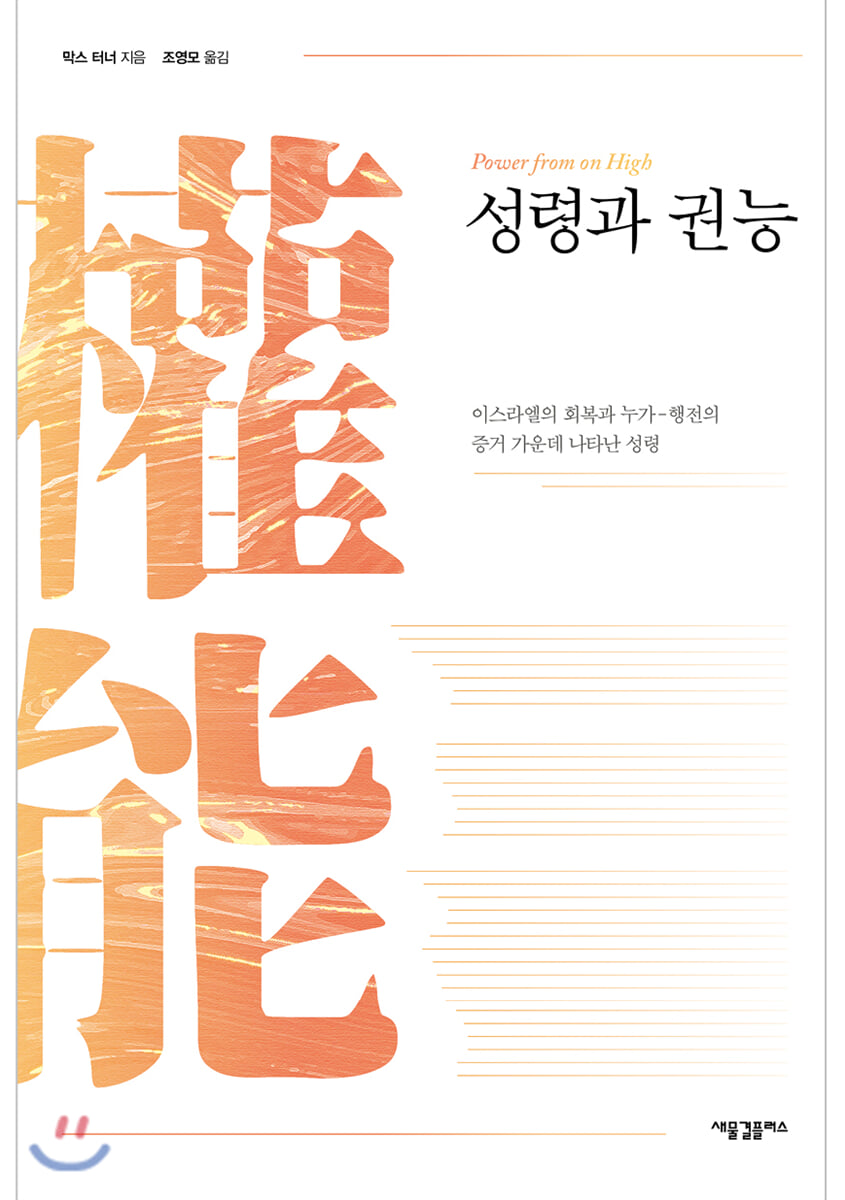
Holy Spirit and Power
 |
Description
Book Introduction
While Western churches have long developed a soteriology-centered pneumatology, the widespread Pentecostal movement that arose in non-Western churches, especially in Third World churches, in the 20th century prompted a new perspective on pneumatology.
The Korean church also experienced explosive growth in the 20th century through the experience of various gifts of the Holy Spirit.
However, compared to the intense spiritual experiences experienced in church settings, theological reflection that can view and interpret those experiences from a biblical perspective is still significantly lacking.
This may be one of the greatest regrets of the Korean church.
A book that can be called the 'definitive edition' of the doctrine of the Holy Spirit has finally been published in Korean.
The author of this book, Max Turner, is currently the world's most widely recognized expert on pneumatology.
The fact that his outstanding academic achievements have been translated into Korean is itself a valuable gift to the Korean theological community.
The Korean church also experienced explosive growth in the 20th century through the experience of various gifts of the Holy Spirit.
However, compared to the intense spiritual experiences experienced in church settings, theological reflection that can view and interpret those experiences from a biblical perspective is still significantly lacking.
This may be one of the greatest regrets of the Korean church.
A book that can be called the 'definitive edition' of the doctrine of the Holy Spirit has finally been published in Korean.
The author of this book, Max Turner, is currently the world's most widely recognized expert on pneumatology.
The fact that his outstanding academic achievements have been translated into Korean is itself a valuable gift to the Korean theological community.
- You can preview some of the book's contents.
Preview
index
introduction
Acknowledgements
Abbreviation table
Part 1: Luke and the Holy Spirit in Current Academic Contexts
Chapter 1: Laying the Groundwork: The History of Religion School and Its Responses to the Challenge
Chapter 2: Various Explanations of the Basic Nature of the Gifts of the Holy Spirit
Part 2: The “Spirit of Prophecy” in Judaism as the Background for Luke and Acts
Chapter 3: The "Spirit of Prophecy" and the Archetypal Gifts in Judaism
Chapter 4: The “Spirit of Prophecy” and Supernatural “Power” in Judaism
Chapter 5: The "Spirit of Prophecy," Ethical Influence, and "Salvation" in Intermediate Judaism
Part 3: The Messiah of the Holy Spirit
Chapter 6: The Coming of the Messiah through the Holy Spirit in Luke 1-2
Chapter 7 John the Baptist's Promise: "He will baptize you with the Holy Spirit and fire" (Luke 3:16)
Chapter 8: The Empowerment of the Messianic Son
Chapter 9: Jesus Anointed with the Holy Spirit to Proclaim Liberation from the New Exodus
Chapter 10: Pentecost: The Enthronement of Jesus as Israel's Messiah and the Holy Spirit as His Power for Israel's Restoration
Part 4: The Disciples and the Holy Spirit
Chapter 11: The Disciples of Jesus and the Holy Spirit from the Beginning of His Ministry to the Ascension
Chapter 12: The Gifts of Pentecost Given to the Church in Acts 506
Chapter 13: The Effects of the Pentecostal Gifts in the Life of the Church and “Salvation” in the Book of Acts
Chapter 14 Conclusion
References
Bible Verse Index
Acknowledgements
Abbreviation table
Part 1: Luke and the Holy Spirit in Current Academic Contexts
Chapter 1: Laying the Groundwork: The History of Religion School and Its Responses to the Challenge
Chapter 2: Various Explanations of the Basic Nature of the Gifts of the Holy Spirit
Part 2: The “Spirit of Prophecy” in Judaism as the Background for Luke and Acts
Chapter 3: The "Spirit of Prophecy" and the Archetypal Gifts in Judaism
Chapter 4: The “Spirit of Prophecy” and Supernatural “Power” in Judaism
Chapter 5: The "Spirit of Prophecy," Ethical Influence, and "Salvation" in Intermediate Judaism
Part 3: The Messiah of the Holy Spirit
Chapter 6: The Coming of the Messiah through the Holy Spirit in Luke 1-2
Chapter 7 John the Baptist's Promise: "He will baptize you with the Holy Spirit and fire" (Luke 3:16)
Chapter 8: The Empowerment of the Messianic Son
Chapter 9: Jesus Anointed with the Holy Spirit to Proclaim Liberation from the New Exodus
Chapter 10: Pentecost: The Enthronement of Jesus as Israel's Messiah and the Holy Spirit as His Power for Israel's Restoration
Part 4: The Disciples and the Holy Spirit
Chapter 11: The Disciples of Jesus and the Holy Spirit from the Beginning of His Ministry to the Ascension
Chapter 12: The Gifts of Pentecost Given to the Church in Acts 506
Chapter 13: The Effects of the Pentecostal Gifts in the Life of the Church and “Salvation” in the Book of Acts
Chapter 14 Conclusion
References
Bible Verse Index
Into the book
We have already shown that for Luke receiving the gift of the Holy Spirit did not mean experiencing the Holy Spirit as a person.
So the question that arises here is this:
“What act or series of acts does the “gift of the Holy Spirit” given to Christians refer to?” The problem with the claim that it refers (simultaneously) to the initiation of sonship and the empowerment for mission becomes clearer now.
These claims involve, at least conceptually and potentially, quite different activities of the Holy Spirit.
Although everyone may need the former from the beginning of their Christian life, we generally consider missions a gift given to mature Christians, and “empowerment for missions” a gift that follows later.
Some might rationalize these notions by taking the position that Luke was trying to emphasize that the Holy Spirit works through all Christians from the very beginning of their faith life to encourage them to do missions.
If this is true, it is reasonable to say that they receive the Holy Spirit as an empowerment for missionary work at conversion-initiation.
But to do that, he must prove that he believed it.
If Luke saw the Holy Spirit as beginning to work only later and only in some Christians, then it would be semantically inconsistent to say that he regarded the gift of the Holy Spirit given at conversion-initiation as an empowerment for missions.
---From “Chapter 2: Various Explanations of the Basic Characteristics of the Gifts of the Holy Spirit”
In chapters 3-5 above, I have raised significant questions about many of the interpretations offered today regarding the Jewish concept of the “spirit of prophecy.”
I have given a proper definition of the “spirit of prophecy” and have noted the archetypal gifts associated with it: charismatic revelation and wisdom, spontaneous prophetic utterances, and charismatic praise.
Although the “spirit of prophecy” was not considered (within Judaism) the source of charismatic proclamation (which developed in Christianity), the Holy Spirit and (more specifically) the “spirit of prophecy” were accepted as sources of supernatural miracles and were also recognized as having the potential for spiritual and ethical renewal.
This was especially true of the “Messianic tradition” reflected in Isaiah 11:1-4, upon which Luke based his account.
Thus, within Judaism, there is no clear distinction between the “spirit of prophecy” and the “charismatic spirit,” as Menzies argues, nor is there a clear distinction between the spirit of prophecy and the “salvationary spirit.”
This conclusion implies that the “spirit of prophecy” cannot be assumed to be unrelated to Luke’s concept of salvation, nor can it be considered a secondary gift of empowerment for missionary work.
Nor can we infer that Luke distinguished the Holy Spirit from the ministry of supernatural power.
We need to look closely at how Luke treated this current of Jewish thought.
---From “Chapter 5: The Spirit of Prophecy, Ethical Influence, and Salvation in Intermediate Judaism”
Within the narrative, the views attributed to John the Baptist (or any other character) and those of the narrator/implied author need to be separated, at least potentially.
From Luke's perspective, John the Baptist was the very prophet Israel had been waiting for.
Therefore, his words can never go unfulfilled.
But even though Gabriel had assured his readers that John would be filled with the Holy Spirit from birth (1:15) and Jesus had praised John the Baptist as “greater than a prophet” and “the greatest among those born of women” (7:26-28),51 Luke recognized that there were some limits to John’s understanding (cf.
7:18-21).
He further knew that the salvific event, when combined with traditional hopes, took on a “form” quite different from that previously expected.
The author Luke takes his readers right to the heart of this irony when he records the disciples' despair on the road to Emmaus when they say to the resurrected Jesus, "We had hoped that it was he who was to redeem Israel" (24:21).
In fact, Luke himself sees that much of John the Baptist's promise recorded in 3:16-17 was fulfilled beyond Pentecost (Acts 1:5; 11:16) in a completely unexpected way.
But he preserves the essence of John the Baptist's words, as we will see shortly.
---From "Chapter 7: John the Baptist's Promise"
The hope for God's reign and Jesus' kingship is linked throughout Luke's Gospel with the hope for Israel's new exodus, liberation, and restoration.
Thus, John the Baptist promises that the one to come will “purify” Israel with the Holy Spirit and fire (3:16).
Luke portrays Jesus as partially fulfilling this hope during his earthly ministry.
But his full kingly rule (1:32-33) extends even beyond his arrival in Jerusalem (Luke 9:51; 19:11-27; 23:42).
Acts 2:33-36 asserts that Jesus began this promised reign through his exaltation to the right hand of God as David's Lord (Psalm 110:1).
He is now in a position to “restore” Israel.
But how can the Lord, seated at God's right hand in heaven, exercise His sovereignty to restore Israel? The final passage of Luke (24:44-49), the prologue of Acts (1:3-8), and the Pentecost address offer the answer: He exercises this sovereignty through the gift of the Holy Spirit, who made Him Lord.
The remainder of Acts supports the picture of the exalted Messiah as the exalted Messiah, and key passages suggest that Israel's restoration was already underway.
---From "Chapter 10 Pentecost"
We have noted that among the texts dealing with the reception of the Holy Spirit, with the exception of Pentecost (Acts 1:8; 2:4, 11), only once (Acts 9:17, 20) is the first gift of the Spirit given directly as an empowerment for preaching and witness.
This is consistent with other pictures in Acts.
Although the empowerment of the Holy Spirit for witnessing is a very important aspect of Luke's pneumatology, Luke does not, overall, portray the majority of Christians as actively engaged in evangelism.
In Jerusalem, those who proclaimed the gospel, performed miracles, and carried out the “ministry of the word of God” were not generally the group of believers, but the apostles (6:2; cf.
4:33).
The evangelism that Luke sees is primarily the task of the twelve disciples in Ephesus, Paul, and especially those empowered with power, such as Stephen (6:8, 10), Philip (8:5-40), Barnabas, John, Mark, Silas, Timothy, and Apollos.
They were also undoubtedly evangelists and co-workers (cf. Luke 8:4, 11:19-20, etc.) beyond those mentioned by Luke.
19:22; 20:4).
---From “The Pentecostal Gifts Given to the Church in Chapter 12 of the Book of Acts”
Therefore, the Holy Spirit of Pentecost is not simply “a gift of power bestowed upon a sanctified life,” but rather a “power from above,” a charismatic prophetic spirit that transforms, shapes, (and sanctifies) the community, guides the mission of the community, and empowers it.
This position is therefore very closely related to that presented in Gordon Fee's work on Paul and the Acts of the Apostles and to that articulated in Lederley's more theological analysis.
For Luke, converts must receive the Holy Spirit without delay, for the Spirit of prophecy is the only means by which the heavenly Lord can communicate with his people, guiding them and assuring them of his love, enlightening them about the meaning of forgiveness of sins, promoting obedience, imparting wisdom and understanding that make a changed life possible, and empowering their lives of service and witness.
For the author of Acts, without the spirit of prophecy, a reconciled community, a knowledge of God, and a joyful service to Him are impossible, and those who are “filled with the Spirit” are beacons illuminating the less intense ways in which the Spirit works through the congregation.
It is not surprising, then, that Luke thought that the Holy Spirit should be given within the broader complex of conversion-initiation (while preserving within this a certain degree of divine sovereignty and freedom of the Holy Spirit).
The challenge here is to provide a coherent doctrine on the relationship between baptism of conversion and the Holy Spirit, as is already being developed by authors in the broader charismatic church tradition.
So the question that arises here is this:
“What act or series of acts does the “gift of the Holy Spirit” given to Christians refer to?” The problem with the claim that it refers (simultaneously) to the initiation of sonship and the empowerment for mission becomes clearer now.
These claims involve, at least conceptually and potentially, quite different activities of the Holy Spirit.
Although everyone may need the former from the beginning of their Christian life, we generally consider missions a gift given to mature Christians, and “empowerment for missions” a gift that follows later.
Some might rationalize these notions by taking the position that Luke was trying to emphasize that the Holy Spirit works through all Christians from the very beginning of their faith life to encourage them to do missions.
If this is true, it is reasonable to say that they receive the Holy Spirit as an empowerment for missionary work at conversion-initiation.
But to do that, he must prove that he believed it.
If Luke saw the Holy Spirit as beginning to work only later and only in some Christians, then it would be semantically inconsistent to say that he regarded the gift of the Holy Spirit given at conversion-initiation as an empowerment for missions.
---From “Chapter 2: Various Explanations of the Basic Characteristics of the Gifts of the Holy Spirit”
In chapters 3-5 above, I have raised significant questions about many of the interpretations offered today regarding the Jewish concept of the “spirit of prophecy.”
I have given a proper definition of the “spirit of prophecy” and have noted the archetypal gifts associated with it: charismatic revelation and wisdom, spontaneous prophetic utterances, and charismatic praise.
Although the “spirit of prophecy” was not considered (within Judaism) the source of charismatic proclamation (which developed in Christianity), the Holy Spirit and (more specifically) the “spirit of prophecy” were accepted as sources of supernatural miracles and were also recognized as having the potential for spiritual and ethical renewal.
This was especially true of the “Messianic tradition” reflected in Isaiah 11:1-4, upon which Luke based his account.
Thus, within Judaism, there is no clear distinction between the “spirit of prophecy” and the “charismatic spirit,” as Menzies argues, nor is there a clear distinction between the spirit of prophecy and the “salvationary spirit.”
This conclusion implies that the “spirit of prophecy” cannot be assumed to be unrelated to Luke’s concept of salvation, nor can it be considered a secondary gift of empowerment for missionary work.
Nor can we infer that Luke distinguished the Holy Spirit from the ministry of supernatural power.
We need to look closely at how Luke treated this current of Jewish thought.
---From “Chapter 5: The Spirit of Prophecy, Ethical Influence, and Salvation in Intermediate Judaism”
Within the narrative, the views attributed to John the Baptist (or any other character) and those of the narrator/implied author need to be separated, at least potentially.
From Luke's perspective, John the Baptist was the very prophet Israel had been waiting for.
Therefore, his words can never go unfulfilled.
But even though Gabriel had assured his readers that John would be filled with the Holy Spirit from birth (1:15) and Jesus had praised John the Baptist as “greater than a prophet” and “the greatest among those born of women” (7:26-28),51 Luke recognized that there were some limits to John’s understanding (cf.
7:18-21).
He further knew that the salvific event, when combined with traditional hopes, took on a “form” quite different from that previously expected.
The author Luke takes his readers right to the heart of this irony when he records the disciples' despair on the road to Emmaus when they say to the resurrected Jesus, "We had hoped that it was he who was to redeem Israel" (24:21).
In fact, Luke himself sees that much of John the Baptist's promise recorded in 3:16-17 was fulfilled beyond Pentecost (Acts 1:5; 11:16) in a completely unexpected way.
But he preserves the essence of John the Baptist's words, as we will see shortly.
---From "Chapter 7: John the Baptist's Promise"
The hope for God's reign and Jesus' kingship is linked throughout Luke's Gospel with the hope for Israel's new exodus, liberation, and restoration.
Thus, John the Baptist promises that the one to come will “purify” Israel with the Holy Spirit and fire (3:16).
Luke portrays Jesus as partially fulfilling this hope during his earthly ministry.
But his full kingly rule (1:32-33) extends even beyond his arrival in Jerusalem (Luke 9:51; 19:11-27; 23:42).
Acts 2:33-36 asserts that Jesus began this promised reign through his exaltation to the right hand of God as David's Lord (Psalm 110:1).
He is now in a position to “restore” Israel.
But how can the Lord, seated at God's right hand in heaven, exercise His sovereignty to restore Israel? The final passage of Luke (24:44-49), the prologue of Acts (1:3-8), and the Pentecost address offer the answer: He exercises this sovereignty through the gift of the Holy Spirit, who made Him Lord.
The remainder of Acts supports the picture of the exalted Messiah as the exalted Messiah, and key passages suggest that Israel's restoration was already underway.
---From "Chapter 10 Pentecost"
We have noted that among the texts dealing with the reception of the Holy Spirit, with the exception of Pentecost (Acts 1:8; 2:4, 11), only once (Acts 9:17, 20) is the first gift of the Spirit given directly as an empowerment for preaching and witness.
This is consistent with other pictures in Acts.
Although the empowerment of the Holy Spirit for witnessing is a very important aspect of Luke's pneumatology, Luke does not, overall, portray the majority of Christians as actively engaged in evangelism.
In Jerusalem, those who proclaimed the gospel, performed miracles, and carried out the “ministry of the word of God” were not generally the group of believers, but the apostles (6:2; cf.
4:33).
The evangelism that Luke sees is primarily the task of the twelve disciples in Ephesus, Paul, and especially those empowered with power, such as Stephen (6:8, 10), Philip (8:5-40), Barnabas, John, Mark, Silas, Timothy, and Apollos.
They were also undoubtedly evangelists and co-workers (cf. Luke 8:4, 11:19-20, etc.) beyond those mentioned by Luke.
19:22; 20:4).
---From “The Pentecostal Gifts Given to the Church in Chapter 12 of the Book of Acts”
Therefore, the Holy Spirit of Pentecost is not simply “a gift of power bestowed upon a sanctified life,” but rather a “power from above,” a charismatic prophetic spirit that transforms, shapes, (and sanctifies) the community, guides the mission of the community, and empowers it.
This position is therefore very closely related to that presented in Gordon Fee's work on Paul and the Acts of the Apostles and to that articulated in Lederley's more theological analysis.
For Luke, converts must receive the Holy Spirit without delay, for the Spirit of prophecy is the only means by which the heavenly Lord can communicate with his people, guiding them and assuring them of his love, enlightening them about the meaning of forgiveness of sins, promoting obedience, imparting wisdom and understanding that make a changed life possible, and empowering their lives of service and witness.
For the author of Acts, without the spirit of prophecy, a reconciled community, a knowledge of God, and a joyful service to Him are impossible, and those who are “filled with the Spirit” are beacons illuminating the less intense ways in which the Spirit works through the congregation.
It is not surprising, then, that Luke thought that the Holy Spirit should be given within the broader complex of conversion-initiation (while preserving within this a certain degree of divine sovereignty and freedom of the Holy Spirit).
The challenge here is to provide a coherent doctrine on the relationship between baptism of conversion and the Holy Spirit, as is already being developed by authors in the broader charismatic church tradition.
---From "Chapter 14 Conclusion"
Publisher's Review
While Western churches have long developed a soteriology-centered pneumatology, the widespread Pentecostal movement that arose in non-Western churches, especially in Third World churches, in the 20th century prompted a new perspective on pneumatology.
The Korean church also experienced explosive growth in the 20th century through the experience of various gifts of the Holy Spirit.
However, compared to the intense spiritual experiences experienced in church settings, theological reflection that can view and interpret those experiences from a biblical perspective is still significantly lacking.
This may be one of the greatest regrets of the Korean church.
A book that can be called the 'definitive edition' of the doctrine of the Holy Spirit has finally been published in Korean.
The author of this book, Max Turner, is currently the world's most widely recognized expert on pneumatology.
The fact that his outstanding academic achievements have been translated into Korean is itself a valuable gift to the Korean theological community.
Over the past 50 years, three leading figures in international New Testament scholarship have dominated discussions on the doctrine of the Holy Spirit.
They are James Dunn, Robert Menzies and Max Turner.
Traditional pneumatological interpreters, represented by James Dunn, understand Jesus' baptism in the Holy Spirit in the Jordan River as his initiation into the new covenant life.
If we follow this interpretation, the event in which Jesus and his disciples (after Pentecost) received the Holy Spirit signifies their calling as God's people.
In other words, the greatest function of the Holy Spirit is soteriological.
On the other hand, scholars such as Robert Menzies understand the Holy Spirit as a missionary gift or ability given after conversion.
They believe that believers who have already been saved are given a missionary mission at some point in the future by receiving the so-called baptism of the Holy Spirit.
This is the typical way they understand Luke-Acts.
However, Max Turner challenges this interpretation, arguing that the nature of the Holy Spirit experienced by Jesus and his disciples is consistent with the “spirit of prophecy” foretold in the Old Testament and Judaism.
As an international New Testament scholar, he preaches his argument by meticulously annotating the Old Testament, Second Temple Jewish literature, and New Testament texts.
It also examines in detail the past and present theological discussions surrounding the doctrine of the Holy Spirit.
Turner sees Jesus' baptism in the Jordan River as empowering him to fulfill his mission as king-messiah foretold in the Old Testament.
He is seen as having been given the ability to perform his duties as a servant-warrior, especially as described in the Old Testament Book of Isaiah.
According to him, in order to fulfill his mission as the Messianic Son and Servant-Warrior, Jesus went out into the wilderness like the Israel of the Old Testament, was filled with the Holy Spirit, overcame the temptations of Satan, and returned to Galilee to begin liberating Israel from their “slavery and poverty,” “captivity,” and “blindness” as prophesied in Isaiah 61.
Moreover, after his death on the cross and resurrection, Jesus becomes the “Lord” who pours out the Spirit of God promised by the prophet Joel at the right hand of God’s throne and imparts various gifts and abilities to the church.
Thus, the Holy Spirit that Jesus possessed during his earthly ministry and that he bestowed upon the church after his resurrection and ascension is precisely the spirit of prophecy that appeared in the Old Testament-Judaism.
As the Spirit of prophecy, the Holy Spirit mediates the reality of God's salvation, and as a result, reveals God's will and word to God's people in various ways.
Therefore, the experience of the Holy Spirit that Jesus' disciples experienced after Pentecost was not limited to simply receiving salvation or gaining the power for missionary work.
Rather, by receiving the Holy Spirit bestowed by Jesus, Jesus' disciples were able to possess all the spiritual blessings that the Holy Spirit bestows as the Spirit of prophecy—various gifts, power, joy, words and inspiration, sanctification, etc.
The driving force behind the missionary work of the early church was here.
So what implications does Turner's interpretation, which regards the work of the Holy Spirit as the activity of God's prophetic Spirit, have for the modern church's pneumatology? Turner himself summarizes this in two points.
He first urges the traditional church—those who seek to limit pneumatology solely to soteriology—to acknowledge and restore the transcendent activity of the Holy Spirit presented in the New Testament pneumatology.
Next, he urges those of the Pentecostal lineage—those who would limit the Holy Spirit to only a charismatic aspect—to restore the inclusiveness of the Holy Spirit.
In other words, we must realize that the Holy Spirit is not simply an object that can be replaced with gifts or abilities, but rather a being who can bestow upon God's people the various benefits that God's presence brings.
Certainly, Turner's pneumatology offers ample potential for establishing a holistic view of the pneumatology, transcending the long-standing barrier between traditional and Pentecostal interpretations.
This extensive work will undoubtedly be a valuable gift that will elevate the discussion of the doctrine of the Holy Spirit in Korean theological circles to a new level.
As the title of this book suggests, the Korean church today stands at a critical juncture where it must once again restore its mission as the new Israel as a “light to the nations,” empowered by the power of the Holy Spirit from above.
The Korean church also experienced explosive growth in the 20th century through the experience of various gifts of the Holy Spirit.
However, compared to the intense spiritual experiences experienced in church settings, theological reflection that can view and interpret those experiences from a biblical perspective is still significantly lacking.
This may be one of the greatest regrets of the Korean church.
A book that can be called the 'definitive edition' of the doctrine of the Holy Spirit has finally been published in Korean.
The author of this book, Max Turner, is currently the world's most widely recognized expert on pneumatology.
The fact that his outstanding academic achievements have been translated into Korean is itself a valuable gift to the Korean theological community.
Over the past 50 years, three leading figures in international New Testament scholarship have dominated discussions on the doctrine of the Holy Spirit.
They are James Dunn, Robert Menzies and Max Turner.
Traditional pneumatological interpreters, represented by James Dunn, understand Jesus' baptism in the Holy Spirit in the Jordan River as his initiation into the new covenant life.
If we follow this interpretation, the event in which Jesus and his disciples (after Pentecost) received the Holy Spirit signifies their calling as God's people.
In other words, the greatest function of the Holy Spirit is soteriological.
On the other hand, scholars such as Robert Menzies understand the Holy Spirit as a missionary gift or ability given after conversion.
They believe that believers who have already been saved are given a missionary mission at some point in the future by receiving the so-called baptism of the Holy Spirit.
This is the typical way they understand Luke-Acts.
However, Max Turner challenges this interpretation, arguing that the nature of the Holy Spirit experienced by Jesus and his disciples is consistent with the “spirit of prophecy” foretold in the Old Testament and Judaism.
As an international New Testament scholar, he preaches his argument by meticulously annotating the Old Testament, Second Temple Jewish literature, and New Testament texts.
It also examines in detail the past and present theological discussions surrounding the doctrine of the Holy Spirit.
Turner sees Jesus' baptism in the Jordan River as empowering him to fulfill his mission as king-messiah foretold in the Old Testament.
He is seen as having been given the ability to perform his duties as a servant-warrior, especially as described in the Old Testament Book of Isaiah.
According to him, in order to fulfill his mission as the Messianic Son and Servant-Warrior, Jesus went out into the wilderness like the Israel of the Old Testament, was filled with the Holy Spirit, overcame the temptations of Satan, and returned to Galilee to begin liberating Israel from their “slavery and poverty,” “captivity,” and “blindness” as prophesied in Isaiah 61.
Moreover, after his death on the cross and resurrection, Jesus becomes the “Lord” who pours out the Spirit of God promised by the prophet Joel at the right hand of God’s throne and imparts various gifts and abilities to the church.
Thus, the Holy Spirit that Jesus possessed during his earthly ministry and that he bestowed upon the church after his resurrection and ascension is precisely the spirit of prophecy that appeared in the Old Testament-Judaism.
As the Spirit of prophecy, the Holy Spirit mediates the reality of God's salvation, and as a result, reveals God's will and word to God's people in various ways.
Therefore, the experience of the Holy Spirit that Jesus' disciples experienced after Pentecost was not limited to simply receiving salvation or gaining the power for missionary work.
Rather, by receiving the Holy Spirit bestowed by Jesus, Jesus' disciples were able to possess all the spiritual blessings that the Holy Spirit bestows as the Spirit of prophecy—various gifts, power, joy, words and inspiration, sanctification, etc.
The driving force behind the missionary work of the early church was here.
So what implications does Turner's interpretation, which regards the work of the Holy Spirit as the activity of God's prophetic Spirit, have for the modern church's pneumatology? Turner himself summarizes this in two points.
He first urges the traditional church—those who seek to limit pneumatology solely to soteriology—to acknowledge and restore the transcendent activity of the Holy Spirit presented in the New Testament pneumatology.
Next, he urges those of the Pentecostal lineage—those who would limit the Holy Spirit to only a charismatic aspect—to restore the inclusiveness of the Holy Spirit.
In other words, we must realize that the Holy Spirit is not simply an object that can be replaced with gifts or abilities, but rather a being who can bestow upon God's people the various benefits that God's presence brings.
Certainly, Turner's pneumatology offers ample potential for establishing a holistic view of the pneumatology, transcending the long-standing barrier between traditional and Pentecostal interpretations.
This extensive work will undoubtedly be a valuable gift that will elevate the discussion of the doctrine of the Holy Spirit in Korean theological circles to a new level.
As the title of this book suggests, the Korean church today stands at a critical juncture where it must once again restore its mission as the new Israel as a “light to the nations,” empowered by the power of the Holy Spirit from above.
GOODS SPECIFICS
- Date of issue: February 21, 2020
- Format: Hardcover book binding method guide
- Page count, weight, size: 736 pages | 1,188g | 168*233*40mm
- ISBN13: 9791161291413
- ISBN10: 1161291415
You may also like
카테고리
korean


korean

![GQ KOREA Mark (Monthly): December [2025]](http://librairie.coreenne.fr/cdn/shop/files/8ef265dbbfbf186523ed75ba7319009d.jpg?v=1765340328&width=3840)


