

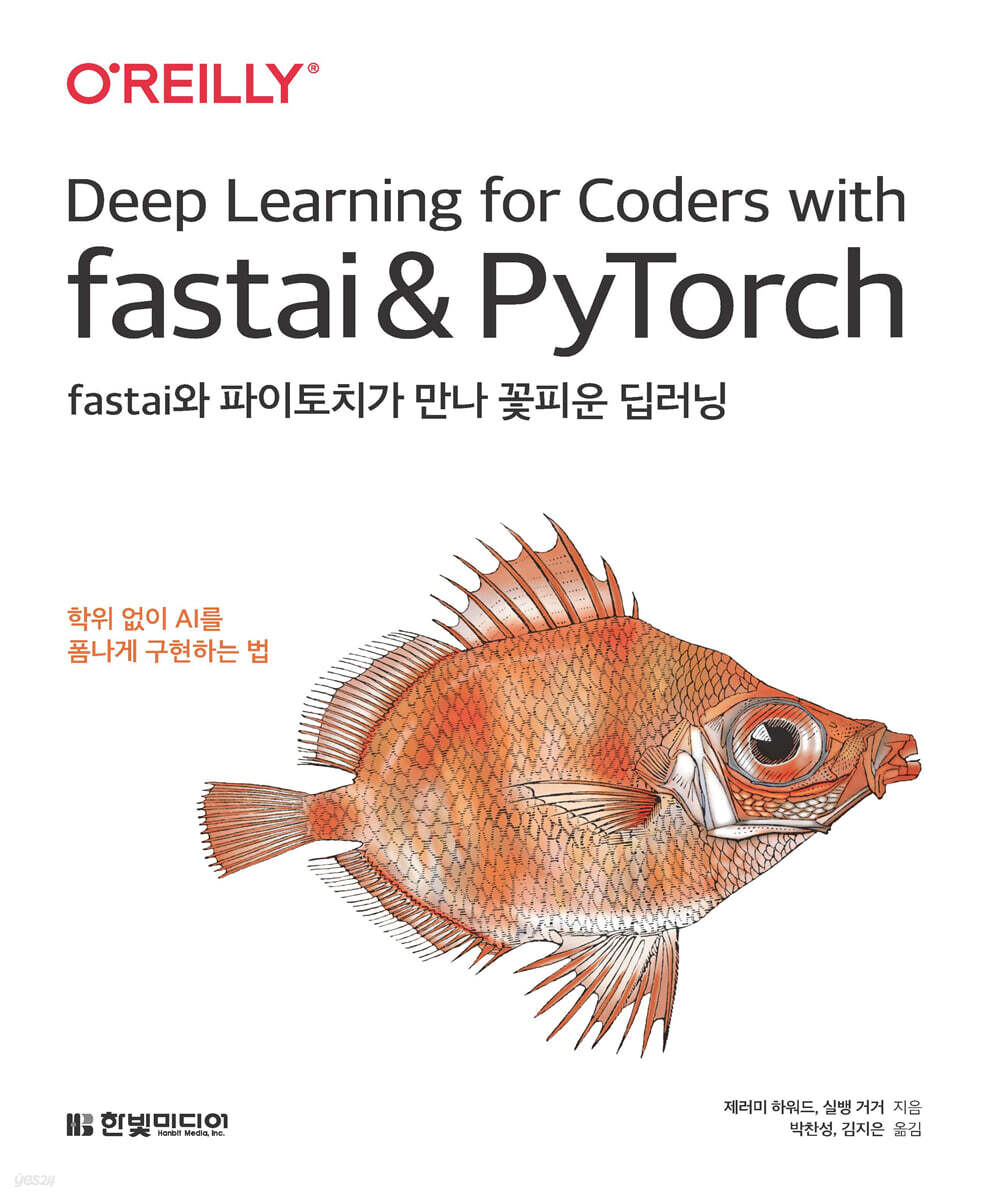
Deep Learning Blossoms with Fastai and PyTorch
 |
Description
Book Introduction
Studying deep learning is divided into before and after encountering 'fastai'.
The code I wrote does deep learning! Now I can live a little more leisurely!
The fastai library provides the first consistent interface to deep learning applications, enabling 'deep learning for everyone.'
Deep learning is no longer the exclusive domain of tech giants like Google, Facebook, and Microsoft.
Programmers familiar with Python can gain amazing experience implementing deep learning with just a little mathematical background, small data, and short code snippets.
In this book, Jeremy and Sylvain, the creators of the fastai library, introduce how to train models for various tasks with fastai and PyTorch.
It also explains the deep learning theory necessary to fully understand the internal algorithm.
The code I wrote does deep learning! Now I can live a little more leisurely!
The fastai library provides the first consistent interface to deep learning applications, enabling 'deep learning for everyone.'
Deep learning is no longer the exclusive domain of tech giants like Google, Facebook, and Microsoft.
Programmers familiar with Python can gain amazing experience implementing deep learning with just a little mathematical background, small data, and short code snippets.
In this book, Jeremy and Sylvain, the creators of the fastai library, introduce how to train models for various tasks with fastai and PyTorch.
It also explains the deep learning theory necessary to fully understand the internal algorithm.
- You can preview some of the book's contents.
Preview
index
PART I: Practical Deep Learning
CHAPTER 1: A Journey Through Deep Learning
1.1 Deep Learning for Everyone
1.2 Neural Networks: A Brief History
1.3 About the Author
1.4 Deep Learning Training Methods
1.5 Software: PyTorch, Fastai, Jupyter Notebook
1.6 Creating Your First Model
1.7 Deep Learning in Various Fields
1.8 Validation and Testing Datasets
1.9 Moments of Adventure, Choices Just for You
1.10 Questionnaire
CHAPTER 2 From Model to Product
2.1 Implementing a Deep Learning Project
2.2 Data Collection
2.3 From Data to DataLoaders
2.4 Model training and data preparation using the trained model
2.5 Converting the model to an online application
2.6 How to avoid disaster
2.7 Advantages of Technical Writing
2.8 Questionnaire
CHAPTER 3 DATA ETHICS
3.1 Key Cases of Data Ethics
3.2 Integrating Machine Learning and Product Design
3.3 Topics of Data Ethics
3.4 Identifying and Resolving Ethical Issues
3.5.
The role of policy
3.6 Conclusion
3.7 Questionnaire
3.8 Deep Learning in Practice: Summary
PART II Understanding the Fastai Application Layer
CHAPTER 4: A Look Inside the Learning Process of a Digit Classifier
4.1 Pixels: The Fundamentals of Computer Image Processing
4.2 First attempt: pixel similarity
4.3 Calculating Evaluation Indicators Using Broadcasting
4.4 Stochastic Gradient Descent
4.5 MNIST loss function
4.6 Everything in one place
4.7 Adding nonlinearities
4.8 Terminology
4.9 Questionnaire
CHAPTER 5 IMAGE CLASSIFICATION
5.1 Extending the dog/cat example to pet breeds
5.2 Pre-sizing
5.3 Cross entropy loss
5.4 Model Interpretation
5.5 Improving the Model
5.6 Conclusion
5.7 Questionnaire
CHAPTER 6 OTHER IMAGE PROCESSING ISSUES
6.1 Multi-label classification
6.2 Regression
6.3 Conclusion
6.4 Questionnaire
CHAPTER 7 Learning the Latest Model
7.1 ImageNet
7.2 Normalization
7.3 Progressive sizing
7.4 Augmentation during testing
7.5 Mixup
7.6 Label Smoothing
7.7 Conclusion
7.8 Questionnaire
CHAPTER 8: A Deep Dive into Collaborative Filtering
8.1 First impressions of the data
8.2 Learning latent elements
8.3 Creating DataLoaders
8.4 Collaborative Filtering from Scratch
8.5 Analysis of Embeddings and Bias
8.6 Building an Initial Collaborative Filtering Model
8.7 Deep Learning for Collaborative Filtering
8.8 Conclusion
8.9 Questionnaire
CHAPTER 9: Dive Deeper into Table Data Modeling
9.1 Categorical Embedding
9.2 Techniques other than deep learning
9.3 Dataset
9.4 Decision Trees
9.5 Random Forest
9.6 Interpretation of the Model
9.7 Extrapolation and Neural Networks
9.8 Ensemble
9.9 Conclusion
9.10 Questionnaire
CHAPTER 10 Dive Deeper into NLP: Recurrent Neural Networks
10.1 Text Preprocessing
10.2 Training a Text Classifier
10.3 Misinformation and Language Models
10.4 Conclusion
10.5 Questionnaire
CHAPTER 11 Transforming Data with Fastai's Intermediate-Level API
11.1 A Deep Dive into Fastai's Hierarchical API
11.2 TfmdLists and Datasets: Converting Collection Lists
11.3 Trying Out the Intermediate Data API: SiamesePair
11.4 Conclusion
11.5 Questionnaire
11.6 Understanding Fastai Applications: Summary
PART III: Fundamentals of Deep Learning
CHAPTER 12 Implementing a Language Model from Scratch
12.1 Data
12.2 First Language Model
12.3 Improving RNNs
12.4 Multilayer RNN
12.5 LSTM
12.6 Regularization of LSTMs
12.7 Conclusion
12.8 Questionnaire
CHAPTER 13 Convolutional Neural Networks
13.1 The Magic of Convolution
13.2 The First Convolutional Neural Network
13.3 Color Images
13.4 Improving Learning Stability
13.5 Conclusion
13.6 Questionnaire
CHAPTER 14 ResNets
14.1 Back to the ImageNet Problem
14.2 Building a Modern CNN: ResNet
14.3 Conclusion
14.4 Questionnaire
CHAPTER 15 A Deep Dive into Application Architecture
15.1 Image Processing
15.2 Natural Language Processing
15.3 Tabular
15.4 Conclusion
15.5 Questionnaire
CHAPTER 16 Learning Process
16.1 Setting a baseline
16.2 Comprehensive Optimizer
16.3 Momentum
16.4 RMSProp
16.5 Adam
16.6 Separate weight decay
16.7 Callback
16.8 Conclusion
16.9 Questionnaire
16.10 Deep Learning Fundamentals: Summary
PART IV: Implementing Deep Learning from Scratch
CHAPTER 17 Building a Neural Network from the Ground Up
17.1 Building Neural Network Layers from Scratch
17.2 Forward and Backpropagation
17.3 Conclusion
17.4 Questionnaire
CHAPTER 18 Interpreting CNNs Using CAM
18.1 CAM and Hook
18.2 Gradient CAM
18.3 Conclusion
18.4 Questionnaire
CHAPTER 19 Building a Learner Class from Scratch
19.1 Data
19.2 Modules and Parameters
19.3 loss
19.4 Learner
19.5 Conclusion
19.6 Questionnaire
CHAPTER 20 Conclusion
Appendix A: Creating a GitHub-Based Blog
A.1 Blogging with GitHub Pages
A.2 Using Jupyter Notebooks for Blogging
Appendix B Data Project Checklist
B.1 Data Scientist
B.2 Strategy
B.3 Data
B.4 Analysis
B.5 Implementation
B.6 Maintenance
B.7 Limitations
CHAPTER 1: A Journey Through Deep Learning
1.1 Deep Learning for Everyone
1.2 Neural Networks: A Brief History
1.3 About the Author
1.4 Deep Learning Training Methods
1.5 Software: PyTorch, Fastai, Jupyter Notebook
1.6 Creating Your First Model
1.7 Deep Learning in Various Fields
1.8 Validation and Testing Datasets
1.9 Moments of Adventure, Choices Just for You
1.10 Questionnaire
CHAPTER 2 From Model to Product
2.1 Implementing a Deep Learning Project
2.2 Data Collection
2.3 From Data to DataLoaders
2.4 Model training and data preparation using the trained model
2.5 Converting the model to an online application
2.6 How to avoid disaster
2.7 Advantages of Technical Writing
2.8 Questionnaire
CHAPTER 3 DATA ETHICS
3.1 Key Cases of Data Ethics
3.2 Integrating Machine Learning and Product Design
3.3 Topics of Data Ethics
3.4 Identifying and Resolving Ethical Issues
3.5.
The role of policy
3.6 Conclusion
3.7 Questionnaire
3.8 Deep Learning in Practice: Summary
PART II Understanding the Fastai Application Layer
CHAPTER 4: A Look Inside the Learning Process of a Digit Classifier
4.1 Pixels: The Fundamentals of Computer Image Processing
4.2 First attempt: pixel similarity
4.3 Calculating Evaluation Indicators Using Broadcasting
4.4 Stochastic Gradient Descent
4.5 MNIST loss function
4.6 Everything in one place
4.7 Adding nonlinearities
4.8 Terminology
4.9 Questionnaire
CHAPTER 5 IMAGE CLASSIFICATION
5.1 Extending the dog/cat example to pet breeds
5.2 Pre-sizing
5.3 Cross entropy loss
5.4 Model Interpretation
5.5 Improving the Model
5.6 Conclusion
5.7 Questionnaire
CHAPTER 6 OTHER IMAGE PROCESSING ISSUES
6.1 Multi-label classification
6.2 Regression
6.3 Conclusion
6.4 Questionnaire
CHAPTER 7 Learning the Latest Model
7.1 ImageNet
7.2 Normalization
7.3 Progressive sizing
7.4 Augmentation during testing
7.5 Mixup
7.6 Label Smoothing
7.7 Conclusion
7.8 Questionnaire
CHAPTER 8: A Deep Dive into Collaborative Filtering
8.1 First impressions of the data
8.2 Learning latent elements
8.3 Creating DataLoaders
8.4 Collaborative Filtering from Scratch
8.5 Analysis of Embeddings and Bias
8.6 Building an Initial Collaborative Filtering Model
8.7 Deep Learning for Collaborative Filtering
8.8 Conclusion
8.9 Questionnaire
CHAPTER 9: Dive Deeper into Table Data Modeling
9.1 Categorical Embedding
9.2 Techniques other than deep learning
9.3 Dataset
9.4 Decision Trees
9.5 Random Forest
9.6 Interpretation of the Model
9.7 Extrapolation and Neural Networks
9.8 Ensemble
9.9 Conclusion
9.10 Questionnaire
CHAPTER 10 Dive Deeper into NLP: Recurrent Neural Networks
10.1 Text Preprocessing
10.2 Training a Text Classifier
10.3 Misinformation and Language Models
10.4 Conclusion
10.5 Questionnaire
CHAPTER 11 Transforming Data with Fastai's Intermediate-Level API
11.1 A Deep Dive into Fastai's Hierarchical API
11.2 TfmdLists and Datasets: Converting Collection Lists
11.3 Trying Out the Intermediate Data API: SiamesePair
11.4 Conclusion
11.5 Questionnaire
11.6 Understanding Fastai Applications: Summary
PART III: Fundamentals of Deep Learning
CHAPTER 12 Implementing a Language Model from Scratch
12.1 Data
12.2 First Language Model
12.3 Improving RNNs
12.4 Multilayer RNN
12.5 LSTM
12.6 Regularization of LSTMs
12.7 Conclusion
12.8 Questionnaire
CHAPTER 13 Convolutional Neural Networks
13.1 The Magic of Convolution
13.2 The First Convolutional Neural Network
13.3 Color Images
13.4 Improving Learning Stability
13.5 Conclusion
13.6 Questionnaire
CHAPTER 14 ResNets
14.1 Back to the ImageNet Problem
14.2 Building a Modern CNN: ResNet
14.3 Conclusion
14.4 Questionnaire
CHAPTER 15 A Deep Dive into Application Architecture
15.1 Image Processing
15.2 Natural Language Processing
15.3 Tabular
15.4 Conclusion
15.5 Questionnaire
CHAPTER 16 Learning Process
16.1 Setting a baseline
16.2 Comprehensive Optimizer
16.3 Momentum
16.4 RMSProp
16.5 Adam
16.6 Separate weight decay
16.7 Callback
16.8 Conclusion
16.9 Questionnaire
16.10 Deep Learning Fundamentals: Summary
PART IV: Implementing Deep Learning from Scratch
CHAPTER 17 Building a Neural Network from the Ground Up
17.1 Building Neural Network Layers from Scratch
17.2 Forward and Backpropagation
17.3 Conclusion
17.4 Questionnaire
CHAPTER 18 Interpreting CNNs Using CAM
18.1 CAM and Hook
18.2 Gradient CAM
18.3 Conclusion
18.4 Questionnaire
CHAPTER 19 Building a Learner Class from Scratch
19.1 Data
19.2 Modules and Parameters
19.3 loss
19.4 Learner
19.5 Conclusion
19.6 Questionnaire
CHAPTER 20 Conclusion
Appendix A: Creating a GitHub-Based Blog
A.1 Blogging with GitHub Pages
A.2 Using Jupyter Notebooks for Blogging
Appendix B Data Project Checklist
B.1 Data Scientist
B.2 Strategy
B.3 Data
B.4 Analysis
B.5 Implementation
B.6 Maintenance
B.7 Limitations
Detailed image

Publisher's Review
Everything you need to know about fast.ai, the cutting-edge deep learning technology that will benefit developers everywhere.
The original version of this book is ranked at the top of the Amazon Computer Neural Network category in the United States.
Because we explain deep learning using the fastai library, which is the hottest topic.
When I talk to people who are just starting to get interested in development and data, I often hear them worry that they won't be good at producing code because they don't have a computer science degree or a developer background.
Of course it could be.
When you're first getting into technology, it's easy to get frustrated because you don't know what you need to know to solve the problems you want to solve.
These individuals will find this book sufficient to satisfy their curiosity about deep learning engineering.
Target audience
This book is best suited for readers who are new to deep learning and machine learning.
Experience with Python coding is a plus.
It also contains content that will be helpful to deep learning practitioners.
We teach you how to achieve world-class results, including techniques covered in the latest research.
It doesn't require advanced math education or years of study.
All it takes is a little common sense and persistence.
- Those who are new to machine learning and deep learning (one year of Python or programming experience is sufficient)
- Those who are utilizing machine learning and deep learning in the field
Key Contents
- Learn image processing, natural language processing, table data, and collaborative filtering models.
- Learn the latest techniques in deep learning.
- Understand how deep learning models work to improve stability, accuracy, and speed.
- Learn how to build deep learning models into web applications.
- Implement deep learning algorithms from scratch.
- Considering the ethical issues inherent in AI work.
The original version of this book is ranked at the top of the Amazon Computer Neural Network category in the United States.
Because we explain deep learning using the fastai library, which is the hottest topic.
When I talk to people who are just starting to get interested in development and data, I often hear them worry that they won't be good at producing code because they don't have a computer science degree or a developer background.
Of course it could be.
When you're first getting into technology, it's easy to get frustrated because you don't know what you need to know to solve the problems you want to solve.
These individuals will find this book sufficient to satisfy their curiosity about deep learning engineering.
Target audience
This book is best suited for readers who are new to deep learning and machine learning.
Experience with Python coding is a plus.
It also contains content that will be helpful to deep learning practitioners.
We teach you how to achieve world-class results, including techniques covered in the latest research.
It doesn't require advanced math education or years of study.
All it takes is a little common sense and persistence.
- Those who are new to machine learning and deep learning (one year of Python or programming experience is sufficient)
- Those who are utilizing machine learning and deep learning in the field
Key Contents
- Learn image processing, natural language processing, table data, and collaborative filtering models.
- Learn the latest techniques in deep learning.
- Understand how deep learning models work to improve stability, accuracy, and speed.
- Learn how to build deep learning models into web applications.
- Implement deep learning algorithms from scratch.
- Considering the ethical issues inherent in AI work.
GOODS SPECIFICS
- Publication date: August 10, 2021
- Page count, weight, size: 720 pages | 183*235*40mm
- ISBN13: 9791162244630
- ISBN10: 1162244631
You may also like
카테고리
korean


korean

![GQ KOREA Mark (Monthly): December [2025]](http://librairie.coreenne.fr/cdn/shop/files/8ef265dbbfbf186523ed75ba7319009d.jpg?v=1765340328&width=3840)


