

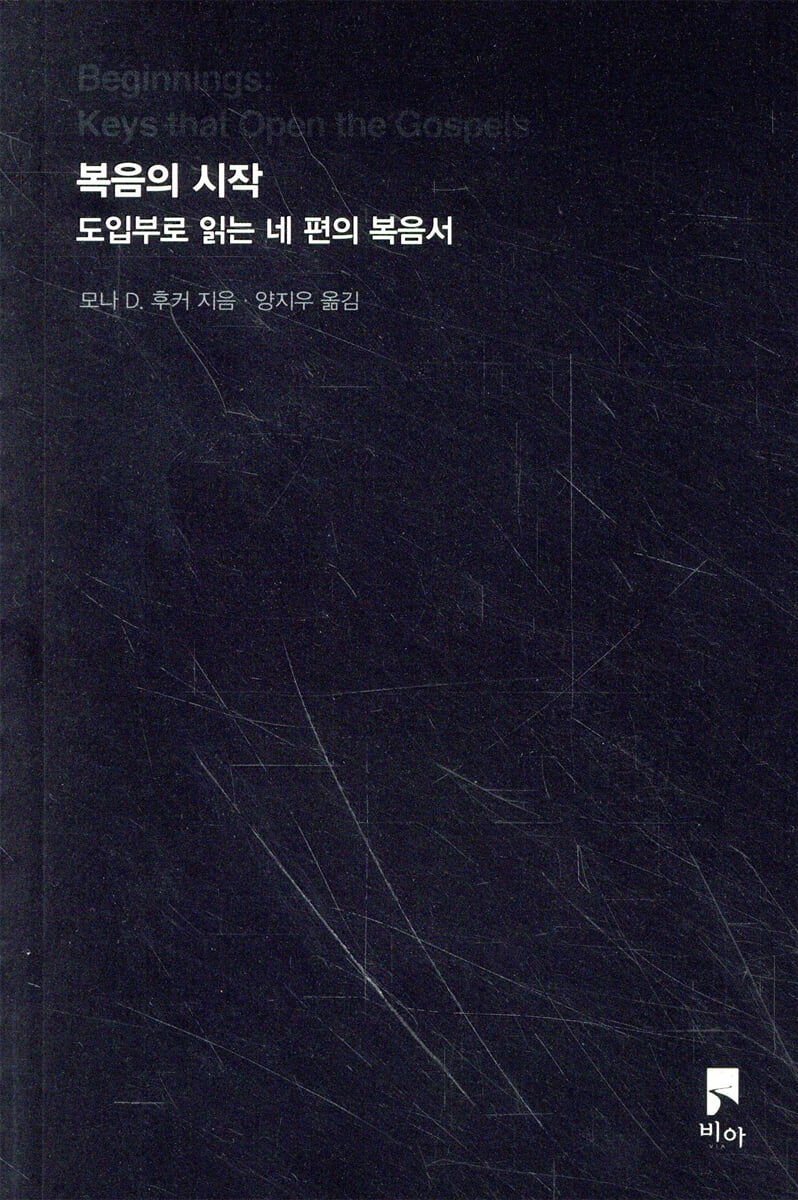
The Beginning of the Gospel
 |
Description
Book Introduction
A fascinating way to read the Gospels, taught by a leading New Testament scholar.
Examining the Keys of the Four Gospels Using the Introduction as a Key
Mona D., the first woman to serve as president of the International Society for the Study of New Drugs and to receive an honorary doctorate from the University of Cambridge.
Hooker's Guide to the Gospels.
Paying attention to the importance of the introduction in a book, we examine the characteristics of the introductions of the four gospels and use them as a key to understand the entire content of each gospel.
The importance of the Bible in Christianity is decisive.
Among them, the four Gospels, the Four Gospels, are documents that contain the core of the gospel, namely, the birth, activities, passion, death, and resurrection of Jesus, and therefore, numerous reading methods have been proposed.
Mona D., who served as Lady Margaret Professor at Cambridge University and is considered a scholar who made significant contributions to the study of the Gospel of Mark and Paul,
Hooker focuses on the introduction of each gospel as a key to understanding its core message.
In a time when 'books' were rare, and a book had to be listened to by several people rather than read alone, authors had to place the key to understanding the entire story before the main story, and write an introduction that hinted at the core of the entire story while also allowing readers to focus on the story.
Mona D.
Hooker focuses on the characteristics of this ancient writing style and analyzes the introduction of each gospel in detail, revealing the characteristics of each gospel.
This book, which summarizes the content originally delivered as lectures, guides readers through detailed yet simple explanations to easily reach the core message of the four gospels.
Readers will experience the unique textual interpretation of a master who has left countless marks on New Testament scholarship, and through this, a new depth of understanding of the literature upon which the Christian faith is rooted.
Examining the Keys of the Four Gospels Using the Introduction as a Key
Mona D., the first woman to serve as president of the International Society for the Study of New Drugs and to receive an honorary doctorate from the University of Cambridge.
Hooker's Guide to the Gospels.
Paying attention to the importance of the introduction in a book, we examine the characteristics of the introductions of the four gospels and use them as a key to understand the entire content of each gospel.
The importance of the Bible in Christianity is decisive.
Among them, the four Gospels, the Four Gospels, are documents that contain the core of the gospel, namely, the birth, activities, passion, death, and resurrection of Jesus, and therefore, numerous reading methods have been proposed.
Mona D., who served as Lady Margaret Professor at Cambridge University and is considered a scholar who made significant contributions to the study of the Gospel of Mark and Paul,
Hooker focuses on the introduction of each gospel as a key to understanding its core message.
In a time when 'books' were rare, and a book had to be listened to by several people rather than read alone, authors had to place the key to understanding the entire story before the main story, and write an introduction that hinted at the core of the entire story while also allowing readers to focus on the story.
Mona D.
Hooker focuses on the characteristics of this ancient writing style and analyzes the introduction of each gospel in detail, revealing the characteristics of each gospel.
This book, which summarizes the content originally delivered as lectures, guides readers through detailed yet simple explanations to easily reach the core message of the four gospels.
Readers will experience the unique textual interpretation of a master who has left countless marks on New Testament scholarship, and through this, a new depth of understanding of the literature upon which the Christian faith is rooted.
- You can preview some of the book's contents.
Preview
index
Entering
1.
The Dramatic Key - Mark 1:1-13
2.
The Key to Prophecy - Matthew 1-2
3.
Spiritual Keys - Luke 1-2
4.
The Keys of Glory - John 1:1-18
Coming out
Read more
1.
The Dramatic Key - Mark 1:1-13
2.
The Key to Prophecy - Matthew 1-2
3.
Spiritual Keys - Luke 1-2
4.
The Keys of Glory - John 1:1-18
Coming out
Read more
Into the book
If you've ever stopped by a library or bookstore and picked up a book, it was probably because you were drawn to its cover and title.
Before deciding whether to borrow or buy a book, you probably read the editor's blurb on the cover, look at the table of contents, and check the preface and introduction to ensure that the book lives up to its cover and title.
The information contained in today's book's title, cover, blurb, table of contents, and preface was, in ancient times, required to be included in the first paragraph of the text.
The Gospel writers also conveyed information about their books to us in this way.
This is why we must pay attention to the opening words of each Gospel.
---p.11
The first thing we must remember is that these books were written to be heard, not to be read.
We're so accustomed to the printed word that it's hard to imagine a world without newspapers and magazines, a world where we had to write each word by hand rather than with a word processor, a world where a single copy had to be transcribed word by word through the arduous process of copying it.
Likewise, I cannot imagine a world in which people who are accustomed to hearing texts live.
In that world, books were rare items.
In a time when only a few people owned books, if the Christian community had a copy of the Gospels, it would have been considered a treasure.
The Gospels were written above all for the Christian community.
Later, copies of the Gospels would have been made and distributed to Christian congregations in other regions and cities.
Imagine the early Christian community gathered for worship.
They would have been eager to hear the Gospel being read.
It is important to keep in mind here the big difference between 'listening' and 'reading'.
---p.15
The idea that the Gospel of Mark functions as a drama is a fascinating one.
A closer analysis of the text of Mark's Gospel reveals interesting similarities with contemporary Greek dramas.
According to Aristotle, a typical tragedy unfolds as follows:
First, the background that led to the tragic situation is presented as a 'complex conflict'.
And within it, various incidents occur that make it impossible to avoid tragedy.
This is followed by a 'turning point' or 'reversal' in the story, where a moment of discovery or recognition occurs and the characters begin to grasp what has happened.
Now, the drama reveals the essence of the story that has been hidden until now and reaches a 'denouement' (untying) ending, that is, the ending where the tragedy is resolved.
Aristotle called the first scene of a tragedy the 'prologue', and in actual dramas, it also provided the audience with the information they needed to understand the play.
Everything ends with an epilogue. ---p.18~19
As I was working out the details of this lecture, the University of Victoria faxed me some documents, but something about what I received seemed odd.
Because my fax machine spit out the same printed page three times and missed one side.
Moreover, the quality of all the prints was terrible.
But the original document may not have been like that.
What Matthew gives us in the Sermon on the Mount story is truly that of Jesus, the one who knows and teaches God's will.
If until then all people had received were imperfect facsimile copies transmitted through Moses, now they had the original.
Because Jesus is greater than Moses.
Jesus' teachings are not copies of Moses', but Moses' teachings are copies and Jesus gives us the original.
---p.82~83
Luke also connects in another way what God did in the past, what He is doing in and through Jesus, and what He is doing in and through Jesus' disciples.
Throughout the first two chapters, Luke continually refers to God's holy spirit, the Holy Spirit.
This is a crucial clue that reveals the meaning of what is happening in the story.
...
It is in their introductions that the gospel writers reveal their hand and give us the key to unlocking the meaning of their stories.
In light of what we have learned through this, we are invited to hear the rest of the story.
But Luke doesn't stop there; in his sequel, he continues to show that the events that occur in the life of the church are also the work of the Holy Spirit. ---p.111-112
The author of the Gospel of John, in his own preface, gives us the key to understanding the entire Gospel.
If we accept that the Word that appeared in the beginning and has resonated throughout history has now become flesh in the person of Jesus, we will understand that Jesus' words and actions are the very actions of God Himself.
The light that shone through the darkness at the creation of the world, the light that has shone through God throughout history as He reveals Himself to His people, shone so brightly in the life and death of Jesus that darkness has never overcome it.
The moment when God's glory is most clearly revealed is, paradoxically, in his final victory on the cross.
In the Gospel of John, Jesus' last words before he dies are a triumphant cry.
“It is finished.” (John 19:30)
Before deciding whether to borrow or buy a book, you probably read the editor's blurb on the cover, look at the table of contents, and check the preface and introduction to ensure that the book lives up to its cover and title.
The information contained in today's book's title, cover, blurb, table of contents, and preface was, in ancient times, required to be included in the first paragraph of the text.
The Gospel writers also conveyed information about their books to us in this way.
This is why we must pay attention to the opening words of each Gospel.
---p.11
The first thing we must remember is that these books were written to be heard, not to be read.
We're so accustomed to the printed word that it's hard to imagine a world without newspapers and magazines, a world where we had to write each word by hand rather than with a word processor, a world where a single copy had to be transcribed word by word through the arduous process of copying it.
Likewise, I cannot imagine a world in which people who are accustomed to hearing texts live.
In that world, books were rare items.
In a time when only a few people owned books, if the Christian community had a copy of the Gospels, it would have been considered a treasure.
The Gospels were written above all for the Christian community.
Later, copies of the Gospels would have been made and distributed to Christian congregations in other regions and cities.
Imagine the early Christian community gathered for worship.
They would have been eager to hear the Gospel being read.
It is important to keep in mind here the big difference between 'listening' and 'reading'.
---p.15
The idea that the Gospel of Mark functions as a drama is a fascinating one.
A closer analysis of the text of Mark's Gospel reveals interesting similarities with contemporary Greek dramas.
According to Aristotle, a typical tragedy unfolds as follows:
First, the background that led to the tragic situation is presented as a 'complex conflict'.
And within it, various incidents occur that make it impossible to avoid tragedy.
This is followed by a 'turning point' or 'reversal' in the story, where a moment of discovery or recognition occurs and the characters begin to grasp what has happened.
Now, the drama reveals the essence of the story that has been hidden until now and reaches a 'denouement' (untying) ending, that is, the ending where the tragedy is resolved.
Aristotle called the first scene of a tragedy the 'prologue', and in actual dramas, it also provided the audience with the information they needed to understand the play.
Everything ends with an epilogue. ---p.18~19
As I was working out the details of this lecture, the University of Victoria faxed me some documents, but something about what I received seemed odd.
Because my fax machine spit out the same printed page three times and missed one side.
Moreover, the quality of all the prints was terrible.
But the original document may not have been like that.
What Matthew gives us in the Sermon on the Mount story is truly that of Jesus, the one who knows and teaches God's will.
If until then all people had received were imperfect facsimile copies transmitted through Moses, now they had the original.
Because Jesus is greater than Moses.
Jesus' teachings are not copies of Moses', but Moses' teachings are copies and Jesus gives us the original.
---p.82~83
Luke also connects in another way what God did in the past, what He is doing in and through Jesus, and what He is doing in and through Jesus' disciples.
Throughout the first two chapters, Luke continually refers to God's holy spirit, the Holy Spirit.
This is a crucial clue that reveals the meaning of what is happening in the story.
...
It is in their introductions that the gospel writers reveal their hand and give us the key to unlocking the meaning of their stories.
In light of what we have learned through this, we are invited to hear the rest of the story.
But Luke doesn't stop there; in his sequel, he continues to show that the events that occur in the life of the church are also the work of the Holy Spirit. ---p.111-112
The author of the Gospel of John, in his own preface, gives us the key to understanding the entire Gospel.
If we accept that the Word that appeared in the beginning and has resonated throughout history has now become flesh in the person of Jesus, we will understand that Jesus' words and actions are the very actions of God Himself.
The light that shone through the darkness at the creation of the world, the light that has shone through God throughout history as He reveals Himself to His people, shone so brightly in the life and death of Jesus that darkness has never overcome it.
The moment when God's glory is most clearly revealed is, paradoxically, in his final victory on the cross.
In the Gospel of John, Jesus' last words before he dies are a triumphant cry.
“It is finished.” (John 19:30)
---p.155~156
Publisher's Review
The perspectives of masters on Christian faith and Christian texts.
The first book of 'Via's Views'.
Examining the Key Points of the Four Gospels Using the Introduction as a Key
“I wonder if perhaps the Gospel writers’ plan was too successful.
We often use the material they provide in the introduction to illuminate the rest of the story, but we soon forget that what they gave us was "special information" that was distinct from what followed.
As a result, we often find ourselves confused by the characters in the story's inability to perceive what we clearly see, and we often criticize them for their inability to perceive.
We forget that the characters in the story don't have information we already know.
...
We have read the text as if the prologues were simply part of the story, ignoring the special role they play in informing and illuminating the entire Gospel.”
Mona D., the first woman to serve as President of the International Society for the Study of New Drugs and to receive an honorary doctorate from the University of Cambridge.
A Guide to the Four Gospels by Hooker.
The author explains how the gospel writers used the introductions of their books to spread the gospel under the circumstances of the time when neither book covers nor separate promotional material could be added, and how the introductions serve as a key to understanding the entire content of the gospel.
No one denies the decisive importance of the Bible in the Christian faith.
In particular, the four Gospels of Mark, Matthew, Luke, and John are documents that contain the core of the Gospel of Jesus' birth, activities, passion, death, and resurrection, and therefore, numerous methods have been suggested for reading them properly.
Mona D., who served as Lady Margaret Professor at Cambridge University and is considered a scholar who made significant contributions to the study of the Gospel of Mark and Paul.
Hooker focuses on the introduction of each Gospel as a key to understanding the core of the four Gospels, a method for reading the Gospels.
In the era when the Gospels were written, reading was emphasized on “listening” rather than “reading.”
Since the Gospel is not a document for Christians to “read,” but a document for them to “listen to,” the format of the book had to be designed to be accessible to the listeners’ ears in order for them to get to the core of the content.
Therefore, the gospel writers had to place the key to understanding the entire story before they began to develop the main story, so that the readers (audience) could focus on the entire story without straying from the core of the gospel.
The introduction of the four gospels is not simply a beginning; it is the 'beginning of the gospel' that provides a preview of the core of the story and helps us understand the entire story that follows, and it is the key that opens the door to the gospel.
Based on these thoughts, Mona D.
Hooker carefully reads the introduction to each gospel, identifies its characteristics, and examines the relationship between the introduction and the main text.
This book, which summarizes the content originally delivered as a lecture, guides readers through detailed yet simple explanations to easily reach the core message that the Gospels are trying to convey.
Readers will experience the unique textual interpretation of a master who has left countless marks on New Testament scholarship, and through this, a new depth of understanding of the literature upon which the Christian faith is rooted.
The first book of 'Via's Views'.
Examining the Key Points of the Four Gospels Using the Introduction as a Key
“I wonder if perhaps the Gospel writers’ plan was too successful.
We often use the material they provide in the introduction to illuminate the rest of the story, but we soon forget that what they gave us was "special information" that was distinct from what followed.
As a result, we often find ourselves confused by the characters in the story's inability to perceive what we clearly see, and we often criticize them for their inability to perceive.
We forget that the characters in the story don't have information we already know.
...
We have read the text as if the prologues were simply part of the story, ignoring the special role they play in informing and illuminating the entire Gospel.”
Mona D., the first woman to serve as President of the International Society for the Study of New Drugs and to receive an honorary doctorate from the University of Cambridge.
A Guide to the Four Gospels by Hooker.
The author explains how the gospel writers used the introductions of their books to spread the gospel under the circumstances of the time when neither book covers nor separate promotional material could be added, and how the introductions serve as a key to understanding the entire content of the gospel.
No one denies the decisive importance of the Bible in the Christian faith.
In particular, the four Gospels of Mark, Matthew, Luke, and John are documents that contain the core of the Gospel of Jesus' birth, activities, passion, death, and resurrection, and therefore, numerous methods have been suggested for reading them properly.
Mona D., who served as Lady Margaret Professor at Cambridge University and is considered a scholar who made significant contributions to the study of the Gospel of Mark and Paul.
Hooker focuses on the introduction of each Gospel as a key to understanding the core of the four Gospels, a method for reading the Gospels.
In the era when the Gospels were written, reading was emphasized on “listening” rather than “reading.”
Since the Gospel is not a document for Christians to “read,” but a document for them to “listen to,” the format of the book had to be designed to be accessible to the listeners’ ears in order for them to get to the core of the content.
Therefore, the gospel writers had to place the key to understanding the entire story before they began to develop the main story, so that the readers (audience) could focus on the entire story without straying from the core of the gospel.
The introduction of the four gospels is not simply a beginning; it is the 'beginning of the gospel' that provides a preview of the core of the story and helps us understand the entire story that follows, and it is the key that opens the door to the gospel.
Based on these thoughts, Mona D.
Hooker carefully reads the introduction to each gospel, identifies its characteristics, and examines the relationship between the introduction and the main text.
This book, which summarizes the content originally delivered as a lecture, guides readers through detailed yet simple explanations to easily reach the core message that the Gospels are trying to convey.
Readers will experience the unique textual interpretation of a master who has left countless marks on New Testament scholarship, and through this, a new depth of understanding of the literature upon which the Christian faith is rooted.
GOODS SPECIFICS
- Date of issue: January 31, 2020
- Page count, weight, size: 168 pages | 210g | 120*180*20mm
- ISBN13: 9788928646708
- ISBN10: 8928646707
You may also like
카테고리
korean


korean

![GQ KOREA Mark (Monthly): December [2025]](http://librairie.coreenne.fr/cdn/shop/files/8ef265dbbfbf186523ed75ba7319009d.jpg?v=1765340328&width=3840)


