

Statistics for Data Science
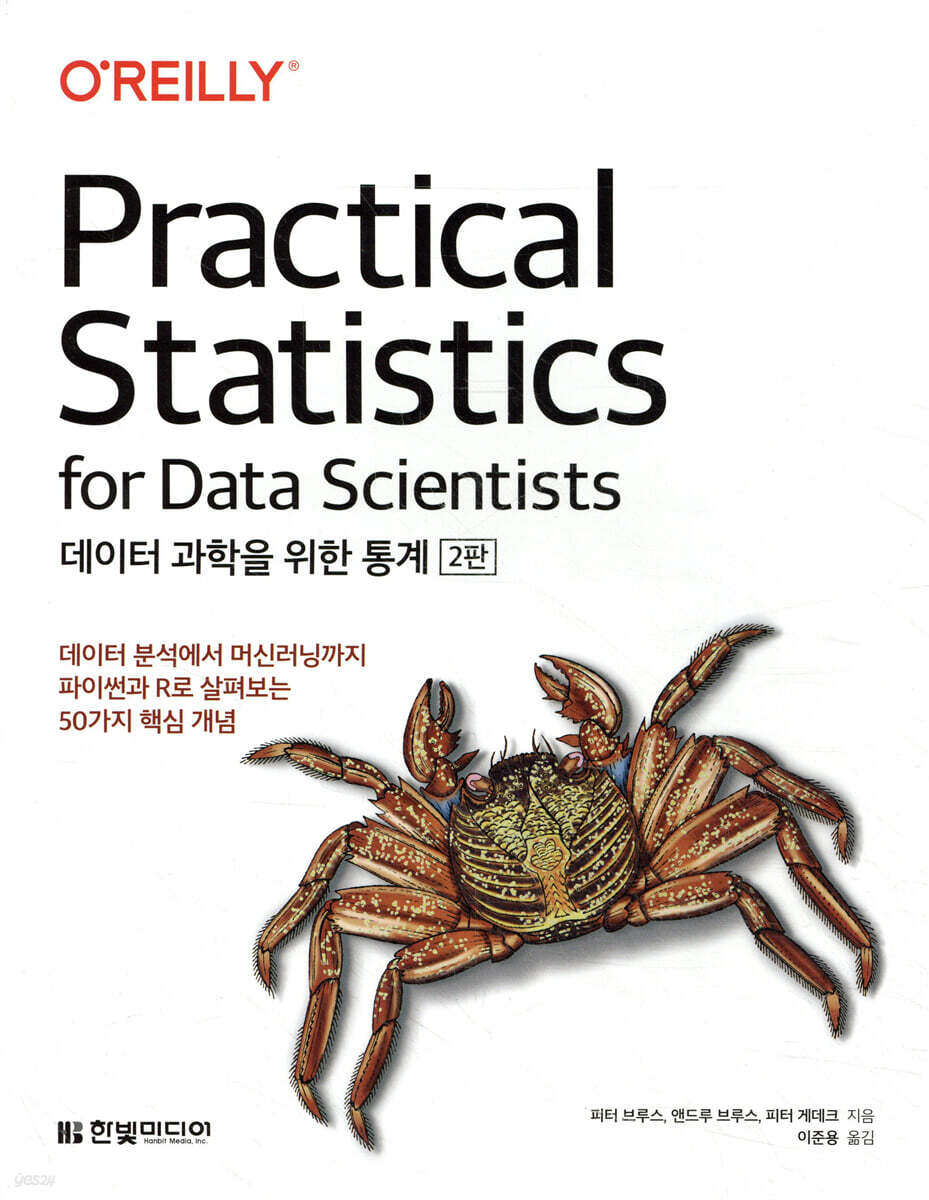 |
Description
Book Introduction
Practical Statistics: Learn Just What You Need with Python and R
Statistical techniques are central to data science, but data scientists don't need to know classical statistics in detail.
This book introduces only the essential statistical concepts and techniques from a data science perspective.
By going through the 50 concepts step by step and running the code, you can quickly absorb essential statistical knowledge.
The second edition includes new Python code that is compatible with existing R code.
I hope that "Statistics for Data Science" will help you grow into a competent data scientist who can effectively utilize the necessary theories in the right places.
- You can preview some of the book's contents.
Preview
index
CHAPTER 1 Exploratory Data Analysis
1.1 Elements of structured data
1.2 Table data
1.3 Location Estimation
1.4 Variant Estimation
1.5 Exploring Data Distributions
1.6 Exploring Binary and Categorical Data
1.7 Correlation
1.8 Exploring More Than One Variable
1.9 In conclusion
CHAPTER 2 Data and Sampling Distributions
2.1 Random sampling and sampling bias
2.2 Selection bias
2.3 Sampling distribution in statistics
2.4 Bootstrap
2.5 Confidence interval
2.6 Normal distribution
2.7 Long-tailed distribution
2.8 Student's t distribution
2.9 Binomial distribution
2.10 Chi-square distribution
2.11 F distribution
2.12 Poisson distribution and other related distributions
2.13 In conclusion
CHAPTER 3 Statistical Experiments and Significance Testing
3.1 A/B test
3.2 Hypothesis testing
3.3 Resampling
3.4 Statistical significance and p value
3.5 t black
3.6 Multiple testing
3.7 degrees of freedom
3.8 Analysis of variance
3.9 Chi-square test
3.10 Multi-armed bandit algorithm
3.11 Power and sample size
3.12 In conclusion
CHAPTER 4 REGRESS AND PREDICTION
4.1 Simple linear regression
4.2 Multiple linear regression
4.3 Prediction using regression
4.4 Factor variables in regression
4.5 Interpreting the regression equation
4.6 Regression Diagnosis
4.7 Polynomial Regression and Spline Regression
4.8 In conclusion
CHAPTER 5 CLASSIFICATION
5.1 Naive Bayes
5.2 Discriminant Analysis
5.3 Logistic Regression
5.4 Evaluating the Classification Model
5.5 Handling Imbalanced Data
5.6 In conclusion
CHAPTER 6 Statistical Machine Learning
6.1 k-nearest neighbors
6.2 Tree Model
6.3 Bagging and Random Forests
6.4 Boosting
6.5 In conclusion
CHAPTER 7 Unsupervised Learning
7.1 Principal component analysis
7.2 k-means clustering
7.3 Hierarchical clustering
7.4 Model-Based Clustering
7.5 Scaling and Categorical Variables
7.6 In conclusion
Detailed image

Publisher's Review
50 Core Concepts from Data Analytics to Machine Learning
Learn only as much as you need by running Python and R code!
Many data scientists run into limitations because they don't understand statistical concepts.
Even if the problem is slightly complicated, it is common to be confused and not know where to start or how to solve it, or to be embarrassed and not understand the output results.
This book is written for working data scientists and artificial intelligence developers who are thirsty for statistical knowledge.
The goals are twofold:
First, it introduces the core concepts of statistics related to data science in an easy-to-digest and follow-through manner.
Second, from a data science perspective, it helps us distinguish which concepts are truly important and useful, and which are less important.
It consists of topics widely used in today's data analysis and machine learning fields, such as EDA, sampling distribution, significance testing, regression analysis, classification, statistical machine learning, and unsupervised learning, and it 'points out' and organizes only about 50 concepts that data scientists must know.
Among the concepts considered important in classical statistics, such as degrees of freedom, p-values, and correlation coefficients, data scientists working with big data do not need to know the details in detail, so we provide guidance accordingly.
For convenience of learning, we have organized 'Glossary of Terms' and 'Key Concepts' for each major section, and in cases where the same term is used differently in statistics, data science, and computer science, we have organized the differences.
The biggest feature of the 2nd edition is the newly provided Python code.
A new author with over 30 years of experience in scientific computing and data science has been brought in to contribute Python code.
Even if you only know Python or R, you can understand the contents of the book and run the code.
If you know how to handle both, it will be fun to compare the implementation differences between the two languages.
If you find statistics books for the general public daunting and specialized-level statistics textbooks daunting, I hope you'll use this book as a stepping stone to develop your statistical knowledge and statistical thinking skills.
Anyone who successfully completes this book will become a competent data scientist who can effectively apply the necessary theories in the right places.
Key Contents
-Getting started with exploratory data analysis, the cornerstone of data science.
-How to reduce bias and obtain a high-quality dataset through random sampling
- How to apply experimental design principles to derive valid conclusions and find clear answers.
-How to estimate results and detect anomalies using regression analysis
-Major classification techniques for predicting and finding categories
-Statistical machine learning techniques that learn from data
- An unsupervised learning technique that extracts meaning from unlabeled data.
GOODS SPECIFICS
- Date of issue: May 7, 2021
- Page count, weight, size: 380 pages | 183*235*30mm
- ISBN13: 9791162244180
- ISBN10: 1162244186
You may also like
카테고리
korean


korean


