

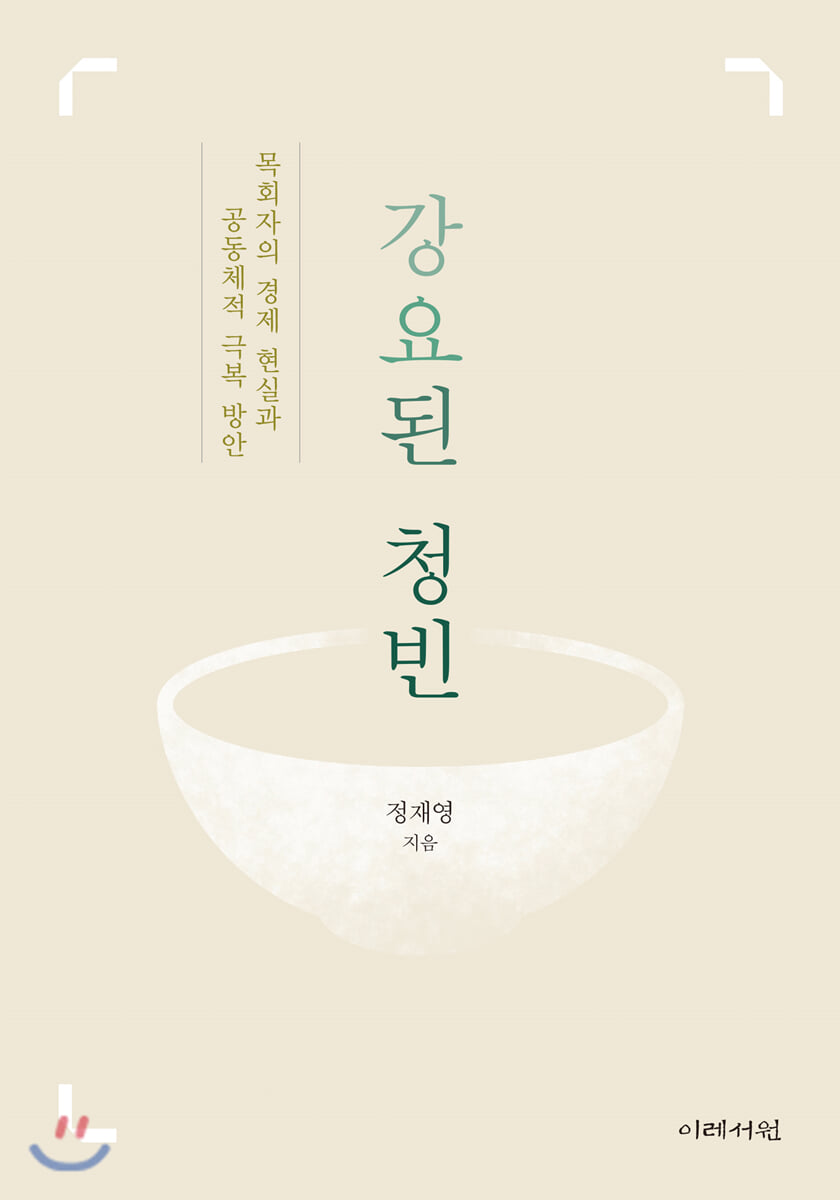
forced poverty
 |
Description
Book Introduction
Average monthly income for pastors: 1.76 million won
Trader's dedication pay, church egoism and polarization, and poor theological education
The True Face of the Korean Church Behind the Poverty of Pastors
A large church that takes losses for the sake of its neighbors and society.
A small church that is reborn as a true 'local church' by leveraging its own strengths.
Dreaming of a Korean church community maturing through their cooperation.
According to a 2017 survey by the Korean Christian Pastors Association, the average monthly income of pastors was 1.76 million won.
Pastors of churches with less than 50 members had an average monthly income of 1.24 million won, while pastors of churches with 50-100 members had an average monthly income of 1.85 million won.
In that case, it can be said that most of the pastors of small churches in our country, which are estimated to number around 50,000, are in difficult financial situations.
What does this situation mean for the Korean church? The poverty of pastors is linked to structural problems within the Korean church, including the decline of the Korean Protestant church, church egoism and polarization, an imbalance in the supply and demand of pastors, and unrealistic salaries.
So the author's interest extends beyond the issue of pastoral poverty to the topic of the growth and maturity of the Korean church.
One solution the author suggests to the problem of pastoral poverty is the restoration of the communal nature of the church.
In other words, we must recognize that not only the individual church is a community, but the entire Korean church is one community.
As part of this, the author reminds large churches that they have a responsibility to their neighbors, society, and small churches.
For small churches, we propose a pastoral plan that maximizes their unique strengths.
The author's ultimate hope is to create a healthy Korean church ecosystem where all churches, regardless of size, location, or denomination, coexist and cooperate.
Trader's dedication pay, church egoism and polarization, and poor theological education
The True Face of the Korean Church Behind the Poverty of Pastors
A large church that takes losses for the sake of its neighbors and society.
A small church that is reborn as a true 'local church' by leveraging its own strengths.
Dreaming of a Korean church community maturing through their cooperation.
According to a 2017 survey by the Korean Christian Pastors Association, the average monthly income of pastors was 1.76 million won.
Pastors of churches with less than 50 members had an average monthly income of 1.24 million won, while pastors of churches with 50-100 members had an average monthly income of 1.85 million won.
In that case, it can be said that most of the pastors of small churches in our country, which are estimated to number around 50,000, are in difficult financial situations.
What does this situation mean for the Korean church? The poverty of pastors is linked to structural problems within the Korean church, including the decline of the Korean Protestant church, church egoism and polarization, an imbalance in the supply and demand of pastors, and unrealistic salaries.
So the author's interest extends beyond the issue of pastoral poverty to the topic of the growth and maturity of the Korean church.
One solution the author suggests to the problem of pastoral poverty is the restoration of the communal nature of the church.
In other words, we must recognize that not only the individual church is a community, but the entire Korean church is one community.
As part of this, the author reminds large churches that they have a responsibility to their neighbors, society, and small churches.
For small churches, we propose a pastoral plan that maximizes their unique strengths.
The author's ultimate hope is to create a healthy Korean church ecosystem where all churches, regardless of size, location, or denomination, coexist and cooperate.
- You can preview some of the book's contents.
Preview
index
1.
Introduction
2.
The Financial Situation of Pastors: Are Pastors Being Paid Appropriately for Their Work?
1) Can pastors make a living solely on their stipends?: The overall economic situation of pastors.
2) Shadow Workers in the Church: The Situation of Assistant Pastors
3.
The Cause of Pastoral Poverty: Is Pastoral Poverty Individually Responsible?
1) A Calling Without a Place to Go: Imbalance in Supply and Demand of Pastors
2) Closed Growth Plate: The Decline of the Korean Protestant Church
3) The Torn Body of Christ: Protestantism
4) Voluntary poverty or forced poverty?: Unrealistic pastoral care
4.
Overcoming Pastoral Poverty: The Korean Church as a Community
1) What does the "catholic church" in the Apostles' Creed mean?: Restoring the catholic nature of the church.
2) “All for One, One for All”: Developing Alternatives at the Church Level
3) Pastors who are respected in society: Regulating the supply and demand of pastors and raising their standards.
4) To become a true 'local church': Careful church planting
5) A means of livelihood or ministry outside the church?: The reality of pastoral duality.
6) Can religious leaders receive help from society?: Utilizing public institutions.
7) Preparedness or Concern?: Pastors' Retirement Planning
5.
Concluding Remarks │ [Appendix: Interview with Assistant Minister]
Introduction
2.
The Financial Situation of Pastors: Are Pastors Being Paid Appropriately for Their Work?
1) Can pastors make a living solely on their stipends?: The overall economic situation of pastors.
2) Shadow Workers in the Church: The Situation of Assistant Pastors
3.
The Cause of Pastoral Poverty: Is Pastoral Poverty Individually Responsible?
1) A Calling Without a Place to Go: Imbalance in Supply and Demand of Pastors
2) Closed Growth Plate: The Decline of the Korean Protestant Church
3) The Torn Body of Christ: Protestantism
4) Voluntary poverty or forced poverty?: Unrealistic pastoral care
4.
Overcoming Pastoral Poverty: The Korean Church as a Community
1) What does the "catholic church" in the Apostles' Creed mean?: Restoring the catholic nature of the church.
2) “All for One, One for All”: Developing Alternatives at the Church Level
3) Pastors who are respected in society: Regulating the supply and demand of pastors and raising their standards.
4) To become a true 'local church': Careful church planting
5) A means of livelihood or ministry outside the church?: The reality of pastoral duality.
6) Can religious leaders receive help from society?: Utilizing public institutions.
7) Preparedness or Concern?: Pastors' Retirement Planning
5.
Concluding Remarks │ [Appendix: Interview with Assistant Minister]
Into the book
There was no information about the contract or working conditions, and I couldn't find out the salary in advance.
During the interview, the pastor said, “Give me enough so I don’t starve to death,” and I think he meant it exactly as he said.
The treatment is much worse than at my previous church.
Although I am receiving a room fee, I am spending 200,000 won more of my own money.
Life is good, but we can't afford to buy the things we need.
It's embarrassing to say, but I use 'Eomka' (Mom's Card).
There are quite a few evangelists around me who use the Umka.
About 15 percent of our seminary students become full-time evangelists, and I'm one of the lucky ones.
_ Page 146
Additionally, the monthly income of pastors of churches with more than 300 members was relatively high at 3.15 million won, while pastors of churches with 100-300 members earned 2.02 million won and pastors of churches with 50-100 members earned 1.85 million won.
Moreover, in the case of micro-churches with less than 50 members, the monthly income was 1.24 million won, which was less than half of the monthly income of pastors of churches with more than 300 members and was considered to be at the extreme poverty level.
A survey of pastors of small churches found that 21.4% of all respondents did not receive a salary, 8.3% received it irregularly, and only 70.4% received it regularly.
In addition, according to the results of a survey conducted by the National Association of Churches for Pioneers targeting 309 pastors of pioneer churches, 200 pastors, or 64%, received a salary of less than 1 million won.
_ Page 25
According to the church's 2019 statistical report, the total number of members was 2,554,000 as of the end of 2018, a decrease of 73,000 from the previous year.
The number of church members has been on a downward trend since 2010, with the largest decrease in 2017, a decrease of more than 100,000 compared to the previous year.
The number of churches and pastors is increasing even though the total number of believers is decreasing.
In 2018, the number of churches increased by 94 to 9,190, and the number of pastors increased by 674, from 19,832 to 20,506.
In just one year, the number of pastors has increased by more than seven times compared to a similar number of churches.
Moreover, since the total number of church members has actually decreased, the number of church members per church is bound to be much smaller.
It is believed that this situation will not be much different for other denominations.
_ Pages 46-47
Due to these factors, the Korean church is going through a more difficult time than ever before, and the image of Protestantism and pastors is viewed as very negative.
According to the results of a survey by the Korea Christian Council, Protestantism received an average score of 2.16 on a 5-point scale in terms of favorability toward religion among non-Protestants, which was much lower than Buddhism (3.22) and Catholicism (3.13).
If converted to a 100-point scale, it is a failing grade with less than 50 points.
In the image evaluation by religion, Protestantism received 69.8% agreement with the item, “They are more interested in expanding their influence than in pursuing the truth,” showing a much greater negative image than Buddhism (27.0%) and Catholicism (13.2%).
Additionally, among the evaluation items for pastors, only 19.8% agreed with the item “not being greedy for personal material things,” indicating that pastors are perceived as being greedy for material things.
_ Pages 55-56
These family-centered values pose a serious problem for our society, as they are a significant factor in focusing an important part of an individual's interest and life in the private sphere.
Familism is often cited as the biggest factor hindering the expansion of the public sphere in our society, by focusing on the interests of individuals or families that provide a fence for individuals rather than public goals.
This value orientation has also had a direct impact on the church, so that religious life is not able to advance to a public level, but remains in the private interests of individual churches, which can be considered as quasi-family groups, and a situation has developed where all churches are solely focused on the revival and growth of their own churches.
Here, the numerical growth of individual churches is considered to be a sign of pastoral success, and church members come to believe that larger churches are better churches. This exclusive and selfish belief that our church should do better than other churches has fueled individualism.
_ Pages 59-60
In this respect, we need to rethink the meaning of a small church.
There is a risk that small churches may be seen as lacking something, but thinking that a church is problematic simply because it is small is a misunderstanding of the church.
The view that pastors of large churches are successful pastors and pastors of small churches are failed pastors is based on a view of the church that is thoroughly distorted by economicism.
Rather, we should see small churches as having a form closer to the essential characteristics of the church and the church as a community spoken of in the Bible.
_ Page 75
Society is becoming increasingly uncertain.
In a context of such post-modern change, "bottom-up" efforts, where leaders and members work together to develop their own alternatives while focusing on the lives of ordinary people and the practical changes they experience, will be more appropriate than grand mission statements or strategic plans.
Rather than pursuing universal principles applicable to any era or society and discussing grand narratives, a virtue appropriate for leaders in the post-modern era is to listen to the small stories of ordinary people and guide them to create their own stories about their lives and faith.
Page 78
In relation to local community movements, there has been widespread discussion recently about "Capitalism 4.0" as an alternative to overcoming the market crisis caused by neoliberalism.
These alternative economic activities, such as fair trade, social enterprises, and ethical consumption, refer to "communitarian capitalism" activities, which are understood as an important way to not only overcome the problems of current capitalism but also structurally solve the problem of global poverty.
It would also be very meaningful for pastors to participate in these alternative economic activities.
In particular, it is expected that this will be a way for pastors of small churches with difficult financial circumstances to conduct pastoral ministry on their own without relying solely on external support, and that by undertaking practical missionary work within the local community, they will be able to create a new pastoral model suitable for future society.
During the interview, the pastor said, “Give me enough so I don’t starve to death,” and I think he meant it exactly as he said.
The treatment is much worse than at my previous church.
Although I am receiving a room fee, I am spending 200,000 won more of my own money.
Life is good, but we can't afford to buy the things we need.
It's embarrassing to say, but I use 'Eomka' (Mom's Card).
There are quite a few evangelists around me who use the Umka.
About 15 percent of our seminary students become full-time evangelists, and I'm one of the lucky ones.
_ Page 146
Additionally, the monthly income of pastors of churches with more than 300 members was relatively high at 3.15 million won, while pastors of churches with 100-300 members earned 2.02 million won and pastors of churches with 50-100 members earned 1.85 million won.
Moreover, in the case of micro-churches with less than 50 members, the monthly income was 1.24 million won, which was less than half of the monthly income of pastors of churches with more than 300 members and was considered to be at the extreme poverty level.
A survey of pastors of small churches found that 21.4% of all respondents did not receive a salary, 8.3% received it irregularly, and only 70.4% received it regularly.
In addition, according to the results of a survey conducted by the National Association of Churches for Pioneers targeting 309 pastors of pioneer churches, 200 pastors, or 64%, received a salary of less than 1 million won.
_ Page 25
According to the church's 2019 statistical report, the total number of members was 2,554,000 as of the end of 2018, a decrease of 73,000 from the previous year.
The number of church members has been on a downward trend since 2010, with the largest decrease in 2017, a decrease of more than 100,000 compared to the previous year.
The number of churches and pastors is increasing even though the total number of believers is decreasing.
In 2018, the number of churches increased by 94 to 9,190, and the number of pastors increased by 674, from 19,832 to 20,506.
In just one year, the number of pastors has increased by more than seven times compared to a similar number of churches.
Moreover, since the total number of church members has actually decreased, the number of church members per church is bound to be much smaller.
It is believed that this situation will not be much different for other denominations.
_ Pages 46-47
Due to these factors, the Korean church is going through a more difficult time than ever before, and the image of Protestantism and pastors is viewed as very negative.
According to the results of a survey by the Korea Christian Council, Protestantism received an average score of 2.16 on a 5-point scale in terms of favorability toward religion among non-Protestants, which was much lower than Buddhism (3.22) and Catholicism (3.13).
If converted to a 100-point scale, it is a failing grade with less than 50 points.
In the image evaluation by religion, Protestantism received 69.8% agreement with the item, “They are more interested in expanding their influence than in pursuing the truth,” showing a much greater negative image than Buddhism (27.0%) and Catholicism (13.2%).
Additionally, among the evaluation items for pastors, only 19.8% agreed with the item “not being greedy for personal material things,” indicating that pastors are perceived as being greedy for material things.
_ Pages 55-56
These family-centered values pose a serious problem for our society, as they are a significant factor in focusing an important part of an individual's interest and life in the private sphere.
Familism is often cited as the biggest factor hindering the expansion of the public sphere in our society, by focusing on the interests of individuals or families that provide a fence for individuals rather than public goals.
This value orientation has also had a direct impact on the church, so that religious life is not able to advance to a public level, but remains in the private interests of individual churches, which can be considered as quasi-family groups, and a situation has developed where all churches are solely focused on the revival and growth of their own churches.
Here, the numerical growth of individual churches is considered to be a sign of pastoral success, and church members come to believe that larger churches are better churches. This exclusive and selfish belief that our church should do better than other churches has fueled individualism.
_ Pages 59-60
In this respect, we need to rethink the meaning of a small church.
There is a risk that small churches may be seen as lacking something, but thinking that a church is problematic simply because it is small is a misunderstanding of the church.
The view that pastors of large churches are successful pastors and pastors of small churches are failed pastors is based on a view of the church that is thoroughly distorted by economicism.
Rather, we should see small churches as having a form closer to the essential characteristics of the church and the church as a community spoken of in the Bible.
_ Page 75
Society is becoming increasingly uncertain.
In a context of such post-modern change, "bottom-up" efforts, where leaders and members work together to develop their own alternatives while focusing on the lives of ordinary people and the practical changes they experience, will be more appropriate than grand mission statements or strategic plans.
Rather than pursuing universal principles applicable to any era or society and discussing grand narratives, a virtue appropriate for leaders in the post-modern era is to listen to the small stories of ordinary people and guide them to create their own stories about their lives and faith.
Page 78
In relation to local community movements, there has been widespread discussion recently about "Capitalism 4.0" as an alternative to overcoming the market crisis caused by neoliberalism.
These alternative economic activities, such as fair trade, social enterprises, and ethical consumption, refer to "communitarian capitalism" activities, which are understood as an important way to not only overcome the problems of current capitalism but also structurally solve the problem of global poverty.
It would also be very meaningful for pastors to participate in these alternative economic activities.
In particular, it is expected that this will be a way for pastors of small churches with difficult financial circumstances to conduct pastoral ministry on their own without relying solely on external support, and that by undertaking practical missionary work within the local community, they will be able to create a new pastoral model suitable for future society.
_ Page 123
Publisher's Review
A Report on the Economic Reality of Pastors and the Current State of the Korean Church
The primary purpose of this book is to examine the economic reality of Korean church pastors and to bring this issue to public attention.
According to a 2017 survey by the Korean Christian Pastors Association, the average monthly income of pastors was 1.76 million won.
Considering that 54.8% of all wage earners in the country earn more than 2 million won per month, the income of pastors is significantly lower than the average for all wage earners.
More specifically, the average monthly income of pastors in churches with less than 50 members was 1.24 million won, and the average monthly income of pastors in churches with 50 to 100 members was 1.85 million won.
The religious community estimates that there are approximately 70,000 churches in Korea, and that there are approximately 50,000 small churches with less than 100 members.
If so, many pastors are in difficult financial situations.
Meanwhile, assistant pastors often work late into the night throughout the week and take on all the chores at the church, receiving much lower salaries than the senior pastor.
So, is the plight of pastors solely the responsibility of individual pastors? The author argues that the reasons for their poverty include the imbalance in the supply and demand of pastors, the decline of the Korean Protestant church, individualism, and the poverty imposed only on pastors.
Furthermore, it links this to chronic problems in the Korean church, such as the social distrust of the church and pastors, the rapid increase in Canaanite believers, poor seminary education and proliferation of seminaries, and the polarization of churches.
What can we do for the Korean church community?
The economic difficulties faced by small churches are difficult to resolve at the individual church level.
If relatively well-off large churches or their affiliated denominations turn a blind eye to the situation, small churches will inevitably be pushed into an even more difficult situation.
Therefore, all churches, denominations, and believers must recognize that pastoral poverty is a structural problem in the Korean church and work together to find alternatives.
One solution the author suggests is to restore the communal nature of the Korean church.
Protestantism advocates individualism, which recognizes the autonomy of individual churches, but the integrity of the church is achieved through the general church.
Just as a local church is a community of believers, the Korean church is also a community of over 70,000 churches in this land.
This book emphasizes that a healthy Korean church ecosystem can be created when large, medium, and small churches each fulfill their respective roles and cooperate, and presents a solution.
● Readers of this book
- Christians who are concerned about the difficult reality of pastors and the Korean church
- Pastors interested in alternative ministry and local community movements in an era where the institutional church is weakening and the number of Canaanite believers is rapidly increasing.
- A denominational official who establishes policies related to the economic realities of affiliated pastors
- A pastor of a mid- to large-sized church who feels responsible for restoring the communal nature of the Korean church.
The primary purpose of this book is to examine the economic reality of Korean church pastors and to bring this issue to public attention.
According to a 2017 survey by the Korean Christian Pastors Association, the average monthly income of pastors was 1.76 million won.
Considering that 54.8% of all wage earners in the country earn more than 2 million won per month, the income of pastors is significantly lower than the average for all wage earners.
More specifically, the average monthly income of pastors in churches with less than 50 members was 1.24 million won, and the average monthly income of pastors in churches with 50 to 100 members was 1.85 million won.
The religious community estimates that there are approximately 70,000 churches in Korea, and that there are approximately 50,000 small churches with less than 100 members.
If so, many pastors are in difficult financial situations.
Meanwhile, assistant pastors often work late into the night throughout the week and take on all the chores at the church, receiving much lower salaries than the senior pastor.
So, is the plight of pastors solely the responsibility of individual pastors? The author argues that the reasons for their poverty include the imbalance in the supply and demand of pastors, the decline of the Korean Protestant church, individualism, and the poverty imposed only on pastors.
Furthermore, it links this to chronic problems in the Korean church, such as the social distrust of the church and pastors, the rapid increase in Canaanite believers, poor seminary education and proliferation of seminaries, and the polarization of churches.
What can we do for the Korean church community?
The economic difficulties faced by small churches are difficult to resolve at the individual church level.
If relatively well-off large churches or their affiliated denominations turn a blind eye to the situation, small churches will inevitably be pushed into an even more difficult situation.
Therefore, all churches, denominations, and believers must recognize that pastoral poverty is a structural problem in the Korean church and work together to find alternatives.
One solution the author suggests is to restore the communal nature of the Korean church.
Protestantism advocates individualism, which recognizes the autonomy of individual churches, but the integrity of the church is achieved through the general church.
Just as a local church is a community of believers, the Korean church is also a community of over 70,000 churches in this land.
This book emphasizes that a healthy Korean church ecosystem can be created when large, medium, and small churches each fulfill their respective roles and cooperate, and presents a solution.
● Readers of this book
- Christians who are concerned about the difficult reality of pastors and the Korean church
- Pastors interested in alternative ministry and local community movements in an era where the institutional church is weakening and the number of Canaanite believers is rapidly increasing.
- A denominational official who establishes policies related to the economic realities of affiliated pastors
- A pastor of a mid- to large-sized church who feels responsible for restoring the communal nature of the Korean church.
GOODS SPECIFICS
- Publication date: November 11, 2019
- Page count, weight, size: 160 pages | 208g | 140*200*20mm
- ISBN13: 9788974355227
- ISBN10: 8974355221
You may also like
카테고리
korean


korean

![GQ KOREA Mark (Monthly): December [2025]](http://librairie.coreenne.fr/cdn/shop/files/8ef265dbbfbf186523ed75ba7319009d.jpg?v=1765340328&width=3840)


