

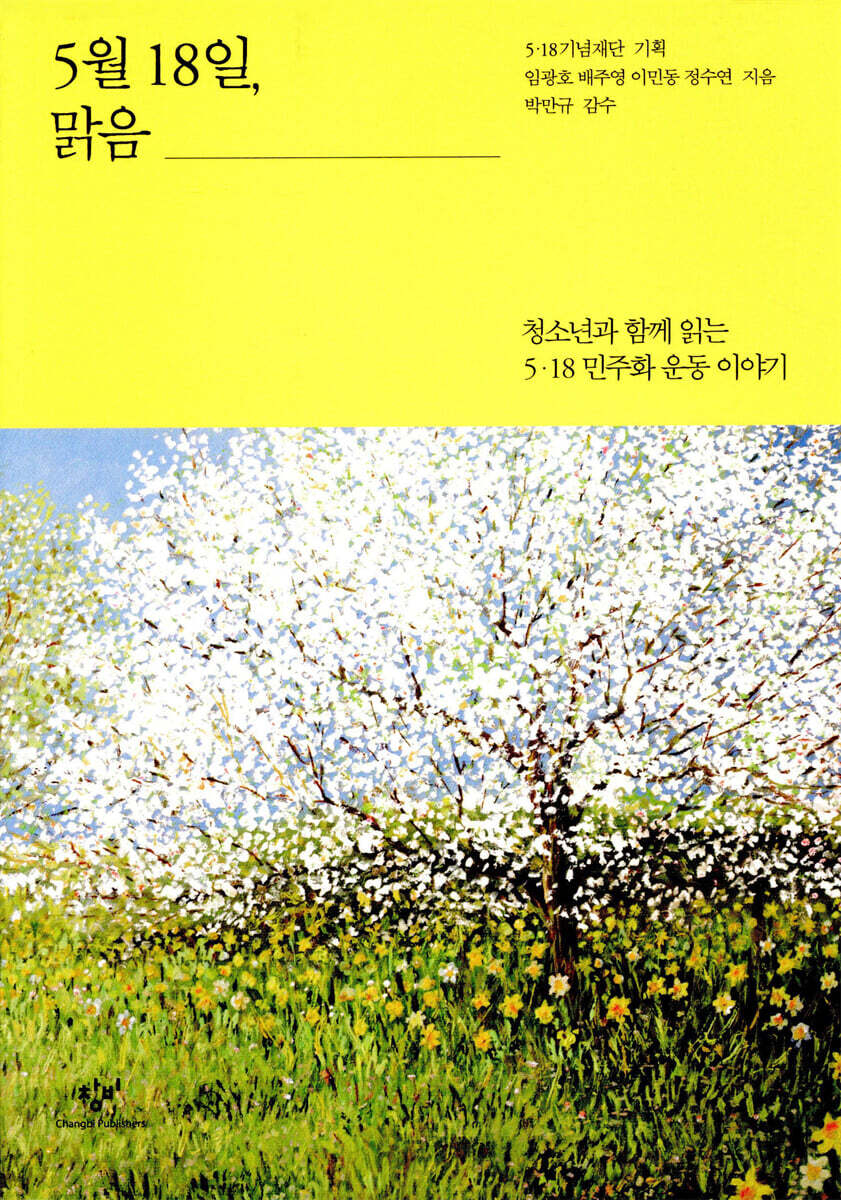
May 18, clear
 |
Description
Book Introduction
- A word from MD
-
For our May, which will be as clear as everA new story of May 18th written for the next generation.
It meticulously tells the story of the struggle that unfolded for ten days starting on May 18th of that year, a day made all the more sorrowful by the clear skies, and the ongoing efforts to restore truth and honor, as well as the stories of those who have strived to make the world a brighter place by remembering the deaths that day.
March 22, 2019. Youth PD Kim Do-hoon
What happened that day in May 1980?
A New Story of May 18th for the Next Generation
Talking about May 18th to today's youth.
"May 18, Clear," planned by the May 18 Memorial Foundation and published after two years, is a book that tells the story of May 18 from May 1980 to the present day.
It contains the story of the struggle that took place over ten days, starting on May 18th of that year, when the sky was clear and the sadness was even greater, and the stories of those who have tried to make the world a brighter place while remembering the deaths that day.
By covering only the most accurate and objective facts, we aim to help young people gain a correct understanding of May 18 and develop a perspective on history.
We have made various efforts to share our complex modern history with young people.
First, I tried to explain difficult Chinese characters and concepts as easily as possible.
It also provides helpful explanations of the historical background essential to understanding May 18, especially the Yushin era and the June Democracy Movement.
At the end of each chapter, a variety of cases from around the world, including Argentina and France, are introduced, allowing readers to view the May 18th incident within the context of world history.
The precious photographic materials held by the May 18 Memorial Foundation also help with understanding.
This book will be a good guide not only for young people studying history, but also for readers in their 20s and 30s who have only partially encountered the May 18th incident through movies or novels.
A New Story of May 18th for the Next Generation
Talking about May 18th to today's youth.
"May 18, Clear," planned by the May 18 Memorial Foundation and published after two years, is a book that tells the story of May 18 from May 1980 to the present day.
It contains the story of the struggle that took place over ten days, starting on May 18th of that year, when the sky was clear and the sadness was even greater, and the stories of those who have tried to make the world a brighter place while remembering the deaths that day.
By covering only the most accurate and objective facts, we aim to help young people gain a correct understanding of May 18 and develop a perspective on history.
We have made various efforts to share our complex modern history with young people.
First, I tried to explain difficult Chinese characters and concepts as easily as possible.
It also provides helpful explanations of the historical background essential to understanding May 18, especially the Yushin era and the June Democracy Movement.
At the end of each chapter, a variety of cases from around the world, including Argentina and France, are introduced, allowing readers to view the May 18th incident within the context of world history.
The precious photographic materials held by the May 18 Memorial Foundation also help with understanding.
This book will be a good guide not only for young people studying history, but also for readers in their 20s and 30s who have only partially encountered the May 18th incident through movies or novels.
- You can preview some of the book's contents.
Preview
index
In publishing the book
Entering
Part 1.
What happened that day in May?
Chapter 1.
A heart waiting for spring
Chapter 2.
Glorious vacation, tragic Gwangju
Chapter 3.
The emergence of a citizen army
Chapter 4.
Hinzpeter and the Fighter's Report
Chapter 5.
Gwangju, liberated
Chapter 6.
My last day at the wiretapping office
Part 2.
May, until it becomes history
Chapter 7.
A journey to find the truth
Chapter 8.
Justice finally comes to court
Chapter 9.
Singing, writing, and drawing May
Chapter 10.
Towards solidarity in pain
Taking it one step further - When injustice and justice collide
Chronology of the May 18th Democratization Movement
main
References
Entering
Part 1.
What happened that day in May?
Chapter 1.
A heart waiting for spring
Chapter 2.
Glorious vacation, tragic Gwangju
Chapter 3.
The emergence of a citizen army
Chapter 4.
Hinzpeter and the Fighter's Report
Chapter 5.
Gwangju, liberated
Chapter 6.
My last day at the wiretapping office
Part 2.
May, until it becomes history
Chapter 7.
A journey to find the truth
Chapter 8.
Justice finally comes to court
Chapter 9.
Singing, writing, and drawing May
Chapter 10.
Towards solidarity in pain
Taking it one step further - When injustice and justice collide
Chronology of the May 18th Democratization Movement
main
References
Detailed image
Publisher's Review
Rice balls, fancy vacations, Hinzpeter, citizen soldiers…
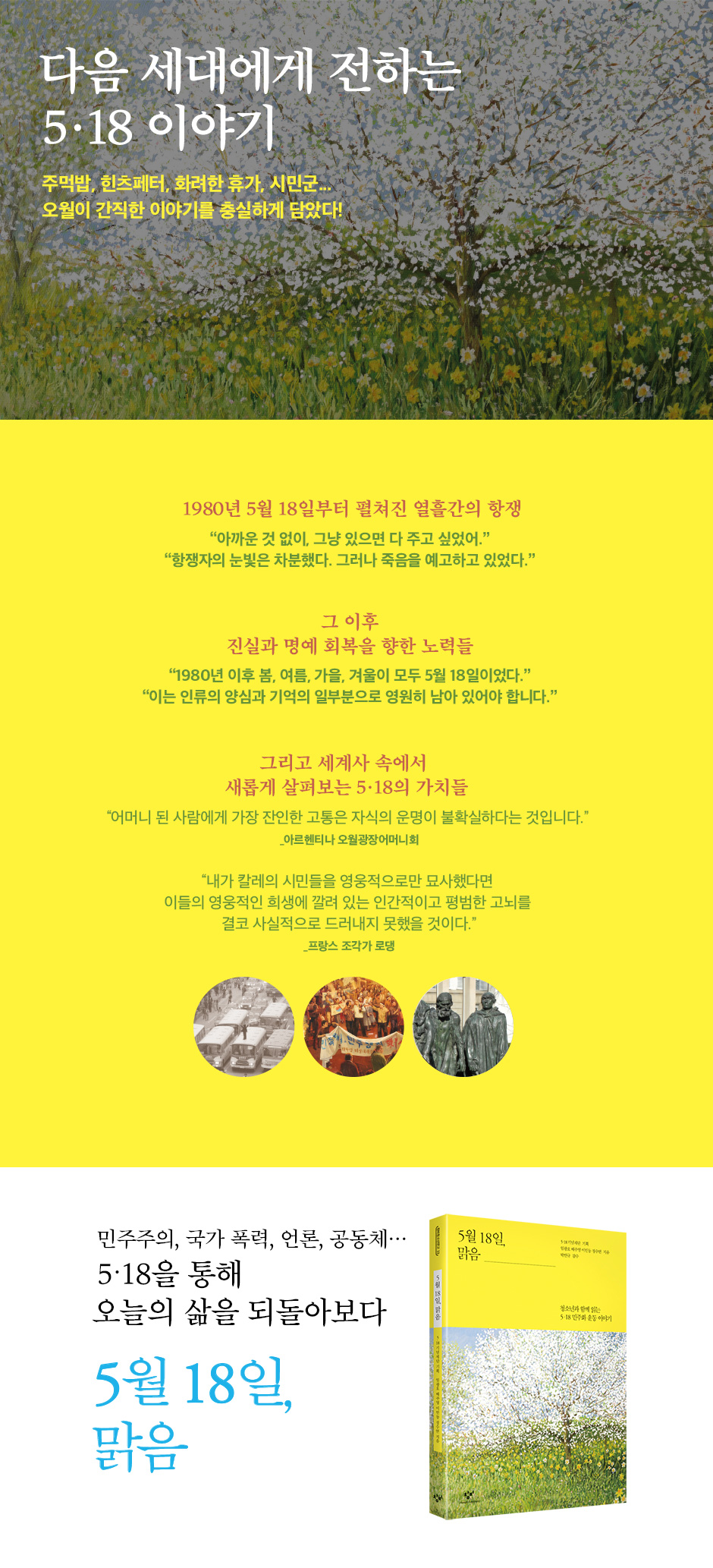
It faithfully captures the story of May 1980.
The expression 'May 18 Democratization Movement' has two main meanings.
In a narrow sense, it refers to the ten-day struggle that followed May 18, 1980, and in a broader sense, it refers to the various efforts to uncover the truth and restore honor thereafter.
"May 18th, Clear" captures both of these aspects.
In other words, Part 1 explains the ten-day struggle that took place in May 1980 in chronological order, and Part 2 shows the various activities and efforts that have continued since the struggle to this day.
Part 1 focuses on the ten-day struggle, so the events unfold with great urgency.
The sudden onslaught of clubs and combat boots on students gathered in front of Chonnam National University, the resistance of citizens, vehicle protests led by buses and taxis, the armed citizen army, the collapse of the domestic media and the activities of foreign reporters, the formation of a community in the gap where martial law forces temporarily retreated, and ultimately, the events continue without pause until the approaching final day.
Thanks to the vivid description, it feels as if the cityscape of Gwangju at that time is unfolding before your eyes.
However, it does not stop at simply introducing the incident, but examines democratic values and concepts that we must examine, such as democracy, the press, and state violence, between the stories.
When necessary, we also cite foreign examples, such as the Paris Commune and Picasso's "Guernica," to reaffirm the various meanings of the May 18th incident.
Part 2 focuses on how, after the uprising, survivors and those who remember struggle to uncover the truth about the unjust deaths and restore the victims' honor.
A turbulent history unfolds rapidly, from the people protesting and issuing statements under the surveillance and oppression of a dictatorship, to the 'Gwangju Hearing' that followed the June Democracy Movement, to the trials of Chun Doo-hwan and Roh Tae-woo, and finally to the establishment of the May 18th Gwangju Democratization Movement as a 'democratization movement.'
It also introduces the stories of various citizens who remember history and stand in solidarity with the underprivileged.
From religious figures caring for the injured and their families to writers who expose the incident and revive memories through literature, art, and film, people from all walks of life are making May 18 history.
The solidarity of pain continues to the Sewol ferry disaster.
The sight of the 'May Mothers' comforting the families of the Sewol ferry victims and showing solidarity with them clearly exemplifies the spirit of May 18.
The parties involved, the survivors, those who remember…
The diverse citizens who made May 18 history
While explaining the May 18th incident in chronological order, this book particularly captures the efforts of various citizens.
It introduces not only prominent figures such as the well-known citizen militia spokesperson Yoon Sang-won and German journalist Jurgen Hinzpeter, but also ordinary market merchants, high school students, and office workers who fought diligently in their own positions, even though they were not prominent in history.
In particular, the voices of these people who appear here and there are moving in themselves.
The stories of citizens, including a reporter who was on the scene at the time of the incident, a young man who witnessed people being shot by martial law soldiers, a merchant who cooked for the militia in an alley, and a nurse who treated the wounded at the hospital, convey the May 18th incident from various perspectives in a three-dimensional way, while also revealing the many efforts of citizens that went into making May 18th history.
As a reporter, I couldn't find the words to adequately describe this behavior.
Words like atrocity, outrage, and indiscriminate attack were too bland to be of much use.
Reporter Kim Chung-geun (page 56)
I watched the situation from the intersection behind the Catholic Center, and whenever a death occurred, I marked the ground with the letter '정' (正).
Twelve people died in about 30 minutes.
_Gwangju citizen Lim Chun-sik (page 66)
When I told him that he shouldn't donate blood because he was weak, he got really angry.
If I don't give a single drop of blood at a time like this, even if I die, then I'm not a citizen.
(……) At that time, I was born as a human and experienced so many of the saddest and most touching moments as a human.
_Gwangju Christian Hospital Nursing Supervisor Ahn Seong-rye (page 98)
So let us all leave behind a proud history of fighting against injustice to the end.
If we get through this dawn, morning will definitely come.
Citizens' Army Spokesperson Yoon Sang-won (page 122)
Since 1980, spring, summer, fall, and winter have all been on May 18th.
Human rights activist Oh Chang-ik (page 156)
Through events and people in world history
Illuminating the Universal Meaning of May 18th
In each major scene of May 18, events, anecdotes, and people universally known in world history frequently appear.
When explaining the citizens who remained at the South Jeolla Provincial Office on the last day of the struggle, prepared to die, the historical background contained in Rodin's sculpture "The Burghers of Calais" is mentioned.
The human agony and the tragedy of determination felt by ordinary people intersect across time.
When talking about the May Mothers' House, a group of Gwangju women who fought against the dictatorship, the case of the Argentine 'May Square Mothers', who fought wearing white hoods under the dictatorship of Jorge Videla and others, comes up.
By actively comparing and contrasting the story with major world events, the significance of May 18 can be viewed from various angles and understood within the context of world history.
May 18 is an event that has not yet ended.
Although there have been many achievements, such as the judicial sentencing of two former presidents, the launch of various commemorative projects, and the inscription of the May 18th records on UNESCO's Memory of the World Register, many tasks still remain.
It remains to identify those ultimately responsible for ordering the shooting, to uncover the truth that remains buried, and to correct the misunderstandings and distortions that persist.
"May 18th, Clear" provides accurate historical facts, allowing for a comprehensive understanding of May 18th and for us to work together on the remaining tasks.
It faithfully captures the story of May 1980.
The expression 'May 18 Democratization Movement' has two main meanings.
In a narrow sense, it refers to the ten-day struggle that followed May 18, 1980, and in a broader sense, it refers to the various efforts to uncover the truth and restore honor thereafter.
"May 18th, Clear" captures both of these aspects.
In other words, Part 1 explains the ten-day struggle that took place in May 1980 in chronological order, and Part 2 shows the various activities and efforts that have continued since the struggle to this day.
Part 1 focuses on the ten-day struggle, so the events unfold with great urgency.
The sudden onslaught of clubs and combat boots on students gathered in front of Chonnam National University, the resistance of citizens, vehicle protests led by buses and taxis, the armed citizen army, the collapse of the domestic media and the activities of foreign reporters, the formation of a community in the gap where martial law forces temporarily retreated, and ultimately, the events continue without pause until the approaching final day.
Thanks to the vivid description, it feels as if the cityscape of Gwangju at that time is unfolding before your eyes.
However, it does not stop at simply introducing the incident, but examines democratic values and concepts that we must examine, such as democracy, the press, and state violence, between the stories.
When necessary, we also cite foreign examples, such as the Paris Commune and Picasso's "Guernica," to reaffirm the various meanings of the May 18th incident.
Part 2 focuses on how, after the uprising, survivors and those who remember struggle to uncover the truth about the unjust deaths and restore the victims' honor.
A turbulent history unfolds rapidly, from the people protesting and issuing statements under the surveillance and oppression of a dictatorship, to the 'Gwangju Hearing' that followed the June Democracy Movement, to the trials of Chun Doo-hwan and Roh Tae-woo, and finally to the establishment of the May 18th Gwangju Democratization Movement as a 'democratization movement.'
It also introduces the stories of various citizens who remember history and stand in solidarity with the underprivileged.
From religious figures caring for the injured and their families to writers who expose the incident and revive memories through literature, art, and film, people from all walks of life are making May 18 history.
The solidarity of pain continues to the Sewol ferry disaster.
The sight of the 'May Mothers' comforting the families of the Sewol ferry victims and showing solidarity with them clearly exemplifies the spirit of May 18.
The parties involved, the survivors, those who remember…
The diverse citizens who made May 18 history
While explaining the May 18th incident in chronological order, this book particularly captures the efforts of various citizens.
It introduces not only prominent figures such as the well-known citizen militia spokesperson Yoon Sang-won and German journalist Jurgen Hinzpeter, but also ordinary market merchants, high school students, and office workers who fought diligently in their own positions, even though they were not prominent in history.
In particular, the voices of these people who appear here and there are moving in themselves.
The stories of citizens, including a reporter who was on the scene at the time of the incident, a young man who witnessed people being shot by martial law soldiers, a merchant who cooked for the militia in an alley, and a nurse who treated the wounded at the hospital, convey the May 18th incident from various perspectives in a three-dimensional way, while also revealing the many efforts of citizens that went into making May 18th history.
As a reporter, I couldn't find the words to adequately describe this behavior.
Words like atrocity, outrage, and indiscriminate attack were too bland to be of much use.
Reporter Kim Chung-geun (page 56)
I watched the situation from the intersection behind the Catholic Center, and whenever a death occurred, I marked the ground with the letter '정' (正).
Twelve people died in about 30 minutes.
_Gwangju citizen Lim Chun-sik (page 66)
When I told him that he shouldn't donate blood because he was weak, he got really angry.
If I don't give a single drop of blood at a time like this, even if I die, then I'm not a citizen.
(……) At that time, I was born as a human and experienced so many of the saddest and most touching moments as a human.
_Gwangju Christian Hospital Nursing Supervisor Ahn Seong-rye (page 98)
So let us all leave behind a proud history of fighting against injustice to the end.
If we get through this dawn, morning will definitely come.
Citizens' Army Spokesperson Yoon Sang-won (page 122)
Since 1980, spring, summer, fall, and winter have all been on May 18th.
Human rights activist Oh Chang-ik (page 156)
Through events and people in world history
Illuminating the Universal Meaning of May 18th
In each major scene of May 18, events, anecdotes, and people universally known in world history frequently appear.
When explaining the citizens who remained at the South Jeolla Provincial Office on the last day of the struggle, prepared to die, the historical background contained in Rodin's sculpture "The Burghers of Calais" is mentioned.
The human agony and the tragedy of determination felt by ordinary people intersect across time.
When talking about the May Mothers' House, a group of Gwangju women who fought against the dictatorship, the case of the Argentine 'May Square Mothers', who fought wearing white hoods under the dictatorship of Jorge Videla and others, comes up.
By actively comparing and contrasting the story with major world events, the significance of May 18 can be viewed from various angles and understood within the context of world history.
May 18 is an event that has not yet ended.
Although there have been many achievements, such as the judicial sentencing of two former presidents, the launch of various commemorative projects, and the inscription of the May 18th records on UNESCO's Memory of the World Register, many tasks still remain.
It remains to identify those ultimately responsible for ordering the shooting, to uncover the truth that remains buried, and to correct the misunderstandings and distortions that persist.
"May 18th, Clear" provides accurate historical facts, allowing for a comprehensive understanding of May 18th and for us to work together on the remaining tasks.
GOODS SPECIFICS
- Date of issue: March 15, 2019
- Page count, weight, size: 256 pages | 445g | 152*210*20mm
- ISBN13: 9788936452339
- ISBN10: 8936452339
You may also like
카테고리
korean


korean

![GQ KOREA Mark (Monthly): December [2025]](http://librairie.coreenne.fr/cdn/shop/files/8ef265dbbfbf186523ed75ba7319009d.jpg?v=1765340328&width=3840)


