

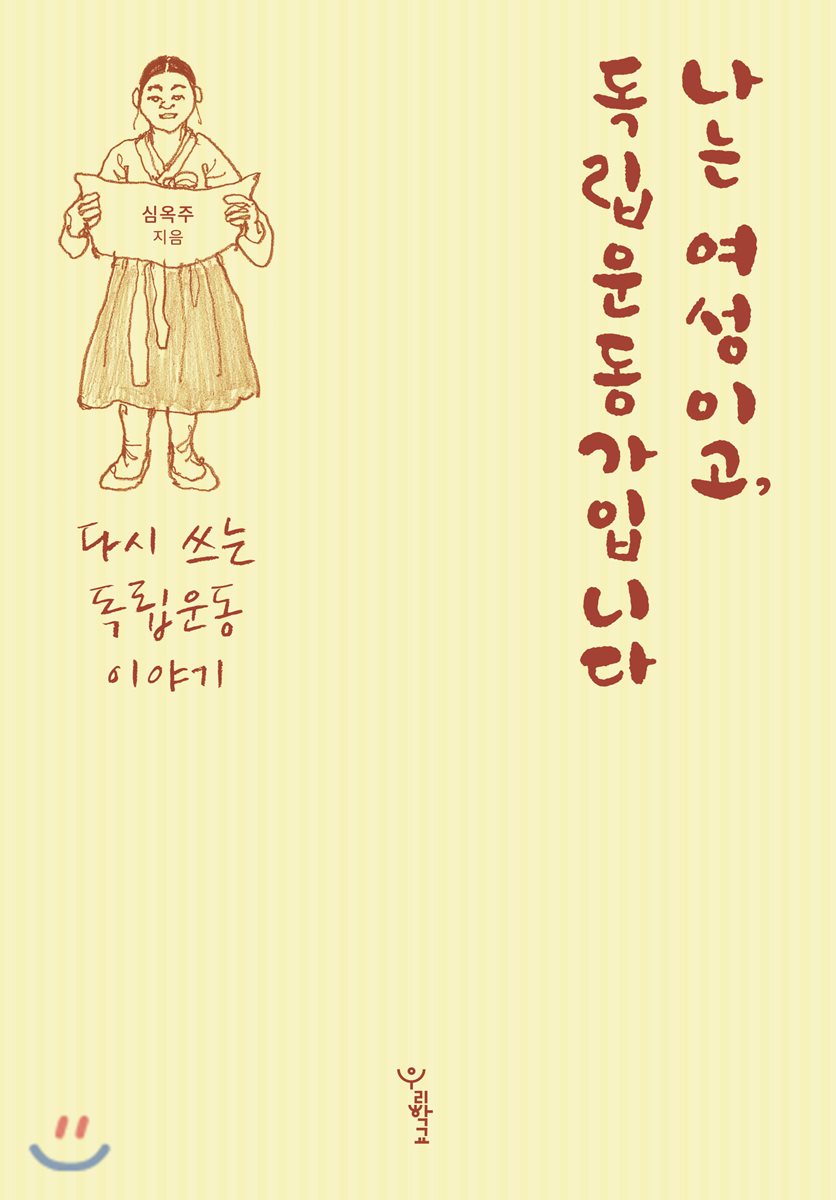
I am a woman and an independence activist.
 |
Description
Book Introduction
100 years after the March 1st Movement, why do we still only remember martyr Yu Gwan-sun?
Why have the women of Joseon who fought together disappeared from memory and records?
"I am a Woman and an Independence Activist" is a book that introduces female independence activists who were trapped in the shadows of history.
Each story, divided into 7 categories according to the scope and role of the independence movement and introduced through 40 sections, is concise and clear.
By examining female independence activists who have disappeared from records and been forgotten, readers are led to discover for themselves where Korean women stand today and what direction they should take in their lives going forward.
The author emphasizes again that the independence movement was not just for men, and that women did not remain in a supporting role, merely 'supporting' the movement.
It naturally conveys the message that they are all at the center of the independence movement and the main players who led the liberation of the Republic of Korea.
Additionally, the historical figures introduced in the book were drawn one by one with delicate touch by artist Jang Gyeong-hye based on historical data.
The paintings, which were created with the hope that women would not be confined to vague historical records and photographs, but would be recorded as living, breathing scenes of history, convey a warm and nostalgic feeling to readers.
Why have the women of Joseon who fought together disappeared from memory and records?
"I am a Woman and an Independence Activist" is a book that introduces female independence activists who were trapped in the shadows of history.
Each story, divided into 7 categories according to the scope and role of the independence movement and introduced through 40 sections, is concise and clear.
By examining female independence activists who have disappeared from records and been forgotten, readers are led to discover for themselves where Korean women stand today and what direction they should take in their lives going forward.
The author emphasizes again that the independence movement was not just for men, and that women did not remain in a supporting role, merely 'supporting' the movement.
It naturally conveys the message that they are all at the center of the independence movement and the main players who led the liberation of the Republic of Korea.
Additionally, the historical figures introduced in the book were drawn one by one with delicate touch by artist Jang Gyeong-hye based on historical data.
The paintings, which were created with the hope that women would not be confined to vague historical records and photographs, but would be recorded as living, breathing scenes of history, convey a warm and nostalgic feeling to readers.
- You can preview some of the book's contents.
Preview
index
Introduction
Part 1: Long Live Korean Independence! Shouting in a Woman's Voice
Women, shouting against the barriers of the times / Only independence without any discrimination / The March 1st Movement and its subsequent history / One step closer to the world through learning
Part 2: Secret female student groups across the country
The Hosudon Secret Society and the Harmony Wall / The March of Resistance, Ilshin Girls' School / Soongui Girls' School and the Songjuk Society / Embracing Dreams, Shinmyeong Girls' School / The Gwangju Student Movement and the Baekcheongdan of Suphia Girls' School / Missionary Jeon Wi-ryeong and Gijeon Girls' School
There's no reason why a woman in her 3rd year can't do it.
Meeting Yu Gwan-sun Beyond the Textbook / Kim Ran-sa, Teacher of Heroes / Kim Du-seok, the Teacher Who Opposed Shinto Shrine Worship / Park Ae-sun, a Teacher at Suphia Girls' School / Hwang Esther, a Companion of the Times / Choi Jeong-suk, a Patriotic Enlightenment Activist
Part 4 I will read, learn, and speak for myself.
Yun Hee-soon, Carrying the Fatherland in Her Heart / Female Leader Kim Maria and Geunhwahoe / Air Force Pilot Kwon Ki-ok, Who Longed for Independence / Cha Mirisa, Torch of Women's Education / Na Hye-seok, Pioneer of Women's Awareness Reform / New Education and New Worker Choi Yong-shin / Our Enemy is Not Us, Nam Ja-hyeon
Part 5: Moments in History Unwavering in Pain
The Korean Women's Declaration of Independence captures the spirit of the nation / Kwak Nak-won, the spiritual leader of the Provisional Government / Jeong Jeong-hwa, who harbored hopes for liberation with her family / Women of the Hwaseo School who practiced benevolence and righteousness / Go Soo-seon, a leading Jeju doctor / Lee Hye-ryeon, for the country she loved her whole life / Jo Maria, who loved her country / On historical correctness and humanity
Part 6: The Anti-Japanese Movement: Moving Ahead to a Deeper and Broader World
The National Debt Redemption Movement and Korean Women / Two Park Esthers with the Same Aspiration / The Cry of Women's Organizations and the Jeju Haenyeo Anti-Japanese Movement / Hawaiian Women Raise Funds for Ahn Jung-geun's Trial / Women as Members of the Provisional Government
Part 7: Remembering Forgotten Female Independence Activists
A place so small, yet infinitely large / The pregnant woman wearing glasses who threw a bomb at the Pyeongnam Provincial Office / The youth of the era, the activities of the Women's Liberation Army / Not a silent cry, but a true voice
Outgoing post
Part 1: Long Live Korean Independence! Shouting in a Woman's Voice
Women, shouting against the barriers of the times / Only independence without any discrimination / The March 1st Movement and its subsequent history / One step closer to the world through learning
Part 2: Secret female student groups across the country
The Hosudon Secret Society and the Harmony Wall / The March of Resistance, Ilshin Girls' School / Soongui Girls' School and the Songjuk Society / Embracing Dreams, Shinmyeong Girls' School / The Gwangju Student Movement and the Baekcheongdan of Suphia Girls' School / Missionary Jeon Wi-ryeong and Gijeon Girls' School
There's no reason why a woman in her 3rd year can't do it.
Meeting Yu Gwan-sun Beyond the Textbook / Kim Ran-sa, Teacher of Heroes / Kim Du-seok, the Teacher Who Opposed Shinto Shrine Worship / Park Ae-sun, a Teacher at Suphia Girls' School / Hwang Esther, a Companion of the Times / Choi Jeong-suk, a Patriotic Enlightenment Activist
Part 4 I will read, learn, and speak for myself.
Yun Hee-soon, Carrying the Fatherland in Her Heart / Female Leader Kim Maria and Geunhwahoe / Air Force Pilot Kwon Ki-ok, Who Longed for Independence / Cha Mirisa, Torch of Women's Education / Na Hye-seok, Pioneer of Women's Awareness Reform / New Education and New Worker Choi Yong-shin / Our Enemy is Not Us, Nam Ja-hyeon
Part 5: Moments in History Unwavering in Pain
The Korean Women's Declaration of Independence captures the spirit of the nation / Kwak Nak-won, the spiritual leader of the Provisional Government / Jeong Jeong-hwa, who harbored hopes for liberation with her family / Women of the Hwaseo School who practiced benevolence and righteousness / Go Soo-seon, a leading Jeju doctor / Lee Hye-ryeon, for the country she loved her whole life / Jo Maria, who loved her country / On historical correctness and humanity
Part 6: The Anti-Japanese Movement: Moving Ahead to a Deeper and Broader World
The National Debt Redemption Movement and Korean Women / Two Park Esthers with the Same Aspiration / The Cry of Women's Organizations and the Jeju Haenyeo Anti-Japanese Movement / Hawaiian Women Raise Funds for Ahn Jung-geun's Trial / Women as Members of the Provisional Government
Part 7: Remembering Forgotten Female Independence Activists
A place so small, yet infinitely large / The pregnant woman wearing glasses who threw a bomb at the Pyeongnam Provincial Office / The youth of the era, the activities of the Women's Liberation Army / Not a silent cry, but a true voice
Outgoing post
Detailed image
Publisher's Review
Coming out proudly from the shadows of history
Time to meet female independence activists
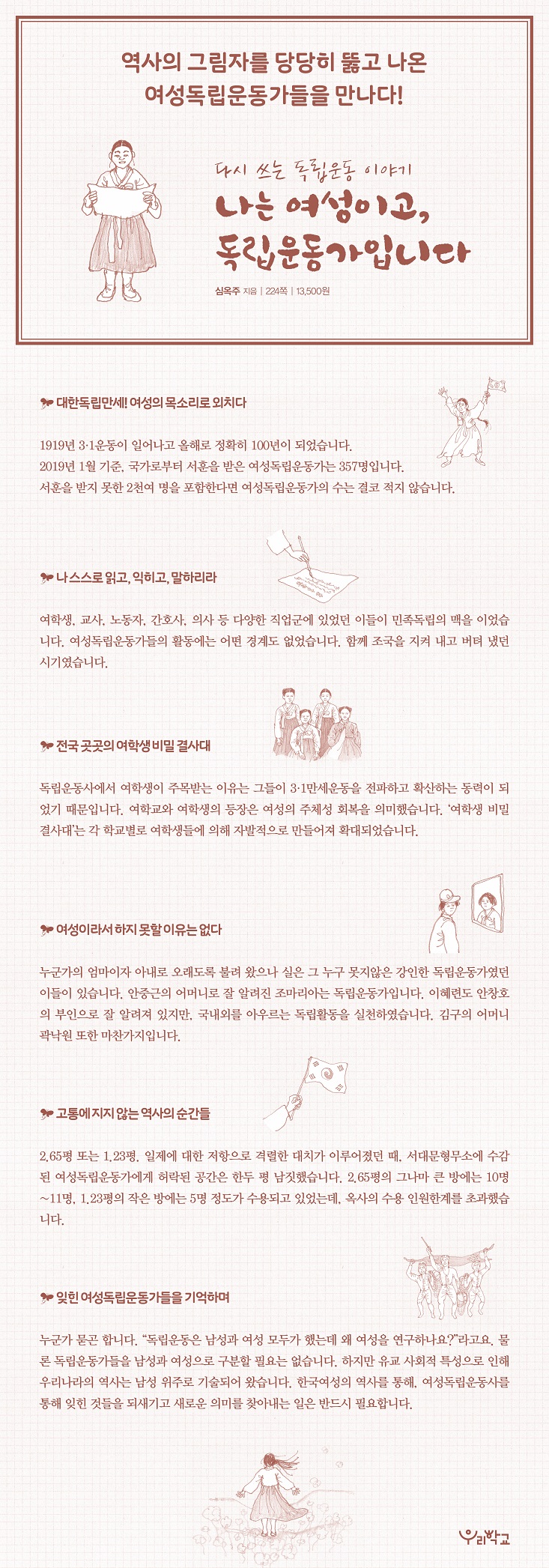
As of January 2019, 357 female independence activists have received honors from the state.
In addition to them, if we include the approximately 2,000 women who did not receive medals, the number of female independence activists is by no means small.
Even though it was a civil revolution in which everyone, regardless of age or gender, came together with one heart, we have known little about female independence activists, except for a few women, including Yu Gwan-sun.
So, many people may think that the independence movement was mainly led and carried out by men.
A century has passed since the March 1st Movement, yet why can't we even count on one hand the number of people we remember? Why have the Joseon women who fought and joined forces disappeared from records? At a time when gender equality was not yet recognized and women lacked access to proper education, there were women who, with unwavering conviction and determination, dedicated themselves to Korea's independence. "I Am a Woman, an Independence Activist" introduces various female independence activists and highlights their activities and achievements.
Each story, divided into seven categories according to the scope and role of the independence movement and introduced through 40 sections, is concise and clear.
Rather than simply shouting, "There were these women, so let's pay attention now!", it sheds new light on the March 1st Movement by closely examining the reality faced by women at the time.
Perhaps this book is a little different from the orthodox history books.
It does not read the main story of Korean history chronologically, nor does it list major historical events.
However, we go out to find women in history that we have not properly known about until now.
This is thanks to the author's passionate will to not overlook the fact that history begins from small beginnings, just as a small spark blooms into a large flame.
The independence movement was not just for men.
It was not the case that women remained in a supporting role, simply ‘supporting’ male activists.
The author emphasizes again that they were all at the center of the independence movement and the main players who led the liberation of the Republic of Korea, as they were the ones who protected and persevered together during that time.
By listening to the untold stories of female independence activists who have disappeared from records and forgotten from memory, we can gain insight into the current state of Korean women and, thus, the direction in which our lives should take in the future.
Ultimately, this book advances to fundamental reflection and enlightenment on the questions, "What is history?", "What is education?", and "What is a woman?", and brings together "women, education, and history" in our time into a single, integrated keyword.
Okay, let's dive into the book.
Long live Korean independence!
Women, Shouting Out Against the Barriers of the Times
In Part 1, we will examine the historical significance and role of female independence activists and examine the overall process of the March 1st Movement.
The author says that the driving force that enabled women during the Japanese colonial period to fiercely resist the Japanese was a progressive change in consciousness.
This demonstrated the will for independence through concrete actions against Japan's colonial policies and slave education.
While studying the development of the independence movement, the author paid particular attention to the activities of female students who were active throughout the country.
The author tells a more detailed story about this in Part 2, 'Secret Female Student Societies Across the Nation'.
A secret society is a group secretly organized to strengthen the resolve for independence movement. Representative female student secret societies include the 'Hosudon Girls' School Secret Society' and the 'Sungeui Girls' School Songjuk Society'.
The March 1st Movement in the Jeollanam-do region began in Gwangju and spread to Damyang, Gokseong, Hwasun, Yeonggwang, and other areas. In February 1930, students at Suphia Girls' School organized a secret organization called the "Baekcheongdan" (白靑團), which meant "youth of the white-clad nation."
In addition, we will meet strong female students who resisted the injustice of Japanese rule by looking at the secret society 'Girls' Association' of Gwangju Girls' High School, 'Lee Moon-hoe' of Ewha Haktang in Seoul, 'Ilshin Girls' School' in Busan, and 'Yeongmyeong Girls' School' in Gongju.
In Parts 3 and 4, we examine the women who bravely challenged the possibilities of the women's independence movement and expanded its scope through the institution of school and the value of education.
You can hear the stories of Yu Gwan-sun, her teacher Kim Ran-sa, Kim Du-seok, a teacher who opposed Shinto shrine worship, Park Ae-sun, a teacher at Suphia Girls' School who boldly dedicated her life to the independence movement, Hwang Esther, who endlessly pondered the independence and growth of her country, and Choi Jeong-suk, who studied at Jeju's first girls' school and then actively participated in the independence movement.
We also examine the activities of female independence activists who constantly took on challenges, including the first female soldier, Yun Hee-soon, and Kim Maria, Kwon Ki-ok, Cha Mi-ri-sa, and Na Hye-seok, who were active both domestically and internationally.
Part 5 introduces women who have long been called someone's mother and wife, but who were actually strong independence activists no less than anyone else.
Kwak Nak-won married Kim Sun-young at the age of 14 and had a son, Kim Gu.
There is a very famous anecdote about how when her husband became paralyzed at the age of 17, she went to An-ak, Sincheon, Jangyeon, and Haeju to find doctors to help him regain his stability.
Although her life was difficult and painful due to discrimination and poverty, Kwak Nak-won was a female independence activist who always stayed by her son Kim Gu's side and personally practiced love for her country.
The same goes for Lee Hye-ryeon, a female independence activist known as Ahn Chang-ho's wife, who carried out independence activities both domestically and internationally.
The person who supported the various activities pursued by Ahn Chang-ho, such as the Public Association, the Korean National Association, and the Heungsadan, and who took it upon himself to promote the participation of women in the Americas was Lee Hye-ryeon.
Also widely known as Ahn Jung-geun's mother, Maria Jo is mostly recorded in letters exchanged with her son, and there is not much information about her, which is regrettable.
I recall Jo Maria's words, "Don't think about housework, just fight like a man until the end," and reflect on his courage that did not give in to the harsh reality.
In Parts 6 and 7, we will look into the various aspects of the anti-Japanese movement that spread not only domestically but also around the world, and trace the footsteps of female independence activists who fought for national independence during the Japanese colonial period.
The author listens to the earnest cries of female independence activists who, while imprisoned in Jeju, the southernmost island of Korea and frequently plundered and oppressed by the Japanese, as far away as Hawaii and as close as the Seodaemun Prison, a space measuring 15 centimeters wide and 10 centimeters high, refused to yield to reality and carried out the national salvation movement.
Living a life that is not burdened by pain,
Remembering the female independence activists
The author of this book, Shim Ok-ju, is the director of the Women's Independence Movement Research Institute and a member of the Presidential Committee for the Commemoration of the 100th Anniversary of the March 1st Movement and the Establishment of the Provisional Government of the Republic of Korea.
More passionately and enterprisingly than anyone else, she is conducting research related to the independence movement and is working to restore the names of each forgotten female independence activist.
It is said that the reason he entered this field was when he began researching Yun Hee-sun, the first female military general in the late Joseon Dynasty.
The author says that many people ask, “Both men and women participated in the independence movement, so why study women?”
Each time, the author calmly nods and begins to tell the story.
Of course, there is no need to divide independence activists into male and female.
However, it is true that history up until now has been written mainly from a male perspective.
Therefore, it is inevitable that the question of in what context women's history has continued, what character they have, and what activities they have engaged in are important.
The author emphasizes that it is absolutely necessary to recall forgotten things and find new meaning through the history of Korean women and the history of the women's independence movement.
I believe that my interest in this will lead to setting Korean history straight.
These women independence activists lived fiercely for freedom and independence.
If we don't forget that many more women, beyond those introduced in this book, fought for our country's independence, and if we remember the fierce and desperate struggles of those lives, won't our lives here and now be filled with more solid moments of history?
Because history does not stop at the past, does not remain in the present, and ultimately moves toward the future.
Time to meet female independence activists
As of January 2019, 357 female independence activists have received honors from the state.
In addition to them, if we include the approximately 2,000 women who did not receive medals, the number of female independence activists is by no means small.
Even though it was a civil revolution in which everyone, regardless of age or gender, came together with one heart, we have known little about female independence activists, except for a few women, including Yu Gwan-sun.
So, many people may think that the independence movement was mainly led and carried out by men.
A century has passed since the March 1st Movement, yet why can't we even count on one hand the number of people we remember? Why have the Joseon women who fought and joined forces disappeared from records? At a time when gender equality was not yet recognized and women lacked access to proper education, there were women who, with unwavering conviction and determination, dedicated themselves to Korea's independence. "I Am a Woman, an Independence Activist" introduces various female independence activists and highlights their activities and achievements.
Each story, divided into seven categories according to the scope and role of the independence movement and introduced through 40 sections, is concise and clear.
Rather than simply shouting, "There were these women, so let's pay attention now!", it sheds new light on the March 1st Movement by closely examining the reality faced by women at the time.
Perhaps this book is a little different from the orthodox history books.
It does not read the main story of Korean history chronologically, nor does it list major historical events.
However, we go out to find women in history that we have not properly known about until now.
This is thanks to the author's passionate will to not overlook the fact that history begins from small beginnings, just as a small spark blooms into a large flame.
The independence movement was not just for men.
It was not the case that women remained in a supporting role, simply ‘supporting’ male activists.
The author emphasizes again that they were all at the center of the independence movement and the main players who led the liberation of the Republic of Korea, as they were the ones who protected and persevered together during that time.
By listening to the untold stories of female independence activists who have disappeared from records and forgotten from memory, we can gain insight into the current state of Korean women and, thus, the direction in which our lives should take in the future.
Ultimately, this book advances to fundamental reflection and enlightenment on the questions, "What is history?", "What is education?", and "What is a woman?", and brings together "women, education, and history" in our time into a single, integrated keyword.
Okay, let's dive into the book.
Long live Korean independence!
Women, Shouting Out Against the Barriers of the Times
In Part 1, we will examine the historical significance and role of female independence activists and examine the overall process of the March 1st Movement.
The author says that the driving force that enabled women during the Japanese colonial period to fiercely resist the Japanese was a progressive change in consciousness.
This demonstrated the will for independence through concrete actions against Japan's colonial policies and slave education.
While studying the development of the independence movement, the author paid particular attention to the activities of female students who were active throughout the country.
The author tells a more detailed story about this in Part 2, 'Secret Female Student Societies Across the Nation'.
A secret society is a group secretly organized to strengthen the resolve for independence movement. Representative female student secret societies include the 'Hosudon Girls' School Secret Society' and the 'Sungeui Girls' School Songjuk Society'.
The March 1st Movement in the Jeollanam-do region began in Gwangju and spread to Damyang, Gokseong, Hwasun, Yeonggwang, and other areas. In February 1930, students at Suphia Girls' School organized a secret organization called the "Baekcheongdan" (白靑團), which meant "youth of the white-clad nation."
In addition, we will meet strong female students who resisted the injustice of Japanese rule by looking at the secret society 'Girls' Association' of Gwangju Girls' High School, 'Lee Moon-hoe' of Ewha Haktang in Seoul, 'Ilshin Girls' School' in Busan, and 'Yeongmyeong Girls' School' in Gongju.
In Parts 3 and 4, we examine the women who bravely challenged the possibilities of the women's independence movement and expanded its scope through the institution of school and the value of education.
You can hear the stories of Yu Gwan-sun, her teacher Kim Ran-sa, Kim Du-seok, a teacher who opposed Shinto shrine worship, Park Ae-sun, a teacher at Suphia Girls' School who boldly dedicated her life to the independence movement, Hwang Esther, who endlessly pondered the independence and growth of her country, and Choi Jeong-suk, who studied at Jeju's first girls' school and then actively participated in the independence movement.
We also examine the activities of female independence activists who constantly took on challenges, including the first female soldier, Yun Hee-soon, and Kim Maria, Kwon Ki-ok, Cha Mi-ri-sa, and Na Hye-seok, who were active both domestically and internationally.
Part 5 introduces women who have long been called someone's mother and wife, but who were actually strong independence activists no less than anyone else.
Kwak Nak-won married Kim Sun-young at the age of 14 and had a son, Kim Gu.
There is a very famous anecdote about how when her husband became paralyzed at the age of 17, she went to An-ak, Sincheon, Jangyeon, and Haeju to find doctors to help him regain his stability.
Although her life was difficult and painful due to discrimination and poverty, Kwak Nak-won was a female independence activist who always stayed by her son Kim Gu's side and personally practiced love for her country.
The same goes for Lee Hye-ryeon, a female independence activist known as Ahn Chang-ho's wife, who carried out independence activities both domestically and internationally.
The person who supported the various activities pursued by Ahn Chang-ho, such as the Public Association, the Korean National Association, and the Heungsadan, and who took it upon himself to promote the participation of women in the Americas was Lee Hye-ryeon.
Also widely known as Ahn Jung-geun's mother, Maria Jo is mostly recorded in letters exchanged with her son, and there is not much information about her, which is regrettable.
I recall Jo Maria's words, "Don't think about housework, just fight like a man until the end," and reflect on his courage that did not give in to the harsh reality.
In Parts 6 and 7, we will look into the various aspects of the anti-Japanese movement that spread not only domestically but also around the world, and trace the footsteps of female independence activists who fought for national independence during the Japanese colonial period.
The author listens to the earnest cries of female independence activists who, while imprisoned in Jeju, the southernmost island of Korea and frequently plundered and oppressed by the Japanese, as far away as Hawaii and as close as the Seodaemun Prison, a space measuring 15 centimeters wide and 10 centimeters high, refused to yield to reality and carried out the national salvation movement.
Living a life that is not burdened by pain,
Remembering the female independence activists
The author of this book, Shim Ok-ju, is the director of the Women's Independence Movement Research Institute and a member of the Presidential Committee for the Commemoration of the 100th Anniversary of the March 1st Movement and the Establishment of the Provisional Government of the Republic of Korea.
More passionately and enterprisingly than anyone else, she is conducting research related to the independence movement and is working to restore the names of each forgotten female independence activist.
It is said that the reason he entered this field was when he began researching Yun Hee-sun, the first female military general in the late Joseon Dynasty.
The author says that many people ask, “Both men and women participated in the independence movement, so why study women?”
Each time, the author calmly nods and begins to tell the story.
Of course, there is no need to divide independence activists into male and female.
However, it is true that history up until now has been written mainly from a male perspective.
Therefore, it is inevitable that the question of in what context women's history has continued, what character they have, and what activities they have engaged in are important.
The author emphasizes that it is absolutely necessary to recall forgotten things and find new meaning through the history of Korean women and the history of the women's independence movement.
I believe that my interest in this will lead to setting Korean history straight.
These women independence activists lived fiercely for freedom and independence.
If we don't forget that many more women, beyond those introduced in this book, fought for our country's independence, and if we remember the fierce and desperate struggles of those lives, won't our lives here and now be filled with more solid moments of history?
Because history does not stop at the past, does not remain in the present, and ultimately moves toward the future.
GOODS SPECIFICS
- Date of issue: February 16, 2019
- Page count, weight, size: 224 pages | 291g | 148*210*20mm
- ISBN13: 9791187050841
- ISBN10: 1187050849
You may also like
카테고리
korean


korean

![GQ KOREA Mark (Monthly): December [2025]](http://librairie.coreenne.fr/cdn/shop/files/8ef265dbbfbf186523ed75ba7319009d.jpg?v=1765340328&width=3840)


