

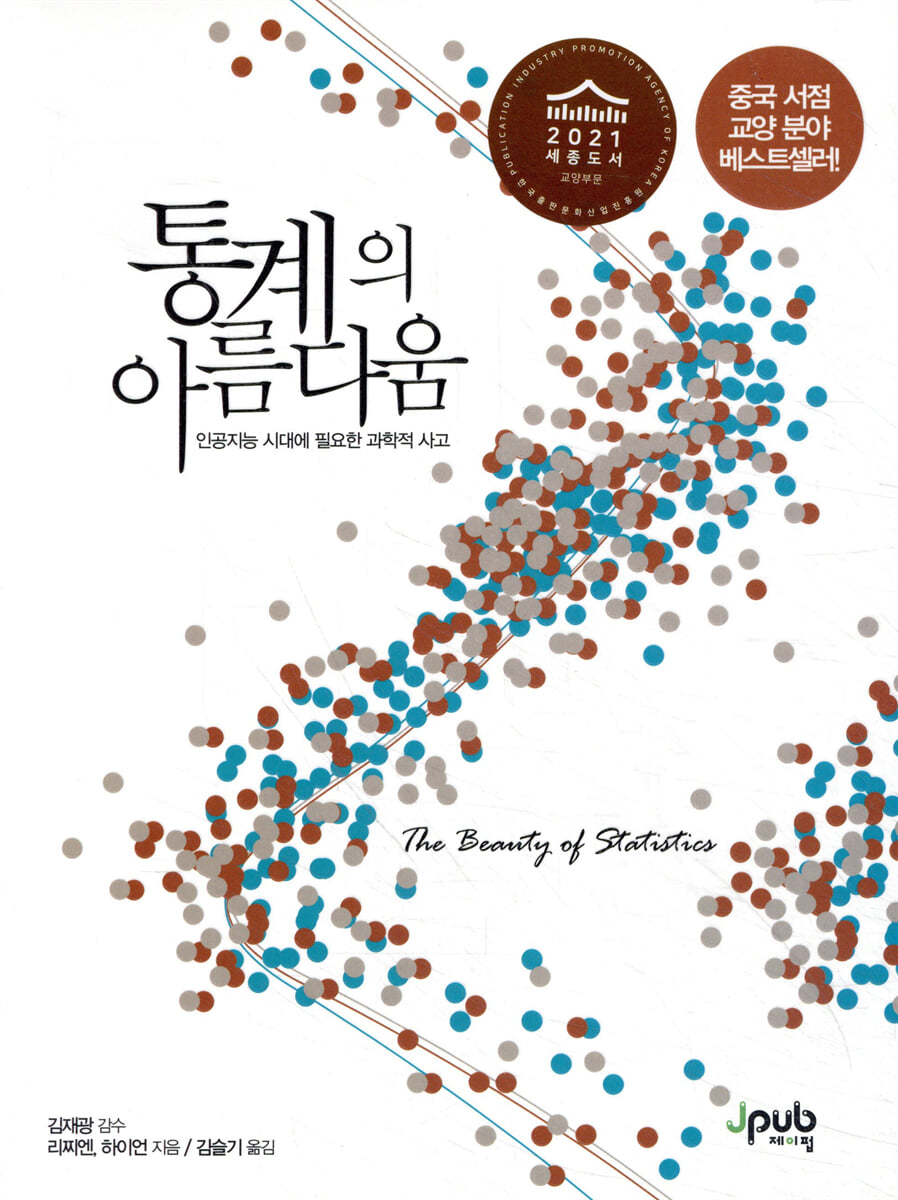
The beauty of statistics
 |
Description
Book Introduction
96 statistical stories filled with fun and wisdom!
China's best-selling statistics/AI textbook!
This book begins with statistics and discusses data, mathematics, and data visualization.
Of course, we are not forgetting to describe not only statistical models and methods, but also big data technologies and the pitfalls of data.
The meaning contained in each chapter is very unique and on a different level from any existing professional book or textbook.
The book's structural design is dazzling, its discussions are both profound and simple, and its content encompasses everything from the past to the future.
At the end of each chapter are short, concise, classic, yet profound stories and examples.
The story is full of statistical wisdom and knowledge.
Only through this simple and classic story can people truly appreciate the beauty of statistics.
China's best-selling statistics/AI textbook!
This book begins with statistics and discusses data, mathematics, and data visualization.
Of course, we are not forgetting to describe not only statistical models and methods, but also big data technologies and the pitfalls of data.
The meaning contained in each chapter is very unique and on a different level from any existing professional book or textbook.
The book's structural design is dazzling, its discussions are both profound and simple, and its content encompasses everything from the past to the future.
At the end of each chapter are short, concise, classic, yet profound stories and examples.
The story is full of statistical wisdom and knowledge.
Only through this simple and classic story can people truly appreciate the beauty of statistics.
- You can preview some of the book's contents.
Preview
index
Chapter 1: Statistics and Science 1
1.1 Stochastic World 4
1.1.1 Pocketball Playing Physicist 4
1.1.2 Does God Play Dice? 7
1.1.3 Arrest of Serial Killer 11
1.1.4 Mathematicians Who Toss Coins 14
1.2 Understanding Probability 18
1.2.1 Distribution of game prizes 18
1.2.2 6 consecutive numbers and 14 consecutive numbers 22
1.2.3 Goat Behind the Host 25
1.2.4 Find the missing submarine 29
1.3 Statistical Thinking and Models 32
1.3.1 Woman Tasting Tea 32
1.3.2 'Trash Man' Get Out 37
1.3.3 The Miracle of Six Sigma 40
1.3.4 Newton's Apple 43
1.4 Statistics and Science 45
1.4.1 Jida Castle and the New Military 45
1.4.2 Deep Blue and AlphaGo 48
1.4.3 Chinese and Western Medicine 51
1.4.4 All models are wrong 55
Chapter 2 Data and Mathematics 59
2.1 Data and Space 62
2.1.1 Bugs of the Multidimensional World 62
2.1.2 Matrix and Transformer 66
2.1.3 Numerical arithmetic and linear equations 71
2.1.4 Twenty-eight Numbers and the Zodiac 74
2.2 Random Variables and Distributions 79
2.2.1 Bernoulli's Coin 79
2.2.2 A few encounters and a strange 37 83
2.2.3 De Moivre's Normal Distribution 86
2.2.4 The Drunkard's Gait 89
2.3 Getting to Know Data 91
2.3.1 Ship of Theseus 91
2.3.2 From gender to weight 93
2.3.3 Age and General Age 96
2.3.4 Physical Examination Record 100
2.4 Fundamentals of Mathematical Statistics 102
2.4.1 Spectator Table and Il-yeop Ji-chu 102
2.4.2 The Wicked Gambler's Tactics 105
2.4.3 Average Salary 108
2.4.4 Soybean and Peacock Feathers 112
Chapter 3 Data Visualization 117
3.1 Statistical Graphs in History 120
3.1.1 Hadowa and Graffiti 120
3.1.2 London Cholera Prevention 121
3.1.3 The Nightingale's Rose 123
3.1.4 Napoleonic Expeditions 126
3.2 Data and Visualization 129
3.2.1 Queen's Dress 129
3.2.2 Canvas and Paper 131
3.2.3 Prince Simsu and the Painter of Daraeki 134
3.2.4 Space Shuttle Challenger 137
3.3 Basic Statistics Graph 140
3.3.1 Secrets of Old Faithful Geyser 140
3.3.2 The Originator of Statistical Graphs 142
3.3.3 The Poetry of the Old State 145
3.3.4 Emerging Motion Chart 148
3.4 Relationships between data 150
3.4.1 Orbit of Polyma 150
3.4.2 Highest Peaks of the 50 States 153
3.4.3 Titanic Survivors 156
3.4.4 Chernov's Face 158
Chapter 4 Models and Methods 161
4.1 Frequently Used Statistical Models 164
4.1.1 The Sun and the Tides 164
4.1.2 Dimensional Reduction Attack 168
4.1.3 Customer is King 173
4.1.4 Stock Trends 177
4.2 Machine Learning 181
4.2.1 The Legend of Beer and Diapers 181
4.2.2 Finding the "Daughter of a Perfect Parent" 185
4.2.3 It's better to kill the wrong person than to never miss 188
4.2.4 Trees and Forests 194
4.3 Artificial Intelligence 201
4.3.1 The Second and Third Stages of Artificial Intelligence 201
4.3.2 The Past and Present of Deep Learning 204
4.3.3 Mysterious Nerve 207
4.3.4 Beautiful Filter 212
4.4 Other Analysis Methods 217
4.4.1 Tea, alcohol, Pepsi-Cola 217
4.4.2 Monte Carlo and the Atomic Bomb 222
4.4.3 Doctor's Handwriting 224
4.4.4 Desert Butterfly 229
Chapter 5: The Big Data Era 233
5.1 The History of Technology 236
5.1.1 Origins of Statistics 236
5.1.2 The Advent of the Information Age 238
5.1.3 Data Mining and Business Intelligence 241
5.1.4 A New Era in the Big Data Era 243
5.2 Analysis Tools 247
5.2.1 Who Said Novices Can't Do Data Analysis? 247
5.2.2 Competitive Analysis Software 250
5.2.3 Full-Stack Developer's Favorite 254
5.2.4 My favorite R 256
5.3 Computing Framework 260
5.3.1 The Elephant in the Refrigerator 260
5.3.2 Commanding Soldiers and Commanding Generals 263
5.3.3 Electric Tiger and Electric Ant 266
5.3.4 The Future of Moore's Law 270
5.4 Applications in the Big Data Industry 274
5.4.1 The Rise of the Internet 274
5.4.2 Starting Point of Traffic 276
5.4.3 Sources of Income 278
5.4.4 Products you might like and how to please them 282
Chapter 6: Data Pitfalls 287
6.1 Can't see the forest for the trees 290
6.1.1 The Curious Scorpio 290
6.1.2 The Winner's Curse 292
6.1.3 The price of shooting down an airplane is 295
6.1.4 A Bond with the Goddess 297
6.2 Correlation and Causation 300
6.2.1 Fire and Hot Beverages 300
6.2.2 Secrets of Popular Posts 302
6.2.3 City of Snow and Fire 303
6.2.4 Is a name really that important? 305
6.3 Samples and Surveys 308
6.3.1 The Unpredictable US Presidential Election 308
6.3.2 Asymmetric Durex Data 311
6.3.3 The Legend of the Lucky One 313
6.3.4 Dismissal of Harvard President 316
6.4 The Oedo of Figure 318
6.4.1 Changes in Income 318
6.4.2 Tollgates and Stops 320
6.4.3 Escape from the East Wing 322
6.4.4 Poisonous Fitting 326
Reference 331
Search 335
1.1 Stochastic World 4
1.1.1 Pocketball Playing Physicist 4
1.1.2 Does God Play Dice? 7
1.1.3 Arrest of Serial Killer 11
1.1.4 Mathematicians Who Toss Coins 14
1.2 Understanding Probability 18
1.2.1 Distribution of game prizes 18
1.2.2 6 consecutive numbers and 14 consecutive numbers 22
1.2.3 Goat Behind the Host 25
1.2.4 Find the missing submarine 29
1.3 Statistical Thinking and Models 32
1.3.1 Woman Tasting Tea 32
1.3.2 'Trash Man' Get Out 37
1.3.3 The Miracle of Six Sigma 40
1.3.4 Newton's Apple 43
1.4 Statistics and Science 45
1.4.1 Jida Castle and the New Military 45
1.4.2 Deep Blue and AlphaGo 48
1.4.3 Chinese and Western Medicine 51
1.4.4 All models are wrong 55
Chapter 2 Data and Mathematics 59
2.1 Data and Space 62
2.1.1 Bugs of the Multidimensional World 62
2.1.2 Matrix and Transformer 66
2.1.3 Numerical arithmetic and linear equations 71
2.1.4 Twenty-eight Numbers and the Zodiac 74
2.2 Random Variables and Distributions 79
2.2.1 Bernoulli's Coin 79
2.2.2 A few encounters and a strange 37 83
2.2.3 De Moivre's Normal Distribution 86
2.2.4 The Drunkard's Gait 89
2.3 Getting to Know Data 91
2.3.1 Ship of Theseus 91
2.3.2 From gender to weight 93
2.3.3 Age and General Age 96
2.3.4 Physical Examination Record 100
2.4 Fundamentals of Mathematical Statistics 102
2.4.1 Spectator Table and Il-yeop Ji-chu 102
2.4.2 The Wicked Gambler's Tactics 105
2.4.3 Average Salary 108
2.4.4 Soybean and Peacock Feathers 112
Chapter 3 Data Visualization 117
3.1 Statistical Graphs in History 120
3.1.1 Hadowa and Graffiti 120
3.1.2 London Cholera Prevention 121
3.1.3 The Nightingale's Rose 123
3.1.4 Napoleonic Expeditions 126
3.2 Data and Visualization 129
3.2.1 Queen's Dress 129
3.2.2 Canvas and Paper 131
3.2.3 Prince Simsu and the Painter of Daraeki 134
3.2.4 Space Shuttle Challenger 137
3.3 Basic Statistics Graph 140
3.3.1 Secrets of Old Faithful Geyser 140
3.3.2 The Originator of Statistical Graphs 142
3.3.3 The Poetry of the Old State 145
3.3.4 Emerging Motion Chart 148
3.4 Relationships between data 150
3.4.1 Orbit of Polyma 150
3.4.2 Highest Peaks of the 50 States 153
3.4.3 Titanic Survivors 156
3.4.4 Chernov's Face 158
Chapter 4 Models and Methods 161
4.1 Frequently Used Statistical Models 164
4.1.1 The Sun and the Tides 164
4.1.2 Dimensional Reduction Attack 168
4.1.3 Customer is King 173
4.1.4 Stock Trends 177
4.2 Machine Learning 181
4.2.1 The Legend of Beer and Diapers 181
4.2.2 Finding the "Daughter of a Perfect Parent" 185
4.2.3 It's better to kill the wrong person than to never miss 188
4.2.4 Trees and Forests 194
4.3 Artificial Intelligence 201
4.3.1 The Second and Third Stages of Artificial Intelligence 201
4.3.2 The Past and Present of Deep Learning 204
4.3.3 Mysterious Nerve 207
4.3.4 Beautiful Filter 212
4.4 Other Analysis Methods 217
4.4.1 Tea, alcohol, Pepsi-Cola 217
4.4.2 Monte Carlo and the Atomic Bomb 222
4.4.3 Doctor's Handwriting 224
4.4.4 Desert Butterfly 229
Chapter 5: The Big Data Era 233
5.1 The History of Technology 236
5.1.1 Origins of Statistics 236
5.1.2 The Advent of the Information Age 238
5.1.3 Data Mining and Business Intelligence 241
5.1.4 A New Era in the Big Data Era 243
5.2 Analysis Tools 247
5.2.1 Who Said Novices Can't Do Data Analysis? 247
5.2.2 Competitive Analysis Software 250
5.2.3 Full-Stack Developer's Favorite 254
5.2.4 My favorite R 256
5.3 Computing Framework 260
5.3.1 The Elephant in the Refrigerator 260
5.3.2 Commanding Soldiers and Commanding Generals 263
5.3.3 Electric Tiger and Electric Ant 266
5.3.4 The Future of Moore's Law 270
5.4 Applications in the Big Data Industry 274
5.4.1 The Rise of the Internet 274
5.4.2 Starting Point of Traffic 276
5.4.3 Sources of Income 278
5.4.4 Products you might like and how to please them 282
Chapter 6: Data Pitfalls 287
6.1 Can't see the forest for the trees 290
6.1.1 The Curious Scorpio 290
6.1.2 The Winner's Curse 292
6.1.3 The price of shooting down an airplane is 295
6.1.4 A Bond with the Goddess 297
6.2 Correlation and Causation 300
6.2.1 Fire and Hot Beverages 300
6.2.2 Secrets of Popular Posts 302
6.2.3 City of Snow and Fire 303
6.2.4 Is a name really that important? 305
6.3 Samples and Surveys 308
6.3.1 The Unpredictable US Presidential Election 308
6.3.2 Asymmetric Durex Data 311
6.3.3 The Legend of the Lucky One 313
6.3.4 Dismissal of Harvard President 316
6.4 The Oedo of Figure 318
6.4.1 Changes in Income 318
6.4.2 Tollgates and Stops 320
6.4.3 Escape from the East Wing 322
6.4.4 Poisonous Fitting 326
Reference 331
Search 335
Detailed image

Into the book
The book is written with the assumption that the reader has a basic understanding of middle school mathematics.
If you want to understand the basic statistical methods from the perspective of probability introduced in the book, this book can serve as an introductory reference to statistics.
In addition, I focused more on introducing statistical thinking and big data application practices, integrating it with my experience in the industry.
Even if you exclude all the formulas introduced in the book, it will not significantly affect the reading experience, and it can be used as statistical data in the era of big data and artificial intelligence.
---p.xix
Six Sigma is essentially a set of management systems.
Its core is in improving production processes and eliminating quality defects, and includes a number of statistical methods related to quality control.
Here we will look at the application methods and managerial implications of Six Sigma.
We'll focus our discussion on the statistical thinking behind Six Sigma, keeping in mind the concept of small probability.
---p.40
This time, we explained the basic concepts and calculation methods related to matrices.
Although it is part of mathematical knowledge, it mainly focuses on calculations and not proofs, so you can understand it more deeply through practice or using a computer.
Section 5.2.4, “My Favorite R,” introduces the R language, which is a simple programming language for math/science.
In particular, if you are familiar with matrix calculations, you will be able to verify the basic matrix operations introduced this time using functions in the R language.
---p.70
Almost all statistical programs include a histogram function, so we don't have to manually divide the intervals and count the number of intervals on the horizontal axis.
Just decide on the number of bars (if they are too dense or too wide, it will look bad) and the histogram will be created automatically.
We can observe the distribution characteristics of data very conveniently using a histogram.
For example, as shown in Figure 3.13, it is clear that the eruption duration and time interval are bimodal distributed.
In other words, it means that the wave oscillates around two central points.
---p.141
This presents an example of principal component analysis of multidimensional data (10 sports items, 10 dimensions).
The analytical perspective was mainly to interpret the relationships between variables, which is also one of the main applications of principal component analysis.
The scope of application of this method is naturally wider than this, and can be used for clustering analysis and modeling indices, among other things.
If you want to know about specific applications and mathematical principles, please refer to specialized materials on the PCA method.
---p.172
The current main technology in artificial intelligence is deep learning, an extension of the neural network model.
To be honest, deep learning is a type of machine learning and a classification method.
It can be considered similar to methods such as decision trees and support vector machines.
However, because the structure of deep learning is modeled after the human nervous system, it is highly effective in many cognitive problems.
And because parallel computing is so easy with GPUs, it's often recognized as one big analytics area.
If you want to understand the basic statistical methods from the perspective of probability introduced in the book, this book can serve as an introductory reference to statistics.
In addition, I focused more on introducing statistical thinking and big data application practices, integrating it with my experience in the industry.
Even if you exclude all the formulas introduced in the book, it will not significantly affect the reading experience, and it can be used as statistical data in the era of big data and artificial intelligence.
---p.xix
Six Sigma is essentially a set of management systems.
Its core is in improving production processes and eliminating quality defects, and includes a number of statistical methods related to quality control.
Here we will look at the application methods and managerial implications of Six Sigma.
We'll focus our discussion on the statistical thinking behind Six Sigma, keeping in mind the concept of small probability.
---p.40
This time, we explained the basic concepts and calculation methods related to matrices.
Although it is part of mathematical knowledge, it mainly focuses on calculations and not proofs, so you can understand it more deeply through practice or using a computer.
Section 5.2.4, “My Favorite R,” introduces the R language, which is a simple programming language for math/science.
In particular, if you are familiar with matrix calculations, you will be able to verify the basic matrix operations introduced this time using functions in the R language.
---p.70
Almost all statistical programs include a histogram function, so we don't have to manually divide the intervals and count the number of intervals on the horizontal axis.
Just decide on the number of bars (if they are too dense or too wide, it will look bad) and the histogram will be created automatically.
We can observe the distribution characteristics of data very conveniently using a histogram.
For example, as shown in Figure 3.13, it is clear that the eruption duration and time interval are bimodal distributed.
In other words, it means that the wave oscillates around two central points.
---p.141
This presents an example of principal component analysis of multidimensional data (10 sports items, 10 dimensions).
The analytical perspective was mainly to interpret the relationships between variables, which is also one of the main applications of principal component analysis.
The scope of application of this method is naturally wider than this, and can be used for clustering analysis and modeling indices, among other things.
If you want to know about specific applications and mathematical principles, please refer to specialized materials on the PCA method.
---p.172
The current main technology in artificial intelligence is deep learning, an extension of the neural network model.
To be honest, deep learning is a type of machine learning and a classification method.
It can be considered similar to methods such as decision trees and support vector machines.
However, because the structure of deep learning is modeled after the human nervous system, it is highly effective in many cognitive problems.
And because parallel computing is so easy with GPUs, it's often recognized as one big analytics area.
---p.204
Publisher's Review
96 statistical stories filled with fun and wisdom!
China's best-selling statistics/AI textbook!
This book, written by an author with a deep understanding of the macroscopic theoretical framework from classic to modern statistics, presents 96 engaging stories about the major stories, cases, and historical events in the development of statistical theory.
A beautiful blend of text and mathematical formulas, this book begins with statistics and discusses data, mathematics, and data visualization.
Of course, we are not forgetting to describe not only statistical models and methods, but also big data technologies and the pitfalls of data.
The meaning contained in each chapter is very unique and on a different level from any existing professional book or textbook.
The book's structural design is dazzling, its discussions are both profound and simple, and its content encompasses everything from the past to the future.
At the end of each chapter are short, concise, classic, yet profound stories and examples.
The story is full of statistical wisdom and knowledge.
Only through this simple and classic story can people truly appreciate the beauty of statistics.
Target audience for this book
Someone with background knowledge equivalent to middle school mathematics and probability theory
Those who want to acquire statistical thinking and big data skills
For those who want to understand statistical concepts in the age of artificial intelligence more easily.
Programmers or people working in statistics-related industries who are interested in machine learning
Recommendation
In today's data-rich era, a good book must not only systematically organize knowledge, but also elicit the joy and beauty of knowledge.
It needs to motivate readers while also providing them with an interest in learning, and this book does this very well.
We have supported our claims by citing reliable sources and included various examples related to data science.
Historically famous stories, amusing anecdotes from everyday life, topics trending online, and scenes from science fiction and martial arts novels all serve as excellent examples for the author to explain statistical concepts and methods.
We analyzed and discussed interesting problems that we carefully selected, and presented solutions while simultaneously deriving important statistical concepts and methods.
After reading this book, you will have a deep understanding of how statistics are applied in everyday life.
― Rick Jin, CEO of Flickering.ai
If the authors of statistics textbooks disguised as mathematics had followed the style of this book even a little, surely more young people would be pursuing data science careers.
Could have been.
_ Wu Shizhi, Professor, Renmin University of China
This book, written in elegant prose, teaches us how to quantitatively understand the order and profound beauty hidden throughout the world.
If you want to thrive in the age of big data and artificial intelligence, you can't miss this book.
_ Zhou Tao (周?), Professor, University of Electronic Sciences
This book is an excellent statistics book written in a textbook style.
The practical value and fascinating aspects of statistics are explained through unadorned writing and detailed, yet witty examples.
Statistics is not just a skill, it is the 'law' of this world that we must learn and understand.
_ Byeong-i-soo (?一?), CFO of Lantouz (Lazy Investment) and member of 'Tongjizdu (City of Statistics)'
Solid theory, unique thinking, engaging applications, and a vibrant narrative add to the mix, offering readers a sumptuous statistical feast.
_ Chui Xuan (邱怡?), Ph.D. in Statistics from Purdue University and member of 'Tongzhi Zhi Du (City of Statistics)'
The 96 statistical stories in this book are all fun, exciting, and full of wisdom.
Reading the text feels like sipping fragrant wine in the spring breeze.
_ Wei Taiyun, Head of Data Modeling Department at Percent and member of Tongzhi Zhi Du (City of Statistics)
China's best-selling statistics/AI textbook!
This book, written by an author with a deep understanding of the macroscopic theoretical framework from classic to modern statistics, presents 96 engaging stories about the major stories, cases, and historical events in the development of statistical theory.
A beautiful blend of text and mathematical formulas, this book begins with statistics and discusses data, mathematics, and data visualization.
Of course, we are not forgetting to describe not only statistical models and methods, but also big data technologies and the pitfalls of data.
The meaning contained in each chapter is very unique and on a different level from any existing professional book or textbook.
The book's structural design is dazzling, its discussions are both profound and simple, and its content encompasses everything from the past to the future.
At the end of each chapter are short, concise, classic, yet profound stories and examples.
The story is full of statistical wisdom and knowledge.
Only through this simple and classic story can people truly appreciate the beauty of statistics.
Target audience for this book
Someone with background knowledge equivalent to middle school mathematics and probability theory
Those who want to acquire statistical thinking and big data skills
For those who want to understand statistical concepts in the age of artificial intelligence more easily.
Programmers or people working in statistics-related industries who are interested in machine learning
Recommendation
In today's data-rich era, a good book must not only systematically organize knowledge, but also elicit the joy and beauty of knowledge.
It needs to motivate readers while also providing them with an interest in learning, and this book does this very well.
We have supported our claims by citing reliable sources and included various examples related to data science.
Historically famous stories, amusing anecdotes from everyday life, topics trending online, and scenes from science fiction and martial arts novels all serve as excellent examples for the author to explain statistical concepts and methods.
We analyzed and discussed interesting problems that we carefully selected, and presented solutions while simultaneously deriving important statistical concepts and methods.
After reading this book, you will have a deep understanding of how statistics are applied in everyday life.
― Rick Jin, CEO of Flickering.ai
If the authors of statistics textbooks disguised as mathematics had followed the style of this book even a little, surely more young people would be pursuing data science careers.
Could have been.
_ Wu Shizhi, Professor, Renmin University of China
This book, written in elegant prose, teaches us how to quantitatively understand the order and profound beauty hidden throughout the world.
If you want to thrive in the age of big data and artificial intelligence, you can't miss this book.
_ Zhou Tao (周?), Professor, University of Electronic Sciences
This book is an excellent statistics book written in a textbook style.
The practical value and fascinating aspects of statistics are explained through unadorned writing and detailed, yet witty examples.
Statistics is not just a skill, it is the 'law' of this world that we must learn and understand.
_ Byeong-i-soo (?一?), CFO of Lantouz (Lazy Investment) and member of 'Tongjizdu (City of Statistics)'
Solid theory, unique thinking, engaging applications, and a vibrant narrative add to the mix, offering readers a sumptuous statistical feast.
_ Chui Xuan (邱怡?), Ph.D. in Statistics from Purdue University and member of 'Tongzhi Zhi Du (City of Statistics)'
The 96 statistical stories in this book are all fun, exciting, and full of wisdom.
Reading the text feels like sipping fragrant wine in the spring breeze.
_ Wei Taiyun, Head of Data Modeling Department at Percent and member of Tongzhi Zhi Du (City of Statistics)
GOODS SPECIFICS
- Publication date: November 9, 2020
- Page count, weight, size: 372 pages | 170*225*18mm
- ISBN13: 9791190665438
- ISBN10: 1190665433
You may also like
카테고리
korean


korean

![GQ KOREA Mark (Monthly): December [2025]](http://librairie.coreenne.fr/cdn/shop/files/8ef265dbbfbf186523ed75ba7319009d.jpg?v=1765340328&width=3840)


