

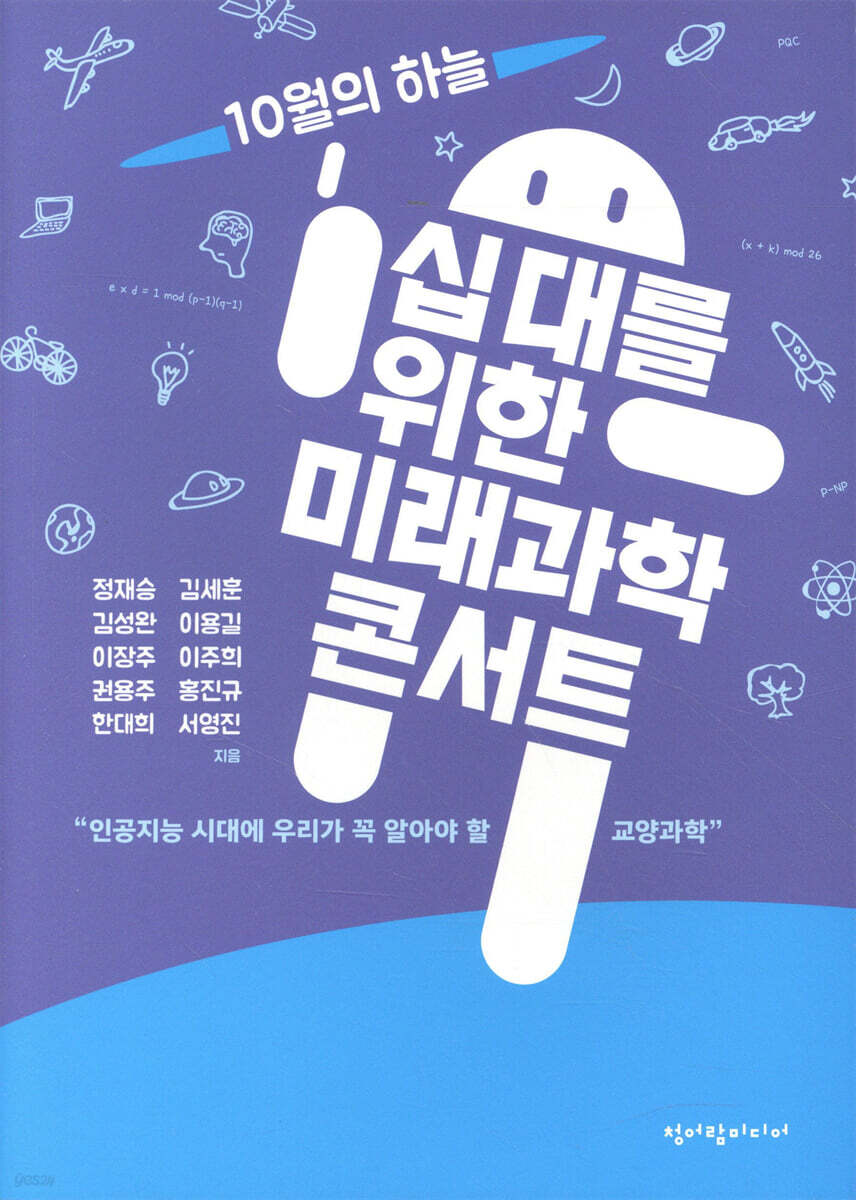
Future Science Concert for Teenagers
 |
Description
Book Introduction
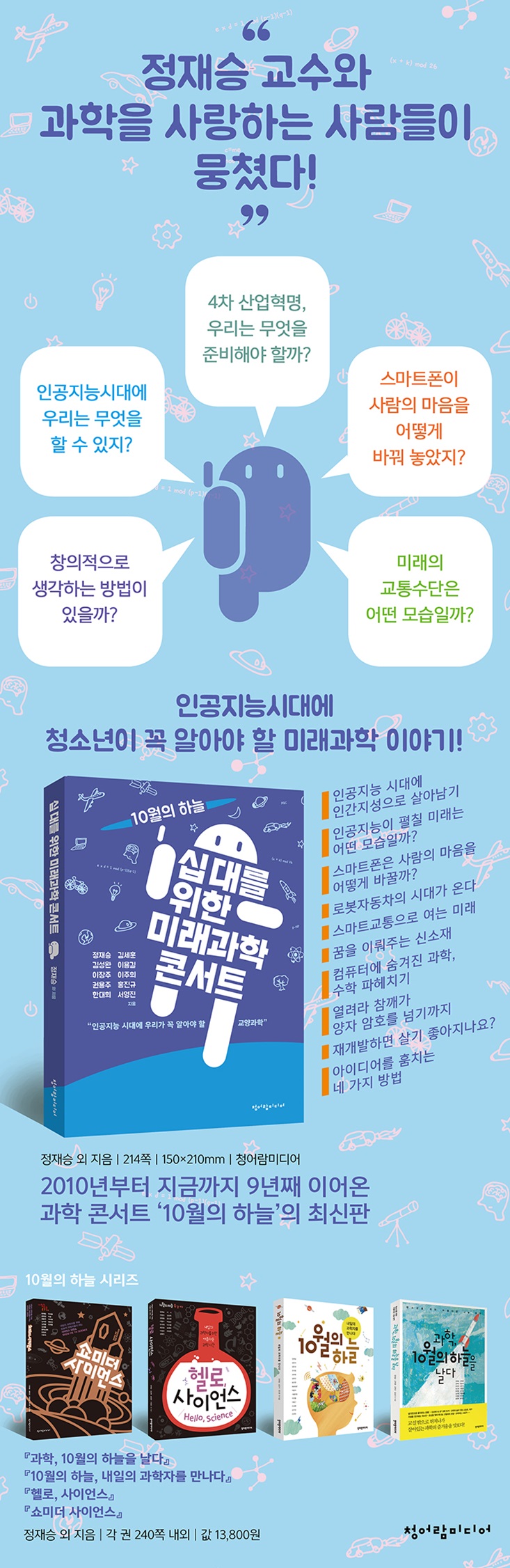
Professor Jeong Jae-seung and science lovers have come together!
The latest work from the youth talent donation science lecture series "October Sky"
We explore life, change, and future science in the age of artificial intelligence with Professor Jeong Jae-seung and experts from various fields.
This book is the fifth in the "October Sky" series, a compilation of interesting lectures presented at events organized by "October Sky," which was launched to introduce the joy of science to young people.
We will explore with experts in various fields what artificial intelligence is, how much it will impact our lives, and what future transportation methods it will change.
In addition, it contains stories about future science that everyone, not just teenagers, should know, including how smartphones, further developed through artificial intelligence, have changed the human mind, the amazing evolution of computers that led to the development of artificial intelligence, the world of encryption that becomes more robust with each new technology, and even how to think creatively.
The latest work from the youth talent donation science lecture series "October Sky"
We explore life, change, and future science in the age of artificial intelligence with Professor Jeong Jae-seung and experts from various fields.
This book is the fifth in the "October Sky" series, a compilation of interesting lectures presented at events organized by "October Sky," which was launched to introduce the joy of science to young people.
We will explore with experts in various fields what artificial intelligence is, how much it will impact our lives, and what future transportation methods it will change.
In addition, it contains stories about future science that everyone, not just teenagers, should know, including how smartphones, further developed through artificial intelligence, have changed the human mind, the amazing evolution of computers that led to the development of artificial intelligence, the world of encryption that becomes more robust with each new technology, and even how to think creatively.
- You can preview some of the book's contents.
Preview
index
preface
01.
Surviving with Human Intelligence in the Age of Artificial Intelligence _ Jaeseung Jeong
02.
What will the future of artificial intelligence look like? _ Kim Seong-wan
03.
How will smartphones change people's minds? _ Lee Jang-ju
04.
The Age of Robot Cars is Coming _ Kwon Yong-ju
05.
The Future Opened by Smart Transportation _ Daehee Han
06.
New Materials That Make Dreams Come True _ Kim Se-hoon
07.
Uncovering the Science and Mathematics Hidden in Computers _ Yonggil Lee
08.
Open Sesame: Until Quantum Cryptography is Overcome _ Lee Ju-hee
09.
Will redevelopment make living better? _ Hong Jin-gyu
10.
Four Ways to Steal Ideas _ Seo Young-jin
01.
Surviving with Human Intelligence in the Age of Artificial Intelligence _ Jaeseung Jeong
02.
What will the future of artificial intelligence look like? _ Kim Seong-wan
03.
How will smartphones change people's minds? _ Lee Jang-ju
04.
The Age of Robot Cars is Coming _ Kwon Yong-ju
05.
The Future Opened by Smart Transportation _ Daehee Han
06.
New Materials That Make Dreams Come True _ Kim Se-hoon
07.
Uncovering the Science and Mathematics Hidden in Computers _ Yonggil Lee
08.
Open Sesame: Until Quantum Cryptography is Overcome _ Lee Ju-hee
09.
Will redevelopment make living better? _ Hong Jin-gyu
10.
Four Ways to Steal Ideas _ Seo Young-jin
Detailed image
Publisher's Review
Started to share the joy of science
Talent Donation Science Lecture Series "October Sky"
〈October Sky〉, now in its 9th year in 2018, is a talent donation science lecture series that began in 2010 at the suggestion of Professor Jaeseung Jeong.
Every year, on the last Saturday of October, practicing scientists, science writers, engineers, and experts from various fields of culture and arts visit young people in small and medium-sized cities who do not have many opportunities to experience science to share the mysteries of science and the wonders of nature.
The name of the event, “October Sky,” was also taken from the movie “October Sky,” which depicts the story of Homer Hickam, a boy from a coal mining village, pursuing his dream of becoming a rocket scientist.
For teenagers who think of science as something painful, difficult, and something they want to give up on, and for children who think of scientists as people from a faraway land who can only be incredibly smart, "October Sky" shows that science is something interesting, something familiar, and something close to us.
And it allows you to meet scientists in person.
This year's event will be held on Saturday, October 27th at 2:00 PM.
Fifty lectures await young people who dream of becoming scientists at 25 libraries across the country, including Uiseong County Public Library, Sunchang County Public Library, and Jeju Halla Library.
Scientists from various fields, including Professor Jaeseung Jeong, neuroscientist Dr. Dongseon Jang who appeared on 'Knowing Bros 2', Professor Sangwook Kim of the Department of Physics at Kyunghee University who is appearing in Season 3, and Dr. Soyeon Yi, Korea's first astronaut, will tell a variety of scientific stories from everyday life to space.
Through 'October Sky,' speakers can look back on the original intentions they had when they first embarked on the path of science, donors can experience the joy of sharing their talents with others, and children can experience the wonders of science and nurture their dreams of becoming future scientists.
If anyone, not just scientists, were to dedicate just one day to contributing their talents to a better world, starting with "October Sky," our hearts would become as clear as the autumn sky.
Jaeseung Jeong, Professor of Bio and Brain Engineering at KAIST
- From the preface
* 〈October Sky〉, which celebrated its 9th anniversary in 2018, brings together approximately 40 scientists to share the joy of science with 3,000 students every year.
Held every year on the last Saturday of October at 2:00 PM, the entire process of “October Sky”, from planning and preparation to the lectures and event management on the day, is accomplished solely through talent donations.
In the age of artificial intelligence
Future Science Stories Youth Must Know
In 2016, when the artificial intelligence program AlphaGo defeated Lee Sedol, artificial intelligence became so close that we could feel it in our own skin.
One of the biggest concerns for teenagers and their parents today is survival in the age of artificial intelligence.
The media says that as artificial intelligence advances, countless jobs will disappear.
Neither teenagers nor their parents are clear about what they should learn and prepare for, and they are vaguely focusing on math, science, and coding education.
But fears and worries about the future remain.
So, what do scientists and experts in various fields working at the forefront of the AI era think about the current situation?
This book consists of 10 chapters in total, and from the perspectives of experts in each field, it talks about future science that must be known in the age of artificial intelligence, such as what artificial intelligence is and how it is developing, how technologies such as smartphones are changing our minds, what conveniences the development of self-driving cars and smart transportation brings, how cutting-edge new materials are used in our daily lives, what computer programming is, what encryption technology is used to deal with hacking, the impact of urban redevelopment on us, and how to develop creative thinking.
01.
Surviving with Human Intelligence in the Age of Artificial Intelligence _ Jaeseung Jeong, Professor of Bio and Brain Engineering, KAIST
We will explore how artificial intelligence differs from the human brain and how we should live when artificial intelligence replaces human labor in the future.
Just as people living in the 1980s, 30 years ago, could not have imagined that we would be living like this in the 2010s, it is difficult to even imagine that your life 30 years from now will be completely different from what it is now.
Despite these unpredictable circumstances, to become a vital part of our society, you must develop the ability to think independently, to solve new problems and unconventional problems, no matter what the world throws at you.
I really want you to remember that it's really important to develop the ability to see things from your own perspective.
_ Page 28 of the text
02.
What will the future of artificial intelligence look like? _ Kim Seong-wan, Pearl Abyss R&D Team
We examine the background of the development of artificial intelligence, the occupations in which it is being introduced, and predict the future that awaits us.
03.
How do smartphones change the human mind? _ Lee Jang-ju, Ph.D., Cultural Psychology
We examine how smartphone technology has changed people from a cultural psychological perspective.
It is said that the word crisis is a combination of danger and opportunity.
To turn risk into opportunity, we need to be able to read the world and the changing minds of the people who live in it.
In society, most things that are considered valuable are those that relieve people of their worries or annoyances or provide them with enjoyable experiences.
A changing society means that the things that bother us and worry us will change, and the types of things that are enjoyable will emerge.
_ Page 63 of the text
04.
The Age of Robot Cars is Coming _ Kwon Yong-ju, Automotive Reporter
Learn what autonomous driving is and how cars will change in the future.
05.
A Future Opened by Smart Transportation _ Daehee Han, Director of the Transportation Research Lab, Daejeon Metropolitan City
It tells us about the new means of transportation that emerged with technological advancements and how urban transportation developed.
06.
New materials that make dreams come true _ Kim Se-hoon, CEO of Awesome Ray Co., Ltd.
It tells us how mankind has utilized various materials developed to achieve its dreams.
A single sheet of A4 paper is so weak that it is difficult to stand it up on its own.
What's the best way to get the most strength from a single piece of paper? You could fold it several times to make it smaller, but rolling it into a stick shape makes it easier to form into a stronger form.
It's the same paper, but when rolled up, it turns into a stronger material.
There are cases where the properties of a substance change simply by changing its shape.
For this reason, when making a product, we often spend a long time thinking about the optimal structure needed to achieve the desired properties.
_ Page 110 of the text
07.
Uncovering the Science and Mathematics Hidden in Computers _ Yonggil Lee, Wishcat Development Director
Computers are now used in a variety of fields, including cars, bicycles, rice cookers, and toys.
Learn about the science and math behind these computers.
Talking to a computer, that is, writing a programming language, is about conveying to the computer something that exists in the world.
To explain something, we need to convey both mathematical thinking and scientific evidence to the computer.
For example, if you fall down while walking, you can explain the cause and effect using various mathematical and scientific knowledge such as gravity, acceleration, and the elasticity of objects.
But even if you know a programming language, if you don't have this knowledge, the computer won't be able to fully understand what you're saying.
_ Page 144 of the text
08.
Open Sesame: How Quantum Cryptography Can Be Overcome by Lee Ju-hee, Senior Researcher at ARIST
New threats have emerged due to technological developments, and we introduce the cryptographic technologies available to prevent them.
09.
Will redevelopment make living better? _ Hong Jin-gyu, Professor of Atmospheric Sciences, Yonsei University
We tend to assume that urban redevelopment will naturally improve everything, but is that really the case? Let's explore how urban redevelopment affects us.
As urban temperatures drop, atmospheric mixing weakens, which can also have unexpected consequences.
For example, if you put ramen soup in boiling water, the soup will immediately mix evenly with the water, but if you turn off the heat, the soup will immediately sink to the bottom.
This weakened mixing caused by lower temperatures due to trees can lead to worse air pollution.
As atmospheric mixing weakens, fine dust will settle on roads where people walk and beneath buildings, which will further increase the concentration of fine dust near where we live.
_ Page 184 of the text
10.
Four Ways to Steal Ideas _ Seo Young-jin, Creativity Development Columnist
Science was able to advance thanks to creative thinking, that is, thinking differently from others.
Let's look at how to develop creative thinking.
What exactly makes a good idea? No matter how innovative something is, if it lacks the effort to pursue excellence, it quickly becomes a failed idea.
What if an idea, after extensive research, only resonates with a tiny minority of society and negatively impacts the rest? The concepts of change, experimentation, and communication must all be embedded within the idea.
It must have a positive impact on humanity and enrich our lives through its ideas.
_ Page 199 of the text
Waiting for “October Sky” to be held next year
“October Sky” celebrates its 10th anniversary in 2019.
Since 2010, “October Sky” has been held without fail every year on the last Saturday of October.
It began as a way to share the joy and wonder of science with young people and to inspire them to dream about science, but now it also serves to alleviate concerns and anxieties about science and technology, including the rapidly developing artificial intelligence.
Through the new book, "Future Science Concert for Teenagers," teenagers and parents who were unable to attend the "October Sky" event will be able to examine what artificial intelligence is and how science and technology will impact our lives through the broad perspectives of experts in each field. This will help them understand what they need to study and prepare for in the future.
Talent Donation Science Lecture Series "October Sky"
〈October Sky〉, now in its 9th year in 2018, is a talent donation science lecture series that began in 2010 at the suggestion of Professor Jaeseung Jeong.
Every year, on the last Saturday of October, practicing scientists, science writers, engineers, and experts from various fields of culture and arts visit young people in small and medium-sized cities who do not have many opportunities to experience science to share the mysteries of science and the wonders of nature.
The name of the event, “October Sky,” was also taken from the movie “October Sky,” which depicts the story of Homer Hickam, a boy from a coal mining village, pursuing his dream of becoming a rocket scientist.
For teenagers who think of science as something painful, difficult, and something they want to give up on, and for children who think of scientists as people from a faraway land who can only be incredibly smart, "October Sky" shows that science is something interesting, something familiar, and something close to us.
And it allows you to meet scientists in person.
This year's event will be held on Saturday, October 27th at 2:00 PM.
Fifty lectures await young people who dream of becoming scientists at 25 libraries across the country, including Uiseong County Public Library, Sunchang County Public Library, and Jeju Halla Library.
Scientists from various fields, including Professor Jaeseung Jeong, neuroscientist Dr. Dongseon Jang who appeared on 'Knowing Bros 2', Professor Sangwook Kim of the Department of Physics at Kyunghee University who is appearing in Season 3, and Dr. Soyeon Yi, Korea's first astronaut, will tell a variety of scientific stories from everyday life to space.
Through 'October Sky,' speakers can look back on the original intentions they had when they first embarked on the path of science, donors can experience the joy of sharing their talents with others, and children can experience the wonders of science and nurture their dreams of becoming future scientists.
If anyone, not just scientists, were to dedicate just one day to contributing their talents to a better world, starting with "October Sky," our hearts would become as clear as the autumn sky.
Jaeseung Jeong, Professor of Bio and Brain Engineering at KAIST
- From the preface
* 〈October Sky〉, which celebrated its 9th anniversary in 2018, brings together approximately 40 scientists to share the joy of science with 3,000 students every year.
Held every year on the last Saturday of October at 2:00 PM, the entire process of “October Sky”, from planning and preparation to the lectures and event management on the day, is accomplished solely through talent donations.
In the age of artificial intelligence
Future Science Stories Youth Must Know
In 2016, when the artificial intelligence program AlphaGo defeated Lee Sedol, artificial intelligence became so close that we could feel it in our own skin.
One of the biggest concerns for teenagers and their parents today is survival in the age of artificial intelligence.
The media says that as artificial intelligence advances, countless jobs will disappear.
Neither teenagers nor their parents are clear about what they should learn and prepare for, and they are vaguely focusing on math, science, and coding education.
But fears and worries about the future remain.
So, what do scientists and experts in various fields working at the forefront of the AI era think about the current situation?
This book consists of 10 chapters in total, and from the perspectives of experts in each field, it talks about future science that must be known in the age of artificial intelligence, such as what artificial intelligence is and how it is developing, how technologies such as smartphones are changing our minds, what conveniences the development of self-driving cars and smart transportation brings, how cutting-edge new materials are used in our daily lives, what computer programming is, what encryption technology is used to deal with hacking, the impact of urban redevelopment on us, and how to develop creative thinking.
01.
Surviving with Human Intelligence in the Age of Artificial Intelligence _ Jaeseung Jeong, Professor of Bio and Brain Engineering, KAIST
We will explore how artificial intelligence differs from the human brain and how we should live when artificial intelligence replaces human labor in the future.
Just as people living in the 1980s, 30 years ago, could not have imagined that we would be living like this in the 2010s, it is difficult to even imagine that your life 30 years from now will be completely different from what it is now.
Despite these unpredictable circumstances, to become a vital part of our society, you must develop the ability to think independently, to solve new problems and unconventional problems, no matter what the world throws at you.
I really want you to remember that it's really important to develop the ability to see things from your own perspective.
_ Page 28 of the text
02.
What will the future of artificial intelligence look like? _ Kim Seong-wan, Pearl Abyss R&D Team
We examine the background of the development of artificial intelligence, the occupations in which it is being introduced, and predict the future that awaits us.
03.
How do smartphones change the human mind? _ Lee Jang-ju, Ph.D., Cultural Psychology
We examine how smartphone technology has changed people from a cultural psychological perspective.
It is said that the word crisis is a combination of danger and opportunity.
To turn risk into opportunity, we need to be able to read the world and the changing minds of the people who live in it.
In society, most things that are considered valuable are those that relieve people of their worries or annoyances or provide them with enjoyable experiences.
A changing society means that the things that bother us and worry us will change, and the types of things that are enjoyable will emerge.
_ Page 63 of the text
04.
The Age of Robot Cars is Coming _ Kwon Yong-ju, Automotive Reporter
Learn what autonomous driving is and how cars will change in the future.
05.
A Future Opened by Smart Transportation _ Daehee Han, Director of the Transportation Research Lab, Daejeon Metropolitan City
It tells us about the new means of transportation that emerged with technological advancements and how urban transportation developed.
06.
New materials that make dreams come true _ Kim Se-hoon, CEO of Awesome Ray Co., Ltd.
It tells us how mankind has utilized various materials developed to achieve its dreams.
A single sheet of A4 paper is so weak that it is difficult to stand it up on its own.
What's the best way to get the most strength from a single piece of paper? You could fold it several times to make it smaller, but rolling it into a stick shape makes it easier to form into a stronger form.
It's the same paper, but when rolled up, it turns into a stronger material.
There are cases where the properties of a substance change simply by changing its shape.
For this reason, when making a product, we often spend a long time thinking about the optimal structure needed to achieve the desired properties.
_ Page 110 of the text
07.
Uncovering the Science and Mathematics Hidden in Computers _ Yonggil Lee, Wishcat Development Director
Computers are now used in a variety of fields, including cars, bicycles, rice cookers, and toys.
Learn about the science and math behind these computers.
Talking to a computer, that is, writing a programming language, is about conveying to the computer something that exists in the world.
To explain something, we need to convey both mathematical thinking and scientific evidence to the computer.
For example, if you fall down while walking, you can explain the cause and effect using various mathematical and scientific knowledge such as gravity, acceleration, and the elasticity of objects.
But even if you know a programming language, if you don't have this knowledge, the computer won't be able to fully understand what you're saying.
_ Page 144 of the text
08.
Open Sesame: How Quantum Cryptography Can Be Overcome by Lee Ju-hee, Senior Researcher at ARIST
New threats have emerged due to technological developments, and we introduce the cryptographic technologies available to prevent them.
09.
Will redevelopment make living better? _ Hong Jin-gyu, Professor of Atmospheric Sciences, Yonsei University
We tend to assume that urban redevelopment will naturally improve everything, but is that really the case? Let's explore how urban redevelopment affects us.
As urban temperatures drop, atmospheric mixing weakens, which can also have unexpected consequences.
For example, if you put ramen soup in boiling water, the soup will immediately mix evenly with the water, but if you turn off the heat, the soup will immediately sink to the bottom.
This weakened mixing caused by lower temperatures due to trees can lead to worse air pollution.
As atmospheric mixing weakens, fine dust will settle on roads where people walk and beneath buildings, which will further increase the concentration of fine dust near where we live.
_ Page 184 of the text
10.
Four Ways to Steal Ideas _ Seo Young-jin, Creativity Development Columnist
Science was able to advance thanks to creative thinking, that is, thinking differently from others.
Let's look at how to develop creative thinking.
What exactly makes a good idea? No matter how innovative something is, if it lacks the effort to pursue excellence, it quickly becomes a failed idea.
What if an idea, after extensive research, only resonates with a tiny minority of society and negatively impacts the rest? The concepts of change, experimentation, and communication must all be embedded within the idea.
It must have a positive impact on humanity and enrich our lives through its ideas.
_ Page 199 of the text
Waiting for “October Sky” to be held next year
“October Sky” celebrates its 10th anniversary in 2019.
Since 2010, “October Sky” has been held without fail every year on the last Saturday of October.
It began as a way to share the joy and wonder of science with young people and to inspire them to dream about science, but now it also serves to alleviate concerns and anxieties about science and technology, including the rapidly developing artificial intelligence.
Through the new book, "Future Science Concert for Teenagers," teenagers and parents who were unable to attend the "October Sky" event will be able to examine what artificial intelligence is and how science and technology will impact our lives through the broad perspectives of experts in each field. This will help them understand what they need to study and prepare for in the future.
GOODS SPECIFICS
- Date of publication: October 22, 2018
- Page count, weight, size: 214 pages | 421g | 150*210*20mm
- ISBN13: 9791158710828
- ISBN10: 1158710828
You may also like
카테고리
korean


korean

![GQ KOREA Mark (Monthly): December [2025]](http://librairie.coreenne.fr/cdn/shop/files/8ef265dbbfbf186523ed75ba7319009d.jpg?v=1765340328&width=3840)


