

Where, to whom, and how did the Buddha teach?
 |
Description
Book Introduction
Understand at a glance with diagrams and maps
Korea's first statistical study of early scriptures!
- Where did Buddha stay the most?
- Who is the person who talked to Buddha the most?
- What type of dialogue format does Buddha have?
A total of 5,434 sutras contained in the four Nikayas: Matjima, Digha, Sangutta, and Anguttara.
The traces of Buddha and his disciples, revealed through thorough research!
Although many translations of early scriptures have been done so far, there has been no research material that allows for a comprehensive understanding of the Nikayas at a glance with accurate statistics.
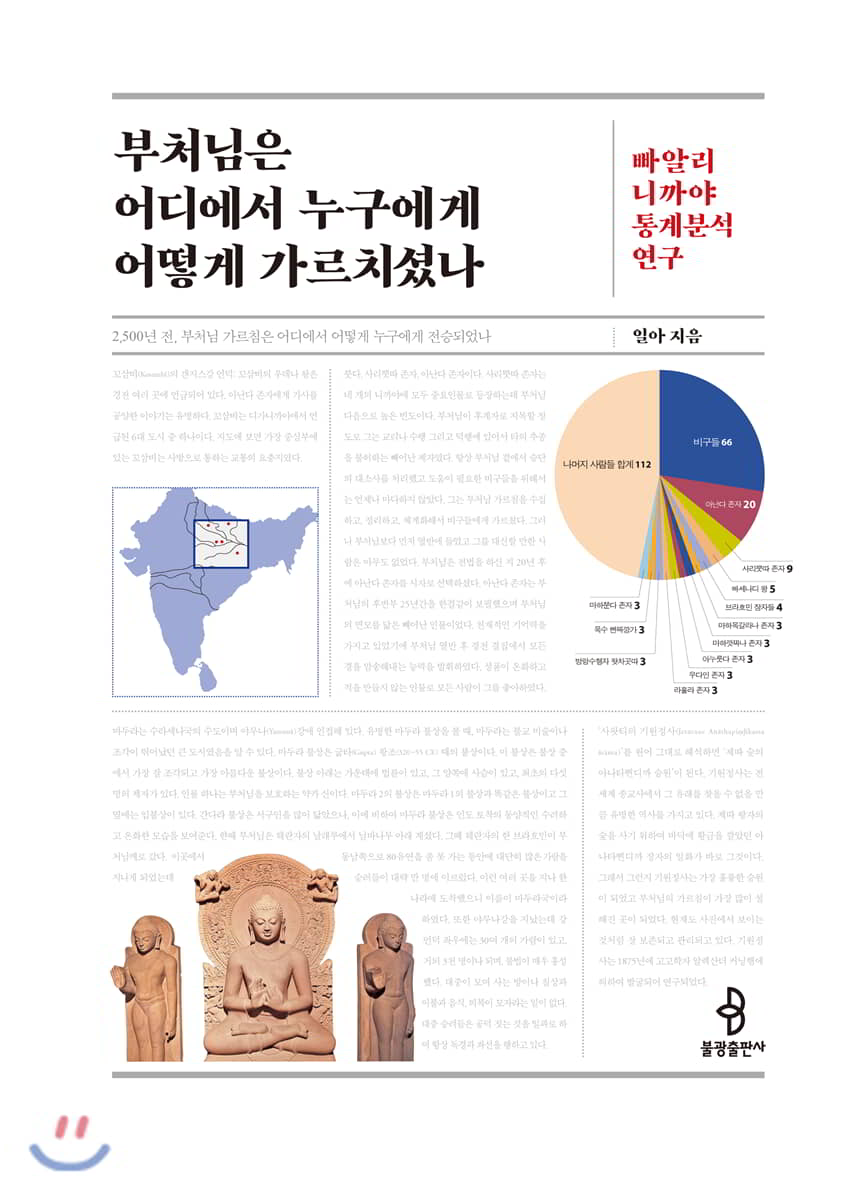
This book is the result of repeated research on 5,434 early sutras, which examine where the Buddha and his disciples primarily resided, to whom they spoke, and in what manner.
We compared the statistics by drawing a chart, and indicated the high frequency considering the characteristics of each data, and explained the monks and details related to each location.
These places were then marked on a map of India to help us understand where the Buddha and his disciples stayed most often.
Additionally, we selected six important figures who appear in the sutra according to frequency, two nuns, and six laypersons who appear as interlocutors, and examined their appearances.
Color charts, photographs, and a variety of archaeological materials provide readers with a more direct and realistic view of the situation in India at that time.
This brings us one step closer to inferring the appearance of Buddhism 2,500 years ago at the time of its birth and the process by which the vivid original sound of the Buddha's teachings was transmitted.
This is a remarkable study that supports our understanding of the roots of Buddhism.
Korea's first statistical study of early scriptures!
- Where did Buddha stay the most?
- Who is the person who talked to Buddha the most?
- What type of dialogue format does Buddha have?
A total of 5,434 sutras contained in the four Nikayas: Matjima, Digha, Sangutta, and Anguttara.
The traces of Buddha and his disciples, revealed through thorough research!
Although many translations of early scriptures have been done so far, there has been no research material that allows for a comprehensive understanding of the Nikayas at a glance with accurate statistics.
This book is the result of repeated research on 5,434 early sutras, which examine where the Buddha and his disciples primarily resided, to whom they spoke, and in what manner.
We compared the statistics by drawing a chart, and indicated the high frequency considering the characteristics of each data, and explained the monks and details related to each location.
These places were then marked on a map of India to help us understand where the Buddha and his disciples stayed most often.
Additionally, we selected six important figures who appear in the sutra according to frequency, two nuns, and six laypersons who appear as interlocutors, and examined their appearances.
Color charts, photographs, and a variety of archaeological materials provide readers with a more direct and realistic view of the situation in India at that time.
This brings us one step closer to inferring the appearance of Buddhism 2,500 years ago at the time of its birth and the process by which the vivid original sound of the Buddha's teachings was transmitted.
This is a remarkable study that supports our understanding of the roots of Buddhism.
- You can preview some of the book's contents.
Preview
index
preface
Note
Statistics and charts of the background diagram of the four Nikayas in Part 1
Chapter 1 Background Diagram and Table of the Sangyutta Nikaya
1.
Preliminary Considerations on the Samyutta Nikaya
1) The names and numbers of the 56 Sangyutti
2) Points to note and problems when creating a diagram of the Sangyutta Nikaya
3) Examine in detail whether each Sangyutta has a regular shape.
2.
Diagram and explanation of the Sangyutta Nikaya
1) Figure 1-1: Background diagram of the Samyutta Nikaya
2) Table 1-2: Frequency statistics according to Table 1-1 of the Samyutta Nikaya
3) Figure 1-3: Location frequency chart according to Figure 1-2 of the Samyutta Nikaya
4) Table 1-4: Frequency chart of important figures according to Table 1-2 of the Samyutta Nikaya
5) Figure 1-5: Dialogue partner frequency chart according to Figure 1-2 of the Samyutta Nikaya
6) Figure 1-6: Frequency chart of sermon forms according to Figure 1-2 of the Samyutta Nikaya
Chapter 2 Background Diagram and Table of Contents of the Matjimanikaya
1.
Preliminary Considerations on the Matjimanikaya
2.
Diagram and explanation of the Matjimanikaya
1) Figure 2-1: Background diagram of the Matjimanikaya
2) Table 2-2: Frequency statistics according to Table 2-1 of the Matjimanikaya
3) Figure 2-3: Location frequency chart according to Figure 2-2 of the Matjimanikaya
4) Figure 2-4: Frequency chart of important figures according to Figure 2-2 of the Matjimanikaya
5) Figure 2-5: Dialogue partner frequency chart according to Figure 2-2 of the Matjimanikaya
6) Figure 2-6: Frequency chart of sermon forms according to Figure 2-2 of the Matjjimanikaya
Chapter 3: Background Diagrams and Charts of the Dighanikaya
1.
Preliminary Considerations on the Dighanikaya
1) Points to note when creating a Dighanikaya diagram
2) 18 places mentioned in the Mahaparinibbana Sutta, but not in the diagram of this study
2.
Diagram and explanation of the Dighanikaya
1) Figure 3-1: Background diagram of the Dighanikaya
2) Table 3-2: Frequency statistics according to Table 3-1 of the Dighanikaya
3) Figure 3-3: Location frequency chart according to Figure 3-2 of the Dighanikaya
4) Figure 3-4: Frequency chart of important figures according to Figure 3-2 of the Dighanikaya
5) Figure 3-5: Dialogue partner frequency chart according to Figure 3-2 of the Dighanikaya
6) Figure 3-6: Frequency chart of sermon forms according to Figure 3-2 of the Dighanikaya
Chapter 4 Background Diagram and Table of the Anguttara Nikaya
1.
Preliminary Considerations on the Anguttara Nikaya
1) Things to keep in mind when creating an Anguttara Nikaya diagram
2) Number and starting form of each sutra of the Anguttara Nikaya
2.
Diagram and explanation of the Anguttara Nikaya
1) Figure 4-1: Background diagram of the Anguttara Nikaya
2) Figure 4-2: Frequency statistics according to Figure 4-1 of the Anguttara Nikaya
3) Figure 4-3: Location frequency chart according to Figure 4-2 of the Anguttara Nikaya
4) Figure 4-4: Frequency chart of important figures according to Figure 4-2 of the Anguttara Nikaya
5) Figure 4-5: Dialogue partner frequency chart according to Figure 4-2 of the Anguttara Nikaya
6) Figure 4-6: Frequency chart of sermon forms according to Figure 4-2 of the Anguttara Nikaya
Chapter 5: Comparison of the four Nikayas
1.
Comparison of the four Nikaya locations
2.
Comparison of the pictorial representations of the four Nikayas
3.
Comparison of Dialogue Partners in the Four Nikayas
4.
Comparison of the four Nikaya sermon formats
Part 2: Description of the Places of Stay of Each of the Four Nikayas
The ten most frequent monasteries in the four Nikayas of Chapter 1
Jetavane An?thapi??ikassa ?r?ma, the first monastery of Savatthi
The Migaramatu lecture hall (Mig?ram?tup?s?da) of the Savatthi 2nd floor (Pubb?r?ma)
Ghosit?r?ma of the Kosambi (Kosamb?) monastery, 3rd floor
Nigrodh?r?ma, the Nigrodh?r?ma monastery of Kapilavatthu, the fourth monastery
Seungwon 5 Vesali Big Forest Central Hall (K?t?g?ras?l?)
The Bamboo Grove Monastery of Rajagaha (Kalandakaniv?pa)
The 7th Pattaliputta Monastery (kukku??r?ma)
The brick monastery of Nadika in the 8th Vajji (Ginjakavasath?r?ma)
Tapodārma (Hot Spring) Monastery of Rajagaha, 9th Monastery
R?jak?r?ma (Bhikkhuni) Monastery 10
Chapter 2: Description of each location in the four Nikayas
1.
Description of the places in the Samyutta Nikaya: 77 different places in total
2.
Description of the locations of the Matjimanikaya: 46 different locations in total
3.
Description of places in the Dighanikaya: 24 different places in total
4.
Description of places in the Anguttara Nikaya: 60 different places in total
Part 3: Maps and Statistics for Each of the Four Nikayas
Chapter 1: Description of each location in the four Nikayas
1.
Map of each location in Sangyutta Nikaya
1) A total of 77 different places in Sangyutta Nikaya
2) Maps of 77 different locations in total
3) Frequency statistics of locations distributed in Sangyutta Nikaya
2.
Map of each location of Matjimanikaya
1) A total of 46 different locations
2) Map of 46 different locations in total
3) Frequency statistics of locations distributed in Matjimanikaya
3.
Map of each location in the Dighanikaya
1) A total of 24 different places in the Dighanikaya
2) Maps of 24 different locations in the Dighanikaya
3) Frequency statistics of locations distributed in Dighanikaya
4.
Map of each location in the Anguttara Nikaya
1) Anguttara Nikaya, a total of 60 different locations
2) Maps of 60 different locations in Anguttara Nikaya
3) Frequency statistics of locations distributed in Anguttara Nikaya
Chapter 2: Comparison of the Regional Distribution of the Four Nikayas
1.
Comparison of the top 10 most frequent regions in the four Nikayas
2.
Comparison of regional distribution of locations across the four Nikayas
Part 4: The Most Frequent People in Key Figures and Interaction Partners
Chapter 1: Key Figures and Interlocutors in the Four Nikayas
1.
Frequency of important figures appearing in the four Nikayas
1) Frequency chart of important figures in the four Nikayas
2) Frequency chart of the sum of the major figures in the four Nikayas
3) Frequency order according to the four Nikayas' important figures chart
2.
Frequency of interlocutors appearing in the four Nikayas
1) Dialogue frequency chart of the four Nikayas
2) Frequency chart of the total number of conversation partners in the four Nikayas
3) Frequency order by the four Nikaya dialogue partners diagram
Chapter 2: Description of Eight Key Figures and Six Key Personnel
1.
Selecting key figures and conversation partners
1) Selection of key figures
2) Selecting conversation partners
2.
Six Venerables and two Nuns, according to the frequency of important figures
1) Venerable Sariputta
2) Venerable Ananda
3) Venerable Mah?moggall?na
4) Venerable Mah?kacc?na
5) Venerable Mahakassapa
6) Venerable Anuruddha
7) Bhikkhuni Mah?paj?pat? Gotam?
8) Khem? Bhikkhuni
3.
Six lay Buddhists who played a significant role in the Buddha's Sangha as interlocutors
1) The Venerable An?thapi??ika
2) The housewife Visakha (Vis?kh?)
3) King Pasenadi
4) King Bimbisara
5) Citta the Elder
6) J?vaka Kom?rabhacca
Deriving the results of each section based on the analysis data
1.
Conclusion of Part 1
2.
Conclusion of Part 2
3.
Conclusion of Part 3
4.
Conclusion of Part 4
References
index
Note
Statistics and charts of the background diagram of the four Nikayas in Part 1
Chapter 1 Background Diagram and Table of the Sangyutta Nikaya
1.
Preliminary Considerations on the Samyutta Nikaya
1) The names and numbers of the 56 Sangyutti
2) Points to note and problems when creating a diagram of the Sangyutta Nikaya
3) Examine in detail whether each Sangyutta has a regular shape.
2.
Diagram and explanation of the Sangyutta Nikaya
1) Figure 1-1: Background diagram of the Samyutta Nikaya
2) Table 1-2: Frequency statistics according to Table 1-1 of the Samyutta Nikaya
3) Figure 1-3: Location frequency chart according to Figure 1-2 of the Samyutta Nikaya
4) Table 1-4: Frequency chart of important figures according to Table 1-2 of the Samyutta Nikaya
5) Figure 1-5: Dialogue partner frequency chart according to Figure 1-2 of the Samyutta Nikaya
6) Figure 1-6: Frequency chart of sermon forms according to Figure 1-2 of the Samyutta Nikaya
Chapter 2 Background Diagram and Table of Contents of the Matjimanikaya
1.
Preliminary Considerations on the Matjimanikaya
2.
Diagram and explanation of the Matjimanikaya
1) Figure 2-1: Background diagram of the Matjimanikaya
2) Table 2-2: Frequency statistics according to Table 2-1 of the Matjimanikaya
3) Figure 2-3: Location frequency chart according to Figure 2-2 of the Matjimanikaya
4) Figure 2-4: Frequency chart of important figures according to Figure 2-2 of the Matjimanikaya
5) Figure 2-5: Dialogue partner frequency chart according to Figure 2-2 of the Matjimanikaya
6) Figure 2-6: Frequency chart of sermon forms according to Figure 2-2 of the Matjjimanikaya
Chapter 3: Background Diagrams and Charts of the Dighanikaya
1.
Preliminary Considerations on the Dighanikaya
1) Points to note when creating a Dighanikaya diagram
2) 18 places mentioned in the Mahaparinibbana Sutta, but not in the diagram of this study
2.
Diagram and explanation of the Dighanikaya
1) Figure 3-1: Background diagram of the Dighanikaya
2) Table 3-2: Frequency statistics according to Table 3-1 of the Dighanikaya
3) Figure 3-3: Location frequency chart according to Figure 3-2 of the Dighanikaya
4) Figure 3-4: Frequency chart of important figures according to Figure 3-2 of the Dighanikaya
5) Figure 3-5: Dialogue partner frequency chart according to Figure 3-2 of the Dighanikaya
6) Figure 3-6: Frequency chart of sermon forms according to Figure 3-2 of the Dighanikaya
Chapter 4 Background Diagram and Table of the Anguttara Nikaya
1.
Preliminary Considerations on the Anguttara Nikaya
1) Things to keep in mind when creating an Anguttara Nikaya diagram
2) Number and starting form of each sutra of the Anguttara Nikaya
2.
Diagram and explanation of the Anguttara Nikaya
1) Figure 4-1: Background diagram of the Anguttara Nikaya
2) Figure 4-2: Frequency statistics according to Figure 4-1 of the Anguttara Nikaya
3) Figure 4-3: Location frequency chart according to Figure 4-2 of the Anguttara Nikaya
4) Figure 4-4: Frequency chart of important figures according to Figure 4-2 of the Anguttara Nikaya
5) Figure 4-5: Dialogue partner frequency chart according to Figure 4-2 of the Anguttara Nikaya
6) Figure 4-6: Frequency chart of sermon forms according to Figure 4-2 of the Anguttara Nikaya
Chapter 5: Comparison of the four Nikayas
1.
Comparison of the four Nikaya locations
2.
Comparison of the pictorial representations of the four Nikayas
3.
Comparison of Dialogue Partners in the Four Nikayas
4.
Comparison of the four Nikaya sermon formats
Part 2: Description of the Places of Stay of Each of the Four Nikayas
The ten most frequent monasteries in the four Nikayas of Chapter 1
Jetavane An?thapi??ikassa ?r?ma, the first monastery of Savatthi
The Migaramatu lecture hall (Mig?ram?tup?s?da) of the Savatthi 2nd floor (Pubb?r?ma)
Ghosit?r?ma of the Kosambi (Kosamb?) monastery, 3rd floor
Nigrodh?r?ma, the Nigrodh?r?ma monastery of Kapilavatthu, the fourth monastery
Seungwon 5 Vesali Big Forest Central Hall (K?t?g?ras?l?)
The Bamboo Grove Monastery of Rajagaha (Kalandakaniv?pa)
The 7th Pattaliputta Monastery (kukku??r?ma)
The brick monastery of Nadika in the 8th Vajji (Ginjakavasath?r?ma)
Tapodārma (Hot Spring) Monastery of Rajagaha, 9th Monastery
R?jak?r?ma (Bhikkhuni) Monastery 10
Chapter 2: Description of each location in the four Nikayas
1.
Description of the places in the Samyutta Nikaya: 77 different places in total
2.
Description of the locations of the Matjimanikaya: 46 different locations in total
3.
Description of places in the Dighanikaya: 24 different places in total
4.
Description of places in the Anguttara Nikaya: 60 different places in total
Part 3: Maps and Statistics for Each of the Four Nikayas
Chapter 1: Description of each location in the four Nikayas
1.
Map of each location in Sangyutta Nikaya
1) A total of 77 different places in Sangyutta Nikaya
2) Maps of 77 different locations in total
3) Frequency statistics of locations distributed in Sangyutta Nikaya
2.
Map of each location of Matjimanikaya
1) A total of 46 different locations
2) Map of 46 different locations in total
3) Frequency statistics of locations distributed in Matjimanikaya
3.
Map of each location in the Dighanikaya
1) A total of 24 different places in the Dighanikaya
2) Maps of 24 different locations in the Dighanikaya
3) Frequency statistics of locations distributed in Dighanikaya
4.
Map of each location in the Anguttara Nikaya
1) Anguttara Nikaya, a total of 60 different locations
2) Maps of 60 different locations in Anguttara Nikaya
3) Frequency statistics of locations distributed in Anguttara Nikaya
Chapter 2: Comparison of the Regional Distribution of the Four Nikayas
1.
Comparison of the top 10 most frequent regions in the four Nikayas
2.
Comparison of regional distribution of locations across the four Nikayas
Part 4: The Most Frequent People in Key Figures and Interaction Partners
Chapter 1: Key Figures and Interlocutors in the Four Nikayas
1.
Frequency of important figures appearing in the four Nikayas
1) Frequency chart of important figures in the four Nikayas
2) Frequency chart of the sum of the major figures in the four Nikayas
3) Frequency order according to the four Nikayas' important figures chart
2.
Frequency of interlocutors appearing in the four Nikayas
1) Dialogue frequency chart of the four Nikayas
2) Frequency chart of the total number of conversation partners in the four Nikayas
3) Frequency order by the four Nikaya dialogue partners diagram
Chapter 2: Description of Eight Key Figures and Six Key Personnel
1.
Selecting key figures and conversation partners
1) Selection of key figures
2) Selecting conversation partners
2.
Six Venerables and two Nuns, according to the frequency of important figures
1) Venerable Sariputta
2) Venerable Ananda
3) Venerable Mah?moggall?na
4) Venerable Mah?kacc?na
5) Venerable Mahakassapa
6) Venerable Anuruddha
7) Bhikkhuni Mah?paj?pat? Gotam?
8) Khem? Bhikkhuni
3.
Six lay Buddhists who played a significant role in the Buddha's Sangha as interlocutors
1) The Venerable An?thapi??ika
2) The housewife Visakha (Vis?kh?)
3) King Pasenadi
4) King Bimbisara
5) Citta the Elder
6) J?vaka Kom?rabhacca
Deriving the results of each section based on the analysis data
1.
Conclusion of Part 1
2.
Conclusion of Part 2
3.
Conclusion of Part 3
4.
Conclusion of Part 4
References
index
Into the book
This study is an attempt to derive, through various sources, where the Buddha and his disciples mainly stayed, to whom they spoke, and in what manner.
The following four factors were statistically revealed in the 5,434 sutras of the four Pāli Nikayas: ① the places where the Buddha stayed, ② the important people who preached the sutras, ③ the dialogue partners who listened to the Buddha's words, and ④ the dialogue format.
--- p.
6
There are 56 Sangyuttas because the Sangyutta Nikaya is grouped into 56 topics.
According to the British Pali Association's calculations, the total number of sutras is 2,889, but according to Bhikkhu Bodhi's calculations, there are a total of 2,904 sutras.
Here, we follow the calculations of the Bhikkhu Bodhi.
--- p.
24
It would be safe to assume that the Buddha preached 2,528 of the 2,904 sutras of the Samyutta Nikaya, or 87%, at the Jetavana Monastery in Savatthi.
Ignoring the total number of 2,904 sutras and the special circumstances of the Samyutta Nikaya, it cannot be said that only 723 sutras were preached at the Jetavana Monastery.
--- p.
33
The reason why the Venerable Sariputta appears so frequently is because he appears as the main character in the '28 Sariputta Sangyutta'.
Sariputta also appears as the main character in the 38th and 39th Sangyutti sutras, and the setting of these sutras is his hometown, Nalaka.
In his hometown, he teaches wandering monks through a question-and-answer format.
This is why the frequency has increased.
--- p.
77
The Matjhīma Nikāya is not a sutra that is too speculative or elaborate like the Digānikaya, nor is it too simple or plain like the Sāṇyutta Nikāya, nor is it a sutra that is too short and lacks depth like the Anguttārā Nikāya.
It is the Nikaya most preferred by Southern Buddhist monks as a sutra that logically explains the core of practice under various topics.
--- p.
84
In the 34 suttas of the Digha Nikaya, we can see that there are six types of monasteries.
As with other Nikayas, the forest type has the greatest number of varieties.
This shows that he stayed in many different forests.
Since there are a total of 34 locations, the types and number of locations are not that many.
However, the Indasala Cave and the tall, lofty buildings are unique places that appear only in this sutra.
--- p.
119
The Anguttara Nikaya is only about six pages long in Roman script, and even this is extremely rare.
Many are two or three lines long, but most are one sentence, half a page, or a whole page long.
As a result, in most cases, the places, important people, and conversation partners that are required for each case in this study are not present.
For example, out of a total of 2,344 sutras, only 50 are clearly designated as Savatthi Sutras.
Including the scriptures that mention places other than Giwonjeongsa, there are a total of 193 scriptures that mention places other than Giwonjeongsa.
--- p.
128
This diagram shows the locations, important people, interlocutors, and conversational styles that appear in all 2,344 suttas of the Anguttara Nikaya.
As you can see from the diagram, there are as many as 2,024 cases without a regular shape.
Although there are no actual scriptures, the places, important people, conversation partners, and sermons were assumed to be the same, so there were many ‘Giwonjeongsa’, ‘Buddha’, ‘Bhikkhus’, and ‘sermons’.
--- p.
132
The figures who appear in all four Nikayas are the Buddha, the Venerable Sariputta, and the Venerable Ananda.
The Venerable Sariputta appears as an important figure in all four Nikayas, second only to the Buddha in frequency.
He was an outstanding disciple, unrivaled in doctrine, practice, and virtue, to the point that the Buddha designated him as his successor.
He always handled all matters of the Sangha by the Buddha's side, and he never hesitated to help monks in need.
He collected, organized, and systematized the Buddha's teachings and taught them to monks.
However, he entered nirvana before the Buddha, and there was no one who could replace him.
--- p.
173
As seen in the above quote from the Majjhima Nikaya Sutta 75, the Buddha went to a small town called Kammasadhamma, meditated in the forest during the day, and stayed at a Brahmin fire-worshiping shrine at night.
At this temple, the Buddha met the wandering ascetic Magandiya, enlightened him of his wrong thinking, and gave him teachings.
Wherever the Buddha went, he met people there and imparted noble teachings to everyone he met.
Buddha was truly a dharma preacher for the happiness of all living beings.
--- p.
383
Sariputta and Moggallana had already practiced asceticism and practiced for about eight years before meeting the Buddha.
When the Buddha met Sariputta after six years of asceticism and enlightenment, one year had already passed since he had begun his dharma preaching activities. If we assume this period to be seven years, then Sariputta began his monastic practice one year earlier.
Given the period of time they practiced, it can be seen that Sariputta and Moggallana had already mastered the basic core of practice, and that they were at a level of practice that was incomparably higher than that of the Buddha's disciples who had just left home at the time.
The following four factors were statistically revealed in the 5,434 sutras of the four Pāli Nikayas: ① the places where the Buddha stayed, ② the important people who preached the sutras, ③ the dialogue partners who listened to the Buddha's words, and ④ the dialogue format.
--- p.
6
There are 56 Sangyuttas because the Sangyutta Nikaya is grouped into 56 topics.
According to the British Pali Association's calculations, the total number of sutras is 2,889, but according to Bhikkhu Bodhi's calculations, there are a total of 2,904 sutras.
Here, we follow the calculations of the Bhikkhu Bodhi.
--- p.
24
It would be safe to assume that the Buddha preached 2,528 of the 2,904 sutras of the Samyutta Nikaya, or 87%, at the Jetavana Monastery in Savatthi.
Ignoring the total number of 2,904 sutras and the special circumstances of the Samyutta Nikaya, it cannot be said that only 723 sutras were preached at the Jetavana Monastery.
--- p.
33
The reason why the Venerable Sariputta appears so frequently is because he appears as the main character in the '28 Sariputta Sangyutta'.
Sariputta also appears as the main character in the 38th and 39th Sangyutti sutras, and the setting of these sutras is his hometown, Nalaka.
In his hometown, he teaches wandering monks through a question-and-answer format.
This is why the frequency has increased.
--- p.
77
The Matjhīma Nikāya is not a sutra that is too speculative or elaborate like the Digānikaya, nor is it too simple or plain like the Sāṇyutta Nikāya, nor is it a sutra that is too short and lacks depth like the Anguttārā Nikāya.
It is the Nikaya most preferred by Southern Buddhist monks as a sutra that logically explains the core of practice under various topics.
--- p.
84
In the 34 suttas of the Digha Nikaya, we can see that there are six types of monasteries.
As with other Nikayas, the forest type has the greatest number of varieties.
This shows that he stayed in many different forests.
Since there are a total of 34 locations, the types and number of locations are not that many.
However, the Indasala Cave and the tall, lofty buildings are unique places that appear only in this sutra.
--- p.
119
The Anguttara Nikaya is only about six pages long in Roman script, and even this is extremely rare.
Many are two or three lines long, but most are one sentence, half a page, or a whole page long.
As a result, in most cases, the places, important people, and conversation partners that are required for each case in this study are not present.
For example, out of a total of 2,344 sutras, only 50 are clearly designated as Savatthi Sutras.
Including the scriptures that mention places other than Giwonjeongsa, there are a total of 193 scriptures that mention places other than Giwonjeongsa.
--- p.
128
This diagram shows the locations, important people, interlocutors, and conversational styles that appear in all 2,344 suttas of the Anguttara Nikaya.
As you can see from the diagram, there are as many as 2,024 cases without a regular shape.
Although there are no actual scriptures, the places, important people, conversation partners, and sermons were assumed to be the same, so there were many ‘Giwonjeongsa’, ‘Buddha’, ‘Bhikkhus’, and ‘sermons’.
--- p.
132
The figures who appear in all four Nikayas are the Buddha, the Venerable Sariputta, and the Venerable Ananda.
The Venerable Sariputta appears as an important figure in all four Nikayas, second only to the Buddha in frequency.
He was an outstanding disciple, unrivaled in doctrine, practice, and virtue, to the point that the Buddha designated him as his successor.
He always handled all matters of the Sangha by the Buddha's side, and he never hesitated to help monks in need.
He collected, organized, and systematized the Buddha's teachings and taught them to monks.
However, he entered nirvana before the Buddha, and there was no one who could replace him.
--- p.
173
As seen in the above quote from the Majjhima Nikaya Sutta 75, the Buddha went to a small town called Kammasadhamma, meditated in the forest during the day, and stayed at a Brahmin fire-worshiping shrine at night.
At this temple, the Buddha met the wandering ascetic Magandiya, enlightened him of his wrong thinking, and gave him teachings.
Wherever the Buddha went, he met people there and imparted noble teachings to everyone he met.
Buddha was truly a dharma preacher for the happiness of all living beings.
--- p.
383
Sariputta and Moggallana had already practiced asceticism and practiced for about eight years before meeting the Buddha.
When the Buddha met Sariputta after six years of asceticism and enlightenment, one year had already passed since he had begun his dharma preaching activities. If we assume this period to be seven years, then Sariputta began his monastic practice one year earlier.
Given the period of time they practiced, it can be seen that Sariputta and Moggallana had already mastered the basic core of practice, and that they were at a level of practice that was incomparably higher than that of the Buddha's disciples who had just left home at the time.
--- p.
477
477
Publisher's Review
The vast amount of early scriptures that were difficult to understand through literature alone
A groundbreaking study of scriptures visualized with statistics!
This book is a research material that analyzes the four Nikayas, Matjima, Digha, Sangutta, and Anguttara, and compiles statistics and charts of related information.
Not only can you delve into individual sutras through various visualizations such as circles, bar graphs, and photos, but you can also compare the four Nikayas simultaneously to see the similarities and differences between each sutra at a glance.
He also gave a detailed account of the places where the Buddha's teachings were given in each of the four Nikayas, and dealt separately with Jetavana, the first cradle of the Buddha's teachings and the most important of these places.
We also examined in detail other monks and places that appear in each Nikaya.
Based on this, the locations of the sermons are marked on the map according to the statistical data obtained from each of the four Nikayas, allowing one to directly check on the map how many places the Buddha stayed and preached before entering nirvana.
In particular, by investigating the 10 monasteries with the highest frequency of being places of sermons, we were able to simultaneously understand the geographical and historical background of each monastery at the time of the Buddha.
We also examined in detail the characters appearing in the early scriptures.
We created a 'Frequency Chart of Important Figures' in the four Nikayas, selected the six most frequently appearing venerables, and added the two most important nuns to examine their appearances in detail.
This study, which is highly useful in that it statistically compiles the content of early Buddhist scriptures, a feat never attempted before in Korea, is highly valuable as a visual resource for Buddhism and serves as the best guide for taking a step closer to inferring the process of Buddhist transmission.
It's not a vague religious story
Analysis of the early scriptures through data!
This groundbreaking study of early scripture statistics consists of four parts.
For each chapter, we extracted all the relevant content from the four Nikayas: Matjima, Digha, Sangyutta, and Anguttara, and compiled statistics.
Part 1 is about the background.
A statistical table was created based on the frequency of the four items that appear in each scripture: ① location, ② important person, ③ conversation partner, and ④ sermon type.
Through this, we aimed to reveal the background of the Buddha's teachings more clearly and to find out the characteristics of the background of the sermons in each Nikaya.
If we find the commonalities and differences between each Nikaya, we can understand specifically the background of the Pāli Nikaya's sermons, and the intention of the sermons themselves can also be clearly conveyed.
The second part is characterized by descriptions of the places where the sermons are given in each of the four Nikayas.
The most important place for preaching, the Gwonjeongsa Temple, was covered in detail, and other monasteries and places mentioned in each Nikaya were also explained.
In addition, we attempted to take a broad view by using not only scriptures but also archaeologically verified information boards and all other available materials.
In particular, we attempted to derive the characteristics of the Pāli Nikāya based on all available data, from the content mentioned in the scriptures, which can be said to be the most important source, to the inscriptions on the Bharhut and Sanchi stupas, to the data mentioned in each commentary, to the archaeological excavation data of Alexander Cunningham, to the Buddhist Chronicles of Fa-Hsien and the Western Regions Chronicles of the Great Tang Dynasty by Xuanzang.
Part 3 marks the locations of sermons on a map according to the statistical data obtained from each of the four Nikayas.
These are statistics on how many different places the Buddha stayed.
Based on the information about the places of the four Nikayas examined in Parts 1 and 2, we can see that there are a total of 77 places recorded in the Samyutta Nikaya, a total of 46 places recorded in the Matjhīma Nikaya, a total of 24 places recorded in the Digha Nikaya, and a total of 60 places recorded in the Anguttara Nikaya.
The locations of each Nikaya were numbered and charted, and these numbers were included on the map.
Finally, in the fourth part, the six most frequently appearing Venerables were selected based on the 'Frequency Chart of Important Figures' examined in the four Nikayas, and the two most important nuns were added to examine their appearances.
The interlocutors in the four Nikayas were selected from a total of six people, including two who were particularly frequent, and the work of examining their personal aspects was also not omitted.
The six important figures are Venerable Sariputta, Venerable Ananda, Venerable Maha Moggallana, Venerable Maha Kassapa, and Venerable Anuruddha.
And the two nuns who play an important role are Bhikkuni Mahapajapati Gotami and Bhikkuni Khema.
In addition, various photographs, maps, drawings, and fragments of the Sanchi and Bharhut towers were used, and Alexander Cunningham's archaeological excavation report and accompanying drawings and photographs, as well as materials such as monastery ruins and signboards excavated by the Indian archaeological excavation team, were also used.
By synthesizing the background, places, and people and providing statistics, this study provides a foundation for realistically estimating the situation in the early days of Buddhism.
A groundbreaking study of scriptures visualized with statistics!
This book is a research material that analyzes the four Nikayas, Matjima, Digha, Sangutta, and Anguttara, and compiles statistics and charts of related information.
Not only can you delve into individual sutras through various visualizations such as circles, bar graphs, and photos, but you can also compare the four Nikayas simultaneously to see the similarities and differences between each sutra at a glance.
He also gave a detailed account of the places where the Buddha's teachings were given in each of the four Nikayas, and dealt separately with Jetavana, the first cradle of the Buddha's teachings and the most important of these places.
We also examined in detail other monks and places that appear in each Nikaya.
Based on this, the locations of the sermons are marked on the map according to the statistical data obtained from each of the four Nikayas, allowing one to directly check on the map how many places the Buddha stayed and preached before entering nirvana.
In particular, by investigating the 10 monasteries with the highest frequency of being places of sermons, we were able to simultaneously understand the geographical and historical background of each monastery at the time of the Buddha.
We also examined in detail the characters appearing in the early scriptures.
We created a 'Frequency Chart of Important Figures' in the four Nikayas, selected the six most frequently appearing venerables, and added the two most important nuns to examine their appearances in detail.
This study, which is highly useful in that it statistically compiles the content of early Buddhist scriptures, a feat never attempted before in Korea, is highly valuable as a visual resource for Buddhism and serves as the best guide for taking a step closer to inferring the process of Buddhist transmission.
It's not a vague religious story
Analysis of the early scriptures through data!
This groundbreaking study of early scripture statistics consists of four parts.
For each chapter, we extracted all the relevant content from the four Nikayas: Matjima, Digha, Sangyutta, and Anguttara, and compiled statistics.
Part 1 is about the background.
A statistical table was created based on the frequency of the four items that appear in each scripture: ① location, ② important person, ③ conversation partner, and ④ sermon type.
Through this, we aimed to reveal the background of the Buddha's teachings more clearly and to find out the characteristics of the background of the sermons in each Nikaya.
If we find the commonalities and differences between each Nikaya, we can understand specifically the background of the Pāli Nikaya's sermons, and the intention of the sermons themselves can also be clearly conveyed.
The second part is characterized by descriptions of the places where the sermons are given in each of the four Nikayas.
The most important place for preaching, the Gwonjeongsa Temple, was covered in detail, and other monasteries and places mentioned in each Nikaya were also explained.
In addition, we attempted to take a broad view by using not only scriptures but also archaeologically verified information boards and all other available materials.
In particular, we attempted to derive the characteristics of the Pāli Nikāya based on all available data, from the content mentioned in the scriptures, which can be said to be the most important source, to the inscriptions on the Bharhut and Sanchi stupas, to the data mentioned in each commentary, to the archaeological excavation data of Alexander Cunningham, to the Buddhist Chronicles of Fa-Hsien and the Western Regions Chronicles of the Great Tang Dynasty by Xuanzang.
Part 3 marks the locations of sermons on a map according to the statistical data obtained from each of the four Nikayas.
These are statistics on how many different places the Buddha stayed.
Based on the information about the places of the four Nikayas examined in Parts 1 and 2, we can see that there are a total of 77 places recorded in the Samyutta Nikaya, a total of 46 places recorded in the Matjhīma Nikaya, a total of 24 places recorded in the Digha Nikaya, and a total of 60 places recorded in the Anguttara Nikaya.
The locations of each Nikaya were numbered and charted, and these numbers were included on the map.
Finally, in the fourth part, the six most frequently appearing Venerables were selected based on the 'Frequency Chart of Important Figures' examined in the four Nikayas, and the two most important nuns were added to examine their appearances.
The interlocutors in the four Nikayas were selected from a total of six people, including two who were particularly frequent, and the work of examining their personal aspects was also not omitted.
The six important figures are Venerable Sariputta, Venerable Ananda, Venerable Maha Moggallana, Venerable Maha Kassapa, and Venerable Anuruddha.
And the two nuns who play an important role are Bhikkuni Mahapajapati Gotami and Bhikkuni Khema.
In addition, various photographs, maps, drawings, and fragments of the Sanchi and Bharhut towers were used, and Alexander Cunningham's archaeological excavation report and accompanying drawings and photographs, as well as materials such as monastery ruins and signboards excavated by the Indian archaeological excavation team, were also used.
By synthesizing the background, places, and people and providing statistics, this study provides a foundation for realistically estimating the situation in the early days of Buddhism.
GOODS SPECIFICS
- Date of issue: July 30, 2019
- Page count, weight, size: 608 pages | 1,350g | 182*257*33mm
- ISBN13: 9788974796778
- ISBN10: 8974796775
You may also like
카테고리
korean


korean

![GQ KOREA Mark (Monthly): December [2025]](http://librairie.coreenne.fr/cdn/shop/files/8ef265dbbfbf186523ed75ba7319009d.jpg?v=1765340328&width=3840)


