

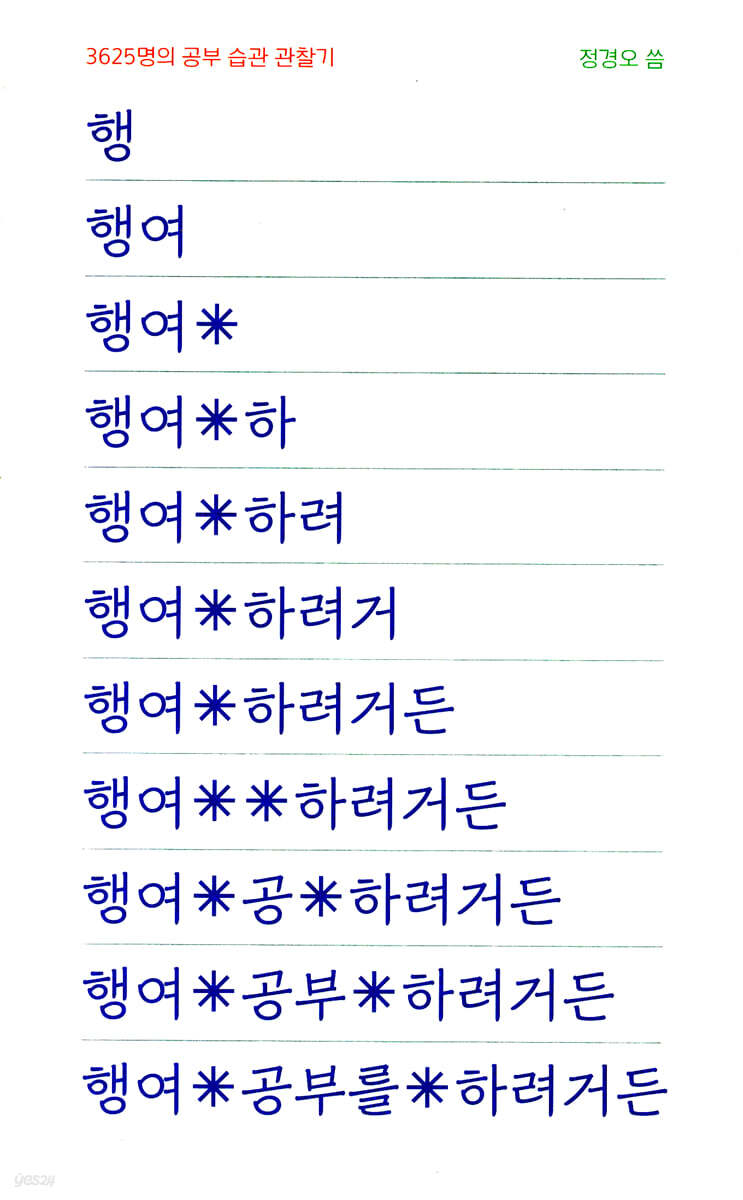
If you want to study
 |
Description
Book Introduction
- A word from MD
-
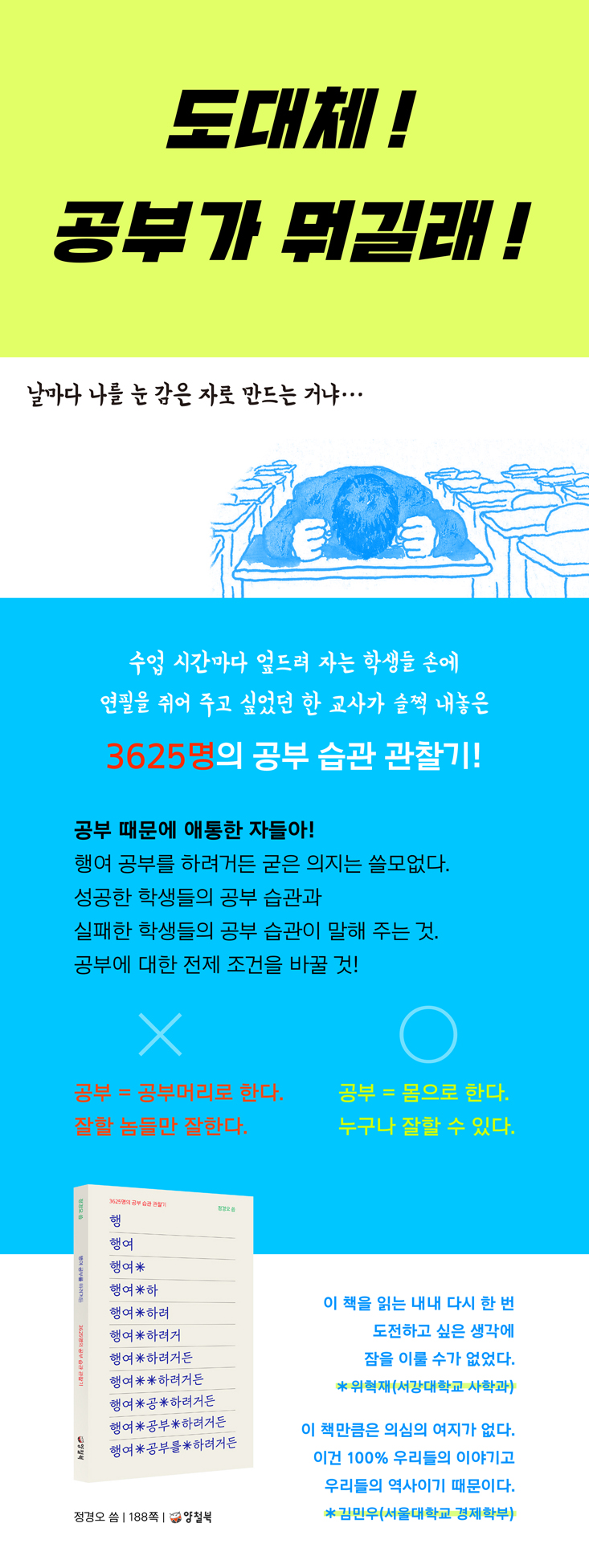
Study Habit Observation of 3,625 PeopleA high school teacher talks about the study habits of 3,625 students he met and taught over 10 years.
This book does not contain any special study methods.
It just shows things that everyone knows but no one puts into practice.
A study story about creating small habits in everyday life.
May 25, 2018. Youth PD Kim Tae-hee
It's not a grand or great change.
Creating small habits in daily life, studying
Studying can't be everything.
However, studying opens up another door that allows us to think about other possibilities.
It's just one more option.
So why do some students ‘succeed’ in their studies, while others ‘fail’?
Here, a high school teacher shares the study habits of 3,625 people he observed.
I wrote a short essay about the study habits of students I met and taught over the past 10 years.
I hope that by reading each chapter without burden, each person will reflect on their own study habits and lay the foundation for what kind of habits to develop not only for the college entrance exam but also for lifelong study, and further, for their own lives.
Creating small habits in daily life, studying
Studying can't be everything.
However, studying opens up another door that allows us to think about other possibilities.
It's just one more option.
So why do some students ‘succeed’ in their studies, while others ‘fail’?
Here, a high school teacher shares the study habits of 3,625 people he observed.
I wrote a short essay about the study habits of students I met and taught over the past 10 years.
I hope that by reading each chapter without burden, each person will reflect on their own study habits and lay the foundation for what kind of habits to develop not only for the college entrance exam but also for lifelong study, and further, for their own lives.
- You can preview some of the book's contents.
Preview
index
Preface_Why it should become a habit
1st Period | Habits / Tong / The Meaning of Studying / Trust / A Deep-Rooted Tree / Jeongja / My East Wind / Right Now / Empty Promissory Note / Motivation
2nd Period | Execution / Early Bird / Time Trapper / Brainwashing / 1 Minute / Mistake / School Lesson / Low Level / Expert / Essence / Player / Rolling Paper
3rd Period | Speed and Accuracy / Basic Textbook / Book 1 / Book 2 / Lost Learning Methods 1 / Lost Learning Methods 2 / Lost Learning Methods 3 / Comprehension / 10,000 / Repeat / Speed / The Power of Inertia / Reconstructing Thinking
4th Period | Preview-Oriented / Deadline / The Law of Acceleration / Listening / Hoshiwoohaeng / Body Thinking 1 / Body Thinking 2 / Principled / Review Cycle / Conversation / Pattern
Lunchtime | Fuel / Hunger 1 / Hunger 2
5th Period | Ignorance / Answer / West German Question / Metacognition 1 / Metacognition 2 / Metacognition 3 / 5th Period / Basics / Traps of Understanding / Effects of Errors / Commentary
6th Period | Do / Marathoners High / Play / Math Perfect Score / Question Note / Expanding Thinking / Confessions of a Top-Ranking Student / Memento / The Writer / Pareto's Law 1 / Pareto's Law 2
7th Period | Conditions of Understanding / Master of Time / Study Planner / Copycat / Image Training / Mac / Formalist / Interpretation Level / Speed Reading / Probability / Mock Test
Cleaning Time | Trade Secret 1 / Trade Secret 2 / Trade Secret 3
Supplementary lessons | Double-edged sword / Early departure / Handwriting / Messy 1 / Messy 2 / Retaking the exam / Reading skills 1 / Reading skills 2 / English diary / Simplification
Self-study | Critical Mistakes / 13 Hours / Online Lecture 1 / Online Lecture 2 / The Importance of Accumulation / Big Data / Study Framework 1 / Study Framework 2 / Single Volume / Framework 1 / Framework 2 / Recorder
1st Period | Habits / Tong / The Meaning of Studying / Trust / A Deep-Rooted Tree / Jeongja / My East Wind / Right Now / Empty Promissory Note / Motivation
2nd Period | Execution / Early Bird / Time Trapper / Brainwashing / 1 Minute / Mistake / School Lesson / Low Level / Expert / Essence / Player / Rolling Paper
3rd Period | Speed and Accuracy / Basic Textbook / Book 1 / Book 2 / Lost Learning Methods 1 / Lost Learning Methods 2 / Lost Learning Methods 3 / Comprehension / 10,000 / Repeat / Speed / The Power of Inertia / Reconstructing Thinking
4th Period | Preview-Oriented / Deadline / The Law of Acceleration / Listening / Hoshiwoohaeng / Body Thinking 1 / Body Thinking 2 / Principled / Review Cycle / Conversation / Pattern
Lunchtime | Fuel / Hunger 1 / Hunger 2
5th Period | Ignorance / Answer / West German Question / Metacognition 1 / Metacognition 2 / Metacognition 3 / 5th Period / Basics / Traps of Understanding / Effects of Errors / Commentary
6th Period | Do / Marathoners High / Play / Math Perfect Score / Question Note / Expanding Thinking / Confessions of a Top-Ranking Student / Memento / The Writer / Pareto's Law 1 / Pareto's Law 2
7th Period | Conditions of Understanding / Master of Time / Study Planner / Copycat / Image Training / Mac / Formalist / Interpretation Level / Speed Reading / Probability / Mock Test
Cleaning Time | Trade Secret 1 / Trade Secret 2 / Trade Secret 3
Supplementary lessons | Double-edged sword / Early departure / Handwriting / Messy 1 / Messy 2 / Retaking the exam / Reading skills 1 / Reading skills 2 / English diary / Simplification
Self-study | Critical Mistakes / 13 Hours / Online Lecture 1 / Online Lecture 2 / The Importance of Accumulation / Big Data / Study Framework 1 / Study Framework 2 / Single Volume / Framework 1 / Framework 2 / Recorder
Detailed image
Into the book
There were those who would write when their thoughts became distracted.
He mainly transcribed only the difficult concepts or the parts that needed to be read slowly and organized. However, his method of transcribing was not a method of cultivating the mind by pressing down on each letter, but rather a method of transcribing without an original, where he would study the concepts, then immediately close the book and write.
He was the one who could see with his eyes closed what he could not see with his eyes open.
Just as a teacher writes on the blackboard and explains, he also became a teacher and taught himself.
He said that he was trying to understand what he was missing by writing it down.
He was accepted to the Department of Korean Language Education at Korea University through regular admissions.
_ Page 120 'The Transcript' (7th period)
There are those who pack their bags and study at home, skipping school.
The first mistake they make in life is the moment they miss the palm tree and go home.
Page 170, 'Critical Mistakes' (Self-study)
There is someone who analyzes the test questions after each test.
The way he writes is surprisingly simple.
(…)
In textbooks, parts that have been tested in the past are duplicated or accumulated.
After one semester, his textbooks
It is not just a simple textbook, but Big Data that provides important information for the exam.
You will be able to understand which parts are frequently tested on exams, which parts have not been tested yet, and even the tendencies of the teachers in the exams.
He is a very clever man who sees the forest and touches the trees.
It is very rare for students to re-read their exam papers after the exam is over.
So maybe he's becoming a 1% student over time.
Page 169, 'Big Data' (Self-directed learning)
He mainly transcribed only the difficult concepts or the parts that needed to be read slowly and organized. However, his method of transcribing was not a method of cultivating the mind by pressing down on each letter, but rather a method of transcribing without an original, where he would study the concepts, then immediately close the book and write.
He was the one who could see with his eyes closed what he could not see with his eyes open.
Just as a teacher writes on the blackboard and explains, he also became a teacher and taught himself.
He said that he was trying to understand what he was missing by writing it down.
He was accepted to the Department of Korean Language Education at Korea University through regular admissions.
_ Page 120 'The Transcript' (7th period)
There are those who pack their bags and study at home, skipping school.
The first mistake they make in life is the moment they miss the palm tree and go home.
Page 170, 'Critical Mistakes' (Self-study)
There is someone who analyzes the test questions after each test.
The way he writes is surprisingly simple.
(…)
In textbooks, parts that have been tested in the past are duplicated or accumulated.
After one semester, his textbooks
It is not just a simple textbook, but Big Data that provides important information for the exam.
You will be able to understand which parts are frequently tested on exams, which parts have not been tested yet, and even the tendencies of the teachers in the exams.
He is a very clever man who sees the forest and touches the trees.
It is very rare for students to re-read their exam papers after the exam is over.
So maybe he's becoming a 1% student over time.
Page 169, 'Big Data' (Self-directed learning)
--- From the text
Publisher's Review
Another door of possibility opens,
Studying means
Studying can't be everything.
Of course.
However, if you believe that studying is something you do with your butt and your grades don't improve no matter how hard you work, if you want to study but don't know how, if there's something you want to do but studying is holding you back, then that's a different problem.
Instead of studying like crazy to be number one, study enough to be able to do what you want to do.
How on earth do you go about studying for that? Why do some students "succeed" in their studies, while others "fail"?
Here, a high school teacher shares the study habits of 3,625 people he observed.
I wrote a short essay about the study habits of students I met and taught over the past 10 years.
It was not written by great geniuses generalizing their own experiences, but by teachers in the field who included stories of ordinary students.
This short, essay-like report, which included 3,625 students, includes both "successful" and "unsuccessful" students in their studies.
Of course, success and failure here do not refer to arithmetic rankings.
The question is, how faithful am I becoming to my dreams?
It's not a grand or great change.
Creating small habits in your daily life
Studying to establish deep, unshakable roots
Both successful and unsuccessful students in their studies live and study according to their own habits.
The only difference is what kind of habit it is.
And these seemingly small habits add up and lead us down a completely different path.
It also means that studying is ultimately done with the body.
This means that anyone can study well if they make it a habit.
So there's no need to be scared in advance.
It's not about making grand, dramatic changes, but about creating small habits in your daily life, and those habits will last a lifetime.
Isn't that what we should be studying during our school years? To become a deep-rooted tree, unshaken by any wind, to develop habits like deep roots.
Whether it's studying, a dream, or work, the fundamental power to build it up is the same.
The attitude of walking honestly toward one's goal and the strength to get back up when one falls down are not only necessary for studying during school days.
This book does not contain any special study methods.
There is no such thing as a special study method.
3625 people will show you what a difference it makes when you put into practice things that everyone knows but not everyone does.
I hope that by reading each chapter without burden, each person will reflect on their own study habits and lay the foundation for what kind of habits to develop not only for the college entrance exam but also for lifelong study, and further, for their own lives.
You can never run before you learn to walk.
There are no exceptions.
Studying means
Studying can't be everything.
Of course.
However, if you believe that studying is something you do with your butt and your grades don't improve no matter how hard you work, if you want to study but don't know how, if there's something you want to do but studying is holding you back, then that's a different problem.
Instead of studying like crazy to be number one, study enough to be able to do what you want to do.
How on earth do you go about studying for that? Why do some students "succeed" in their studies, while others "fail"?
Here, a high school teacher shares the study habits of 3,625 people he observed.
I wrote a short essay about the study habits of students I met and taught over the past 10 years.
It was not written by great geniuses generalizing their own experiences, but by teachers in the field who included stories of ordinary students.
This short, essay-like report, which included 3,625 students, includes both "successful" and "unsuccessful" students in their studies.
Of course, success and failure here do not refer to arithmetic rankings.
The question is, how faithful am I becoming to my dreams?
It's not a grand or great change.
Creating small habits in your daily life
Studying to establish deep, unshakable roots
Both successful and unsuccessful students in their studies live and study according to their own habits.
The only difference is what kind of habit it is.
And these seemingly small habits add up and lead us down a completely different path.
It also means that studying is ultimately done with the body.
This means that anyone can study well if they make it a habit.
So there's no need to be scared in advance.
It's not about making grand, dramatic changes, but about creating small habits in your daily life, and those habits will last a lifetime.
Isn't that what we should be studying during our school years? To become a deep-rooted tree, unshaken by any wind, to develop habits like deep roots.
Whether it's studying, a dream, or work, the fundamental power to build it up is the same.
The attitude of walking honestly toward one's goal and the strength to get back up when one falls down are not only necessary for studying during school days.
This book does not contain any special study methods.
There is no such thing as a special study method.
3625 people will show you what a difference it makes when you put into practice things that everyone knows but not everyone does.
I hope that by reading each chapter without burden, each person will reflect on their own study habits and lay the foundation for what kind of habits to develop not only for the college entrance exam but also for lifelong study, and further, for their own lives.
You can never run before you learn to walk.
There are no exceptions.
GOODS SPECIFICS
- Date of issue: May 21, 2018
- Page count, weight, size: 188 pages | 225g | 120*188*20mm
- ISBN13: 9788963722733
- ISBN10: 8963722732
You may also like
카테고리
korean


korean

![GQ KOREA Mark (Monthly): December [2025]](http://librairie.coreenne.fr/cdn/shop/files/8ef265dbbfbf186523ed75ba7319009d.jpg?v=1765340328&width=3840)


