

My University Usage Set
 |
Description
Book Introduction
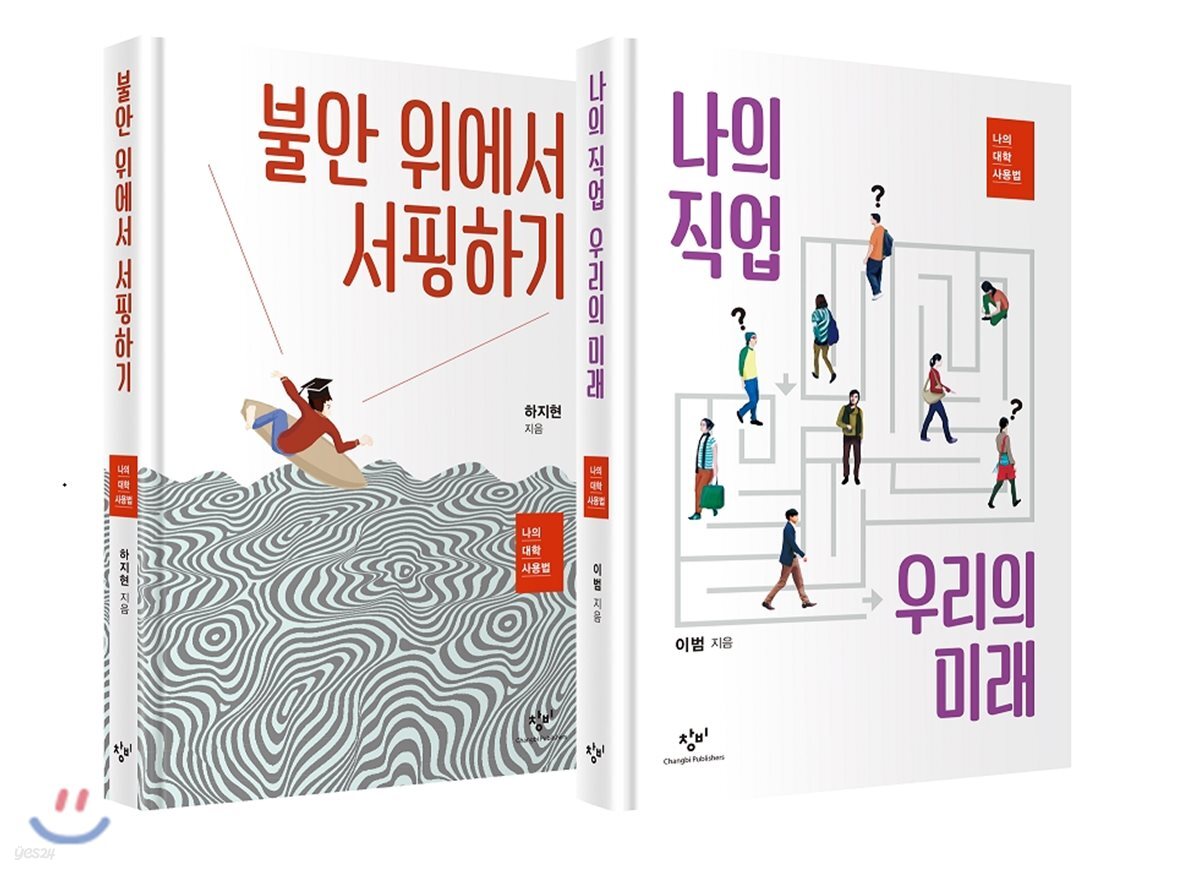
For those who are losing sleep over worries about college and employment, Lee Beom X Ha Ji-hyun's solution to multiply your empathy! Are universities still necessary today? This question has been raised consistently, but the landscape has changed significantly in recent years. This is because the severe employment crisis is fueling the theory of the "uselessness of universities," and universities are voluntarily undertaking restructuring in the face of a survival crisis. As the so-called "Fourth Industrial Revolution" and artificial intelligence threaten human jobs, the concerns of young people and teenagers preparing for the future are deepening. Why should I go to college and what should I do there? In the 'How to Use My College' series, experts from all walks of life share strategies and alternatives necessary for a changing era for young people who are losing sleep over concerns about college and employment. The stories told in a lecture in 2017 were significantly refined and supplemented and compiled into a book. Education critic Lee Beom, who has been unapologetically critical of the current state of education in Korea, has expanded his focus to include employment and the labor market in "My Job, Our Future." We analyze two signals recently sent by the labor market: 'de-specification' and 'polarization', and explore appropriate ways to respond to them at both the personal and societal levels. As we follow the changes in the labor market, the limitations of our education system, which focuses on objective questions and relative evaluation, become more apparent. In her book, "Surfing on Anxiety," psychiatrist Ha Ji-hyun encapsulates this era with the expressions "unpredictable" and "uncontrollable," and discusses the "attitude of mind" necessary for those living in this age of uncertainty. And it delicately explains emotions experienced in daily life, such as depression, loneliness, and anxiety. |
- You can preview some of the book's contents.
Preview
index
Lee Beom's "My Job, Our Future"
prolog
1 The stagnation of the education we have received
Why don't they do relative evaluation?
Multiple choice questions hinder thinking.
Why There Are No Specialized High Schools in Europe
2 An era of exploring questions without answers
Chicken or Employment Insurance?
Self-directed learning ability rather than creativity
Is the current university education still necessary?
3. 'De-spec' and De-academic Background: Changes in the Labor Market
How did the consciousness of academic background arise?
Three Causes of Academic Discrimination
From 'Specs' to 'Expertise'
4 Polarization and impending catastrophe
Why did the wage gap arise?
Irregular jobs and labor without a future
Long-term catastrophe and short-term catastrophe
5. Youth, Challenge the Conventional Idea of Progress
The persuasive power of patriotism
All young people are in the same boat
A revolution through compromise
Ha Ji-hyun's "Surfing on Anxiety"
prolog
1 What Hinders Youth from Becoming Adults?
An era of unpredictability and uncontrollability
University, a space of exploration and belonging
Psychological cicadas that delay growth
2. Emotions encountered in college
Anxiety and depression, similar but different
It's similar to loneliness and hunger.
When confusion and worries become tangled like a thread
Feeling alienated, difficulty fitting in
An experiment in love and intimacy
3 Thinking like a person on a deserted island
Uncertainty as a thrill
Because desire and need are different
Ask and answer
prolog
1 The stagnation of the education we have received
Why don't they do relative evaluation?
Multiple choice questions hinder thinking.
Why There Are No Specialized High Schools in Europe
2 An era of exploring questions without answers
Chicken or Employment Insurance?
Self-directed learning ability rather than creativity
Is the current university education still necessary?
3. 'De-spec' and De-academic Background: Changes in the Labor Market
How did the consciousness of academic background arise?
Three Causes of Academic Discrimination
From 'Specs' to 'Expertise'
4 Polarization and impending catastrophe
Why did the wage gap arise?
Irregular jobs and labor without a future
Long-term catastrophe and short-term catastrophe
5. Youth, Challenge the Conventional Idea of Progress
The persuasive power of patriotism
All young people are in the same boat
A revolution through compromise
Ha Ji-hyun's "Surfing on Anxiety"
prolog
1 What Hinders Youth from Becoming Adults?
An era of unpredictability and uncontrollability
University, a space of exploration and belonging
Psychological cicadas that delay growth
2. Emotions encountered in college
Anxiety and depression, similar but different
It's similar to loneliness and hunger.
When confusion and worries become tangled like a thread
Feeling alienated, difficulty fitting in
An experiment in love and intimacy
3 Thinking like a person on a deserted island
Uncertainty as a thrill
Because desire and need are different
Ask and answer
Publisher's Review
Lee Beom's "My Job, Our Future"
Multiple choice and relative evaluation,
The critical limitations of our education
Is our education system nurturing talents fit for the future society? As an education expert, author Lee Beom examines the problems of our education system by comparing it to those of several other countries before delving into a thorough analysis of the labor market.
The comparison is simple but interesting.
Let's take a look at the test questions from each country.
The author presents actual problems from schools around the world, including Germany, France, and Sweden, to examine what qualities each country is fostering in its students.
The difference between us and the so-called 'educationally advanced' countries is clear at a glance.
Our education only asks students questions that have a 'right' answer.
However, in foreign countries, there are many cases where even the teachers who give the questions do not have the correct answers.
Another crucial difference is that we still use multiple-choice questions and that we use relative evaluation to rank test results.
This type of education hinders the development of the ability to organize one's own thoughts, the ability to set one's own tasks, and the attitude of cooperation, rather than the 'intention of the examiner.'
If we continue this type of education, it will be difficult to develop the qualities needed for future society.
A period of great transformation in the labor market,
What do we really need to prepare for?
The limitations of this type of education become even more apparent when looking at recent changes in the labor market.
The author analyzes that the labor market is currently sending two signals.
One is ‘de-spec’, and the other is polarization.
First, through various data such as interviews with HR managers at each company, Korea's economic development process, and labor market statistics, we reveal why 'de-spec' has become a trend of the times.
If there is a major trend of 'de-spec' on one side, there is polarization represented by irregular workers on the other side.
The so-called 'duplication of labor market' is becoming more serious.
The problem is that these two trends are occurring on different levels.
As a result, confusion arises in the response.
So how should each of us respond to this reality?
In the author's view, the change called 'de-spec' can be addressed through personal effort.
So, I also suggest several good methods.
However, ‘polarization’ is difficult to deal with on an individual basis.
A social solution is needed.
The author presents bold and innovative ideas along with reasons why young people should be politically active and speak out.
If necessary, we must challenge the 'conventional notion of progress' and take more proactive action, or we could face 'catastrophic failure.'
Most of the self-directed learning you've experienced so far isn't truly self-directed learning.
It was self-managed learning.
To put it bluntly, it's 'fake'._Page 70
But these changes don't explain the core of the anxiety that is gripping our society as a whole, and our youth in particular.
To discuss this, we need to look at a more macroscopic societal change than we have seen so far.
This is a phenomenon commonly referred to as 'polarization'._Pages 139-140
Ha Ji-hyun's "Surfing on Anxiety"
Romance is zero, chaos is everyday life
College is no longer a turning point in life.
College is no longer a turning point in adulthood, a chance to take a breather.
In an age of uncertainty, universities have become “spaces where anxiety, depression, and doubt constantly flare up.”
Author Ha Ji-hyun begins her college story from this very point.
As the world has become one where individuals have little control over or predictability of their own lives, the so-called "romanticism of the campus" has long since disappeared from universities.
However, this does not mean that universities are meaningless spaces.
As a psychiatrist, the author focuses on the role of universities as spaces of exploration and belonging.
To grow into an adult, everyone must sufficiently establish a "social identity" through various experiences of exploration and belonging, and college provides the experience and time to form this identity.
The reason why the function of such universities is particularly important is that modern society is one that constantly postpones maturity.
The transition from youth to adulthood is no longer a natural phenomenon that occurs over time.
The author compares today's youth to 'cicadas.'
Cicadas spend much longer inside their cocoons than they do as cicadas.
Are young people, like cicadas in a cocoon, spending too much time preparing for adulthood? While it may be convenient in the short term, this is a pressing issue.
The author advises that students should make full use of the space and time of college to quickly become adults.
Want to go back in time and become an adult quickly?
Advice for those trying to escape the trap
To help those struggling to become adults, the author sets out to explain the various emotions they will face in college.
The age of uncertainty brings about various turmoil in the minds of young people.
The author categorizes and explains various emotions, from the confusion of various worries becoming tangled like a skein of thread, to the alienation of being thrown alone into an inappropriate space, to the depression of having lost all your energy, to the love of experimenting with how close you can become to someone other than your family, encouraging us to find the courage to navigate the times.
What I ultimately want to say through these commentaries is the attitude of mind necessary to live in an uncertain world.
It is a time when we need to adopt the mindset of 'you have to lose to win' and turn uncertainty into a thrill.
The practice of figuring out what I have, like a person stranded on a deserted island, and the practice of distinguishing between desires and needs are also useful mental skills.
Stress is driven by two things: predictability and controllability.
These two things always make things difficult for people.
The reason why young people these days have so many concerns about their career paths is probably because these two factors are not very high._Page 12
The ability to endure and see through the tangled threads is the strength of the ego.
Becoming able to just let go of ambiguous and troublesome situations is the process of becoming an adult._Page 74
Multiple choice and relative evaluation,
The critical limitations of our education
Is our education system nurturing talents fit for the future society? As an education expert, author Lee Beom examines the problems of our education system by comparing it to those of several other countries before delving into a thorough analysis of the labor market.
The comparison is simple but interesting.
Let's take a look at the test questions from each country.
The author presents actual problems from schools around the world, including Germany, France, and Sweden, to examine what qualities each country is fostering in its students.
The difference between us and the so-called 'educationally advanced' countries is clear at a glance.
Our education only asks students questions that have a 'right' answer.
However, in foreign countries, there are many cases where even the teachers who give the questions do not have the correct answers.
Another crucial difference is that we still use multiple-choice questions and that we use relative evaluation to rank test results.
This type of education hinders the development of the ability to organize one's own thoughts, the ability to set one's own tasks, and the attitude of cooperation, rather than the 'intention of the examiner.'
If we continue this type of education, it will be difficult to develop the qualities needed for future society.
A period of great transformation in the labor market,
What do we really need to prepare for?
The limitations of this type of education become even more apparent when looking at recent changes in the labor market.
The author analyzes that the labor market is currently sending two signals.
One is ‘de-spec’, and the other is polarization.
First, through various data such as interviews with HR managers at each company, Korea's economic development process, and labor market statistics, we reveal why 'de-spec' has become a trend of the times.
If there is a major trend of 'de-spec' on one side, there is polarization represented by irregular workers on the other side.
The so-called 'duplication of labor market' is becoming more serious.
The problem is that these two trends are occurring on different levels.
As a result, confusion arises in the response.
So how should each of us respond to this reality?
In the author's view, the change called 'de-spec' can be addressed through personal effort.
So, I also suggest several good methods.
However, ‘polarization’ is difficult to deal with on an individual basis.
A social solution is needed.
The author presents bold and innovative ideas along with reasons why young people should be politically active and speak out.
If necessary, we must challenge the 'conventional notion of progress' and take more proactive action, or we could face 'catastrophic failure.'
Most of the self-directed learning you've experienced so far isn't truly self-directed learning.
It was self-managed learning.
To put it bluntly, it's 'fake'._Page 70
But these changes don't explain the core of the anxiety that is gripping our society as a whole, and our youth in particular.
To discuss this, we need to look at a more macroscopic societal change than we have seen so far.
This is a phenomenon commonly referred to as 'polarization'._Pages 139-140
Ha Ji-hyun's "Surfing on Anxiety"
Romance is zero, chaos is everyday life
College is no longer a turning point in life.
College is no longer a turning point in adulthood, a chance to take a breather.
In an age of uncertainty, universities have become “spaces where anxiety, depression, and doubt constantly flare up.”
Author Ha Ji-hyun begins her college story from this very point.
As the world has become one where individuals have little control over or predictability of their own lives, the so-called "romanticism of the campus" has long since disappeared from universities.
However, this does not mean that universities are meaningless spaces.
As a psychiatrist, the author focuses on the role of universities as spaces of exploration and belonging.
To grow into an adult, everyone must sufficiently establish a "social identity" through various experiences of exploration and belonging, and college provides the experience and time to form this identity.
The reason why the function of such universities is particularly important is that modern society is one that constantly postpones maturity.
The transition from youth to adulthood is no longer a natural phenomenon that occurs over time.
The author compares today's youth to 'cicadas.'
Cicadas spend much longer inside their cocoons than they do as cicadas.
Are young people, like cicadas in a cocoon, spending too much time preparing for adulthood? While it may be convenient in the short term, this is a pressing issue.
The author advises that students should make full use of the space and time of college to quickly become adults.
Want to go back in time and become an adult quickly?
Advice for those trying to escape the trap
To help those struggling to become adults, the author sets out to explain the various emotions they will face in college.
The age of uncertainty brings about various turmoil in the minds of young people.
The author categorizes and explains various emotions, from the confusion of various worries becoming tangled like a skein of thread, to the alienation of being thrown alone into an inappropriate space, to the depression of having lost all your energy, to the love of experimenting with how close you can become to someone other than your family, encouraging us to find the courage to navigate the times.
What I ultimately want to say through these commentaries is the attitude of mind necessary to live in an uncertain world.
It is a time when we need to adopt the mindset of 'you have to lose to win' and turn uncertainty into a thrill.
The practice of figuring out what I have, like a person stranded on a deserted island, and the practice of distinguishing between desires and needs are also useful mental skills.
Stress is driven by two things: predictability and controllability.
These two things always make things difficult for people.
The reason why young people these days have so many concerns about their career paths is probably because these two factors are not very high._Page 12
The ability to endure and see through the tangled threads is the strength of the ego.
Becoming able to just let go of ambiguous and troublesome situations is the process of becoming an adult._Page 74
GOODS SPECIFICS
- Date of publication: May 11, 2018
- Page count, weight, size: 452 pages | 506g | 128*195*30mm
- ISBN13: 9788936459697
- ISBN10: 8936459694
You may also like
카테고리
korean


korean

![GQ KOREA Mark (Monthly): December [2025]](http://librairie.coreenne.fr/cdn/shop/files/8ef265dbbfbf186523ed75ba7319009d.jpg?v=1765340328&width=3840)


