

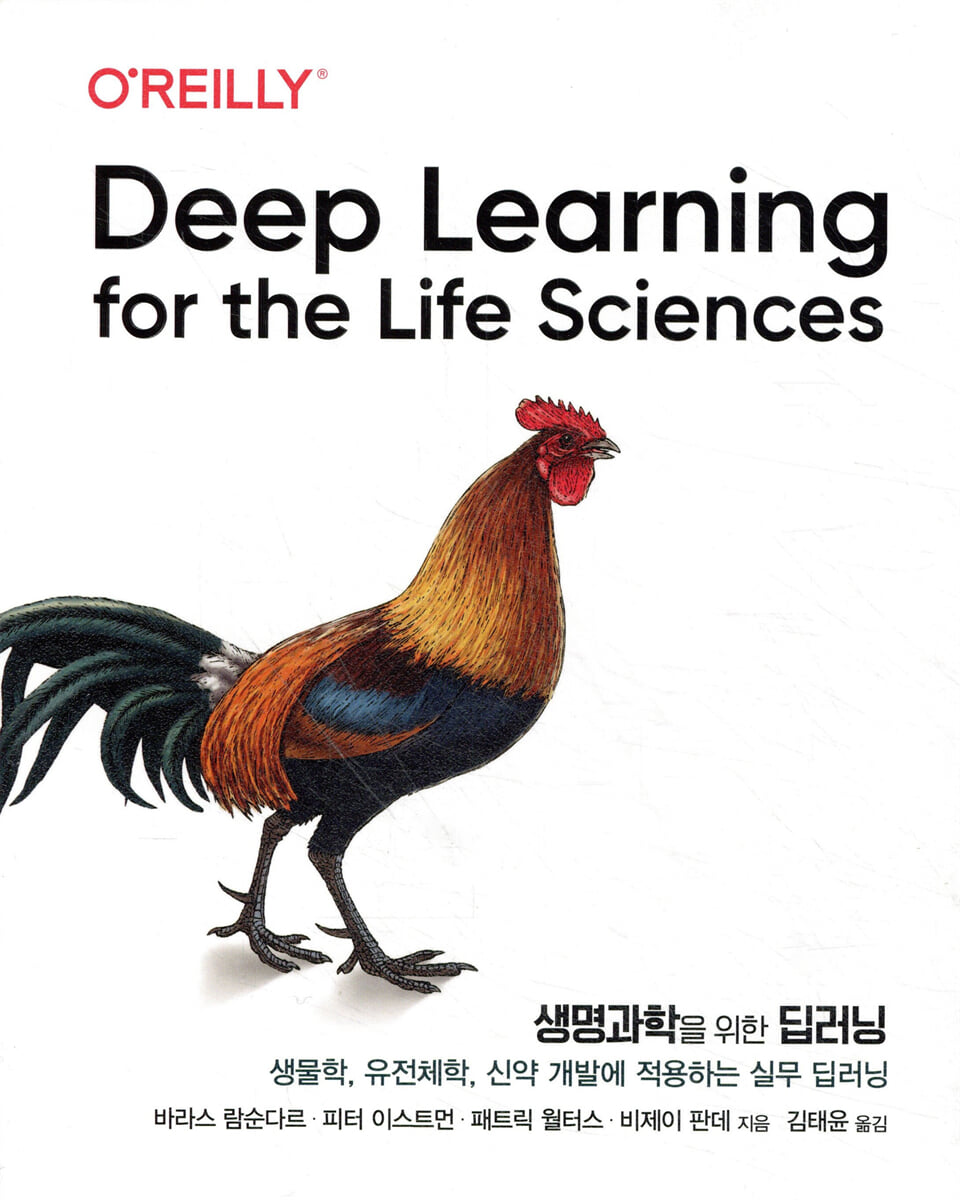
Deep Learning for Life Sciences
 |
Description
Book Introduction
Advances in robotics have automated many life science experiments, generating massive amounts of data.
Modern life scientists need the ability to find hidden patterns in massive data sets, gain knowledge, and draw scientific conclusions.
We introduce how deep learning is being used in various fields of life sciences, from genomics to new drug development and disease diagnosis.
We will also save readers time by providing practical example code that can be used.
Modern life scientists need the ability to find hidden patterns in massive data sets, gain knowledge, and draw scientific conclusions.
We introduce how deep learning is being used in various fields of life sciences, from genomics to new drug development and disease diagnosis.
We will also save readers time by providing practical example code that can be used.
- You can preview some of the book's contents.
Preview
index
Chapter 1.
Why Life Sciences?
__Why is deep learning necessary?
__Modern life science deals with big data.
__What do you learn?
Chapter 2.
Introduction to Deep Learning
__Linear model
__Multilayer Perceptron
__Training the model
__Verify
__Normalization
__Hyperparameter optimization
__Other types of models
____Convolutional Neural Network
____Recurrent Neural Network
__Further Reading
Chapter 3.
Machine Learning with DeepChem
__DeepChem's default dataset
__Creating a toxic molecule prediction model
Building a Handwriting Recognition Model with the __MNIST Dataset
____MNIST handwriting recognition dataset
____Handwriting recognition with convolutional neural networks
__Softmax and Softmax Cross Entropy
__conclusion
Chapter 4.
Handling molecular-level data
What is a __molecule?
____intermolecular bonds
____molecular graph
____molecular structure
____molecular chirality
__Molecular data featurization
____SMILES string and RDKit
____Extended Connection Fingerprint
____molecular descriptor
__Graph convolution
__Solubility Prediction Model
__MoleculeNet
__SMARTS string
__conclusion
Chapter 5.
Biophysics and Machine Learning
__protein structure
____protein sequence
__Can we predict the three-dimensional structure of a protein?
____protein-ligand binding
__Biophysical featurization
____Grid featurization
____atomic featurization
__Biophysical Data Case Study
____PDBBind dataset
____PDBBind dataset featurization
__conclusion
Chapter 6.
Genetics and Deep Learning
__DNA, RNA, protein
__What actually happens inside a cell
__Binding of transcription factors
A convolutional model that predicts the binding of ____ transcription factors
__Chromatin accessibility
__RNA interference
__conclusion
Chapter 7.
Deep Learning for Microscopy
__A brief introduction to microscopes
____Modern optical microscope
__diffraction limit
____Electron microscope and atomic force microscope
____Super-resolution microscope
____Deep Learning and the Diffraction Limit
__Preparing samples for microscopy
____Staining the sample
____Sample fixation
____Sample section processing
____Fluorescence microscope
____Influence of the sample preparation process
__How to use deep learning
____cell counting
__What is a cell line?
Distinguishing ____cells
____Machine Learning and Scientific Experiments
__conclusion
Chapter 8.
Deep Learning for Healthcare Systems
__Computer-aided disease diagnosis
__Uncertainty Prediction Using Bayesian Networks
__Electronic Health Record
__ICD-10 code
__What is unsupervised learning?
____The Risks of Giant Electronic Health Record Databases
Deep Learning for Radiology
____X-ray and CT scan
____histology
____MRI scan
Machine Learning as Therapy
__diabetic retinopathy
__conclusion
____Ethical Considerations
____job problem
____summation
Chapter 9.
Generative model
__VAE
__GAN
__Applying generative models to life sciences
____Finding new drug candidates
____Protein Engineering
____Tools for scientific discovery
The Future of ____Generative Models
Using the __generative model
Analyzing the results of the ____generating model
__conclusion
Chapter 10.
Interpreting deep learning models
__Explain the predicted value
__Optimizing input values
__Predicting uncertainty
__Interpretability, explainability, and actual results
__conclusion
Chapter 11.
Virtual screening
__Preparing the dataset for the prediction model
__Training a Machine Learning Model
__Preparing the dataset for prediction
__Applying the prediction model
__conclusion
Chapter 12.
The Future and Prospects of Deep Learning
__Disease Diagnosis
__Personalized Medicine
__New drug development
__Biology Research
__conclusion
Why Life Sciences?
__Why is deep learning necessary?
__Modern life science deals with big data.
__What do you learn?
Chapter 2.
Introduction to Deep Learning
__Linear model
__Multilayer Perceptron
__Training the model
__Verify
__Normalization
__Hyperparameter optimization
__Other types of models
____Convolutional Neural Network
____Recurrent Neural Network
__Further Reading
Chapter 3.
Machine Learning with DeepChem
__DeepChem's default dataset
__Creating a toxic molecule prediction model
Building a Handwriting Recognition Model with the __MNIST Dataset
____MNIST handwriting recognition dataset
____Handwriting recognition with convolutional neural networks
__Softmax and Softmax Cross Entropy
__conclusion
Chapter 4.
Handling molecular-level data
What is a __molecule?
____intermolecular bonds
____molecular graph
____molecular structure
____molecular chirality
__Molecular data featurization
____SMILES string and RDKit
____Extended Connection Fingerprint
____molecular descriptor
__Graph convolution
__Solubility Prediction Model
__MoleculeNet
__SMARTS string
__conclusion
Chapter 5.
Biophysics and Machine Learning
__protein structure
____protein sequence
__Can we predict the three-dimensional structure of a protein?
____protein-ligand binding
__Biophysical featurization
____Grid featurization
____atomic featurization
__Biophysical Data Case Study
____PDBBind dataset
____PDBBind dataset featurization
__conclusion
Chapter 6.
Genetics and Deep Learning
__DNA, RNA, protein
__What actually happens inside a cell
__Binding of transcription factors
A convolutional model that predicts the binding of ____ transcription factors
__Chromatin accessibility
__RNA interference
__conclusion
Chapter 7.
Deep Learning for Microscopy
__A brief introduction to microscopes
____Modern optical microscope
__diffraction limit
____Electron microscope and atomic force microscope
____Super-resolution microscope
____Deep Learning and the Diffraction Limit
__Preparing samples for microscopy
____Staining the sample
____Sample fixation
____Sample section processing
____Fluorescence microscope
____Influence of the sample preparation process
__How to use deep learning
____cell counting
__What is a cell line?
Distinguishing ____cells
____Machine Learning and Scientific Experiments
__conclusion
Chapter 8.
Deep Learning for Healthcare Systems
__Computer-aided disease diagnosis
__Uncertainty Prediction Using Bayesian Networks
__Electronic Health Record
__ICD-10 code
__What is unsupervised learning?
____The Risks of Giant Electronic Health Record Databases
Deep Learning for Radiology
____X-ray and CT scan
____histology
____MRI scan
Machine Learning as Therapy
__diabetic retinopathy
__conclusion
____Ethical Considerations
____job problem
____summation
Chapter 9.
Generative model
__VAE
__GAN
__Applying generative models to life sciences
____Finding new drug candidates
____Protein Engineering
____Tools for scientific discovery
The Future of ____Generative Models
Using the __generative model
Analyzing the results of the ____generating model
__conclusion
Chapter 10.
Interpreting deep learning models
__Explain the predicted value
__Optimizing input values
__Predicting uncertainty
__Interpretability, explainability, and actual results
__conclusion
Chapter 11.
Virtual screening
__Preparing the dataset for the prediction model
__Training a Machine Learning Model
__Preparing the dataset for prediction
__Applying the prediction model
__conclusion
Chapter 12.
The Future and Prospects of Deep Learning
__Disease Diagnosis
__Personalized Medicine
__New drug development
__Biology Research
__conclusion
Publisher's Review
★ Recommended Article ★
"This book will be a valuable addition to the advancement of the life science community."
- Prabhat, Data Analysis Services Team Leader, Lawrence Berkeley National Laboratory
"This is a great book for understanding basic science and getting started with deep learning applications."
- C.
Titus Brown (C.
Titus Brown), Associate Professor at the University of California
★ What this book covers ★
■ How to apply machine learning to molecular data
Deep Learning as a Powerful Analysis Tool for Genetics/Genomics
Understanding Biophysical Systems with Deep Learning
■ Introduction to Machine Learning Using the DeepChem Library
■ Microscope Image Analysis Using Deep Learning
■ Medical Image Analysis Using Deep Learning
■ VAE and GAN models
■ Interpreting the operating principles of machine learning models
★ Author's Note ★
Recent advances in robotics have led to the automation of many life science experiments, generating enormous amounts of data.
About 20 years ago, data that would have taken a scientist a lifetime to collect can now be accumulated in a day.
As a result, the boundaries between life sciences and data science are rapidly disappearing, and the ability to quickly analyze data in the midst of a deluge of data is becoming an essential skill for life scientists.
The days of processing experimental data and plotting graphs in Excel are over.
For modern life scientists, the most important ability is to discover hidden patterns in massive experimental data, gain new knowledge, and draw scientific conclusions.
Over the past few years, deep learning has emerged as a powerful tool for discovering patterns and meaning in data, demonstrating remarkable performance in big data analysis, particularly in areas such as image analysis, foreign language translation, and speech recognition.
This book introduces the process of applying deep learning to various fields such as genomics, new drug development, and disease diagnosis, as well as how to apply it to the life sciences.
We will also save readers time by providing example code that can be used immediately in practice.
★ Translator's Note ★
This book is my second translation.
I realized the difficulty of translation while translating my previous book, but the moment I saw the title of this book, I completely forgot about it and started translating again.
The convergence of computer science and life sciences is an old dream.
Everyone knows its importance, but is reluctant to approach it.
Perhaps it is because each field is vast and the interdisciplinary studies are abstract.
So this book is like a ray of light to people who think like me.
The authors not only show us where to go next, but also help us understand with practical examples.
Although it is a technical book filled with difficult content, I did my best during the translation process to ensure that readers can easily understand it.
Still, it seems like there are so many things lacking.
If there is anything in this book that you do not understand, please do not hesitate to contact us.
Communication with our readers is always welcome.
"This book will be a valuable addition to the advancement of the life science community."
- Prabhat, Data Analysis Services Team Leader, Lawrence Berkeley National Laboratory
"This is a great book for understanding basic science and getting started with deep learning applications."
- C.
Titus Brown (C.
Titus Brown), Associate Professor at the University of California
★ What this book covers ★
■ How to apply machine learning to molecular data
Deep Learning as a Powerful Analysis Tool for Genetics/Genomics
Understanding Biophysical Systems with Deep Learning
■ Introduction to Machine Learning Using the DeepChem Library
■ Microscope Image Analysis Using Deep Learning
■ Medical Image Analysis Using Deep Learning
■ VAE and GAN models
■ Interpreting the operating principles of machine learning models
★ Author's Note ★
Recent advances in robotics have led to the automation of many life science experiments, generating enormous amounts of data.
About 20 years ago, data that would have taken a scientist a lifetime to collect can now be accumulated in a day.
As a result, the boundaries between life sciences and data science are rapidly disappearing, and the ability to quickly analyze data in the midst of a deluge of data is becoming an essential skill for life scientists.
The days of processing experimental data and plotting graphs in Excel are over.
For modern life scientists, the most important ability is to discover hidden patterns in massive experimental data, gain new knowledge, and draw scientific conclusions.
Over the past few years, deep learning has emerged as a powerful tool for discovering patterns and meaning in data, demonstrating remarkable performance in big data analysis, particularly in areas such as image analysis, foreign language translation, and speech recognition.
This book introduces the process of applying deep learning to various fields such as genomics, new drug development, and disease diagnosis, as well as how to apply it to the life sciences.
We will also save readers time by providing example code that can be used immediately in practice.
★ Translator's Note ★
This book is my second translation.
I realized the difficulty of translation while translating my previous book, but the moment I saw the title of this book, I completely forgot about it and started translating again.
The convergence of computer science and life sciences is an old dream.
Everyone knows its importance, but is reluctant to approach it.
Perhaps it is because each field is vast and the interdisciplinary studies are abstract.
So this book is like a ray of light to people who think like me.
The authors not only show us where to go next, but also help us understand with practical examples.
Although it is a technical book filled with difficult content, I did my best during the translation process to ensure that readers can easily understand it.
Still, it seems like there are so many things lacking.
If there is anything in this book that you do not understand, please do not hesitate to contact us.
Communication with our readers is always welcome.
GOODS SPECIFICS
- Date of issue: August 19, 2020
- Page count, weight, size: 260 pages | 188*235*15mm
- ISBN13: 9791161754420
- ISBN10: 1161754423
You may also like
카테고리
korean


korean

![GQ KOREA Mark (Monthly): December [2025]](http://librairie.coreenne.fr/cdn/shop/files/8ef265dbbfbf186523ed75ba7319009d.jpg?v=1765340328&width=3840)


